ECU RENAULT LAGUNA 2012 X91 / 3.G User Guide
[x] Cancel search | Manufacturer: RENAULT, Model Year: 2012, Model line: LAGUNA, Model: RENAULT LAGUNA 2012 X91 / 3.GPages: 241, PDF Size: 7.82 MB
Page 41 of 241
child restraint/seat ................................ (up to the end of the DU)
child restraint/seat ................................ (up to the end of the DU)
child restraint/seat ................................ (up to the end of the DU)
child safety ............................................ (up to the end of the DU)
transporting children ............................. (up to the end of the DU)
child seats ............................................. (up to the end of the DU)
1.35
ENG_UD23633_2
Sécurité enfants: installation du siège enfant (X91 - B91 - K91 - Renault)
ENG_NU_936-5_BK91_Renault_1
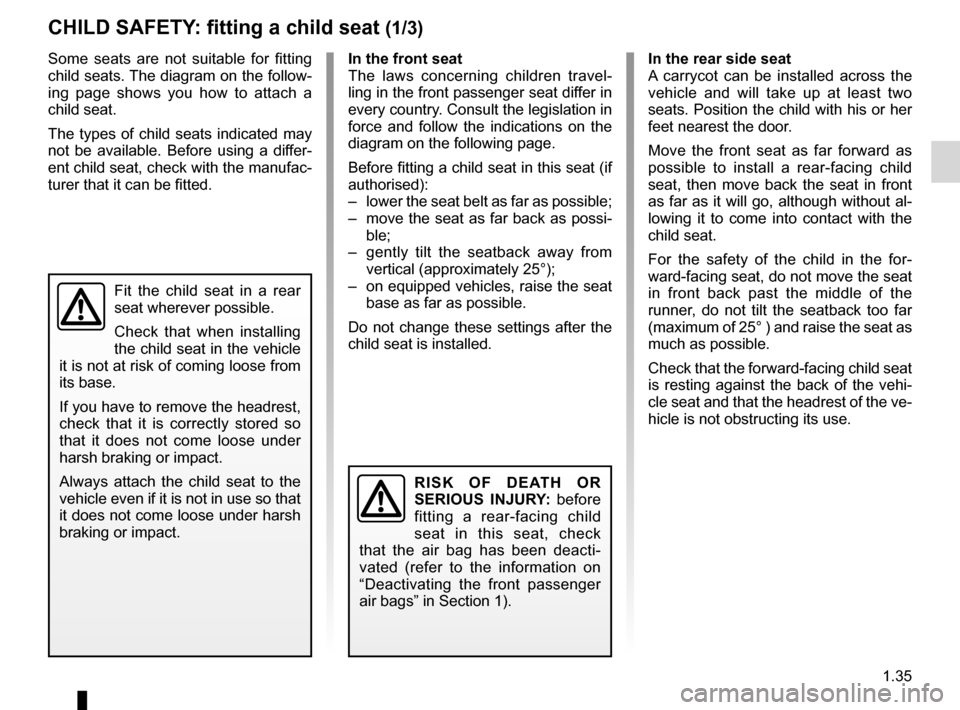
Fitting a child seat
cHILd sAfETY : fitting a child seat (1/3)
In the rear side seat
A carrycot can be installed across the
vehicle and will take up at least two
seats. Position the child with his or her
feet nearest the door.
Move the front seat as far forward as
possible to install a rear-facing child
seat, then move back the seat in front
as far as it will go, although without al-
lowing it to come into contact with the
child seat.
For the safety of the child in the for -
ward-facing seat, do not move the seat
in front back past the middle of the
runner, do not tilt the seatback too far
(maximum of 25° ) and raise the seat as
much as possible.
Check that the forward-facing child seat
is resting against the back of the vehi-
cle seat and that the headrest of the ve-
hicle is not obstructing its use.
In the front seat
The laws concerning children travel
-
ling in the front passenger seat differ in
every country. Consult the legislation in
force and follow the indications on the
diagram on the following page.
Before fitting a child seat in this seat (if
authorised):
– lower the seat belt as far as possible;
– move the seat as far back as possi-
ble;
– gently tilt the seatback away from
vertical (approximately 25°);
– on equipped vehicles, raise the seat
base as far as possible.
Do not change these settings after the
child seat is installed.
R I sK O f dE AT H O R
s ERIOU s INJURY: before
fitting a rear-facing child
seat in this seat, check
that the air bag has been deacti -
vated (refer to the information on
“Deactivating the front passenger
air bags” in Section 1).
Some seats are not suitable for fitting
child seats. The diagram on the follow -
ing page shows you how to attach a
child seat.
The types of child seats indicated may
not be available. Before using a differ-
ent child seat, check with the manufac-
turer that it can be fitted.
Fit the child seat in a rear
seat wherever possible.
Check that when installing
the child seat in the vehicle
it is not at risk of coming loose from
its base.
If you have to remove the headrest,
check that it is correctly stored so
that it does not come loose under
harsh braking or impact.
Always attach the child seat to the
vehicle even if it is not in use so that
it does not come loose under harsh
braking or impact.
Page 42 of 241
1.36
ENG_UD23633_2
Sécurité enfants: installation du siège enfant (X91 - B91 - K91 - Renault)
ENG_NU_936-5_BK91_Renault_1
Jaune NoirNoir texte
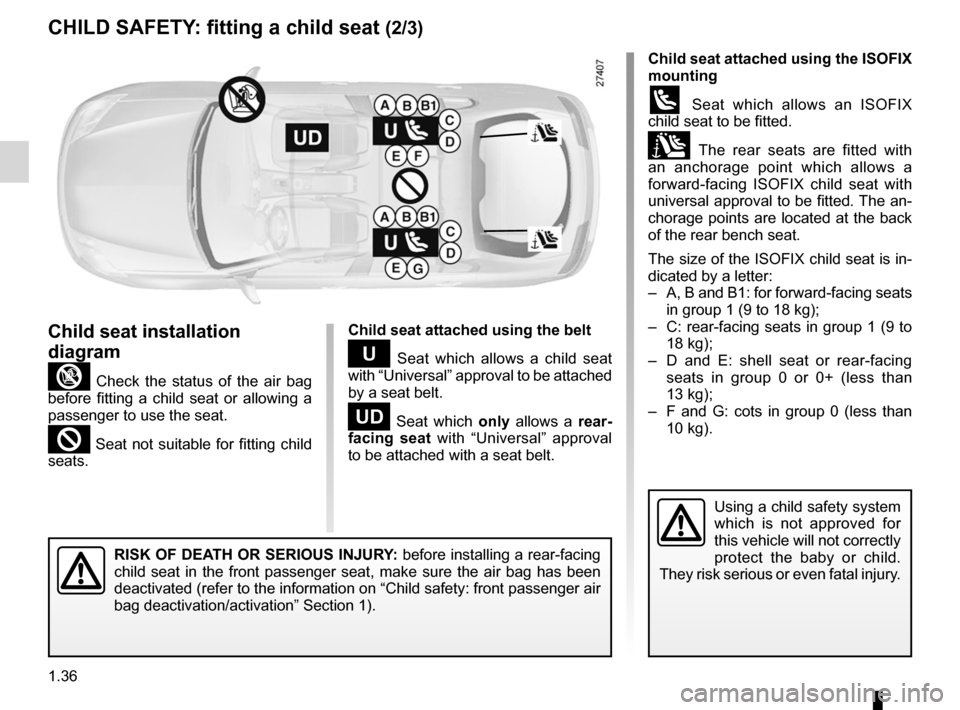
cHILd sAfETY : fitting a child seat (2/3)
child seat attached using the IsOfIX
mounting
ü Seat which allows an ISOFIX
child seat to be fitted.
± The rear seats are fitted with
an anchorage point which allows a
forward-facing ISOFIX child seat with
universal approval to be fitted. The an-
chorage points are located at the back
of the rear bench seat.
The size of the ISOFIX child seat is in-
dicated by a letter:
– A, B and B1: for forward-facing seats
in group 1 (9 to 18 kg);
– C: rear-facing seats in group 1 (9 to
18 kg);
– D and E: shell seat or rear-facing
seats in group 0 or 0+ (less than
13 kg);
– F and G: cots in group 0 (less than
10 kg).
child seat attached using the belt
¬ Seat which allows a child seat
with “Universal” approval to be attached
by a seat belt.
− Seat which only allows a rear-
facing seat with “Universal” approval
to be attached with a seat belt.
Using a child safety system
which is not approved for
this vehicle will not correctly
protect the baby or child.
They risk serious or even fatal injury.
child seat installation
diagram
³ Check the status of the air bag
before fitting a child seat or allowing a
passenger to use the seat.
² Seat not suitable for fitting child
seats.
RIsK Of dEATH OR sERIOUs INJURY: before installing a rear-facing
child seat in the front passenger seat, make sure the air bag has been
deactivated (refer to the information on “Child safety: front passenger air
bag deactivation/activation” Section 1).
Page 43 of 241
JauneNoirNoir texte
1.37
ENG_UD23633_2
Sécurité enfants: installation du siège enfant (X91 - B91 - K91 - Renault)
ENG_NU_936-5_BK91_Renault_1
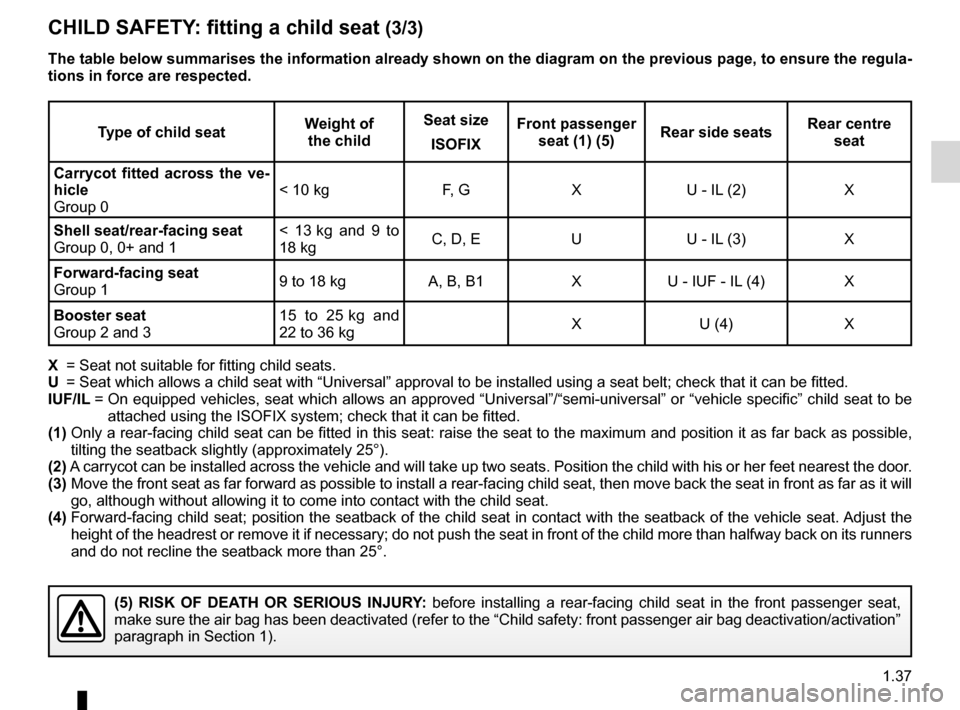
cHILd sAfETY : fitting a child seat (3/3)
Type of child seat Weight of
the child seat size
IsOfIX front passenger
seat (1) (5) Rear side seats Rear centre
seat
carrycot fitted across the ve-
hicle
Group 0 < 10 kg
F, GXU - IL (2) X
shell seat/rear-facing seat
Group 0, 0+ and 1 < 13
kg and 9 to
18 kg C, D, E
UU - IL (3) X
forward-facing seat
Group 1 9 to 18 kg
A, B, B1XU - IUF - IL (4) X
Booster seat
Group 2 and 3 15 to 25
kg and
22 to 36 kg X
U (4) X
X = Seat not suitable for fitting child seats.
U = Seat which allows a child seat with “Universal” approval to be installed using a seat belt; check that it can be fitted.
IUf/IL = On equipped vehicles, seat which allows an approved “Universal”/“semi-universal” or “vehicle specific” child seat to be
attached using the ISOFIX system; check that it can be fitted.
(1) Only a rear-facing child seat can be fitted in this seat: raise the seat to the maximum and position it as far back as possible,
tilting the seatback slightly (approximately 25°).
(2) A carrycot can be installed across the vehicle and will take up two seats. Position the child with his or her feet nearest the door.
(3) Move the front seat as far forward as possible to install a rear-facing child seat, then move back the seat in front as far as it will
go, although without allowing it to come into contact with the child seat.
(4) Forward-facing child seat; position the seatback of the child seat in contact with the seatback of the vehicle seat. Adjust the
height of the headrest or remove it if necessary; do not push the seat in front of the child more than halfway back on its runners
and do not recline the seatback more than 25°.
(5) RIsK Of dEATH OR sERIOUs INJURY: before installing a rear-facing child seat in the front passenger seat,
make sure the air bag has been deactivated (refer to the “Child safety: front passenger air bag deactivation/activation”
paragraph in Section 1).
The table below summarises the information already shown on the diagram on the previous page, to ensure the regula-
tions in force are respected.
Page 44 of 241
air bagdeactivating the front passenger air bags ........ (current page)
front passenger air bag deactivation ..................... (current page)
1.38
ENG_UD28945_7
Sécurité enfants : désactivation, activation airbag passager avant (X91 - B91 - K91 - D91 - Renault)
ENG_NU_936-5_BK91_Renault_1
Jaune NoirNoir texte
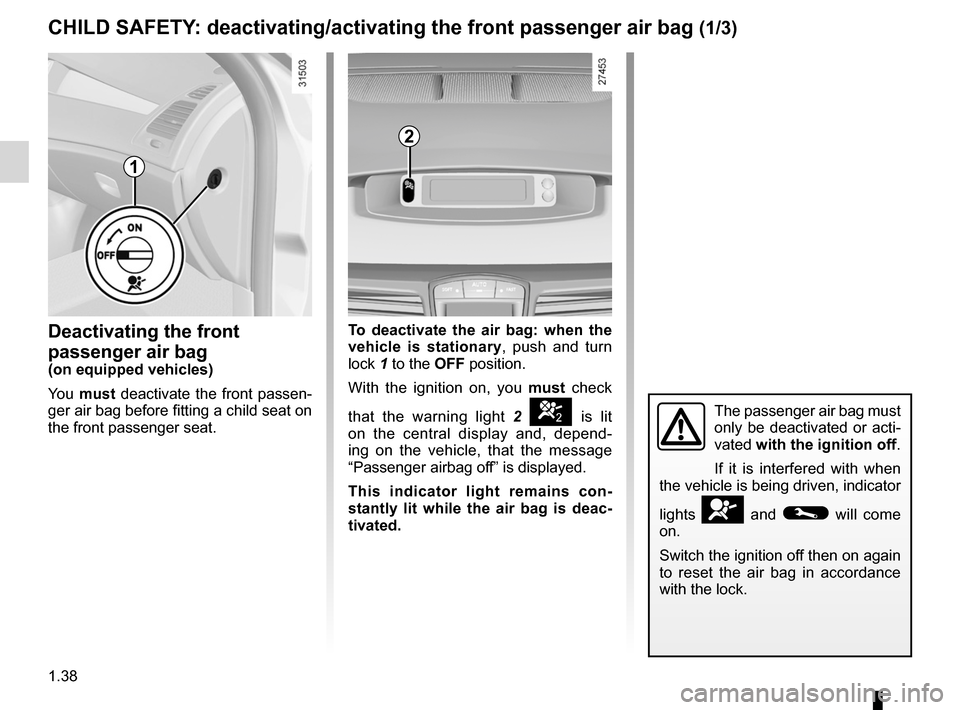
deactivating, activating the front passenger airbag
2
deactivating the front
passenger air bag
(on equipped vehicles)
You must deactivate the front passen-
ger air bag before fitting a child seat on
the front passenger seat. To deactivate the air bag: when the
vehicle is stationary
, push and turn
lock 1 to the Off position.
With the ignition on, you must check
that the warning light 2
] is lit
on the central display and, depend -
ing on the vehicle, that the message
“Passenger airbag off” is displayed.
This indicator light remains con -
stantly lit while the air bag is deac -
tivated.
cHILd sAfETY : deactivating/activating the front passenger air bag (1/3)
1
The passenger air bag must
only be deactivated or acti-
vated with the ignition off.
If it is interfered with when
the vehicle is being driven, indicator
lights
å and © will come
on.
Switch the ignition off then on again
to reset the air bag in accordance
with the lock.
Page 45 of 241
JauneNoirNoir texte
1.39
ENG_UD28945_7
Sécurité enfants : désactivation, activation airbag passager avant (X91 - B91 - K91 - D91 - Renault)
ENG_NU_936-5_BK91_Renault_1
cHILd sAfETY : deactivating/activating the front passenger air bag (2/3)
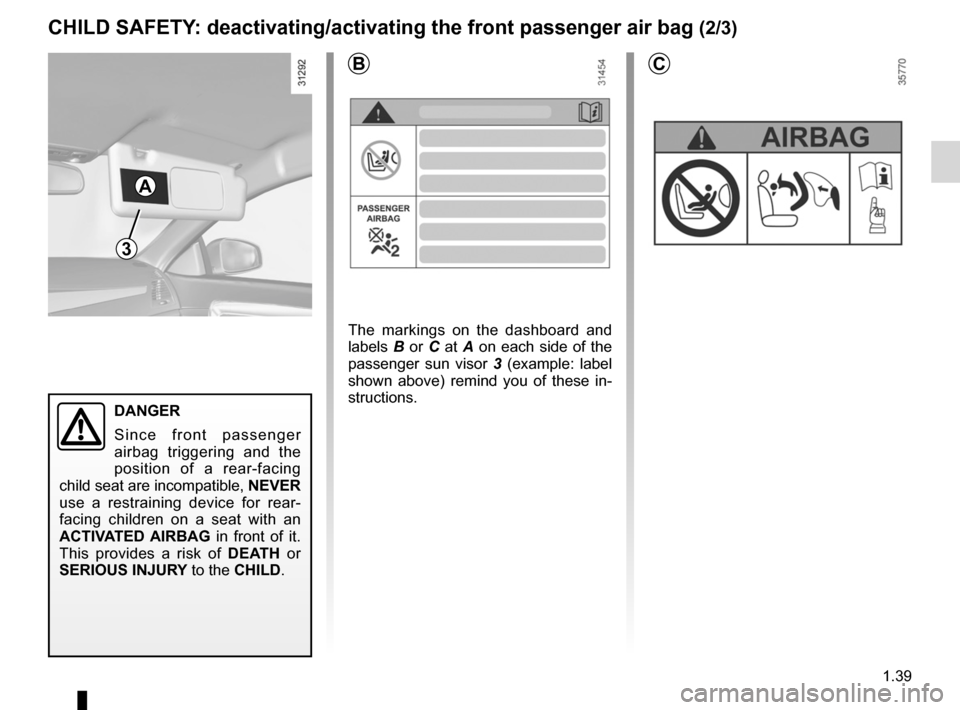
B
A
3
c
dANgER
S i n c e f r o n t p a s s e n g e r
airbag triggering and the
position of a rear-facing
child seat are incompatible, NEvER
use a restraining device for rear -
facing children on a seat with an
A cTI vATE d AIRBA g in front of it.
This provides a risk of dEATH or
sERIOUs INJURY to the cHILd.
The markings on the dashboard and
labels B or C at A on each side of the
passenger sun visor 3 (example: label
shown above) remind you of these in -
structions.
Page 46 of 241
air bagactivating the front passenger air bags ............ (current page)
1.40
ENG_UD28945_7
Sécurité enfants : désactivation, activation airbag passager avant (X91 - B91 - K91 - D91 - Renault)
ENG_NU_936-5_BK91_Renault_1
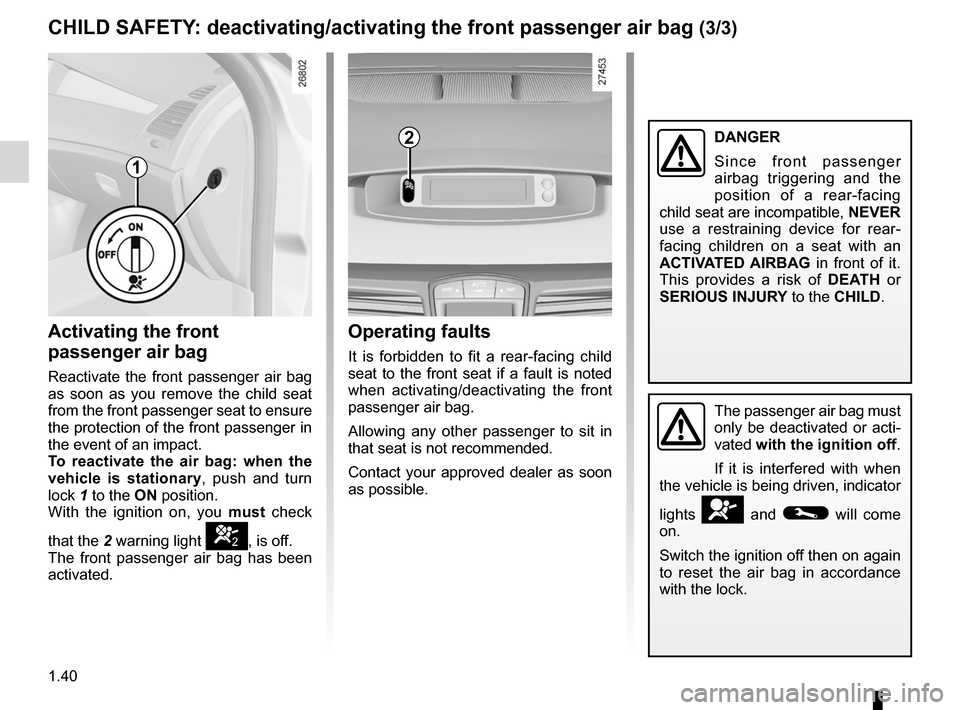
Activating the front
passenger air bag
Reactivate the front passenger air bag
as soon as you remove the child seat
from the front passenger seat to ensure
the protection of the front passenger in
the event of an impact.
To reactivate the air bag: when the
vehicle is stationary , push and turn
lock 1 to the ON position.
With the ignition on, you must check
that the 2 warning light
], is off.
The front passenger air bag has been
activated.
Operating faults
It is forbidden to fit a rear-facing child
seat to the front seat if a fault is noted
when activating/deactivating the front
passenger air bag.
Allowing any other passenger to sit in
that seat is not recommended.
Contact your approved dealer as soon
as possible.
The passenger air bag must
only be deactivated or acti-
vated with the ignition off.
If it is interfered with when
the vehicle is being driven, indicator
lights
å and © will come
on.
Switch the ignition off then on again
to reset the air bag in accordance
with the lock.
1
2
cHILd sAfETY : deactivating/activating the front passenger air bag (3/3)
dANgER
S i n c e f r o n t p a s s e n g e r
airbag triggering and the
position of a rear-facing
child seat are incompatible, NEvER
use a restraining device for rear -
facing children on a seat with an
A cTI vATE d AIRBA g in front of it.
This provides a risk of dEATH or
sERIOUs INJURY to the cHILd.
Page 135 of 241
JauneNoirNoir texte
3.13
ENG_UD23646_7
Lève-vitres électriques (X91 - B91 - K91 - Renault)
ENG_NU_936-5_BK91_Renault_3
ElEcTRIc WINDoWS, ElEcTRIc SuNRooF (3/3)
Precautions during use
– check that the sunroof is properly
closed before leaving your vehicle;
– clean the seal every three months
using products recommended by our
Technical Department;
– do not open the sunroof immedi -
ately after the vehicle has been in
the rain or after your car has been
washed.
– Vehicle with roof bars
As a general rule, if there is a load
on the roof, use of the sunroof is not
recommended.
Before using the sunroof, check the
objects and/or accessories (bike
racks, roof boxes, etc.) attached to
the roof bars: they should be prop -
erly arranged and secured and
should not interfere with the opera -
tion of the sunroof.
Contact an approved Dealer for de-
tails of possible conversions.
operating faults
Electric windows
In case of a fault when closing a
window, the system reverts to normal
mode: pull the switch concerned up as
often as necessary to fully close the
window, then hold the switch (still on
the closure side) for three seconds then
lower and raise the window fully to rein-
itialise the system.
If necessary, contact an approved
Dealer.
Electric sunroof
If the roof does not close, turn button 9
to the 0 position and then press button 8
until the roof is fully closed: consult an
approved Dealer.
Remote control window
closing
(for vehicles with one-touch windows
on all windows).
When you lock the doors from the out-
side, press the locking button on the
RENA ulT card twice in quick suc -
cession, or on the driver's door in
hands-free mode, and all the windows
will close automatically.
It is recommended that the user only
operates the system when the vehi -
cle can be seen clearly and no one is
inside.
Note: locking the doors using the
RENAULT card deactivates hands-free
mode.
Closing windows can cause
serious injury.
If the vehicle is equipped
with this function, this action
will activate deadlocking.
Check that there is no-one
still inside the vehicle
Important: during this operation,
the sunroof anti-pinch facility is de-
activated. Contact your approved
Dealer as soon as possible.
Page 151 of 241
JauneNoirNoir texte
3.29
ENG_UD23649_2
Rangements, aménagements coffre à bagages (X91 - B91 - K91 - Renault)
ENG_NU_936-5_BK91_Renault_3
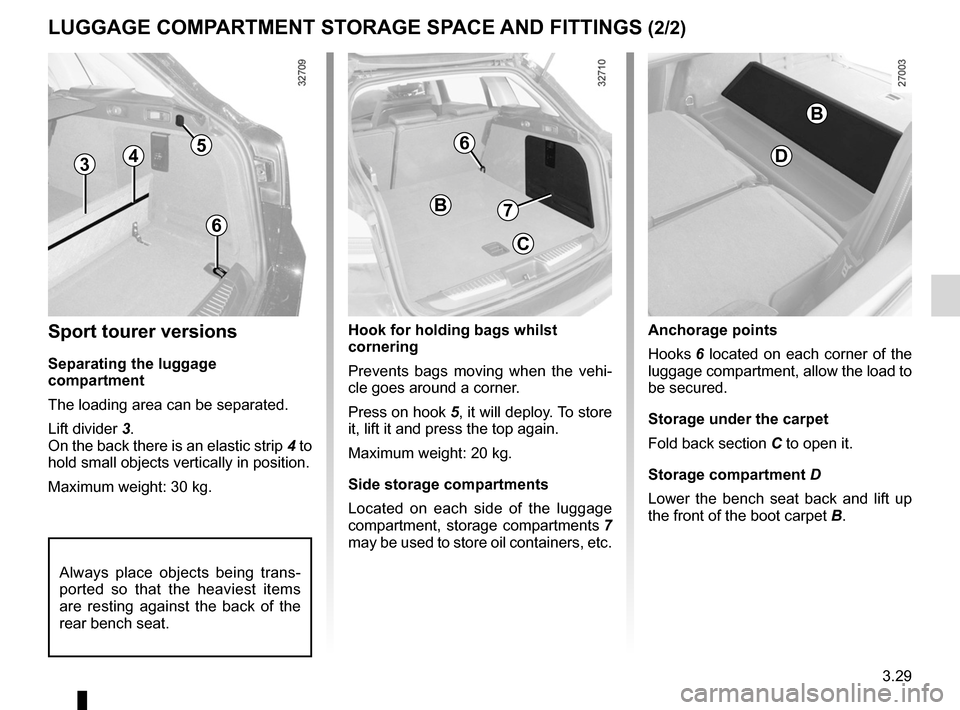
Sport tourer versions
Separating the luggage
compartment
The loading area can be separated.
Lift divider 3.
On the back there is an elastic strip 4 to
hold small objects vertically in position.
Maximum weight: 30 kg. hook for holding bags whilst
cornering
Prevents bags moving when the vehi
-
cle goes around a corner.
Press on hook 5, it will deploy. To store
it, lift it and press the top again.
Maximum weight: 20 kg.
Side storage compartments
Located on each side of the luggage
compartment, storage compartments 7
may be used to store oil containers, etc.
luggAgE coMPARTMENT ST oRAgE SPAcE AND FITTINgS (2/2)
Anchorage points
Hooks 6 located on each corner of the
luggage compartment, allow the load to
be secured.
Storage under the carpet
Fold back section C to open it.
Storage compartment D
Lower the bench seat back and lift up
the front of the boot carpet B.
Always place objects being trans -
ported so that the heaviest items
are resting against the back of the
rear bench seat.
D5
34
6
6
B7
c
B
Page 165 of 241
\
ENG_NU_936-5_BK91_Renault_4
Oil change
S e r v i c e i n t e r v a l : r e f e r t")
JauneNoirNoir texte
4.7
ENG_UD29069_3
Niveau huile moteur : appoint, remplissage (X91 - B91 - K91 - Renault)\
ENG_NU_936-5_BK91_Renault_4
Oil change
S e r v i c e i n t e r v a l : r e f e r t o t h e
Maintenance Document for your vehi -
cle.
Average capacities for oil change
including oil filter
(for information)
2.0 16V engine : 4.4 litres
2.0t engine: 5.4 litres
1.5 dCi engine : 4.5 litres
2.0 dCi engine : 7.4 litres
engine oil grade
Refer to the Maintenance Document for
your vehicle.
Consult your approved Dealer at
once if you notice an abnormal or
repeated drop in any of the fluid
levels.
Never run the engine in an
enclosed space as exhaust
gases are poisonous.
Filling: take care when
topping up the oil that
no oil drips onto engine
components - risk of fire.
Remember to refit the cap securely
as there is a risk of fire if oil splashes
onto hot engine components.
e ngine oil change: if you
are changing the oil when
the engine is hot, be careful
not to scald yourself if the
oil overflows.
The engine may be hot
when carrying out opera -
tions in close proximity. In
addition, the engine cooling
fan can come on at any moment.
Risk of injury.
enGIne OIL LeVeL: topping up/filling (2/2)enGIne OIL CHAnGe
2
112
Deactivate the Stop and
Start function for any opera -
tion performed in the engine
compartment.
Page 173 of 241
 (X44 - X77 - J77 - X85 - \
B90 - X61 - TEST - X77 ph2 - X95 - B95 - D95 - K95 - J95 - R95 - L90 Ph2 - F90 Ph2 - R90\")
JauneNoirNoir texte
4.15
ENG_UD26811_2
Entretien de la carrosserie (peinture mate) (X44 - X77 - J77 - X85 - \
B90 - X61 - TEST - X77 ph2 - X95 - B95 - D95 - K95 - J95 - R95 - L90 Ph2 - F90 Ph2 - R90\
Ph2 - X62
ENG_NU_936-5_BK91_Renault_4
Respect local regulations about wash -
ing vehicles (e.g. do not wash your ve-
hicle on a public highway).
Observe the vehicle stopping distances
when driving on gravelled surfaces to
prevent paint damage.
Repair, or have repaired quickly, areas
where the paint has been damaged, to
prevent corrosion spreading.
Remember to visit the body shop pe -
riodically in order to maintain your
anti-corrosion warranty. Refer to the
Maintenance Document.
If it is necessary to clean mechani -
cal components, hinges, etc., spray
them with products approved by our
Technical Department to protect them
after they have been cleaned.
BODyWORk MAIntenAnCe (2/2)
We have selected special products
to care for your vehicle and you can
obtain these from the manufactur -
er’s accessory outlets.
Using a roller type car wash
Return the windscreen wiper stalk to
the Park position (refer to the informa-
tion on the “Windscreen washer, wiper”
in Section 1). Check the mounting of
external accessories, additional lights
and mirrors, and ensure that the wiper
blades are secured with adhesive tape.
Remove the radio aerial mast if your
vehicle is fitted with this equipment.
Remember to remove the tape and refit
the antenna after washing.
Cleaning the headlights
As the headlights are made of plastic
“glass”, use a soft cloth or cotton wool
to clean them. If this does not clean
them properly, moisten the cloth with
soapy water, then wipe clean with a soft
damp cloth or cotton wool.
Finally, carefully dry off with a soft dry
cloth.
Cleaning products containing alco -
hol must not be used.
Vehicles with a matte paint
finish
This type of paint requires certain pre-
cautions.
Do not do the following
– use wax-based products (polishing);
– rub hard;
– wash the vehicle in a roller-type car
wash;
– wash the vehicle using a high-pres-
sure device;
– attach stickers to the paintwork (risk
of leaving marks).
y ou should do the following
Wash the vehicle by hand using plenty
of water, using a soft cloth or a gentle
sponge.