ignition RENAULT LAGUNA 2012 X91 / 3.G Owner's Manual
[x] Cancel search | Manufacturer: RENAULT, Model Year: 2012, Model line: LAGUNA, Model: RENAULT LAGUNA 2012 X91 / 3.GPages: 241, PDF Size: 7.82 MB
Page 87 of 241
JauneNoirNoir texte
2.5
ENG_UD28948_5
Démarrage, arrêt du moteur (X91 - B91 - K91 - Renault)
ENG_NU_936-5_BK91_Renault_2
StaRtING/StoPPING the eNGINe (3/3)
When you leave your vehi -
cle, especially if you have
your RENAULT card with
you, check that the engine
is completely switched off.
Special note
If the card is no longer in the reader
when you try to switch the engine off,
the message “ No keycard Press and
hold ” will appear on the instrument
panel: press button 1 for over two sec-
onds.
ReNaUL t card in hands-free
mode
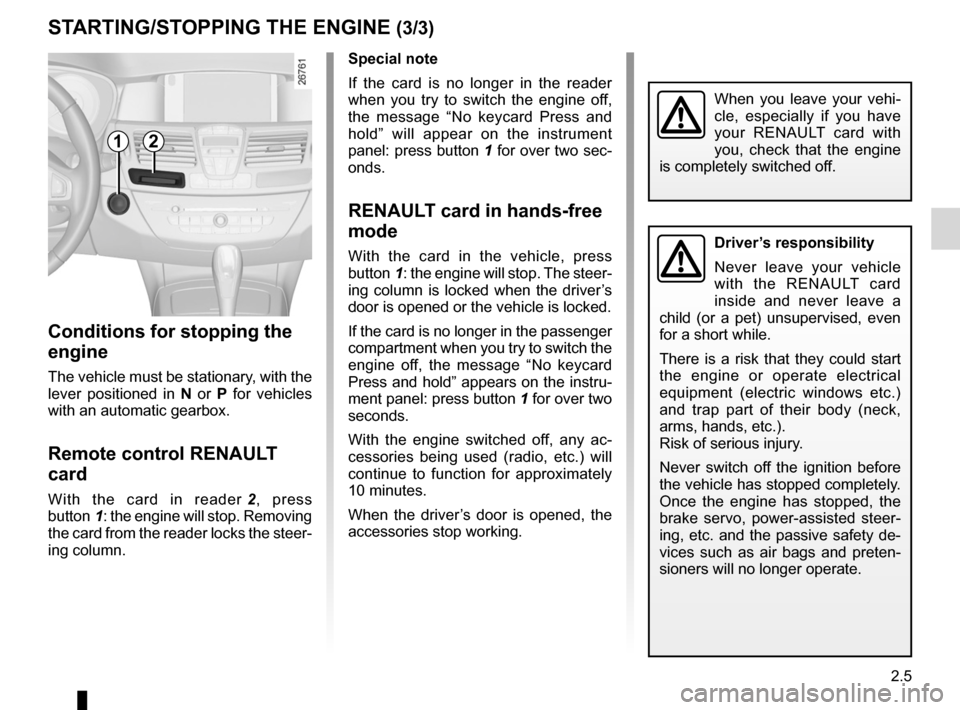
With the card in the vehicle, press
button 1: the engine will stop. The steer-
ing column is locked when the driver’s
door is opened or the vehicle is locked.
If the card is no longer in the passenger
compartment when you try to switch the
engine off, the message “ No keycard
Press and hold ” appears on the instru-
ment panel: press button 1 for over two
seconds.
With the engine switched off, any ac -
cessories being used (radio, etc.) will
continue to function for approximately
10 minutes.
When the driver’s door is opened, the
accessories stop working.
Conditions for stopping the
engine
The vehicle must be stationary, with the
lever positioned in N or P for vehicles
with an automatic gearbox.
Remote control ReNaUL t
card
With the card in reader 2 , press
button 1: the engine will stop. Removing
the card from the reader locks the steer-
ing column.
12
Driver’s responsibility
Never leave your vehicle
with the RENAULT card
inside and never leave a
child (or a pet) unsupervised, even
for a short while.
There is a risk that they could start
the engine or operate electrical
equipment (electric windows etc.)
and trap part of their body (neck,
arms, hands, etc.).
Risk of serious injury.
Never switch off the ignition before
the vehicle has stopped completely.
Once the engine has stopped, the
brake servo, power-assisted steer -
ing, etc. and the passive safety de-
vices such as air bags and preten -
sioners will no longer operate.
Page 88 of 241
starting the engine ................................ (up to the end of the DU)
engine standby ..................................... (up to the end of the DU)
Stop & Start function .............................(up to the end of the DU)
Stop & Start .......................................... (up to the end of the DU)
2.6
ENG_UD28949_4
Fonction Stop and Start (X91 - B91 - K91 - D91 - Renault)
ENG_NU_936-5_BK91_Renault_2
Jaune NoirNoir texte
stop and start function
StoP aND StaRt function (1/3)
The message “Auto Stop” on the instru-
ment panel indicates that the engine is
on standby.
The vehicle equipment remain opera -
tional while the engine is stopped.
The engine will restart as soon as you
press the clutch pedal and move into
gear.This system enables a reduced fuel
consumption and lower greenhouse
gas emissions.
The system is activated automatically
when the vehicle is started.
While driving, the system stops the
engine (standby) when the vehicle is
at a standstill (traffic jam, traffic lights,
etc).
System operating conditionsEngine standby is activated if:
– the vehicle has been driven since its
last stop;
– the gearbox is in neutral;
– the clutch pedal is released;
and
– the vehicle is travelling at less than 3
km/h. Special feature of the automatic
engine re-start
Under certain conditions, the engine
can restart on its own in order to guar-
antee your safety and comfort.
This can occur especially when:
–
the outdoor temperature is too low or
too high (less than around 0 °C or
higher than around 30 °C);
– the “Clear View” function is activated
(please see “Automatic Climate
Control” in Section 3);
– the battery is not sufficiently charged;
– the vehicle speed is above 7 km/h
(downhill slope, etc.);
– repeated pressing on the brake
pedal or braking system require -
ment;
– ...
Special feature of vehi -
cles equipped with an
electronic parking brake
If the engine is put on
standby (the message “ Auto Stop”
is displayed on the instrument
panel), the electronic parking brake
is not applied automatically.
Engine on standby - braking
assistance is no longer op-
erational.
Before getting out of the
vehicle, you must switch
off the ignition by pressing
the engine stop (please see
“Starting, stopping the engine”).
Do not drive off when the
engine is on standby (the
message “Auto Stop” is dis-
played on the instrument
panel).
Page 89 of 241
JauneNoirNoir texte
2.7
ENG_UD28949_4
Fonction Stop and Start (X91 - B91 - K91 - D91 - Renault)
ENG_NU_936-5_BK91_Renault_2
StoP aND StaRt function (2/3)
Special cases
– While the system is operating, and
the engine is stopped (traffic jam,
traffic lights, etc.), if the driver gets
out of their seat or unfastens their
seat belt and opens the driver ’s
door, the ignition will be switched off
and, depending on the vehicle, the
electronic parking brake will be ac -
tivated automatically. To restart and
reactivate the Stop and Start system,
press the start button (please see
“Starting, stopping the engine”).
– In the event of the engine stalling,
if the system is operational, press
down the clutch pedal as far as it will
go to restart.
Deactivate the Stop and
Start function for any opera -
tion performed in the engine
compartment.
Conditions preventing the
standby of the engine
Certain conditions prevent the system
from using the engine standby function,
including when:
– reverse gear is engaged;
– the bonnet is not locked;
– the driver’s door is not closed;
– the driver’s seatbelt is not fastened;
– the outdoor temperature is too low or
too high (less than around 0 °C or
higher than around 30 °C);
– the battery is not sufficiently charged;
– the difference between the vehicle
interior temperature and the auto -
matic climate control instruction is
too high; –
the “Clear View” function is activated
(please see “Automatic Climate
Control” in Section 3);
– the engine coolant temperature is
too low;
– automatic particle filter cleaning is
underway;
or
– ...
To fill up with fuel, the engine must
be stopped (and not on standby):
always stop the engine by pressing
the engine stop button (please see
“Starting, stopping the engine)”.
Page 90 of 241
2.8
ENG_UD28949_4
Fonction Stop and Start (X91 - B91 - K91 - D91 - Renault)
ENG_NU_936-5_BK91_Renault_2
operating faults
When the message “ Check Stop &
Start” appears on the instrument panel
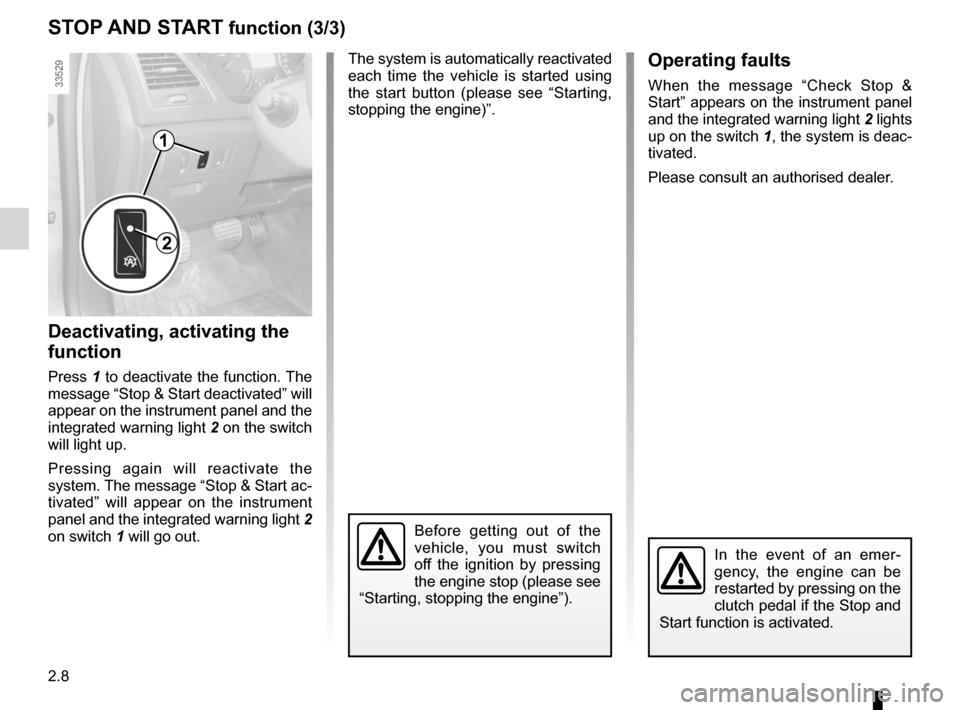
and the integrated warning light 2 lights
up on the switch 1, the system is deac-
tivated.
Please consult an authorised dealer.
Deactivating, activating the
function
Press 1 to deactivate the function. The
message “Stop & Start deactivated ” will
appear on the instrument panel and the
integrated warning light 2 on the switch
will light up.
Pressing again will reactivate the
system. The message “Stop & Start ac-
tivated ” will appear on the instrument
panel and the integrated warning light 2
on switch 1 will go out.
StoP aND StaRt function (3/3)
The system is automatically reactivated
each time the vehicle is started using
the start button (please see “Starting,
stopping the engine)”.
Before getting out of the
vehicle, you must switch
off the ignition by pressing
the engine stop (please see
“Starting, stopping the engine”).
2
1
In the event of an emer -
gency, the engine can be
restarted by pressing on the
clutch pedal if the Stop and
Start function is activated.
Page 91 of 241
catalytic converter................................. (up to the end of the DU)
special features of petrol vehicles ........ (up to the end of the DU)
driving ................................................... (up to the end of the DU)
2.9
ENG_UD13347_4
Particularités des versions essence (X84 - B84 - C84 - E84 - L84 - K84 - J84 - X91 - B91 - K91 - Renault)
ENG_NU_936-5_BK91_Renault_2
Special features of petrol versions
SPeCIaL featUReS of PetRoL veRSIoNS
Do not park the vehicle or
run the engine in locations
where combustible sub -
stances or materials such
as grass or leaves can come into
contact with the hot exhaust system.
The following operating conditions
should be avoided:
– driving for long periods when the low
fuel level warning light is lit;
– using leaded petrol;
– using fuel or lubrication additives
which are not approved.
Or operating faults such as:
– faulty ignition system, running out of
fuel or disconnected spark plugs re-
sulting in the engine misfiring or cut-
ting out when driving;
– loss of power;
may cause the catalytic converter to
overheat, reducing its efficiency which
may irreparably damage it and cause
heat damage to the vehicle. If you notice any of the above operating
faults, have the necessary repairs car-
ried out as soon as possible by an ap-
proved dealer.
These faults may be avoided by regu
-
larly taking your vehicle to an approved
Dealer at the intervals specified in the
Maintenance Document.
Starting problems
To avoid damaging the catalytic con -
verter, do not keep trying to start the
engine (using the start button, or by
pushing or towing the vehicle) without
having identified and corrected the
cause of the fault.
If the fault cannot be identified, do not
continue to try and start the engine, but
contact an approved dealer.
Page 93 of 241
gear lever............................................................... (current page)
changing gear ....................................... (up to the end of the DU)
reverse gear selecting .......................................... (up to the end of the DU)
driving ................................................... (up to the end of the DU)
handbrake ............................................. (up to the end of the DU)
2.11
ENG_UD20298_1
Levier de vitesses/frein à main (X91 - B91 - K91 - Renault)
ENG_NU_936-5_BK91_Renault_2
Gear lever
Handbrake
GeaR LeveR/haNDbRake
Gear lever
Selecting reverse gear
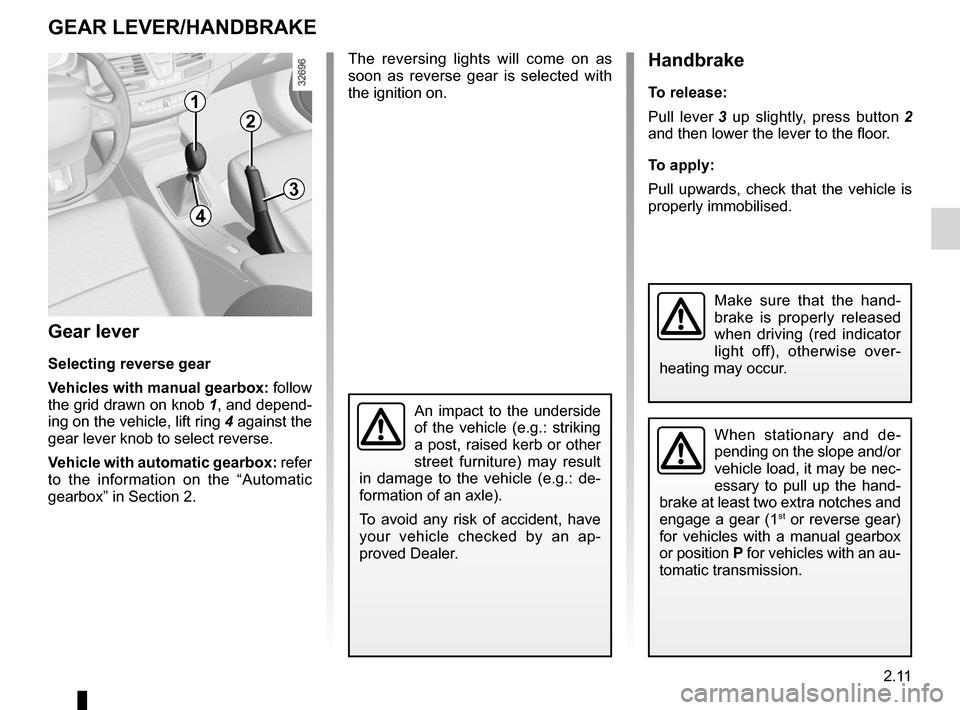
v ehicles with manual gearbox: follow
the grid drawn on knob 1, and depend -
ing on the vehicle, lift ring 4 against the
gear lever knob to select reverse.
v ehicle with automatic gearbox: refer
to the information on the “Automatic
gearbox” in Section 2. The reversing lights will come on as
soon as reverse gear is selected with
the ignition on.
handbrake
t
o release:
Pull lever 3 up slightly, press button 2
and then lower the lever to the floor.
t o apply:
Pull upwards, check that the vehicle is
properly immobilised.
Make sure that the hand -
brake is properly released
when driving (red indicator
light off), otherwise over -
heating may occur.
When stationary and de -
pending on the slope and/or
vehicle load, it may be nec-
essary to pull up the hand -
brake at least two extra notches and
engage a gear (1
st or reverse gear)
for vehicles with a manual gearbox
or position P for vehicles with an au-
tomatic transmission.
An impact to the underside
of the vehicle (e.g.: striking
a post, raised kerb or other
street furniture) may result
in damage to the vehicle (e.g.: de -
formation of an axle).
To avoid any risk of accident, have
your vehicle checked by an ap -
proved Dealer.
1
2
3
4
Page 95 of 241
JauneNoirNoir texte
2.13
ENG_UD9635_3
Frein de parking assisté (X91 - B91 - K91 - Renault)
ENG_NU_936-5_BK91_Renault_2
Special cases
When parking on a slope or towing a
trailer, pull switch 3 for a few seconds
to obtain the maximum braking effect.
To park the vehicle without applying the
assisted parking brake (if there is a risk
of freezing, for example):
– w i t h t h e e n g i n e r u n n i n g a n d
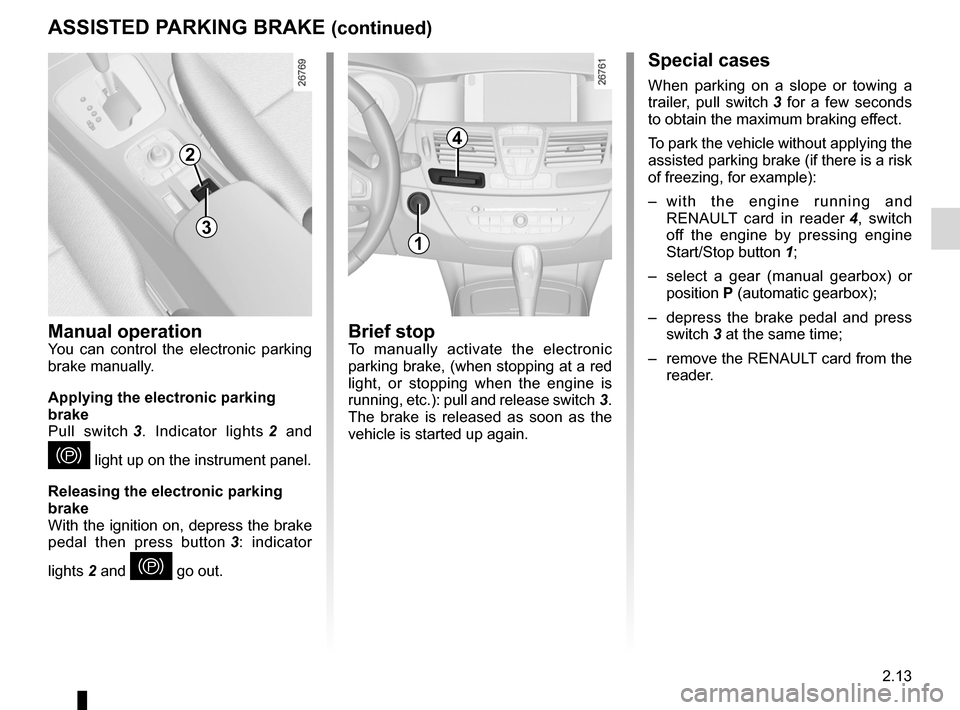
RENAULT card in reader 4 , switch
off the engine by pressing engine
Start/Stop button 1;
– select a gear (manual gearbox) or
position P (automatic gearbox);
– depress the brake pedal and press
switch 3 at the same time;
– remove the RENAULT card from the
reader.
brief stopTo manually activate the electronic
parking brake, (when stopping at a red
light, or stopping when the engine is
running, etc.): pull and release switch 3.
The brake is released as soon as the
vehicle is started up again.
aSSISteD P aRkING bRake (continued)
4
13
Manual operationYou can control the electronic parking
brake manually.
applying the electronic parking
brake
Pull switch 3 . Indicator lights 2 and
} light up on the instrument panel.
Releasing the electronic parking
brake
With the ignition on, depress the brake
pedal then press button 3 : indicator
lights 2 and
} go out.
2
Page 97 of 241
driving ................................................... (up to the end of the DU)
fuel economy ........................................ (up to the end of the DU)
advice on antipollution .......................... (up to the end of the DU)
antipollution advice .............................................................. (current page)
fuel advice on fuel economy ................................... (current page)
2.15
ENG_UD19886_6
Conseils antipollution, économie de carburant, conduite (X45 - H45 - X85 - B85 - C85 - S85 - X91 - X83 - X61 - F61 - K61 - K85 - X95 - B95 - D95 - J95 - R95 - L38 - X61
ENG_NU_936-5_BK91_Renault_2
Advice: antipollution and fuel economy
aDvICe: antipollution, fuel economy and driving (1/3)
Your vehicle complies with criteria for
recycling and recovering vehicles at the
end of their service life which will come
into force in 2015.
Some parts of your vehicle have there-
fore been designed to facilitate future
recycling.
These parts are easy to remove so
that they can be recovered and reproc-
essed by recycling companies.
By virtue of its design, moderate fuel
consumption and initial settings, your
vehicle also conforms to current anti-
pollution regulations. The manufac -
turer is actively striving to reduce pol -
lutant exhaust gas emissions and to
save energy. But the fuel consumption
of your vehicle and the level of pollutant
exhaust gas emissions are also your
responsibility. Ensure that it is main -
tained and used correctly.aiding fuel economy
Depending on the vehicle, in order to
optimise consumption, an indicator light
on the instrument panel will inform you
of the best moment to upshift or down -
shift gears:
\ shift up a gear;
[ shift down a gear.
Maintenance
It is important to remember that failure to
respect antipollution regulations could
lead to legal action being taken against
the vehicle owner. In addition, replacing
engine, fuel supply system and exhaust
components with parts other than those
originally recommended by the manu -
facturer may alter your vehicle so that
it no longer complies with antipollution
regulations. Have your vehicle adjusted and
checked by an approved Dealer, in ac-
cordance with the instructions given in
your maintenance schedule: they will
have all the equipment necessary for
ensuring that your vehicle is maintained
to its original standard.
engine adjustments–
ignition: this does not require ad -
justment.
– spark plugs: for optimum fuel econ-
omy, efficiency and performance
the specifications laid down by our
Design Department must be strictly
applied.
If the spark plugs have to be
changed, use the make, type and
gap specified for your vehicle’s
engine. Contact an approved dealer
for this.
– idle: this does not require adjust -
ment.
– air filter, diesel filter: a clogged ele-
ment reduces performance. It must
be replaced.
Page 98 of 241
2.16
ENG_UD19886_6
Conseils antipollution, économie de carburant, conduite (X45 - H45 - X85 - B85 - C85 - S85 - X91 - X83 - X61 - F61 - K61 - K85 - X95 - B95 - D95 - J95 - R95 - L38 - X61
ENG_NU_936-5_BK91_Renault_2
Jaune NoirNoir texte
aDvICe: antipollution, fuel economy and driving (2/3)
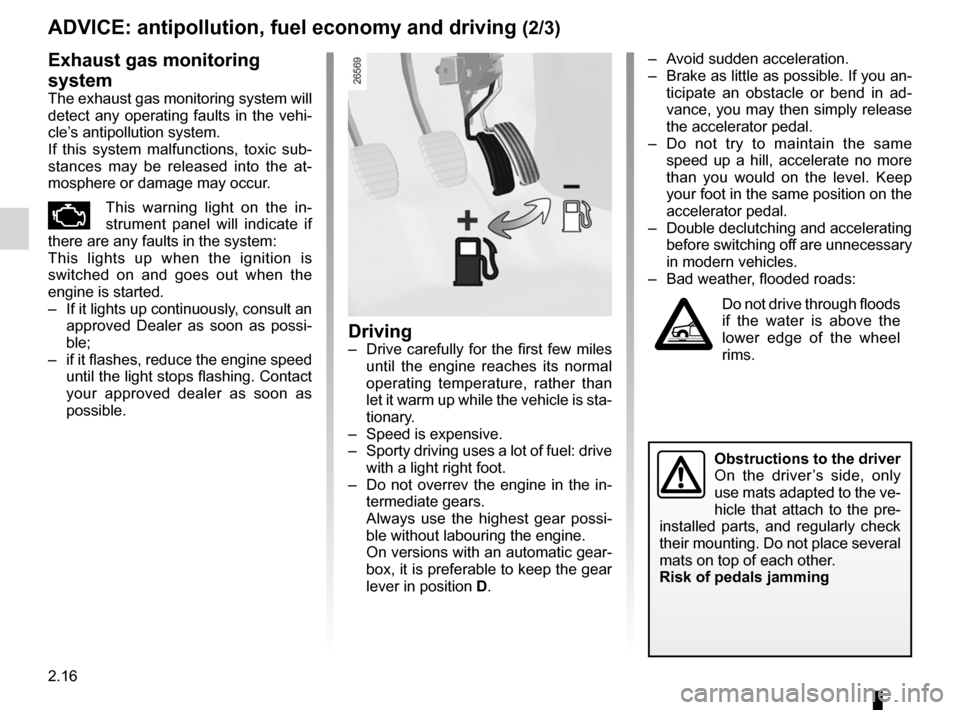
– Avoid sudden acceleration.
– Brake as little as possible. If you an-
ticipate an obstacle or bend in ad -
vance, you may then simply release
the accelerator pedal.
– Do not try to maintain the same
speed up a hill, accelerate no more
than you would on the level. Keep
your foot in the same position on the
accelerator pedal.
– Double declutching and accelerating
before switching off are unnecessary
in modern vehicles.
– Bad weather, flooded roads:
Do not drive through floods
if the water is above the
lower edge of the wheel
rims.
Driving– Drive carefully for the first few miles
until the engine reaches its normal
operating temperature, rather than
let it warm up while the vehicle is sta-
tionary.
– Speed is expensive.
– Sporty driving uses a lot of fuel: drive
with a light right foot.
– Do not overrev the engine in the in-
termediate gears.
Always use the highest gear possi -
ble without labouring the engine.
On versions with an automatic gear-
box, it is preferable to keep the gear
lever in position D.
exhaust gas monitoring
system
The exhaust gas monitoring system will
detect any operating faults in the vehi-
cle’s antipollution system.
If this system malfunctions, toxic sub -
stances may be released into the at -
mosphere or damage may occur.
ÄThis warning light on the in -
strument panel will indicate if
there are any faults in the system:
This lights up when the ignition is
switched on and goes out when the
engine is started.
– If it lights up continuously, consult an
approved Dealer as soon as possi -
ble;
– if it flashes, reduce the engine speed
until the light stops flashing. Contact
your approved dealer as soon as
possible.
obstructions to the driver
On the driver ’s side, only
use mats adapted to the ve-
hicle that attach to the pre-
installed parts, and regularly check
their mounting. Do not place several
mats on top of each other.
Risk of pedals jamming
Page 101 of 241
tyres ...................................................... (up to the end of the DU)
tyre pressure monitor ............................(up to the end of the DU)
tyre pressure ......................................... (up to the end of the DU)
driving ................................................... (up to the end of the DU)
2.19
ENG_UD22198_5
Système de surveillance de pression des pneumatiques (X91 - B91 - K91 - Renault)
ENG_NU_936-5_BK91_Renault_2
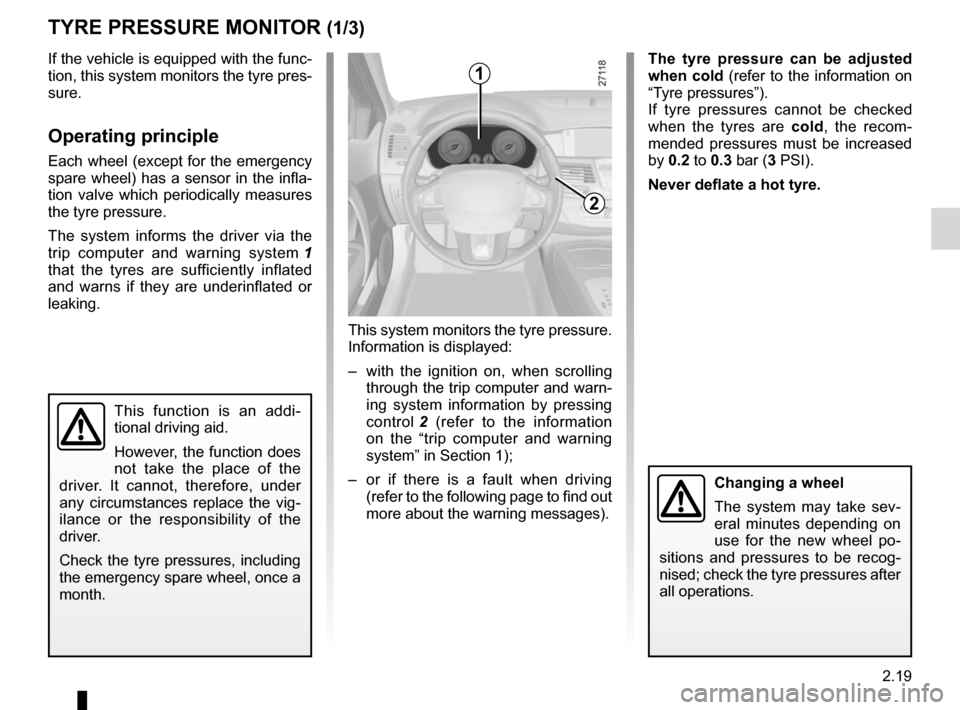
This system monitors the tyre pressure.
Information is displayed:
– with the ignition on, when scrolling
through the trip computer and warn-
ing system information by pressing
control 2 (refer to the information
on the “trip computer and warning
system” in Section 1);
– or if there is a fault when driving
(refer to the following page to find out
more about the warning messages).
Tyre pressure monitor
This function is an addi -
tional driving aid.
However, the function does
not take the place of the
driver. It cannot, therefore, under
any circumstances replace the vig -
ilance or the responsibility of the
driver.
Check the tyre pressures, including
the emergency spare wheel, once a
month.
tyRe PReSSURe MoNItoR (1/3)
If the vehicle is equipped with the func-
tion, this system monitors the tyre pres-
sure.
operating principle
Each wheel (except for the emergency
spare wheel) has a sensor in the infla-
tion valve which periodically measures
the tyre pressure.
The system informs the driver via the
trip computer and warning system 1
that the tyres are sufficiently inflated
and warns if they are underinflated or
leaking.
t he tyre pressure can be adjusted
when cold (refer to the information on
“Tyre pressures”).
If tyre pressures cannot be checked
when the tyres are cold, the recom -
mended pressures must be increased
by 0.2 to 0.3 bar (3 PSI).
Never deflate a hot tyre.1
2
Changing a wheel
The system may take sev -
eral minutes depending on
use for the new wheel po -
sitions and pressures to be recog -
nised; check the tyre pressures after
all operations.