ignition RENAULT LAGUNA 2012 X91 / 3.G Owner's Guide
[x] Cancel search | Manufacturer: RENAULT, Model Year: 2012, Model line: LAGUNA, Model: RENAULT LAGUNA 2012 X91 / 3.GPages: 241, PDF Size: 7.82 MB
Page 107 of 241
JauneNoirNoir texte
2.25
ENG_UD27695_10
Dispositifs de correction et d’assistance à la de conduite (X91 - B91 - K91 - D91 - Renault)
ENG_NU_936-5_BK91_Renault_2
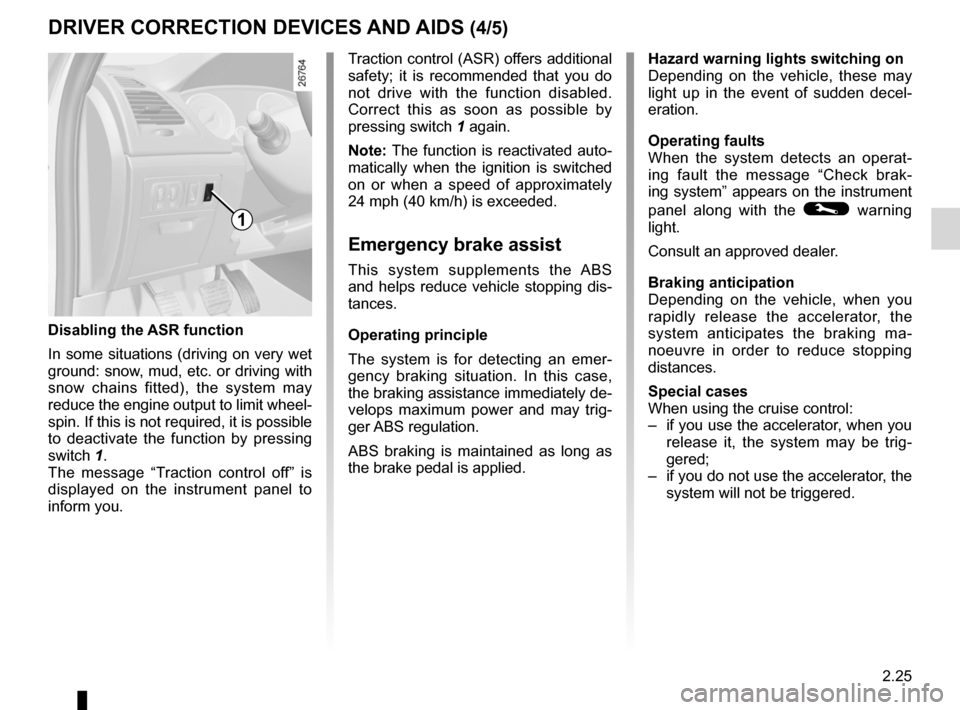
Disabling the aSR function
In some situations (driving on very wet
ground: snow, mud, etc. or driving with
snow chains fitted), the system may
reduce the engine output to limit wheel -
spin. If this is not required, it is possible
to deactivate the function by pressing
switch 1.
The message “ Traction control off ” is
displayed on the instrument panel to
inform you.
Traction control (ASR) offers additional
safety; it is recommended that you do
not drive with the function disabled.
Correct this as soon as possible by
pressing switch 1 again.
Note: The function is reactivated auto-
matically when the ignition is switched
on or when a speed of approximately
24 mph (40 km/h) is exceeded.
emergency brake assist
This system supplements the ABS
and helps reduce vehicle stopping dis-
tances.
operating principle
The system is for detecting an emer -
gency braking situation. In this case,
the braking assistance immediately de-
velops maximum power and may trig -
ger ABS regulation.
ABS braking is maintained as long as
the brake pedal is applied.
DRIveR CoRReCtIoN DevICeS aND aIDS (4/5)
1
hazard warning lights switching on
Depending on the vehicle, these may
light up in the event of sudden decel -
eration.
operating faults
When the system detects an operat -
ing fault the message “ Check brak-
ing system” appears on the instrument
panel along with the
© warning
light.
Consult an approved dealer.
braking anticipation
Depending on the vehicle, when you
rapidly release the accelerator, the
system anticipates the braking ma -
noeuvre in order to reduce stopping
distances.
Special cases
When using the cruise control:
– if you use the accelerator, when you
release it, the system may be trig -
gered;
– if you do not use the accelerator, the
system will not be triggered.
Page 119 of 241
automatic gearbox (use) ....................... (up to the end of the DU)
automatic gearbox selector lever ..........(up to the end of the DU)
changing gear ....................................... (up to the end of the DU)
reverse gear selecting .......................................... (up to the end of the DU)
driving ................................................... (up to the end of the DU)
2.37
ENG_UD27633_9
Boîte de vitesses automatique (X91 - B91 - K91 - D91 - Renault)
ENG_NU_936-5_BK91_Renault_2
Automatic gearbox
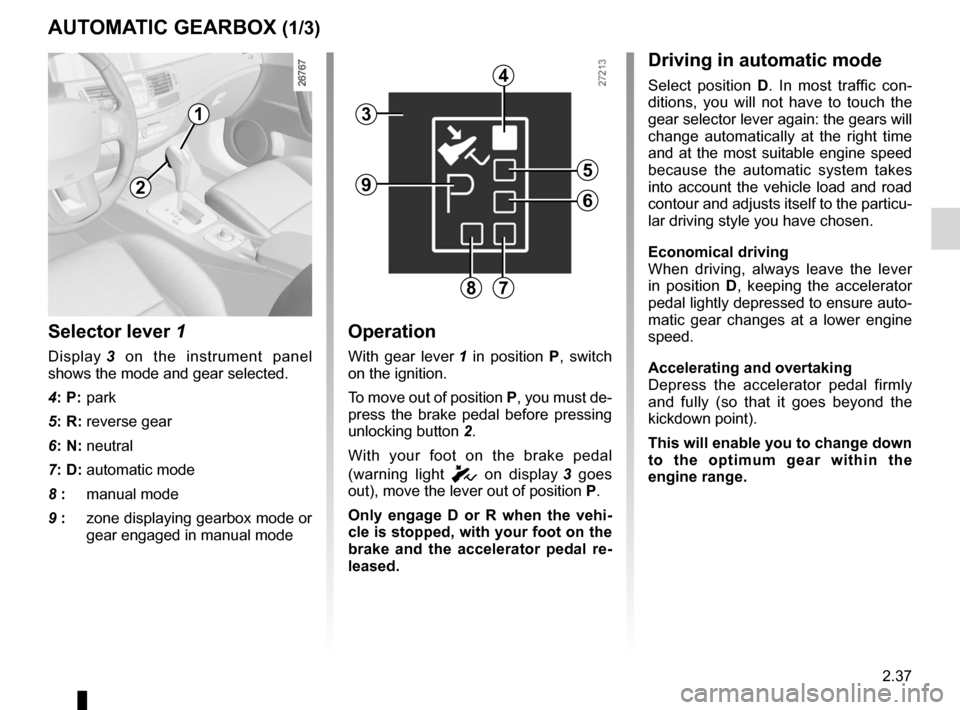
Selector lever 1
Display 3 on the instrument panel
shows the mode and gear selected.
4: P: park
5: R: reverse gear
6: N: neutral
7: D: automatic mode
8 : manual mode
9 : zone displaying gearbox mode or
gear engaged in manual mode
operation
With gear lever 1 in position P, switch
on the ignition.
To move out of position P, you must de-
press the brake pedal before pressing
unlocking button 2.
With your foot on the brake pedal
(warning light
c on display 3 goes
out), move the lever out of position P.
o nly engage D or R when the vehi -
cle is stopped, with your foot on the
brake and the accelerator pedal re -
leased.
aUtoMatIC GeaRbox (1/3)
Driving in automatic mode
Select position D. In most traffic con -
ditions, you will not have to touch the
gear selector lever again: the gears will
change automatically at the right time
and at the most suitable engine speed
because the automatic system takes
into account the vehicle load and road
contour and adjusts itself to the particu-
lar driving style you have chosen.
economical driving
When driving, always leave the lever
in position D, keeping the accelerator
pedal lightly depressed to ensure auto-
matic gear changes at a lower engine
speed.
accelerating and overtaking
Depress the accelerator pedal firmly
and fully (so that it goes beyond the
kickdown point).
this will enable you to change down
to the optimum gear within the
engine range.
3
2
1
4
5
6
78
9
Page 143 of 241
ashtrays ................................................ (up to the end of the DU)
cigar lighter ........................................... (up to the end of the DU)
accessories socket ............................... (up to the end of the DU)
3.21
ENG_UD27634_2
Cendrier, allume-cigares, prises accessoires (X91 - B91 - K91 - Renault)
ENG_NU_936-5_BK91_Renault_3
Ashtray/cigarette lighter
Accessories socket
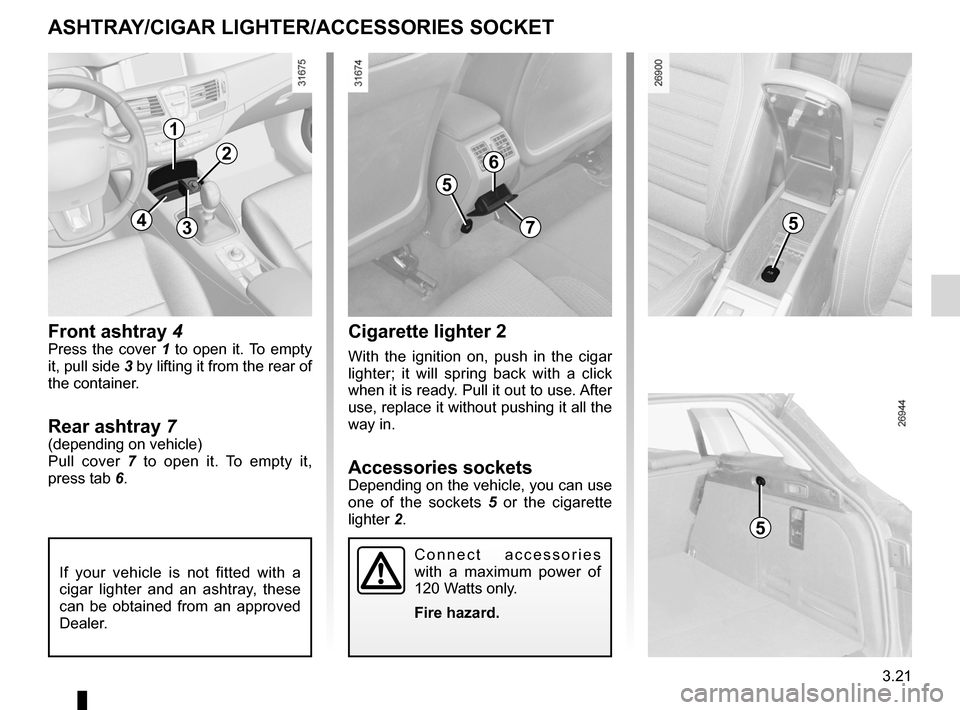
Front ashtray 4Press the cover 1 to open it. To empty
it, pull side 3 by lifting it from the rear of
the container.
Rear ashtray 7(depending on vehicle)
Pull cover 7 to open it. To empty it,
press tab 6.
AShTRA y/cIgAR lIghTER/AccESSoRIES SockET
cigarette lighter 2
With the ignition on, push in the cigar
lighter; it will spring back with a click
when it is ready. Pull it out to use. After
use, replace it without pushing it all the
way in.
Accessories socketsDepending on the vehicle, you can use
one of the sockets 5 or the cigarette
lighter 2.
If your vehicle is not fitted with a
cigar lighter and an ashtray, these
can be obtained from an approved
Dealer.
C o n n e c t a c c e s s o r i e s
with a maximum power of
120 Watts only.
Fire hazard.
1
2
34
5
6
75
5
Page 203 of 241
JauneNoirNoir texte
5.27
ENG_UD29075_3
Batterie : dépannage (X91 - B91 - K91 - Renault)
ENG_NU_936-5_BK91_Renault_5
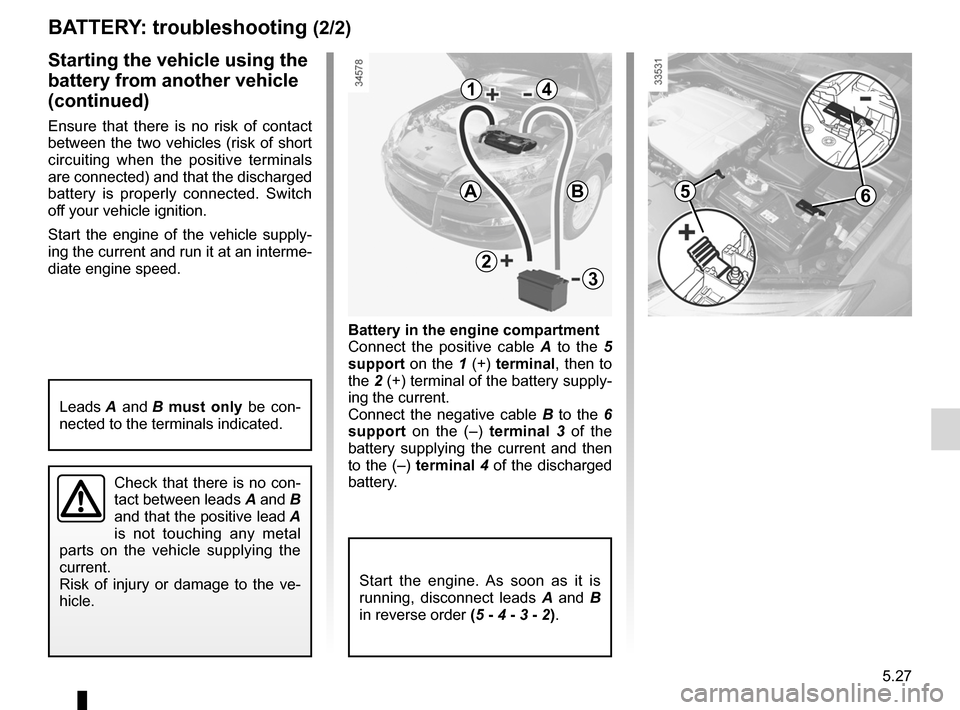
Battery in the engine compartment
Connect the positive cable A to the 5
support on the 1 (+) terminal, then to
the 2 (+) terminal of the battery supply -
ing the current.
Connect the negative cable B to the 6
support on the (–) terminal 3 of the
battery supplying the current and then
to the (–) terminal 4 of the discharged
battery.
BA tter Y: troubleshooting (2/2)
Starting the vehicle using the
battery from another vehicle
(continued)
Ensure that there is no risk of contact
between the two vehicles (risk of short
circuiting when the positive terminals
are connected) and that the discharged
battery is properly connected. Switch
off your vehicle ignition.
Start the engine of the vehicle supply -
ing the current and run it at an interme-
diate engine speed.
Start the engine. As soon as it is
running, disconnect leads A and B
in reverse order (5 - 4 - 3 - 2).
Check that there is no con-
tact between leads A and B
and that the positive lead A
is not touching any metal
parts on the vehicle supplying the
current.
Risk of injury or damage to the ve-
hicle.
Leads A and B must only be con-
nected to the terminals indicated.
56
14
AB
2
3
Page 206 of 241
wiper blades ......................................... (up to the end of the DU)
wipers blades ............................................. (up to the end of the DU)
5.30
ENG_UD20530_1
Balais d’essuie-vitres (X91 - B91 - K91 - Renault)
ENG_NU_936-5_BK91_Renault_5
Wipers (replacing blades)
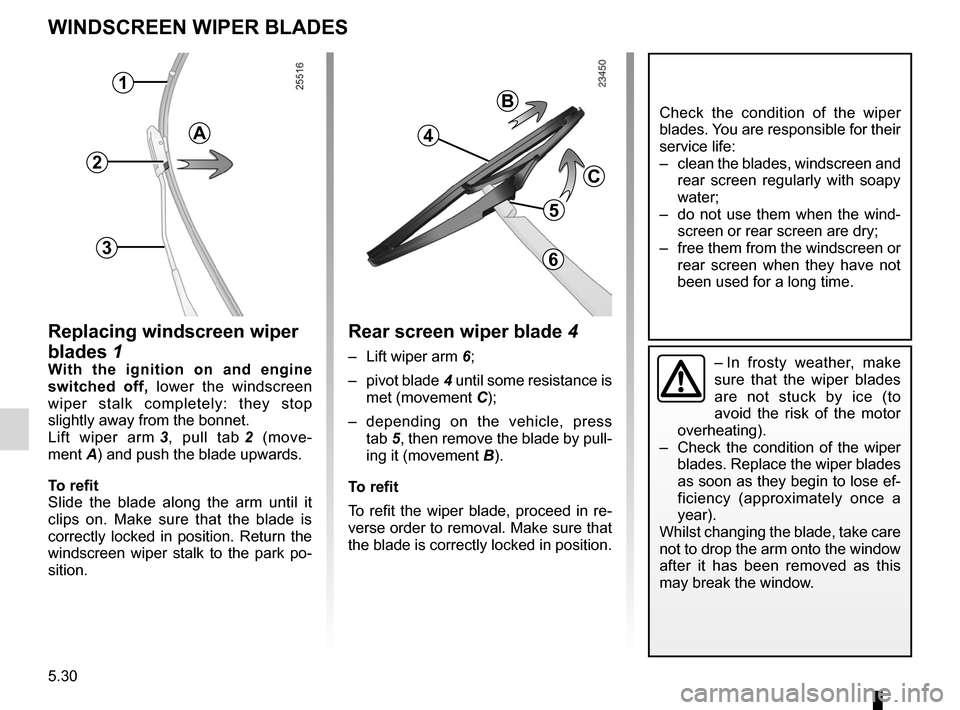
WInDScreen WIPer BLADeS
replacing windscreen wiper
blades 1
With the ignition on and engine
switched off, lower the windscreen
wiper stalk completely: they stop
slightly away from the bonnet.
Lift wiper arm 3 , pull tab 2 (move -
ment A) and push the blade upwards.
t o refit
Slide the blade along the arm until it
clips on. Make sure that the blade is
correctly locked in position. Return the
windscreen wiper stalk to the park po-
sition.– In frosty weather, make
sure that the wiper blades
are not stuck by ice (to
avoid the risk of the motor
overheating).
– Check the condition of the wiper
blades. Replace the wiper blades
as soon as they begin to lose ef-
ficiency (approximately once a
year).
Whilst changing the blade, take care
not to drop the arm onto the window
after it has been removed as this
may break the window.
Check the condition of the wiper
blades. You are responsible for their
service life:
– clean the blades, windscreen and
rear screen regularly with soapy
water;
– do not use them when the wind-
screen or rear screen are dry;
– free them from the windscreen or
rear screen when they have not
been used for a long time.
rear screen wiper blade 4
– Lift wiper arm 6;
– pivot blade 4 until some resistance is
met (movement C);
– depending on the vehicle, press
tab 5, then remove the blade by pull -
ing it (movement B).
t o refit
To refit the wiper blade, proceed in re-
verse order to removal. Make sure that
the blade is correctly locked in position.
A
1
2
3
B
4
c
5
6
Page 211 of 241

ENG_NU_936-5_BK91_Renault_5
OPerA tInG FAuL tS (3/5)
On")
JauneNoirNoir texte
5.35
ENG_UD28899_2
Anomalies de fonctionnement (X91 - B91 - K91 - D91 - X95 - B95 - D95 - \
K95 - J95 - R95 - X98 - Renault)
ENG_NU_936-5_BK91_Renault_5
OPerA tInG FAuL tS (3/5)
On the road POSSIBLe cAuSeSWHAt tO DO
Vibrations. Tyres not inflated to correct pres-
sures, incorrectly balanced or dam -
aged. Check the tyre pressures: if this is not the
problem, have them checked by an ap
-
proved Dealer.
White smoke from the exhaust. This is not necessarily a fault. Smoke
may be caused by regeneration of the
particle filter.Please refer to the information on “Special
features of diesel versions” in Section 2.
Smoke under the bonnet. Short-circuit or cooling system leak.Stop, switch off the ignition, stand away
from the vehicle and contact an approved
dealer.
The oil pressure warning light comes
on: while cornering or braking The level is too low. Top up the engine oil (refer to the informa-
tion on “Engine oil level – Topping up/refill-
ing” in Section 4).
is slow to go out or remains lit
under acceleration Loss of oil pressure.
Stop the vehicle and contact an approved
Dealer.
Page 238 of 241
7.4
FRA_UD29781_15
Index (X91 - B91 - K91 - Renault)
ENG_NU_936-5_BK91_Renault_7
Jaune NoirNoir texte
AlphAbeticAl index (4/5)
p
paintwork
maintenance ..................................................... 4.14 – 4.15
reference ........................................................................ 6.2
parking distance control ......................................... 2.34 → 2.36
power-assisted steering ..................................................... 1.41
puncture ............................................................ 5.2, 5.8 → 5.10
R
radio........................................................................\
........... 3.35
rear bench seat .................................................................. 3.23
rear drive wheels ............................................................... 2.26
rear parcel shelf ...................................................... 3.26 – 3.27
rear screen de-icing/demisting ..................................... 3.5, 3.8
rear seats functions ...................................................................... 3.23
rear view mirrors ..................................................... 1.63 – 1.64
RENAULT ANTI-INTRUDER DEVICE (RAID) ...................1.15
RENAULT card battery .......................................................................... 5.28
use ..................................................................... 1.2 → 1.10
RENAULT card battery ...................................................... 5.28
replacement parts ................................................................ 6.8
reverse gear selecting .................................................. 2.11, 2.37 → 2.39
reversing sensor .................................................... 2.34 → 2.36
running in ........................................................................\
..... 2.2
S
screen wash/wipe .............................................................. 1.72
seat belts ...................................................... 1.20 → 1.26, 1.48
see-me-home lighting ............................................... 1.67, 1.69
service sheets .......................................................... 6.9 → 6.14
signals and lights ................................................... 1.66 → 1.69
special features of diesel versions .....................................2.10
special features of petrol vehicles ....................................... 2.9speed limiter
................................................. 1.48, 2.27 → 2.29
starting the engine ..................................................... 2.3 → 2.8
steering wheel adjustment ................................................................... 1.41
Stop & Start ............................................................... 2.6 → 2.8
Stop & Start function .................................................. 2.6 → 2.8
stopping the engine ................................................... 2.3 → 2.5
storage compartment ............................................. 3.17 → 3.20
storage compartments ....................... 3.17 → 3.20, 3.28 – 3.29
sun blinds ........................................................................\
.. 3.14
sun visor ........................................................................\
.... 3.14
sunroof ................................................................... 3.11 → 3.13
switching on the vehicle ignition .......................................... 2.4
t
tailgate .................................................. 3.24, 3.26, 3.28 – 3.29
tanks and reservoirs brake fluid ...................................................................... 4.9
coolant ........................................................................... 4.8
tanks and reservoirs: windscreen washer ...................................................... 4.10
technical specifications ....................................... 6.2, 6.4 → 6.8
telephone ........................................................................\
... 3.35
temperature regulation .............................................. 3.6 → 3.9
tool kit ........................................................................\
.......... 5.8
towing breakdown ........................................................ 5.31 – 5.32
towing equipment .............................................. 3.30 – 3.31
towing a caravan ............................................. 3.30 – 3.31, 6.7
towing equipment fitting ................................................................. 3.30 – 3.31
towing hitch ............................................................. 5.31 – 5.32
towing rings ................................................... 3.30 – 3.31, 3.33
towing weights ..................................................................... 6.7
traction control: ASR .............................................. 2.22 → 2.26
traction control system: ASR .................................2.22 → 2.26