battery RENAULT SCENIC 2009 J84 / 2.G Engine And Peripherals EDC16 User Guide
[x] Cancel search | Manufacturer: RENAULT, Model Year: 2009, Model line: SCENIC, Model: RENAULT SCENIC 2009 J84 / 2.GPages: 273
Page 72 of 273
DIESEL INJECTION
Fault finding – Interpretation of faults13B
13B-72V3 MR-372-J84-13B250$360.mif
EDC16
PROGRAM No.: C1
Vdiag No.: 51
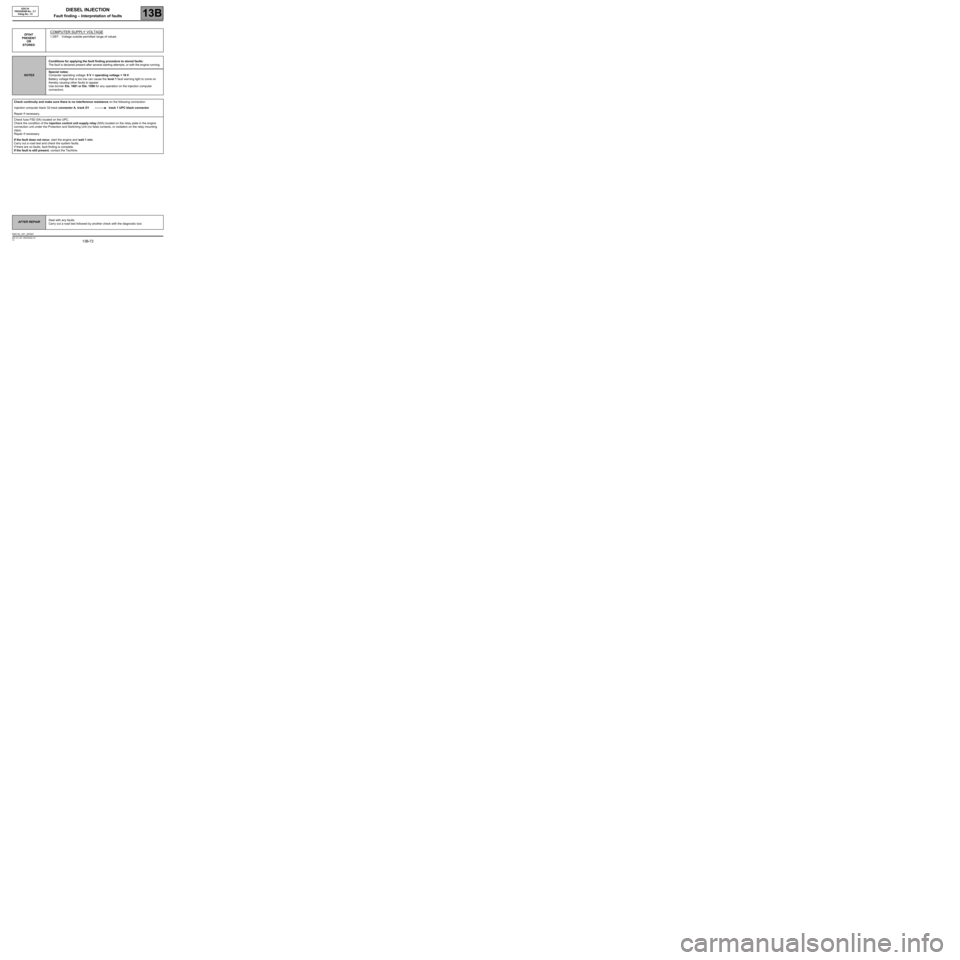
DF047
PRESENT
OR
STOREDCOMPUTER SUPPLY VOLTAGE
1.DEF : Voltage outside permitted range of values
NOTESConditions for applying the fault finding procedure to stored faults:
The fault is declared present after several starting attempts, or with the engine running.
Special notes:
Computer operating voltage: 9 V < operating voltage < 16 V.
Battery voltage that is too low can cause the level 1 fault warning light to come on
thereby causing other faults to appear.
Use bornier Ele. 1681 or Ele. 1590 for any operation on the injection computer
connectors.
Check continuity and make sure there is no interference resistance on the following connection:
injection computer black 32-track connector A, track D1 track 1 UPC black connector
Repair if necessary.
Check fuse F5D (5A) located on the UPC.
Check the condition of the injection control unit supply relay (50A) located on the relay plate in the engine
connection unit under the Protection and Switching Unit (no false contacts, or oxidation on the relay mounting
clips).
Repair if necessary.
If the fault does not recur, start the engine and wait 1 min.
Carry out a road test and check the system faults.
If there are no faults, fault finding is complete.
If the fault is still present, contact the Techline.
AFTER REPAIRDeal with any faults.
Carry out a road test followed by another check with the diagnostic tool.
EDC16_V51_DF047
Page 76 of 273
DIESEL INJECTION
Fault finding – Interpretation of faults13B
13B-76V3 MR-372-J84-13B250$360.mif
EDC16
PROGRAM No.: C1
Vdiag No.: 51
DF050
CONTINUED
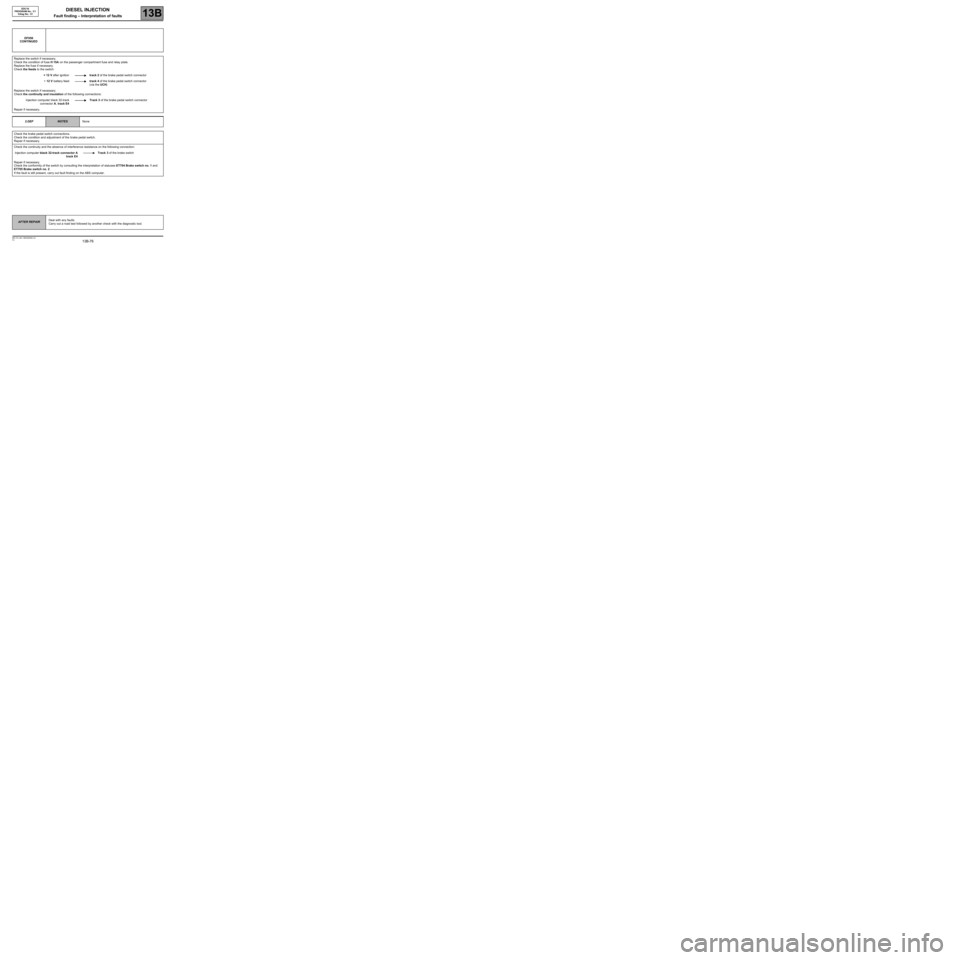
Replace the switch if necessary.
Check the condition of fuse H 15A on the passenger compartment fuse and relay plate.
Replace the fuse if necessary.
Check the feeds to the switch:
+ 12 V after ignitiontrack 2 of the brake pedal switch connector
+ 12 V battery feedtrack 4 of the brake pedal switch connector
(via the UCH)
Replace the switch if necessary.
Check the continuity and insulation of the following connections:
Injection computer black 32-track
connector A, track E4Track 3 of the brake pedal switch connector
Repair if necessary.
2.DEF
NOTESNone
Check the brake pedal switch connections.
Check the condition and adjustment of the brake pedal switch.
Repair if necessary.
Check the continuity and the absence of interference resistance on the following connection:
Injection computer black 32-track connector A
track E4Track 3 of the brake switch
Repair if necessary.
Check the conformity of the switch by consulting the interpretation of statuses ET704 Brake switch no. 1 and
ET705 Brake switch no. 2.
If the fault is still present, carry out fault finding on the ABS computer.
AFTER REPAIRDeal with any faults.
Carry out a road test followed by another check with the diagnostic tool.
Page 81 of 273
DIESEL INJECTION
Fault finding – Interpretation of faults13B
13B-81V3 MR-372-J84-13B250$360.mif
AFTER REPAIRDeal with any faults.
Carry out a road test followed by another check with the diagnostic tool.
EDC16
PROGRAM No.: C1
Vdiag No.: 51
*Opening cyclic ratioDF053
CONTINUED 3
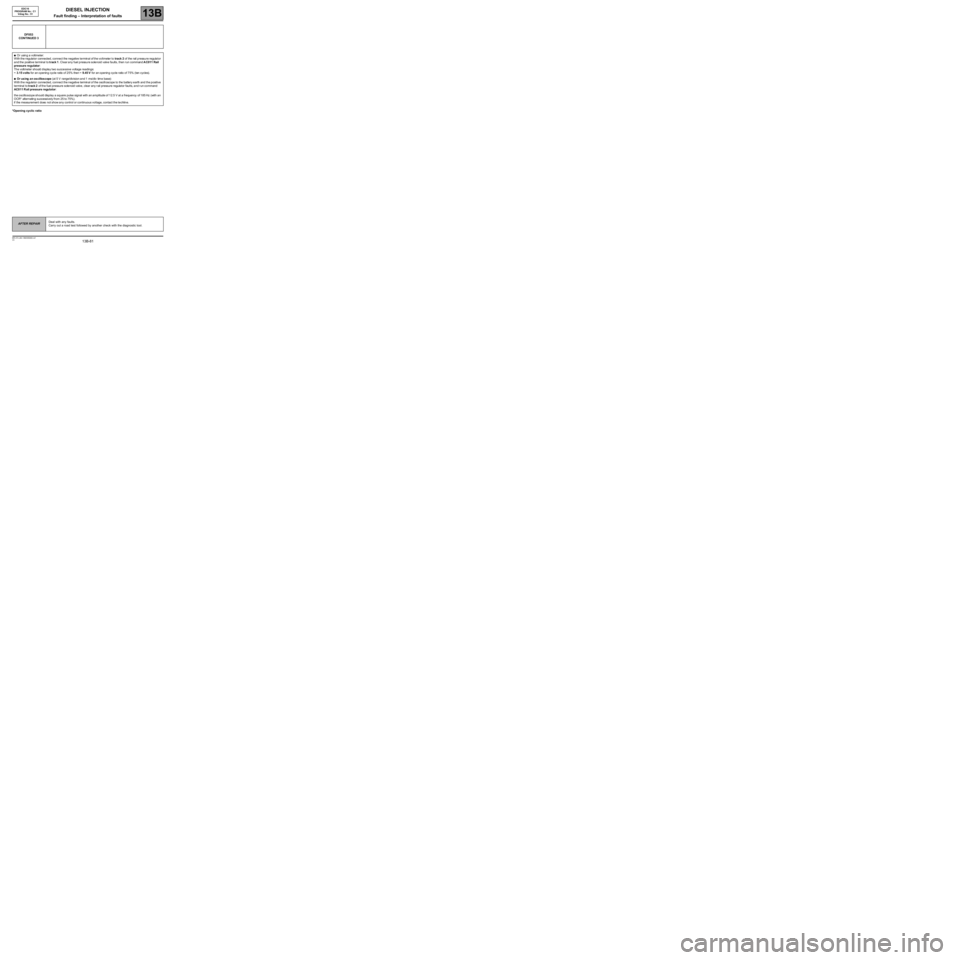
●Or usingavoltmeter:
With the regulator connected, connect the negative terminal of the voltmeter totrack 2of the rail pressure regulator
and thepositive terminal totrack 1.Clear any fuel pressure solenoid valve faults, then run commandAC011 Rail
pressure re gulator:
Thevoltmeter should display two successive voltage readings:
~3.15voltsfor an opening cycle ratio of 25% then~9.45Vfor an opening cycle ratio of 75% (ten cycles).
●Or using an oscillos cope(at 5 V range/division a nd 1 ms/div tim e base):
With the regulator connected, connect the negative terminal of the oscill oscope to the battery earth and the positive
terminal totrack 2of the fuel pressure solenoid valve, clear any r ail pressure regulator faults, and r un command
AC0 11 R ail pressure regulator:
theoscillo sco pe sh ould disp lay a square pulse signal with an a mplitude o f 1 2.5 V at a frequency of 1 85 Hz (with a n
OCR* alternating successively from 25 to 75%).
if the measurement does not show any control or continuous voltage, contact the techline.
Page 86 of 273
DIESEL INJECTION
Fault finding – Interpretation of faults13B
13B-86V3 MR-372-J84-13B250$360.mif
EDC16
PROGRAM No.: C1
Vdiag No.: 51
*Opening cyclic ratioDF054
CONTINUED 2
1.DEF
2.DEF
NOTESNone
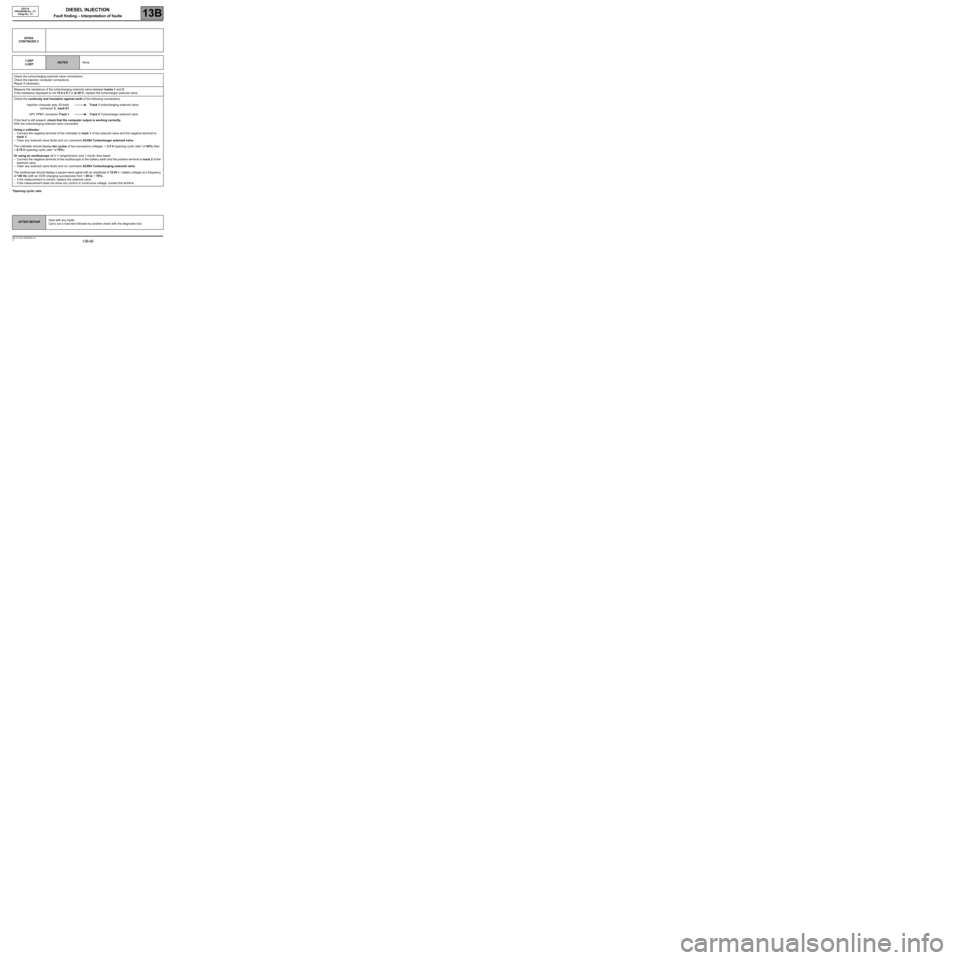
Check the turbocharging solenoid valve connections.
Check the injection computer connections.
Repair if necessary.
Measure the resistance of the turbocharging solenoid valve between tracks 1 and 2:
If the resistance displayed is not 15.4 ± 0.7 Ω at 20˚C, replace the turbocharger solenoid valve.
Check the continuity and insulation against earth of the following connections:
Injection computer grey 32-track
connector C, track E1Track 1 turbocharging solenoid valve
UPC PPM1 connector Track 1 Track 2 Turbocharger solenoid valve
If the fault is still present, check that the computer output is working correctly.
With the turbocharging solenoid valve connected:
Using a voltmeter:
–Connect the negative terminal of the voltmeter to track 1 of the solenoid valve and the negative terminal to
track 2.
–Clear any solenoid valve faults and run command AC004 Turbocharger solenoid valve.
The voltmeter should display ten cycles of two successive voltages: ~ 2.5 V (opening cyclic ratio* of 20%) then
~ 8.75 V (opening cyclic ratio* of 70%).
Or using an oscilloscope (at 5 V range/division and 1 ms/div time base):
–Connect the negative terminal of the oscilloscope to the battery earth and the positive terminal to track 2 of the
solenoid valve.
–Clear any solenoid valve faults and run command AC004 Turbocharging solenoid valve.
The oscilloscope should display a square wave signal with an amplitude of 12.5V (~ battery voltage) at a frequency
of 140 Hz (with an OCR changing successively from ~ 20 to ~ 70%).
–if the measurement is correct, replace the solenoid valve.
–if the measurement does not show any control or continuous voltage, contact the techline.
AFTER REPAIRDeal with any faults.
Carry out a road test followed by another check with the diagnostic tool.
Page 106 of 273
DIESEL INJECTION
Fault finding – Interpretation of faults13B
13B -106V3 MR-372-J84-13B250$405.mif
EDC16
PROGRAM No.: C1
Vdiag No.: 51
DF097
CONTINUED
Check the continuity and absence of interference resistance of the following connections:
Injection computer brown 48-track connector B,
Track D1Track 2 Camshaft sensor
Injection computer brown 48-track connector B,
Track A1Track 1 Camshaft sensor
With the ignition on and the camshaft sensor connected:
Use a voltmeter to measure the voltage between tracks 1 and 3 of the camshaft sensor:
The voltage displayed should be equal to the battery voltage 0.08 V)
–If the voltage is outside permitted tolerance values, take the measurement again on the connector, with the
camshaft sensor disconnected,
–If the voltage is still outside permitted tolerance values with the sensor disconnected.
Check for continuity and absence of interference resistance on the following connection:
Camshaft sensor, track 3 Track 5 injection supply relay mounting
–If the measured voltage is correct with the sensor disconnected.
Measure the camshaft sensor resistance between tracks 2 and 3.
Replace the sensor if its resistance is not 10,250 ± 500 Ω at 20˚C
If the fault is still present, contact the Techline.
AFTER REPAIRDeal with any faults.
Carry out a road test followed by another check with the diagnostic tool.
Page 109 of 273
DIESEL INJECTION
Fault finding – Interpretation of faults13B
13B -109V3 MR-372-J84-13B250$405.mif
EDC16
PROGRAM No.: C1
Vdiag No.: 51
DF195
CONTINUED
With the ignition on and the camshaft sensor connected:
Use a voltmeter to measure the voltage between tracks 1 and 3 of the camshaft sensor:
The voltage displayed should be equal to the battery voltage 0.08 V)
–If the voltage is outside permitted tolerance values, take the measurement again on the connector, with the
camshaft sensor disconnected,
–If the voltage is still outside permitted tolerance values with the sensor disconnected.
Check for continuity and absence of interference resistance on the following connection:
Camshaft sensor, track 3 + after ignition feed after relay
–If the measured voltage is correct with the sensor disconnected,
Measure the resistance of the camshaft sensor between tracks 2 and 3.
Replace the sensor if its resistance is not 10,250 ± 500 Ω at 20˚C
Check that the engine speed sensor is correctly mounted and that the flywheel target is not damaged.
Check that the gap between the engine speed sensor and the flywheel is 0.5 to 1.8 mm.
Measure the resistance of the engine speed sensor between terminals A and B of its black connector.
If the winding resistance is not between 510 Ω and 850 Ω at an engine temperature of 20˚C, replace the engine
speed sensor.
AFTER REPAIRDeal with any faults.
Carry out a road test followed by another check with the diagnostic tool.
Page 172 of 273
DIESEL INJECTION
Fault finding – Interpretation of statuses13B
13B - 172V3 MR-372-J84-13B250$630.mif
EDC16
PROGRAM NO.: C1
Vdiag No.: 51DIESEL INJECTION
Fault finding – Interpretation of statuses
ET001
COMPUTER + AFTER IGNITION FEED
NOTESSpecial notes:
Only perform these tests if the statuses do not correspond with the system
programming functions.
ABSENT
NOTESIgnition on
Check the condition and conformity of supply fuse F5D (5A) of the Protection and Switching Unit.
Repair if necessary.
Check for an earth on the following connections:
Injection computer black, 32-track connector A,
Track G4Battery earth
Injection computer black 32-track connector A,
Track H4Battery earth
Injection computer black 32-track connector A,
Track H1Battery earth
Repair if necessary.
Check for + 12 V on track D1 of connector A of the injection computer.
If there is no voltage, check the continuity and insulation to earth of the following connection:
Injection computer black 32-track connector A,
track D1Track 1 of the UPC black connector
Repair if necessary.
PRESENT
NOTESIgnition on
Check that there is not a + 12 V with ignition switched off on track D1 of connector A of the injection computer.
Repair if necessary.
AFTER REPAIRCarry out a road test followed by another check with the diagnostic tool.
EDC16_V51_ET001
MR-372-J84-13B250$630.mif
Page 176 of 273
DIESEL INJECTION
Fault finding – Interpretation of statuses13B
13B - 176V3 MR-372-J84-13B250$630.mif
EDC16
PROGRAM NO.: C1
Vdiag No.: 51
ET014
CHECK COOLING FAN 1
NOTESSpecial notes:
Only perform these tests if the statuses do not correspond with the system
programming functions.
NOTE:
Status ET014 test and status ET022 GMV1 low speed request change their status at the same time.
RUNNING
The low-speed engine fan unit is supplied in three scenarios:
–the engine coolant temperature is above 89 ˚C;
–the air conditioning is operating
–the injection computer has system faults that could lead to the engine overheating.
When the low-speed engine fan is supplied:
–status ET014 GMV 1 test becomes RUNNING status ET022 Low speed GMV
request becomes ACTIVE.
If the low speed GMV does not work (see 87G, engine compartment connection unit).
The low-speed engine fan assembly stops when:
–the engine coolant temperature is below 89 ˚C;
–the air conditioning is not switched on by the driver.
STOPPED
IMPORTANTWARNING
If the UPC does not detect the injection computer frames, the low speed engine
fan is supplied until the battery is completely discharged.
In the event that the low-speed engine fan assembly is faulty, the high-speed
engine fan assembly will then be activated.
AFTER REPAIRCarry out a road test followed by a complete test with the diagnostic tool.
EDC16_V51_ET014
Page 177 of 273
DIESEL INJECTION
Fault finding – Interpretation of statuses13B
13B - 177V3 MR-372-J84-13B250$630.mif
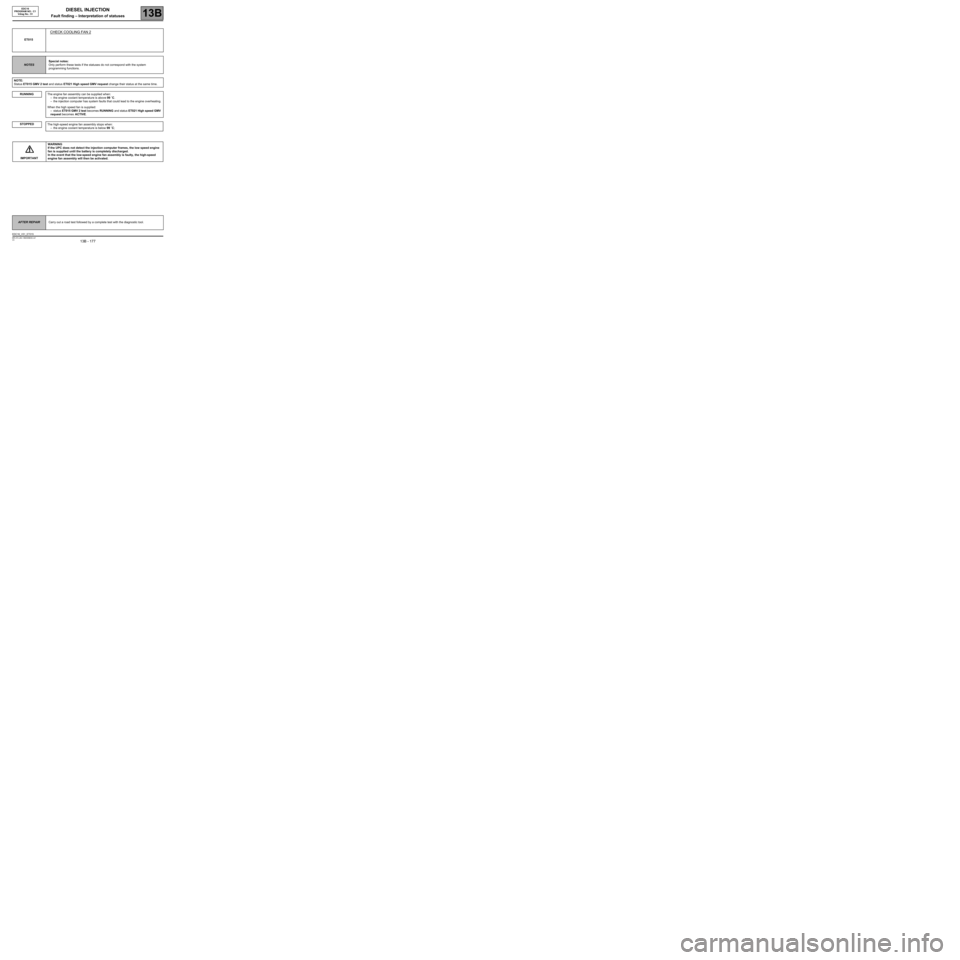
STOPPED
EDC16
PROGRAM NO.: C1
Vdiag No.: 51
ET015
CHECK COOLING FAN 2
NOTESSpecial notes:
Only perform these tests if the statuses do not correspond with the system
programming functions.
NOTE:
Status ET015 GMV 2 test and status ET021 High speed GMV request change their status at the same time.
RUNNING
The engine fan assembly can be supplied when:
–the engine coolant temperature is above 99 ˚C.
–the injection computer has system faults that could lead to the engine overheating.
When the high speed fan is supplied:
–status ET015 GMV 2 test becomes RUNNING and status ET021 High speed GMV
request becomes ACTIVE.
The high-speed engine fan assembly stops when:
–the engine coolant temperature is below 99 ˚C;
IMPORTANTWARNING
If the UPC does not detect the injection computer frames, the low speed engine
fan is supplied until the battery is completely discharged.
In the event that the low-speed engine fan assembly is faulty, the high-speed
engine fan assembly will then be activated.
AFTER REPAIRCarry out a road test followed by a complete test with the diagnostic tool.
EDC16_V51_ET015
Page 178 of 273
DIESEL INJECTION
Fault finding – Interpretation of statuses13B
13B - 178V3 MR-372-J84-13B250$630.mif
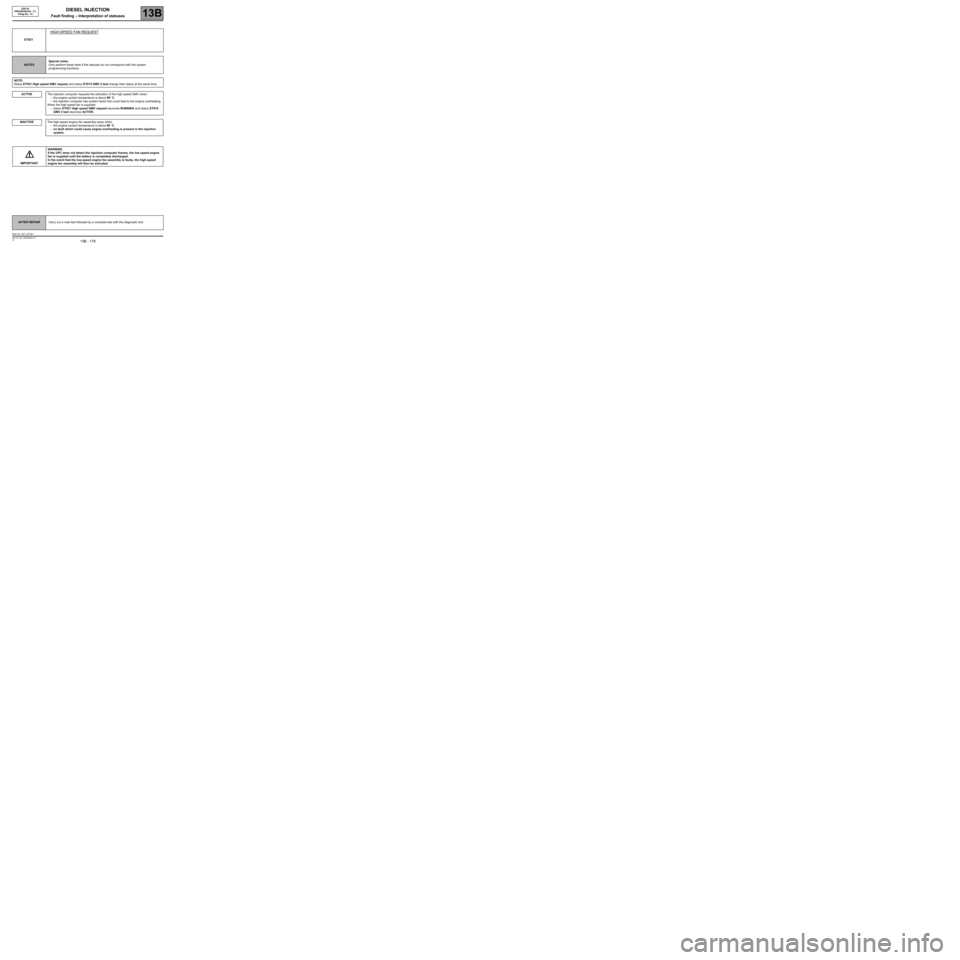
INACTIVE
EDC16
PROGRAM NO.: C1
Vdiag No.: 51
ET021
HIGH-SPEED FAN REQUEST
NOTESSpecial notes:
Only perform these tests if the statuses do not correspond with the system
programming functions.
NOTE:
Status ET021 High speed GMV request and status ET015 GMV 2 test change their status at the same time.
ACTIVE
The injection computer requests the activation of the high speed GMV when:
–the engine coolant temperature is above 99 ˚C.
–the injection computer has system faults that could lead to the engine overheating.
When the high speed fan is supplied:
–status ET021 High speed GMV request becomes RUNNING and status ET015
GMV 2 test becomes ACTIVE.
The high-speed engine fan assembly stops when:
–the engine coolant temperature is below 99 ˚C;
–no fault which could cause engine overheating is present in the injection
system.
IMPORTANTWARNING
If the UPC does not detect the injection computer frames, the low speed engine
fan is supplied until the battery is completely discharged.
In the event that the low-speed engine fan assembly is faulty, the high-speed
engine fan assembly will then be activated.
AFTER REPAIRCarry out a road test followed by a complete test with the diagnostic tool.
EDC16_V51_ET021