fuel pump RENAULT SCENIC 2011 J95 / 3.G Engine And Peripherals EDC16 User Guide
[x] Cancel search | Manufacturer: RENAULT, Model Year: 2011, Model line: SCENIC, Model: RENAULT SCENIC 2011 J95 / 3.GPages: 365, PDF Size: 2.11 MB
Page 323 of 365
13B-323
MR-372-J84-13B200$828.mif
V13
DIESEL INJECTION
Fault finding – Fault Finding Chart
EDC16
Program No.: C1
Vdiag no.: 18, 1C, 20,
50, 58, 5C
13B
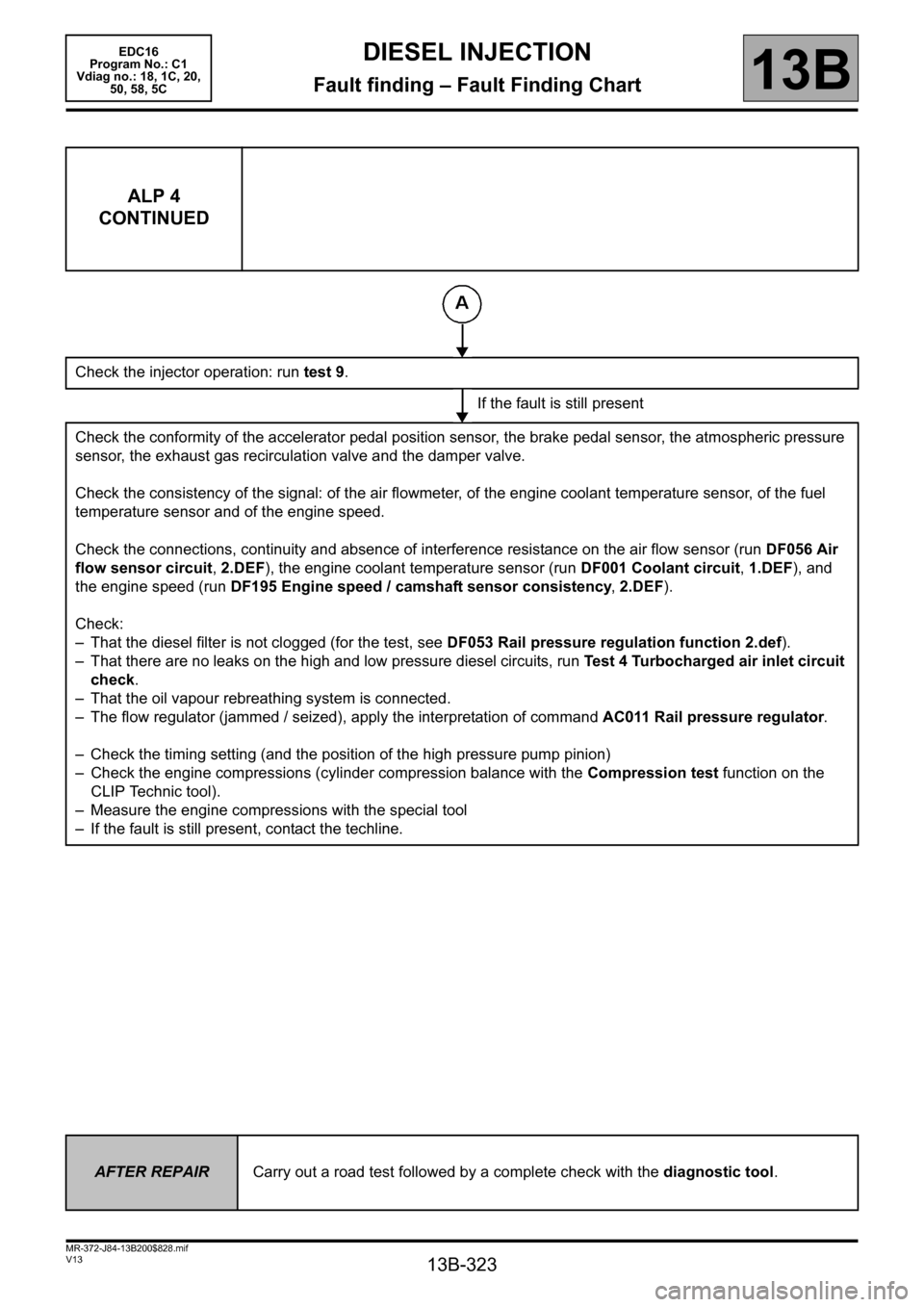
ALP 4
CONTINUED
Check the injector operation: run test 9.
If the fault is still present
Check the conformity of the accelerator pedal position sensor, the brake pedal sensor, the atmospheric pressure
sensor, the exhaust gas recirculation valve and the damper valve.
Check the consistency of the signal: of the air flowmeter, of the engine coolant temperature sensor, of the fuel
temperature sensor and of the engine speed.
Check the connections, continuity and absence of interference resistance on the air flow sensor (run DF056 Air
flow sensor circuit, 2.DEF), the engine coolant temperature sensor (run DF001 Coolant circuit, 1.DEF), and
the engine speed (run DF195 Engine speed / camshaft sensor consistency, 2.DEF).
Check:
– That the diesel filter is not clogged (for the test, see DF053 Rail pressure regulation function 2.def).
– That there are no leaks on the high and low pressure diesel circuits, run Test 4 Turbocharged air inlet circuit
check.
– That the oil vapour rebreathing system is connected.
– The flow regulator (jammed / seized), apply the interpretation of command AC011 Rail pressure regulator.
– Check the timing setting (and the position of the high pressure pump pinion)
– Check the engine compressions (cylinder compression balance with the Compression test function on the
CLIP Technic tool).
– Measure the engine compressions with the special tool
– If the fault is still present, contact the techline.
AFTER REPAIRCarry out a road test followed by a complete check with the diagnostic tool.
Page 326 of 365
13B-326
MR-372-J84-13B200$828.mif
V13
EDC16
Program No.: C1
Vdiag no.: 18, 1C, 20,
50, 58, 5CDIESEL INJECTION
Fault finding – Fault Finding Chart13B
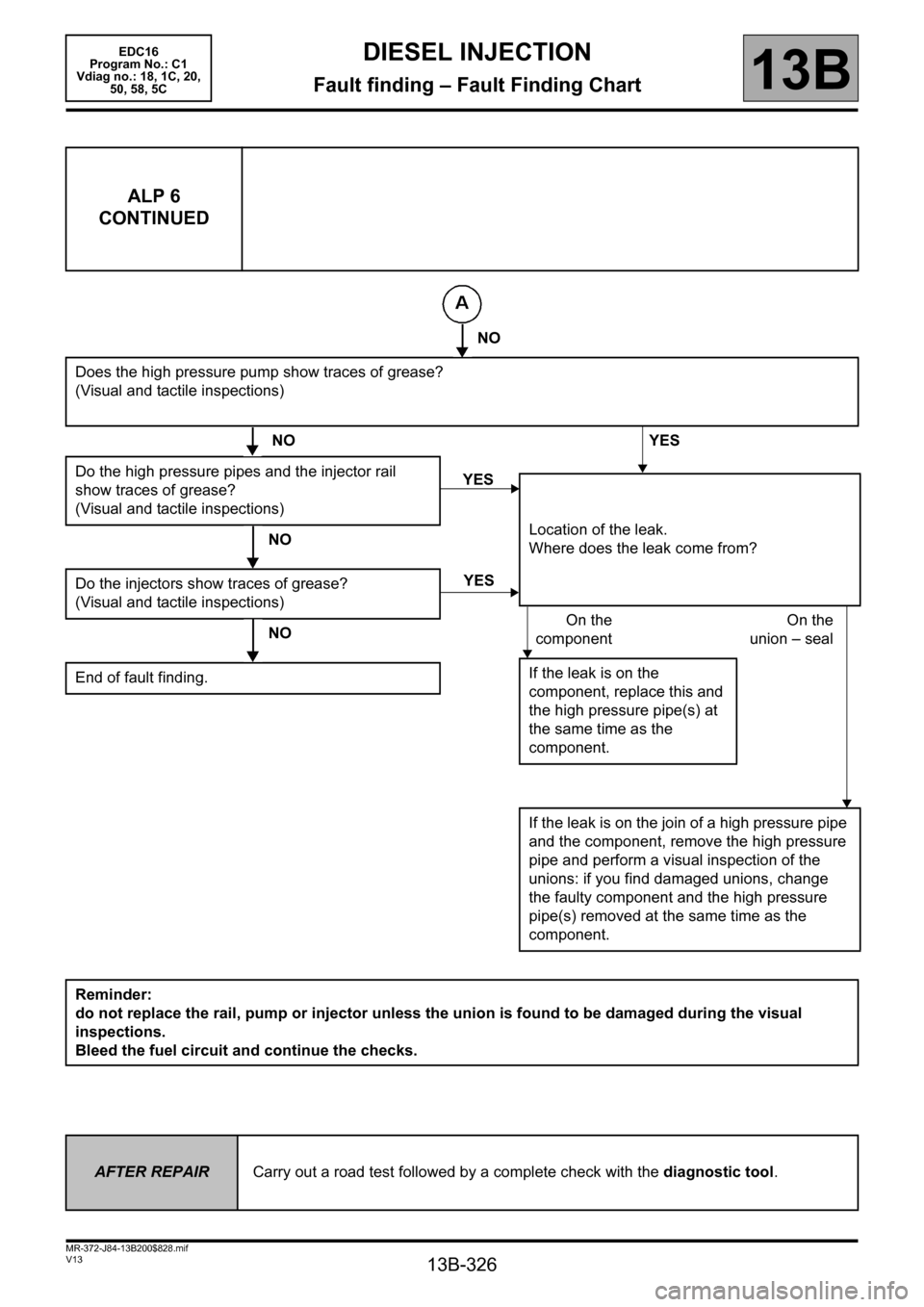
ALP 6
CONTINUED
NO
Does the high pressure pump show traces of grease?
(Visual and tactile inspections)
NO YES
Do the high pressure pipes and the injector rail
show traces of grease?
(Visual and tactile inspections)
NO
Do the injectors show traces of grease?
(Visual and tactile inspections)
NO
End of fault finding.
Reminder:
do not replace the rail, pump or injector unless the union is found to be damaged during the visual
inspections.
Bleed the fuel circuit and continue the checks.
YES
Location of the leak.
Where does the leak come from?
On the
componentOn the
union – seal
If the leak is on the
component, replace this and
the high pressure pipe(s) at
the same time as the
component.
If the leak is on the join of a high pressure pipe
and the component, remove the high pressure
pipe and perform a visual inspection of the
unions: if you find damaged unions, change
the faulty component and the high pressure
pipe(s) removed at the same time as the
component.
YES
AFTER REPAIRCarry out a road test followed by a complete check with the diagnostic tool.
Page 327 of 365
13B-327
MR-372-J84-13B200$828.mif
V13
DIESEL INJECTION
Fault finding – Fault Finding Chart
EDC16
Program No.: C1
Vdiag no.: 18, 1C, 20,
50, 58, 5C
13B
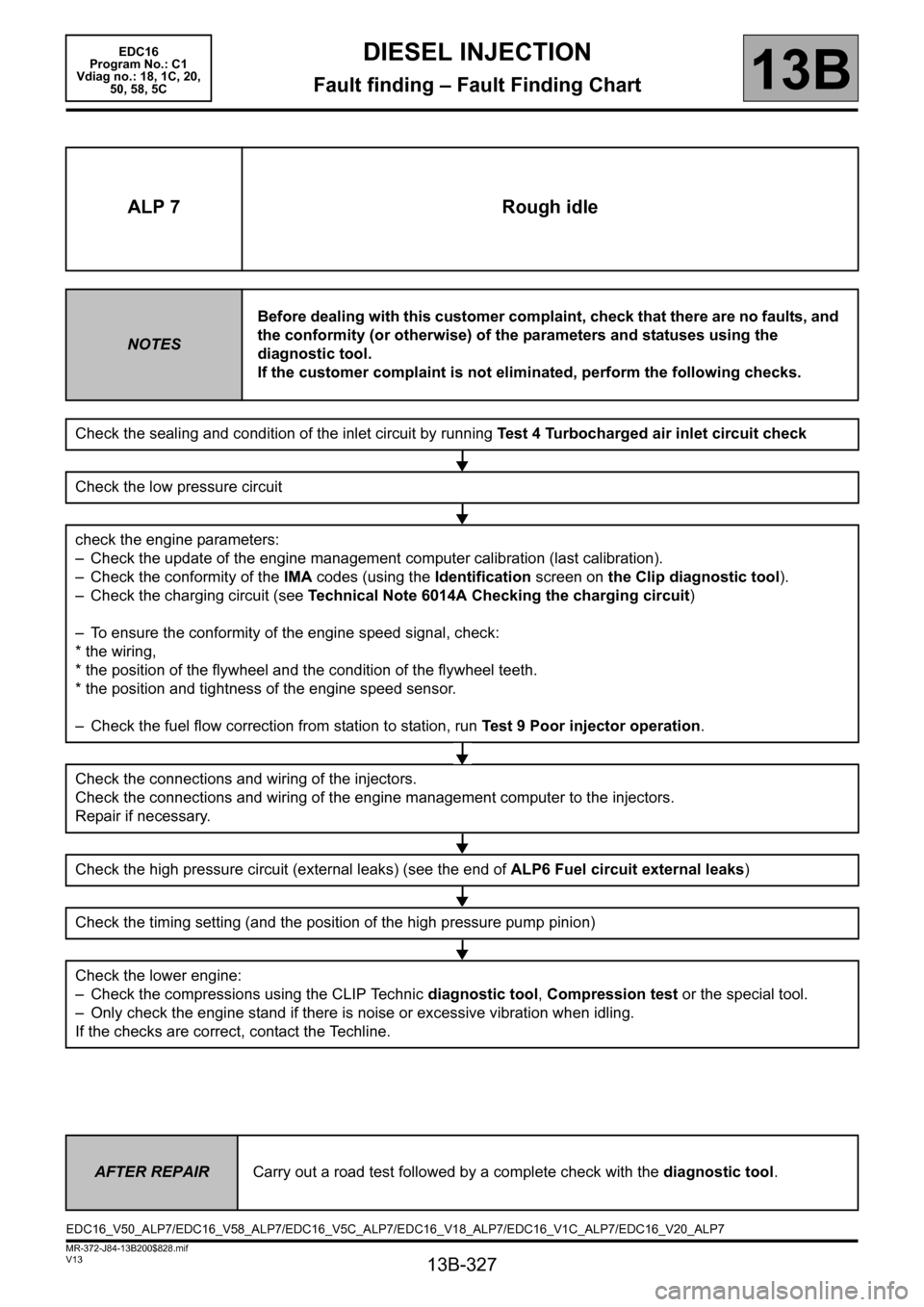
ALP 7 Rough idle
NOTESBefore dealing with this customer complaint, check that there are no faults, and
the conformity (or otherwise) of the parameters and statuses using the
diagnostic tool.
If the customer complaint is not eliminated, perform the following checks.
Check the sealing and condition of the inlet circuit by running Test 4 Turbocharged air inlet circuit check
Check the low pressure circuit
check the engine parameters:
– Check the update of the engine management computer calibration (last calibration).
– Check the conformity of the IMA codes (using the Identification screen on the Clip diagnostic tool).
– Check the charging circuit (see Technical Note 6014A Checking the charging circuit)
– To ensure the conformity of the engine speed signal, check:
* the wiring,
* the position of the flywheel and the condition of the flywheel teeth.
* the position and tightness of the engine speed sensor.
– Check the fuel flow correction from station to station, run Test 9 Poor injector operation.
Check the connections and wiring of the injectors.
Check the connections and wiring of the engine management computer to the injectors.
Repair if necessary.
Check the high pressure circuit (external leaks) (see the end of ALP6 Fuel circuit external leaks)
Check the timing setting (and the position of the high pressure pump pinion)
Check the lower engine:
– Check the compressions using the CLIP Technic diagnostic tool, Compression test or the special tool.
– Only check the engine stand if there is noise or excessive vibration when idling.
If the checks are correct, contact the Techline.
AFTER REPAIRCarry out a road test followed by a complete check with the diagnostic tool.
EDC16_V50_ALP7/EDC16_V58_ALP7/EDC16_V5C_ALP7/EDC16_V18_ALP7/EDC16_V1C_ALP7/EDC16_V20_ALP7
Page 343 of 365
13B-343
MR-372-J84-13B200$900.mif
V13
EDC16
Program No.: C1
Vdiag no.: 18, 1C, 20,
50, 58, 5CDIESEL INJECTION
Fault finding – Tests13B
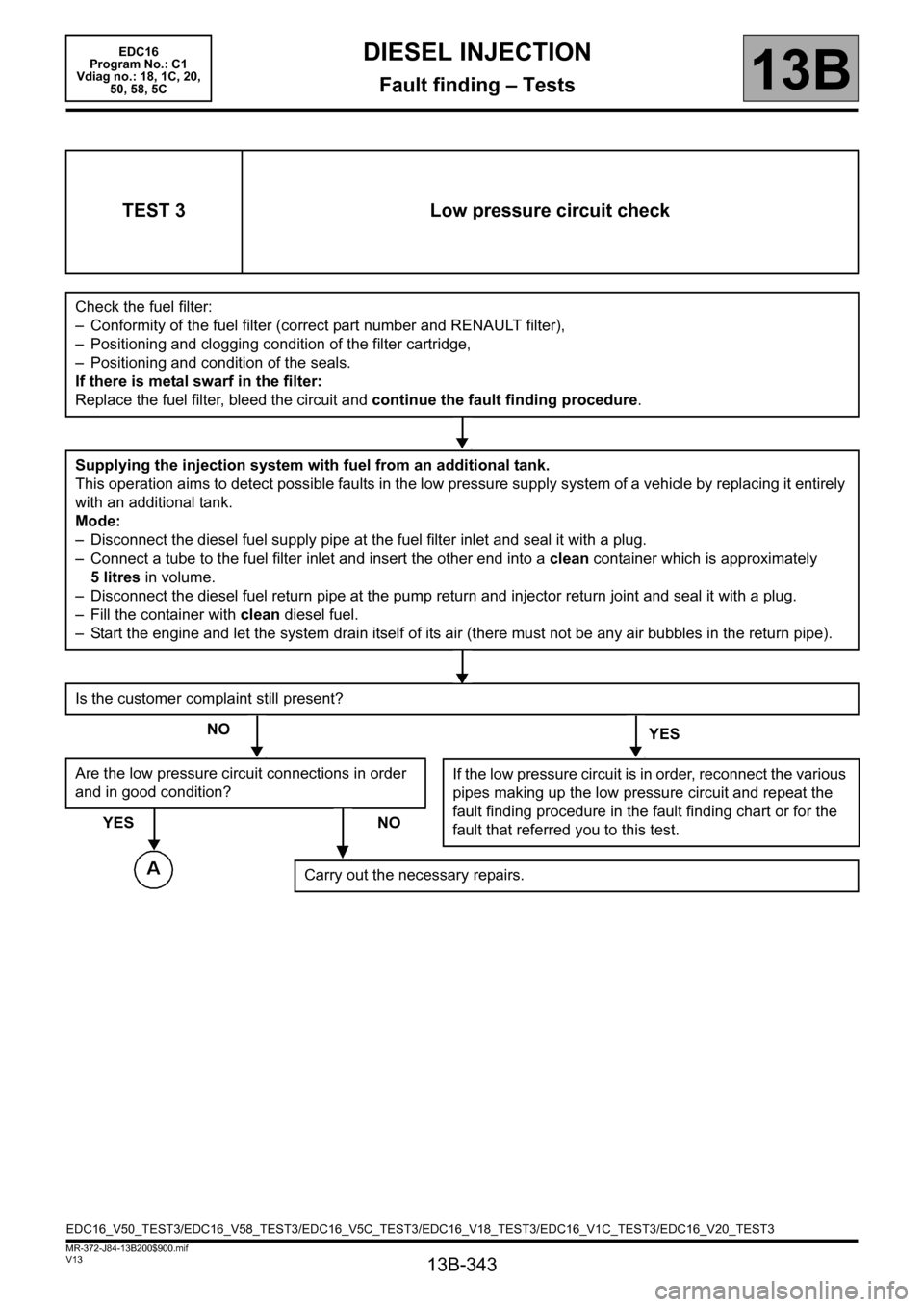
TEST 3 Low pressure circuit check
Check the fuel filter:
– Conformity of the fuel filter (correct part number and RENAULT filter),
– Positioning and clogging condition of the filter cartridge,
– Positioning and condition of the seals.
If there is metal swarf in the filter:
Replace the fuel filter, bleed the circuit and continue the fault finding procedure.
Supplying the injection system with fuel from an additional tank.
This operation aims to detect possible faults in the low pressure supply system of a vehicle by replacing it entirely
with an additional tank.
Mode:
– Disconnect the diesel fuel supply pipe at the fuel filter inlet and seal it with a plug.
– Connect a tube to the fuel filter inlet and insert the other end into a clean container which is approximately
5 litres in volume.
– Disconnect the diesel fuel return pipe at the pump return and injector return joint and seal it with a plug.
– Fill the container with clean diesel fuel.
– Start the engine and let the system drain itself of its air (there must not be any air bubbles in the return pipe).
Is the customer complaint still present?
NO
YES
Are the low pressure circuit connections in order
and in good condition?
YES NO
If the low pressure circuit is in order, reconnect the various
pipes making up the low pressure circuit and repeat the
fault finding procedure in the fault finding chart or for the
fault that referred you to this test.
Carry out the necessary repairs.
EDC16_V50_TEST3/EDC16_V58_TEST3/EDC16_V5C_TEST3/EDC16_V18_TEST3/EDC16_V1C_TEST3/EDC16_V20_TEST3
Page 344 of 365
13B-344
MR-372-J84-13B200$900.mif
V13
DIESEL INJECTION
Fault finding – Tests
EDC16
Program No.: C1
Vdiag no.: 18, 1C, 20,
50, 58, 5C
13B
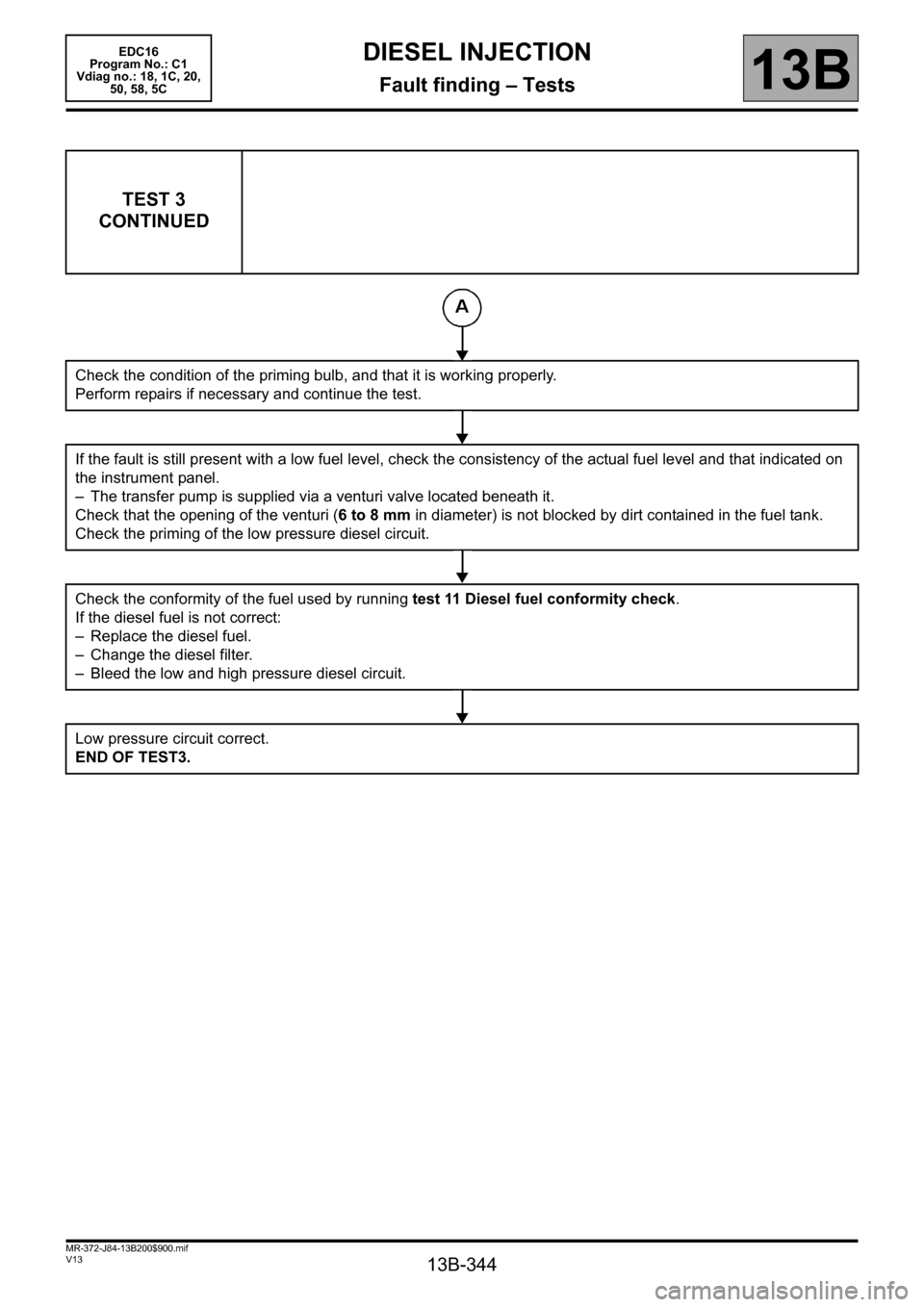
TEST 3
CONTINUED
Check the condition of the priming bulb, and that it is working properly.
Perform repairs if necessary and continue the test.
If the fault is still present with a low fuel level, check the consistency of the actual fuel level and that indicated on
the instrument panel.
– The transfer pump is supplied via a venturi valve located beneath it.
Check that the opening of the venturi (6 to 8 mm in diameter) is not blocked by dirt contained in the fuel tank.
Check the priming of the low pressure diesel circuit.
Check the conformity of the fuel used by running test 11 Diesel fuel conformity check.
If the diesel fuel is not correct:
– Replace the diesel fuel.
– Change the diesel filter.
– Bleed the low and high pressure diesel circuit.
Low pressure circuit correct.
END OF TEST3.
Page 358 of 365
13B-358
MR-372-J84-13B200$936.mif
V13
DIESEL INJECTION
Fault finding – Tests
EDC16
Program No: C1
Vdiag No: 18, 1C, 20,
50, 58, 5C
13B
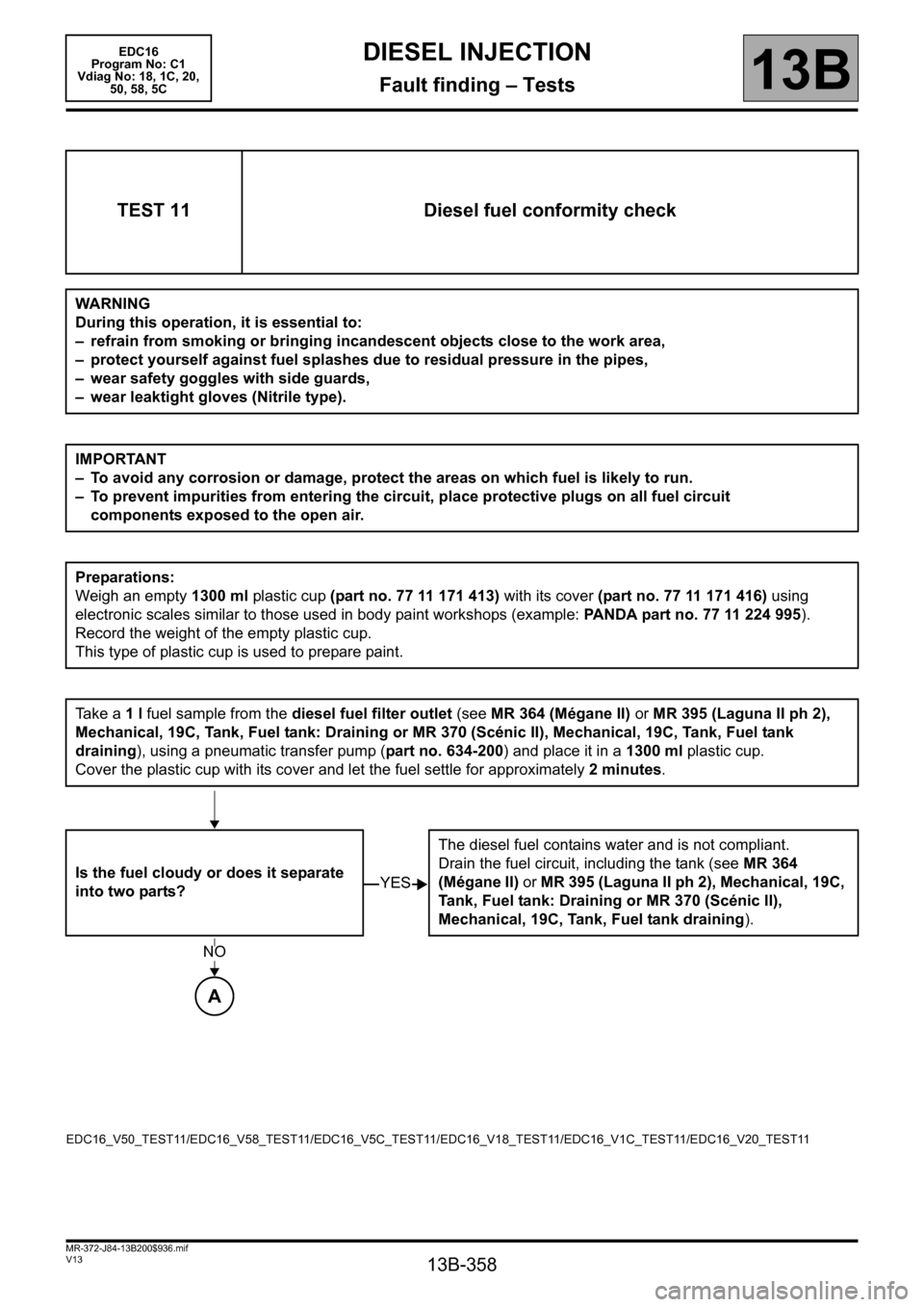
TEST 11 Diesel fuel conformity check
WARNING
During this operation, it is essential to:
– refrain from smoking or bringing incandescent objects close to the work area,
– protect yourself against fuel splashes due to residual pressure in the pipes,
– wear safety goggles with side guards,
– wear leaktight gloves (Nitrile type).
IMPORTANT
– To avoid any corrosion or damage, protect the areas on which fuel is likely to run.
– To prevent impurities from entering the circuit, place protective plugs on all fuel circuit
components exposed to the open air.
Preparations:
Weigh an empty 1300 ml plastic cup (part no. 77 11 171 413) with its cover (part no. 77 11 171 416) using
electronic scales similar to those used in body paint workshops (example: PANDA part no. 77 11 224 995).
Record the weight of the empty plastic cup.
This type of plastic cup is used to prepare paint.
Ta k e a 1 l fuel sample from the diesel fuel filter outlet (see MR 364 (Mégane II) or MR 395 (Laguna II ph 2),
Mechanical, 19C, Tank, Fuel tank: Draining or MR 370 (Scénic II), Mechanical, 19C, Tank, Fuel tank
draining), using a pneumatic transfer pump (part no. 634-200) and place it in a 1300 ml plastic cup.
Cover the plastic cup with its cover and let the fuel settle for approximately 2 minutes.
Is the fuel cloudy or does it separate
into two parts?The diesel fuel contains water and is not compliant.
Drain the fuel circuit, including the tank (see MR 364
(Mégane II) or MR 395 (Laguna II ph 2), Mechanical, 19C,
Tank, Fuel tank: Draining or MR 370 (Scénic II),
Mechanical, 19C, Tank, Fuel tank draining).
YES
NO
A
EDC16_V50_TEST11/EDC16_V58_TEST11/EDC16_V5C_TEST11/EDC16_V18_TEST11/EDC16_V1C_TEST11/EDC16_V20_TEST11
Page 365 of 365
13B-365
MR-372-J84-13B200$972.mif
V13
13B
DIESEL INJECTION
Fault finding – Glossary
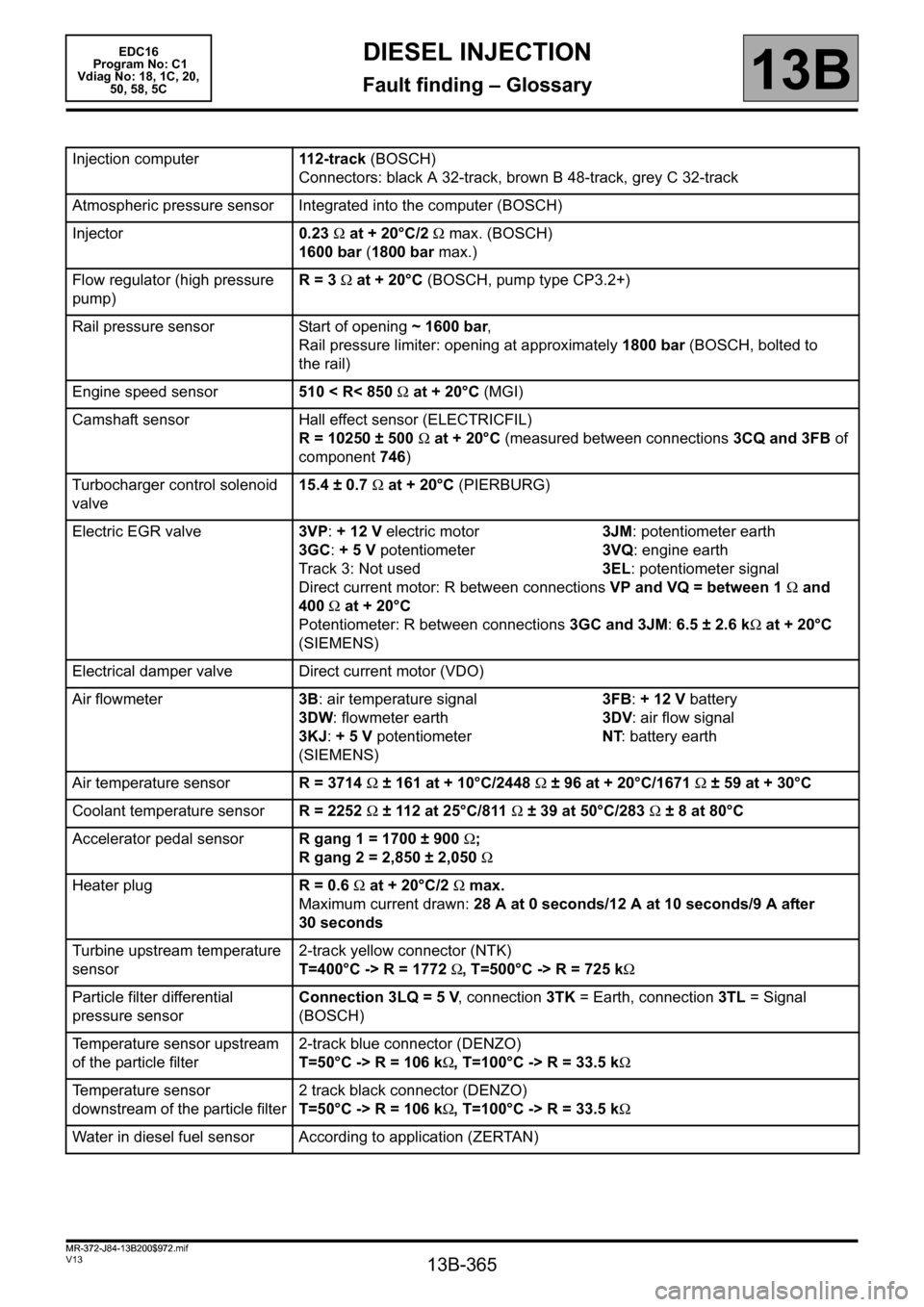
Injection computer112-track (BOSCH)
Connectors: black A 32-track, brown B 48-track, grey C 32-track
Atmospheric pressure sensor Integrated into the computer (BOSCH)
Injector0.23 Ω at + 20°C/2 Ω max. (BOSCH)
1600 bar (1800 bar max.)
Flow regulator (high pressure
pump)R = 3 Ω at + 20°C (BOSCH, pump type CP3.2+)
Rail pressure sensor Start of opening ~ 1600 bar,
Rail pressure limiter: opening at approximately 1800 bar (BOSCH, bolted to
the rail)
Engine speed sensor510 < R< 850 Ω at + 20°C (MGI)
Camshaft sensor Hall effect sensor (ELECTRICFIL)
R = 10250 ± 500 Ω at + 20°C (measured between connections 3CQ and 3FB of
component 746)
Turbocharger control solenoid
valve15.4 ± 0.7 Ω at + 20°C (PIERBURG)
Electric EGR valve3VP: + 12 V electric motor 3JM: potentiometer earth
3GC: + 5 V potentiometer 3VQ: engine earth
Track 3: Not used 3EL: potentiometer signal
Direct current motor: R between connections VP and VQ = between 1 Ω and
400 Ω at + 20°C
Potentiometer: R between connections 3GC and 3JM: 6.5 ± 2.6 kΩ at + 20°C
(SIEMENS)
Electrical damper valve Direct current motor (VDO)
Air flowmeter3B: air temperature signal 3FB: + 12 V battery
3DW: flowmeter earth 3DV: air flow signal
3KJ: + 5 V potentiometer NT: battery earth
(SIEMENS)
Air temperature sensorR = 3714
Ω ± 161 at + 10°C/2448 Ω ± 96 at + 20°C/1671 Ω ± 59 at + 30°C
Coolant temperature sensorR = 2252 Ω ± 112 at 25°C/811 Ω ± 39 at 50°C/283 Ω ± 8 at 80°C
Accelerator pedal sensorR gang 1 = 1700 ± 900 Ω;
R gang 2 = 2,850 ± 2,050Ω
Heater plugR = 0.6 Ω at + 20°C/2 Ω max.
Maximum current drawn: 28 A at 0 seconds/12 A at 10 seconds/9 A after
30 seconds
Turbine upstream temperature
sensor2-track yellow connector (NTK)
T=400°C -> R = 1772 Ω, T=500°C -> R = 725 kΩ
Particle filter differential
pressure sensorConnection 3LQ = 5 V, connection 3TK = Earth, connection 3TL = Signal
(BOSCH)
Temperature sensor upstream
of the particle filter2-track blue connector (DENZO)
T=50°C -> R = 106 kΩ, T=100°C -> R = 33.5 kΩ
Temperature sensor
downstream of the particle filter2 track black connector (DENZO)
T=50°C -> R = 106 kΩ, T=100°C -> R = 33.5 kΩ
Water in diesel fuel sensor According to application (ZERTAN)
MR-372-J84-13B200$972.mif
EDC16
Program No: C1
Vdiag No: 18, 1C, 20,
50, 58, 5C