Time RENAULT TRAFIC 2016 X82 / 3.G Workshop Manual
[x] Cancel search | Manufacturer: RENAULT, Model Year: 2016, Model line: TRAFIC, Model: RENAULT TRAFIC 2016 X82 / 3.GPages: 292, PDF Size: 3.35 MB
Page 219 of 292
4.15
Glass instrument panel(e.g.: instrument panel, clock, exterior
temperature display, radio display, mul-
timedia or multifunction display etc.)
Use a soft cloth (or cotton wool).
If this does not clean them properly,
use a soft cloth (or cotton wool) slightly
moistened with soapy water and then
wipe clean with another soft damp cloth
or cotton wool.
Finally, carefully dry off with a soft dry
cloth.
Do not use products containing alco-
hol and/or spray fluids on the area.
Seat belts
These must be kept clean.
Use products selected by our Technical
Department (Approved outlets) or
warm, soapy water and a sponge and
wipe with a dry cloth.
Detergents or dyes must not be used
under any circumstances.
INTERIOR TRIM MAINTENANCE (1/2)
Textiles (seats, door trim, etc)
Vacuum-clean the textiles regularly.
Liquid stain
Use soapy water.
Dab lightly (never rub) with a soft cloth,
rinse and remove the excess.
Solid or pasty stain
Carefully remove the excess solid or
pasty material immediately with a
spatula (working from the edges to the
centre to avoid spreading the stain).
Clean as for a liquid stain.
Special instructions for sweets or
chewing gum
Put an ice cube on the stain to solidify
it, then proceed as for a solid stain.
A well-maintained vehicle will last
longer. It is therefore recommended to
maintain the interior of the vehicle regu-
larly.
A stain should always be dealt with
swiftly.
Whatever type of stain is on the trim,
use
cold (or warm) soapy water with
natural soap.
Detergents (washing-up liquid, pow-
dered products, alcohol-based prod-
ucts) should not be used.
Use a soft cloth.
Rinse and soak up the excess.
For further recommendations for
maintaining the interior, and/or for
any unsatisfactory results, please
see an authorised dealer.
Page 233 of 292
5.13
Use in winter
Chains
For safety reasons, fitting snow
chains to the rear axle is strictly for-
bidden.
Chains cannot be fitted to tyres which
are larger than those originally fitted to
the vehicle.
Snow or Winter tyres
We would recommend that these be
fitted to all four wheels to ensure that
your vehicle retains maximum adhe-
sion.
Warning : These tyres sometimes have
a specific direction of rotation and a
maximum speed index which may be
lower than the maximum speed of your
vehicle.
TYRES (3/3)
Studded tyres
This type of equipment may only be
used for a limited period and as laid
down by local legislation. It is neces-
sary to observe the speed specified by
current legislation.
These tyres must, at a minimum, be
fitted to the two front wheels.
In all cases, we would recommend
that you contact an approved dealer
who will be able to advise you on
the choice of equipment which is
most suitable for your vehicle.
Emergency spare wheel
Refer to the information on the
“Emergency spare wheel” and in-
structions on “Changing a wheel” in
Section 5.
Changing wheels around
This practice is not recommended.
17” wheels cannot be
fitted with chains.
If you wish to fit snow
chains, you must use spe-
cial equipment.
Consult an approved Dealer.
Chains may only be fitted
to tyres of the same size
as those originally fitted to
your vehicle.
Page 234 of 292
5.14
FRONT HEADLIGHTS: changing bulbs (1/2)
Take care when working in
the engine compartment
as the engine cooling fan
may start to operate at any
moment without warning.
Risk of injury.
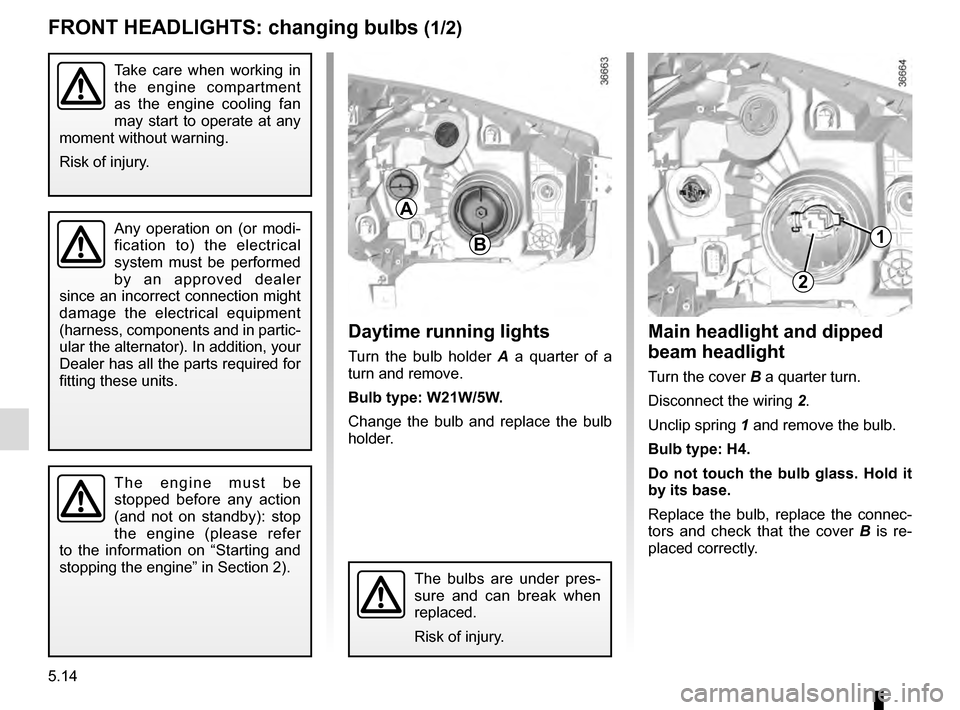
Main headlight and dipped
beam headlight
Turn the cover B a quarter turn.
Disconnect the wiring 2.
Unclip spring 1 and remove the bulb.
Bulb type: H4.
Do not touch the bulb glass. Hold it
by its base.
Replace the bulb, replace the connec-
tors and check that the cover B is re-
placed correctly.
B
A
2
1Any operation on (or modi-
fication to) the electrical
system must be performed
by an approved dealer
since an incorrect connection might
damage the electrical equipment
(harness, components and in partic-
ular the alternator). In addition, your
Dealer has all the parts required for
fitting these units.
The bulbs are under pres-
sure and can break when
replaced.
Risk of injury.
The engine must be
stopped before any action
(and not on standby): stop
the engine (please refer
to the information on “Starting and
stopping the engine” in Section 2).
Daytime running lights
Turn the bulb holder A a quarter of a
turn and remove.
Bulb type: W21W/5W.
Change the bulb and replace the bulb
holder.
Page 243 of 292
5.23
Operating faultsIf the battery is too weak to ensure cor-
rect operation, you can still start (insert
the RENAULT card in the card reader)
and lock/unlock the vehicle (refer to the
information on "Locking/unlocking the
doors" in Section 1).
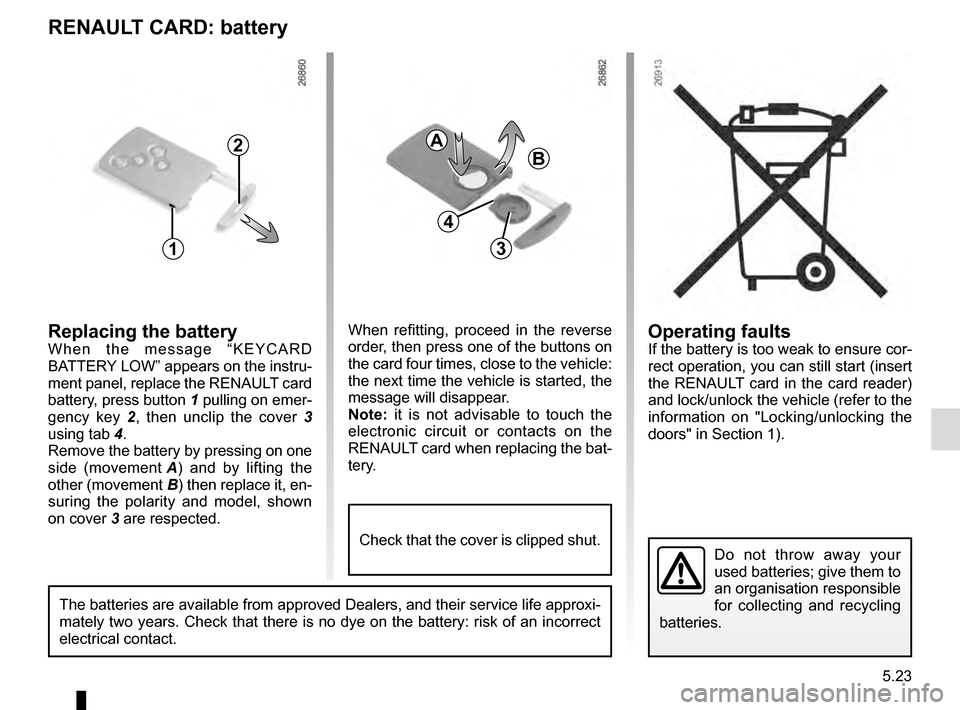
RENAULT CARD: battery
Replacing the batteryWhen the message “KEYCARD
BATTERY LOW” appears on the instru-
ment panel, replace the RENAULT card
battery, press button 1 pulling on emer-
gency key 2, then unclip the cover 3
using tab 4.
Remove the battery by pressing on one
side (movement A) and by lifting the
other (movement B) then replace it, en-
suring the polarity and model, shown
on cover 3 are respected.
Do not throw away your
used batteries; give them to
an organisation responsible
for collecting and recycling
batteries.
1
2
When refitting, proceed in the reverse
order, then press one of the buttons on
the card four times, close to the vehicle:
the next time the vehicle is started, the
message will disappear.
Note: it is not advisable to touch the
electronic circuit or contacts on the
RENAULT card when replacing the bat-
tery.
A
B
3
The batteries are available from approved Dealers, and their service lif\
e approxi-
mately two years. Check that there is no dye on the battery: risk of an \
incorrect
electrical contact.
4
Check that the cover is clipped shut.
Page 249 of 292
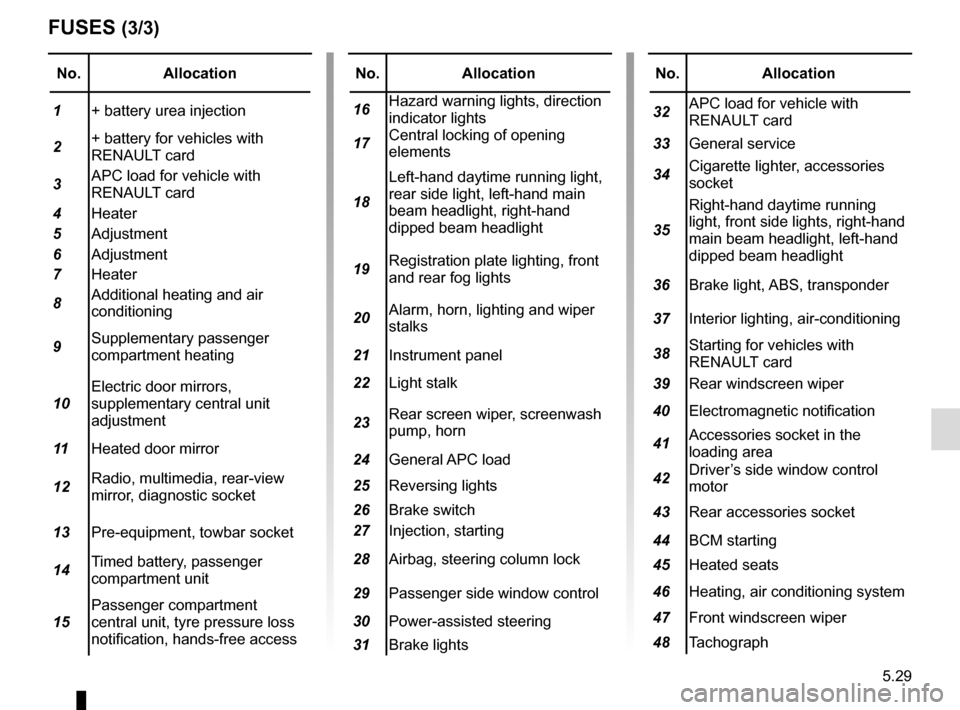
5.29
No.Allocation
1 + battery urea injection
2 + battery for vehicles with
RENAULT card
3 APC load for vehicle with
RENAULT card
4 Heater
5 Adjustment
6 Adjustment
7 Heater
8 Additional heating and air
conditioning
9 Supplementary passenger
compartment heating
10 Electric door mirrors,
supplementary central unit
adjustment
11 Heated door mirror
12 Radio, multimedia, rear-view
mirror, diagnostic socket
13 Pre-equipment, towbar socket
14 Timed battery, passenger
compartment unit
15 Passenger compartment
central unit, tyre pressure loss
notification, hands-free access
FUSES (3/3)
No.
Allocation
16 Hazard warning lights, direction
indicator lights
17 Central locking of opening
elements
18 Left-hand daytime running light,
rear side light, left-hand main
beam headlight, right-hand
dipped beam headlight
19 Registration plate lighting, front
and rear fog lights
20 Alarm, horn, lighting and wiper
stalks
21 Instrument panel
22 Light stalk
23 Rear screen wiper, screenwash
pump, horn
24 General APC load
25 Reversing lights
26 Brake switch
27 Injection, starting
28 Airbag, steering column lock
29 Passenger side window control
30 Power-assisted steering
31 Brake lightsNo. Allocation
32 APC load for vehicle with
RENAULT card
33 General service
34 Cigarette lighter, accessories
socket
35 Right-hand daytime running
light, front side lights, right-hand
main beam headlight, left-hand
dipped beam headlight
36 Brake light, ABS, transponder
37 Interior lighting, air-conditioning
38 Starting for vehicles with
RENAULT card
39 Rear windscreen wiper
40 Electromagnetic notification
41 Accessories socket in the
loading area
42 Driver’s side window control
motor
43 Rear accessories socket
44 BCM starting
45 Heated seats
46 Heating, air conditioning system
47 Front windscreen wiper
48 Tachograph
Page 250 of 292

5.30
ACCESSORIES
Electrical and electronic accessories
Before installing this type of accessory (particularly for transmitters\
/receivers: frequency bandwidth, power level, po-
sition of the aerial, etc.), make sure it is compatible with your vehic\
le. You can get advice from an authorised dealer.
Connect accessories with a maximum power of 120 Watts only. Fire hazard. When several accessory sockets are
used at the same time, the total power of the connected accessories must\
not exceed 180 watts.
No work may be carried out on the vehicle’s electrical or radio circuits, except by authorised dealers: an incorre\
ctly connecte d
system may result in damage being caused to the electrical equipment and\
/or the components connected to it.
If the vehicle is fitted with any aftermarket electrical equipment, make\
sure that the installation is correctly protected by a fuse.
Establish the rating and position of this fuse.
Using the diagnostic socket
The use of electronic accessories on the diagnostic socket may cause ser\
ious disturbance to the vehicle’s electronic systems.
For your safety we recommend that you use only electronic accessories ap\
proved by the manufacturer, consult an Approved
Dealer. Serious accident risk.
Use of transmitting/receiving devices (telephones, CB equipment etc.).\
Telephones and CB equipment with integrated aerials may cause interferenc\
e to the electronic systems originally fitted to the
vehicle: it is advisable only to use equipment with an external aerial. \
Furthermore, we remind you of the need to conform
to the legislation in force concerning the use of such equipment.
Fitting aftermarket accessories
If you wish to install accessories on the vehicle: please contact an aut\
horised dealer. Also, to ensure the correct operation o f
your vehicle, and to avoid any risk to your safety, we recommend that you use only accessories specifically designed for y\
our
vehicle, which are the only accessories for which the manufacturer will \
provide a warranty.
If you are using an anti-theft device, only attach it to the brake pedal\
.
Obstructions to the driver
On the driver’s side, only use mats suitable for the vehicle, attached with the pre-fi\
tted components, and check the fitting re gu-
larly. Do not lay one mat on top of another. There is a risk of wedging the pedals.
Page 251 of 292
5.31
WINDSCREEN WIPER BLADES (1/2)
– In frosty weather, make
sure that the wiper blades
are not stuck by ice (to
avoid the risk of the motor
overheating).
– Check the condition of the wiper
blades.
Replace the wiper blades as soon
as they begin to lose efficiency
(approximately once a year).
Whilst changing the blade, take care
not to drop the arm onto the window
after it has been removed as this
may break the window.
Check the condition of the wiper
blades. You are responsible for their
service life:
– clean the blades, windscreen and rear screen regularly with soapy
water;
– do not use them when the wind- screen or rear screen are dry;
– free them from the windscreen or rear screen when they have not
been used for a long time.
To refit
To refit the wiper blade, proceed in re-
verse order to removal. Make sure that
the blade is correctly locked in position.
Raise the windscreen wiper stalk fully:
the front windscreen wiper blades will
settle down onto the bonnet.
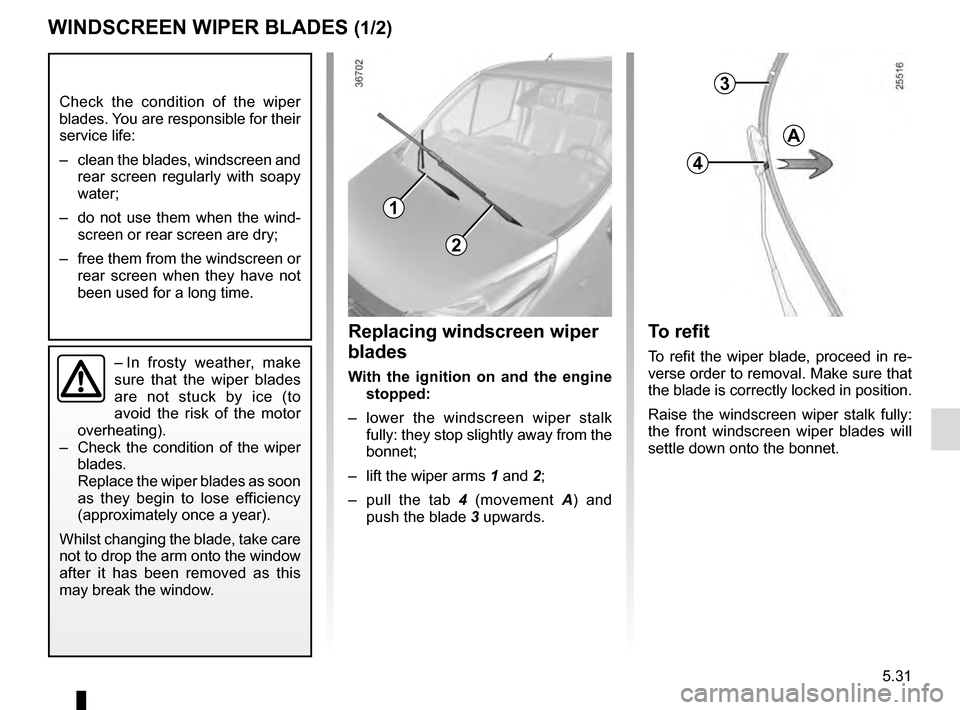
Replacing windscreen wiper
blades
With the ignition on and the engine stopped:
– lower the windscreen wiper stalk fully: they stop slightly away from the
bonnet;
– lift the wiper arms 1 and 2;
– pull the tab 4 (movement A) and
push the blade 3 upwards.
3
4
A
1
2
Page 257 of 292
5.37
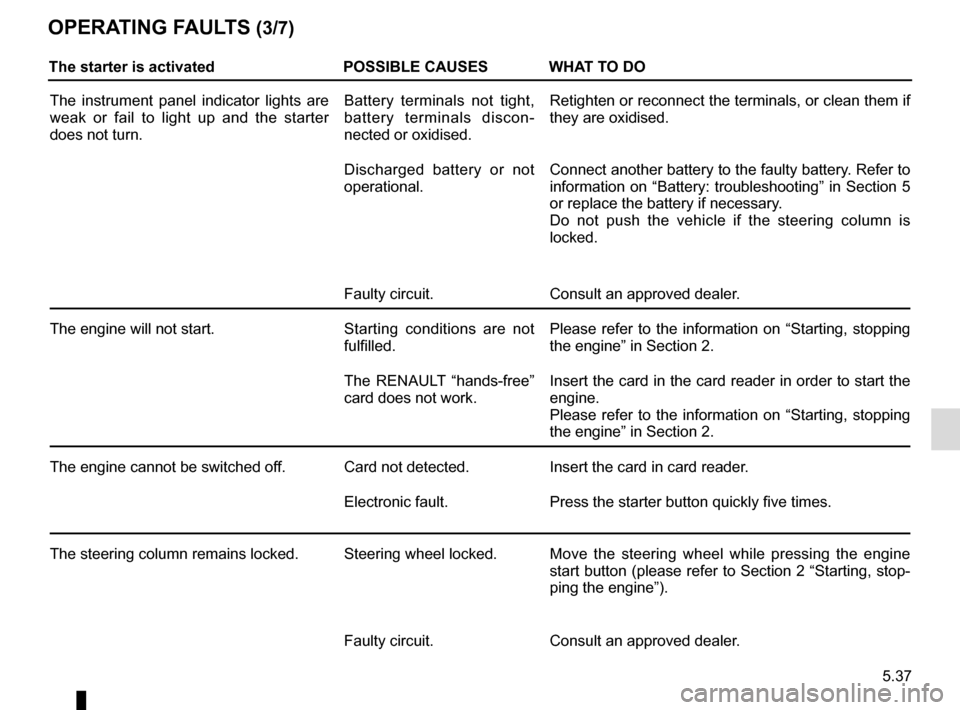
OPERATING FAULTS (3/7)
The starter is activatedPOSSIBLE CAUSES WHAT TO DO
The instrument panel indicator lights are
weak or fail to light up and the starter
does not turn. Battery terminals not tight,
battery terminals discon-
nected or oxidised.Retighten or reconnect the terminals, or clean them if
they are oxidised.
Discharged battery or not
operational. Connect another battery to the faulty battery. Refer to
information on “Battery: troubleshooting” in Section 5
or replace the battery if necessary.
Do not push the vehicle if the steering column is
locked.
Faulty circuit. Consult an approved dealer.
The engine will not start. Starting conditions are not
fulfilled.Please refer to the information on “Starting, stopping
the engine” in Section 2.
The RENAULT “hands-free”
card does not work. Insert the card in the card reader in order to start the
engine.
Please refer to the information on “Starting, stopping
the engine” in Section 2.
The engine cannot be switched off. Card not detected. Insert the card in card reader.
Electronic fault. Press the starter button quickly five times.
The steering column remains locked. Steering wheel locked. Move the steering wheel while pressing the engine
start button (please refer to Section 2 “Starting, stop-
ping the engine”).
Faulty circuit. Consult an approved dealer.
Page 287 of 292

I
idle speed ........................................................................\
.. 2.34
ignition switch ............................................................")
7.3
ALPHABETICAL INDEX (3/5)
I
idle speed ........................................................................\
.. 2.34
ignition switch ...................................................................... 2.2
indicator lights........................................................\
............ 5.19
indicators ....................................................1.108, 5.14 → 5.19
indicators: direction indicators ..................................................... 1.108
instrument panel ..............................................1.84 → 1.91
instrument panel ....................................................1.84 → 1.98
instrument panel messages...................................1.90 → 1.98
interior trim maintenance ..................................................... 4.15 – 4.16
Isofix ....................................................................... 1.47 – 1.48
J
jack ........................................................................\
..... 5.7 – 5.8
K
keys ...................................................................\
........1.2 → 1.5
L
levels .................................................................\
........4.7 → 4.9
levels: brake fluid ...................................................................... 4.8
coolant ................................................................\
........... 4.7
windscreen washer reservoir ......................................... 4.9
lifting the vehicle changing a wheel ................................................ 5.9 – 5.10
lighting: exterior .........................................................1.103 \
→ 1.108
instrument panel ........................................................ 1.103
interior ........................................... 3.17 – 3.18, 5.20 – 5.21
lights adjustment .................................................... 1.106 – 1.107
changing bulbs .................................................. 5.14 – 5.15
front ................................................................... 5.14 – 5.15 lights:
adjusting ....................................................... 1.106 – 1.107
brake lights ......................................................5.16 → 5.19
dipped beam headlights ................ 1.84, 1.103, 5.14 – 5.15
direction indicators .......................1.84, 1.108, 5.14 → 5.16
fog lights .................................................. 1.84, 1.105, 5.16
hazard warning .......................................................... 1.108
main beam headlights .............................. 1.84, 1.103, 5.14
number plate lights ...................................................... 5.19
reversing lights ............................................................. 5.16
side lights ..............................................1.103, 5.14 → 5.16
load permitted on the roof......................................... 6.9 – 6.10
locking the doors ........... 1.2 → 1.8, 1.13 → 1.17, 1.23 → 1.27
luggage compartment cover .............................................. 3.35
luggage retaining net .............................................. 3.36 – 3.37
M
maintenance ............................................................\
.......... 2.16
maintenance: bodywork .......................................................... 4.13 – 4.14
interior trim ........................................................ 4.15 – 4.16
mechanical .......................................4.4, 4.12, 6.12 → 6.17
map reading lights .................................................. 3.17 – 3.18
methods of restraint in addition to the seat belts ...1.37 → 1.43
multimedia equipment .............................................. 3.41, 5.26
N
navigation system .............................................................. 3.41
O
oil change ................................................................... 4.5 – 4.6
opening the doors ................................................... 1.14 – 1.15
operating faults ................................ 1.84 → 1.87, 5.35 → 5.41