ECU RENAULT TWINGO 2012 2.G User Guide
[x] Cancel search | Manufacturer: RENAULT, Model Year: 2012, Model line: TWINGO, Model: RENAULT TWINGO 2012 2.GPages: 220, PDF Size: 6.73 MB
Page 36 of 220

ENG_NU_952-4_X44_Renault_1
Jaune NoirNoir texte
The two rings 1 are located between
the seatba")
1.30
ENG_UD24374_5
Sécurité enfants : choix de la fixation du siège enfant (X44 \
- Renault)
ENG_NU_952-4_X44_Renault_1
Jaune NoirNoir texte
The two rings 1 are located between
the seatback and the seat base of the
seat or bench seat and are identified by
a marking.
To ensure your child seat can be easily
fitted and locked on rings 1, use access
guides 2 on the child seat.
The ISOFIX anchorage
points have been exclu -
sively designed for child
seats with the ISOFIX
system. Never fit a different type of
child seat, seat belt or other objects
to these anchorage points.
Check that nothing is obstructing
the anchorage points.
If your vehicle has been involved in
a road accident, have the ISOFIX
anchorage points checked and re -
place your child seat.
ChILD sAFETY : choosing a child seat mounting (2/3)
1
2
Page 37 of 220

ENG_NU_952-4_X44_Renault_1
The third ring is used to attach the
upper strap")
JauneNoirNoir texte
1.31
ENG_UD24374_5
Sécurité enfants : choix de la fixation du siège enfant (X44 \
- Renault)
ENG_NU_952-4_X44_Renault_1
The third ring is used to attach the
upper strap on some child seats.
Fit the hook of the strap onto ring 3 (for
the rear seats) or 4 (for the front seats)
and pull the strap.
Do not change the position of the seat
to which the child/baby seat is fitted
after pulling the strap.
R I sK O F D E AT h O R
s ERIOU s INJURY: before
installing a child seat in the
front passenger seat, make
sure the air bag has been deacti -
vated (refer to the information on
“Child safety: deactivating/activat -
ing the front passenger air bag” in
Section 1).
Forward facing harness seats are
only permitted if they are installed
using an ISOFIX fitting and without
a seat belt.
ChILD sAFETY : choosing a child seat mounting (3/3)
4
3
Page 38 of 220
child safety............................................ (up to the end of the DU)
child restraint/seat ................................ (up to the end of the DU)
child restraint/seat ................................ (up to the end of the DU)
child seats ............................................. (up to the end of the DU)
child restraint/seat ................................ (up to the end of the DU)
transporting children ............................. (up to the end of the DU)
1.32
ENG_UD24497_2
Sécurité enfants : installation du siège enfant (X44 - Renault\
)
ENG_NU_952-4_X44_Renault_1
Jaune NoirNoir texte
Fitting a child seat
Some seats are not suitable for fitting
child seats. The diagram on the follow -
ing page shows you how to attach a
child seat.
The types of child seat indicated may
not be available. Before using a differ-
ent child seat, check with the manufac-
turer that it can be fitted.
Fit the child seat in a rear
seat wherever possible.
Check that when installing
the child seat in the vehicle
it is not at risk of coming loose from
its base.
If you have to remove the headrest,
check that it is correctly stored so
that it does not come loose under
harsh braking or impact.
Always attach the child seat to the
vehicle even if it is not in use so that
it does not come loose under harsh
braking or impact.
In the front seat
The laws concerning children travel -
ling in this seat differ in every coun -
try. Consult the legislation in force and
follow the indications on the diagram on
the following page.
Before fitting a child seat in this seat (if
authorised):
– lower the seat belt as far as possible;
– move the seat as far back as possi-
ble;
– gently tilt the seatback away from
vertical (approximately 25°).
Do not change these settings after the
child seat is installed.
R I sK O F D E AT h O R
s ERIOU s INJURY: before
installing a child seat in the
front passenger seat, make
sure the air bag has been deacti -
vated (refer to the information on
“Child safety: deactivating/activat -
ing the front passenger air bag” in
section 1).
Forward facing harness seats are
only permitted if they are installed
using an ISOFIX fitting and without
a seat belt.
In the rear side seat
A carrycot can be installed across the
vehicle and will take up at least two
seats. Position the child with his or her
feet nearest the door.
Before installing a child seat, it is rec -
ommended that the rear seat be as far
back as possible, ensuring, if required,
that the floor support of the child seat is
resting on the floor in accordance with
the child seat instructions.
Move the front seat as far forward as
possible to install a child seat, then
move back the seat or seats in front as
far as possible without coming into con-
tact with the child seat.
For the safety of the child in the for -
ward-facing seat, do not move the seat
in front back past the middle of the
runner, do not tilt the seatback too far
(maximum of 25°) and move the seat
backwards as far as possible.
Check that the forward-facing child seat
is resting against the back of the vehi-
cle seat and that the headrest of the ve-
hicle is not obstructing its use.
ChILD sAFETY : fitting a child seat (1/4)
Page 39 of 220

ENG_NU_952-4_X44_Renault_1
ChILD sAFETY : Fitting a child seat (2/4)
R IsK O F D E AT h")
JauneNoirNoir texte
1.33
ENG_UD24497_2
Sécurité enfants : installation du siège enfant (X44 - Renault\
)
ENG_NU_952-4_X44_Renault_1
ChILD sAFETY : Fitting a child seat (2/4)
R IsK O F D E AT h O R
s ERIOU s INJURY: before
installing a rear-facing child
seat in the front passen -
ger seat, make sure the air bag has
been deactivated (refer to Section
1 “Child safety: front passenger air
bag deactivation/activation”).
Forward facing harness seats are
only permitted if they are installed
using an ISOFIX fitting and without
a seat belt.Child seat attached using the belt
¬ Seat which allows a child seat
with “Universal” approval to be attached
by a seat belt.
− Seat which only allows a rear-
facing seat with “Universal” approval
to be attached with a seat belt.
³ Check the status of the air bag
before fitting a child seat or allowing a
passenger to use the seat.
Child seat attached using the IsOFIX
mounting
ü Seat which allows an ISOFIX
child seat to be fitted.
± The rear seats are fitted with
an anchorage point which allows a
forward-facing ISOFIX child seat with
Universal approval to be fitted. The an-
chorage points are located in the lug -
gage compartment and are visible.
The size of the ISOFIX child seat is in-
dicated by a letter:
– A, B and B1: for forward-facing seats
in group 1 (9 to 18 kg);
– C: rear-facing seats in group 1 (9 to
18 kg);
– D and E: shell seat or rear-facing
seats in group 0 or 0+ (less than
13 kg);
– F and G: cots in group 0 (less than
10 kg).
Using a child safety system which is not approved for this vehicle will not
correctly protect the baby or child. They risk serious or even fatal injury.
Page 40 of 220

ENG_NU_952-4_X44_Renault_1
Jaune NoirNoir texte
Type of child seat Weight of
the child seat size
IsOFIX passen")
1.34
ENG_UD24497_2
Sécurité enfants : installation du siège enfant (X44 - Renault\
)
ENG_NU_952-4_X44_Renault_1
Jaune NoirNoir texte
Type of child seat Weight of
the child seat size
IsOFIX passenger front
seat (1) (2) Rear side seats
right left
Carrycot fitted across the vehi- cle
Group 0 < 10 kg
F XU - IL (4) U (4)
shell seat/rear-facing seat
Groups 0, 0 + or 1 < 13 kg and
9 kg to 18 kg D, E
U - IL U - IL (5) U (5)
Rear-facing seat
Groups 0 + and 1 < 13 kg and
9 kg to 18 kg C
U - IL U (3)U (3)
Forward-facing seat
Group 1 9 kg to 18 kg
A, B, B1 IL - IUFU - IUF - IL (6) U (6)
Booster cushion
Group 2 or 3 15 kg to 36 kg
–X U (6)U (6)
(1) RIsK OF DEATh OR sERIOUs INJURY: before installing a rear-facing child seat on the front passenger seat,
check that the air bag has been deactivated (refer to Section 1 “Child safety: deactivating/activating the front passen -
ger air bag”).
Forward facing harness seats are only permitted if they are installed us\
ing an ISOFIX fitting and without a seat belt.
ChILD sAFETY : Fitting a child seat (3/4)
The table below summarises the information already shown on the diagram on the previous page, to ensure the regula-
tions in force are respected.
Page 41 of 220

ENG_NU_952-4_X44_Renault_1
X = Seat not suitable for fitting child seats.
U = Seat which")
JauneNoirNoir texte
1.35
ENG_UD24497_2
Sécurité enfants : installation du siège enfant (X44 - Renault\
)
ENG_NU_952-4_X44_Renault_1
X = Seat not suitable for fitting child seats.
U = Seat which allows a child seat with “Universal” approval to be installed using a seat belt; check that it can be fitted.
IUF/IL = On equipped vehicles, seat which allows an approved “Universal”/“semi-universal” or “vehicle specific” child seat to be
attached using the ISOFIX system; check that it can be fitted.
(2) Before fitting a rear-facing child seat: raise the seat to the maximum and position it as far back as possible, tilting the seatback
slightly (approximately 25°).
(3) It is recommended to position the rear seat as far back as possible ensuring, if required, that the floor support of the child seat
is resting on the floor in accordance with the child seat instructions.
(4) A carrycot can be installed across the vehicle and will take up two seats. Position the child with his or her feet nearest the door.
(5) Move the front seat as far forward as possible to install a rear-facing child seat, then move back the seat or seats in front as
far as they will go, although without allowing them to come into contact\
with the child seat.
(6) Forward-facing child seat; position the seatback of the child seat in contact with the seatback of the vehicle seat. Adjust the
height of the headrest or remove it if necessary; do not push the seat in front of the child more than halfway back on its runners
and do not recline the seatback more than 25°.
ChILD sAFETY : Fitting a child seat (4/4)
Page 42 of 220

ENG_NU_952-4_X44_Renault_1
Jaune NoirNoir texte
Deactivating/activating the front passenger airbag
Deactivati")
1.36
ENG_UD29224_6
sécurité enfants : désactivation/activation airbag (X44 - Rena\
ult)
ENG_NU_952-4_X44_Renault_1
Jaune NoirNoir texte
Deactivating/activating the front passenger airbag
Deactivating the front
passenger airbags
(on equipped vehicles)
In order to fit a child seat to the front
passenger seat when this is allowed,
you must deactivate the front passen-
ger seat additional restraint devices
(side airbags (depending on vehicle),
front airbags, etc.). To deactivate the restraint devices
supplementary to the front passen
-
ger seat belt: switch off the ignition,
press and turn lock 1 to the OFF posi-
tion. The airbag is deactivated.
With the ignition on, it is essential to
check that warning light 2 is lit on the
instrument panel.
This warning light remains lit to con-
firm that you can fit a child seat, as
the passenger air bag has been de -
activated.
1
ChILD sAFETY : deactivating/activating the front passenger airbag (1/3)
2
The passenger air bag must
only be deactivated or acti-
vated with the ignition off.
If it is interfered with when
the vehicle is being driven, indicator
lights
å and © will come
on.
Switch the ignition off then on again
to reset the air bag in accordance
with the lock.
Page 43 of 220

ENG_NU_952-4_X44_Renault_1
ChILD sAFETY : deactivating/activating the front passenger air")
JauneNoirNoir texte
1.37
ENG_UD29224_6
sécurité enfants : désactivation/activation airbag (X44 - Rena\
ult)
ENG_NU_952-4_X44_Renault_1
ChILD sAFETY : deactivating/activating the front passenger airbag (2/3)
DANGER
S i n c e f r o n t p a s s e n g e r
airbag triggering and the
position of a rear-facing
child seat are incompatible, NEVER
use a restraining device for rear -
facing children on a seat with an
ACTIVATED AIRBAG in front of it.
This provides a risk of DEATh or
sERIOUs INJURY to the ChILD.
The markings on the dashboard and
labels A on each side of passenger sun
blind 3 (example: label shown above)
remind you of these instructions.
3
AA
A
Page 44 of 220

ENG_NU_952-4_X44_Renault_1
Activating the front
passenger air bags
You should reactivate the air bag a")
1.38
ENG_UD29224_6
sécurité enfants : désactivation/activation airbag (X44 - Rena\
ult)
ENG_NU_952-4_X44_Renault_1
Activating the front
passenger air bags
You should reactivate the air bag as
soon as you remove the child seat from
the front passenger seat to ensure the
protection of the front passenger in the
event of an impact.
To reactivate the restraint devices
supplementary to the front passen -
ger seat belt: switch off the ignition,
press and turn lock 1 to the ON posi -
tion.
With the ignition on, check that the
warning light 2 goes out.
The front passenger seat belt additional
restraint systems are activated.
Operating faults
If the front passenger air bag activa -
tion/deactivation system is faulty, child
seats must NOT be fitted to the front
seat.
Allowing any other passenger to sit in
that seat is not recommended.
Contact your approved dealer as soon
as possible.
The passenger air bag must
only be deactivated or acti-
vated with the ignition off.
If it is interfered with when
the vehicle is being driven, indicator
lights
å and © will come
on.
Switch the ignition off then on again
to reset the air bag in accordance
with the lock.
2
ChILD sAFETY : deactivating/activating the front passenger airbag (3/3)
1
Page 71 of 220
fuel tank ................................................ (up to the end of the DU)
fuel grade ............................................................... (current page)
fuel tank capacity ................................................... (current page)
1.65
ENG_UD22502_6
Réservoir carburant (X44 - Renault)
ENG_NU_952-4_X44_Renault_1
Fuel tank
FUEL TANK (1/2)
Diesel version
It is essential to use diesel fuel that
conforms with the information given on
the label inside cover A.
Make sure that no water accidentally
enters the fuel tank during filling. The
sealing system and its surrounding
area must be dust-free.Fuel grade
Use a high grade fuel with the appro-
priate octane rating as defined by the
particular standards in force in your
country.
petrol versions
It is essential to use unleaded petrol.
The octane rating (RON) must conform
with the information given on the label
inside cover A. Refer to the information
on “Engine specifications” in Section 6.
Fuel filler cap: this is spe-
cific.
If you have to replace it,
make sure it is identical
to the original cap. Contact an ap -
proved Dealer.
Never place the cap near a source
of heat or flame.
Do not wash the filler area with a
high-pressure washer.
After filling, check that the cap and
cover are closed.
Do not mix even small
amounts of petrol (un -
leaded or E85) with diesel.
Do not use ethanol-based
fuel if your vehicle is not compatible
with this fuel.
Do not add any additives to the fuel,
you risk damaging the engine.
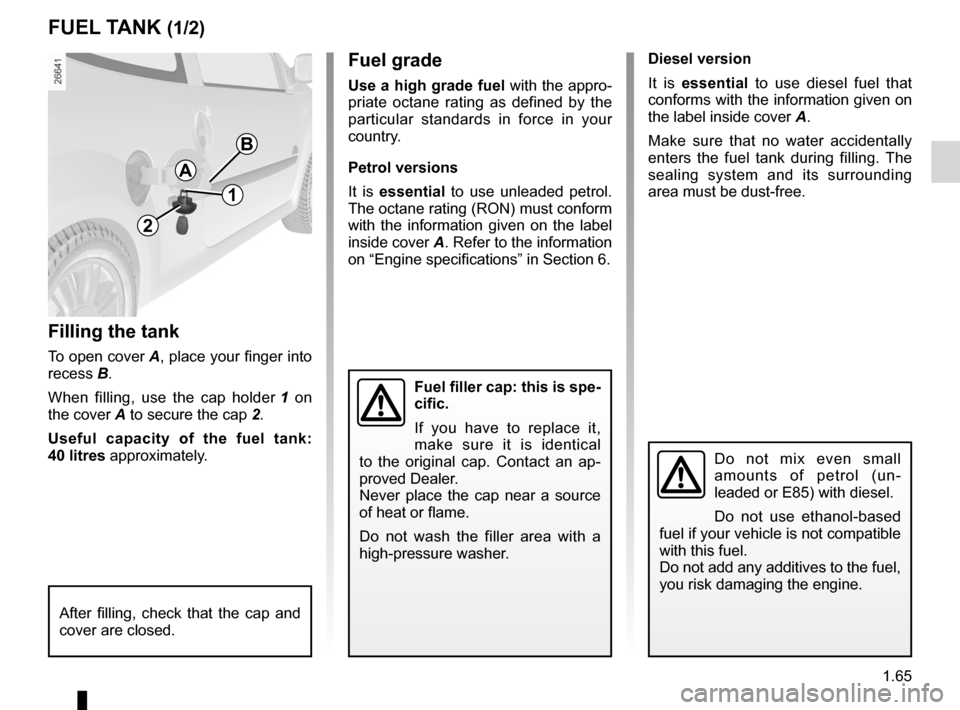
Filling the tank
To open cover A, place your finger into
recess B.
When filling, use the cap holder 1 on
the cover A to secure the cap 2.
Useful capacity of the fuel tank:
40 litres approximately.
1
2
A
B