replace RENAULT TWINGO 2016 3.G Owner's Manual
[x] Cancel search | Manufacturer: RENAULT, Model Year: 2016, Model line: TWINGO, Model: RENAULT TWINGO 2016 3.GPages: 216, PDF Size: 7.15 MB
Page 132 of 216
3.20
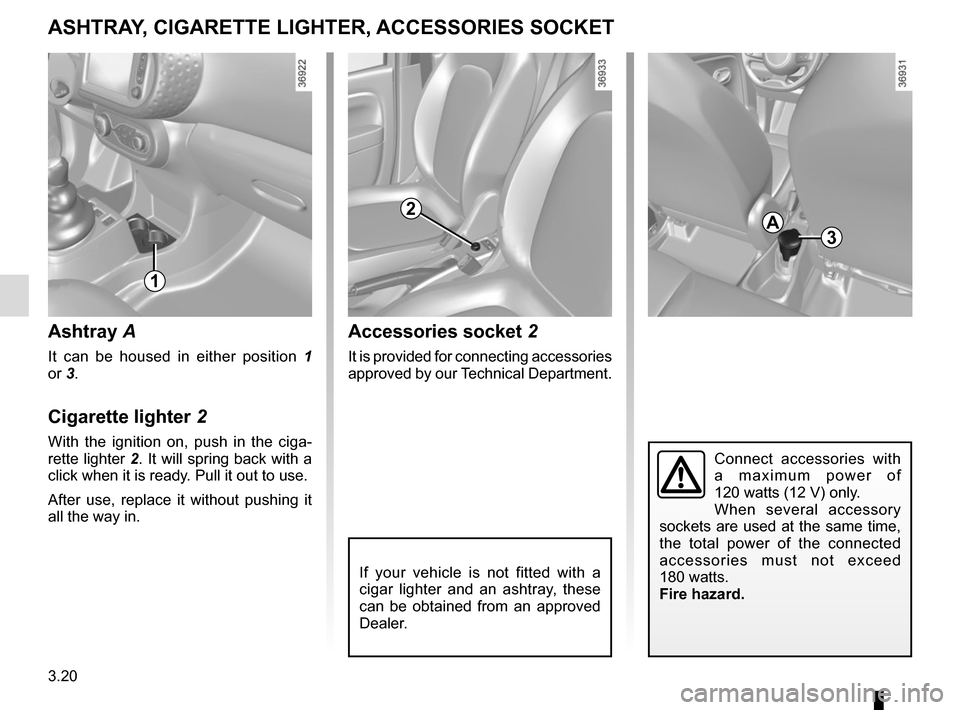
Accessories socket 2
It is provided for connecting accessories
approved by our Technical Department.
Ashtray A
It can be housed in either position 1
or 3.
Cigarette lighter 2
With the ignition on, push in the ciga-
rette lighter 2. It will spring back with a click when it is ready. Pull it out to use.
After use, replace it without pushing it
all the way in.
ASHTRAY, CIGARETTE LIGHTER, ACCESSORIES SOCKET
1
If your vehicle is not fitted with a
cigar lighter and an ashtray, these
can be obtained from an approved
Dealer.
3
2A
Connect accessories with
a maximum power of
120 watts (12 V) only.
When several accessory
sockets are used at the same time,
the total power of the connected
accessories must not exceed
180 watts.
Fire hazard.
Page 142 of 216
4.2
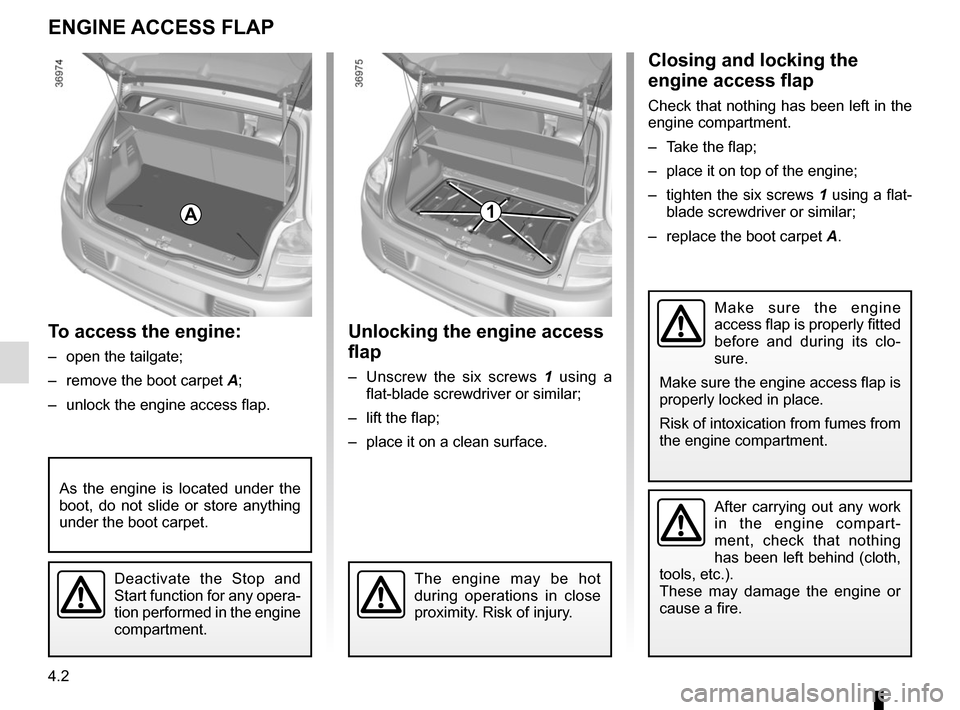
To access the engine:
– open the tailgate;
– remove the boot carpet A;
– unlock the engine access flap.
ENGINE ACCESS FLAP
Unlocking the engine access
flap
– Unscrew the six screws 1 using a
flat-blade screwdriver or similar;
– lift the flap;
– place it on a clean surface.
Closing and locking the
engine access flap
Check that nothing has been left in the
engine compartment.
– Take the flap;
– place it on top of the engine;
– tighten the six screws 1 using a flat- blade screwdriver or similar;
– replace the boot carpet A.
After carrying out any work
in the engine compart-
ment, check that nothing
has been left behind (cloth,
tools, etc.).
These may damage the engine or
cause a fire.
Make sure the engine
access flap is properly fitted
before and during its clo-
sure.
Make sure the engine access flap is
properly locked in place.
Risk of intoxication from fumes from
the engine compartment.
1A
Deactivate the Stop and
Start function for any opera-
tion performed in the engine
compartment.The engine may be hot
during operations in close
proximity. Risk of injury.
As the engine is located under the
boot, do not slide or store anything
under the boot carpet.
Page 147 of 216
4.7
BONNET (2/2)
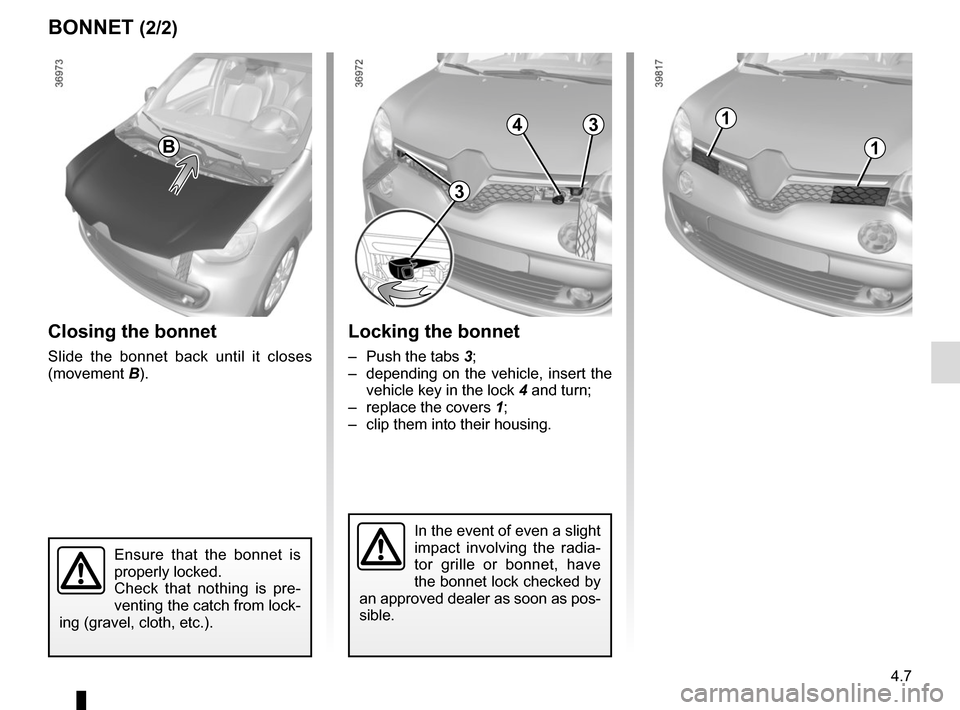
Closing the bonnet
Slide the bonnet back until it closes
(movement B).
Ensure that the bonnet is
properly locked.
Check that nothing is pre-
venting the catch from lock-
ing (gravel, cloth, etc.).
In the event of even a slight
impact involving the radia-
tor grille or bonnet, have
the bonnet lock checked by
an approved dealer as soon as pos-
sible.
B
Locking the bonnet
– Push the tabs 3;
– depending on the vehicle, insert the vehicle key in the lock 4 and turn;
– replace the covers 1;
– clip them into their housing.
431
1
3
Page 148 of 216
4.8
Frequency of checking coolant level
Check the coolant level regularly
(very severe damage is likely to be
caused to the engine if it runs out of
coolant).
If the level needs to be topped up, only
use products approved by our Technical
Department which ensure:
– protection against freezing;
– an anti-corrosion protection for the cooling system.
No operations should be
carried out on the cooling
circuit when the engine is
hot.
Risk of burns.
Replacement interval
Refer to the Maintenance Document for
your vehicle.
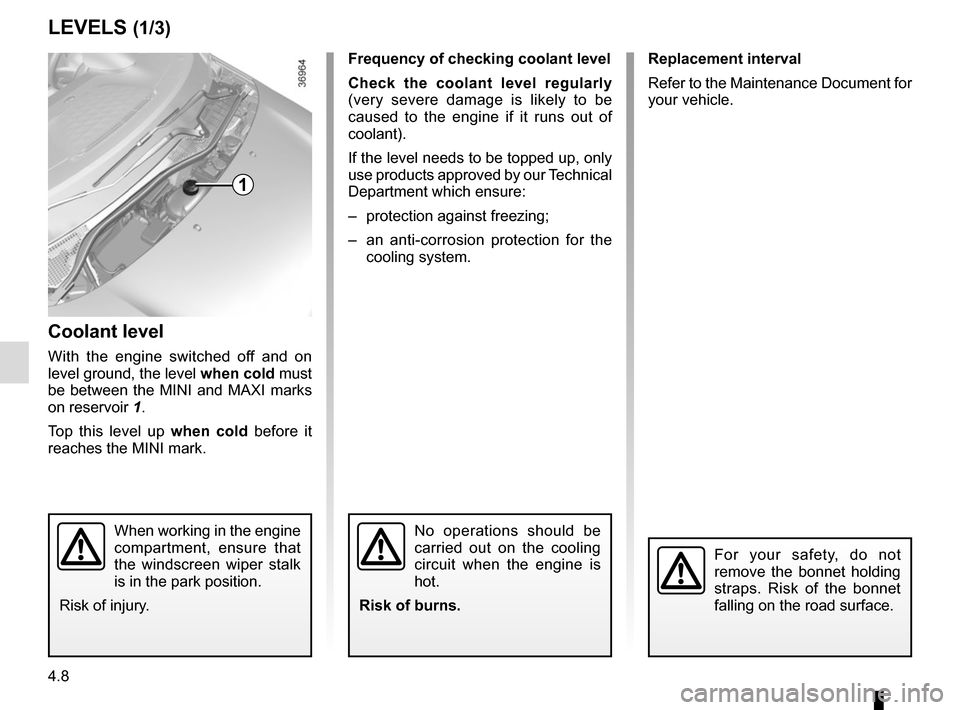
Coolant level
With the engine switched off and on
level ground, the level when cold must
be between the MINI and MAXI marks
on reservoir 1.
Top this level up when cold before it
reaches the MINI mark.
LEVELS (1/3)
1
When working in the engine
compartment, ensure that
the windscreen wiper stalk
is in the park position.
Risk of injury.
For your safety, do not
remove the bonnet holding
straps. Risk of the bonnet
falling on the road surface.
Page 149 of 216
4.9
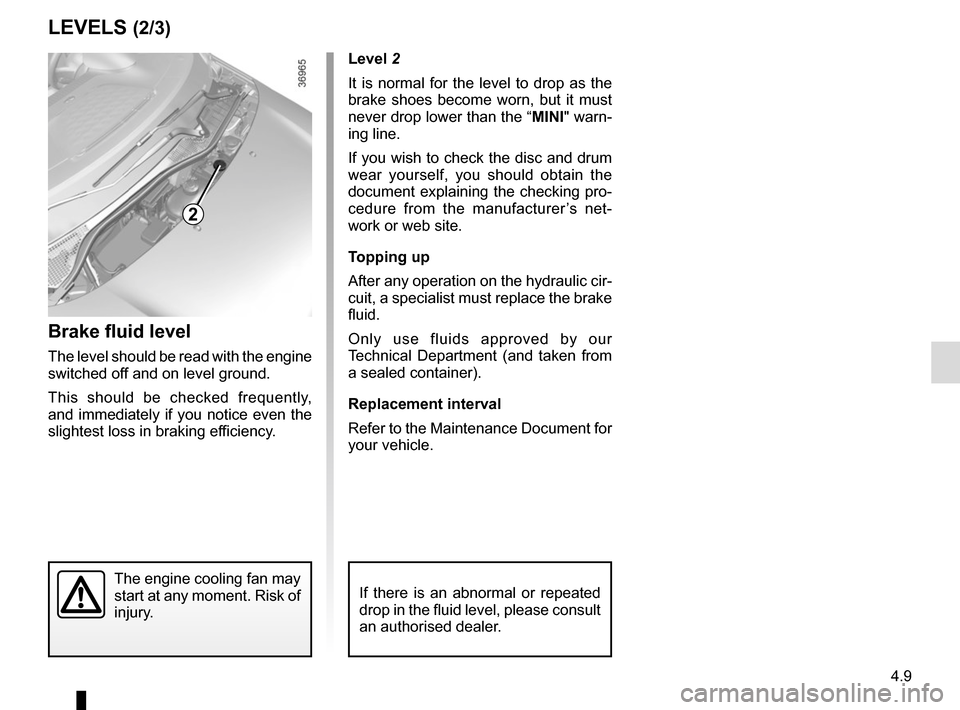
Level 2
It is normal for the level to drop as the
brake shoes become worn, but it must
never drop lower than the “MINI" warn-
ing line.
If you wish to check the disc and drum
wear yourself, you should obtain the
document explaining the checking pro-
cedure from the manufacturer’s net-
work or web site.
Topping up
After any operation on the hydraulic cir-
cuit, a specialist must replace the brake
fluid.
Only use fluids approved by our
Technical Department (and taken from
a sealed container).
Replacement interval
Refer to the Maintenance Document for
your vehicle.
Brake fluid level
The level should be read with the engine
switched off and on level ground.
This should be checked frequently,
and immediately if you notice even the
slightest loss in braking efficiency.
LEVELS (2/3)
2
The engine cooling fan may
start at any moment. Risk of
injury.If there is an abnormal or repeated
drop in the fluid level, please consult
an authorised dealer.
Page 150 of 216
4.10
Filters
The filter elements (air filter, passenger
compartment filter, etc.) should be re-
placed during the maintenance opera-
tions carried out on your vehicle.
Replacement intervals for filter el-
ements: refer to the Maintenance
Document for your vehicle.
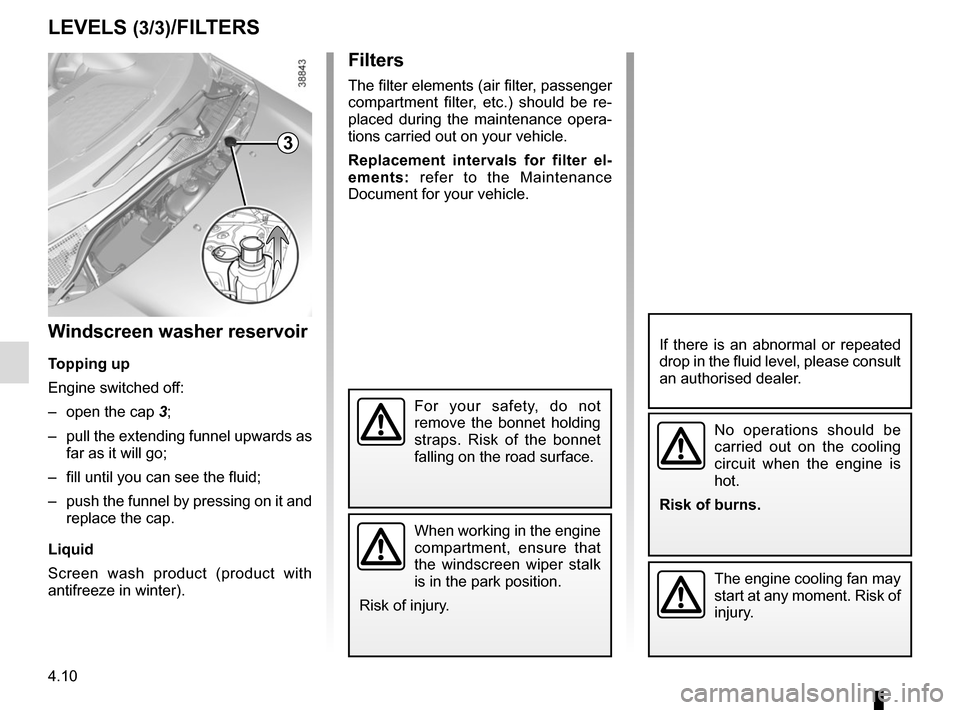
Windscreen washer reservoir
Topping up
Engine switched off:
– open the cap 3;
– pull the extending funnel upwards as far as it will go;
– fill until you can see the fluid;
– push the funnel by pressing on it and replace the cap.
Liquid
Screen wash product (product with
antifreeze in winter).
LEVELS (3/3)/FILTERS
3
When working in the engine
compartment, ensure that
the windscreen wiper stalk
is in the park position.
Risk of injury.
The engine cooling fan may
start at any moment. Risk of
injury.
No operations should be
carried out on the cooling
circuit when the engine is
hot.
Risk of burns.
If there is an abnormal or repeated
drop in the fluid level, please consult
an authorised dealer.
For your safety, do not
remove the bonnet holding
straps. Risk of the bonnet
falling on the road surface.
Page 151 of 216
4.11
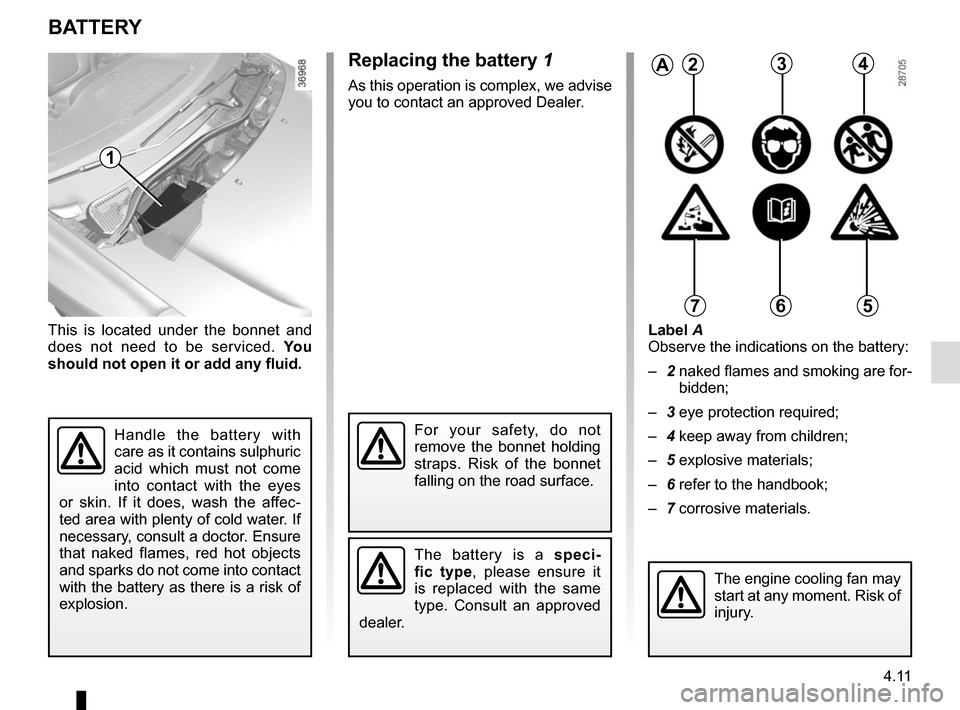
This is located under the bonnet and
does not need to be serviced. Yo u
should not open it or add any fluid. Label A
Observe the indications on the battery:
–
2 naked flames and smoking are for-
bidden;
– 3 eye protection required;
– 4 keep away from children;
– 5 explosive materials;
– 6 refer to the handbook;
– 7 corrosive materials.
BATTERY
2
Handle the battery with
care as it contains sulphuric
acid which must not come
into contact with the eyes
or skin. If it does, wash the affec-
ted area with plenty of cold water. If
necessary, consult a doctor. Ensure
that naked flames, red hot objects
and sparks do not come into contact
with the battery as there is a risk of
explosion.
The battery is a speci-
fic type, please ensure it
is replaced with the same
type. Consult an approved
dealer.
A234
567
The engine cooling fan may
start at any moment. Risk of
injury.
Replacing the battery 1
As this operation is complex, we advise
you to contact an approved Dealer.
1
For your safety, do not
remove the bonnet holding
straps. Risk of the bonnet
falling on the road surface.
Page 160 of 216

5.2
TYRE INFLATION KIT (1/4)
The kit is only approved
for inflating the tyres of the
vehicle originally equipped
with the kit.
It must never be used to inflate
the tyres of another vehicle, or any
other inflatable object (rubber ring,
rubber boat, etc.).
Avoid spillage on skin when han-
dling the repair liquid bottle. If dro-
plets do leak out, rinse them off with
plenty of water.
Keep the repair kit away from chil-
dren.
Do not dispose of the empty bottle
in the countryside. Return it to your
approved dealer or to a recycling or-
ganisation.
The bottle has a limited service
life which is indicated on its label.
Check the expiry date.
Contact an approved dealer to re-
place the inflation tube and repair
product bottle.
A
B
The kit repairs tyres when
tread A has been da-
maged by objects smaller
than 4 mm. It cannot repair
all types of puncture, such as cuts
larger than 4 mm, or cuts in tyre si-
dewall B.
Ensure also that the wheel rim is in
good condition.
Do not pull out the foreign body cau-
sing the puncture if it is still in the
tyre.
Do not attempt to use the
inflation kit if the tyre has
been damaged as a result
of driving with a puncture.
You should therefore carefully check
the condition of the tyre sidewalls
before any operation.
Driving with underinflated, flat or
punctured tyres can be dangerous
and may make the tyre impossible
to repair.
This repair is temporary
A tyre which has been punctured
should always be inspected (and re-
paired, where possible) as soon as
possible by a specialist.
When taking a tyre which has been
repaired using this kit to be replaced,
you must inform the specialist.
When driving, vibration may be felt
due to the presence of the repair
product injected into the tyre.
Page 163 of 216
5.5
Precautions when using the
kit
The kit should not be operated for more
than 15 consecutive minutes.
The container must be replaced after
the first use even if liquid remains
inside.
TYRE INFLATION KIT (4/4)
Following repair with the kit,
do not travel further than
120 miles (200 km). In addi-
tion, reduce your speed and
under no circumstances exceed
48 mph (80 km/h). The sticker,
which you must affix in a prominent
position on the dashboard, reminds
you of this.
Depending on the country or local
legislation, a tyre repaired with the
inflation kit may need to be replaced.
Please be aware that a
poorly tightened or miss-
ing valve cap can make the
tyres less airtight and lead
to pressure loss.
Always use valve caps identical to
those fitted originally and tighten
them fully.
Page 164 of 216
5.6
Tyre and wheel safetyThe tyres are the only contact between
the vehicle and the road, so it is essen-
tial to keep them in good condition. You
must make sure that your tyres conform
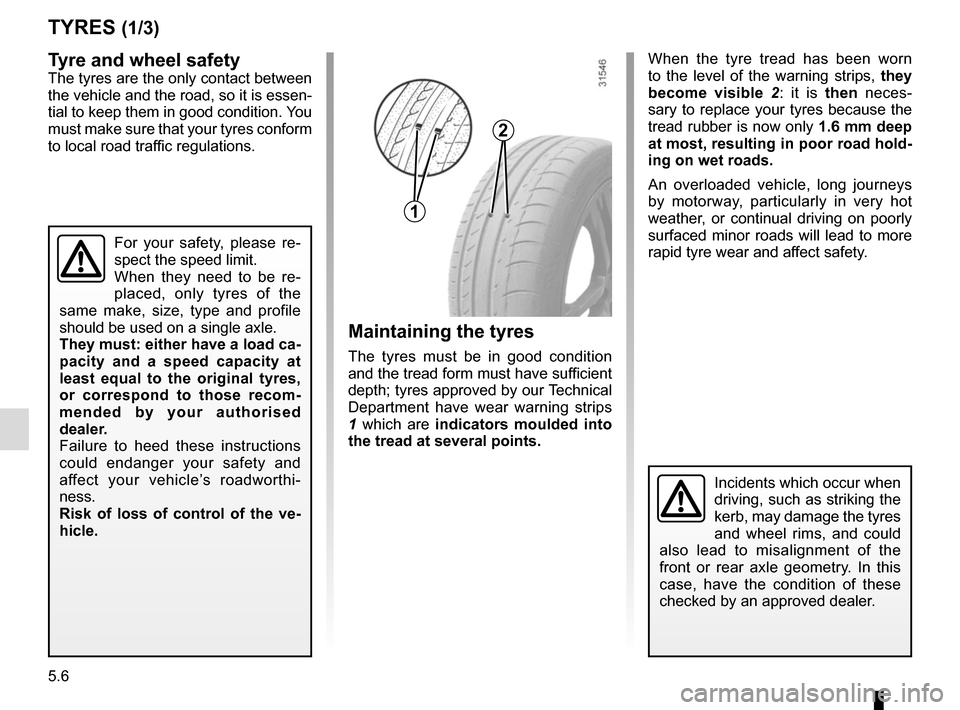
to local road traffic regulations.When the tyre tread has been worn
to the level of the warning strips, they
become visible
2: it is then neces-
sary to replace your tyres because the
tread rubber is now only 1.6 mm deep
at most, resulting in poor road hold-
ing on wet roads.
An overloaded vehicle, long journeys
by motorway, particularly in very hot
weather, or continual driving on poorly
surfaced minor roads will lead to more
rapid tyre wear and affect safety.
TYRES (1/3)
For your safety, please re-
spect the speed limit.
When they need to be re-
placed, only tyres of the
same make, size, type and profile
should be used on a single axle.
They must: either have a load ca-
pacity and a speed capacity at
least equal to the original tyres,
or correspond to those recom-
mended by your authorised
dealer.
Failure to heed these instructions
could endanger your safety and
affect your vehicle’s roadworthi-
ness.
Risk of loss of control of the ve-
hicle.
Incidents which occur when
driving, such as striking the
kerb, may damage the tyres
and wheel rims, and could
also lead to misalignment of the
front or rear axle geometry. In this
case, have the condition of these
checked by an approved dealer.
1
2
Maintaining the tyres
The tyres must be in good condition
and the tread form must have sufficient
depth; tyres approved by our Technical
Department have wear warning strips
1 which are indicators moulded into
the tread at several points.