wheel RENAULT TWINGO 2016 3.G Owner's Manual
[x] Cancel search | Manufacturer: RENAULT, Model Year: 2016, Model line: TWINGO, Model: RENAULT TWINGO 2016 3.GPages: 216, PDF Size: 7.15 MB
Page 160 of 216

5.2
TYRE INFLATION KIT (1/4)
The kit is only approved
for inflating the tyres of the
vehicle originally equipped
with the kit.
It must never be used to inflate
the tyres of another vehicle, or any
other inflatable object (rubber ring,
rubber boat, etc.).
Avoid spillage on skin when han-
dling the repair liquid bottle. If dro-
plets do leak out, rinse them off with
plenty of water.
Keep the repair kit away from chil-
dren.
Do not dispose of the empty bottle
in the countryside. Return it to your
approved dealer or to a recycling or-
ganisation.
The bottle has a limited service
life which is indicated on its label.
Check the expiry date.
Contact an approved dealer to re-
place the inflation tube and repair
product bottle.
A
B
The kit repairs tyres when
tread A has been da-
maged by objects smaller
than 4 mm. It cannot repair
all types of puncture, such as cuts
larger than 4 mm, or cuts in tyre si-
dewall B.
Ensure also that the wheel rim is in
good condition.
Do not pull out the foreign body cau-
sing the puncture if it is still in the
tyre.
Do not attempt to use the
inflation kit if the tyre has
been damaged as a result
of driving with a puncture.
You should therefore carefully check
the condition of the tyre sidewalls
before any operation.
Driving with underinflated, flat or
punctured tyres can be dangerous
and may make the tyre impossible
to repair.
This repair is temporary
A tyre which has been punctured
should always be inspected (and re-
paired, where possible) as soon as
possible by a specialist.
When taking a tyre which has been
repaired using this kit to be replaced,
you must inform the specialist.
When driving, vibration may be felt
due to the presence of the repair
product injected into the tyre.
Page 161 of 216
5.3
TYRE INFLATION KIT (2/4)
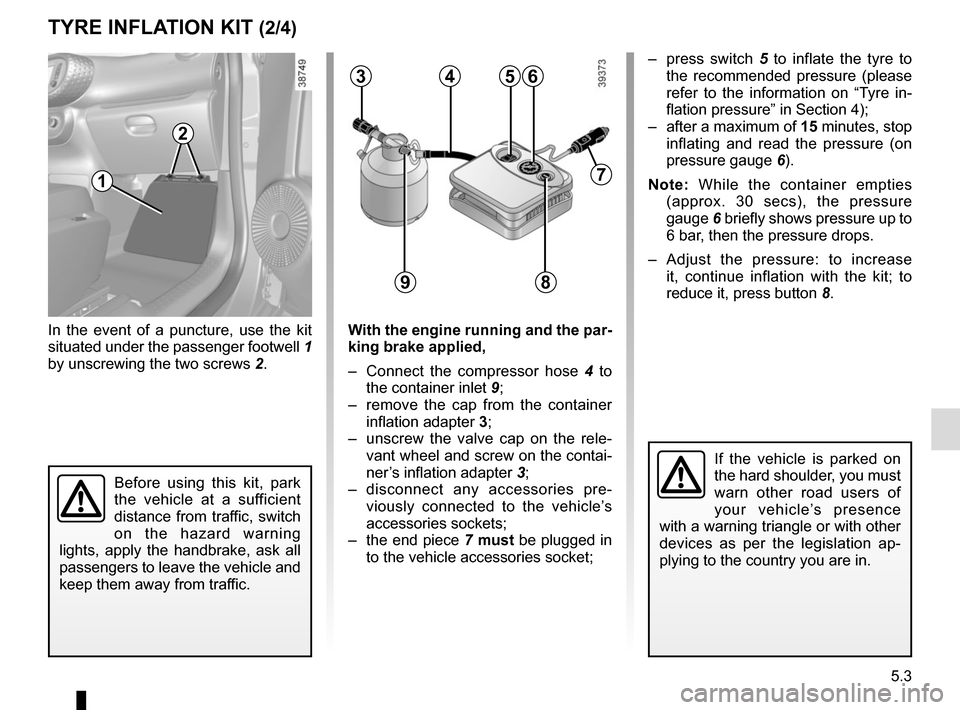
In the event of a puncture, use the kit
situated under the passenger footwell 1
by unscrewing the two screws 2.With the engine running and the par-
king brake applied,
– Connect the compressor hose 4 to
the container inlet 9;
– remove the cap from the container inflation adapter 3;
– unscrew the valve cap on the rele- vant wheel and screw on the contai-
ner’s inflation adapter 3;
– disconnect any accessories pre- viously connected to the vehicle’s
accessories sockets;
– the end piece 7 must be plugged in
to the vehicle accessories socket;
563
Before using this kit, park
the vehicle at a sufficient
distance from traffic, switch
on the hazard warning
lights, apply the handbrake, ask all
passengers to leave the vehicle and
keep them away from traffic.
9
If the vehicle is parked on
the hard shoulder, you must
warn other road users of
your vehicle’s presence
with a warning triangle or with other
devices as per the legislation ap-
plying to the country you are in.
– press switch 5 to inflate the tyre to
the recommended pressure (please
refer to the information on “Tyre in-
flation pressure” in Section 4);
– after a maximum of 15 minutes, stop inflating and read the pressure (on
pressure gauge 6).
Note: While the container empties (approx. 30 secs), the pressure
gauge 6 briefly shows pressure up to
6 bar, then the pressure drops.
– Adjust the pressure: to increase it, continue inflation with the kit; to
reduce it, press button 8.
7
4
8
1
2
Page 164 of 216
5.6
Tyre and wheel safetyThe tyres are the only contact between
the vehicle and the road, so it is essen-
tial to keep them in good condition. You
must make sure that your tyres conform
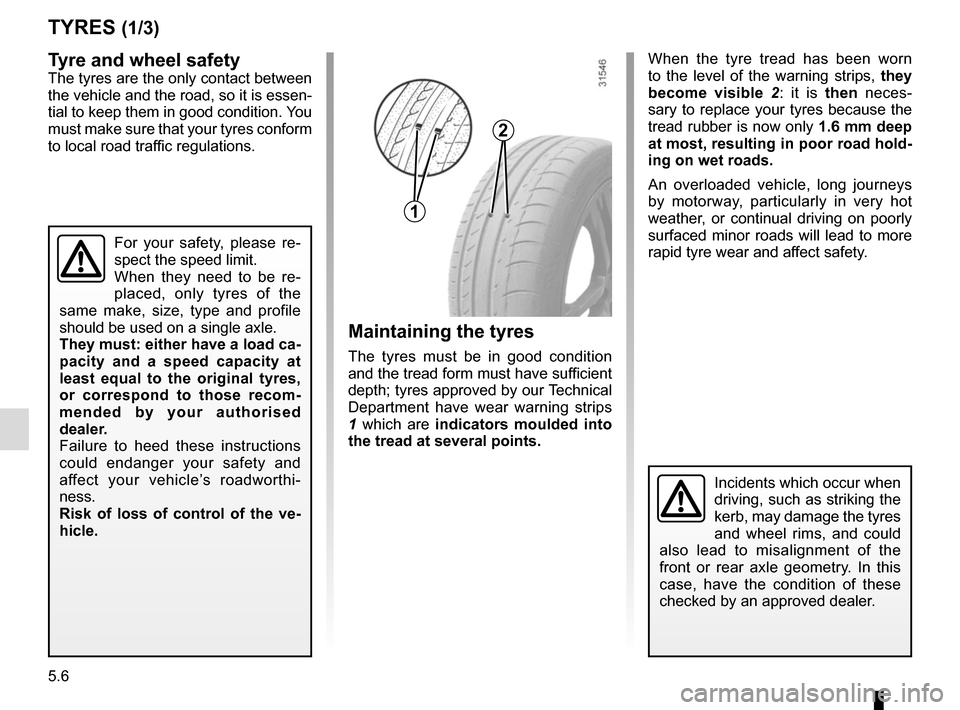
to local road traffic regulations.When the tyre tread has been worn
to the level of the warning strips, they
become visible
2: it is then neces-
sary to replace your tyres because the
tread rubber is now only 1.6 mm deep
at most, resulting in poor road hold-
ing on wet roads.
An overloaded vehicle, long journeys
by motorway, particularly in very hot
weather, or continual driving on poorly
surfaced minor roads will lead to more
rapid tyre wear and affect safety.
TYRES (1/3)
For your safety, please re-
spect the speed limit.
When they need to be re-
placed, only tyres of the
same make, size, type and profile
should be used on a single axle.
They must: either have a load ca-
pacity and a speed capacity at
least equal to the original tyres,
or correspond to those recom-
mended by your authorised
dealer.
Failure to heed these instructions
could endanger your safety and
affect your vehicle’s roadworthi-
ness.
Risk of loss of control of the ve-
hicle.
Incidents which occur when
driving, such as striking the
kerb, may damage the tyres
and wheel rims, and could
also lead to misalignment of the
front or rear axle geometry. In this
case, have the condition of these
checked by an approved dealer.
1
2
Maintaining the tyres
The tyres must be in good condition
and the tread form must have sufficient
depth; tyres approved by our Technical
Department have wear warning strips
1 which are indicators moulded into
the tread at several points.
Page 165 of 216
5.7
Tyre pressuresAdhere to the tyre pressures. The tyre
pressures should be checked at least
once a month and additionally before
any long journey (refer to the label af-
fixed to the edge of the driver’s door).
The pressures should be checked cold:
ignore higher pressures which may be
reached in hot weather or following a
high speed journey.Vehicle fitted with a tyre pressure
loss warning system
If under-inflated (puncture, low pres-
sure, etc.), the warning light
on the instrument panel comes on.
See “Tyre pressure loss warning” in
Section 2.
Fitting new tyres
For safety reasons, this op-
eration must be carried out
by a specialist. Fitting differ-
ent tyres may change your
vehicle as follows:
– it may mean that your vehicle no longer conforms to current regu-
lations;
– it may change the way it handles when cornering;
– it may cause the steering to be heavy;
– it may affect the use of snow chains.
If the pressures cannot be checked
when the tyres are cold, increase the
pressures from 0.2 to 0.3 bar (or 3 PSI).
Never deflate a hot tyre.
Changing wheels around
TYRES (2/3)
Please be aware that a
poorly tightened or missing
valve cap can make the
tyres less airtight and lead
to pressure loss.
Always use valve caps identical to
those fitted originally and tighten
them fully.
Incorrect tyre pressures
lead to abnormal tyre wear
and unusually hot running.
These are factors which
may seriously affect safety and lead
to:
– poor road holding,
– risk of bursting or tread separa- tion.
The pressure depends on the load
and the speed of use. Adjust the
pressure according to the condi-
tions of use (refer to the label affixed
to the edge of the driver’s door).
The front and rear wheels
have different dimensions.
For safety reasons, it is not
permitted to switch the front
wheels (tyres and/or rims) with the
rear wheels.
Page 166 of 216
5.8
TYRES (3/3)
Studded tyres
This type of equipment may only be
used for a limited period and as laid
down by local legislation. It is neces-
sary to observe the speed specified by
current legislation.
These tyres must, at a minimum, be
fitted to the two front wheels.
Chains may only be fitted
to tyres of the same size
as those originally fitted to
your vehicle.
In all cases, we would recommend
that you contact an approved dealer
who will be able to advise you on
the choice of equipment which is
most suitable for your vehicle.
Snow or winter tyres
We would recommend that these be
fitted to all four wheels to ensure that
your vehicle retains maximum adhe-
sion.
Warning: These tyres sometimes have
a specific direction of rotation and a
maximum speed index which may be
lower than the maximum speed of your
vehicle.
16” wheels cannot be
fitted with chains.
If you wish to fit snow
chains, you must use spe-
cial equipment .
Consult an approved Dealer.
Use in winter
Chains
For safety reasons, only fit chains
on the rear axle.
Chains cannot be fitted to tyres which
are larger than those originally fitted to
the vehicle.
Page 175 of 216
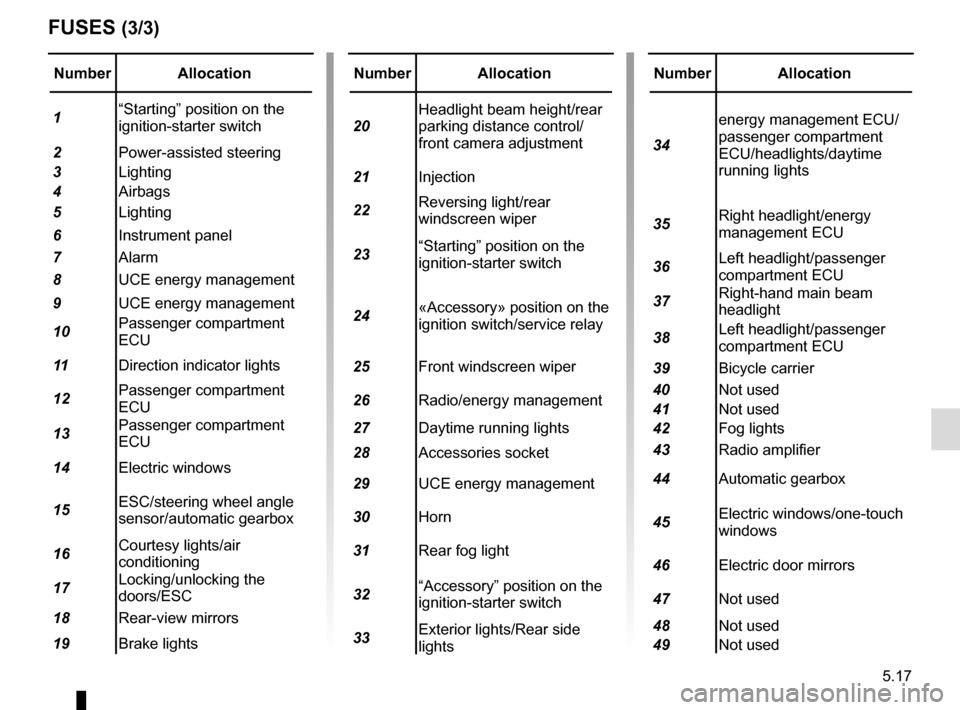
5.17
Number Allocation
1 “Starting” position on the
ignition-starter switch
2 Power-assisted steering
3 Lighting
4 Airbags
5 Lighting
6 Instrument panel
7 Alarm
8 UCE energy management
9 UCE energy management
10 Passenger compartment
ECU
11 Direction indicator lights
12 Passenger compartment
ECU
13 Passenger compartment
ECU
14 Electric windows
15 ESC/steering wheel angle
sensor/automatic gearbox
16 Courtesy lights/air
conditioning
17 Locking/unlocking the
doors/ESC
18 Rear-view mirrors
19 Brake lights
FUSES (3/3)
Number Allocation
20 Headlight beam height/rear
parking distance control/
front camera adjustment
21 Injection
22 Reversing light/rear
windscreen wiper
23 “Starting” position on the
ignition-starter switch
24 «Accessory» position on the
ignition switch/service relay
25 Front windscreen wiper
26 Radio/energy management
27 Daytime running lights
28 Accessories socket
29 UCE energy management
30 Horn
31 Rear fog light
32 “Accessory” position on the
ignition-starter switch
33 Exterior lights/Rear side
lightsNumber Allocation
34 energy management ECU/
passenger compartment
ECU/headlights/daytime
running lights
35 Right headlight/energy
management ECU
36 Left headlight/passenger
compartment ECU
37 Right-hand main beam
headlight
38 Left headlight/passenger
compartment ECU
39 Bicycle carrier
40 Not used
41 Not used
42 Fog lights
43 Radio amplifier
44 Automatic gearbox
45 Electric windows/one-touch
windows
46 Electric door mirrors
47 Not used
48 Not used
49 Not used
Page 183 of 216
5.25
TOWING: breakdown recovery (1/2)
Towing a vehicle with an
automatic gearbox
With the engine switched off, the trans-
mission is no longer lubricated. It is
preferable to tow this type of vehicle on
a trailer or tow it with the rear wheels off
the ground.
Under exceptional circumstances, you
may tow the vehicle with all four wheels
on the ground, only going forward, with
the gear lever in the neutral N position,
and for a distance not exceeding
30 miles (50 km).
If the gear lever cannot be put into the
N position, please consult an autho-
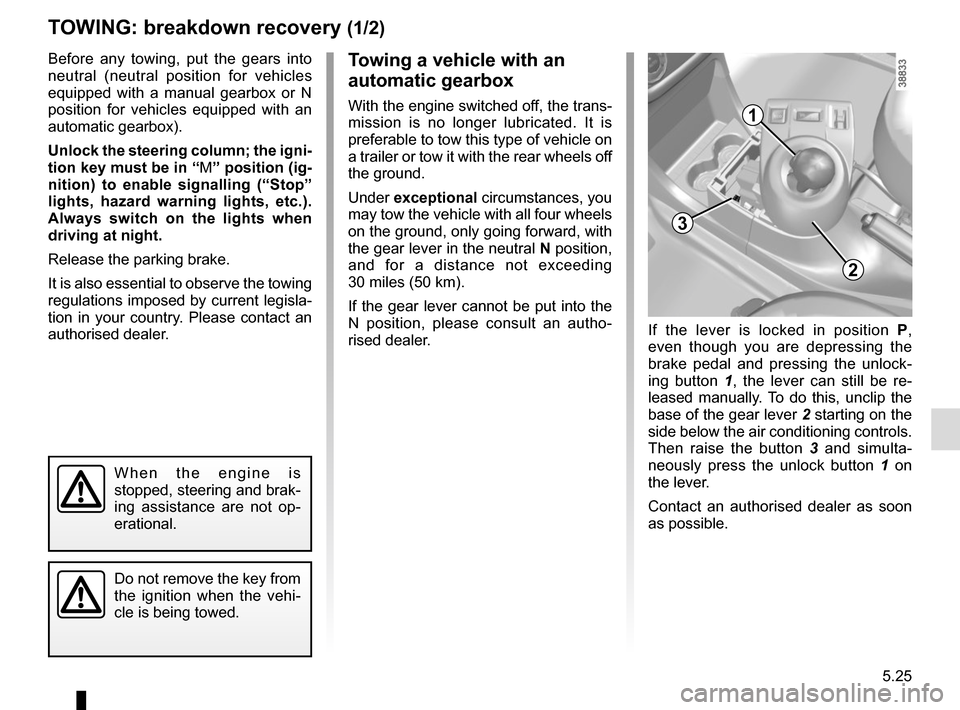
rised dealer.1
2
Before any towing, put the gears into
neutral (neutral position for vehicles
equipped with a manual gearbox or N
position for vehicles equipped with an
automatic gearbox).
Unlock the steering column; the igni-
tion key must be in “ M” position (ig-
nition) to enable signalling (“Stop”
lights, hazard warning lights, etc.).
Always switch on the lights when
driving at night.
Release the parking brake.
It is also essential to observe the towing
regulations imposed by current legisla-
tion in your country. Please contact an
authorised dealer.
When the engine is
stopped, steering and brak-
ing assistance are not op-
erational.
Do not remove the key from
the ignition when the vehi-
cle is being towed.
3
If the lever is locked in position P ,
even though you are depressing the
brake pedal and pressing the unlock-
ing button 1 , the lever can still be re-
leased manually. To do this, unclip the
base of the gear lever 2 starting on the
side below the air conditioning controls.
Then raise the button 3 and simulta-
neously press the unlock button 1 on
the lever.
Contact an authorised dealer as soon
as possible.
Page 186 of 216
5.28
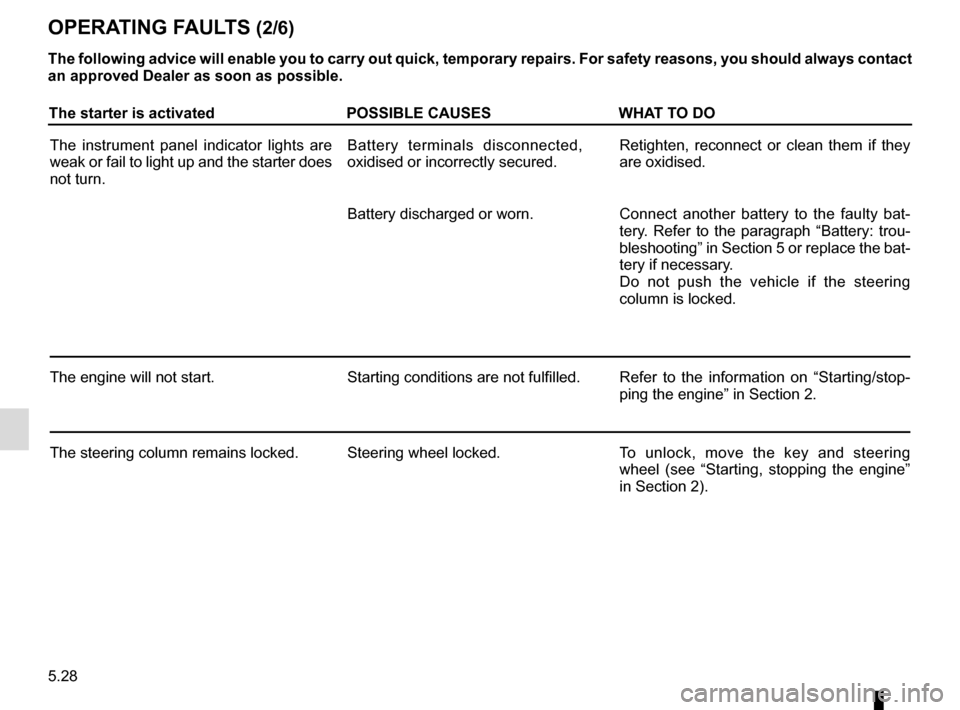
The starter is activatedPOSSIBLE CAUSESWHAT TO DO
The instrument panel indicator lights are
weak or fail to light up and the starter does
not turn. Battery terminals disconnected,
oxidised or incorrectly secured.
Retighten, reconnect or clean them if they
are oxidised.
Battery discharged or worn. Connect another battery to the faulty bat-
tery. Refer to the paragraph “Battery: trou-
bleshooting” in Section 5 or replace the bat-
tery if necessary.
Do not push the vehicle if the steering
column is locked.
The engine will not start. Starting conditions are not fulfilled.Refer to the information on “Starting/stop-
ping the engine” in Section 2.
The steering column remains locked. Steering wheel locked. To unlock, move the key and steering
wheel (see “Starting, stopping the engine”
in Section 2).
OPERATING FAULTS (2/6)
The following advice will enable you to carry out quick, temporary repai\
rs. For safety reasons, you should always contact
an approved Dealer as soon as possible.
Page 194 of 216

6.4
1,554*
1,454 (1)
1,430 (2)0,6302,4920,473
3,595
DIMENSIONS (in metres)
1,444 (1)
1,442 (2)
1,875(1) Vehicle with 15” wheels
(2) Vehicle with 16” wheels
* unladen
Page 212 of 216

rear bench seat.........................................................\
......... 3.22
rear lightsnumber plate lights ...................................................")
7.4
ALPHABETICAL INDEX (4/5)
rear bench seat.........................................................\
......... 3.22
rear lightsnumber plate lights ...................................................... 5.12
rear seats..............................................................\
............. 1.14 functions ..............................................................\
........ 3.22
rear view camera .................................................... 2.34 – 2.35
rear view mirrors ................................................................ 1.39
remote control door locking batteries ..............................................................\
......... 5.18
remote control door locking unit ................................1.2 → 1.4
RENAULT ANTI-INTRUDER DEVICE (RAID) ................... 1.10
replacement parts ................................................................ 6.7
reverse gear selecting ....................................................2.9, 2.36 → 2.38
reversing sensor ..................................................... 2.32 – 2.33
roof bars ........................................................................\
.... 3.27
roof rack roof bars ....................................................................... 3.27
running in ........................................................................\
..... 2.2
S
seat belt pretensioners front seat belt ...................................................1.15 → 1.18
seat belts .............................................1.12 → 1.18, 1.21, 1.48
service sheets..........................................................\
6.8 → 6.13
side indicator lights changing bulbs ............................................................. 5.13
side protection devices ...................................................... 1.20
signals and lights ...................................................1.58 → 1.63
speakers location ...............................................................\
......... 5.21
special features of petrol vehicles ....................................... 2.8
speed limiter .................................................1.47, 2.25 → 2.27
starting the engine .....................................................2.2 → 2.7
steering wheel adjustment .............................................................\
...... 1.22 Stop & Start ......................................................1.47, 2.4
→ 2.7
Stop & Start function..................................................2.4 → 2.7
stopping the engine ............................................................. 2.3
storage compartment.............................................3.16 → 3.19
storage compartments ...........................................3.16 → 3.19
sun visor ........................................................................\
.... 3.19
sunroof.................................................................\
.............. 3.14
switching on the vehicle ignition ................................. 2.2 – 2.3
T
tailgate ........................................................... 3.23, 3.25 – 3.26
tanks and reservoirs brake fluid ...................................................................... 4.9
coolant ................................................................\
........... 4.8
tanks and reservoirs: windscreen washer ...................................................... 4.10
technical specifications ..............................................6.4 → 6.7
telephone ..............................................................\
............. 3.28
temperature regulation ............................................ 3.7 → 3.11
towing breakdown ........................................................ 5.25 – 5.26
towing a caravan ................................................................. 6.6
towing hitch............................................................\
............ 5.26
towing rings ....................................................................... 3.26
towing weights ..................................................................... 6.6
transporting children ..........................1.23 – 1.24, 1.26 → 1.36
transporting objects in the luggage compartment ........................................ 3.26
on the roof ...................................................................... 6.6
trip computer and warning system... 1.44 → 1.48, 1.50 → 1.55
tyre inflation kit......................................................\
.....5.2 → 5.5
tyre pressure...............................2.16 → 2.18, 4.12 – 4.13, 5.7
tyre pressure loss warning.....................................2.16 → 2.18
tyre pressures ......................................................... 4.12 – 4.13
tyres ........................ 2.13, 2.16 → 2.18, 4.12 – 4.13, 5.6 → 5.8