instrument panel RENAULT TWINGO 2016 3.G Owner's Guide
[x] Cancel search | Manufacturer: RENAULT, Model Year: 2016, Model line: TWINGO, Model: RENAULT TWINGO 2016 3.GPages: 216, PDF Size: 7.15 MB
Page 175 of 216
5.17
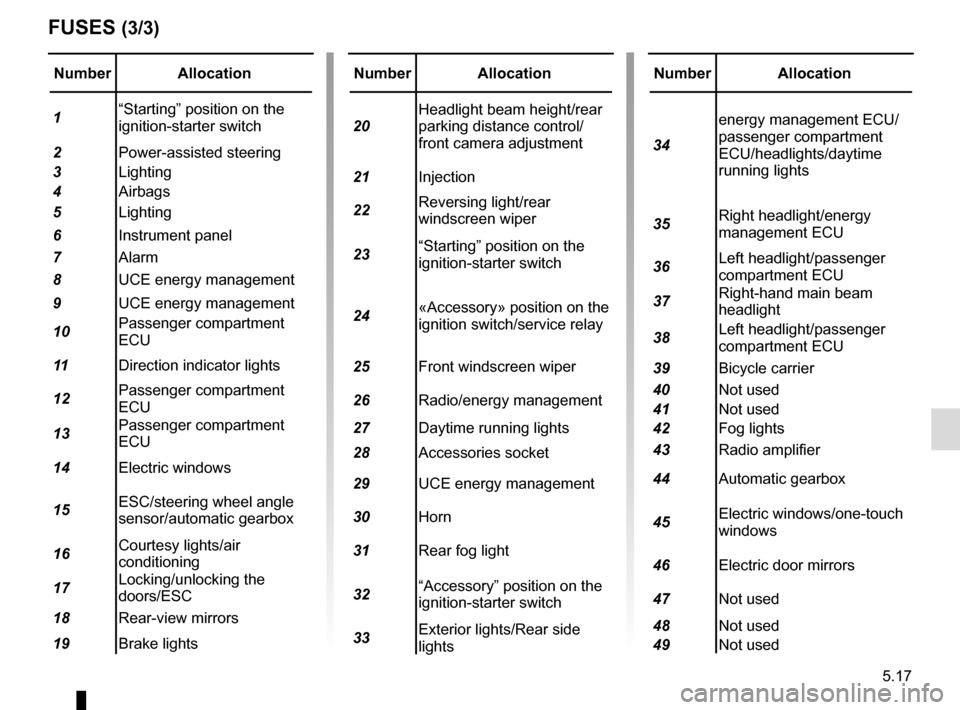
Number Allocation
1 “Starting” position on the
ignition-starter switch
2 Power-assisted steering
3 Lighting
4 Airbags
5 Lighting
6 Instrument panel
7 Alarm
8 UCE energy management
9 UCE energy management
10 Passenger compartment
ECU
11 Direction indicator lights
12 Passenger compartment
ECU
13 Passenger compartment
ECU
14 Electric windows
15 ESC/steering wheel angle
sensor/automatic gearbox
16 Courtesy lights/air
conditioning
17 Locking/unlocking the
doors/ESC
18 Rear-view mirrors
19 Brake lights
FUSES (3/3)
Number Allocation
20 Headlight beam height/rear
parking distance control/
front camera adjustment
21 Injection
22 Reversing light/rear
windscreen wiper
23 “Starting” position on the
ignition-starter switch
24 «Accessory» position on the
ignition switch/service relay
25 Front windscreen wiper
26 Radio/energy management
27 Daytime running lights
28 Accessories socket
29 UCE energy management
30 Horn
31 Rear fog light
32 “Accessory” position on the
ignition-starter switch
33 Exterior lights/Rear side
lightsNumber Allocation
34 energy management ECU/
passenger compartment
ECU/headlights/daytime
running lights
35 Right headlight/energy
management ECU
36 Left headlight/passenger
compartment ECU
37 Right-hand main beam
headlight
38 Left headlight/passenger
compartment ECU
39 Bicycle carrier
40 Not used
41 Not used
42 Fog lights
43 Radio amplifier
44 Automatic gearbox
45 Electric windows/one-touch
windows
46 Electric door mirrors
47 Not used
48 Not used
49 Not used
Page 186 of 216
5.28
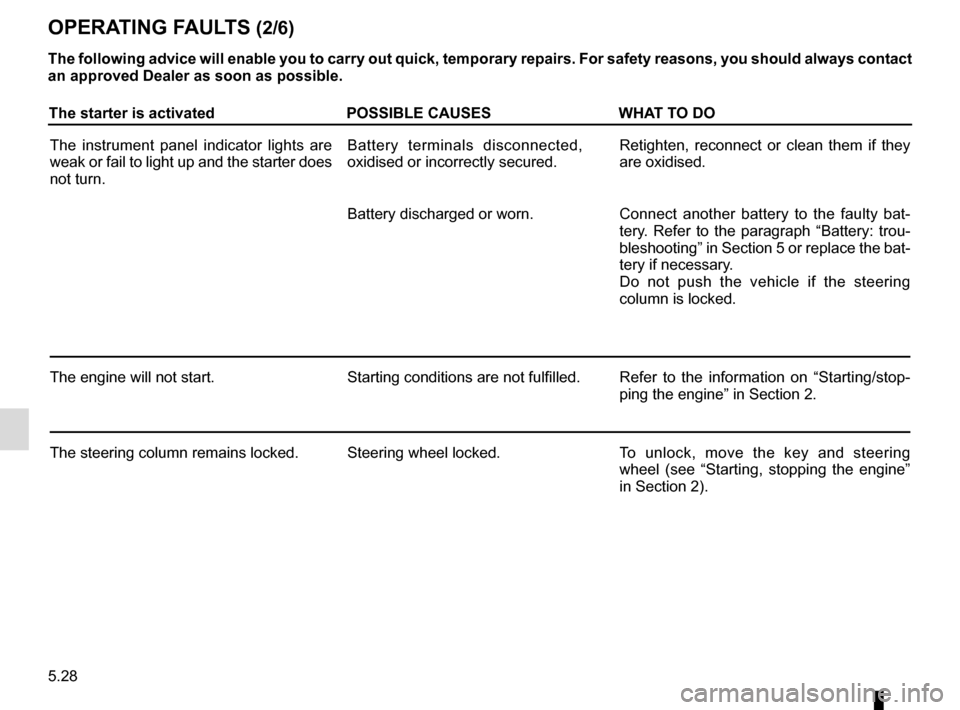
The starter is activatedPOSSIBLE CAUSESWHAT TO DO
The instrument panel indicator lights are
weak or fail to light up and the starter does
not turn. Battery terminals disconnected,
oxidised or incorrectly secured.
Retighten, reconnect or clean them if they
are oxidised.
Battery discharged or worn. Connect another battery to the faulty bat-
tery. Refer to the paragraph “Battery: trou-
bleshooting” in Section 5 or replace the bat-
tery if necessary.
Do not push the vehicle if the steering
column is locked.
The engine will not start. Starting conditions are not fulfilled.Refer to the information on “Starting/stop-
ping the engine” in Section 2.
The steering column remains locked. Steering wheel locked. To unlock, move the key and steering
wheel (see “Starting, stopping the engine”
in Section 2).
OPERATING FAULTS (2/6)
The following advice will enable you to carry out quick, temporary repai\
rs. For safety reasons, you should always contact
an approved Dealer as soon as possible.
Page 211 of 216

I
ignition switch ............................................................. 2.2 – 2.3
indicators ........................................................1.61,\
5.9")
7.3
ALPHABETICAL INDEX (3/5)
I
ignition switch ............................................................. 2.2 – 2.3
indicators ........................................................1.61,\
5.9 → 5.13
indicators: direction indicators ....................................................... 1.61
instrument panel ..............................................1.49 → 1.55
instrument panel ....................................................1.44 → 1.55
interior trim maintenance ..................................................... 4.16 – 4.17
Isofix .................................................................\
.....1.26 → 1.28
K
keys ...................................................................\
........1.2 → 1.4
L
lane departure warning ........................................... 2.23 – 2.24
levels .................................................................\
......4.8 → 4.10
levels: brake fluid ...................................................................... 4.9
coolant ................................................................\
........... 4.8
windscreen washer reservoir ....................................... 4.10
lighting: exterior .............................................................1.\
58 → 1.63
instrument panel .......................................................... 1.58
interior ...............................................................\
.. 3.15, 5.14
lights adjustment ........................................................ 1.62 – 1.63
changing bulbs .................................................... 5.9 – 5.10
front ..................................................................... 5.9 – 5.10
lights: adjusting ........................................................... 1.62 – 1.63
brake lights .................................................................. 5.12
dipped beam headlights ........... 1.44, 1.58, 5.9 – 5.10, 5.12
direction indicators ............................ 1.44, 1.61, 5.9 – 5.10
fog lights .................................................... 1.44, 1.60, 5.12
hazard warning ............................................................ 1.61 main beam headlights .................................. 1.44, 1.58, 5.9
reversing lights ............................................................. 5.12
side lights .......................................... 1.58, 5.9 – 5.10, 5.12
load permitted on the roof..............................................\
...... 6.6
locking the doors ..............................................1.4, 1.6 → 1.10
luggage compartment cover .............................................. 3.24
M
maintenance ............................................................\
.......... 2.14
maintenance: bodywork .......................................................... 4.14 – 4.15
interior trim ........................................................ 4.16 – 4.17
mechanical ......................................... 4.3, 4.11, 6.8 → 6.13
map reading lights ............................................................. 3.15
methods of restraint in addition to the seat belts ...1.15 → 1.21
multimedia equipment .............................................. 3.28, 5.21
N
navigation system .............................................................. 3.28
O
oil change ................................................................... 4.4 – 4.5
opening the doors ......................................................1.6 → 1.9
operating faults ................................ 1.44 → 1.48, 5.27 → 5.32
P
paintwork maintenance ..................................................... 4.14 – 4.15
parking distance control.......................................... 2.32 – 2.33
power-assisted steering.................................................\
.... 1.22
pretensioners .........................................................1\
.15 → 1.18
R
radio...................................................................\
................ 3.28
radio frequency remote control/key use ....................................................................\
...1.2 → 1.4