engine cover RENAULT TWINGO 2016 3.G Owners Manual
[x] Cancel search | Manufacturer: RENAULT, Model Year: 2016, Model line: TWINGO, Model: RENAULT TWINGO 2016 3.GPages: 216, PDF Size: 7.15 MB
Page 73 of 216
1.67
FUEL TANK (1/2)
A
B2
1
Fuel grade
Use a high-grade fuel that complies
with the legislation in force in each
country and which must comply with
the specifications given on the label
on the cover A. Please refer to the in-
formation on “Engine specifications” in
Section 6.
Useful capacity of fuel tank:
approximately 28 litres or 35 litres, de-
pending on the vehicle.
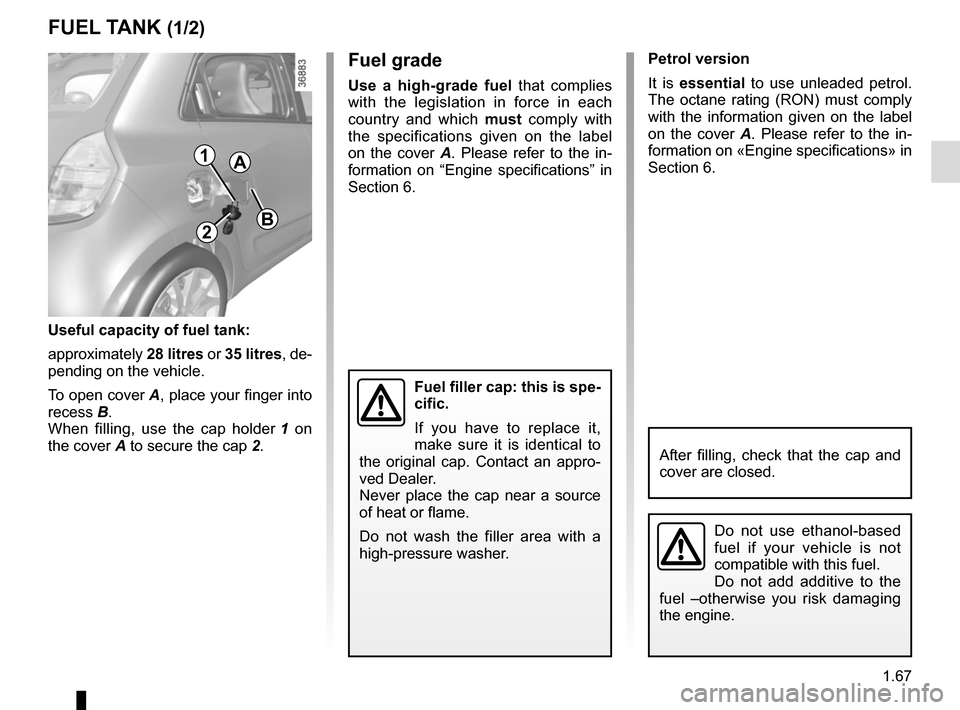
To open cover A, place your finger into
recess B.
When filling, use the cap holder 1 on
the cover A to secure the cap 2.
After filling, check that the cap and
cover are closed.
Fuel filler cap: this is spe-
cific.
If you have to replace it,
make sure it is identical to
the original cap. Contact an appro-
ved Dealer.
Never place the cap near a source
of heat or flame.
Do not wash the filler area with a
high-pressure washer.
Do not use ethanol-based
fuel if your vehicle is not
compatible with this fuel.
Do not add additive to the
fuel –otherwise you risk damaging
the engine.
Petrol version
It is essential to use unleaded petrol.
The octane rating (RON) must comply
with the information given on the label
on the cover A. Please refer to the in-
formation on «Engine specifications» in
Section 6.
Page 74 of 216
1.68
FUEL TANK (2/2)
Filling with fuel
With the ignition off, insert the nozzle
and insert it fully before turning it on to
fill the fuel tank (risk of splashing).
Keep the nozzle in this position
throughout the entire filling operation.
When the pump cuts out automatically
at the end of the filling procedure, a
maximum of two further filling attempts
may be made, as there must be suffi-
cient space in the fuel tank to allow for
expansion.
Make sure that no water enters the fuel
tank during filling. The cover A and its
surround must remain clean.
Petrol versions
Using leaded petrol will damage the
antipollution system and may lead to a
loss of warranty.
To ensure that the fuel tank is not filled
with leaded petrol, the fuel tank filler
neck contains a restrictor fitted with a
foolproof system which only allows
the nozzle for unleaded petrol to be
used (at the pump).
Vehicle fitted with the Stop and
Start function
To fill up with fuel, the engine must
be stopped (and not on standby):
stop the engine (please refer to the
information on “Starting and stop-
ping the engine” in Section 2).
Persistent fuel odour
If you notice a persistent
fuel odour you should:
– stop the vehicle as soon as traf- fic conditions allow and switch off
the ignition;
– switch on the hazard warning lights and ask your passengers to
leave the vehicle and stay clear
of the traffic;
– contact an approved Dealer.
No modifications what-
soever are permitted on
any part of the fuel supply
system (electronic units,
wiring, fuel circuit, injectors, pro-
tective covers, etc.) as this may be
dangerous (unless undertaken by
qualified Network personnel).
Page 88 of 216

2.14
MAINTENANCE AND ANTIPOLLUTION ADVICE
Your vehicle complies with criteria for
recycling and recovering vehicles at the
end of their service life which will come
into force in 2015.
Some parts of your vehicle have there-
fore been designed to facilitate future
recycling.
These parts are easy to remove so
that they can be recovered and reproc-
essed by recycling companies.
By virtue of its design, moderate fuel
consumption and initial settings, your
vehicle also conforms to current anti-
pollution regulations. The manufac-
turer is actively striving to reduce pol-
lutant exhaust gas emissions and to
save energy. But the fuel consumption
of your vehicle and the level of pollutant
exhaust gas emissions are also your
responsibility. Ensure that it is main-
tained and used correctly.
Maintenance
It is important to remember that fail-
ure to respect anti-pollution regulations
could lead to legal action being taken
against the vehicle owner.In addition, replacing engine, fuel
supply system and exhaust compo-
nents with parts other than those origi-
nally recommended by the manufac-
turer may alter your vehicle so that it
no longer complies with anti-pollution
regulations.
Have your vehicle adjusted and
checked by an authorised dealer, in ac-
cordance with the instructions given in
your maintenance schedule: they will
have all the equipment necessary for
ensuring that your vehicle is maintained
to its original standard.
Engine adjustments
– Spark plugs:
for optimum condi-
tions of use, output and performance
the specifications laid down by our
Design Department must be strictly
applied.
If the spark plugs have to be changed, use the make, type and gap specified
for your vehicle’s engine. Contact an
authorised dealer for this.
– Air filter, fuel filter: a choked ele-
ment will reduce efficiency. It must
be replaced.
– Ignition and idle speed: no adjust-
ment is needed.
Exhaust gas monitoring
system
The exhaust gas monitoring system will
detect any operating faults in the vehi-
cle’s antipollution system.
If this system malfunctions, toxic sub-
stances may be released into the at-
mosphere or damage may occur.
ÄThis warning light on the in-
strument panel will indicate if
there are any faults in the system:
This lights up when the ignition is
switched on and goes out when the
engine is started.
– If it lights up continuously, consult an approved Dealer as soon as possi-
ble;
– if it flashes, reduce the engine speed until the light stops flashing. Contact
an authorised dealer as soon as pos-
sible.
Page 146 of 216
4.6
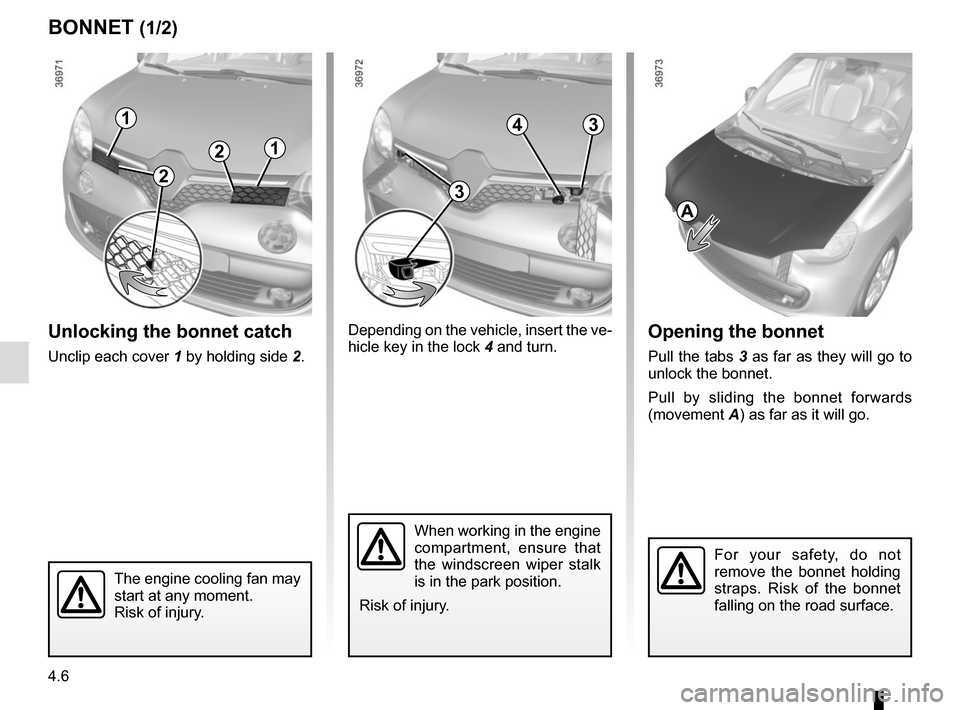
Unlocking the bonnet catch
Unclip each cover 1 by holding side 2.
BONNET (1/2)
1
The engine cooling fan may
start at any moment.
Risk of injury.
Opening the bonnet
Pull the tabs 3 as far as they will go to
unlock the bonnet.
Pull by sliding the bonnet forwards
(movement A) as far as it will go.
When working in the engine
compartment, ensure that
the windscreen wiper stalk
is in the park position.
Risk of injury.
A
43
3
For your safety, do not
remove the bonnet holding
straps. Risk of the bonnet
falling on the road surface.
Depending on the vehicle, insert the ve-
hicle key in the lock 4 and turn.
1
2
2
Page 167 of 216
5.9
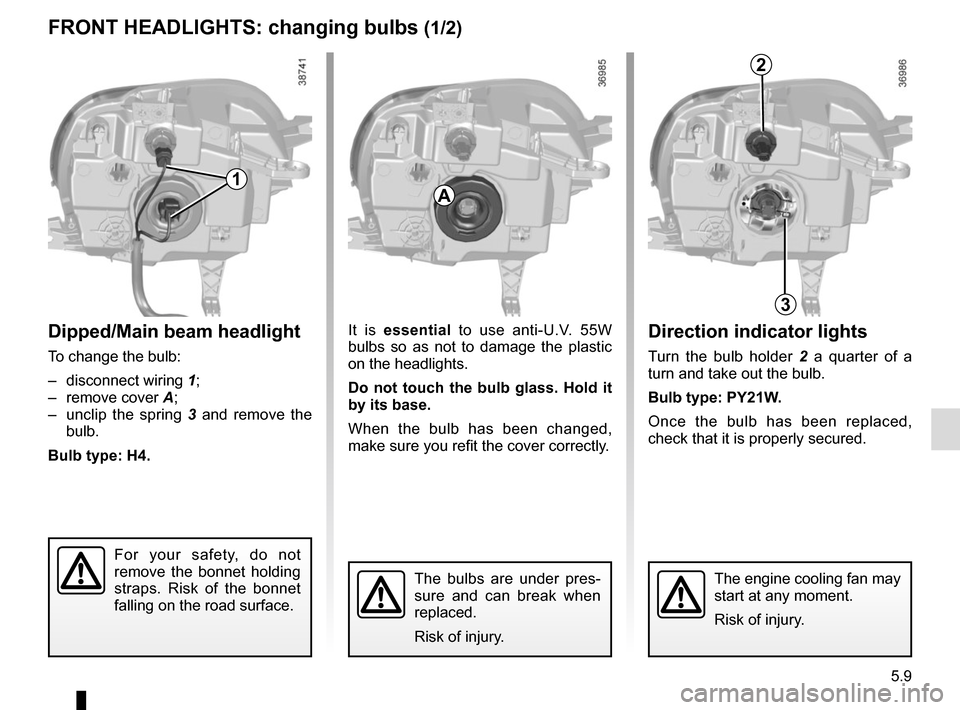
Direction indicator lights
Turn the bulb holder 2 a quarter of a
turn and take out the bulb.
Bulb type: PY21W.
Once the bulb has been replaced,
check that it is properly secured.
Dipped/Main beam headlight
To change the bulb:
– disconnect wiring 1;
– remove cover A;
– unclip the spring 3 and remove the
bulb.
Bulb type: H4.
FRONT HEADLIGHTS: changing bulbs (1/2)
The engine cooling fan may
start at any moment.
Risk of injury.
It is essential to use anti-U.V. 55W
bulbs so as not to damage the plastic
on the headlights.
Do not touch the bulb glass. Hold it
by its base.
When the bulb has been changed,
make sure you refit the cover correctly.
A
3
2
The bulbs are under pres-
sure and can break when
replaced.
Risk of injury.
1
For your safety, do not
remove the bonnet holding
straps. Risk of the bonnet
falling on the road surface.
Page 177 of 216
5.19
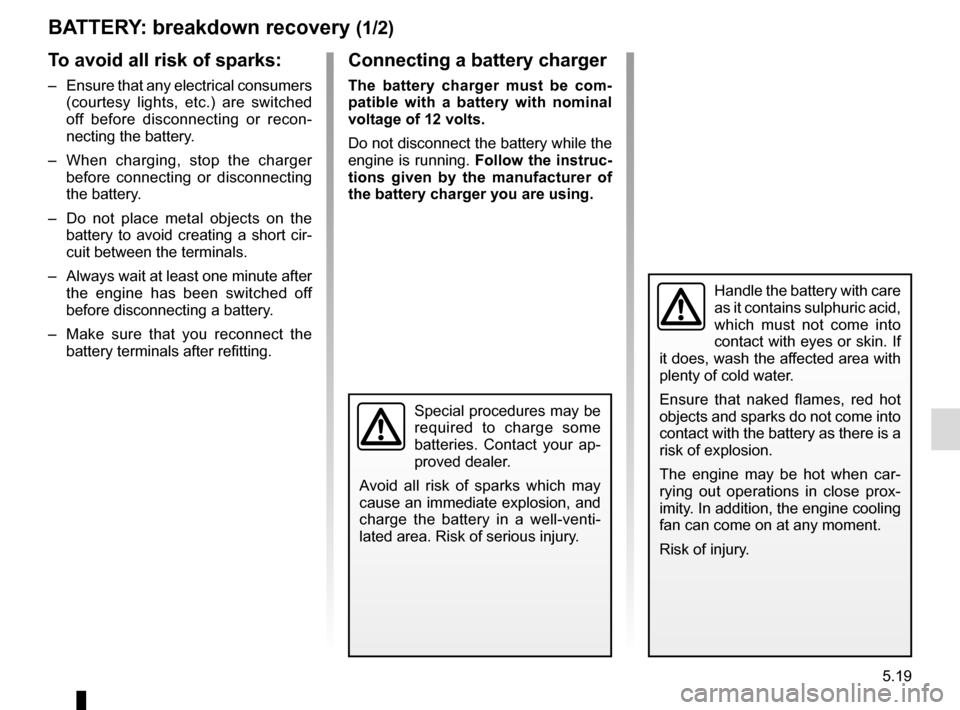
BATTERY: breakdown recovery (1/2)
To avoid all risk of sparks:
– Ensure that any electrical consumers (courtesy lights, etc.) are switched
off before disconnecting or recon-
necting the battery.
– When charging, stop the charger before connecting or disconnecting
the battery.
– Do not place metal objects on the battery to avoid creating a short cir-
cuit between the terminals.
– Always wait at least one minute after the engine has been switched off
before disconnecting a battery.
– Make sure that you reconnect the battery terminals after refitting.
Connecting a battery charger
The battery charger must be com-
patible with a battery with nominal
voltage of 12 volts.
Do not disconnect the battery while the
engine is running. Follow the instruc-
tions given by the manufacturer of
the battery charger you are using.
Special procedures may be
required to charge some
batteries. Contact your ap-
proved dealer.
Avoid all risk of sparks which may
cause an immediate explosion, and
charge the battery in a well-venti-
lated area. Risk of serious injury.
Handle the battery with care
as it contains sulphuric acid,
which must not come into
contact with eyes or skin. If
it does, wash the affected area with
plenty of cold water.
Ensure that naked flames, red hot
objects and sparks do not come into
contact with the battery as there is a
risk of explosion.
The engine may be hot when car-
rying out operations in close prox-
imity. In addition, the engine cooling
fan can come on at any moment.
Risk of injury.
Page 178 of 216
5.20
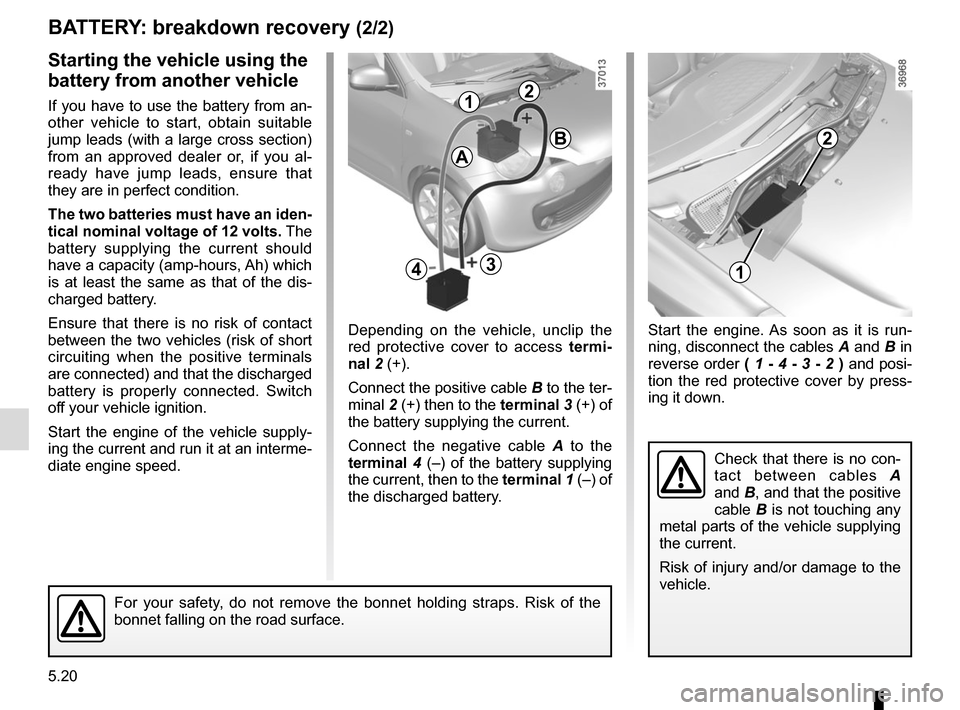
Start the engine. As soon as it is run-
ning, disconnect the cables A and B in
reverse order ( 1 - 4 - 3 - 2 ) and posi-
tion the red protective cover by press-
ing it down.
BATTERY: breakdown recovery (2/2)
Depending on the vehicle, unclip the
red protective cover to access termi-
nal 2 (+).
Connect the positive cable B to the ter-
minal 2 (+) then to the terminal 3 (+) of
the battery supplying the current.
Connect the negative cable A to the
terminal 4 (–) of the battery supplying
the current, then to the terminal 1 (–) of
the discharged battery.
Starting the vehicle using the
battery from another vehicle
If you have to use the battery from an-
other vehicle to start, obtain suitable
jump leads (with a large cross section)
from an approved dealer or, if you al-
ready have jump leads, ensure that
they are in perfect condition.
The two batteries must have an iden-
tical nominal voltage of 12 volts. The
battery supplying the current should
have a capacity (amp-hours, Ah) which
is at least the same as that of the dis-
charged battery.
Ensure that there is no risk of contact
between the two vehicles (risk of short
circuiting when the positive terminals
are connected) and that the discharged
battery is properly connected. Switch
off your vehicle ignition.
Start the engine of the vehicle supply-
ing the current and run it at an interme-
diate engine speed.
Check that there is no con-
tact between cables A
and B, and that the positive
cable B is not touching any
metal parts of the vehicle supplying
the current.
Risk of injury and/or damage to the
vehicle.
1
2
21
3
B
A
4
For your safety, do not remove the bonnet holding straps. Risk of the
bonnet falling on the road surface.
Page 183 of 216
5.25
TOWING: breakdown recovery (1/2)
Towing a vehicle with an
automatic gearbox
With the engine switched off, the trans-
mission is no longer lubricated. It is
preferable to tow this type of vehicle on
a trailer or tow it with the rear wheels off
the ground.
Under exceptional circumstances, you
may tow the vehicle with all four wheels
on the ground, only going forward, with
the gear lever in the neutral N position,
and for a distance not exceeding
30 miles (50 km).
If the gear lever cannot be put into the
N position, please consult an autho-
rised dealer.1
2
Before any towing, put the gears into
neutral (neutral position for vehicles
equipped with a manual gearbox or N
position for vehicles equipped with an
automatic gearbox).
Unlock the steering column; the igni-
tion key must be in “ M” position (ig-
nition) to enable signalling (“Stop”
lights, hazard warning lights, etc.).
Always switch on the lights when
driving at night.
Release the parking brake.
It is also essential to observe the towing
regulations imposed by current legisla-
tion in your country. Please contact an
authorised dealer.
When the engine is
stopped, steering and brak-
ing assistance are not op-
erational.
Do not remove the key from
the ignition when the vehi-
cle is being towed.
3
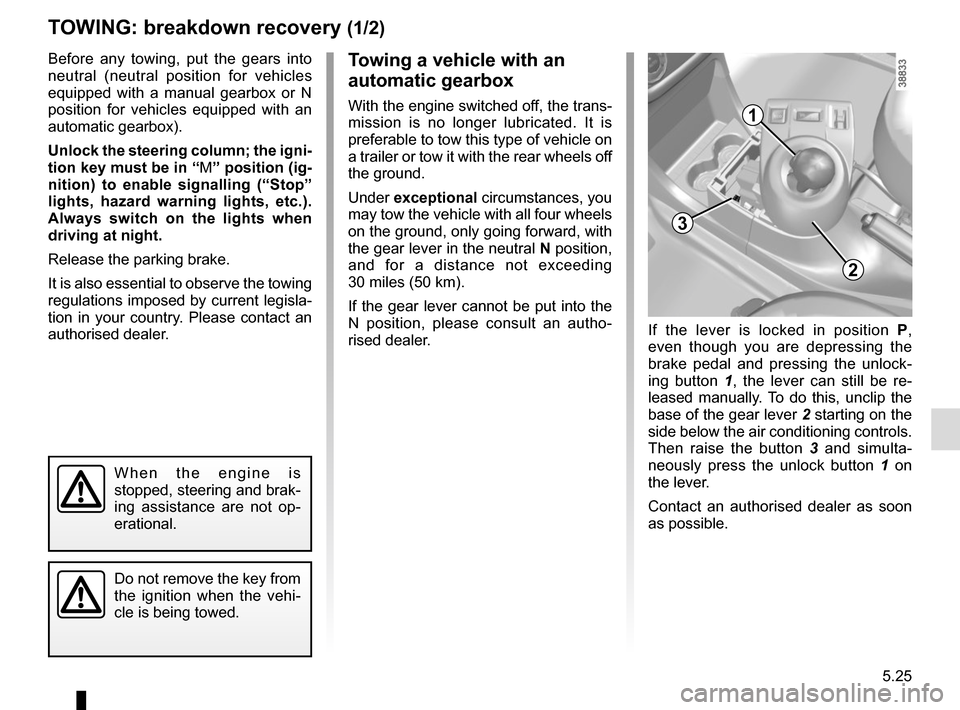
If the lever is locked in position P ,
even though you are depressing the
brake pedal and pressing the unlock-
ing button 1 , the lever can still be re-
leased manually. To do this, unclip the
base of the gear lever 2 starting on the
side below the air conditioning controls.
Then raise the button 3 and simulta-
neously press the unlock button 1 on
the lever.
Contact an authorised dealer as soon
as possible.
Page 210 of 216
7.2
ALPHABETICAL INDEX (2/5)
driving recommendations ......................................2.10 → 2.13
E
ECO driving ...........................................................2.10 → 2.13
ECO mode ........................................................................\
. 2.11
electric beam height adjustment ............................. 1.62 – 1.63
electric windows ..................................................... 3.12 – 3.13
electronic stability control: ESC .............................2.19 → 2.22
emergency brake assist.........................................2.19 → 2.22
emergency braking ................................................2.19 → 2.22
engine access .................................................................\
........... 4.2
technical specifications .................................................. 6.5
engine access flap ............................................................... 4.2
engine coolant ..................................................................... 4.8
engine oil ...................................................................4.3 → 4.5
engine oil capacity ...................................................... 4.4 – 4.5
engine oil level ...........................................................4.3 → 4.5
engine specifications .................................................... 6.3, 6.5
engine standby ..........................................................2.4 → 2.7
environment ............................................................\
........... 2.15
ESC: electronic stability control ....................1.46, 2.19 → 2.22
external temperature ......................................................... 1.57
F
faults operating faults ................................................5.27 → 5.32
filter air filter ........................................................................\
. 4.10
oil filter .................................................................. 4.4 – 4.5
passenger compartment filter ...................................... 4.10
fitting a radio ...................................................................... 5.21
fittings ...............................................................\
.....3.16 → 3.19
front engine cover ....................................................... 4.6 – 4.7
front passenger air bag deactivation ................................. 1.36
front seat adjustment ......................................................... 1.11 front seats
adjustment ........................................................ 1.11 – 1.12
fuel advice on fuel economy ...................................2.10 → 2.13
consumption ................................1.52 – 1.53, 2.10 → 2.13
filling ......................................................... 1.44, 1.67 – 1.68
grade ................................................................. 1.67 – 1.68
fuel consumption ...............................1.52 – 1.53, 2.10 → 2.13
fuel economy .........................................................2.10 → 2.13
fuel filler cap ........................................................... 1.67 – 1.68
fuel level ................................................................... 1.44, 1.49
fuel tank capacity ...............................................................\
......... 1.67
fuel tank capacity .................................................... 1.67 – 1.68
fuses ..................................................................\
....5.15 → 5.17
G
gear lever..............................................................\
............... 2.9
glove box ........................................................................\
... 3.16
H
handbrake...............................................................\
............. 2.9
hands-free telephone integrated control ............................ 3.28
hazard warning lights signal .............................................. 1.61
headlight beam adjustment .................................... 1.62 – 1.63
headrest................................................................\
............. 3.21
heated seats ...................................................................... 1.11
heated windscreen ..................................................3.7 → 3.10
heating and air conditioning system ........................ 3.4 → 3.11
heating system ........................................................ 3.4 → 3.11
Hill Start Assist.......................................................2.19 → 2.22
horn ...................................................................\
................ 1.61
horn: flash ..................................................................\
........... 1.61