warning RENAULT TWIZY 2017 1.G User Guide
[x] Cancel search | Manufacturer: RENAULT, Model Year: 2017, Model line: TWIZY, Model: RENAULT TWIZY 2017 1.GPages: 118, PDF Size: 2.48 MB
Page 40 of 118
1.34
Low traction battery level
warning light
This comes on when the traction bat-
tery charge level has reached the re-
serve threshold. Please see the infor-
mation on “Displays and indicators” in
Section 1.
\bElectrotechnical system
warning light
If it lights up while driving, this means
there is an electrotechnical fault in the
“58 volt” electrical circuit. Please see an
authorised dealer as soon as possible.
When the vehicle is started or while
driving, if it flashes accompanied by
the
® warning light and a beep,
this indicates that the charging flap is
open or not correctly closed. Stop and
switch off the ignition, make sure that
the charging cord is disconnected and
that the flap is fully closed.
©Not used
ERROR Not used
+ Not used
WARNING LIGHTS (3/3)
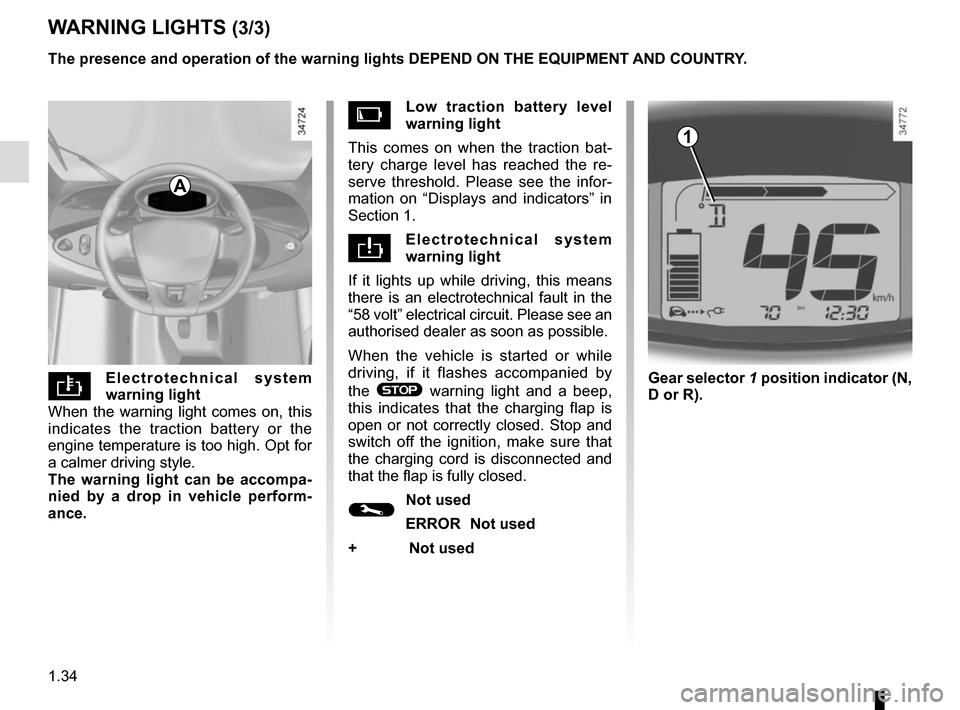
Electrotechnical system
warning light
When the warning light comes on, this
indicates the traction battery or the
engine temperature is too high. Opt for
a calmer driving style.
The warning light can be accompa-
nied by a drop in vehicle perform-
ance. The presence and operation of the warning lights DEPEND ON THE EQUIPMENT\
AND COUNTRY.
A
Gear selector 1 position indicator (N,
D or R).
1
Page 41 of 118
1.35
DISPLAYS AND INDICATORS (1/2)
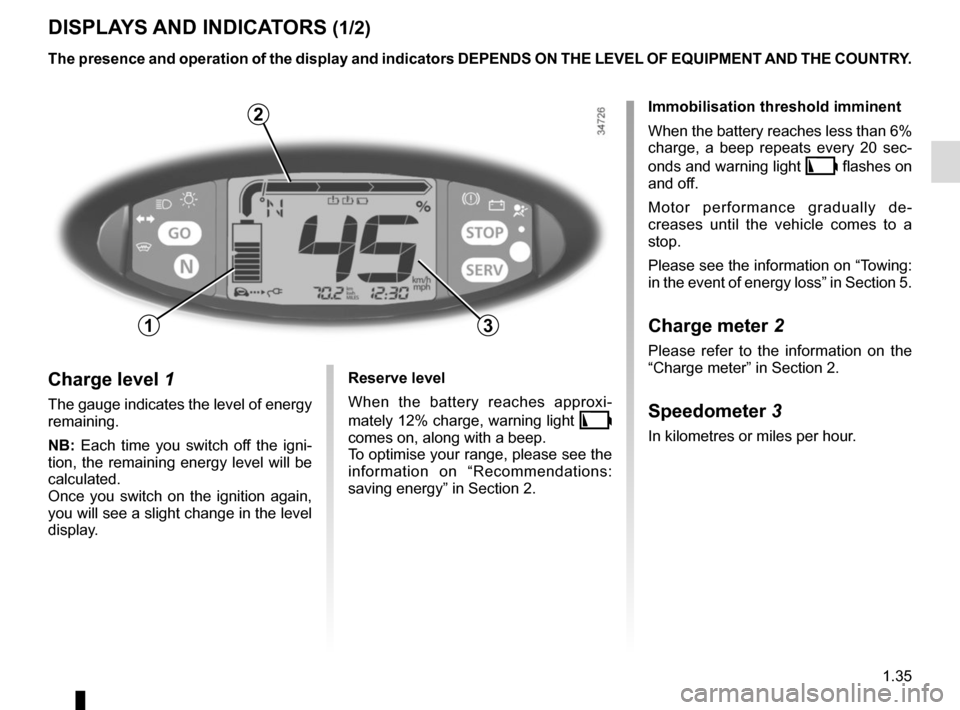
Charge level 1
The gauge indicates the level of energy
remaining.
NB: Each time you switch off the igni-
tion, the remaining energy level will be
calculated.
Once you switch on the ignition again,
you will see a slight change in the level
display. The presence and operation of the display and indicators DEPENDS ON THE \
LEVEL OF EQUIPMENT AND THE COUNTRY.
Immobilisation threshold imminent
When the battery reaches less than 6%
charge, a beep repeats every 20 sec-
onds and warning light
Ṏ flashes on
and off.
Motor performance gradually de-
creases until the vehicle comes to a
stop.
Please see the information on “Towing:
in the event of energy loss” in Section 5.
Charge meter 2
Please refer to the information on the
“Charge meter” in Section 2.
Speedometer 3
In kilometres or miles per hour.
1
2
3
Reserve level
When the battery reaches approxi-
mately 12% charge, warning light
Ṏ
comes on, along with a beep.
To optimise your range, please see the
information on “Recommendations:
saving energy” in Section 2.
Page 44 of 118
1.38
AUDIBLE AND VISUAL SIGNALS
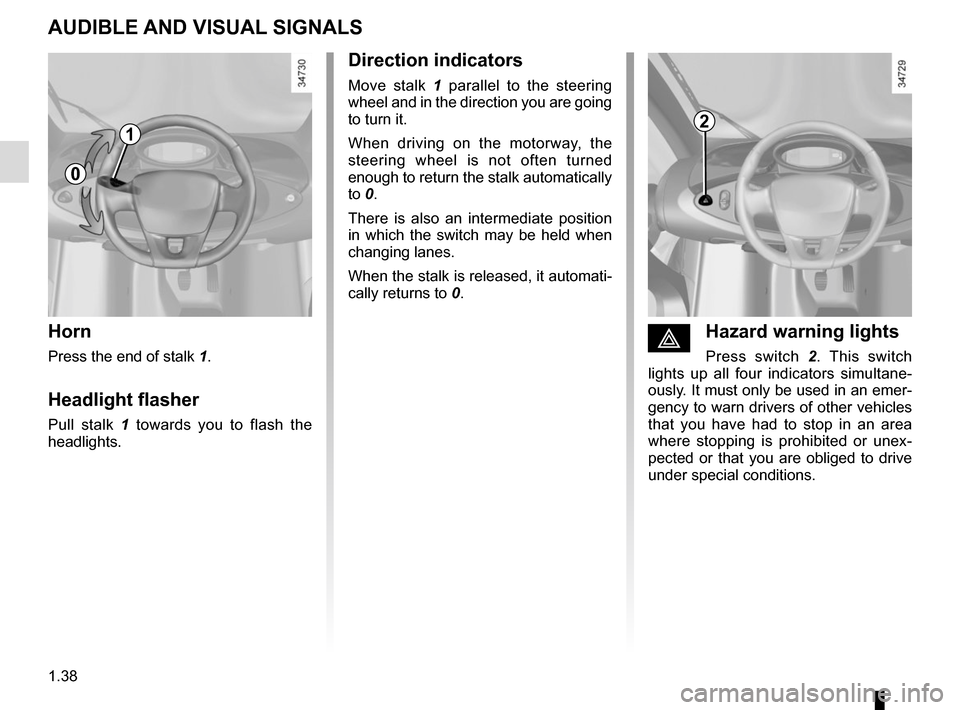
Horn
Press the end of stalk 1.
Headlight flasher
Pull stalk 1 towards you to flash the
headlights.
éHazard warning lights
Press switch 2 . This switch
lights up all four indicators simultane-
ously. It must only be used in an emer-
gency to warn drivers of other vehicles
that you have had to stop in an area
where stopping is prohibited or unex-
pected or that you are obliged to drive
under special conditions.
Direction indicators
Move stalk 1 parallel to the steering
wheel and in the direction you are going
to turn it.
When driving on the motorway, the
steering wheel is not often turned
enough to return the stalk automatically
to 0.
There is also an intermediate position
in which the switch may be held when
changing lanes.
When the stalk is released, it automati-
cally returns to 0.
21
0
Page 47 of 118
1.41
EXTERIOR LIGHTING AND SIGNALS (2/2)
Lights-on warning buzzerIf the stalk is not returned to its ini-
tial position
e after the ignition is
switched off, a warning beep sounds
four times to warn you.
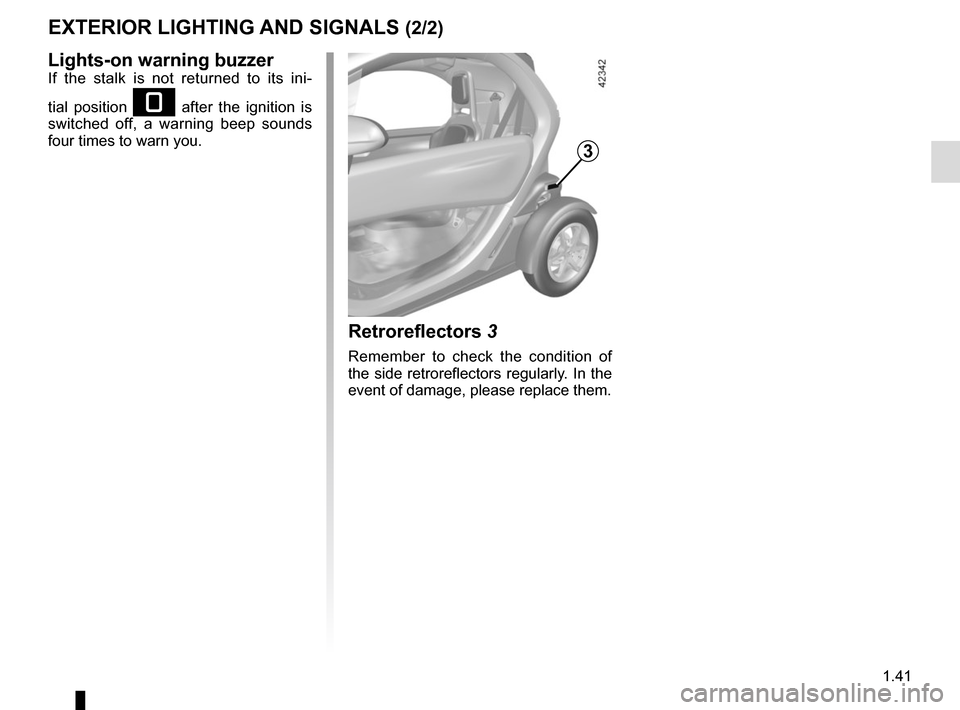
Retroreflectors 3
Remember to check the condition of
the side retroreflectors regularly. In the
event of damage, please replace them.
3
Page 50 of 118
2.2
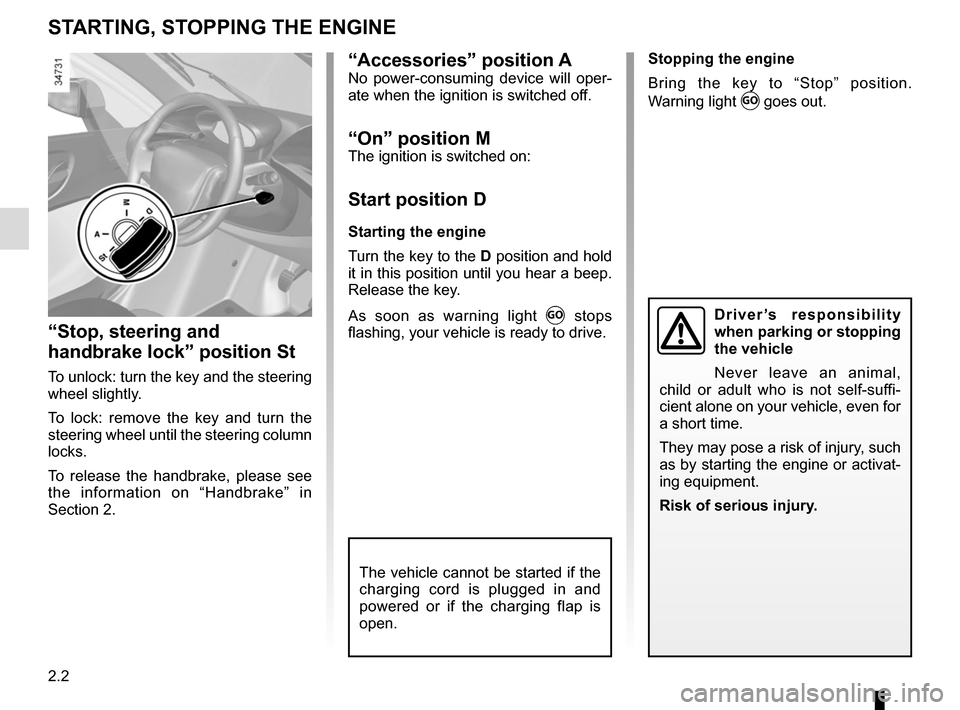
“Accessories” position ANo power-consuming device will oper-
ate when the ignition is switched off.
“On” position MThe ignition is switched on:
Start position D
Starting the engine
Turn the key to the D position and hold
it in this position until you hear a beep.
Release the key.
As soon as warning light
Ṑ stops
flashing, your vehicle is ready to drive.“Stop, steering and
handbrake lock” position St
To unlock: turn the key and the steering
wheel slightly.
To lock: remove the key and turn the
steering wheel until the steering column
locks.
To release the handbrake, please see
the information on “Handbrake” in
Section 2.
STARTING, STOPPING THE ENGINE
The vehicle cannot be started if the
charging cord is plugged in and
powered or if the charging flap is
open.
Stopping the engine
Bring the key to “Stop” position.
Warning light
Ṑ goes out.
Driver’s responsibility
when parking or stopping
the vehicle
Never leave an animal,
child or adult who is not self-suffi-
cient alone on your vehicle, even for
a short time.
They may pose a risk of injury, such
as by starting the engine or activat-
ing equipment.
Risk of serious injury.
Page 52 of 118
2.4
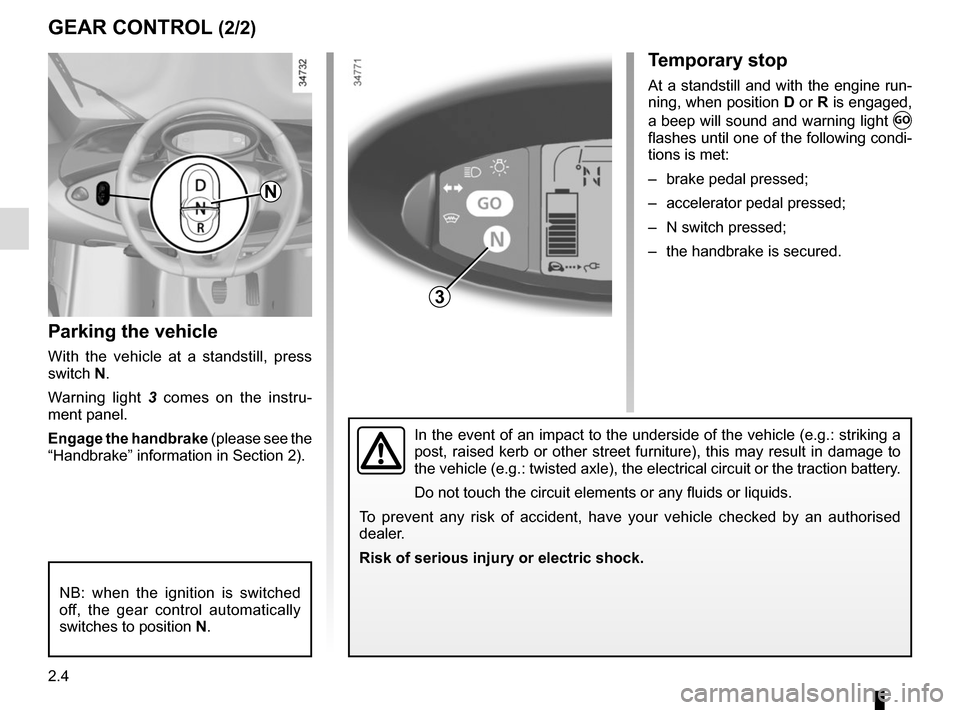
Parking the vehicle
With the vehicle at a standstill, press
switch N.
Warning light 3 comes on the instru-
ment panel.
Engage the handbrake (please see the
“Handbrake” information in Section 2).
GEAR CONTROL (2/2)
In the event of an impact to the underside of the vehicle (e.g.: striki\
ng a
post, raised kerb or other street furniture), this may result in damage\
to
the vehicle (e.g.: twisted axle), the electrical circuit or the tracti\
on battery.
Do not touch the circuit elements or any fluids or liquids.
To prevent any risk of accident, have your vehicle checked by an authoris\
ed
dealer.
Risk of serious injury or electric shock.
N
3
NB: when the ignition is switched
off, the gear control automatically
switches to position N.
Temporary stop
At a standstill and with the engine run-
ning, when position D or R is engaged,
a beep will sound and warning light
Ṑ
flashes until one of the following condi-
tions is met:
– brake pedal pressed;
– accelerator pedal pressed;
– N switch pressed;
– the handbrake is secured.
Page 53 of 118
2.5
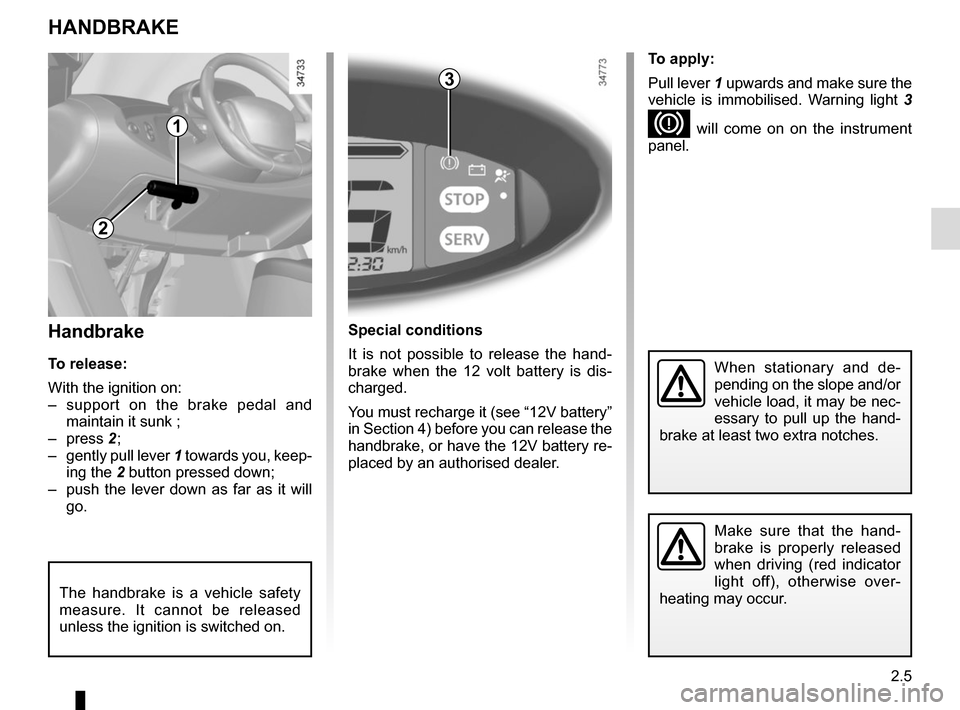
Handbrake
To release:
With the ignition on:
– support on the brake pedal and maintain it sunk ;
– press 2 ;
– gently pull lever 1 towards you, keep-
ing the 2 button pressed down;
– push the lever down as far as it will go.When stationary and de-
pending on the slope and/or
vehicle load, it may be nec-
essary to pull up the hand-
brake at least two extra notches.
Make sure that the hand-
brake is properly released
when driving (red indicator
light off), otherwise over-
heating may occur.
1
2
HANDBRAKE
To apply:
Pull lever 1 upwards and make sure the
vehicle is immobilised. Warning light 3
D will come on on the instrument
panel.
3
Special conditions
It is not possible to release the hand-
brake when the 12 volt battery is dis-
charged.
You must recharge it (see “12V battery”
in Section 4) before you can release the
handbrake, or have the 12V battery re-
placed by an authorised dealer.
The handbrake is a vehicle safety
measure. It cannot be released
unless the ignition is switched on.
Page 60 of 118
3.2
WINDSCREEN DE-ICING, DEMISTING
1
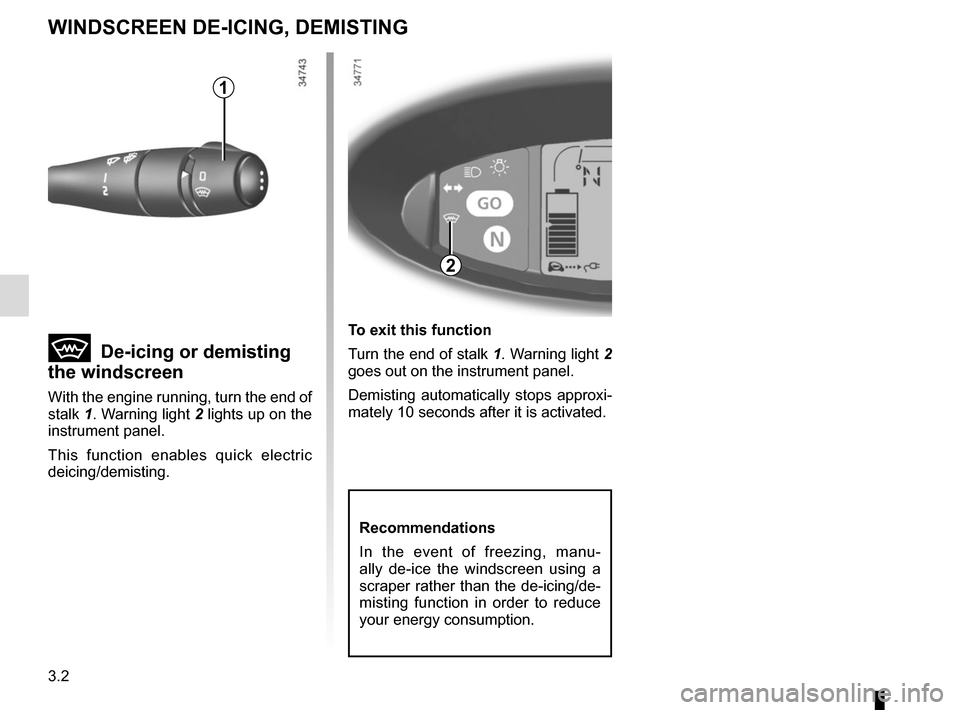
De-icing or demisting
the windscreen
With the engine running, turn the end of
stalk 1. Warning light 2 lights up on the
instrument panel.
This function enables quick electric
deicing/demisting.
To exit this function
Turn the end of stalk 1. Warning light 2
goes out on the instrument panel.
Demisting automatically stops approxi-
mately 10 seconds after it is activated.
2
Recommendations
In the event of freezing, manu-
ally de-ice the windscreen using a
scraper rather than the de-icing/de-
misting function in order to reduce
your energy consumption.
Page 69 of 118
4.5
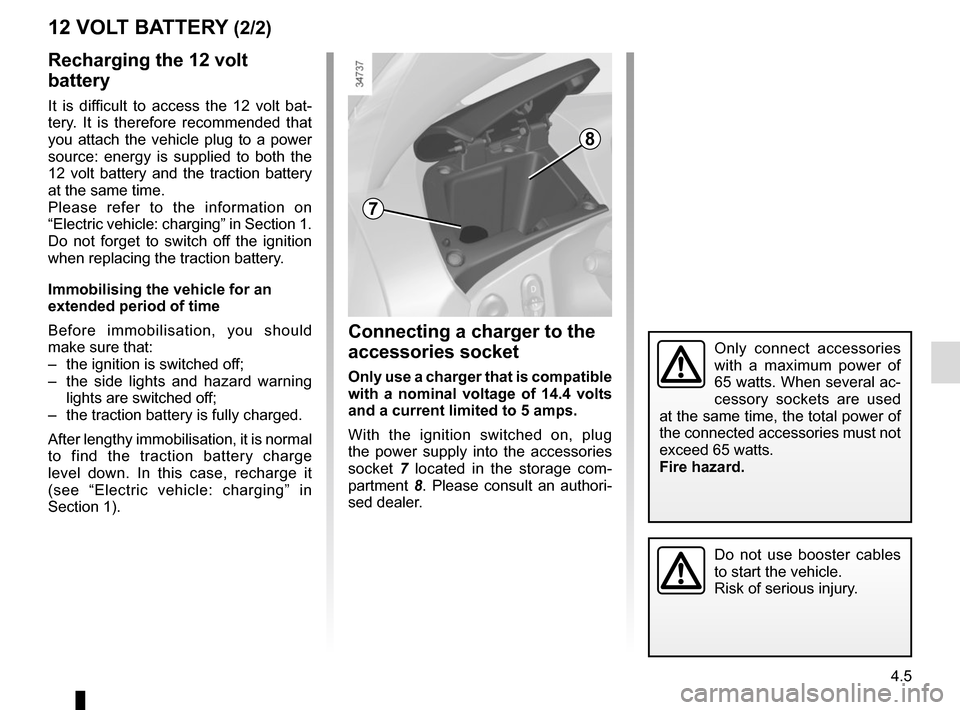
12 VOLT BATTERY (2/2)Connecting a charger to the
accessories socket
Only use a charger that is compatible
with a nominal voltage of 14.4 volts
and a current limited to 5 amps.
With the ignition switched on, plug
the power supply into the accessories
socket 7 located in the storage com-
partment 8. Please consult an authori-
sed dealer.
Recharging the 12 volt
battery
It is difficult to access the 12 volt bat-
tery. It is therefore recommended that
you attach the vehicle plug to a power
source: energy is supplied to both the
12 volt battery and the traction battery
at the same time.
Please refer to the information on
“Electric vehicle: charging” in Section 1.
Do not forget to switch off the ignition
when replacing the traction battery.
Immobilising the vehicle for an
extended period of time
Before immobilisation, you should
make sure that:
– the ignition is switched off;
– the side lights and hazard warning lights are switched off;
– the traction battery is fully charged.
After lengthy immobilisation, it is normal
to find the traction battery charge
level down. In this case, recharge it
(see “Electric vehicle: charging” in
Section 1).
Do not use booster cables
to start the vehicle.
Risk of serious injury.
8
7
Only connect accessories
with a maximum power of
65 watts. When several ac-
cessory sockets are used
at the same time, the total power of
the connected accessories must not
exceed 65 watts.
Fire hazard.
Page 76 of 118
5.2
TYRES (1/4)
The tyres are the only contact between
the vehicle and the road, so it is essen-
tial to keep them in good condition.
You must make sure that your tyres
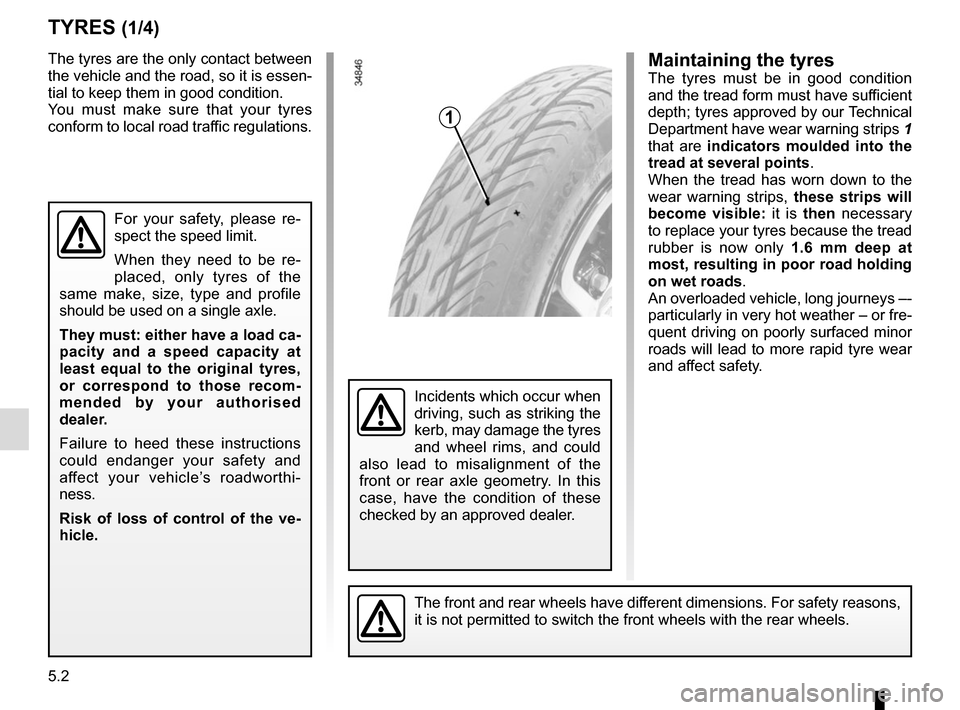
conform to local road traffic regulations.Maintaining the tyresThe tyres must be in good condition
and the tread form must have sufficient
depth; tyres approved by our Technical
Department have wear warning strips 1
that are indicators moulded into the
tread at several points.
When the tread has worn down to the
wear warning strips, these strips will
become visible: it is then necessary
to replace your tyres because the tread
rubber is now only 1.6 mm deep at
most, resulting in poor road holding
on wet roads.
An overloaded vehicle, long journeys –-
particularly in very hot weather – or fre-
quent driving on poorly surfaced minor
roads will lead to more rapid tyre wear
and affect safety.
For your safety, please re-
spect the speed limit.
When they need to be re-
placed, only tyres of the
same make, size, type and profile
should be used on a single axle.
They must: either have a load ca-
pacity and a speed capacity at
least equal to the original tyres,
or correspond to those recom-
mended by your authorised
dealer.
Failure to heed these instructions
could endanger your safety and
affect your vehicle’s roadworthi-
ness.
Risk of loss of control of the ve-
hicle.
Incidents which occur when
driving, such as striking the
kerb, may damage the tyres
and wheel rims, and could
also lead to misalignment of the
front or rear axle geometry. In this
case, have the condition of these
checked by an approved dealer.
1
The front and rear wheels have different dimensions. For safety reasons,
it is not permitted to switch the front wheels with the rear wheels.