air condition RENAULT WIND 2012 1.G User Guide
[x] Cancel search | Manufacturer: RENAULT, Model Year: 2012, Model line: WIND, Model: RENAULT WIND 2012 1.GPages: 185, PDF Size: 5.52 MB
Page 97 of 185
JauneNoirNoir texte
3.13
ENG_UD11200_1
Air conditionné automatique (E33 - X33 - Renault)
ENG_NU_865-6_E33_Renault_3
autoMatiC CliMate ContRol (2/6)
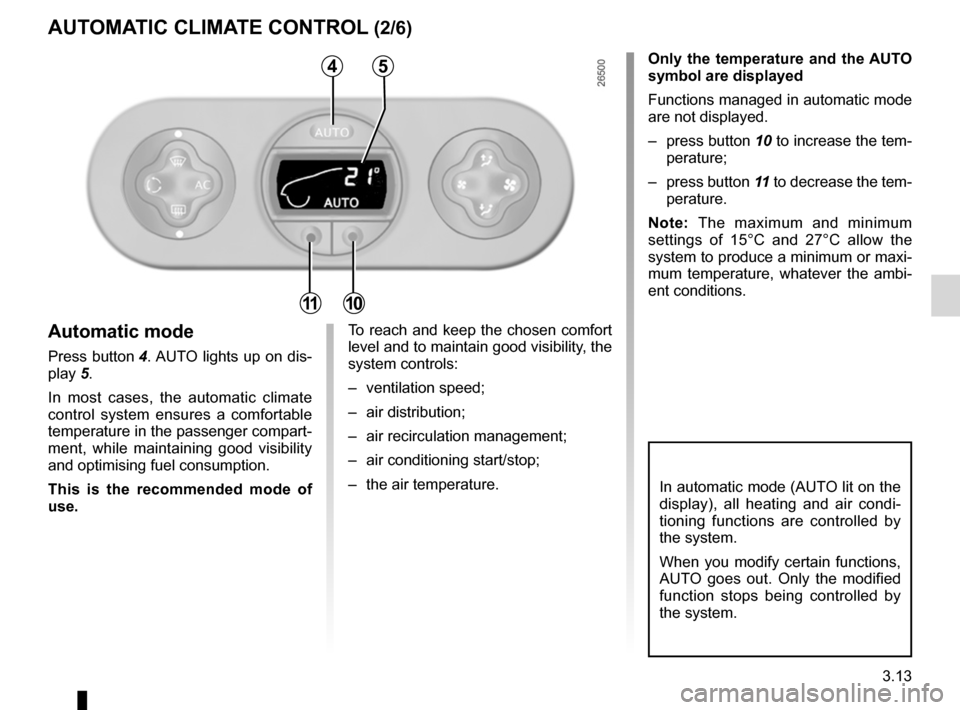
only the temperature and the auto
symbol are displayed
Functions managed in automatic mode
are not displayed.
– press button 10 to increase the tem-
perature;
– press button 11 to decrease the tem-
perature.
n ote: The maximum and minimum
settings of 15°C and 27°C allow the
system to produce a minimum or maxi-
mum temperature, whatever the ambi-
ent conditions.
In automatic mode (AUTO lit on the
display), all heating and air condi -
tioning functions are controlled by
the system.
When you modify certain functions,
AUTO goes out. Only the modified
function stops being controlled by
the system.
To reach and keep the chosen comfort
level and to maintain good visibility, the
system controls:
– ventilation speed;
– air distribution;
– air recirculation management;
– air conditioning start/stop;
– the air temperature.automatic mode
Press button 4. AUTO lights up on dis-
play 5.
In most cases, the automatic climate
control system ensures a comfortable
temperature in the passenger compart-
ment, while maintaining good visibility
and optimising fuel consumption.
this is the recommended mode of
use.
45
1011
Page 98 of 185
3.14
ENG_UD11200_1
Air conditionné automatique (E33 - X33 - Renault)
ENG_NU_865-6_E33_Renault_3
Jaune NoirNoir texte
autoMatiC CliMate ContRol (3/6)
adjusting automatic mode
The system normally operates in auto-
matic mode but you can alter the stand-
ard settings used by the system (air
distribution, etc.). These options are
explained on the following pages.
automatic mode is the recom -
mended mode of use
In most cases, the automatic cli -
mate control system ensures a com-
fortable temperature in the passen -
ger compartment, while maintaining
good visibility and optimising fuel
consumption.
The types of adjustments that can
be made are described in the follow -
ing pages.
Return to automatic mode as soon
as possible.
The displayed temperature values
show a comfort level.
When starting the engine, increas -
ing or decreasing the value dis -
played will not allow the com -
fort level to be reached any more
quickly. The system will always op-
timise the temperature increase or
decrease (the ventilation system
does not start instantly at maximum
speed: it gradually increases). This
may take several minutes.
Generally speaking, unless there is
a particular reason not to, the dash-
board air vents should remain open.
Page 99 of 185
rear screen de-icing/demisting .............................. (current page)
windscreen de-icing/demisting .............................. (current page)
JauneNoirNoir texte
3.15
ENG_UD11200_1
Air conditionné automatique (E33 - X33 - Renault)
ENG_NU_865-6_E33_Renault_3
autoMatiC CliMate ContRol (4/6)
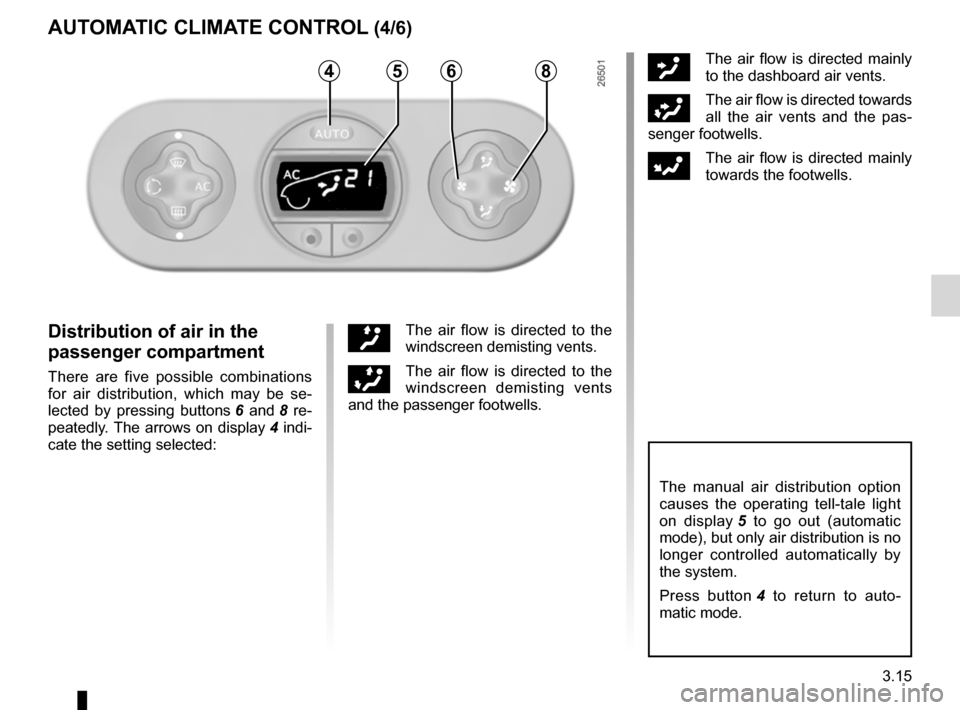
ôThe air flow is directed mainly
to the dashboard air vents.
öThe air flow is directed towards
all the air vents and the pas-
senger footwells.
FThe air flow is directed mainly
towards the footwells.
The manual air distribution option
causes the operating tell-tale light
on display 5 to go out (automatic
mode), but only air distribution is no
longer controlled automatically by
the system.
Press button 4 to return to auto -
matic mode.
Distribution of air in the
passenger compartment
There are five possible combinations
for air distribution, which may be se -
lected by pressing buttons 6 and 8 re -
peatedly. The arrows on display 4 indi-
cate the setting selected:
õThe air flow is directed to the
windscreen demisting vents.
÷The air flow is directed to the
windscreen demisting vents
and the passenger footwells.
6845
Page 100 of 185
3.16
ENG_UD11200_1
Air conditionné automatique (E33 - X33 - Renault)
ENG_NU_865-6_E33_Renault_3
Jaune NoirNoir texte
autoMatiC CliMate ContRol (5/6)
In automatic mode, depending on
the outside air conditions, the ven-
tilation may not start immediately at
maximum power but will increase
progressively until the engine tem -
perature is warm enough to heat the
passenger compartment air. This
may take from a few seconds to
several minutes.
switching air conditioning on
or off
In automatic mode, the system switches
the air conditioning system on or off,
depending on the climate conditions.
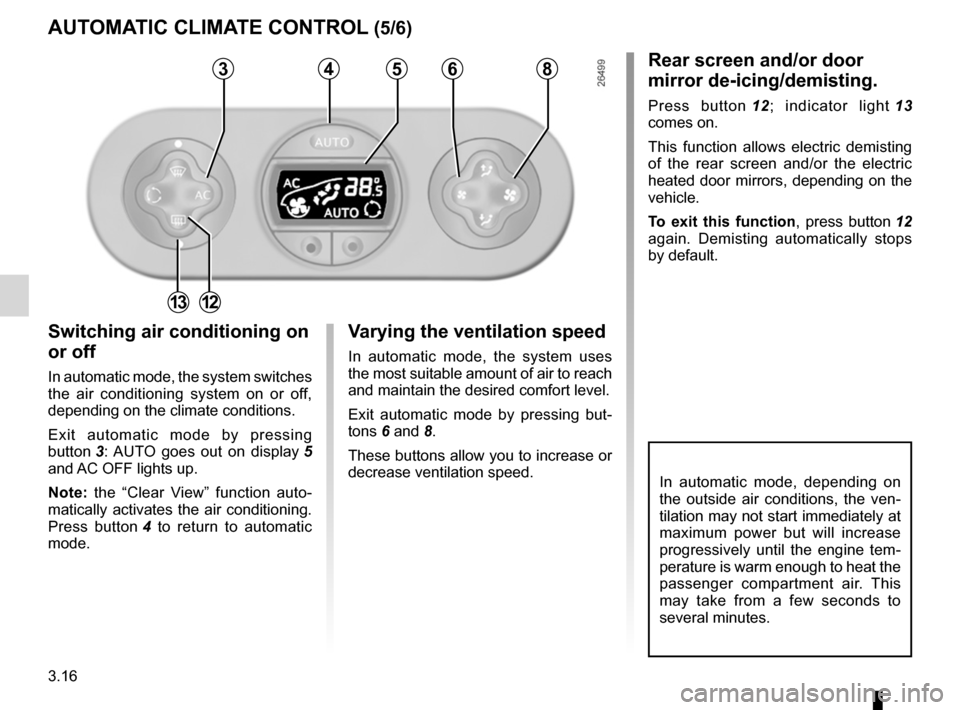
Exit automatic mode by pressing
button 3 : AUTO goes out on display 5
and AC OFF lights up.
n ote: the “Clear View” function auto -
matically activates the air conditioning.
Press button 4 to return to automatic
mode.
v arying the ventilation speed
In automatic mode, the system uses
the most suitable amount of air to reach
and maintain the desired comfort level.
Exit automatic mode by pressing but -
tons 6 and 8.
These buttons allow you to increase or
decrease ventilation speed.
Rear screen and/or door
mirror de-icing/demisting.
Press button 12 ; indicator light 13
comes on.
This function allows electric demisting
of the rear screen and/or the electric
heated door mirrors, depending on the
vehicle.
t o exit this function, press button 12
again. Demisting automatically stops
by default.
4568
13
3
12
Page 101 of 185
JauneNoirNoir texte
3.17
ENG_UD11200_1
Air conditionné automatique (E33 - X33 - Renault)
ENG_NU_865-6_E33_Renault_3
autoMatiC CliMate ContRol (6/6)
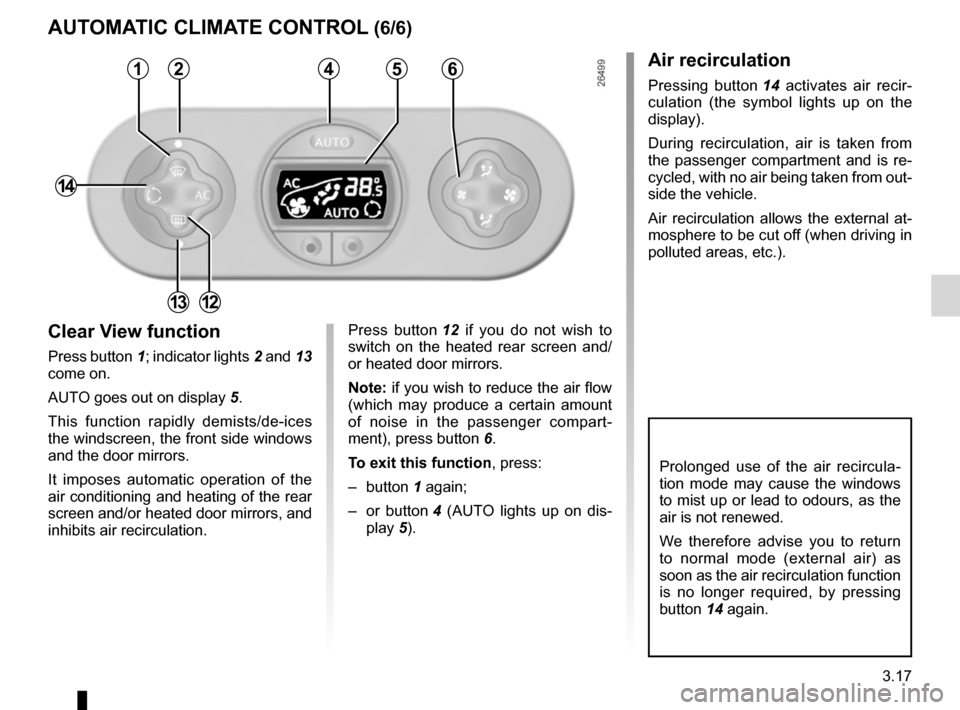
Clear v iew function
Press button 1; indicator lights 2 and 13
come on.
AUTO goes out on display 5.
This function rapidly demists/de-ices
the windscreen, the front side windows
and the door mirrors.
It imposes automatic operation of the
air conditioning and heating of the rear
screen and/or heated door mirrors, and
inhibits air recirculation. Press button
12 if you do not wish to
switch on the heated rear screen and/
or heated door mirrors.
note: if you wish to reduce the air flow
(which may produce a certain amount
of noise in the passenger compart -
ment), press button 6.
t o exit this function , press:
– button 1 again;
– or button 4 (AUTO lights up on dis -
play 5).
air recirculation
Pressing button 14 activates air recir -
culation (the symbol lights up on the
display).
During recirculation, air is taken from
the passenger compartment and is re-
cycled, with no air being taken from out-
side the vehicle.
Air recirculation allows the external at-
mosphere to be cut off (when driving in
polluted areas, etc.).456
13
12
14
12
Prolonged use of the air recircula -
tion mode may cause the windows
to mist up or lead to odours, as the
air is not renewed.
We therefore advise you to return
to normal mode (external air) as
soon as the air recirculation function
is no longer required, by pressing
button 14 again.
Page 102 of 185
air conditioning ..................................... (up to the end of the DU)
heating system ..................................... (up to the end of the DU)
air conditioning ..................................... (up to the end of the DU)
temperature regulation ......................... (up to the end of the DU)
ventilation ............................................. (up to the end of the DU)
heating and air conditioning system ...................... (current page)
3.18
ENG_UD11524_2
Air conditionné : informations et conseils d’utilisation (X77 ph2\
- Renault)
ENG_NU_865-6_E33_Renault_3
aiR ConDitioning: information and advice on use
Fuel consumption
You will normally notice an increase
in fuel consumption (especially
when driving in town) when the air
conditioning is operating. For vehi -
cles fitted with manual air condition -
ing, switch off the system when it is
not required.
advice for reducing consumption
and therefore helping to preserve
the environment:
Drive with the air vents open and
the windows closed.
If the vehicle has been parked in
the sun, open the doors for a few
moments to let the hot air escape
before starting the engine.
Maintenance
Refer to the Maintenance Document
for your vehicle for the inspection
frequency.
Do not open the refriger -
ant fluid circuit. The fluid
may damage eyes or skin.
note
Presence of water under the ve -
hicle. After prolonged use of the air
conditioning system, it is normal for
water to be present under the vehi-
cle. This is caused by condensation.
operating faults
As a general rule, contact your ap-
proved Dealer in the event of an op-
erating fault.
– Reduction in de-icing, demist -
ing or air conditioning per -
formance . This may be caused
by the passenger compartment
filter cartridge becoming clogged.
– no cold air is being produced.
Check that the controls are set
correctly and that the fuses are
sound. Otherwise, switch off the
system.
Do not add anything to the
vehicle’s ventilation circuit
(for example, to remove
bad odours).
t here is a risk of damage or of
fire.
Page 129 of 185

5.3
ENG_UD28665_3
Kit de gonflage des pneumatiques (X77 - X85 - B85 - C85 - S85 - X77 ph2\
- K85 - X95 - E95 - X67 -")
tyre inflation kit...................................... (up to the end of the DU)
5.3
ENG_UD28665_3
Kit de gonflage des pneumatiques (X77 - X85 - B85 - C85 - S85 - X77 ph2\
- K85 - X95 - E95 - X67 - X92 - X10 - X98 - X52 - Renault)
ENG_NU_865-6_E33_Renault_5
Tyre inflation kit
tyre Pressure KIt (1/3)
The kit is only approved for
inflating the tyres of the ve-
hicle originally equipped
with the kit.
It must never be used to inflate
the tyres of another vehicle, or any
other inflatable object (rubber ring,
rubber boat, etc.).
Avoid spillage on skin when han -
dling the repair liquid bottle. If drop-
lets do leak out, rinse them off with
plenty of water.
Keep the repair kit away from chil -
dren.
Do not dispose of the empty bottle
in the countryside. Return it to your
approved dealer or to a recycling or-
ganisation.
The bottle has a limited service
life which is indicated on its label.
Check the expiry date.
Contact an approved dealer to re -
place the inflation tube and repair
product bottle.
a
B
The kit repairs tyres when
tread A has been dam -
aged by objects smaller
than 4 mm. It cannot repair
all types of puncture, such as cuts
larger than 4 mm, or cuts in tyre
sidewall B.
Ensure also that the wheel rim is in
good condition.
Do not pull out the foreign body
causing the puncture if it is still in
the tyre.
Do not attempt to use the
inflation kit if the tyre has
been damaged as a result
of driving with a puncture.
You should therefore carefully check
the condition of the tyre sidewalls
before any operation.
Driving with underinflated, flat or
punctured tyres can be dangerous
and may make the tyre impossible
to repair.
this repair is temporary
A tyre which has been punctured
should always be inspected (and re-
paired, where possible) as soon as
possible by a specialist.
When taking a tyre which has been
repaired using this kit to be replaced,
you must inform the specialist.
When driving, vibration may be felt
due to the presence of the repair
product injected into the tyre.
Page 167 of 185
technical specifications ......................... (up to the end of the DU)
replacement parts ................................. (up to the end of the DU)
6.7
ENG_UD7339_1
Pièces de rechange et réparations (X76 - Renault)
ENG_NU_865-6_E33_Renault_6
Replacement parts and repairs
Original parts are based on strict specifications and are subject to highly-specialised tests. Therefore, they are of at least the same
level of quality as the parts fitted originally.
If you always fit genuine replacement parts to your vehicle, you will ensure that it performs well. Furthermore, repairs carried out
within the manufacturer’s Network using original parts are guaranteed according to the conditions set out on the reverse of the
repair order.
Replacement paRts and RepaiRs
Page 179 of 185
7.1
FRA_UD30001_7
Index (E33 - X33 - Renault)
ENG_NU_865-6_E33_Renault_7
AlphAbeticAl index (1/4)
A
ABS .............................................................. 1.35, 2.10 → 2.12
accessories........................................................................ 5.25
accessories socket ............................................................ 3.23
additional methods of restraint .....................1.15 → 1.17, 1.19
side protection ............................................................. 1.18
to the front seat belts ....................................... 1.15 → 1.17
adjusting your driving position ........................................... 1.12
air bag ........................................................... 1.15 → 1.19, 1.35
air conditioning ........................................................ 3.8 → 3.18
air vents ...................................................................... 3.6 – 3.7
anti-corrosion check .............................................. 6.14 → 6.18
anti-corrosion protection ......................................... 4.12 – 4.13
anti-lock braking system: ABS ...............................2.10 → 2.12
antipollution advice .................................................................. 2.6 → 2.8
armrest: front .............................................................................. 3.22
ashtray ............................................................................... 3.23
ASR (traction control) ............................................ 2.10 → 2.12
audible and visual signals .................................................. 1.51
b
batteries ............................................................................. 5.24
battery ................................................................................ 4.11
troubleshooting ................................................. 5.22 – 5.23
bonnet ......................................................................... 4.2 – 4.3
brake fluid ............................................................................ 4.8
bulbs changing .......................................................... 5.14 → 5.16
c
catalytic converter ................................................................ 2.4
central door locking .................................................... 1.5, 1.10
changing a bulb ..................................................... 5.14 → 5.16
changing a wheel ........................................................ 5.7 – 5.8changing gear
...................................................................... 2.5
child restraint/seat ............................. 1.20 – 1.21, 1.23 → 1.26
child safety ................1.2 – 1.3, 1.20 – 1.21, 1.23 → 1.26, 3.19
child seats .......................................... 1.20 – 1.21, 1.23 → 1.26
children ................................... 1.2 – 1.3, 1.6 – 1.7, 1.20 – 1.21
children (safety) ................................................................. 3.19
cigar lighter ........................................................................ 3.23
cleaning: inside the vehicle .............................................. 4.14 – 4.15
outside the vehicle ............................................ 4.12 – 4.13
clock .................................................................................. 1.49
closing the doors ........................................................ 1.6 – 1.7
control instruments ................................................ 1.34 → 1.40
controls .................................................................. 1.30 → 1.33
coolant ........................................................................ 1.38, 4.7
courtesy light ................................................. 3.20, 5.17 – 5.18
courtesy mirrors ................................................................. 3.20
cruise control ......................................................... 2.13 → 2.19
cruise control-speed limiter.................................... 2.13 → 2.19
d
dashboard .............................................................. 1.30 → 1.33
daytime running lights ........................................................ 1.52
demisting rear screen ..................................................................... 3.9
dimensions .......................................................................... 6.4
display ................................................................... 1.34 → 1.39
doors .................................................................. 1.6 – 1.7, 1.10
doors/tailgate ..................................................... 1.6 – 1.7, 1.10
driver’s position ..................................................... 1.30 → 1.37
driving ........................................... 2.2, 2.4 → 2.8, 2.10 → 2.19
driving position settings ............................................................ 1.12 → 1.14
e
electric windows ................................................................ 3.19
Page 180 of 185
7.2
FRA_UD30001_7
Index (E33 - X33 - Renault)
ENG_NU_865-6_E33_Renault_7
Jaune NoirNoir texte
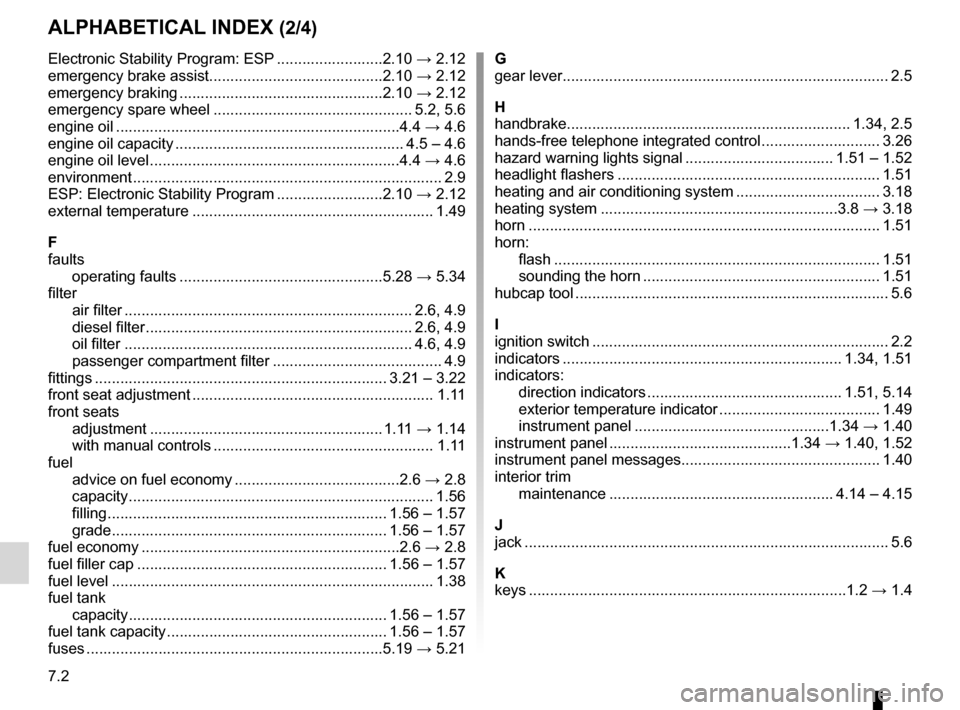
AlphAbeticAl index (2/4)
Electronic Stability Program: ESP .........................2.10 → 2.12
emergency brake assist ......................................... 2.10 → 2.12
emergency braking ................................................ 2.10 → 2.12
emergency spare wheel ............................................... 5.2, 5.6
engine oil ................................................................... 4.4 → 4.6
engine oil capacity ...................................................... 4.5 – 4.6
engine oil level ........................................................... 4.4 → 4.6
environment ......................................................................... 2.9
ESP: Electronic Stability Program .........................2.10 → 2.12
external temperature ......................................................... 1.49
F
faults operating faults ................................................ 5.28 → 5.34
filter air filter .................................................................... 2.6, 4.9
diesel filter ............................................................... 2.6, 4.9
oil filter .................................................................... 4.6, 4.9
passenger compartment filter ........................................ 4.9
fittings ..................................................................... 3.21 – 3.22
front seat adjustment ......................................................... 1.11
front seats adjustment ....................................................... 1.11 → 1.14
with manual controls .................................................... 1.11
fuel advice on fuel economy ....................................... 2.6 → 2.8
capacity ........................................................................ 1.56
filling .................................................................. 1.56 – 1.57
grade ................................................................. 1.56 – 1.57
fuel economy ............................................................. 2.6 → 2.8
fuel filler cap ........................................................... 1.56 – 1.57
fuel level ............................................................................ 1.38
fuel tank capacity ............................................................. 1.56 – 1.57
fuel tank capacity .................................................... 1.56 – 1.57
fuses ...................................................................... 5.19 → 5.21G
gear lever
............................................................................. 2.5
h
handbrake ................................................................... 1.34, 2.5
hands-free telephone integrated control ............................ 3.26
hazard warning lights signal ................................... 1.51 – 1.52
headlight flashers .............................................................. 1.51
heating and air conditioning system .................................. 3.18
heating system ........................................................ 3.8 → 3.18
horn ................................................................................... 1.51
horn: flash ............................................................................. 1.51
sounding the horn ........................................................ 1.51
hubcap tool .......................................................................... 5.6
i
ignition switch ...................................................................... 2.2
indicators .................................................................. 1.34, 1.51
indicators: direction indicators .............................................. 1.51, 5.14
exterior temperature indicator ...................................... 1.49
instrument panel .............................................. 1.34 → 1.40
instrument panel ........................................... 1.34 → 1.40, 1.52
instrument panel messages ............................................... 1.40
interior trim maintenance ..................................................... 4.14 – 4.15
J
jack ...................................................................................... 5.6
K
keys ........................................................................... 1.2 → 1.4