light RENAULT WIND 2012 1.G Workshop Manual
[x] Cancel search | Manufacturer: RENAULT, Model Year: 2012, Model line: WIND, Model: RENAULT WIND 2012 1.GPages: 185, PDF Size: 5.52 MB
Page 97 of 185
JauneNoirNoir texte
3.13
ENG_UD11200_1
Air conditionné automatique (E33 - X33 - Renault)
ENG_NU_865-6_E33_Renault_3
autoMatiC CliMate ContRol (2/6)
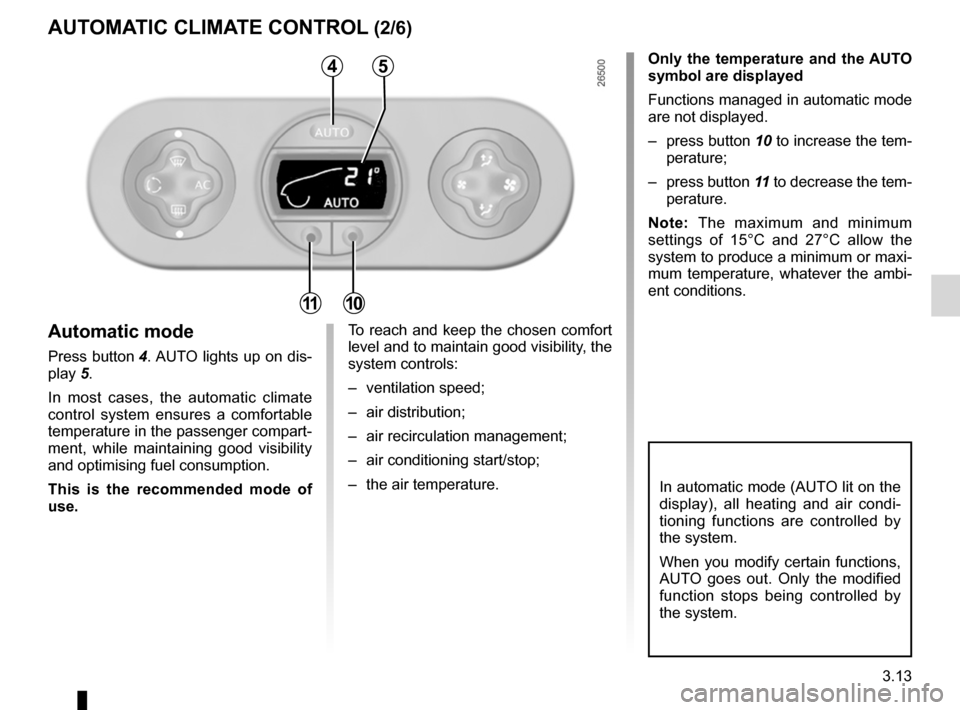
only the temperature and the auto
symbol are displayed
Functions managed in automatic mode
are not displayed.
– press button 10 to increase the tem-
perature;
– press button 11 to decrease the tem-
perature.
n ote: The maximum and minimum
settings of 15°C and 27°C allow the
system to produce a minimum or maxi-
mum temperature, whatever the ambi-
ent conditions.
In automatic mode (AUTO lit on the
display), all heating and air condi -
tioning functions are controlled by
the system.
When you modify certain functions,
AUTO goes out. Only the modified
function stops being controlled by
the system.
To reach and keep the chosen comfort
level and to maintain good visibility, the
system controls:
– ventilation speed;
– air distribution;
– air recirculation management;
– air conditioning start/stop;
– the air temperature.automatic mode
Press button 4. AUTO lights up on dis-
play 5.
In most cases, the automatic climate
control system ensures a comfortable
temperature in the passenger compart-
ment, while maintaining good visibility
and optimising fuel consumption.
this is the recommended mode of
use.
45
1011
Page 99 of 185
rear screen de-icing/demisting .............................. (current page)
windscreen de-icing/demisting .............................. (current page)
JauneNoirNoir texte
3.15
ENG_UD11200_1
Air conditionné automatique (E33 - X33 - Renault)
ENG_NU_865-6_E33_Renault_3
autoMatiC CliMate ContRol (4/6)
ôThe air flow is directed mainly
to the dashboard air vents.
öThe air flow is directed towards
all the air vents and the pas-
senger footwells.
FThe air flow is directed mainly
towards the footwells.
The manual air distribution option
causes the operating tell-tale light
on display 5 to go out (automatic
mode), but only air distribution is no
longer controlled automatically by
the system.
Press button 4 to return to auto -
matic mode.
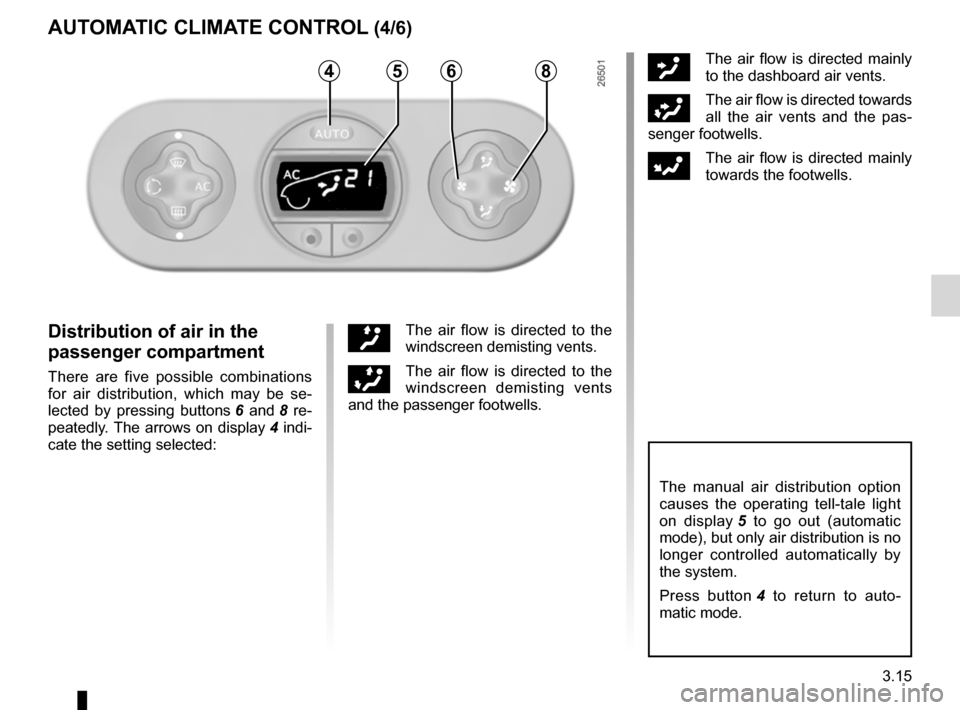
Distribution of air in the
passenger compartment
There are five possible combinations
for air distribution, which may be se -
lected by pressing buttons 6 and 8 re -
peatedly. The arrows on display 4 indi-
cate the setting selected:
õThe air flow is directed to the
windscreen demisting vents.
÷The air flow is directed to the
windscreen demisting vents
and the passenger footwells.
6845
Page 100 of 185
3.16
ENG_UD11200_1
Air conditionné automatique (E33 - X33 - Renault)
ENG_NU_865-6_E33_Renault_3
Jaune NoirNoir texte
autoMatiC CliMate ContRol (5/6)
In automatic mode, depending on
the outside air conditions, the ven-
tilation may not start immediately at
maximum power but will increase
progressively until the engine tem -
perature is warm enough to heat the
passenger compartment air. This
may take from a few seconds to
several minutes.
switching air conditioning on
or off
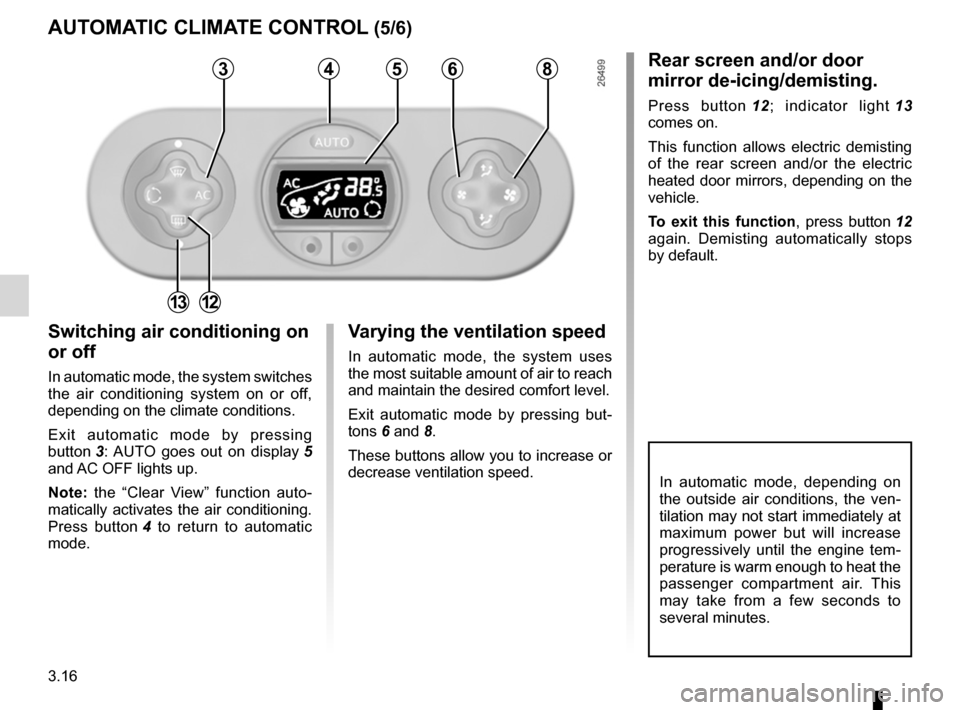
In automatic mode, the system switches
the air conditioning system on or off,
depending on the climate conditions.
Exit automatic mode by pressing
button 3 : AUTO goes out on display 5
and AC OFF lights up.
n ote: the “Clear View” function auto -
matically activates the air conditioning.
Press button 4 to return to automatic
mode.
v arying the ventilation speed
In automatic mode, the system uses
the most suitable amount of air to reach
and maintain the desired comfort level.
Exit automatic mode by pressing but -
tons 6 and 8.
These buttons allow you to increase or
decrease ventilation speed.
Rear screen and/or door
mirror de-icing/demisting.
Press button 12 ; indicator light 13
comes on.
This function allows electric demisting
of the rear screen and/or the electric
heated door mirrors, depending on the
vehicle.
t o exit this function, press button 12
again. Demisting automatically stops
by default.
4568
13
3
12
Page 101 of 185
JauneNoirNoir texte
3.17
ENG_UD11200_1
Air conditionné automatique (E33 - X33 - Renault)
ENG_NU_865-6_E33_Renault_3
autoMatiC CliMate ContRol (6/6)
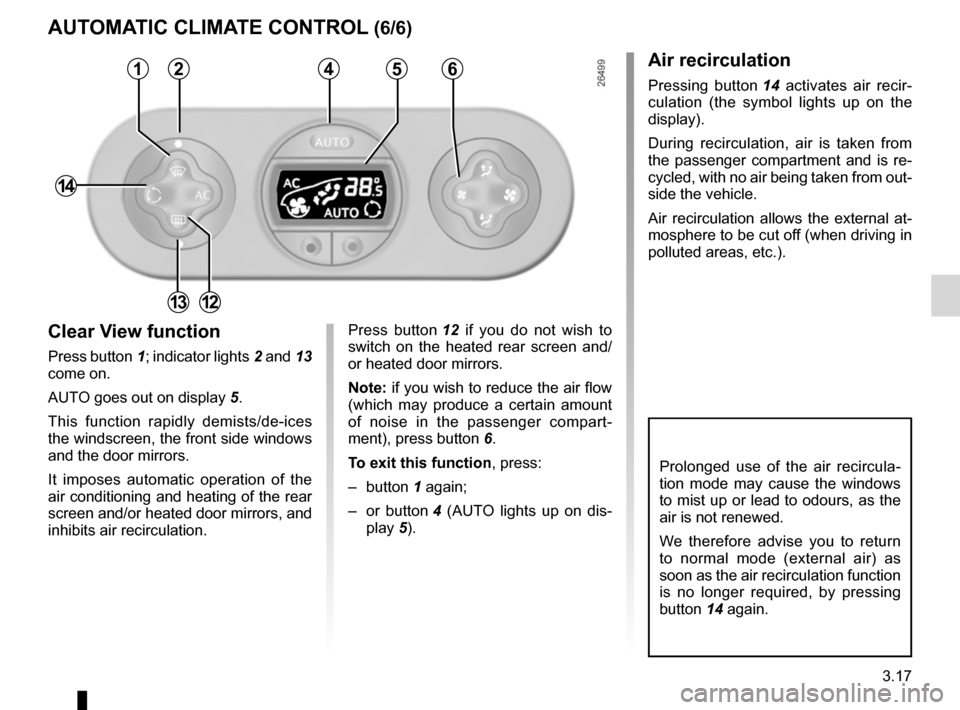
Clear v iew function
Press button 1; indicator lights 2 and 13
come on.
AUTO goes out on display 5.
This function rapidly demists/de-ices
the windscreen, the front side windows
and the door mirrors.
It imposes automatic operation of the
air conditioning and heating of the rear
screen and/or heated door mirrors, and
inhibits air recirculation. Press button
12 if you do not wish to
switch on the heated rear screen and/
or heated door mirrors.
note: if you wish to reduce the air flow
(which may produce a certain amount
of noise in the passenger compart -
ment), press button 6.
t o exit this function , press:
– button 1 again;
– or button 4 (AUTO lights up on dis -
play 5).
air recirculation
Pressing button 14 activates air recir -
culation (the symbol lights up on the
display).
During recirculation, air is taken from
the passenger compartment and is re-
cycled, with no air being taken from out-
side the vehicle.
Air recirculation allows the external at-
mosphere to be cut off (when driving in
polluted areas, etc.).456
13
12
14
12
Prolonged use of the air recircula -
tion mode may cause the windows
to mist up or lead to odours, as the
air is not renewed.
We therefore advise you to return
to normal mode (external air) as
soon as the air recirculation function
is no longer required, by pressing
button 14 again.
Page 104 of 185
lighting:interior ............................................. (up to the end of the DU)
courtesy light ........................................ (up to the end of the DU)
map reading lights ................................ (up to the end of the DU)
sun visor ............................................... (up to the end of the DU)
courtesy mirrors .................................... (up to the end of the DU)
3.20
ENG_UD11203_1
Eclairage intérieur (E33 - X33 - Renault)
ENG_NU_865-6_E33_Renault_3
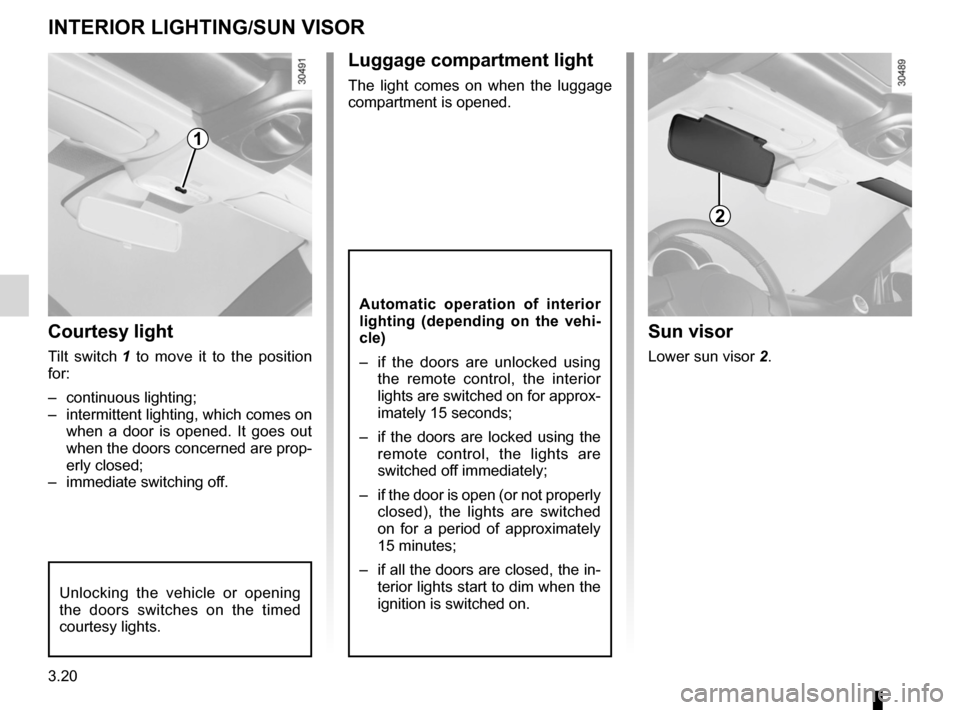
Courtesy light
Tilt switch 1 to move it to the position
for:
– continuous lighting;
– intermittent lighting, which comes on
when a door is opened. It goes out
when the doors concerned are prop-
erly closed;
– immediate switching off.
Interior lighting
Sun visor
inteRioR ligHting/sun visoR
Unlocking the vehicle or opening
the doors switches on the timed
courtesy lights.
1
luggage compartment light
The light comes on when the luggage
compartment is opened.
sun visor
Lower sun visor 2.
2
automatic operation of interior
lighting (depending on the vehi -
cle)
– if the doors are unlocked using
the remote control, the interior
lights are switched on for approx -
imately 15 seconds;
– if the doors are locked using the
remote control, the lights are
switched off immediately;
– if the door is open (or not properly
closed), the lights are switched
on for a period of approximately
15 minutes;
– if all the doors are closed, the in-
terior lights start to dim when the
ignition is switched on.
Page 107 of 185

ashtray .................................................. (up to the end of the DU)
cigar lighter ........................................... (up to the end of the DU)
accessories socket ............................... (up to the end of the DU)
3.23
ENG_UD25712_2
Cendriers-Allume cigares (E33 - X33 - Renault)
ENG_NU_865-6_E33_Renault_3
Accessories socket – Ashtray
asHtRay, aCCessoRies soCket
accessories socket 2 or 3(depending on vehicle)
It is provided for connecting acces -
sories approved by the Technical
Department with a maximum power of
120 Watts (voltage 12 V).
If your vehicle does not have an
ashtray, you can purchase one from
an approved dealer.
2
C o n n e c t a c c e s s o r i e s
with a maximum power of
120 Watts only.
Fire hazard.
ashtray 1
This is a removable ashtray that can
be fitted into the door storage compart-
ments.
To open, lift the cover.
To empty it, pull the assembly. The ash-
tray will come out of its housing.
1
3
Page 112 of 185
bonnet................................................... (up to the end of the DU)
maintenance: mechanical ...................................... (up to the end of the DU)
4.2
ENG_UD24357_4
Capot moteur (E33 - X33 - Renault)
ENG_NU_865-6_E33_Renault_4
Jaune NoirNoir texte
Bonnet
Bonnet (1/2)
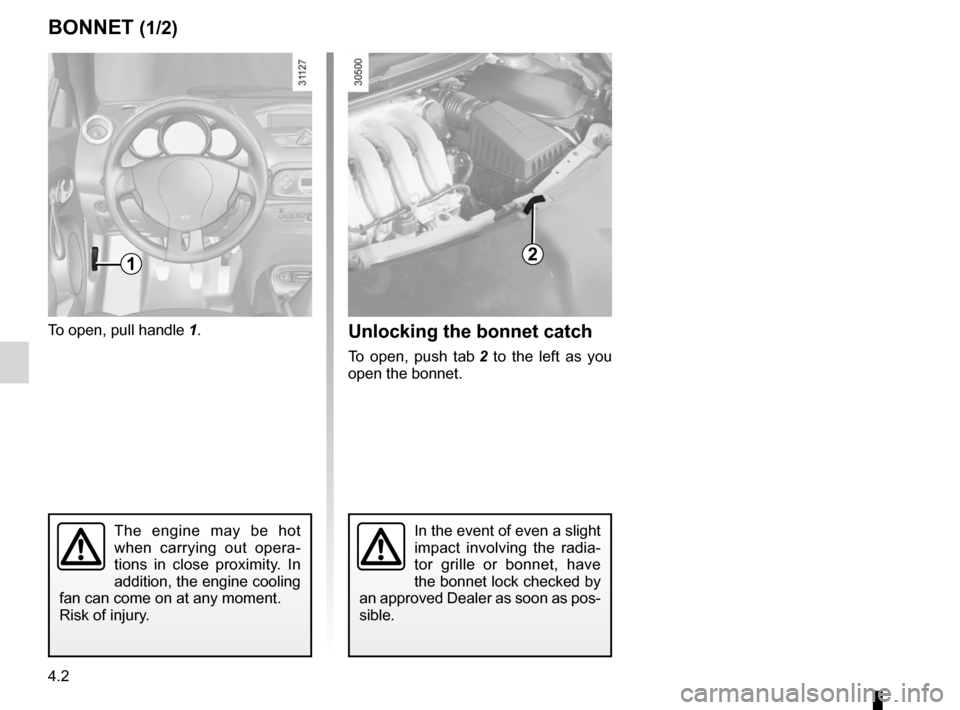
To open, pull handle 1.
The engine may be hot
when carrying out opera -
tions in close proximity. In
addition, the engine cooling
fan can come on at any moment.
Risk of injury.In the event of even a slight
impact involving the radia -
tor grille or bonnet, have
the bonnet lock checked by
an approved Dealer as soon as pos-
sible.
21
Unlocking the bonnet catch
To open, push tab 2 to the left as you
open the bonnet.
Page 118 of 185

brake fluid .............................................................. (current page)
levels: brake fluid ........................................................ (current page)
tanks and reservoirs brake fluid ........................................................ (current page)
4.8
ENG_UD20479_2
Niveaux / filtres (E33 - X33 - Renault)
ENG_NU_865-6_E33_Renault_4
Jaune NoirNoir texte
brake fluid
levelS (2/3)
Brake fluid level
This should be checked frequently,
and immediately if you notice even the
slightest loss in braking efficiency.
The level should be read with the engine
switched off and on level ground. level 2
It is normal for the level to drop as the
brake shoes become worn, but it must
never drop lower than the
“Min” warn-
ing line.
If you wish to check the disc and drum
wear yourself, you should obtain the
document explaining the checking pro-
cedure from our network or from the
manufacturer’s website. t
opping up
After any operation on the hydraulic cir-
cuit, a specialist must replace the fluid.
Only use fluids approved by our
Technical Department (and taken from
a sealed container).
Replacement intervals
Refer to the Maintenance Document for
your vehicle.
The engine may be hot
when working in close prox-
imity. In addition, the engine
cooling fan may start at any
moment.
Risk of injury.When working in the engine
compartment, ensure that
the windscreen wiper stalk
is in the park position.
Risk of injury.
2
Page 122 of 185
maintenance:bodywork ........................................ (up to the end of the DU)
washing ................................................ (up to the end of the DU)
paintwork maintenance ................................... (up to the end of the DU)
anti-corrosion protection ....................... (up to the end of the DU)
cleaning: outside the vehicle .......................... (up to the end of the DU)
4.12
ENG_UD30003_4
Entretien de la carrosserie (E33 - X33 - Renault)
ENG_NU_865-6_E33_Renault_4
Jaune NoirNoir texte
Bodywork maintenance
BoDyWoRk MAintenAnCe (1/2)
A well-maintained vehicle will last
longer. It is therefore recommended to
maintain the exterior of the vehicle reg-
ularly.
Your vehicle has been treated with very
effective anti-corrosion products. It is
nevertheless subject to various outside
influences.
Corrosive agents in the atmosphere
– atmospheric pollution (built-up and
industrial areas),
– saline atmospheres (near the sea,
particularly in hot weather),
– seasonal and damp weather condi -
tions, (e.g. road salt in winter, water
from road cleaners, etc.).
Minor impacts
Abrasive action
Dust and sand in the air, mud, road grit
thrown up by other vehicles, etc.
You should take a number of minor pre-
cautions in order to safeguard your ve-
hicle against such risks.What you should not do
Clean the rotating rotating hard roof
using a high pressure washer and
make sure you carefully wash the rotat-
ing hard roof seals; risk of leaks.
Use a high pressure washer less than
one metre from the vehicle to wash
under the rotating hard roof cover:
risk of damage to the opening/closing
mechanism.
Do not degrease or clean mechani -
cal components (e.g. the engine com -
partment), underneath the body, parts
with hinges (e.g. inside the doors) and
painted plastic external fittings (e.g.
bumpers) using high-pressure clean -
ing equipment or by spraying on prod-
ucts not approved by our Technical
Department. Doing this could give rise
to corrosion or operational faults.
Wash the vehicle in bright sunlight or
freezing temperatures.
Do not scrape off mud or dirt without
pre-wetting. Allow dirt to accumulate on the exterior.
Allow rust to form following minor im
-
pacts.
Do not use solvents not approved by
our Technical Department to remove
stains as this could damage the paint-
work.
Do not drive in snow or muddy condi -
tions without washing the vehicle, par-
ticularly under the wheel arches and
body.
Page 123 of 185
JauneNoirNoir texte
4.13
ENG_UD30003_4
Entretien de la carrosserie (E33 - X33 - Renault)
ENG_NU_865-6_E33_Renault_4
BoDyWoRk MAintenAnCe (2/2)
y ou should
Wash your car frequently, with the
engine off, with cleaning products rec-
ommended by the manufacturer (never
use abrasive products). Rinse thor -
oughly beforehand with a jet:
– spots of tree resin and industrial
grime;
– mud in the wheel arches and under -
neath the body which forms damp
patches;
– bird droppings , which cause a
chemical reaction with the paint that
rapidly discolours paintwork and
may even cause the paint to peel
off;
wash the vehicle immediately to
remove these marks since it is im -
possible to remove them by polish -
ing;
– salt, particularly in the wheel arches
and underneath the body after driv -
ing in areas where the roads have
been gritted.
Remove any plant matter (resin, leaves,
etc.) from the vehicle regularly.
Clean the roof cover using a soft cloth. Respect local regulations about wash
-
ing vehicles (e.g. do not wash your ve-
hicle on a public highway).
Observe the vehicle stopping distances
when driving on gravelled surfaces to
prevent paint damage.
Repair, or have repaired quickly, areas
where the paint has been damaged, to
prevent corrosion spreading.
Remember to visit the body shop pe -
riodically in order to maintain your
anti-corrosion warranty. Refer to the
Maintenance Document.
If it is necessary to clean mechani -
cal components, hinges, etc., spray
them with products approved by our
Technical Department to protect them
after they have been cleaned.
We have selected special products
to care for your vehicle and you can
obtain these from the manufactur -
er’s accessory outlets.
Using a roller type car wash
Return the windscreen wiper stalk to
the Park position (refer to the informa-
tion on the “Windscreen washer, wiper”
in Section 1). Check the mounting of
external accessories, additional lights
and mirrors, and ensure that the wiper
blades are secured with adhesive tape.
Remove the radio aerial mast if your
vehicle is fitted with this equipment.
Remember to remove the tape and refit
the antenna after washing.
Cleaning the headlights
As the headlights are made of plastic
“glass”, use a soft cloth or cotton wool
to clean them. If this does not clean
them properly, moisten the cloth with
soapy water, then wipe clean with a soft
damp cloth or cotton wool.
Finally, carefully dry off with a soft dry
cloth.
Cleaning products containing alco -
hol must not be used.