lock RENAULT WIND ROADSTER 2012 User Guide
[x] Cancel search | Manufacturer: RENAULT, Model Year: 2012, Model line: WIND ROADSTER, Model: RENAULT WIND ROADSTER 2012Pages: 185, PDF Size: 5.52 MB
Page 17 of 185
front seat adjustment ............................(up to the end of the DU)
front seats adjustment ...................................... (up to the end of the DU)
front seats with manual controls ........................................ (current page)
1.11
ENG_UD11155_1
Sièges avant à commandes manuelles (E33 - X33 - Renault)
ENG_NU_865-6_E33_Renault_1
Siège avant
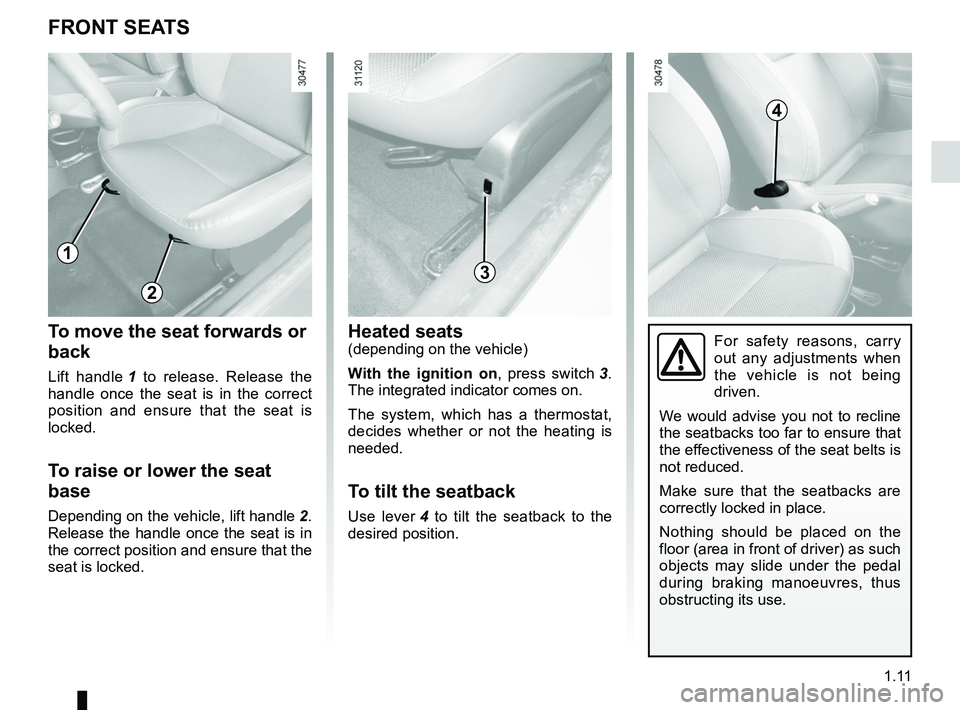
To move the seat forwards or
back
Lift handle 1 to release. Release the
handle once the seat is in the correct
position and ensure that the seat is
locked.
To raise or lower the seat
base
Depending on the vehicle, lift handle 2.
Release the handle once the seat is in
the correct position and ensure that the
seat is locked.
For safety reasons, carry
out any adjustments when
the vehicle is not being
driven.
We would advise you not to recline
the seatbacks too far to ensure that
the effectiveness of the seat belts is
not reduced.
Make sure that the seatbacks are
correctly locked in place.
Nothing should be placed on the
floor (area in front of driver) as such
objects may slide under the pedal
during braking manoeuvres, thus
obstructing its use.
1
2
Heated seats(depending on the vehicle)
With the ignition on , press switch 3 .
The integrated indicator comes on.
The system, which has a thermostat,
decides whether or not the heating is
needed.
To tilt the seatback
Use lever 4 to tilt the seatback to the
desired position.
FRONT SEATS
4
3
Page 19 of 185
JauneNoirNoir texte
1.13
ENG_UD25517_3
Ceintures de sécurité (E33 - X33 - Renault)
ENG_NU_865-6_E33_Renault_1
SEAT BELTS (2/3)
5
34
5
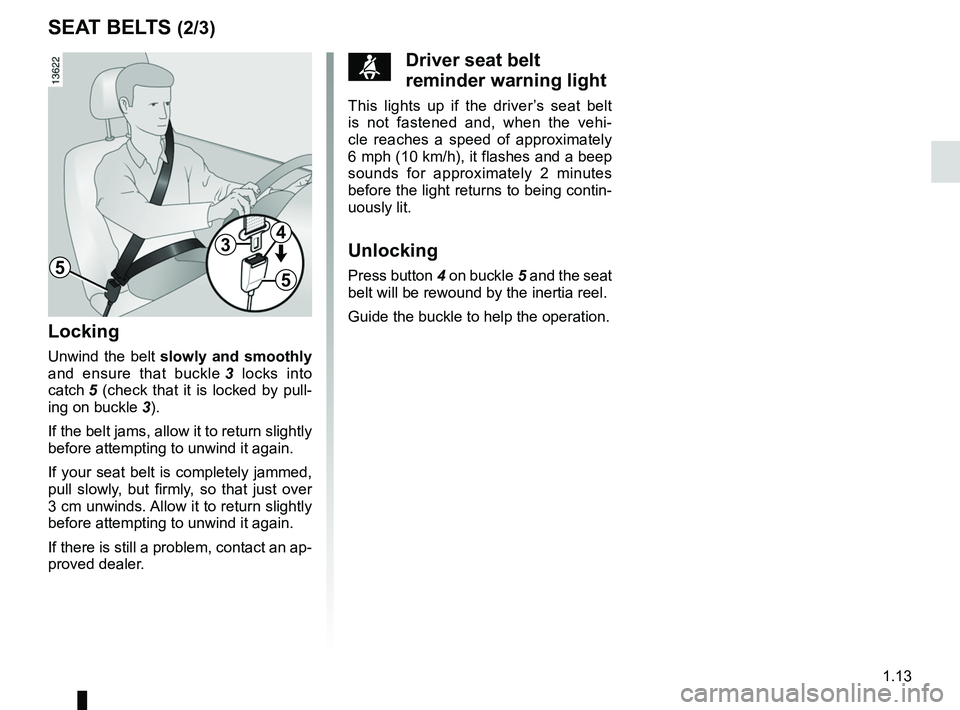
Locking
Unwind the belt slowly and smoothly
and ensure that buckle 3 locks into
catch 5 (check that it is locked by pull -
ing on buckle 3).
If the belt jams, allow it to return slightly
before attempting to unwind it again.
If your seat belt is completely jammed,
pull slowly, but firmly, so that just over
3 cm unwinds. Allow it to return slightly
before attempting to unwind it again.
If there is still a problem, contact an ap-
proved dealer.
ßDriver seat belt
reminder warning light
This lights up if the driver’s seat belt
is not fastened and, when the vehi -
cle reaches a speed of approximately
6 mph (10 km/h), it flashes and a beep
sounds for approximately 2 minutes
before the light returns to being contin-
uously lit.
Unlocking
Press button 4 on buckle 5 and the seat
belt will be rewound by the inertia reel.
Guide the buckle to help the operation.
Page 21 of 185
seat belts .............................................. (up to the end of the DU)
additional methods of restraint ............. (up to the end of the DU)
seat belt pretensioners ......................... (up to the end of the DU)
air bag ................................................... (up to the end of the DU)
air bag ................................................... (up to the end of the DU)
methods of restraint in addition to the front seat belts
(up to the end of the DU)
additional methods of restraint to the front seat belts ......................(up to the end of the DU)
methods of restraint in addition to the seat belts
(up to the end of the DU)
pretensioners ......................................................... (current page)
1.15
ENG_UD20473_2
Dispositifs complémentaires aux ceintures avant (E33 - X33 - Renault)
ENG_NU_865-6_E33_Renault_1
Additional methods of restraint:
to the front seat belts
METHODS OF RESTRAINT IN ADDITION TO THE FRONT SEAT BELTS (1/3)
Depending on the vehicle, they are
composed of:
– seat belt pretensioners;
– chest-level load limiters;
– air bags for driver and front pas -
senger.
These systems are designed to act in-
dependently or together when the ve -
hicle is subjected to a frontal impact.
Depending on the severity of the
impact, the system can trigger:
– seat belt locking;
– the seat belt inertia reel pretensioner
(which engages to correct seat belt
slack);
– the front air bags.
Load limiterAbove a certain severity of impact, this
mechanism is used to limit the force of
the belt against the body so that it is at
an acceptable level.
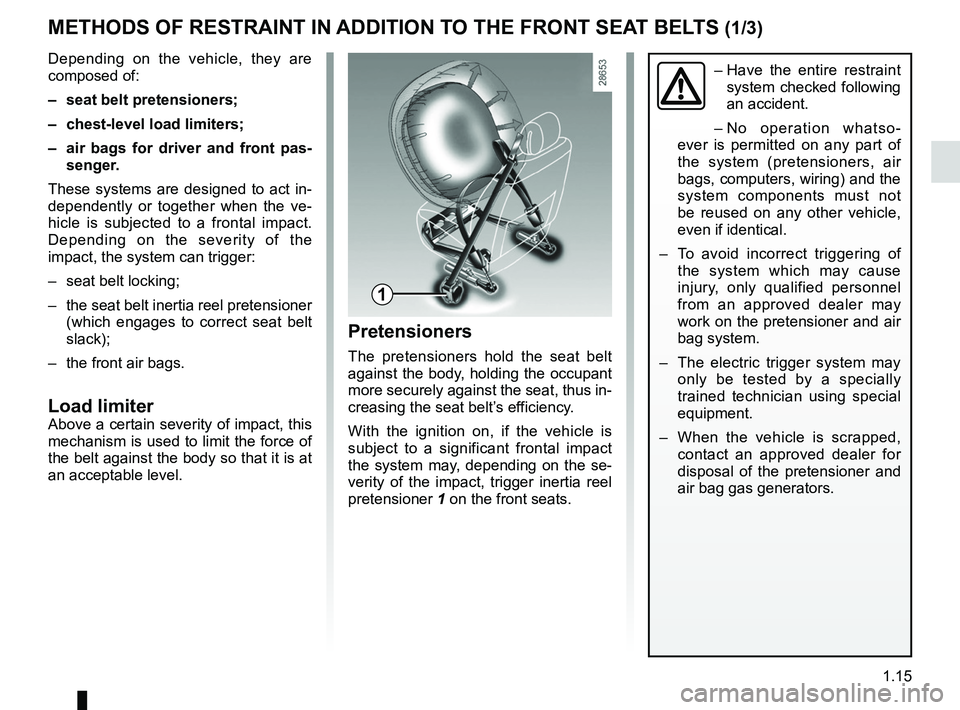
pretensioners
The pretensioners hold the seat belt
against the body, holding the occupant
more securely against the seat, thus in-
creasing the seat belt’s efficiency.
With the ignition on, if the vehicle is
subject to a significant frontal impact
the system may, depending on the se-
verity of the impact, trigger inertia reel
pretensioner 1 on the front seats.
– Have the entire restraint
system checked following
an accident.
– No operation whatso -
ever is permitted on any part of
the system (pretensioners, air
bags, computers, wiring) and the
system components must not
be reused on any other vehicle,
even if identical.
– To avoid incorrect triggering of
the system which may cause
injury, only qualified personnel
from an approved dealer may
work on the pretensioner and air
bag system.
– The electric trigger system may
only be tested by a specially
trained technician using special
equipment.
– When the vehicle is scrapped,
contact an approved dealer for
disposal of the pretensioner and
air bag gas generators.
1
Page 23 of 185
JauneNoirNoir texte
1.17
ENG_UD20473_2
Dispositifs complémentaires aux ceintures avant (E33 - X33 - Renault)
ENG_NU_865-6_E33_Renault_1
METHODS OF RESTRAINT IN ADDITION TO THE FRONT SEAT BELTS (3/3)
Warnings concerning the driver’s air bag
– Do not modify the steering wheel or the steering wheel boss.
– Do not cover the steering wheel boss under any circumstances.
– Do not attach any objects (badge, logo, clock, telephone holder, etc.) to the steering wheel boss.
– The steering wheel must not be removed (except by qualified personnel from our Network).
– When driving, do not sit too close to the steering wheel. Sit with your arms slightly bent (see the information on “Adjusting
your driving position” in Section 1). This will allow sufficient space for the air bag to deploy correctly and be fully effective.
Warnings concerning the passenger air bag
– Do not attach or glue any objects (badge, logo, clock, telephone holder, etc.) to the dashboard on or near the air bag.
– Do not place anything between the dashboard and the passenger (pet, umbrella, walking stick, parcels, etc.).
– The passenger must not put his or her feet on the dashboard or seat as there is a risk that serious injuries may occur. In
general, parts of the body should be kept away from the dashboard (knees, hands, head, etc.).
– The devices in addition to the front passenger seat belt should be reactivated as soon as a child seat is removed, to ensure
the protection of the passenger in the event of an impact.
A REAR-FACING CHILD SEAT MUST NOT BE FITTED TO THE FRONT p ASSENGER SEAT UNLESS
THE ADDITIONAL RESTRAINT SYSTEMS, I.E. THE p ASSENGER AIR BAG, ARE DEACTIVATED.
(refer to the information on “Child safety: deactivating/activating the front passenger air bag” in Section 1)
All of the warnings below are given so that the air bag is not obstructed in any way when it is inflated and also to prevent
the risk of serious injuries caused by items which may be dislodged when the air bag inflates.
Page 26 of 185
child safety............................................ (up to the end of the DU)
child restraint/seat ................................ (up to the end of the DU)
child restraint/seat ................................ (up to the end of the DU)
child restraint/seat ................................ (up to the end of the DU)
child seats ............................................. (up to the end of the DU)
transporting children ............................. (up to the end of the DU)
children ................................................. (up to the end of the DU)
1.20
ENG_UD20549_2
Sécurité enfants : généralités (E33 - X33 - Renault)
ENG_NU_865-6_E33_Renault_1
Jaune NoirNoir texte
Child safety: General information
CHILD SAFETY : General information (1/2)
Carrying children
Children, and adults, must be correctly
seated and strapped in for all journeys.
The children being carried in your vehi-
cle are your responsibility.
A child is not a miniature adult. Children
are at risk of specific injuries as their
muscles and bones have not yet fin -
ished growing. The seat belt alone
would not provide suitable protection.
Use an approved child seat and ensure
you use it correctly.
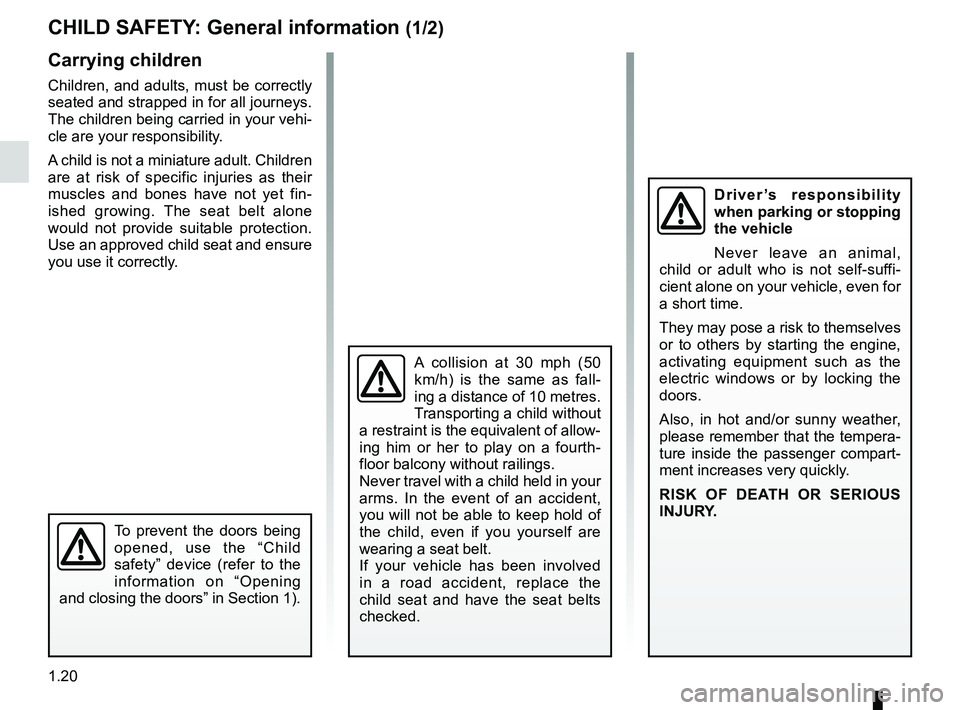
A collision at 30 mph (50
km/h) is the same as fall -
ing a distance of 10 metres.
Transporting a child without
a restraint is the equivalent of allow-
ing him or her to play on a fourth -
floor balcony without railings.
Never travel with a child held in your
arms. In the event of an accident,
you will not be able to keep hold of
the child, even if you yourself are
wearing a seat belt.
If your vehicle has been involved
in a road accident, replace the
child seat and have the seat belts
checked.
D r i v e r ’s r e s p o n s i b i l i t y
when parking or stopping
the vehicle
Never leave an animal,
child or adult who is not self-suffi -
cient alone on your vehicle, even for
a short time.
They may pose a risk to themselves
or to others by starting the engine,
activating equipment such as the
electric windows or by locking the
doors.
Also, in hot and/or sunny weather,
please remember that the tempera-
ture inside the passenger compart-
ment increases very quickly.
RISK OF DEATH OR SERIOUS
INJURY.
To prevent the doors being
opened, use the “Child
safety” device (refer to the
information on “Opening
and closing the doors” in Section 1).
Page 33 of 185
1.27
ENG_UD21752_3
Sécurité enfants : désactivation/activation airbag passager avant (E33 - X33 - Renault)
ENG_NU_865-6_E33_Renault_1
deactivating/activating the front passenger air bag
The passenger air bag must
be activated or deactivated
with the ignition off .
If it is interfered with when
the vehicle is being driven, indicator
lights
å and © will come
on.
Switch the ignition off then on again
to reset the air bag in accordance
with the lock.
CHILD SAFETY : deactivating/activating the front passenger air bag (1/3)
Deactivating the front
passenger airbags
(on equipped vehicles)
In order to fit a child seat to the front
passenger seat when this is allowed,
you must deactivate the front passen-
ger seat additional restraint devices
(side airbags and, depending on vehi -
cle, front airbags, etc.).
2
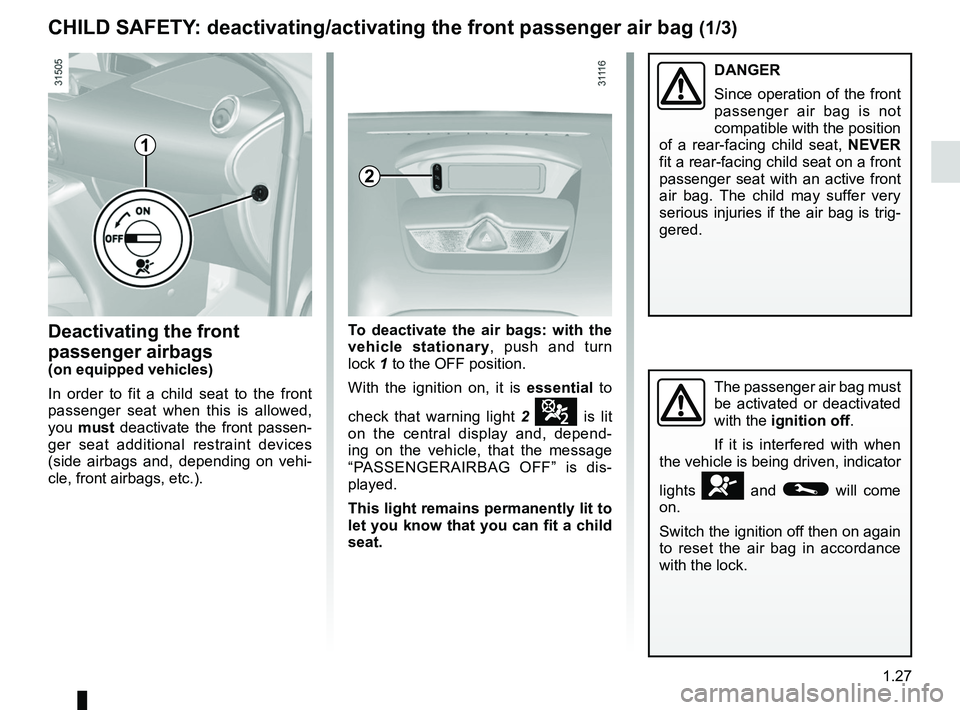
To deactivate the air bags: with the
vehicle stationary , push and turn
lock 1 to the OFF position.
With the ignition on, it is essential to
check that warning light 2
¹ is lit
on the central display and, depend -
ing on the vehicle, that the message
“ PASSENGERAIRBAG OFF ” is dis-
played.
This light remains permanently lit to
let you know that you can fit a child
seat.
1
DANGER
Since operation of the front
passenger air bag is not
compatible with the position
of a rear-facing child seat, NEVER
fit a rear-facing child seat on a front
passenger seat with an active front
air bag. The child may suffer very
serious injuries if the air bag is trig-
gered.
Page 35 of 185
JauneNoirNoir texte
1.29
ENG_UD21752_3
Sécurité enfants : désactivation/activation airbag passager avant (E33 - X33 - Renault)
ENG_NU_865-6_E33_Renault_1
CHILD SAFETY : deactivating/activating the front passenger air bag (3/3)
The passenger air bag must
be activated or deactivated
with the ignition off.
If it is interfered with when
the vehicle is being driven, indicator
lights
å and © will come
on.
Switch the ignition off then on again
to reset the air bag in accordance
with the lock.
Operating faults
It is forbidden to fit a rear-facing child
seat to the front passenger seat if the
air bag activation/deactivation system
is faulty.
Allowing any other passenger to sit in
that seat is not recommended.
Contact your approved dealer as soon
as possible.
Activating the front
passenger air bags
You should reactivate the air bag as
soon as you remove the child seat from
the front passenger seat to ensure the
protection of the front passenger in the
event of an impact.
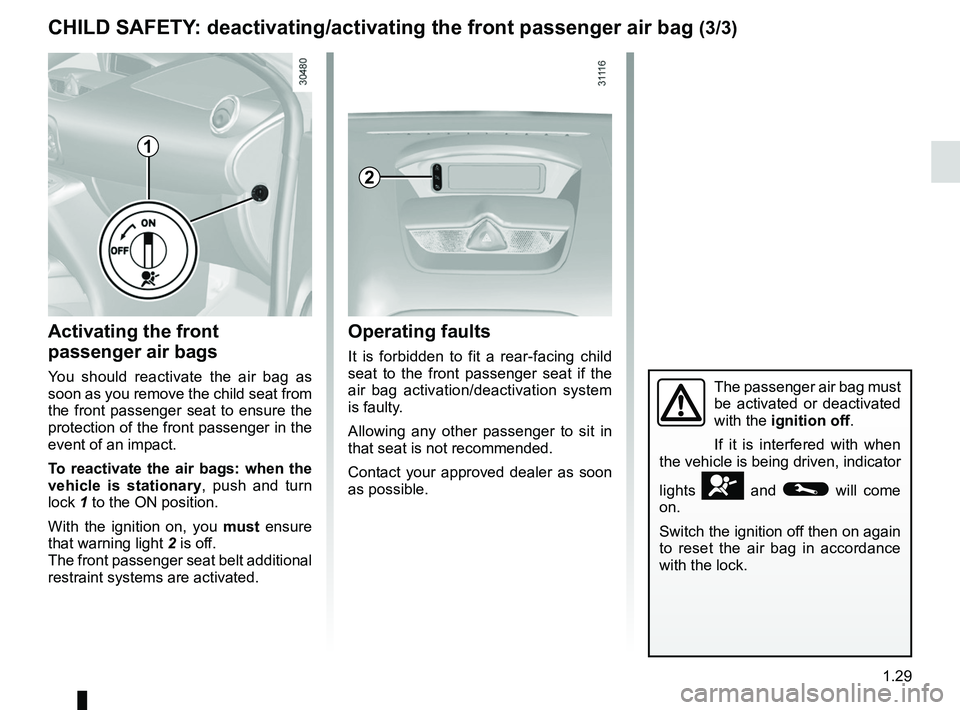
To reactivate the air bags: when the
vehicle is stationary , push and turn
lock 1 to the ON position.
With the ignition on, you must ensure
that warning light 2 is off.
The front passenger seat belt additional
restraint systems are activated.
2
1
Page 37 of 185
JauneNoirNoir texte
1.31
ENG_UD11168_1
Poste de conduite direction à gauche (E33 - X33 - Renault)
ENG_NU_865-6_E33_Renault_1
DRIVING pOSITION: LEFT -HAND DRIVE (2/2)
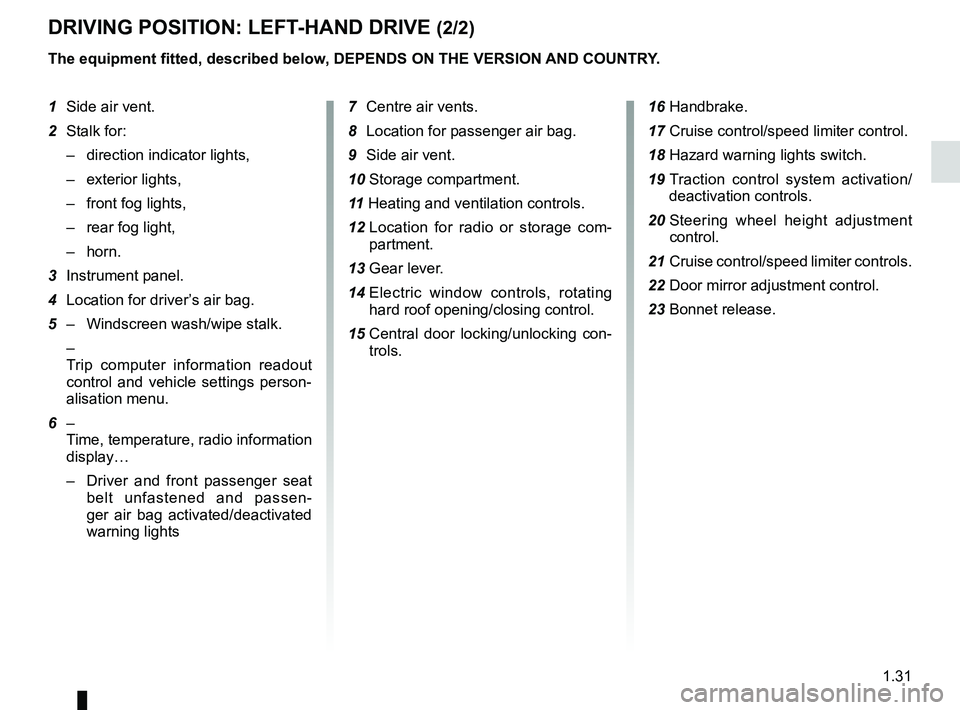
1 Side air vent.
2 Stalk for:
– direction indicator lights,
– exterior lights,
– front fog lights,
– rear fog light,
– horn.
3 Instrument panel.
4 Location for driver’s air bag.
5 – Windscreen wash/wipe stalk.
–
Trip computer information readout
control and vehicle settings person-
alisation menu.
6 –
Time, temperature, radio information
display…
– Driver and front passenger seat
belt unfastened and passen -
ger air bag activated/deactivated
warning lights
The equipment fitted, described below, DEpENDS ON THE VERSION AND COUNTRY.
16 Handbrake.
17 Cruise control/speed limiter control.
18 Hazard warning lights switch.
19 Traction control system activation/
deactivation controls.
20 Steering wheel height adjustment
control.
21 Cruise control/speed limiter controls.
22 Door mirror adjustment control.
23 Bonnet release.
7
Centre air vents.
8 Location for passenger air bag.
9 Side air vent.
10 Storage compartment.
11 Heating and ventilation controls.
12 Location for radio or storage com -
partment.
13 Gear lever.
14 Electric window controls, rotating
hard roof opening/closing control.
15 Central door locking/unlocking con -
trols.
Page 39 of 185
JauneNoirNoir texte
1.33
ENG_UD11169_1
Poste de conduite direction à droite (E33 - X33 - Renault)
ENG_NU_865-6_E33_Renault_1
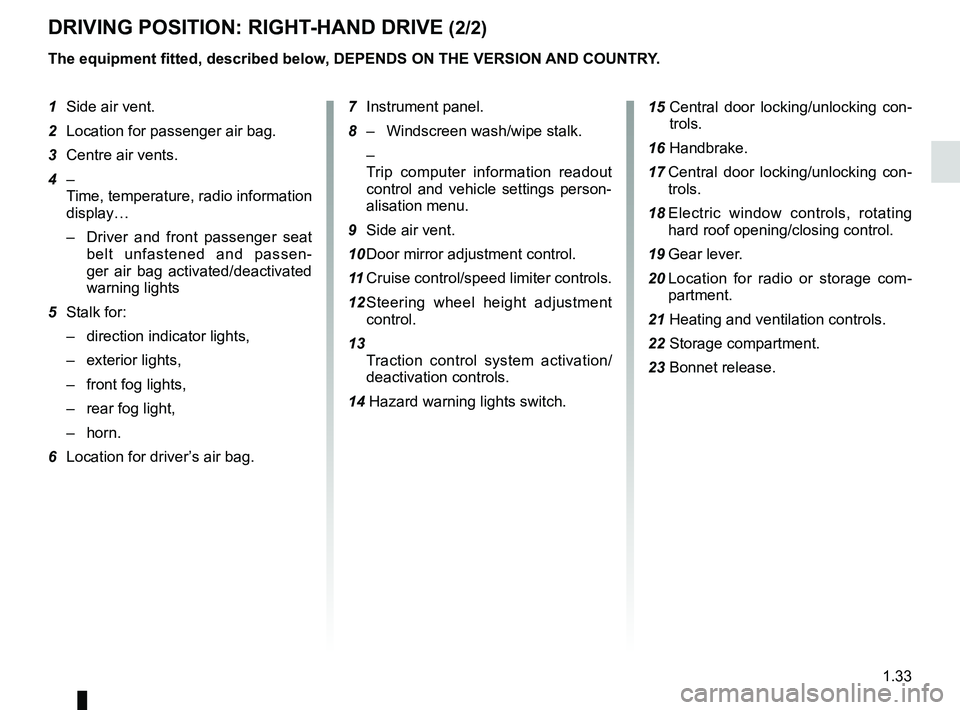
DRIVING pOSITION: RIGHT -HAND DRIVE (2/2)
The equipment fitted, described below, DEpENDS ON THE VERSION AND COUNTRY.
1 Side air vent.
2 Location for passenger air bag.
3 Centre air vents.
4 –
Time, temperature, radio information
display…
– Driver and front passenger seat
belt unfastened and passen -
ger air bag activated/deactivated
warning lights
5 Stalk for:
– direction indicator lights,
– exterior lights,
– front fog lights,
– rear fog light,
– horn.
6 Location for driver’s air bag. 7
Instrument panel.
8 – Windscreen wash/wipe stalk.
–
Trip computer information readout
control and vehicle settings person-
alisation menu.
9 Side air vent.
10 Door mirror adjustment control.
11 Cruise control/speed limiter controls.
12 Steering wheel height adjustment
control.
13 Traction control system activation/
deactivation controls.
14 Hazard warning lights switch. 15
Central door locking/unlocking con -
trols.
16 Handbrake.
17 Central door locking/unlocking con -
trols.
18 Electric window controls, rotating
hard roof opening/closing control.
19 Gear lever.
20 Location for radio or storage com -
partment.
21 Heating and ventilation controls.
22 Storage compartment.
23 Bonnet release.
Page 42 of 185
1.36
ENG_UD20502_3
Tableau de bord : témoins lumineux (E33 - X33 - Renault)
ENG_NU_865-6_E33_Renault_1
Jaune NoirNoir texte
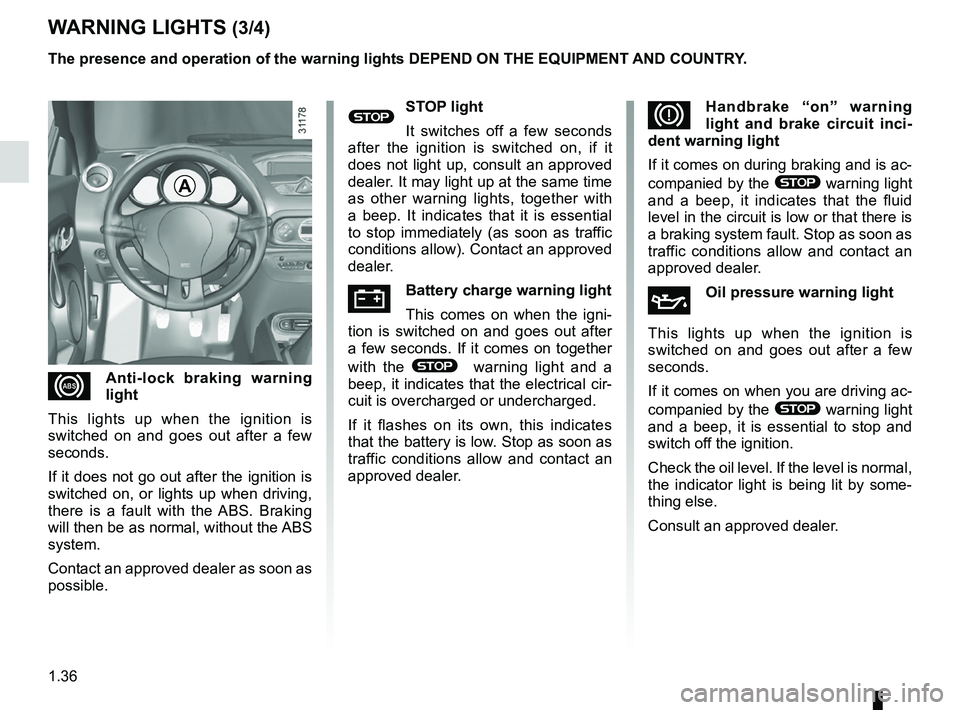
\fAnti-lock braking warning
light
This lights up when the ignition is
switched on and goes out after a few
seconds.
If it does not go out after the ignition is
switched on, or lights up when driving,
there is a fault with the ABS. Braking
will then be as normal, without the ABS
system.
Contact an approved dealer as soon as
possible.
DHandbrake “on” warning
light and brake circuit inci -
dent warning light
If it comes on during braking and is ac-
companied by the
® warning light
and a beep, it indicates that the fluid
level in the circuit is low or that there is
a braking system fault. Stop as soon as
traffic conditions allow and contact an
approved dealer.
ÀOil pressure warning light
This lights up when the ignition is
switched on and goes out after a few
seconds.
If it comes on when you are driving ac-
companied by the
® warning light
and a beep, it is essential to stop and
switch off the ignition.
Check the oil level. If the level is normal,
the indicator light is being lit by some-
thing else.
Consult an approved dealer.
W ARNING LIGHTS (3/4)
The presence and operation of the warning lights DEpEND ON THE EQUIpMENT AND COUNTRY.
A
®STOp light
It switches off a few seconds
after the ignition is switched on, if it
does not light up, consult an approved
dealer. It may light up at the same time
as other warning lights, together with
a beep. It indicates that it is essential
to stop immediately (as soon as traffic
conditions allow). Contact an approved
dealer.
ÚBattery charge warning light
This comes on when the igni -
tion is switched on and goes out after
a few seconds. If it comes on together
with the
® warning light and a
beep, it indicates that the electrical cir-
cuit is overcharged or undercharged.
If it flashes on its own, this indicates
that the battery is low. Stop as soon as
traffic conditions allow and contact an
approved dealer.