lock RENAULT WIND ROADSTER 2012 Owner's Manual
[x] Cancel search | Manufacturer: RENAULT, Model Year: 2012, Model line: WIND ROADSTER, Model: RENAULT WIND ROADSTER 2012Pages: 185, PDF Size: 5.52 MB
Page 54 of 185
steering wheeladjustment ...................................... (up to the end of the DU)
power-assisted steering ........................(up to the end of the DU)
power-assisted steering ........................(up to the end of the DU)
1.48
ENG_UD11167_1
Volant de direction (E33 - X33 - Renault)
ENG_NU_865-6_E33_Renault_1
Operating faults
The steering may become stiff when
driving or when the steering wheel is
turned repeatedly. This is due to the
power assistance overheating. In this
case, it must be allowed to cool down.power-assisted steering
Variable power-assisted steering
The variable power-assisted steering
system is equipped with an electronic
control system which alters the level of
assistance to suit the vehicle speed.
Steering is made easier during parking
manoeuvres (for added comfort) whilst
the force needed to steer increases
progressively as the speed rises (for
enhanced safety at high speeds).
Steering wheel
Power-assisted steering
STEERING WHEEL/pOWER-ASSISTED STEERING
Never leave the steering wheel at
full lock while stationary.
Never switch off the igni -
tion when travelling down -
hill, and avoid doing so in
normal driving (assistance
is not provided).
With the engine switched off, or if
there is a system fault, it is still pos-
sible to turn the steering wheel. The
force required will be greater.
Adjusting the steering wheel
Depending on the vehicle, the steering
wheel position is adjustable.
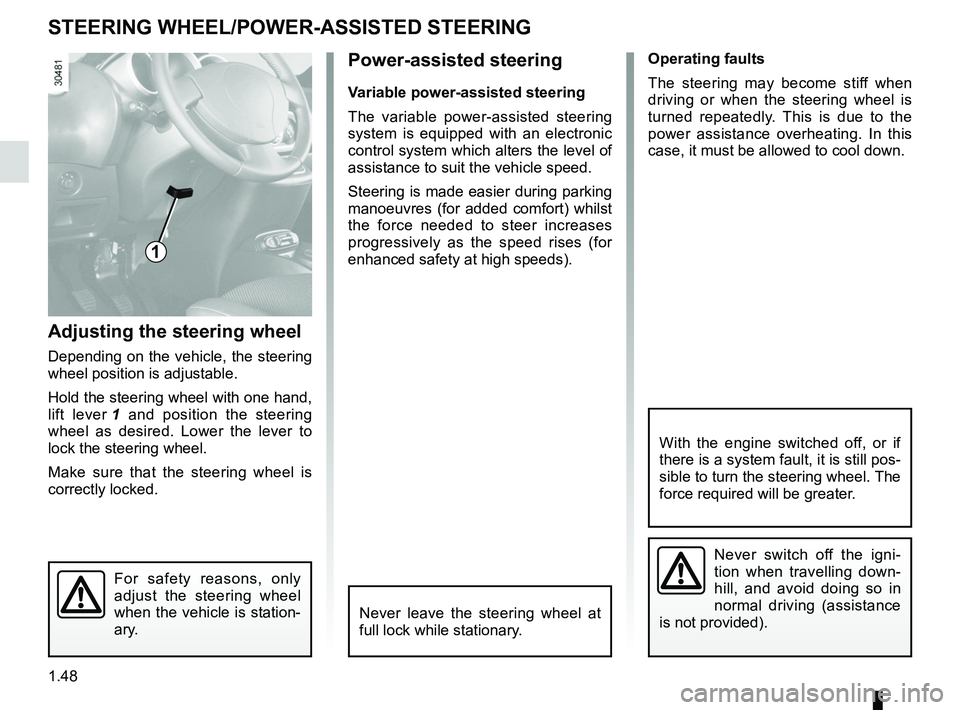
Hold the steering wheel with one hand,
lift lever 1 and position the steering
wheel as desired. Lower the lever to
lock the steering wheel.
Make sure that the steering wheel is
correctly locked.
For safety reasons, only
adjust the steering wheel
when the vehicle is station-
ary.
1
Page 55 of 185
clock ..................................................... (up to the end of the DU)
clock ..................................................... (up to the end of the DU)
external temperature ............................ (up to the end of the DU)
indicators: exterior temperature indicator .......................... (current page)
1.49
ENG_UD11174_1
Heure et température extérieure (E33 - X33 - Renault)
ENG_NU_865-6_E33_Renault_1
Clock and exterior temperature
External temperature
indicator
As ice formation is related
to climatic exposure, local
air humidity and temperature, the
external temperature alone is not
sufficient to detect ice.
CLOCK AND EXTERIOR TEMpERATURE
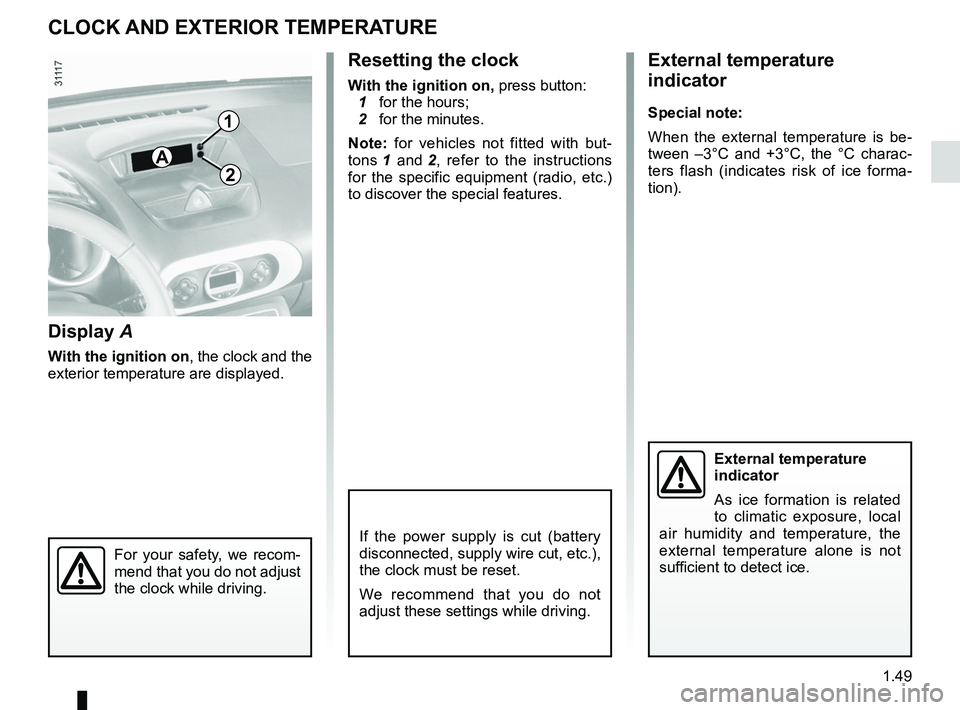
Display A
With the ignition on, the clock and the
exterior temperature are displayed.
For your safety, we recom -
mend that you do not adjust
the clock while driving.
A
1
2
If the power supply is cut (battery
disconnected, supply wire cut, etc.),
the clock must be reset.
We recommend that you do not
adjust these settings while driving.
External temperature
indicator
Special note:
When the external temperature is be -
tween –3°C and +3°C, the °C charac -
ters flash (indicates risk of ice forma -
tion).
Resetting the clock
With the ignition on, press button:
1 for the hours;
2 for the minutes.
Note: for vehicles not fitted with but -
tons 1 and 2 , refer to the instructions
for the specific equipment (radio, etc.)
to discover the special features.
Page 66 of 185
running in .............................................. (up to the end of the DU)
driving ................................................... (up to the end of the DU)
ignition switch ....................................... (up to the end of the DU)
2.2
ENG_UD25521_3
Rodage (E33 - X33 - Renault)
ENG_NU_865-6_E33_Renault_2
Running in
Ignition switch
Up to 600 miles (1,000 km) , do not
exceed 78 mph (130 km/h) in top gear
or 3,000 to 3,500 rpm.
You may only expect top performance
from your vehicle after approximately
1,800 miles (3 000 km).
Service intervals: please refer to your
vehicle’s Maintenance Document.
RUNNING IN/IGNItIoN SwItch
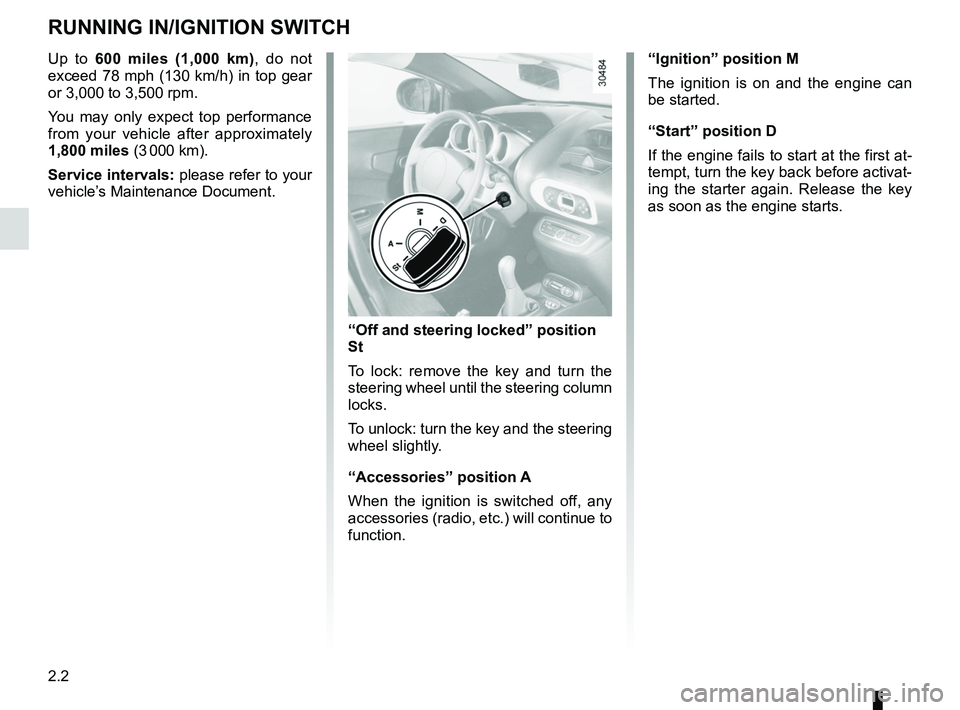
“off and steering locked” position
St
To lock: remove the key and turn the
steering wheel until the steering column
locks.
To unlock: turn the key and the steering
wheel slightly.
“Accessories” position A
When the ignition is switched off, any
accessories (radio, etc.) will continue to
function. “Ignition” position M
The ignition is on and the engine can
be started.
“Start” position D
If the engine fails to start at the first at-
tempt, turn the key back before activat-
ing the starter again. Release the key
as soon as the engine starts.
Page 67 of 185
starting the engine ................................ (up to the end of the DU)
starting the engine ................................ (up to the end of the DU)
2.3
ENG_UD29995_3
Démarrage / Arrêt moteur avec carte RENAULT mains libres (E33 - X33 - Renault)
ENG_NU_865-6_E33_Renault_2
Starting, stopping the engine
St ARtING/StoPPING thE ENGINE
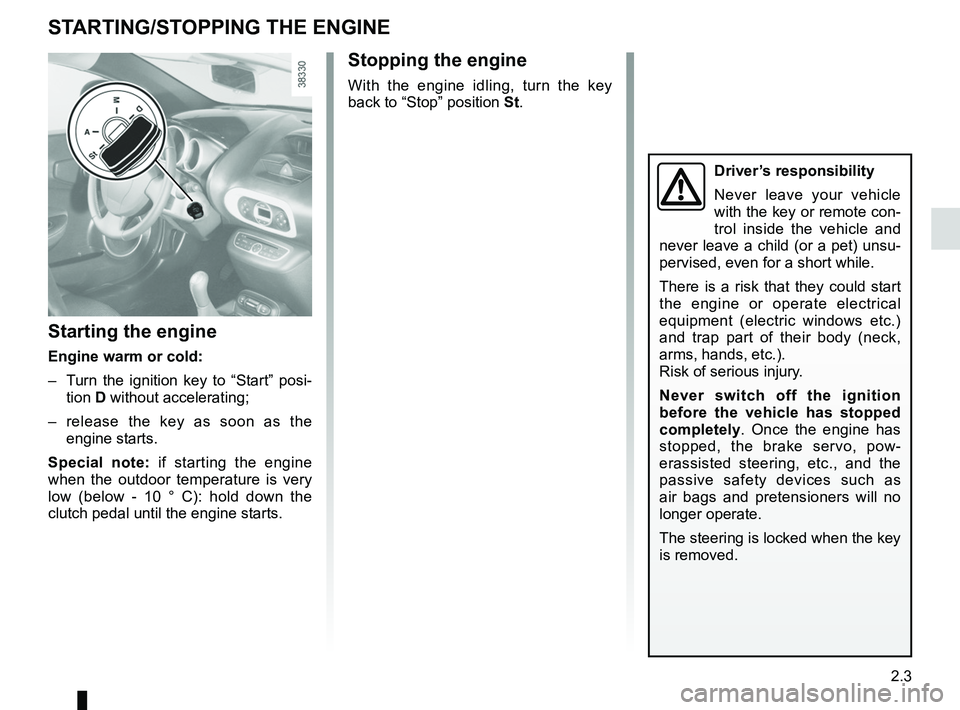
Starting the engine
Engine warm or cold:
– Turn the ignition key to “Start” posi-
tion D without accelerating;
– release the key as soon as the
engine starts.
Special note: if starting the engine
when the outdoor temperature is very
low (below - 10 ° C): hold down the
clutch pedal until the engine starts.
Stopping the engine
With the engine idling, turn the key
back to “Stop” position St.
Driver’s responsibility
Never leave your vehicle
with the key or remote con-
trol inside the vehicle and
never leave a child (or a pet) unsu-
pervised, even for a short while.
There is a risk that they could start
the engine or operate electrical
equipment (electric windows etc.)
and trap part of their body (neck,
arms, hands, etc.).
Risk of serious injury.
Never switch off the ignition
before the vehicle has stopped
completely . Once the engine has
stopped, the brake servo, pow -
erassisted steering, etc., and the
passive safety devices such as
air bags and pretensioners will no
longer operate.
The steering is locked when the key
is removed.
Page 74 of 185
ABS ...................................................... (up to the end of the DU)
anti-lock braking system: ABS ..............(up to the end of the DU)
ESP: Electronic Stability Program ........ (up to the end of the DU)
ASR (traction control) ........................... (up to the end of the DU)
traction control: ASR .............................(up to the end of the DU)
Electronic Stability Program: ESP ........ (up to the end of the DU)
emergency brake assist ........................(up to the end of the DU)
emergency braking ............................... (up to the end of the DU)
traction control: ASR .............................................. (current page)
driving ................................................... (up to the end of the DU)
2.10
ENG_UD11192_1
Dispositifs de correction de conduite (E33 - X33 - Renault)
ENG_NU_865-6_E33_Renault_2
Jaune NoirNoir texte
Driver correction devices/aids
DRIVER coRREctIoN DEVIcES/AIDS (1/3)
In an emergency, apply firm and
continuous pressure to the brake
pedal. There is no need to pump
it repeatedly. The ABS will modu -
late the force applied in the braking
system.
These functions are an ad-
ditional aid in the event of
critical driving conditions,
enabling the vehicle behav -
iour to be adapted to suit the driving
conditions.
However, the functions do not take
the place of the driver. they do
not increase the vehicle’s limits
and should not encourage you
to drive more quickly. Therefore,
they can under no circumstances
replace the vigilance or responsibil -
ity of the driver when manoeuvring
the vehicle (the driver must always
be ready for sudden incidents which
may occur when driving).
Yo u r b r a k i n g s y s t e m s
are partially operational.
However, it is dangerous
to brake suddenly and
it is essential to stop immediately,
as soon as traffic conditions allow.
Contact an approved dealer.
Depending on the vehicle, this is com-
posed of:
– the (A bS) (anti-lock braking
system);
– the electronic stability program
(ESP) with understeer control and
traction control (ASR);
– emergency brake assist. operating faults:
–
If the
x and © indicator
lights on the instrument panel come
on, braking is still operational but
without AbS;
– If the
x, ®, © and
D indicator lights on the instru -
ment panel come on when driving,
this indicates a fault with the braking
and AbS systems.
In both cases, consult an approved
Dealer.
AbS (anti-lock braking
system)
Under heavy braking, the ABS prevents
the wheels from locking, allowing the
stopping distance to be managed and
keeping control of the vehicle.
Under these circumstances, the vehi -
cle can be steered to avoid an obstacle
whilst braking. In addition, this system
can increase stopping distances, par -
ticularly on roads with low surface grip
(wet ground etc.).
You will feel a pulsation through the
brake pedal each time the system is
activated. The ABS does not in any way
improve the vehicle's physical perform-
ance relating to the road surface and
roadholding. It is still essential to follow
the rules of good driving practice (such
as driving at a safe distance from the
vehicle in front etc.).
Page 86 of 185

ENG_NU_865-6_E33_Renault_3
Rotating hard roof
Rotating HaRD RooF: conditions of use
Conditions of use
Imm")
3.2
ENG_UD20475_2
Toit rigide escamotable : condition d’utilisation (E33 - X33 - Renaul\
t)
ENG_NU_865-6_E33_Renault_3
Rotating hard roof
Rotating HaRD RooF: conditions of use
Conditions of use
Immobilise the vehicle on a flat, level
surface (never with the wheel on the
pavement).
Apply the handbrake.
Temperature above -10°C.
Perform the operation with the engine
running if possible (risk of discharging
the battery).
To prevent the system from overheat -
ing, it cuts out automatically. It becomes
operational again after a maximum of
30 minutes.
When opening or clos -
ing the roof, ensure that
nothing interferes with the
moving parts (roof and roof
cover).
Do not drive with the roof unlocked.
Do not open or close the roof if the
wind speed is more than 20 mph
(30 km/h) (risk of damage to the
roof).
Driver’s responsibility
Never leave your vehicle
with the key or remote con-
trol inside and never leave a
child (or a pet) unsupervised, even
for a short while.
He/she may be able to operate the
rotating hard roof and there is a risk
of trapping his/her neck, arm, hand,
etc., which could cause serious in -
juries.
If anything is trapped, reverse the
rotating hard roof’s direction of
travel immediately by pressing the
opposite side of the roof open/close
button.
Never unlock the roof while
driving.
Risk of damage to the roof
and roof cover.
operating the roof
Before opening/closing the roof, check
that there is sufficient space above the
vehicle to allow it to open.
Minimum height required A: 2.05 m.
a
Page 87 of 185
3.3
ENG_UD25715_2
Toit rigide escamotable : ouverture (E33 - X33 - Renault)
ENG_NU_865-6_E33_Renault_3
Rotating HaRD RooF: opening/closing
12
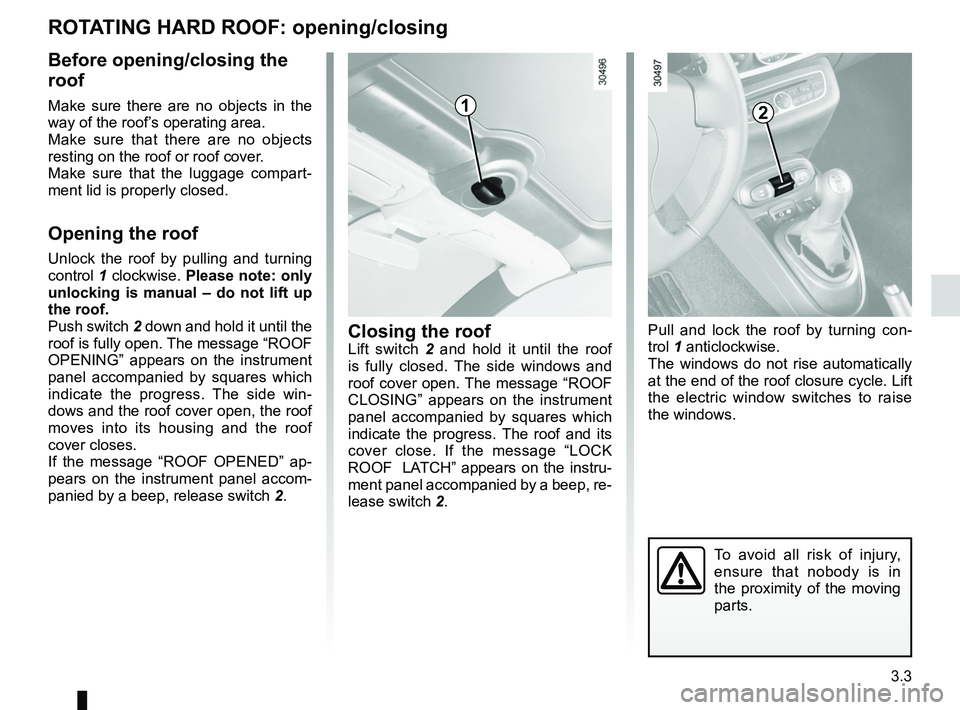
Closing the roofLift switch 2 and hold it until the roof
is fully closed. The side windows and
roof cover open. The message “ROOF
CLOSING ” appears on the instrument
panel accompanied by squares which
indicate the progress. The roof and its
cover close. If the message “ LOCK
ROOF LATCH” appears on the instru-
ment panel accompanied by a beep, re-
lease switch 2.
Before opening/closing the
roof
Make sure there are no objects in the
way of the roof’s operating area.
Make sure that there are no objects
resting on the roof or roof cover.
Make sure that the luggage compart -
ment lid is properly closed.
opening the roof
Unlock the roof by pulling and turning
control 1 clockwise. Please note: only
unlocking is manual – do not lift up
the roof.
Push switch 2 down and hold it until the
roof is fully open. The message “ROOF
OPENING ” appears on the instrument
panel accompanied by squares which
indicate the progress. The side win -
dows and the roof cover open, the roof
moves into its housing and the roof
cover closes.
If the message “ ROOF OPENED” ap-
pears on the instrument panel accom -
panied by a beep, release switch 2.
To avoid all risk of injury,
ensure that nobody is in
the proximity of the moving
parts.
Pull and lock the roof by turning con -
trol 1 anticlockwise.
The windows do not rise automatically
at the end of the roof closure cycle. Lift
the electric window switches to raise
the windows.
Page 88 of 185

ENG_NU_865-6_E33_Renault_3
Jaune NoirNoir texte
Rotating HaRD RooF: operating fault (1/2)
the roof unloc")
3.4
ENG_UD20476_2
Toit rigide escamotable : anomalie de fonctionnement (E33 - X33 - Renaul\
t)
ENG_NU_865-6_E33_Renault_3
Jaune NoirNoir texte
Rotating HaRD RooF: operating fault (1/2)
the roof unlocks but does
not open
Check that the luggage compartment
lid is properly closed. Restart the oper-
ation: lock then unlock the roof without
pushing it upwards.
Repair procedure
If there is a system fault, you can close
the rotating hard roof.
To do this, open the roof cover manu -
ally.
Unclip logo 1 on the luggage compart-
ment lid.
12
Remove plastic cover 2 to access the
screw.Use the emergency key supplied in the
glove box to turn the screw clockwise
until the roof cover opens sufficiently
(point of resistance).
To avoid all risk of injury,
ensure that nobody is in
the proximity of the moving
parts.
When opening/closing the roof,
ensure that nothing interferes with
the moving parts (roof and roof
cover).
Ensure that there are no objects in
roof/roof cover area A.
a
Page 89 of 185

ENG_NU_865-6_E33_Renault_3
Rotating HaRD RooF: operating fault (2/2)
Close the roo")
JauneNoirNoir texte
3.5
ENG_UD20476_2
Toit rigide escamotable : anomalie de fonctionnement (E33 - X33 - Renaul\
t)
ENG_NU_865-6_E33_Renault_3
Rotating HaRD RooF: operating fault (2/2)
Close the roof again manually (move -
ment B ), making sure that there is no
contact with the roof cover.
Lower the roof cover using the emer -
gency key to turn the screw anticlock -
wise until the roof cover closes (point of
resistance).Engage plastic cover 2 in its housing.
Clip on the logo. Pull and turn control
3 anticlockwise to
lock the roof.
Consult an approved dealer.
B
2
3
If the message “CHECK ROOF” ap-
pears on the instrument panel con-
tinually or when the roof open/close
switch is pressed, consult an ap -
proved dealer.
Page 104 of 185
lighting:interior ............................................. (up to the end of the DU)
courtesy light ........................................ (up to the end of the DU)
map reading lights ................................ (up to the end of the DU)
sun visor ............................................... (up to the end of the DU)
courtesy mirrors .................................... (up to the end of the DU)
3.20
ENG_UD11203_1
Eclairage intérieur (E33 - X33 - Renault)
ENG_NU_865-6_E33_Renault_3
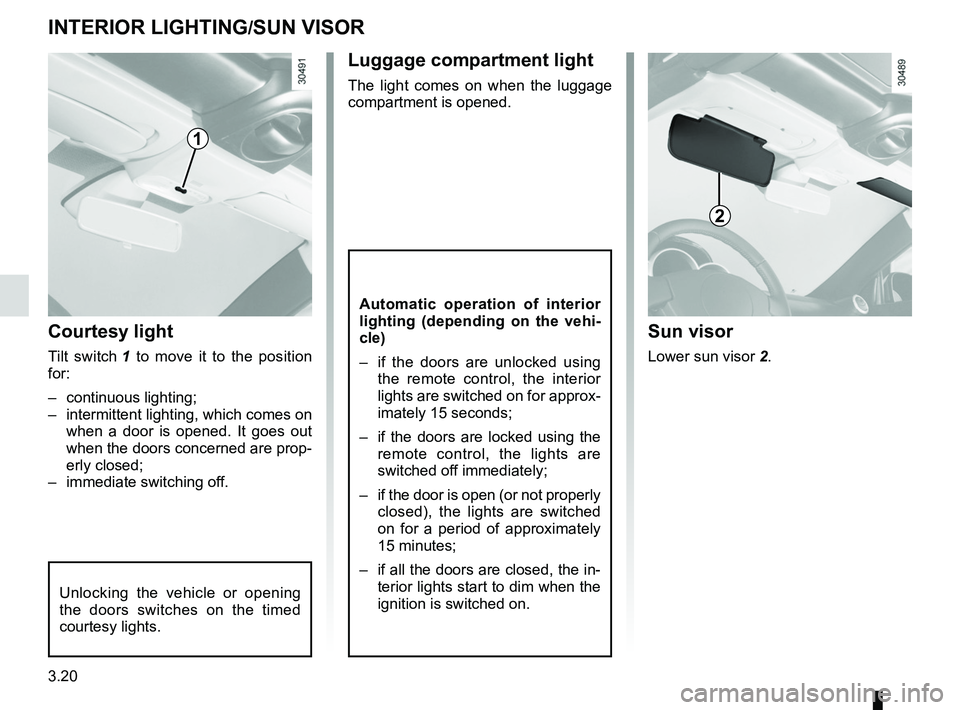
Courtesy light
Tilt switch 1 to move it to the position
for:
– continuous lighting;
– intermittent lighting, which comes on
when a door is opened. It goes out
when the doors concerned are prop-
erly closed;
– immediate switching off.
Interior lighting
Sun visor
inteRioR ligHting/sun visoR
Unlocking the vehicle or opening
the doors switches on the timed
courtesy lights.
1
luggage compartment light
The light comes on when the luggage
compartment is opened.
sun visor
Lower sun visor 2.
2
automatic operation of interior
lighting (depending on the vehi -
cle)
– if the doors are unlocked using
the remote control, the interior
lights are switched on for approx -
imately 15 seconds;
– if the doors are locked using the
remote control, the lights are
switched off immediately;
– if the door is open (or not properly
closed), the lights are switched
on for a period of approximately
15 minutes;
– if all the doors are closed, the in-
terior lights start to dim when the
ignition is switched on.