Connect RENAULT ZOE 2018 Owner's Manual
[x] Cancel search | Manufacturer: RENAULT, Model Year: 2018, Model line: ZOE, Model: RENAULT ZOE 2018Pages: 226, PDF Size: 5.51 MB
Page 183 of 226
5.9
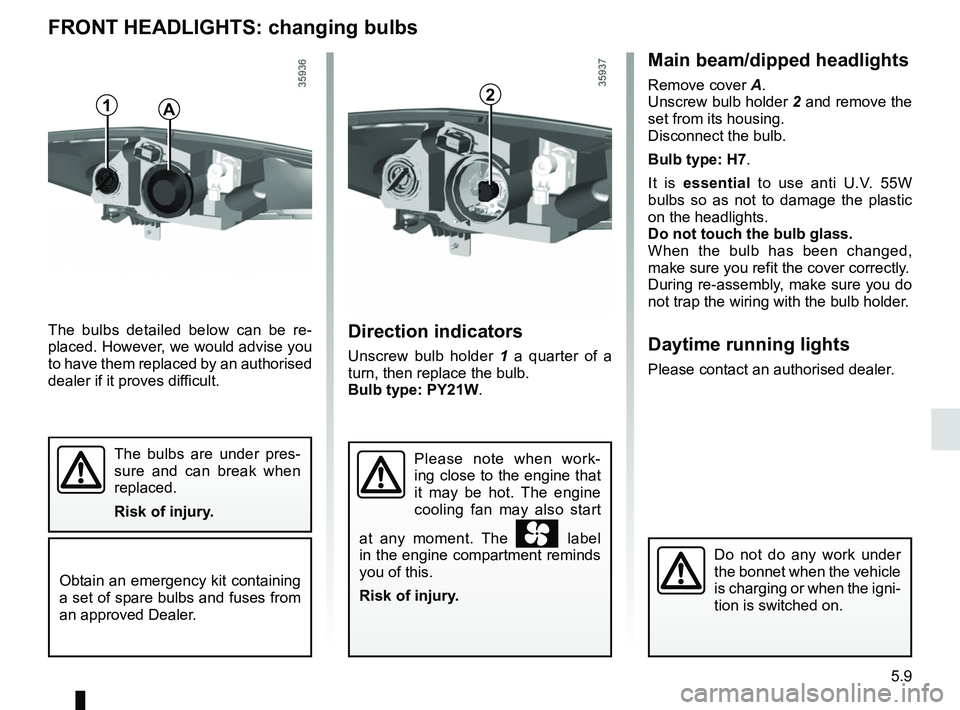
FRONT HEADLIGHTS: changing bulbs
Direction indicators
Unscrew bulb holder 1 a quarter of a
turn, then replace the bulb.
Bulb type: PY21W.
The bulbs detailed below can be re-
placed. However, we would advise you
to have them replaced by an authorised
dealer if it proves difficult.
1A
Obtain an emergency kit containing
a set of spare bulbs and fuses from
an approved Dealer.
Main beam/dipped headlights
Remove cover A.
Unscrew bulb holder 2 and remove the
set from its housing.
Disconnect the bulb.
Bulb type: H7.
It is essential to use anti U.V. 55W
bulbs so as not to damage the plastic
on the headlights.
Do not touch the bulb glass.
When the bulb has been changed,
make sure you refit the cover correctly.
During re-assembly, make sure you do
not trap the wiring with the bulb holder.
Daytime running lights
Please contact an authorised dealer.
The bulbs are under pres-
sure and can break when
replaced.
Risk of injury.
2
Do not do any work under
the bonnet when the vehicle
is charging or when the igni-
tion is switched on.
Please note when work-
ing close to the engine that
it may be hot. The engine
cooling fan may also start
at any moment. The
label
in the engine compartment reminds
you of this.
Risk of injury.
Page 186 of 226
5.12
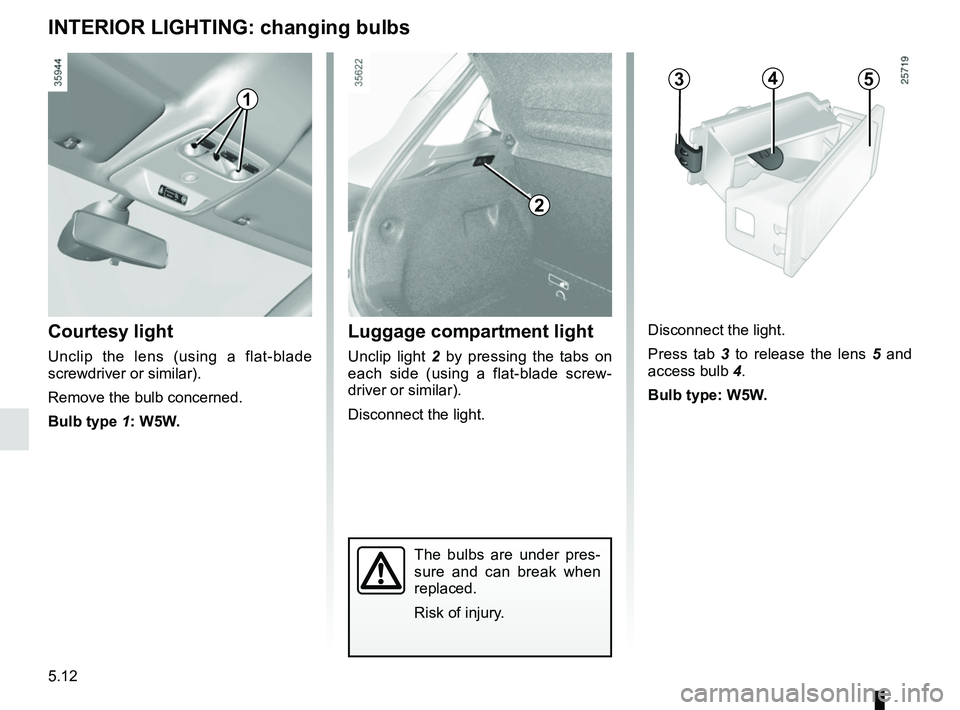
INTERIOR LIGHTING: changing bulbs
The bulbs are under pres-
sure and can break when
replaced.
Risk of injury.
Courtesy light
Unclip the lens (using a flat-blade
screwdriver or similar).
Remove the bulb concerned.
Bulb type 1: W5W.
345
Disconnect the light.
Press tab 3 to release the lens 5 and
access bulb 4.
Bulb type: W5W.
2
Luggage compartment light
Unclip light 2 by pressing the tabs on
each side (using a flat-blade screw-
driver or similar).
Disconnect the light.
1
Page 190 of 226
5.16
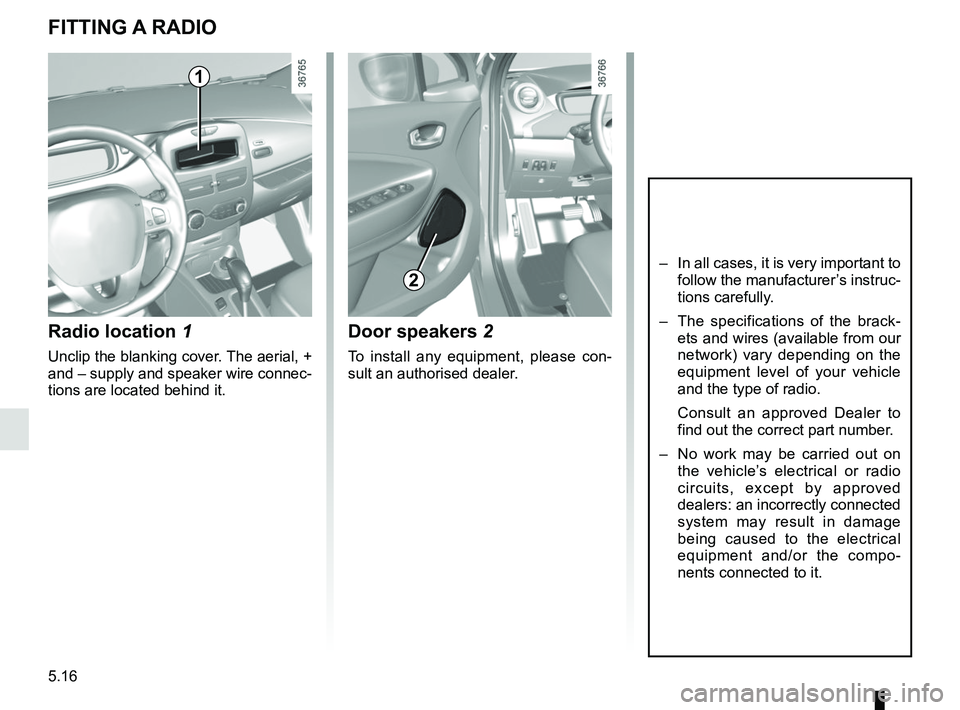
Radio location 1
Unclip the blanking cover. The aerial, +
and – supply and speaker wire connec-
tions are located behind it.
Door speakers 2
To install any equipment, please con-
sult an authorised dealer.
FITTING A RADIO
1
2
– In all cases, it is very important to
follow the manufacturer’s instruc-
tions carefully.
– The specifications of the brack- ets and wires (available from our
network) vary depending on the
equipment level of your vehicle
and the type of radio.
Consult an approved Dealer to find out the correct part number.
– No work may be carried out on the vehicle’s electrical or radio
circuits, except by approved
dealers: an incorrectly connected
system may result in damage
being caused to the electrical
equipment and/or the compo-
nents connected to it.
Page 191 of 226

5.17
ACCESSORIES
Electrical and electronic accessories
Before installing this type of accessory (particularly for transmitters\
/receivers: frequency bandwidth, power level, po-
sition of the aerial, etc.), make sure it is compatible with your vehic\
le. You can get advice from an authorised dealer.
Connect accessories with a maximum power of 120 Watts only. Fire hazard. When several accessory sockets are
used at the same time, the total power of the connected accessories must\
not exceed 180 watts.
No work may be carried out on the vehicle’s electrical or radio circuits, except by approved Dealers: an incorrect\
ly connected
system may result in damage being caused to the electrical equipment and\
/or the components connected to it.
If the vehicle is fitted with any aftermarket electrical equipment, make\
sure that the installation is correctly protected by a fuse.
Establish the rating and position of this fuse.
Using the diagnostic socket
The use of electronic accessories on the diagnostic socket may cause ser\
ious disturbance to the vehicle’s electronic systems.
For your safety we recommend that you use only electronic accessories ap\
proved by the manufacturer, consult an Approved
Dealer. Serious accident risk.
Use of transmission/receiving devices (telephones, CB equipment etc.).\
Telephones and CB equipment with integrated aerials may cause interferenc\
e to the electronic systems originally fitted to the
vehicle: it is advisable only to use equipment with an external aerial. \
Furthermore, we remind you of the need to conform
to the legislation in force concerning the use of such equipment.
Fitting after-market accessories
If you wish to install accessories on the vehicle: please contact an aut\
horised dealer. Also, to ensure the correct operation o f
your vehicle, and to avoid any risk to your safety, we recommend that you use only accessories specifically designed for y\
our
vehicle, which are the only accessories for which the manufacturer will \
provide a warranty.
If you are using an anti-theft device, only attach it to the brake pedal\
.
Obstructions to the driver
On the driver’s side, only use mats suitable for the vehicle, attached with the pre-fi\
tted components, and check the fitting re gu-
larly. Do not lay one mat on top of another. There is a risk of wedging the pedals
Page 196 of 226

The following advice will enable you to carry out quick, temporary repai\
rs. For safety reasons you should always contact
an approved dealer as soon as possible.
FAULTSPO")
5.22
OPERATING FAULTS (1/4)
The following advice will enable you to carry out quick, temporary repai\
rs. For safety reasons you should always contact
an approved dealer as soon as possible.
FAULTSPOSSIBLE CAUSESWHAT TO DO
Impossible to charge the traction bat-
tery.
The charging flap warning light flashes
red. The outdoor temperature is lower
than -26°C.
Recharge your vehicle in a more suitable
environment. If necessary, please refer to
the information on “Towing: breakdown re-
covery” in Section 5.
No electrical current in the wall
socket or poor connection of cable
to domestic socket. Check your installation (circuit breaker, pro-
grammer, etc.).
Check the connections (socket, etc.).
Please refer to the information on “Electric
vehicle: charging” in Section 1.
The cord is defective. Please see an authorised dealer to replace
it.
Impossible to charge the traction bat-
tery.
The charging flap warning light flashes
blue. The charging cord is not correctly
locked to the vehicle. Plug the charging cord correctly to the ve-
hicle. Refer to the information on “Electric
vehicle: charging” in Section 1.
The activation of the air conditioning
using the card RENAULT fails to work. The card RENAULT is outside its
area of action.Step closer to the vehicle.
One of the usage conditions is not
complied with. Please refer to the information on “Air-
conditioning: remote control activation” in
Section 3.
Page 199 of 226
5.25
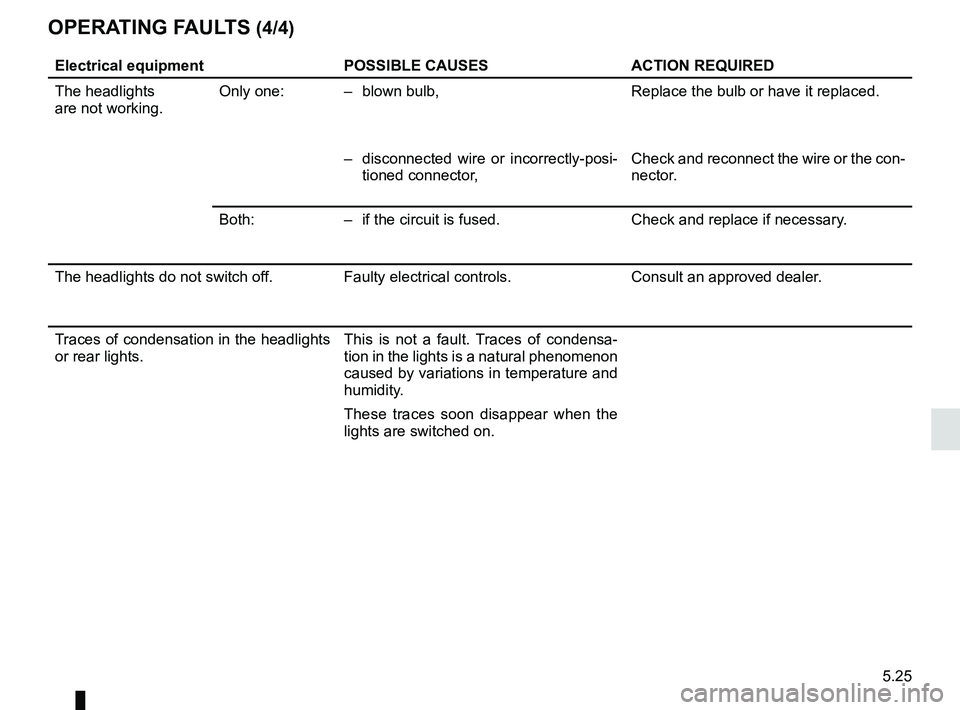
OPERATING FAULTS (4/4)
Electrical equipmentPOSSIBLE CAUSESACTION REQUIRED
The headlights
are not working. Only one: – blown bulb,
Replace the bulb or have it replaced.
– disconnected wire or incorrectly-posi- tioned connector, Check and reconnect the wire or the con-
nector.
Both: – if the circuit is fused. Check and replace if necessary.
The headlights do not switch off. Faulty electrical controls. Consult an approved dealer.
Traces of condensation in the headlights
or rear lights. This is not a fault. Traces of condensa-
tion in the lights is a natural phenomenon
caused by variations in temperature and
humidity.
These traces soon disappear when the
lights are switched on.
Page 219 of 226

A
ABS ....................................................................\
...2.16 → 2.20
accessories...................................................................")
7.1
ALPHABETICAL INDEX (1/5)
A
ABS ....................................................................\
...2.16 → 2.20
accessories........................................................................\
5.17
accessories socket ............................................................ 3.26
additional methods of restraint .....................1.37 → 1.40, 1.43
side protection ............................................................. 1.42
to the front seat belts .......................................1.37 → 1.40
to the rear seat belts ........................................1.37 → 1.41
adjusting your driving position ........................................... 1.33
air bag....................................................................1.37 → 1.43
activating the front passenger air bags ........................ 1.57
deactivating the front passenger air bags .................... 1.55
air conditioning ................ 1.20 – 1.21, 3.4 → 3.11, 3.18 – 3.19
air vents ...................................................................... 3.2 – 3.3
anti-corrosion check ..............................................6.13 → 6.17
anti-corrosion protection ...................................................... 4.9
anti-lock braking system: ABS ...............................2.16 → 2.20
armrest: front ..................................................................\
............ 3.24
ashtray ................................................................\
............... 3.26
audible and visual signals.................................................. 1.79
B
battery........................................................................\
........ 1.63
12 volt battery maintenance ......................................................... 4.6 – 4.7
12 volt battery ............................................1.2 → 1.6, 4.6 – 4.7
bonnet........................................................................\
. 4.2 – 4.3
brake fluid ........................................................................\
.... 4.5
bulbs changing ........................................................... 5.10 – 5.11
C
central door locking ......................................1.26, 1.29 → 1.31
changing a bulb ...................................................... 5.10 – 5.11
changing gear ............................................................. 2.5 – 2.6 charge meter .............................................................. 1.66, 2.7
charging cord .......................................1.8
→ 1.15, 1.20 – 1.21
charging flap ............................................................1.8 → 1.15
charging socket ..................................... 1.2 → 1.6, 1.8 → 1.15
child restraint/seat .............................1.44 – 1.45, 1.47 → 1.57
child safety..1.18 – 1.19, 1.24, 1.28, 1.44 – 1.45, 1.47 → 1.57,
3.20 – 3.21
child seats..........................................1.44 – 1.45, 1.47 → 1.54
children ........................... 1.18 – 1.19, 1.27 – 1.28, 1.44 – 1.45
children (safety) ............................................. 1.24, 3.20 – 3.21
cleaning: inside the vehicle .............................................. 4.12 – 4.13
clock ....................................................................... 1.75 – 1.76
closing the doors ...................................................1.27 → 1.30
connected services .............................................................. 1.3
control instruments ................................................1.62 → 1.68
controls ...............................................................\
...1.58 → 1.61
coolant ................................................................\
................. 4.4
courtesy light ............................................................ 3.22, 5.12
courtesy mirrors ................................................................. 3.22
cruise control ................................................1.63, 2.21 → 2.27
cruise control-speed limiter....................................2.21 → 2.27
D
dashboard..............................................................1.58 → 1.61
daytime running lights................................................. 1.81, 5.9
deadlocking the doors ....................................................... 1.26
display .................................................1.58 → 1.66, 2.29, 3.33
doors.............................................................. 1.27 – 1.28, 1.31
doors/tailgate ................................................. 1.26 – 1.28, 1.31
driver’s position .....................................................1.58 → 1.64
driving .............................. 2.2 → 2.6, 2.10 – 2.11, 2.13 → 2.29
driving position settings ............................................................1.33 → 1.36
driving recommendations ........................................ 2.7 → 2.11