ECO mode SAAB 9-3 2000 Owner's Manual
[x] Cancel search | Manufacturer: SAAB, Model Year: 2000, Model line: 9-3, Model: SAAB 9-3 2000Pages: 236, PDF Size: 10.85 MB
Page 141 of 236
141 Starting and driving
Gear changingManual transmissionTo start the engine the clutch pedal must
be fully depressed.
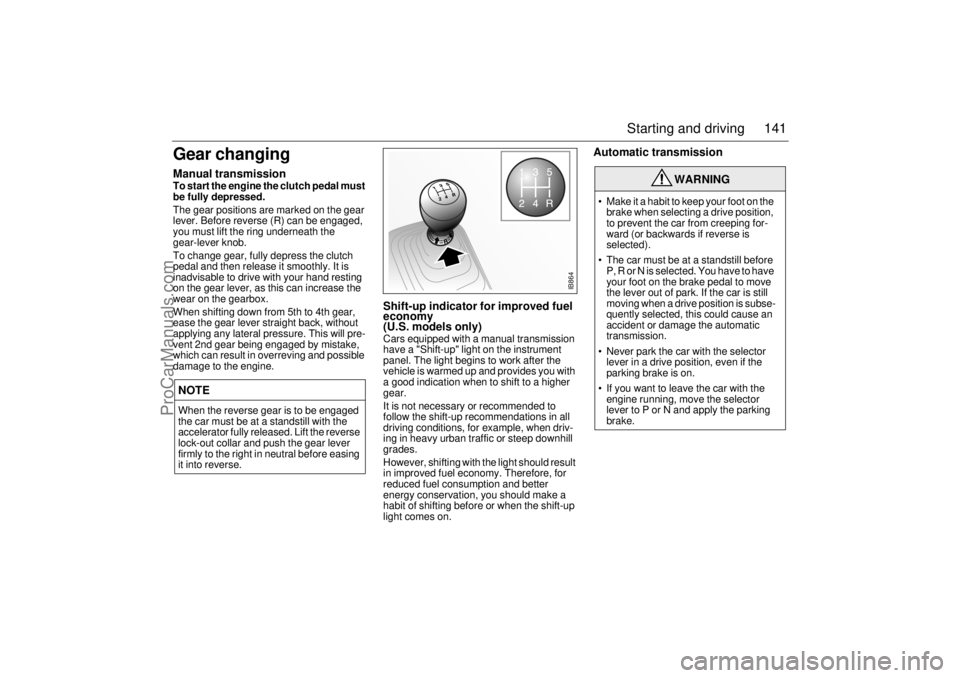
The gear positions are marked on the gear
lever. Before reverse (R) can be engaged,
you must lift the ring underneath the
gear-lever knob.
To change gear, fully depress the clutch
pedal and then release it smoothly. It is
inadvisable to drive with your hand resting
on the gear lever, as this can increase the
wear on the gearbox.
When shifting down from 5th to 4th gear,
ease the gear lever straight back, without
applying any lateral pressure. This will pre-
vent 2nd gear being engaged by mistake,
which can result in overreving and possible
damage to the engine.
Shift-up indicator for improved fuel
economy
(U.S. models only)Cars equipped with a manual transmission
have a "Shift-up" light on the instrument
panel. The light begins to work after the
vehicle is warmed up and provides you with
a good indication when to shift to a higher
gear.
It is not necessary or recommended to
follow the shift-up recommendations in all
driving conditions, for example, when driv-
ing in heavy urban traffic or steep downhill
grades.
However, shifting with the light should result
in improved fuel economy. Therefore, for
reduced fuel consumption and better
energy conservation, you should make a
habit of shifting before or when the shift-up
light comes on.
Automatic transmission
NOTEWhen the reverse gear is to be engaged
the car must be at a standstill with the
accelerator fully released. Lift the reverse
lock-out collar and push the gear lever
firmly to the right in neutral before easing
it into reverse.
WARNING
Make it a habit to keep your foot on the
brake when selecting a drive position,
to prevent the car from creeping for-
ward (or backwards if reverse is
selected).
The car must be at a standstill before
P, R or N is selected. You have to have
your foot on the brake pedal to move
the lever out of park. If the car is still
moving when a drive position is subse-
quently selected, this could cause an
accident or damage the automatic
transmission.
Never park the car with the selector
lever in a drive position, even if the
parking brake is on.
If you want to leave the car with the
engine running, move the selector
lever to P or N and apply the parking
brake.
IB864
ProCarManuals.com
Page 142 of 236
142 Starting and drivingThe electronic control module for the auto-
matic transmission receives information on
engine torque and road speed. It also con-
trols the hydraulic pressure in the transmis-
sion to ensure that gear changing is as
smooth as possible.
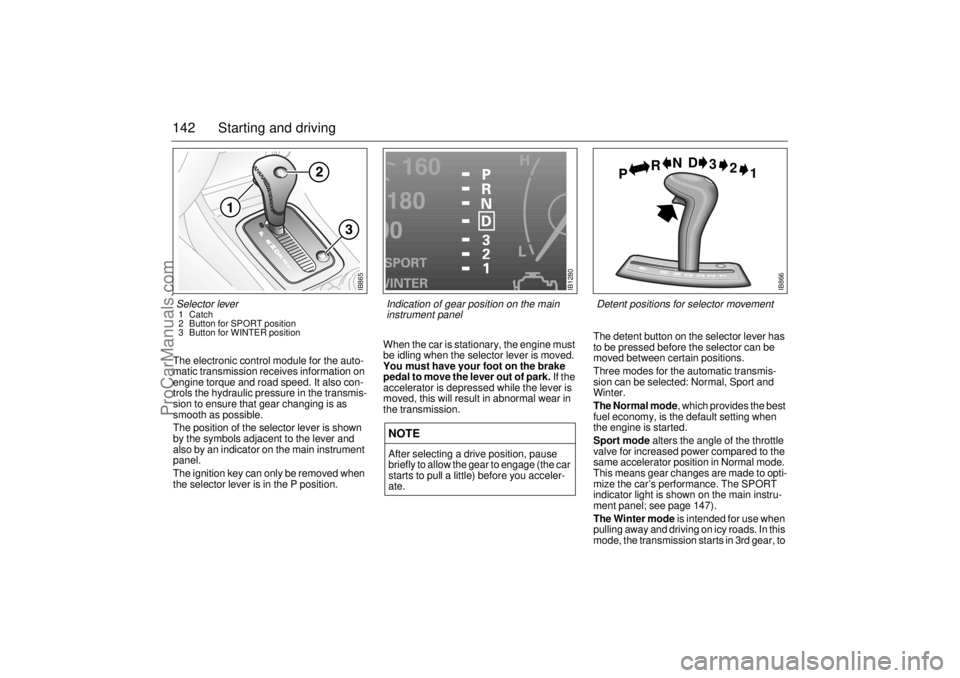
The position of the selector lever is shown
by the symbols adjacent to the lever and
also by an indicator on the main instrument
panel.
The ignition key can only be removed when
the selector lever is in the P position.When the car is stationary, the engine must
be idling when the selector lever is moved.
You must have your foot on the brake
pedal to move the lever out of park. If the
accelerator is depressed while the lever is
moved, this will result in abnormal wear in
the transmission. The detent button on the selector lever has
to be pressed before the selector can be
moved between certain positions.
Three modes for the automatic transmis-
sion can be selected: Normal, Sport and
Winter.
The Normal mode, which provides the best
fuel economy, is the default setting when
the engine is started.
Sport mode alters the angle of the throttle
valve for increased power compared to the
same accelerator position in Normal mode.
This means gear changes are made to opti-
mize the car’s performance. The SPORT
indicator light is shown on the main instru-
ment panel; see page 147).
The Winter mode is intended for use when
pulling away and driving on icy roads. In this
mode, the transmission starts in 3rd gear, to
NOTEAfter selecting a drive position, pause
briefly to allow the gear to engage (the car
starts to pull a little) before you acceler-
ate.
IB1280
Indication of gear position on the main
instrument panel
IB865
Selector lever 1 Catch
2 Button for SPORT position
3 Button for WINTER position
PRND
3
2
1
IB866
Detent positions for selector movement
ProCarManuals.com
Page 144 of 236
144 Starting and driving
Automatic transmission
fault indicator
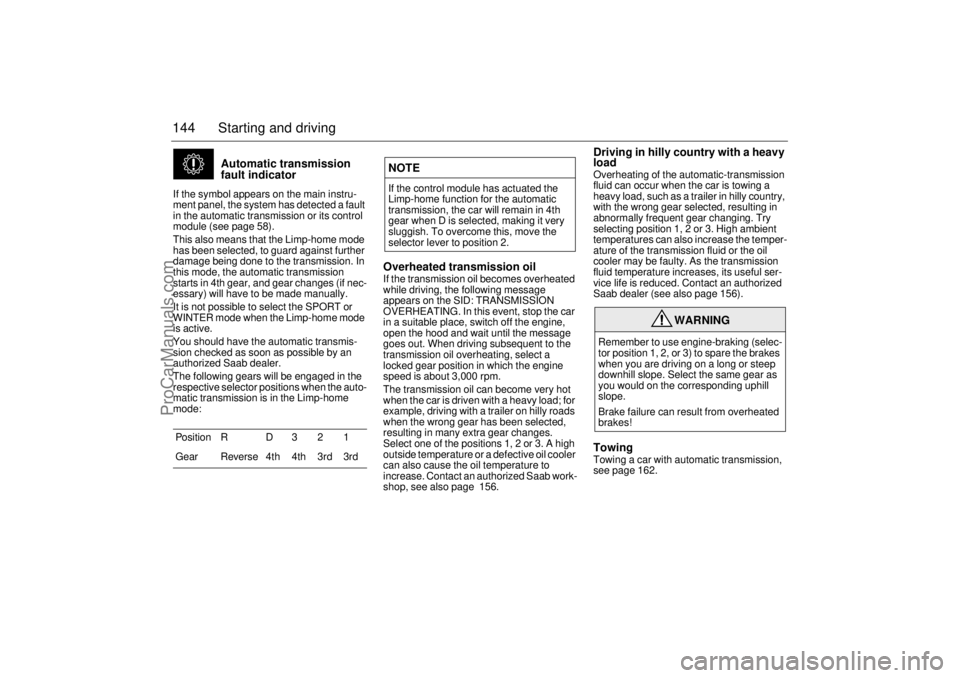
If the symbol appears on the main instru-
ment panel, the system has detected a fault
in the automatic transmission or its control
module (see page 58).
This also means that the Limp-home mode
has been selected, to guard against further
damage being done to the transmission. In
this mode, the automatic transmission
starts in 4th gear, and gear changes (if nec-
essary) will have to be made manually.
It is not possible to select the SPORT or
WINTER mode when the Limp-home mode
is active.
You should have the automatic transmis-
sion checked as soon as possible by an
authorized Saab dealer.
The following gears will be engaged in the
respective selector positions when the auto-
matic transmission is in the Limp-home
mode:
Overheated transmission oilIf the transmission oil becomes overheated
while driving, the following message
appears on the SID: TRANSMISSION
OVERHEATING. In this event, stop the car
in a suitable place, switch off the engine,
open the hood and wait until the message
goes out. When driving subsequent to the
transmission oil overheating, select a
locked gear position in which the engine
speed is about 3,000 rpm.
The transmission oil can become very hot
when the car is driven with a heavy load; for
example, driving with a trailer on hilly roads
when the wrong gear has been selected,
resulting in many extra gear changes.
Select one of the positions 1, 2 or 3. A high
outside temperature or a defective oil cooler
can also cause the oil temperature to
increase. Contact an authorized Saab work-
shop, see also page 156.
Driving in hilly country with a heavy
loadOverheating of the automatic-transmission
fluid can occur when the car is towing a
heavy load, such as a trailer in hilly country,
with the wrong gear selected, resulting in
abnormally frequent gear changing. Try
selecting position 1, 2 or 3. High ambient
temperatures can also increase the temper-
ature of the transmission fluid or the oil
cooler may be faulty. As the transmission
fluid temperature increases, its useful ser-
vice life is reduced. Contact an authorized
Saab dealer (see also page 156).TowingTowing a car with automatic transmission,
see page 162. Position R D 3 2 1
Gear Reverse 4th 4th 3rd 3rd
NOTEIf the control module has actuated the
Limp-home function for the automatic
transmission, the car will remain in 4th
gear when D is selected, making it very
sluggish. To overcome this, move the
selector lever to position 2.
WARNING
Remember to use engine-braking (selec-
tor position 1, 2, or 3) to spare the brakes
when you are driving on a long or steep
downhill slope. Select the same gear as
you would on the corresponding uphill
slope.
Brake failure can result from overheated
brakes!
ProCarManuals.com
Page 146 of 236

146 Starting and drivingIf the gear selector lever is moved from position D to 1, a
change-down to 3rd gear will occur at about 110 mph (180 km/h).
A change-down to 2nd gear will occur at about 75 mph (120 km/h)
and to 1st gear at about 40 mph (65 km/h).
When position 1 is selected, all the other gears will be locked out.
Manual gear-changing is not recommended on slippery roads.
2.0 Turbo 185 hp and 205 hp: If one of the drive wheels spins
excessively, the engine torque will be reduced to avoid damaging
the transmissionKick-downWhen the accelerator is pressed down hard, a downshift to the next
lower gear will occur to provide maximum acceleration, e.g. for over-
taking.
The change-up to the next gear again will take place either when the
accelerator is released or when maximum engine speed for that
gear is reached.
Adaptive gear-change patternsAdaptive gear-change patterns are selected automatically depend-
ing on the engine load. This function applies in the Normal and Sport
modes.
The change occurs at a higher rotation speed and the gear remains
engaged for a longer period, if the control module senses that the
load does not drop. These change patterns avoid unnecessary gear
changes when, for example, driving on long inclines with a trailer,
and to prevent overheating of the transmission oil. This function cuts
in automatically if the oil becomes too hot, to protect the transmis-
sion from serious damage, and lower the oil temperature.
The adaptive change pattern function is not activated at speeds over
93 mph (150 km/h). If a pattern is in operation when this speed is
exceeded, it will be maintained until the control module senses that
a more suitable one can be activated.
The adaptive gear-change pattern function is deselected when:
Winter mode is selected.
The engine is switched off.
The load is reduced by so much that this function is no longer
required.
“Automatic transmission fault indicator” appears on the
main instrument panel, see page 144. 1
Position 1 should be used when maximum
engine-braking is required on steep downhill
slopes and to avoid frequent gear-changing on
steep climbs.
Do not move the selector to position 1 at speeds
in excess of 30 mph (50 km/h).
ProCarManuals.com
Page 149 of 236

149 Starting and driving
Disengaging the system The system will be disengaged:
When the brake or clutch pedal is
depressed.
When the switch is moved to CANCEL.
When the switch is moved to OFF.
When the engine is switched off.
When the selector lever is moved to posi-
tion N (cars with automatic transmission).
BrakingTo avoid overheating the brakes, (e.g. when
negotiating long descents with a drop of
several hundred feet), select a low gear to
use the braking effect of the engine. If the
car has automatic transmission, move the
selector lever to position 1 or 2.
When driving fast, you can help to prolong
the life of the brakes by thinking ahead and
braking harder for short periods, rather than
braking more moderately over long
stretches. Brake pad wear indicatorsThe outboard brake pads on the front
wheels incorporate pad-wear indicators.
When the lining is down to 3 mm, the pad
will produce a screeching, squealing or
scraping noise when the brakes are applied.
New pads should be installed without delay.
Brake pads should only be replaced by
an authorized Saab dealer.
To ensure optimum brake performance,
it is recommended that you use only
Saab original brake pads.
WARNING
It is prudent to try your brakes from
time to time, especially when driving in
heavy rain, on roads with a lot of sur-
face water, or in snow or slush. In such
conditions, the brakes may take
longer than normal to take effect. To
rectify this, touch the brake pedal peri-
odically to dry the brakes out.
The same applies after the car has
been washed or when the weather is
very humid.
The brakes are power assisted and it
should be kept in mind that the servo
unit only provides the power assis-
tance when the engine is running.
The brake pressure required when the
engine is off,( e.g. when the car is
being towed) is roughly four times the
normal pedal force required. The
pedal also feels hard and unrespon-
sive.
ProCarManuals.com
Page 157 of 236
157 Starting and driving
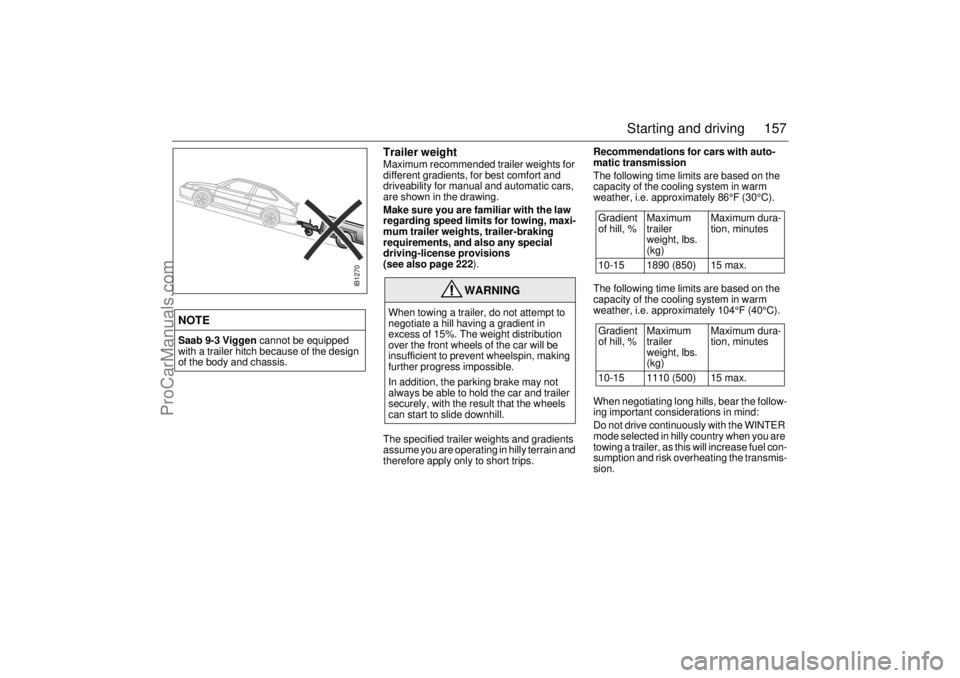
Trailer weightMaximum recommended trailer weights for
different gradients, for best comfort and
driveability for manual and automatic cars,
are shown in the drawing.
Make sure you are familiar with the law
regarding speed limits for towing, maxi-
mum trailer weights, trailer-braking
requirements, and also any special
driving-license provisions
(see also page 222).
The specified trailer weights and gradients
assume you are operating in hilly terrain and
therefore apply only to short trips.Recommendations for cars with auto-
matic transmission
The following time limits are based on the
capacity of the cooling system in warm
weather, i.e. approximately 86°F (30°C).
The following time limits are based on the
capacity of the cooling system in warm
weather, i.e. approximately 104°F (40°C).
When negotiating long hills, bear the follow-
ing important considerations in mind:
Do not drive continuously with the WINTER
mode selected in hilly country when you are
towing a trailer, as this will increase fuel con-
sumption and risk overheating the transmis-
sion.
NOTESaab 9-3 Viggen cannot be equipped
with a trailer hitch because of the design
of the body and chassis.
WARNING
When towing a trailer, do not attempt to
negotiate a hill having a gradient in
excess of 15%. The weight distribution
over the front wheels of the car will be
insufficient to prevent wheelspin, making
further progress impossible.
In addition, the parking brake may not
always be able to hold the car and trailer
securely, with the result that the wheels
can start to slide downhill.
Gradient
of hill, % Maximum
trailer
weight, lbs.
(kg)Maximum dura-
tion, minutes
10-15 1890 (850) 15 max.
Gradient
of hill, % Maximum
trailer
weight, lbs.
(kg)Maximum dura-
tion, minutes
10-15 1110 (500) 15 max.
IB1270
ProCarManuals.com
Page 192 of 236

192 Car careWheelsAlternative wheels and tiresIf you wish to fit other tires or wheels than
those supplied with the car, consult your
Saab dealer first as to the possibilities avail-
able.
Wheels/tires combinations that are not
approved by Saab can negatively affect the
car´s directional stability, steering and brak-
ing in both wet and dry conditions.
Do not assume that a wheel/tire combina-
tion will function properly just because it will
bolt on.
The wheels and tires have been carefully
matched to the characteristics of the car and
play a key role in its outstanding roadhold-
ing and handling.
Tire pressureTires need to be inflated to suit the load car-
ried and the maximum speed the car will be
driven (see the recommended tire pres-
sures on the back cover). Note that all
values apply to cold tires. For tires with an
aspect ratio less than /60, increase the tire
pressure by 3 psi (20 kPa) for rough roads
with potholes to minimize the risk of rim
damage.
Never reduce the pressure of a hot tire. If the
tires are hot when you check them, only
increase the pressure, if necessary.
Soft tires will cause faster wear than
over-pressurized tires. They also increase
fuel consumption.
If a valve is leaking, simply unscrew it and fit
a new one.
Important! Remember to adjust the tire
pressures if you change the load in the car
or intend to cruise at a substantially higher
or lower speed than normal.
NOTEFor wide wheels and/or low-profile tires,
bear in mind the following:
Tires and wheels can be damaged in
potholes etc.
Springs and shock absorbers can be
overloaded.
The wheels can come into contact with
chassis and body components.
The speed and load limits for the tires
must not be exceeded; see page 193.
Wheels larger than 16” must not be
fitted on the Saab 9-3. For Viggen
models the wheel should not be larger
than 17”. The maximum permissible
offset for the 9-3 is 49 mm and for the
Viggen 42 mm.
When fitting wheels on a 9-3, please
note that a 15” wheel should be used
on 9-3 Coupé and 5-door models, and
nothing smaller than 16” wheel should
be used for Viggen models. Fitting a
smaller size wheel on a Viggen is not
possible due to the size of the brake
discs.
NOTECheck the tire pressures at least once
per month.
Underinflation is the main cause of:
Tires wearing out prematurely.
Damage to the sidewalls.
Damage to the wheels.
ProCarManuals.com
Page 214 of 236

214 Maintenance and owner assistanceChange of Address Notification
(U.S.)Two change of address cards are provided
at the end of the Warranties and Service
Record Booklet. Knowing your current
address allows Saab to contact you in the
event of a recall or service campaign.
Please help us keep our records up to date
for your own peace of mind.Service informationFactory Service Manuals for the Saab 9-3
and 9-5 car lines can be ordered through the
dealer. These are comprehensive manuals
comprised of several sections in multiple
ring-type binders, geared to use by profes-
sional technicians.
Sections may be ordered individually. Con-
sult your Saab dealer for prices and for a list-
ing of available sections for your model.
Reporting Safety
Defects (U.S.A.)If you believe that your vehicle has a defect
which could cause a crash or could cause
injury or death, you should immediately
inform the National Highway Traffic Safety
Administration (NHTSA) in addition to noti-
fying Saab Cars USA, Inc.
If NHTSA receives similar complaints, it
may open an investigation, and if it finds that
a safety defect exists in a group of vehicles,
it may order a recall and remedy campaign.
However, NHTSA cannot become involved
in individual problems between you, your
dealer, or Saab Cars USA, Inc.
To contact NHTSA, you may either call the
Auto Safety Hotline toll-free at 1-800-424-
9393 (or 202/366-0123 in Washington D.C.
area) or write to: NHTSA, U.S. Department
of Transportation, Washington, D.C. 20590.
You can also obtain other information about
motor vehicle safety from the Hotline.
Reporting Safety
Defects to the Canadian
governmentIf you live in Canada, and believe that your
vehicle has a safety defect, you should
immediately notify Transport Canada, in
addition to notifying General Motors of
Canada Limited.
You may write to Transport Canada at Box
8880, Ottawa, Ontario, K1G 3J2.
In addition to notifying Transport Canada in
a situation like this, we certainly hope you
will notify us. In Canada, please call our
Saab Customer Assistance Centre at
1-800-263- 1999.
Or write:
General Motors of Canada Limited
Customer Assistance Centre,
1908 Colonel Sam Drive,
Oshawa, Ontario, L1H 8P7.
ProCarManuals.com
Page 215 of 236

215 Maintenance and owner assistance
Saab Original Service Program M2000 USA, Canada, (9-3 Models)* These are the minimum required Emission Control System maintenance steps. Saab urges that all recommended maintenance procedures be performed
according to this program.
(a.) Engine oil and filter should be changed at least once a year. Intermediate oil and filter changes (halfway between indicated intervals) suggested for
cars primarily used for driving in dense city traffic or for repeated short trip operation without sufficient warm up.
** Service intervals:
Refer to the Warranties & Service Record Book for service intervals beyond 100,000 miles (160,000 km).Service Intervals **
Miles = U.S. Cars
Kilometers = Canadian Cars
1,000
(1,600 km)
10,000
(16,000 km)
20,000
(32,000 km)
30,000
(48,000 km)
40,000
(64,000 km)
50,000
(80,000 km)
60,000
(96,000 km)
70,000
(112,000 km)
80,000
(128,000 km)
90,000
(144,000 km)
100,000
(160,000 km)
Service #
1234567891011
Engine and engine compartment
E Engine oil and filter (a.)!!!!!!!!!!!
R Engine coolant freezing point and level""" "" "" "
R Engine coolant flush and replace (max. 3-year intervals)!!!
R Engine cooling system, hoses and cap""""""""""
R Drive belt; condition""""" ! """"
E Spark plugs!
*
!*
!*
E Crankcase ventilation and vacuum lines""
Application/type of service (col. 1) Service Procedure
E = emission service"= Check - top up, adjust or replace if necessary
R = regular maintenance!= Replace
#= Lubricate
ProCarManuals.com
Page 231 of 236

231 Technical data
Several of the systems in your Saab
car may be adjusted to better fit your
individual needsSome functions are governed by legal
requirements and cannot therefore be
reprogrammed.
Consult an authorized Saab dealer for fur-
ther information.
Car alarm/central locking system:
The level of the siren when locking/
unlocking, HIGH or LOW.
The number of blinks when locking/
unlocking, 1 to 7.
Automatic locking of the trunk when the
car is driven, 1 to 8 mph (2-14 km/h), YES
or NO.
Preclude the unlocking of the trunk while
the car is driven, YES or NO.
Automatic locking of the trunk after
1 second-4 minutes if it has not been
opened, YES or NO.
Automatic locking of the trunk when it is
closed, YES or NO.Automatic climate control (ACC):
Indoor temperature can be
increased/decreased relative to the
selected temperature.
Delayed start of fan after starting the car,
to reduce risk of fogging windshield.
Temperature at which the defroster mode
is automatically selected.
Response time for the fan speed when
the selected temperature is changed.
Temperature at which the air distribution
switches from defrost mode to
defrost/floor mode.
Last manual selection will be selected the
next time the car is started.Saab Information Display (SID):
Outdoor temperature display can be
adjusted.
Days remaining to next service can be
activated/counted or not.
Delete “Test Brake Light“ message on
SID at start-up.
Miscellaneous:
Select the on-time for heated rear seat.
Coolant temperature gauge adjustment
can be increased/decreased.
Fuel level gauge adjustment can be
increased/decreased.
Additional sweep of the wipers after wind-
shield washer function (ON or OFF).
Follow me home on-time can vary from 20
to 50 seconds.
Night panel illumination deactivation
speed for the speedometer can be
adjusted.
ProCarManuals.com