belt SAAB 9-3 2000 Owner's Manual
[x] Cancel search | Manufacturer: SAAB, Model Year: 2000, Model line: 9-3, Model: SAAB 9-3 2000Pages: 236, PDF Size: 10.85 MB
Page 50 of 236
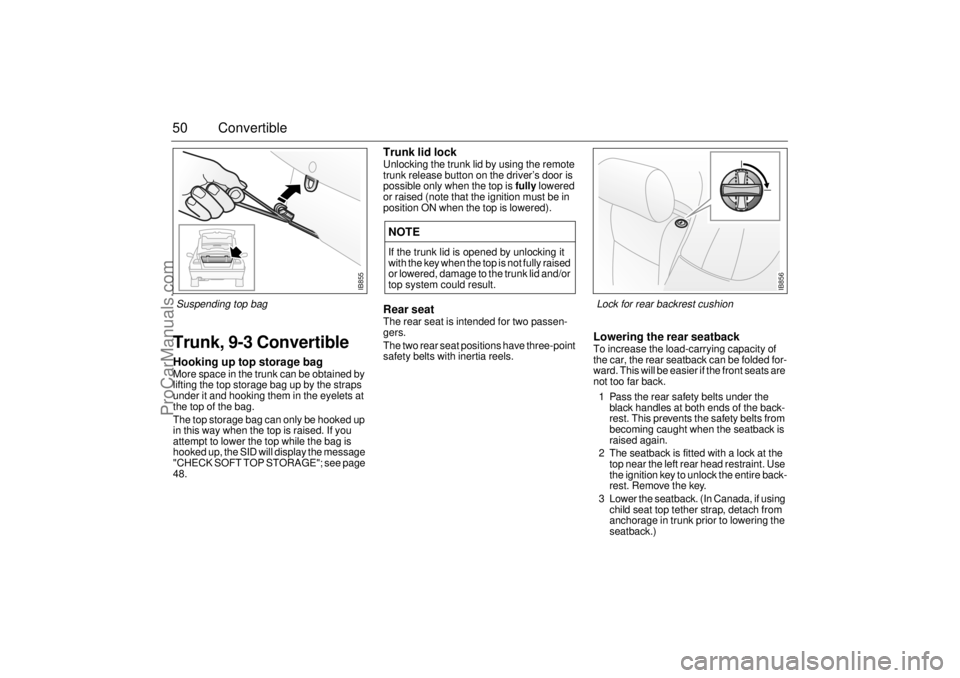
50 ConvertibleTrunk, 9-3 ConvertibleHooking up top storage bagMore space in the trunk can be obtained by
lifting the top storage bag up by the straps
under it and hooking them in the eyelets at
the top of the bag.
The top storage bag can only be hooked up
in this way when the top is raised. If you
attempt to lower the top while the bag is
hooked up, the SID will display the message
"CHECK SOFT TOP STORAGE"; see page
48.
Trunk lid lockUnlocking the trunk lid by using the remote
trunk release button on the driver’s door is
possible only when the top is fully lowered
or raised (note that the ignition must be in
position ON when the top is lowered).Rear seatThe rear seat is intended for two passen-
gers.
The two rear seat positions have three-point
safety belts with inertia reels.
Lowering the rear seatbackTo increase the load-carrying capacity of
the car, the rear seatback can be folded for-
ward. This will be easier if the front seats are
not too far back.
1 Pass the rear safety belts under the
black handles at both ends of the back-
rest. This prevents the safety belts from
becoming caught when the seatback is
raised again.
2 The seatback is fitted with a lock at the
top near the left rear head restraint. Use
the ignition key to unlock the entire back-
rest. Remove the key.
3 Lower the seatback. (In Canada, if using
child seat top tether strap, detach from
anchorage in trunk prior to lowering the
seatback.)
NOTEIf the trunk lid is opened by unlocking it
with the key when the top is not fully raised
or lowered, damage to the trunk lid and/or
top system could result.
IB855
Suspending top bag
IB856
Lock for rear backrest cushion
ProCarManuals.com
Page 55 of 236
55 Instruments and controls
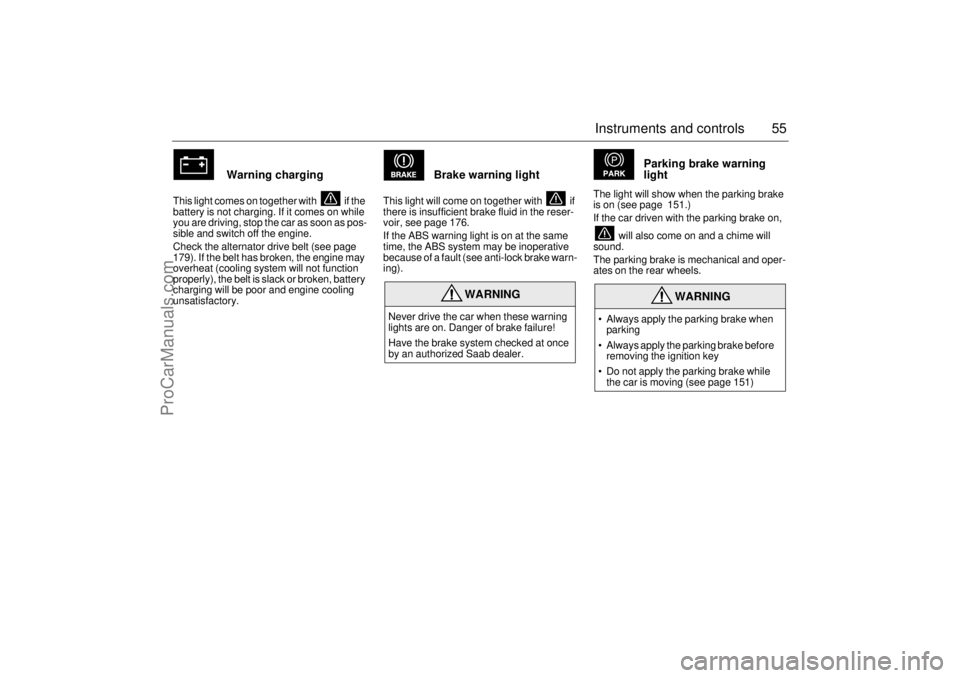
Warning charging
This light comes on together with if the
battery is not charging. If it comes on while
you are driving, stop the car as soon as pos-
sible and switch off the engine.
Check the alternator drive belt (see page
179). If the belt has broken, the engine may
overheat (cooling system will not function
properly), the belt is slack or broken, battery
charging will be poor and engine cooling
unsatisfactory.
Brake warning light
This light will come on together with if
there is insufficient brake fluid in the reser-
voir, see page 176.
If the ABS warning light is on at the same
time, the ABS system may be inoperative
because of a fault (see anti-lock brake warn-
ing).
Parking brake warning
light
The light will show when the parking brake
is on (see page 151.)
If the car driven with the parking brake on,
will also come on and a chime will
sound.
The parking brake is mechanical and oper-
ates on the rear wheels.
WARNING
Never drive the car when these warning
lights are on. Danger of brake failure!
Have the brake system checked at once
by an authorized Saab dealer.
WARNING
• Always apply the parking brake when
parking
Always apply the parking brake before
removing the ignition key
Do not apply the parking brake while
the car is moving (see page 151)
ProCarManuals.com
Page 113 of 236
113 Interior equipment, trunk
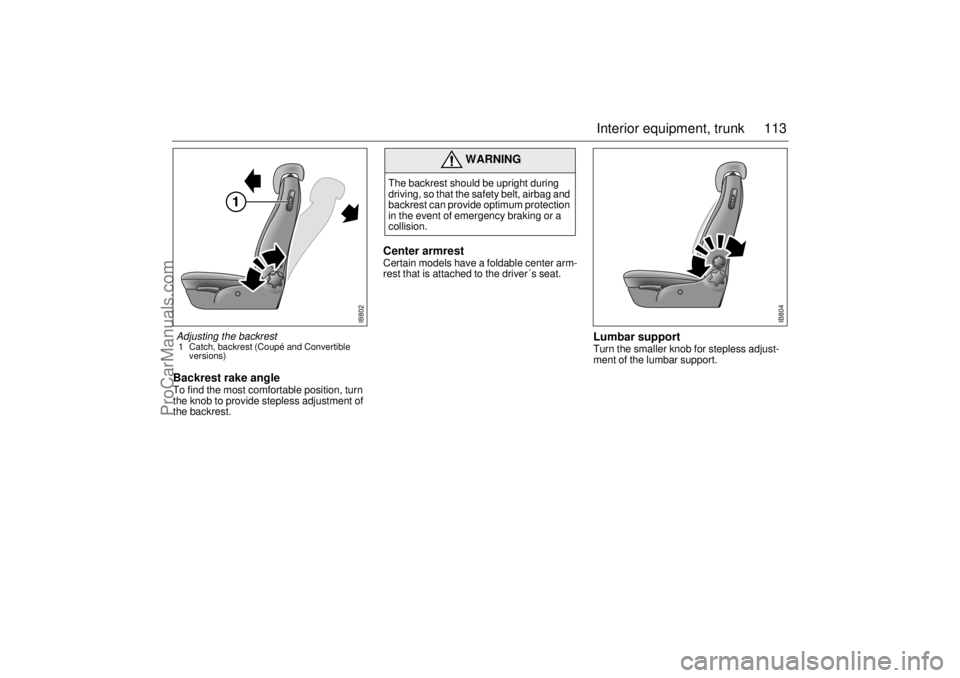
Backrest rake angle To find the most comfortable position, turn
the knob to provide stepless adjustment of
the backrest.
Center armrestCertain models have a foldable center arm-
rest that is attached to the driver´s seat.
Lumbar supportTurn the smaller knob for stepless adjust-
ment of the lumbar support.
WARNING
The backrest should be upright during
driving, so that the safety belt, airbag and
backrest can provide optimum protection
in the event of emergency braking or a
collision.
IB802
Adjusting the backrest 1 Catch, backrest (Coupé and Convertible
versions)
IB804
ProCarManuals.com
Page 125 of 236
125 Interior equipment, trunk
Trunk, Coupé and 5-doorTrunk lid lockUnlock the trunk lid by pressing the lower button on the remote trans-
mitter, by pressing the remote release button on the driver’s door or
by using the key. The alarm horn sounds three times and the lights
flash when the trunk is released with the remote control.
Programming features, see page 231.
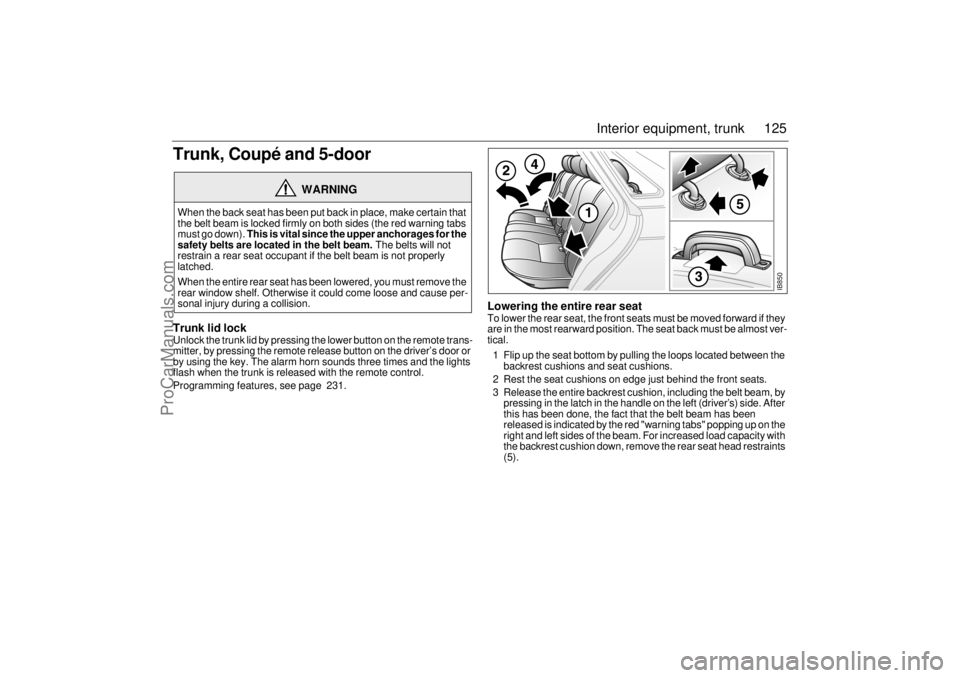
Lowering the entire rear seatTo lower the rear seat, the front seats must be moved forward if they
are in the most rearward position. The seat back must be almost ver-
tical.
1 Flip up the seat bottom by pulling the loops located between the
backrest cushions and seat cushions.
2 Rest the seat cushions on edge just behind the front seats.
3 Release the entire backrest cushion, including the belt beam, by
pressing in the latch in the handle on the left (driver’s) side. After
this has been done, the fact that the belt beam has been
released is indicated by the red "warning tabs" popping up on the
right and left sides of the beam. For increased load capacity with
the backrest cushion down, remove the rear seat head restraints
(5).
WARNING
When the back seat has been put back in place, make certain that
the belt beam is locked firmly on both sides (the red warning tabs
must go down). This is vital since the upper anchorages for the
safety belts are located in the belt beam. The belts will not
restrain a rear seat occupant if the belt beam is not properly
latched.
When the entire rear seat has been lowered, you must remove the
rear window shelf. Otherwise it could come loose and cause per-
sonal injury during a collision.
IB850
ProCarManuals.com
Page 126 of 236
126 Interior equipment, trunk4 Lower the entire backrest cushion by pulling this same handle
(item 3) forward. At the same time, pivot the beam backwards.
IMPORTANT: When you replace the belt beam using the handle
(item 3), you must verify that it is properly locked and that the two
red "warning tabs" go down (thereby indicating that locking has
taken place properly).
5 To increase the volume, the rear head restraints can be removed
before the backrest cushion is lowered.
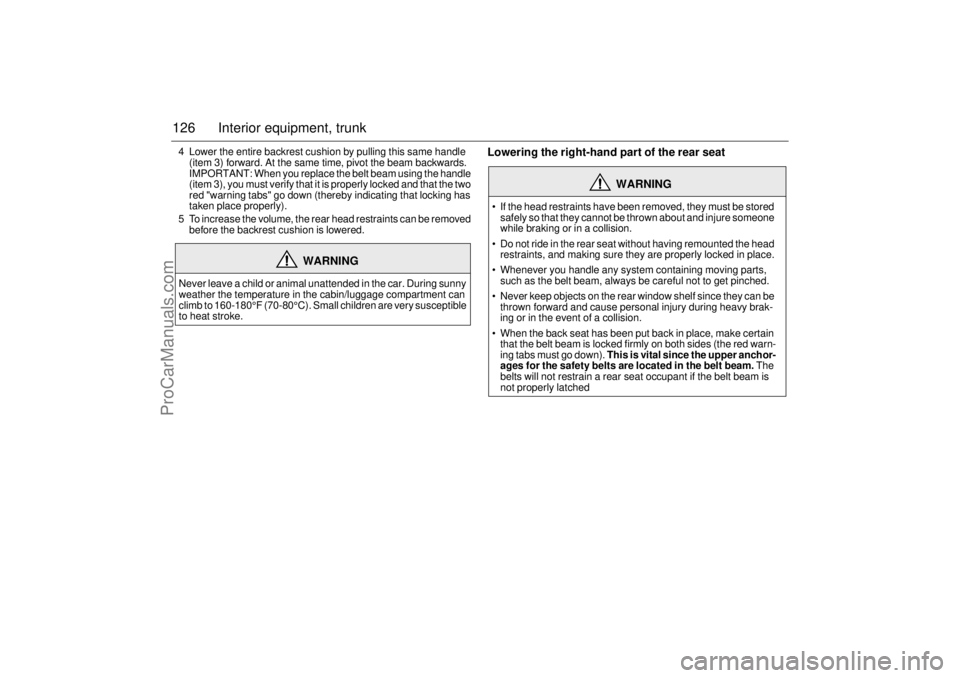
Lowering the right-hand part of the rear seat
WARNING
Never leave a child or animal unattended in the car. During sunny
weather the temperature in the cabin/luggage compartment can
climb to 160-180°F (70-80°C). Small children are very susceptible
to heat stroke.
WARNING
If the head restraints have been removed, they must be stored
safely so that they cannot be thrown about and injure someone
while braking or in a collision.
Do not ride in the rear seat without having remounted the head
restraints, and making sure they are properly locked in place.
Whenever you handle any system containing moving parts,
such as the belt beam, always be careful not to get pinched.
Never keep objects on the rear window shelf since they can be
thrown forward and cause personal injury during heavy brak-
ing or in the event of a collision.
When the back seat has been put back in place, make certain
that the belt beam is locked firmly on both sides (the red warn-
ing tabs must go down). This is vital since the upper anchor-
ages for the safety belts are located in the belt beam.
The
belts will not restrain a rear seat occupant if the belt beam is
not properly latched
ProCarManuals.com
Page 127 of 236
127 Interior equipment, trunk
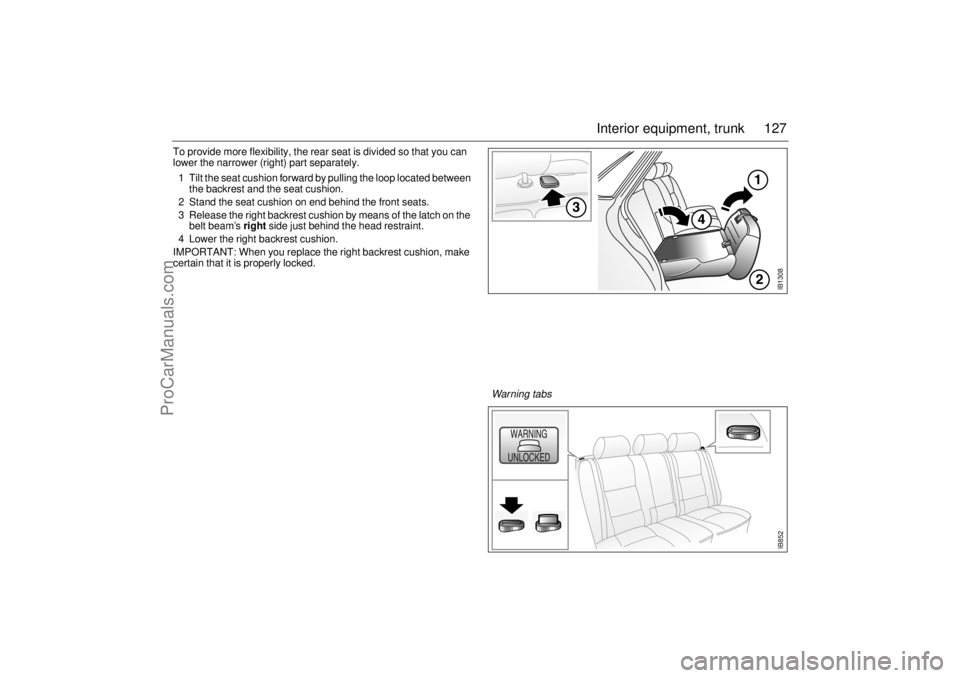
To provide more flexibility, the rear seat is divided so that you can
lower the narrower (right) part separately.
1 Tilt the seat cushion forward by pulling the loop located between
the backrest and the seat cushion.
2 Stand the seat cushion on end behind the front seats.
3 Release the right backrest cushion by means of the latch on the
belt beam’s right side just behind the head restraint.
4 Lower the right backrest cushion.
IMPORTANT: When you replace the right backrest cushion, make
certain that it is properly locked.
IB1308IB852
Warning tabs
ProCarManuals.com
Page 129 of 236
129 Interior equipment, trunk
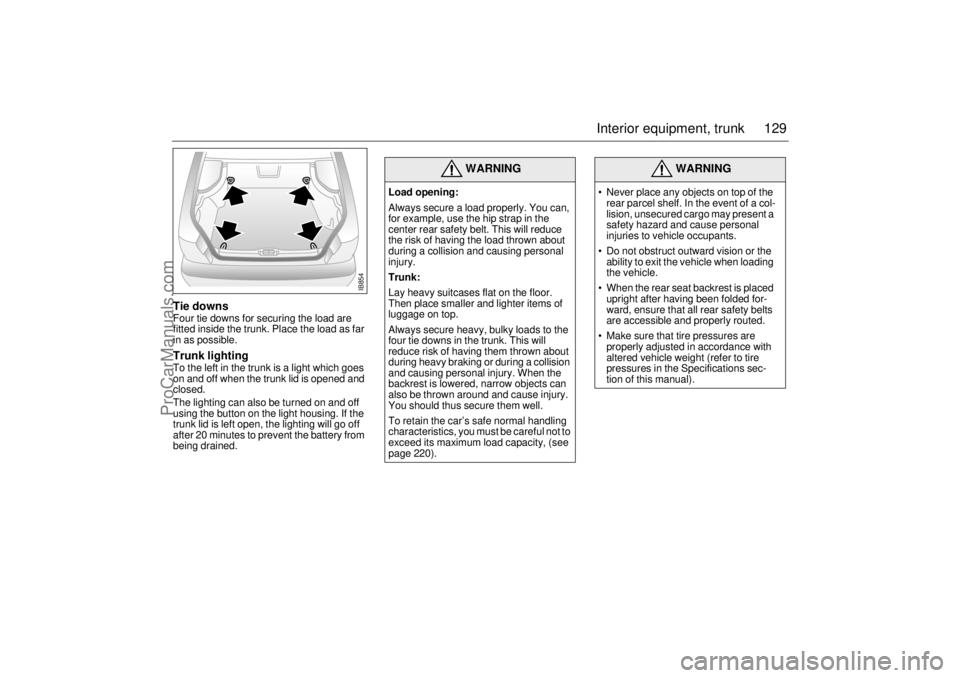
Tie downsFour tie downs for securing the load are
fitted inside the trunk. Place the load as far
in as possible.Trunk lightingTo the left in the trunk is a light which goes
on and off when the trunk lid is opened and
closed.
The lighting can also be turned on and off
using the button on the light housing. If the
trunk lid is left open, the lighting will go off
after 20 minutes to prevent the battery from
being drained.
WARNING
Load opening:
Always secure a load properly. You can,
for example, use the hip strap in the
center rear safety belt. This will reduce
the risk of having the load thrown about
during a collision and causing personal
injury.
Trunk:
Lay heavy suitcases flat on the floor.
Then place smaller and lighter items of
luggage on top.
Always secure heavy, bulky loads to the
four tie downs in the trunk. This will
reduce risk of having them thrown about
during heavy braking or during a collision
and causing personal injury. When the
backrest is lowered, narrow objects can
also be thrown around and cause injury.
You should thus secure them well.
To retain the car’s safe normal handling
characteristics, you must be careful not to
exceed its maximum load capacity, (see
page 220).
WARNING
Never place any objects on top of the
rear parcel shelf. In the event of a col-
lision, unsecured cargo may present a
safety hazard and cause personal
injuries to vehicle occupants.
Do not obstruct outward vision or the
ability to exit the vehicle when loading
the vehicle.
When the rear seat backrest is placed
upright after having been folded for-
ward, ensure that all rear safety belts
are accessible and properly routed.
Make sure that tire pressures are
properly adjusted in accordance with
altered vehicle weight (refer to tire
pressures in the Specifications sec-
tion of this manual).
IB854
ProCarManuals.com
Page 165 of 236
165 Starting and driving
Driving considerations
with compact spare
wheel/tire fitted The following should be observed when the
compact spare wheel (T115/70 R16) is
installed:
The compact spare is light and easy to
handle when changing the wheel. Do not
drive farther than necessary with the com-
pact spare fitted – the maximum life of the
wheel is only just over 2000 miles
(3,500 km). Have the standard wheel
repaired and reinstalled as soon as possi-
ble.
The car’s ground clearance is reduced with
the compact spare fitted. Note that only one
compact spare wheel may be used at any
time. Take care not to hit the curb and do not
fit snow chains. Leave the wheel cover off,
so that the warning text is readily visible.
For long tripsBefore starting off on a long journey, it is
advisable to have your car inspected over
by your Saab dealer.
Obtain a few important items to take along
on your journey such as spare bulbs, wiper
blades, fuses, a Poly-Vee-belt and the like.
You can check some points yourself before-
hand:
Make sure that the engine is in good con-
dition.
Check that no oil or fuel leaks out of the
engine or gearbox/transmission.
Inspect the Poly-Vee-belt and replace it if
it shows any signs of wear.
Check the battery charge.
Check the tires for tread pattern and air
pressure, including the compact spare
wheel.
Take an extra car key/remote control and
keep it separate, see also page 30.
Check the brakes.
Check all bulbs.
Check for the presence of the tool kit and
the jack in the car.
WARNING
Do not exceed 50 mph (80 km/h) as the
tire can overheat and adversely affect the
handling of the car.
The tire should be inflated to 60 psi
(420 kPa).
NOTETo avoid damaging a punctured alloy
wheel this can be placed outside up in the
spare-wheel well but only while driving to
the closest workshop.
A general rule is that all heavy loads must
be well secured in the luggage compart-
ment, see page 129.
ProCarManuals.com
Page 167 of 236
167 Car care
IB944
Hood release handle ....... 168
Engine .............................. 168
Engine bay ....................... 169
Engine oil ......................... 172
Transmission fluid .......... 173
Coolant ............................. 174
Brake- clutch fluid and
brake pads ..................... 176
Power steering ................ 177
Battery .............................. 177
Drive belt .......................... 179
Wipers and washers ....... 179
Wiper blades .................... 179
Changing bulbs ............... 181
Fuses ................................ 187
Wheels.............................. 192
Safety belts ...................... 199 Upholstery and trim ......... 200
Textile carpeting .............. 200
Engine bay ........................ 201
Washing ............................ 201
Waxing and polishing ...... 202
Touching up the paint ..... 202
Anti-corrosion treatment . 203
Recovery and/or recycling
of automotive materials. 205
Air conditioning (A/C
system) ........................... 207 Car care
ProCarManuals.com
Page 169 of 236
169 Car care
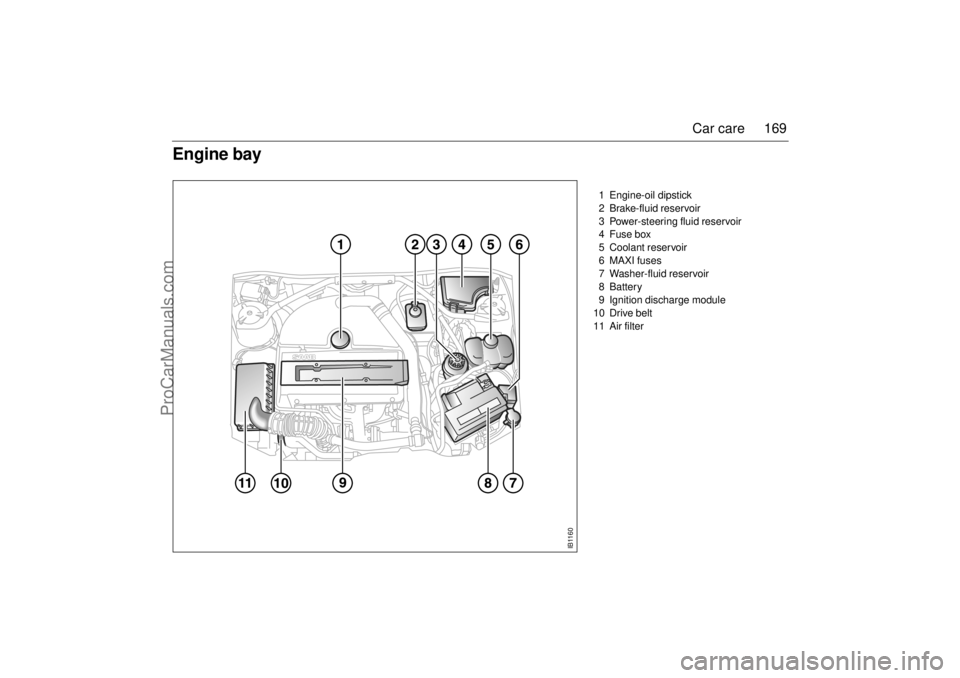
1 Engine-oil dipstick
2 Brake-fluid reservoir
3 Power-steering fluid reservoir
4 Fuse box
5 Coolant reservoir
6 MAXI fuses
7 Washer-fluid reservoir
8Battery
9 Ignition discharge module
10 Drive belt
11 Air filter
Engine bay
IB1160
ProCarManuals.com