belt SAAB 9-3 2000 Owner's Guide
[x] Cancel search | Manufacturer: SAAB, Model Year: 2000, Model line: 9-3, Model: SAAB 9-3 2000Pages: 236, PDF Size: 10.85 MB
Page 179 of 236
179 Car care
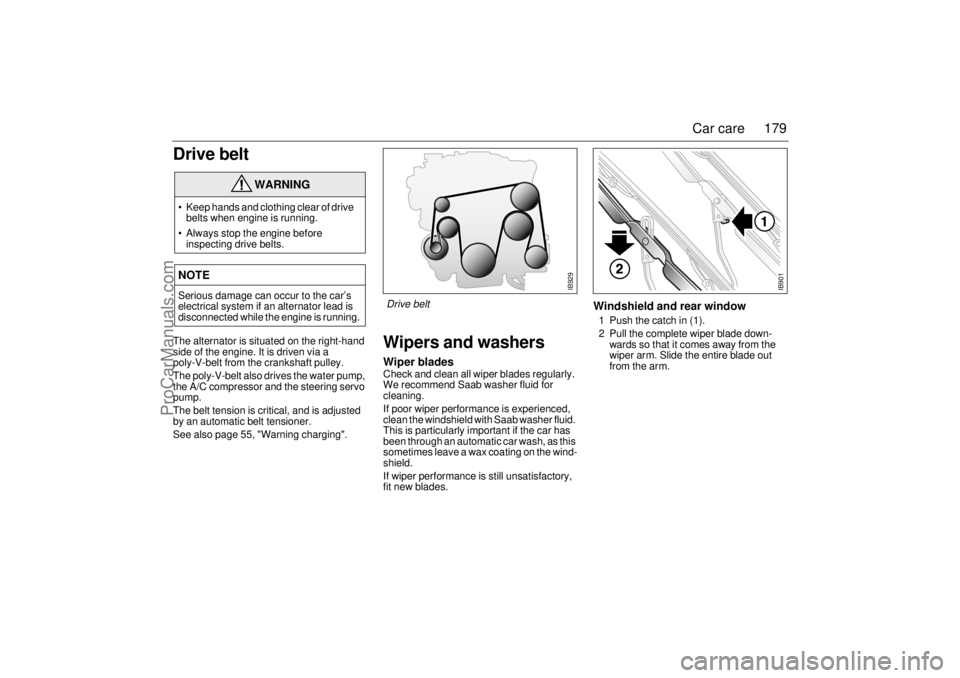
Drive beltThe alternator is situated on the right-hand
side of the engine. It is driven via a
poly-V-belt from the crankshaft pulley.
The poly-V-belt also drives the water pump,
the A/C compressor and the steering servo
pump.
The belt tension is critical, and is adjusted
by an automatic belt tensioner.
See also page 55, "Warning charging".
Wipers and washersWiper bladesCheck and clean all wiper blades regularly.
We recommend Saab washer fluid for
cleaning.
If poor wiper performance is experienced,
clean the windshield with Saab washer fluid.
This is particularly important if the car has
been through an automatic car wash, as this
sometimes leave a wax coating on the wind-
shield.
If wiper performance is still unsatisfactory,
fit new blades.
Windshield and rear window1 Push the catch in (1).
2 Pull the complete wiper blade down-
wards so that it comes away from the
wiper arm. Slide the entire blade out
from the arm.
WARNING
Keep hands and clothing clear of drive
belts when engine is running.
Always stop the engine before
inspecting drive belts.NOTESerious damage can occur to the car’s
electrical system if an alternator lead is
disconnected while the engine is running.
IB929
Drive belt
IB901
ProCarManuals.com
Page 186 of 236
186 Car care
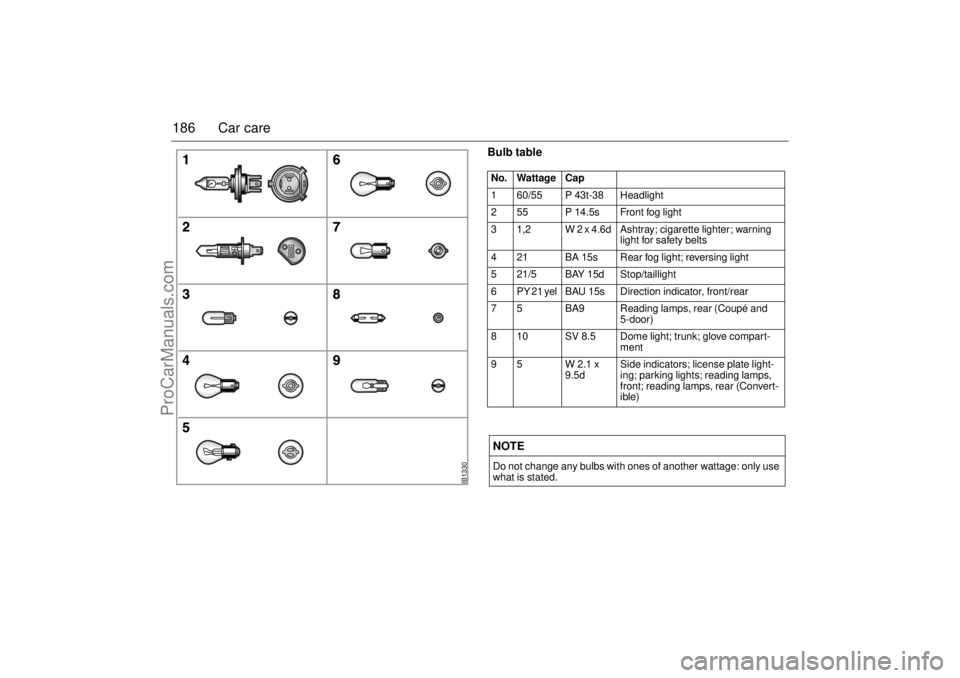
Bulb tableNo. Wattage Cap
1 60/55 P 43t-38 Headlight
2 55 P 14.5s Front fog light
3 1,2 W 2 x 4.6d Ashtray; cigarette lighter; warning
light for safety belts
4 21 BA 15s Rear fog light; reversing light
5 21/5 BAY 15d Stop/taillight
6 PY 21 yel BAU 15s Direction indicator, front/rear
7 5 BA9 Reading lamps, rear (Coupé and
5-door)
8 10 SV 8.5 Dome light; trunk; glove compart-
ment
95 W 2.1 x
9.5d Side indicators; license plate light-
ing; parking lights; reading lamps,
front; reading lamps, rear (Convert-
ible) NOTEDo not change any bulbs with ones of another wattage: only use
what is stated.
IB1330
ProCarManuals.com
Page 188 of 236

188 Car careMAXI fusesThe MAXI fuses are housed in the fuse box
under the hood. These fuses can be
checked in the same way as the other fuses.
The MAXI fuses are designed to protect the
car’s electrical system from being dam-
aged. Each MAXI fuse protects a number of
electrical circuits and functions and there-
fore has a higher rating (amperage) than the
standard fuses. No spare MAXI fuses are
supplied with the car.
DICE / TWICEDICE = Dashboard Integrated Central Elec-
tronics
TWICE = Theft-Warning Central Electronics
DICE and TWICE are electronic control
modules.
DICE controls, among other things:
Front lights and interior lighting.
Instrument illumination.
Intermittent wiper operation.
Electric heating of rear window and door
mirrors.
TWICE controls, among other things:
Central locking.
Car alarm (Anti-theft system).
Engine immobilizer.
Auto checking of lights.
Electric heating of rear seat.
Safety belt reminder.
Electrically adjustable passenger seat.The DICE and TWICE control modules are
linked to a data bus, which is basically an
information carrier that allows information to
be exchanged between all the control mod-
ules and components connected to the bus.
If a fault occurs in any of these components,
diagnostic faults codes are set in the rele-
vant control module, which enhances fault
diagnosis at the Saab dealer.
The scan tool connector for fault diagnosis
is located under the instrument panel on the
drivers side.
NOTEIf a MAXI fuse blows, it means that there
is a major fault in the electrical system.
Have the car checked without delay by an
authorized Saab dealer.
IB920
MAXI fuse for soft-top system
(Convertible)
ProCarManuals.com
Page 199 of 236
199 Car care
Flat spottingAll tires get hot, especially on long journeys
or when the car is driven hard. After the car
has been parked with hot tires and the tires
have cooled down, a flat spot can form in the
tire, where it is in contact with the ground.
The same can occur if the car has not been
moved for a long time.
Flat spots can cause vibration that can be
felt through the steering wheel, similar to
that experienced when the wheels need bal-
ancing. Flat spots of this type disappear
once the tires get hot again, usually after
10–15 miles (20–25 km) of driving at cruis-
ing speed.
Safety beltsA check should be made periodically to
ensure that the safety belts are working
properly.
Hold the diagonal strap and pull it sharply.
The seat belt should lock and it should not
be possible to withdraw it further.
A sharp tug on the belt should cause the
inertia reel to lock. Check the floor anchor-
age points for corrosion damage. If a belt is
worn or has any fraying edges, it should be
replaced.
Safety belts must not come into contact with
substances such as polishes, oil or chemi-
cals. If the belts get dirty, wash them with
warm water and a detergent or have them
replaced.
WARNING
Safety belts and belt pretensioners that
were in use in a serious collision must be
replaced even if they are not visibly
damaged.
No attempt must be made to repair, or
modify the function of, safety belts.
IB923
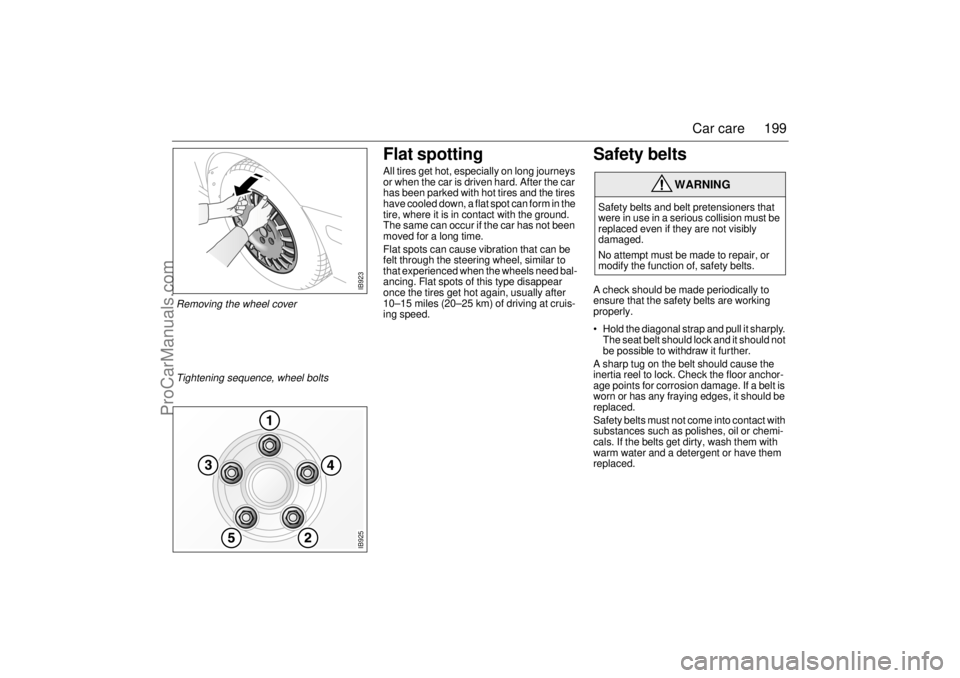
Removing the wheel cover
IB925
Tightening sequence, wheel bolts
ProCarManuals.com
Page 207 of 236
207 Car care
Air conditioning
(A/C system)
Fault diagnosis If a fault occurs in the A/C system, there are
a number of checks you can perform your-
self. If the fault persists, however, have the
system checked by an authorized Saab
dealer.Important!
When the A/C system is in operation, mois-
ture from the air will condense on the evap-
orator. When the car is then parked, this
condensation will drip off the evaporator
and form a small pool of water on the
ground. This is normal. The warmer the
ambient air and the higher the humidity, the
greater the amount of condensation formed.Inadequate cooling:
a Make sure that the temperature and
air-distribution controls are in the
appropriate settings, see page 77.
b Check that the condenser (forward of
the radiator) has not become clogged
with dirt and insects.
c Make sure that the drive belt for the com-
pressor is not slipping, see page 179.
d Check the fuses for the ventilation fans
and compressor, see page 189.
NOTE The A/C system is designed for use
with R134a refrigerant.
Refrigerant handling requires special
equipment and special procedures for
charging and draining the system.
All repairs and adjustments on the A/C
system must be carried out by a Saab
dealer authorized for this kind of work.
Never mix R134a and R12 refriger-
ants.
WARNING
The A/C system is pressurized. Do not
break any connections or undo A/C
system components.
Escaping refrigerant gas can cause
blindness or other injury.
ProCarManuals.com
Page 208 of 236
208 Car careMaintenance The drive belt for the compressor should
be inspected under the regular service
program.
Clean dirt and insects away from the con-
denser and radiator to prevent clogging.
When washing the car, use the hose to
spray the radiator and condenser (located
forward of the radiator) from both sides
(both from the front of the car and from
inside the engine bay). Do not use a pres-
sure washer.
Caution: Do not use the hose when the
engine is hot.
Other than in extremely cold weather, do not
cover the radiator, e.g. with screen netting,
as this will greatly diminish its cooling capac-
ity.
Note: The A/C system will only operate
when the outdoor temperature is above the
freezing point (0°C, 32°F). Switch on the
A/C system when the car stands in a warm
place.
Headlight aimingThe vehicle is equipped with vertical and
horizontal aim indicators. The aim has been
preset at the factory and should normally not
need further adjustments. This is true even
though your vertical and horizontal aim indi-
cators may not fall exactly on the "0" (zero)
marks on their scales.
If your headlight is damaged in an accident,
the headlight aim may be affected. If you
believe your headlights need to be
re-aimed, we recommend that you take it to
your Saab dealer for service. However, it is
possible for you to re-aim your headlights as
described in the following procedure.
To check the aim, the vehicle should be
properly prepared as follows: Place the vehicle on a level pad or surface
The vehicle should be unladen and fuel
tank full, and one person or 160 lbs.
(75 kg) on the drivers seat
The vehicle should not have any snow, ice
or mud attached to it
Tires should be inflated to the prescribed
pressure
Rock the vehicle to stabilize the suspen-
sion
WARNING
Before checking/adjusting the headlight
aiming, switch off the engine to avoid
danger of fingers and hands being injured
by moving parts.
The radiator fan can start up even when
the engine is switched off.
ProCarManuals.com
Page 215 of 236

215 Maintenance and owner assistance
Saab Original Service Program M2000 USA, Canada, (9-3 Models)* These are the minimum required Emission Control System maintenance steps. Saab urges that all recommended maintenance procedures be performed
according to this program.
(a.) Engine oil and filter should be changed at least once a year. Intermediate oil and filter changes (halfway between indicated intervals) suggested for
cars primarily used for driving in dense city traffic or for repeated short trip operation without sufficient warm up.
** Service intervals:
Refer to the Warranties & Service Record Book for service intervals beyond 100,000 miles (160,000 km).Service Intervals **
Miles = U.S. Cars
Kilometers = Canadian Cars
1,000
(1,600 km)
10,000
(16,000 km)
20,000
(32,000 km)
30,000
(48,000 km)
40,000
(64,000 km)
50,000
(80,000 km)
60,000
(96,000 km)
70,000
(112,000 km)
80,000
(128,000 km)
90,000
(144,000 km)
100,000
(160,000 km)
Service #
1234567891011
Engine and engine compartment
E Engine oil and filter (a.)!!!!!!!!!!!
R Engine coolant freezing point and level""" "" "" "
R Engine coolant flush and replace (max. 3-year intervals)!!!
R Engine cooling system, hoses and cap""""""""""
R Drive belt; condition""""" ! """"
E Spark plugs!
*
!*
!*
E Crankcase ventilation and vacuum lines""
Application/type of service (col. 1) Service Procedure
E = emission service"= Check - top up, adjust or replace if necessary
R = regular maintenance!= Replace
#= Lubricate
ProCarManuals.com
Page 218 of 236

218 Maintenance and owner assistance
Service Intervals **
Miles = U.S. Cars
Kilometers = Canadian Cars
1,000
(1,600 km)
10,000
(16,000 km)
20,000
(32,000 km)
30,000
(48,000 km)
40,000
(64,000 km)
50,000
(80,000 km)
60,000
(96,000 km)
70,000
(112,000 km)
80,000
(128,000 km)
90,000
(144,000 km)
100,000
(160,000 km)
Service #
1234567891011
Chassis (cont.)
RToe-in"""
R Cabin air filter!!!!!
R Door hinges, stops and locks##########
R Removable towbar###########
R Airbag system, SRS warning lamp, visual inspection"""""""""""
R Safety belts; operation and visual inspection of belt for
tears and fraying"""""""""""
R Wiper blades"""""""""""
R Washer system: check and top-up"""""""""""
R Reset service indicator"""""""""""
Customer programming
R Carry out systems programming per customer request"
Road test
R Check performance of drive train, steering and brakes
and verify tire balance.
Check function of instruments and controls, including
horn, windshield wipers, cruise control and climate sys-
tem.
Note any noises or problems for correction."""""""""""
ProCarManuals.com
Page 219 of 236
219 Technical data
Technical data General particulars .......... 220
Engine ............................... 223
Engine oil .......................... 223
Engine variants ................ 225
Electrical system.............. 225
Drive belts......................... 225
Manual transmission ....... 226
Automatic transmission .. 226
Suspension....................... 226
Steering............................. 226
Brake system.................... 227
Rims and tires .................. 227
Plates and labels .............. 229
IB993
ProCarManuals.com
Page 225 of 236
225 Technical data
Engine variants Electrical system
Drive belts
2.0 Turbo 185 hp, manual transmissionRating, EEC at 5500 rpm ____________ 185 hp (136 kW)
Max. torque (man.), EEC at 2100 rpm __ 194.0 ft.lb (263 Nm)
Compression ratio _________________ 9.2:1 2.0 Turbo 185 hp, automatic transmissionRating, EEC at 5750 rpm ____________ 185 hp (136 kW)
Max. torque EEC at 1900 rpm ________ 184.4 ft.lb. (250 Nm)
Compression ratio _________________ 9.2:1 2.0 Turbo 205 hp, manual transmissionRating, EEC, at 5500 rpm____________ 205 hp (151 kW)
Max. torque EEC at 2200 rpm ________ 209 ft.lb (283 Nm)
Compression ratio _________________ 9.2:12.0 Turbo 205 hp, automatic transmissionRating, EEC, at 5750 rpm____________ 205 hp (151 kW)
Max. torque EEC at 1900 rpm ________ 184.4 ft.lb (250 Nm)
Compression ratio _________________ 9.2:12.3 Turbo 230 hp, manual transmissionRating, EEC, at 5500 rpm ____________ 230 hp (169 kW)
Max. torque EEC at 2500 rpm ________ 258.1 ft.lb (350 Nm)
Compression ratio _________________ 9.3:1Voltage ___________________________ 12 V
Battery capacity ____________________ 60 Ah
Starter motor ______________________ 1.4 kW
Alternator rating ____________________ 130 A/14 V
Firing order ________________________ 1-3-4-2
Spark plugs:
2.0 Turbo 185 bhp _________________ NGK PFR 7H-10
2.0 Turbo 205 bhp _________________ NGK PFR 7H-10
Viggen __________________________ NGK PFR 7H-10
Electrode gap ______________________ 1.0 mm
Outside length
2.0 Turbo and Viggen ________________ 2345 mm Drive belt
IB929
ProCarManuals.com