display SAAB 9-3 2000 Owners Manual
[x] Cancel search | Manufacturer: SAAB, Model Year: 2000, Model line: 9-3, Model: SAAB 9-3 2000Pages: 236, PDF Size: 10.85 MB
Page 3 of 236
3
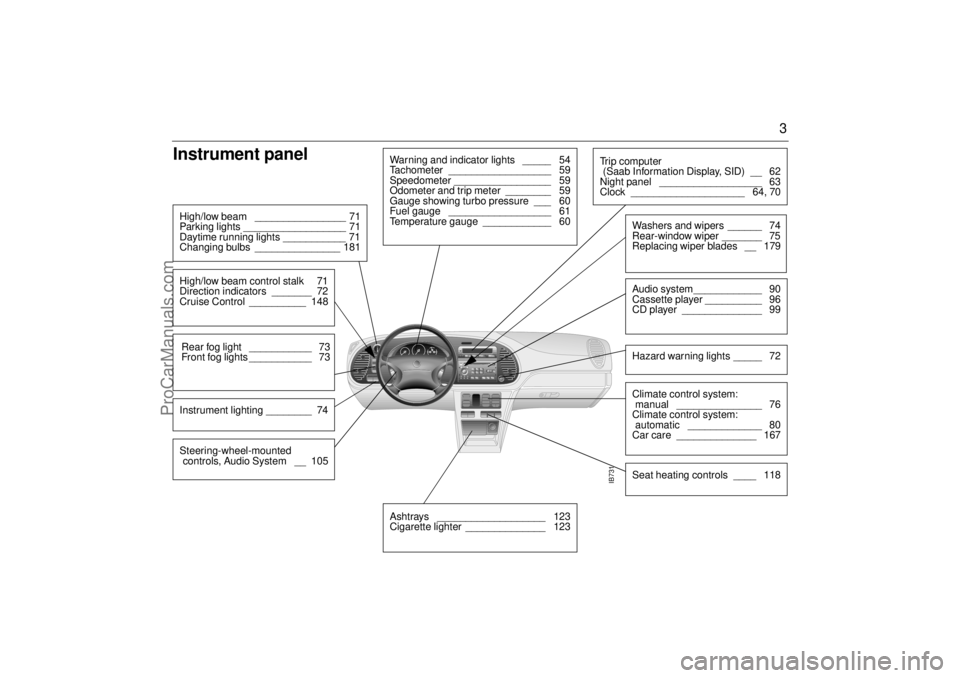
Instrument panel High/low beam ________________ 71
Parking lights __________________ 71
Daytime running lights ___________ 71
Changing bulbs _______________ 181High/low beam control stalk 71
Direction indicators _______ 72
Cruise Control __________ 148Rear fog light ___________ 73
Front fog lights ___________ 73Instrument lighting ________ 74
Warning and indicator lights _____ 54
Tachometer __________________ 59
Speedometer _________________ 59
Odometer and trip meter ________ 59
Gauge showing turbo pressure ___ 60
Fuel gauge __________________ 61
Temperature gauge ____________ 60
IB731
Ashtrays ___________________ 123
Cigarette lighter ______________ 123
Tr i p c o m p u t e r
(Saab Information Display, SID) __ 62
Night panel __________________ 63
Clock ____________________ 64, 70
Washers and wipers ______ 74
Rear-window wiper _______ 75
Replacing wiper blades __ 179Audio system____________ 90
Cassette player __________ 96
CD player ______________ 99Hazard warning lights _____ 72Climate control system:
manual _______________ 76
Climate control system:
automatic _____________ 80
Car care ______________ 167Seat heating controls ____ 118
Steering-wheel-mounted
controls, Audio System __ 105
ProCarManuals.com
Page 39 of 236

39 Security
Overview of, LED signals and SID messagesSome signals may differ between model variants for different
countries.Status LED signal
Activation (during 10-second delay). Comes on for 10 seconds.
Alarm activated (after delay). Flashes once every third
second.
Deactivation. Comes on for 2 seconds.
Alarm not activated. Off.
Door, trunk lid or hood open or
opened during delay period.Flashes three times per sec-
ond for 10 seconds.
Unlocking the trunk lid. Flashes three times per sec-
ond for 10 seconds.
Closing of door, trunk lid or hood
after delay period.Comes on for 10 seconds.
Car immobilized but not locked.
Car alarm not activated.Flashes twice at three sec-
onds intervals.
Fault in a switch serving doors, hood
or trunk lid.Flashing (instead of being
on continuously) during
delay period.
SID message Reason/action
SERVICE THEFT ALARM Probably a faulty sensor or siren.
Have the car checked by an autho-
rized Saab dealer.
KEY NOT ACCEPTED Fault in key transmitter or in igni-
tion-switch receiver. Turn ignition
switch to ON and press one of the
buttons on the remote control. Start
the engine.
Have the car checked by an autho-
rized Saab dealer.
REPLACE KEY BATTERY Fit a new battery in the remote con-
trol.
DOOR ALARM ONLY Window-glass sensor is disabled.
FULL THEFT ALARM Window-glass sensor is included in
circuit.
REMOTE KEY
TRANSPONDRTurn the ignition key to position ON
and then press the button for open-
ing the trunk lid. SID displays the
number of remote controls and
transmitters (transponders) coded to
the car.
ProCarManuals.com
Page 48 of 236

48 ConvertibleFault messages in SIDThe following CHECK messages are
included in the soft top system and can be
displayed on the SID together with a beep.
SID displays Cause Action
CHECK SOFT
TOP STORAGE The soft top storage bag is hooked up.
An item in the trunk under the soft top is
obstructing the soft top. Unhook and lower the soft top storage bag, see page 50.
Make sure that no item in the trunk is lying against the soft top
storage.
CLOSE TRUNK
LID The raising or lowering of the soft top is
obstructed because the trunk lid is not closed. Close the trunk lid so it is latched securely.
CHECK SOFT
TOP LATCHES The soft top is not latched to the top beam of the
windshield.
Somebody is trying to lower the soft top while it
is still locked to the windshield beam. Lock the soft top with the locking handle, see page 45.
Release the soft top with the locking handle, see page 43.
FINISH SOFT
TOP MOTION Raising or lowering was stopped before the
cycle completed. Finish the soft top motion completely.
CHECK SOFT
TOP COVER The soft top cover is not being locked.
The soft top cover doesn’t open. Make sure that the valve for manual raising of the soft top is
closed, see page 46.
Try to slide the ROOF button backwards once more.
SOFT TOP FAIL-
URE Serious fault in soft top mechanism. Try to slide the ROOF button once more.
BE VERY CAREFUL AND MAKE SURE THAT NOTHING IS
OBSTRUCTING THE OPERATION OF THE SOFT TOP.
Remove anything that can obstruct the operation of the soft top.
Operate the soft top manually, see page 46.
CHECK SOFT
TOP Something is in the way and is obstructing the
operation of the soft top by the electro- hydrau-
lics.
The soft top cover has not locked at the front on
both sides.
The 5th bow (rear window) has not locked to the
soft top cover on both sides. Try to slide the ROOF button once more.
BE VERY CAREFUL AND MAKE SURE THAT NOTHING IS
OBSTRUCTING THE OPERATION OF THE SOFT TOP.
Remove anything that can obstruct the operation of the soft top.
ProCarManuals.com
Page 50 of 236
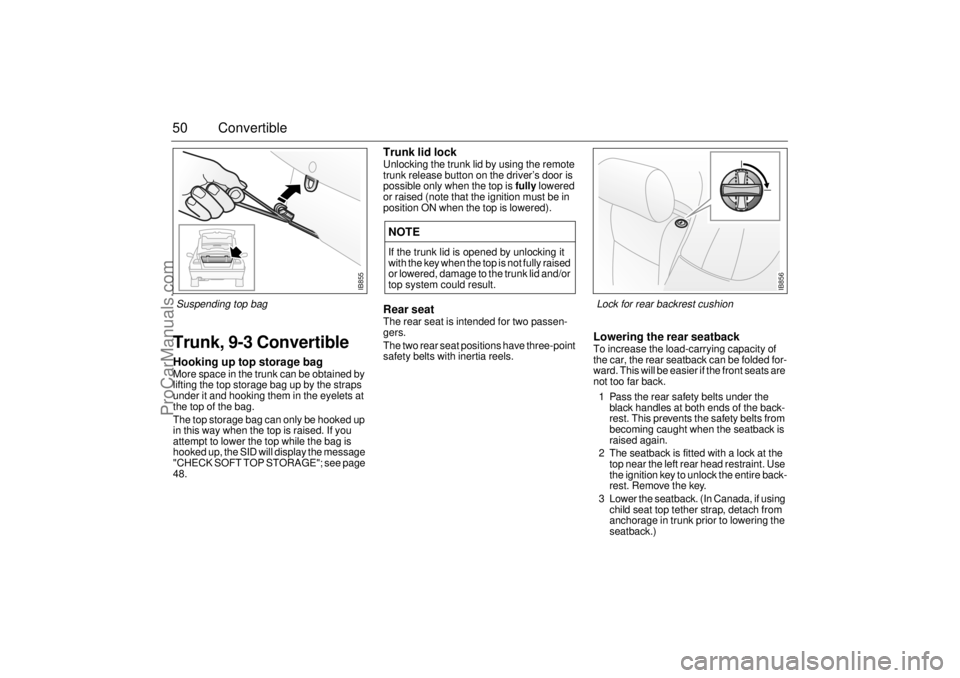
50 ConvertibleTrunk, 9-3 ConvertibleHooking up top storage bagMore space in the trunk can be obtained by
lifting the top storage bag up by the straps
under it and hooking them in the eyelets at
the top of the bag.
The top storage bag can only be hooked up
in this way when the top is raised. If you
attempt to lower the top while the bag is
hooked up, the SID will display the message
"CHECK SOFT TOP STORAGE"; see page
48.
Trunk lid lockUnlocking the trunk lid by using the remote
trunk release button on the driver’s door is
possible only when the top is fully lowered
or raised (note that the ignition must be in
position ON when the top is lowered).Rear seatThe rear seat is intended for two passen-
gers.
The two rear seat positions have three-point
safety belts with inertia reels.
Lowering the rear seatbackTo increase the load-carrying capacity of
the car, the rear seatback can be folded for-
ward. This will be easier if the front seats are
not too far back.
1 Pass the rear safety belts under the
black handles at both ends of the back-
rest. This prevents the safety belts from
becoming caught when the seatback is
raised again.
2 The seatback is fitted with a lock at the
top near the left rear head restraint. Use
the ignition key to unlock the entire back-
rest. Remove the key.
3 Lower the seatback. (In Canada, if using
child seat top tether strap, detach from
anchorage in trunk prior to lowering the
seatback.)
NOTEIf the trunk lid is opened by unlocking it
with the key when the top is not fully raised
or lowered, damage to the trunk lid and/or
top system could result.
IB855
Suspending top bag
IB856
Lock for rear backrest cushion
ProCarManuals.com
Page 51 of 236
51 Convertible
Trunk Pass-Through in the rear
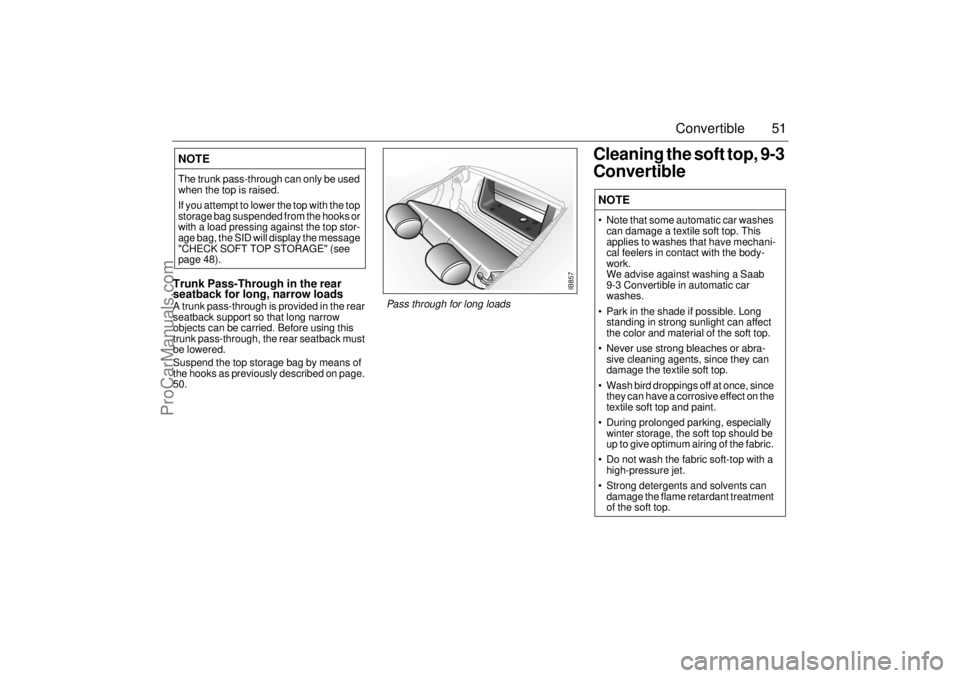
seatback for long, narrow loadsA trunk pass-through is provided in the rear
seatback support so that long narrow
objects can be carried. Before using this
trunk pass-through, the rear seatback must
be lowered.
Suspend the top storage bag by means of
the hooks as previously described on page.
50.
Cleaning the soft top, 9-3
Convertible
NOTEThe trunk pass-through can only be used
when the top is raised.
If you attempt to lower the top with the top
storage bag suspended from the hooks or
with a load pressing against the top stor-
age bag, the SID will display the message
"CHECK SOFT TOP STORAGE" (see
page 48).
NOTE Note that some automatic car washes
can damage a textile soft top. This
applies to washes that have mechani-
cal feelers in contact with the body-
work.
We advise against washing a Saab
9-3 Convertible in automatic car
washes.
Park in the shade if possible. Long
standing in strong sunlight can affect
the color and material of the soft top.
Never use strong bleaches or abra-
sive cleaning agents, since they can
damage the textile soft top.
Wash bird droppings off at once, since
they can have a corrosive effect on the
textile soft top and paint.
During prolonged parking, especially
winter storage, the soft top should be
up to give optimum airing of the fabric.
Do not wash the fabric soft-top with a
high-pressure jet.
Strong detergents and solvents can
damage the flame retardant treatment
of the soft top.
IB857
Pass through for long loads
ProCarManuals.com
Page 59 of 236
59 Instruments and controls
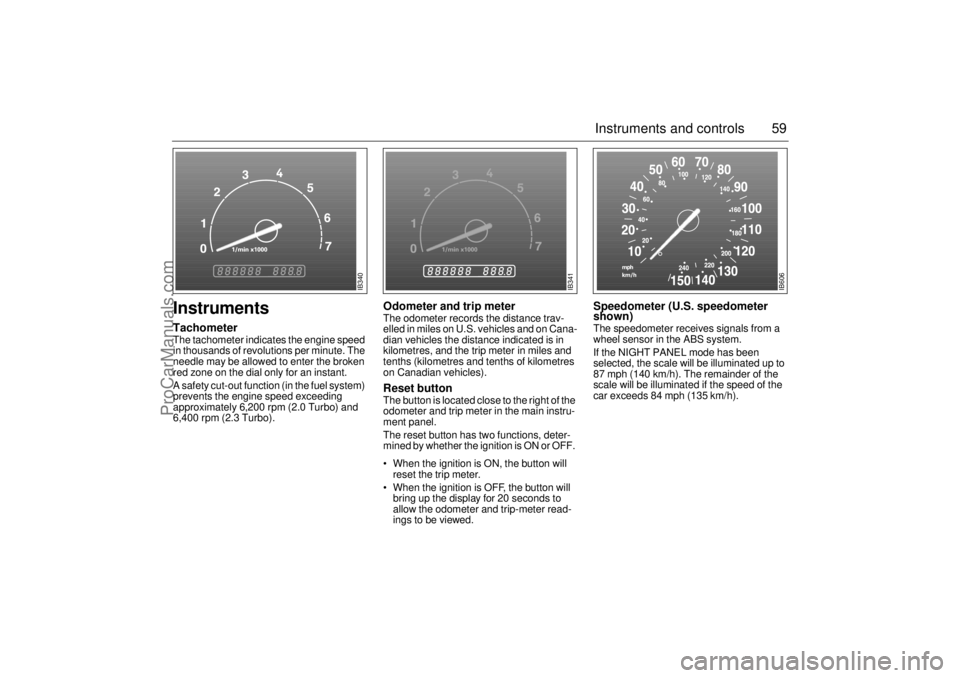
Instruments TachometerThe tachometer indicates the engine speed
in thousands of revolutions per minute. The
needle may be allowed to enter the broken
red zone on the dial only for an instant.
A safety cut-out function (in the fuel system)
prevents the engine speed exceeding
approximately 6,200 rpm (2.0 Turbo) and
6,400 rpm (2.3 Turbo).
Odometer and trip meterThe odometer records the distance trav-
elled in miles on U.S. vehicles and on Cana-
dian vehicles the distance indicated is in
kilometres, and the trip meter in miles and
tenths (kilometres and tenths of kilometres
on Canadian vehicles). Reset button The button is located close to the right of the
odometer and trip meter in the main instru-
ment panel.
The reset button has two functions, deter-
mined by whether the ignition is ON or OFF.
When the ignition is ON, the button will
reset the trip meter.
When the ignition is OFF, the button will
bring up the display for 20 seconds to
allow the odometer and trip-meter read-
ings to be viewed.
Speedometer (U.S. speedometer
shown)The speedometer receives signals from a
wheel sensor in the ABS system.
If the NIGHT PANEL mode has been
selected, the scale will be illuminated up to
87 mph (140 km/h). The remainder of the
scale will be illuminated if the speed of the
car exceeds 84 mph (135 km/h).
IB340
IB341
IB606
ProCarManuals.com
Page 60 of 236
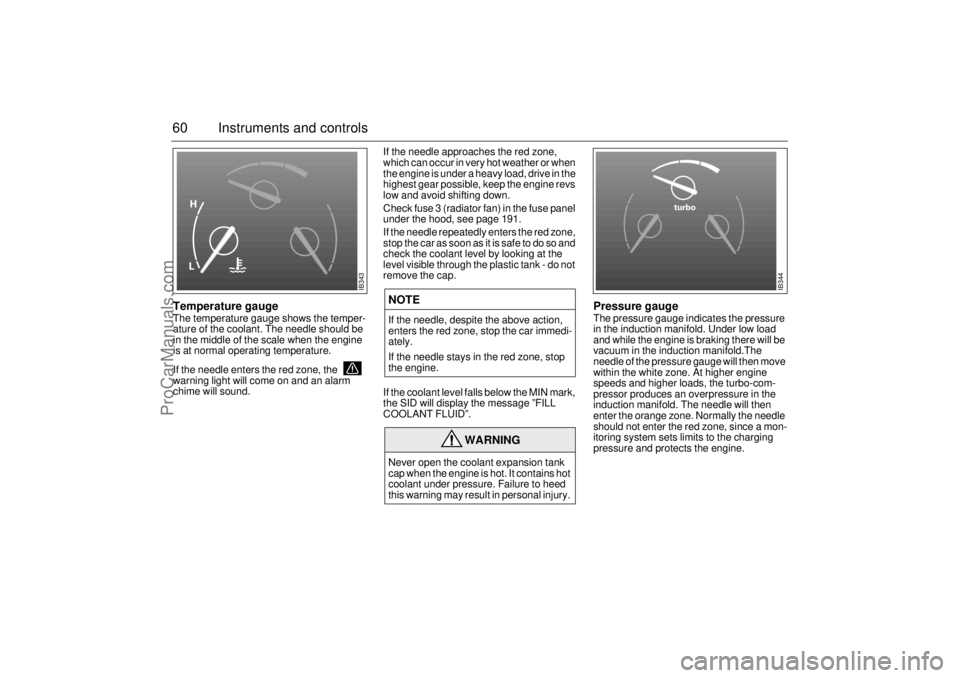
60 Instruments and controlsTemperature gaugeThe temperature gauge shows the temper-
ature of the coolant. The needle should be
in the middle of the scale when the engine
is at normal operating temperature.
If the needle enters the red zone, the
warning light will come on and an alarm
chime will sound. If the needle approaches the red zone,
which can occur in very hot weather or when
the engine is under a heavy load, drive in the
highest gear possible, keep the engine revs
low and avoid shifting down.
Check fuse 3 (radiator fan) in the fuse panel
under the hood, see page 191.
If the needle repeatedly enters the red zone,
stop the car as soon as it is safe to do so and
check the coolant level by looking at the
level visible through the plastic tank - do not
remove the cap.
If the coolant level falls below the MIN mark,
the SID will display the message ”FILL
COOLANT FLUID”.
Pressure gaugeThe pressure gauge indicates the pressure
in the induction manifold. Under low load
and while the engine is braking there will be
vacuum in the induction manifold.The
needle of the pressure gauge will then move
within the white zone. At higher engine
speeds and higher loads, the turbo-com-
pressor produces an overpressure in the
induction manifold. The needle will then
enter the orange zone. Normally the needle
should not enter the red zone, since a mon-
itoring system sets limits to the charging
pressure and protects the engine.
NOTEIf the needle, despite the above action,
enters the red zone, stop the car immedi-
ately.
If the needle stays in the red zone, stop
the engine.
WARNING
Never open the coolant expansion tank
cap when the engine is hot. It contains hot
coolant under pressure. Failure to heed
this warning may result in personal injury.
IB343
IB344
ProCarManuals.com
Page 61 of 236
61 Instruments and controls
Under certain barometric conditions the
needle may enter the first part of the red
zone without necessarily indicating that a
fault has arisen.
If the needle repeatedly enters the red zone
and the engine at the same time loses
power, because the monitoring system is
holding the charging pressure down, you
should contact an authorized Saab dealer.
If the speed exceeds 143 mph (230 km/h),
the increase in speed will be limited by the
lowering of the boost pressure. The pres-
sure gauge then moves towards the middle
of the orange zone, indicating reduced
engine output and thus reduces the speed
of the car as well.
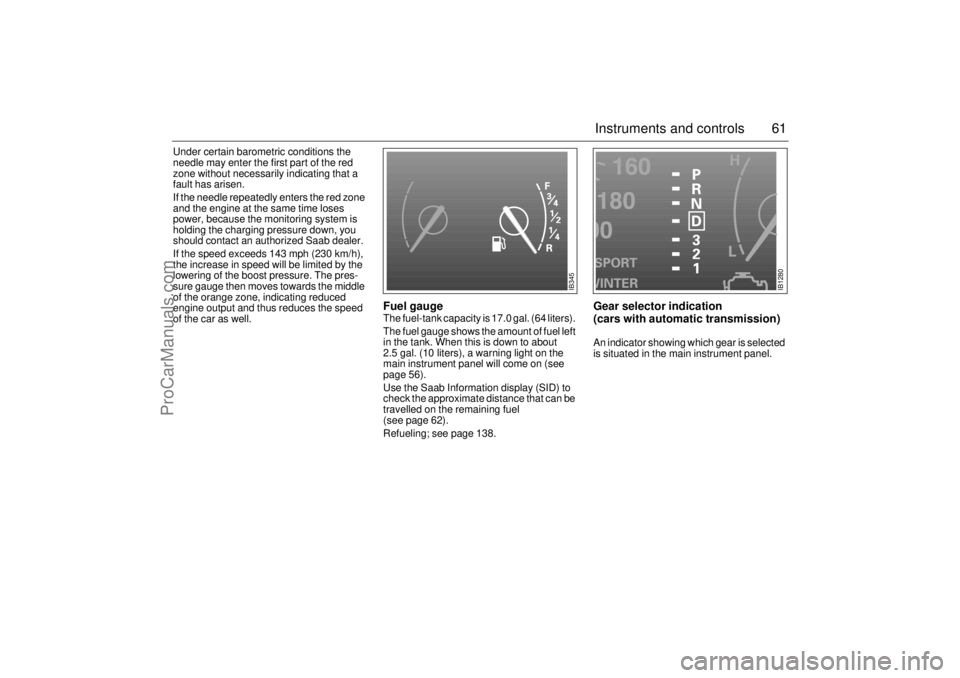
Fuel gaugeThe fuel-tank capacity is 17.0 gal. (64 liters).
The fuel gauge shows the amount of fuel left
in the tank. When this is down to about
2.5 gal. (10 liters), a warning light on the
main instrument panel will come on (see
page 56).
Use the Saab Information display (SID) to
check the approximate distance that can be
travelled on the remaining fuel
(see page 62).
Refueling; see page 138.
Gear selector indication
(cars with automatic transmission)An indicator showing which gear is selected
is situated in the main instrument panel.
IB345
IB1280
ProCarManuals.com
Page 62 of 236
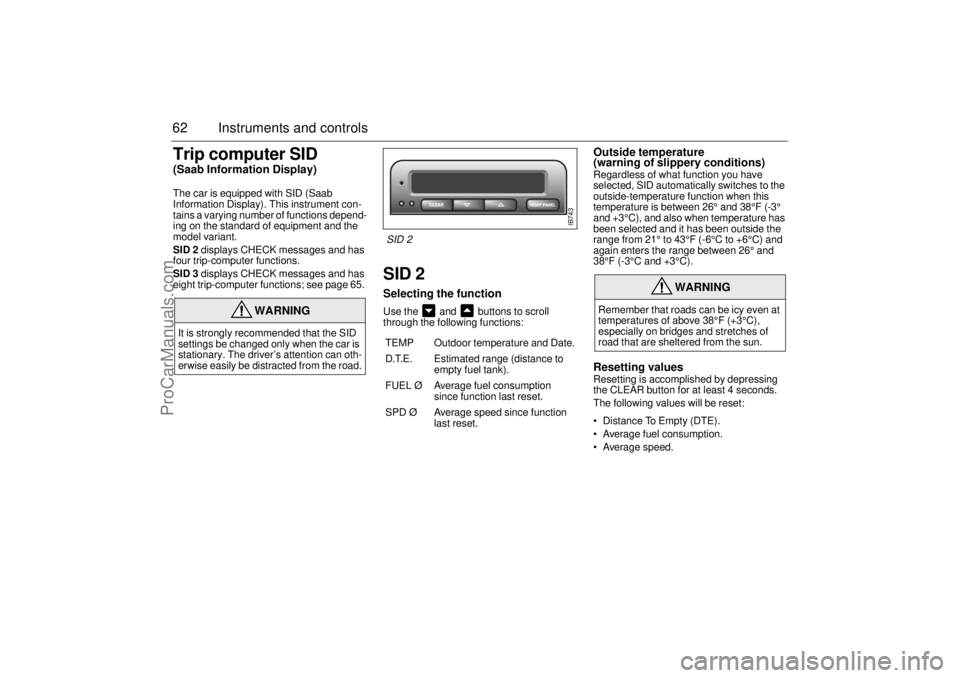
62 Instruments and controlsTrip computer SID(Saab Information Display)The car is equipped with SID (Saab
Information Display). This instrument con-
tains a varying number of functions depend-
ing on the standard of equipment and the
model variant.
SID 2 displays CHECK messages and has
four trip-computer functions.
SID 3 displays CHECK messages and has
eight trip-computer functions; see page 65.
SID 2 Selecting the function Use the and buttons to scroll
through the following functions:
Outside temperature
(warning of slippery conditions) Regardless of what function you have
selected, SID automatically switches to the
outside-temperature function when this
temperature is between 26° and 38°F (-3°
and +3°C), and also when temperature has
been selected and it has been outside the
range from 21° to 43°F (-6°C to +6°C) and
again enters the range between 26° and
38°F (-3°C and +3°C). Resetting values Resetting is accomplished by depressing
the CLEAR button for at least 4 seconds.
The following values will be reset:
Distance To Empty (DTE).
Average fuel consumption.
Average speed.
WARNING
It is strongly recommended that the SID
settings be changed only when the car is
stationary. The driver’s attention can oth-
erwise easily be distracted from the road.
TEMP Outdoor temperature and Date.
D.T.E. Estimated range (distance to
empty fuel tank).
FUEL Ø Average fuel consumption
since function last reset.
SPD Ø Average speed since function
last reset.
WARNING
Remember that roads can be icy even at
temperatures of above 38°F (+3°C),
especially on bridges and stretches of
road that are sheltered from the sun.
IB743
SID 2
ProCarManuals.com
Page 63 of 236

63 Instruments and controls
CHECK messages When the engine is started, CHECKING will
appear on the display for about four sec-
onds, while the SID checks are being per-
formed.
When a CHECK message is generated
while the car is being driven, a chime will
sound, INFO DISPL will illuminate on the
main instrument panel, and the message
will appear on the SID. The number of mes-
sages that can be displayed by the SID
varies with the specification of the car.
If more than one CHECK message has
been generated, the
+ symbol will appear to
the left of the text on the display. The mes-
sages appear in order of priority.
If a new fault occurs while another message
is being displayed, the message relating to
the new one will appear for 10 seconds,
after which the display will return to the ear-
lier one.
Press CLEAR once to acknowledge a mes-
sage, whereupon it will be cleared from the
display. It will not be displayed again before
the ignition has been switched off and then
on again. The following CHECK messages may be
displayed:
1 This message cannot be removed by pressing
CLEAR. Press the brake pedal to clear.
2 This message will be displayed approxi-
mately 600 miles (1,000 km) before the next
scheduled service is due, or when 365 days
have elapsed since the last service. The
message should be cleared at the time of that
service (see the Saab Warranties & Service
Record Booklet).
If you have carried out the service yourself,
you can clear the message by pressing
CLEAR once. Reset by pressing CLEAR for
at least eight seconds, until ”SERVICE”
appears on the display and a chime sounds.
Night Panel To improve night-driving conditions inside
the car, the Night Panel mode can be
selected. In this mode, the amount of infor-
mation displayed is reduced, and only the
most important instruments and displays
will be illuminated.
When the Night Panel button is pressed,
only the speedometer will be illuminated (up
to the 87 mph or 140-km/h graduation), all
the other instruments illumination will be
extinguished and their needles moved to
zero. Both the SID and the ACC displays will
be extinguished and the backlighting for
switches and other controls will be dimmed.
Note: All indicator and warning lights,
together with the display of CHECK mes-
sages, will operate as normal.
The following conditions will wake up the
respective displays in the Night-Panel
mode:
Adjusting of the Audio System, SID or
ACC (display comes on for ten seconds).
CHECK message generated in the SID.
High engine revs cause the rev counter to
be illuminated until the engine speed has
fallen again.
If the quantity of fuel remaining falls below
4 gallons (15 liters), the fuel gauge will be
illuminated.
If the engine temperature rises above nor-
mal, the temperature gauge will be illumi-
nated. Display shows: See
page
TEST BRAKE LIGHTS
1)
183
BRAKE LIGHT FAILURE 183
FRONT LIGHT FAILURE 181
REAR LIGHT FAILURE 183
FOG LIGHT FAILURE 183
WASHER FLUID LEVEL LOW 180
FILL COOLANT FLUID 174
TIGHTEN FUEL FILLER CAP 138
KEY NOT ACCEPTED 39
REPLACE KEY BATTERY 39
SERVICE THEFT ALARM 39
TRANSMISSION OVERHEAT-
ING 144
TIME FOR SERVICE
2)
212
ProCarManuals.com