door lock SAAB 9-3 2003 Owner's Manual
[x] Cancel search | Manufacturer: SAAB, Model Year: 2003, Model line: 9-3, Model: SAAB 9-3 2003Pages: 256, PDF Size: 21.66 MB
Page 100 of 256

100 Interior equipmentTo closeRaise the front edge of the button one step.
The window will stop when it is fully closed
or when the button is released.
Automatic closing (option): Raise the
button all the way and release it. If the
window does not close automatically, refer
to Calibration on page 101.
Comfort closing (option)Comfort closing is the remote closing of
open windows and the sunroof, and the
retracting of electrically retractable door
mirrors.
Press and hold the locking button on the
remote control until the windows are closed
and door mirrors retracted (takes roughly
2 s). The doors must be shut.
Confirmation that closing has finished is
provided by the direction indicators, which
flash once. No confirmation indicates that
closing was not possible. This may be due
to a door being open or a window requiring
calibration.
Pinch protectionOn certain model variants, the electric win-
dows are equipped with pinch protection.
This is activated if something gets trapped
between the window pane and door frame
when the window is closed. The window will
stop and lower slightly.
WARNING
Take care when closing a window to
ensure that no one gets caught.
WARNING
Make sure no one is so close to the car
that they can be injured if comfort closing
is activated.
ProCarManuals.com
Page 102 of 256
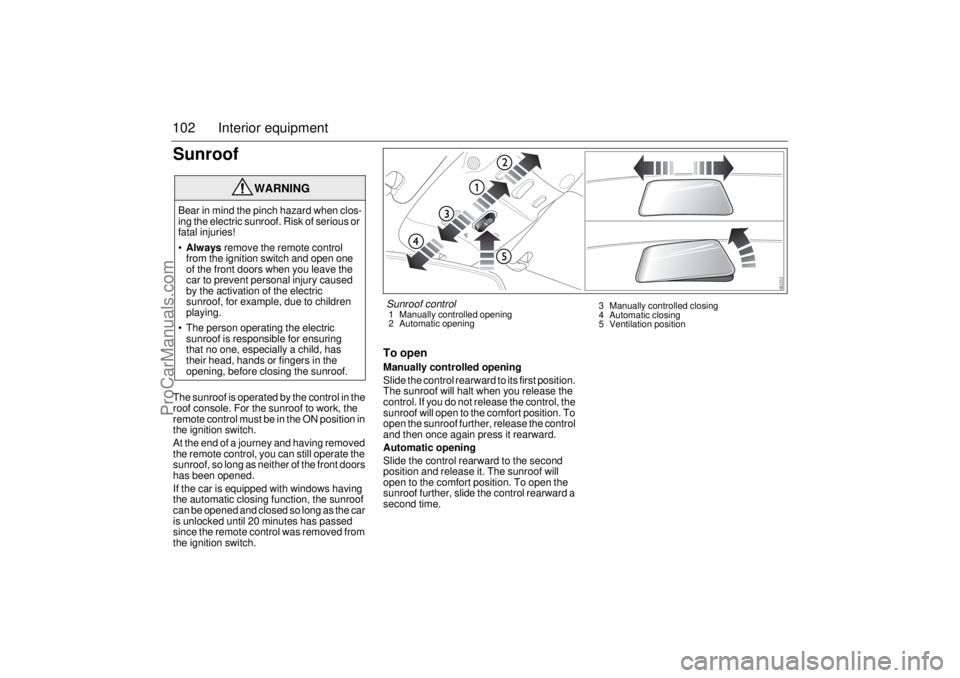
102 Interior equipmentSunroofThe sunroof is operated by the control in the
roof console. For the sunroof to work, the
remote control must be in the ON position in
the ignition switch.
At the end of a journey and having removed
the remote control, you can still operate the
sunroof, so long as neither of the front doors
has been opened.
If the car is equipped with windows having
the automatic closing function, the sunroof
can be opened and closed so long as the car
is unlocked until 20 minutes has passed
since the remote control was removed from
the ignition switch.
To openManually controlled opening
Slide the control rearward to its first position.
The sunroof will halt when you release the
control. If you do not release the control, the
sunroof will open to the comfort position. To
open the sunroof further, release the control
and then once again press it rearward.
Automatic opening
Slide the control rearward to the second
position and release it. The sunroof will
open to the comfort position. To open the
sunroof further, slide the control rearward a
second time.
WARNING
Bear in mind the pinch hazard when clos-
ing the electric sunroof. Risk of serious or
fatal injuries!
Always remove the remote control
from the ignition switch and open one
of the front doors when you leave the
car to prevent personal injury caused
by the activation of the electric
sunroof, for example, due to children
playing.
The person operating the electric
sunroof is responsible for ensuring
that no one, especially a child, has
their head, hands or fingers in the
opening, before closing the sunroof.
Sunroof control1 Manually controlled opening
2 Automatic opening3 Manually controlled closing
4 Automatic closing
5 Ventilation position
ProCarManuals.com
Page 103 of 256

103 Interior equipment
To closeManually controlled closing
Slide the control forward to its first position.
The sunroof will halt when you release the
control.
Automatic closing
Slide the control forward to its second posi-
tion and release it. The sunroof will close
fully.
The sunroof pinch protection halts closing
and opens the sunroof slightly if something
obstructs closing.Ventilation position (rear edge of
sunroof open)
To open – press in the control.
To close – slide the control forward to the
second position.
It is also possible to select the ventilation
position when the sunroof is open by press-
ing in the control. The sunroof will then close
automatically. Press the control once
more to open the sunroof to its ventilation
position.
If you wish to open the sunroof fully from
the ventilation position, you must first close
it (slide the control forward). You can then
slide the control rearward to open the sun-
roof.
The sunroof incorporates an interior, man-
ual, sliding sun blind.
Comfort opening (option)Comfort opening is the remote opening of
windows and the sunroof.
Press and hold the unlocking button on the
remote control until the windows and sun-
roof start to open (approx. 2 s).
If the sunroof is in the ventilation position, it
will not open.
Comfort closing (option)Comfort closing is the remote closing of
open windows and the sunroof, and the
retracting of electrically retractable door
mirrors.
Press and hold the locking button on the
remote control until the windows are closed
and door mirrors retracted (takes roughly
2 s). The doors must be shut.
WARNING
Exercise great care when closing the
sunroof to ensure that nothing gets
trapped.
WARNING
Make sure no one is so close to the car
that they can be injured if comfort closing
is activated.
ProCarManuals.com
Page 104 of 256

104 Interior equipmentPinch protectionThe sunroof is equipped with pinch protec-
tion. This is activated if something gets
trapped when the sunroof is being closed.
The sunroof will stop and open slightly.
Overriding the pinch protection
If dirt, ice or similar create so much resis-
tance that the pinch protection cuts in (sun-
roof cannot be closed), the pinch protection
can be temporarily disengaged.
1 Make sure the ignition is ON.
2 Press and hold the button on the
driver’s door while operating the window
in question.
3 Close the sunroof with the button on the
roof console.
The pinch protection will be operative the
next time the sunroof is operated.
Emergency operation of the sunroofIn an emergency, such as if there is an elec-
trical failure, the sunroof can be operated
with a screwdriver.
Remove the lens from the roof console. Use
a screwdriver to press in the pin in the slot
in the center of the motor shaft and turn the
screwdriver.
Turn clockwise to close the sunroof.
If the rear edge of the sunroof is open (ven-
tilation position), turn the screwdriver
counter-clockwise.
WARNING
Make sure nothing obstructs the sunroof
when it is closed without pinch protection.
Button for overriding the sunroof pinch
protection
ProCarManuals.com
Page 123 of 256
123 Starting and driving
Steering wheel lockThe steering wheel lock is electronic. The
lock engages when the remote control is
removed from the ignition and unlocks when
the remote control is inserted. A click can be
heard when the steering wheel lock locks
and unlocks.
If the car is parked with one front wheel
touching the curb, for example, you may
need to turn the steering wheel slightly
when you insert the remote control to allow
the steering wheel lock to unlock. If you do
not succeed on first attempt you must
remove the remote control before trying
again. Turn the steering wheel and insert
the remote control into the ignition switch.
If the steering wheel lock does not disen-
gage it will not be possible to turn the remote
control in the ignition switch.
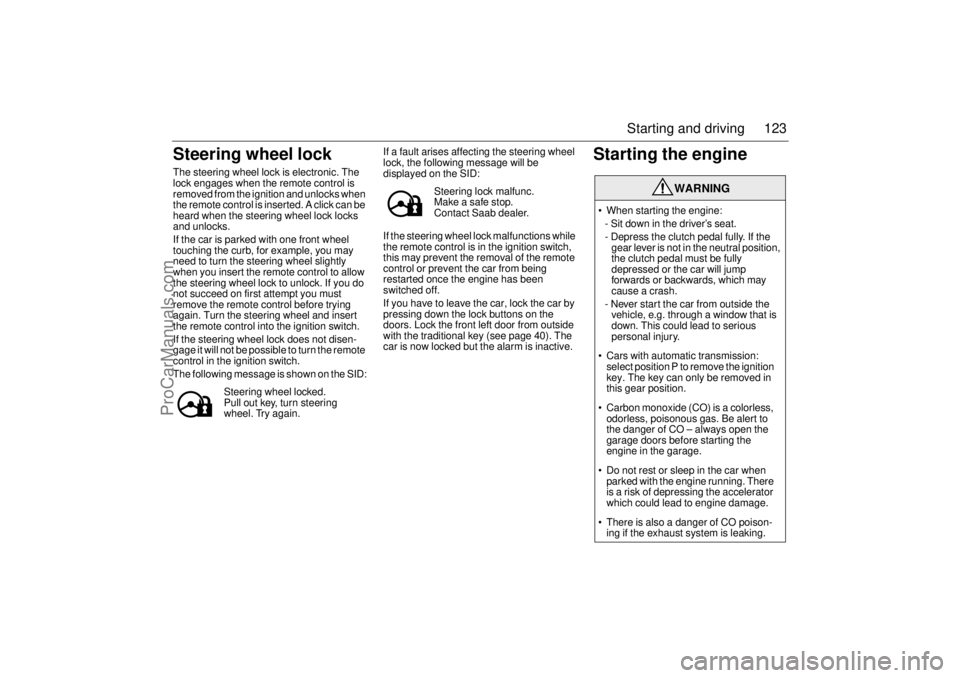
The following message is shown on the SID:If a fault arises affecting the steering wheel
lock, the following message will be
displayed on the SID:
If the steering wheel lock malfunctions while
the remote control is in the ignition switch,
this may prevent the removal of the remote
control or prevent the car from being
restarted once the engine has been
switched off.
If you have to leave the car, lock the car by
pressing down the lock buttons on the
doors. Lock the front left door from outside
with the traditional key (see page 40). The
car is now locked but the alarm is inactive.
Starting the engine
Steering wheel locked.
Pull out key, turn steering
wheel. Try again.
Steering lock malfunc.
Make a safe stop.
Contact Saab dealer.
WARNING
When starting the engine:
- Sit down in the driver’s seat.
- Depress the clutch pedal fully. If the
gear lever is not in the neutral position,
the clutch pedal must be fully
depressed or the car will jump
forwards or backwards, which may
cause a crash.
- Never start the car from outside the
vehicle, e.g. through a window that is
down. This could lead to serious
personal injury.
Cars with automatic transmission:
select position P to remove the ignition
key. The key can only be removed in
this gear position.
Carbon monoxide (CO) is a colorless,
odorless, poisonous gas. Be alert to
the danger of CO – always open the
garage doors before starting the
engine in the garage.
Do not rest or sleep in the car when
parked with the engine running. There
is a risk of depressing the accelerator
which could lead to engine damage.
There is also a danger of CO poison-
ing if the exhaust system is leaking.
ProCarManuals.com
Page 155 of 256

155 Starting and driving
Driving in cold weatherIn cold weather, special attention should be
paid to the following:
Before driving off, make sure that the
wiper blades have not frozen to the wind-
shield.
Remove any snow from the heating
system air intakes between the hood and
the windshield.
If necessary, inject oil into the locks to
prevent them from freezing. Use molyb-
denum-sulphide oil (MoS
2). If the locks
freeze, exercise care when unlocking the
car (manual unlocking) to avoid breaking
the key. Warm up the key or use a de-icer.
It is particularly important when the roads
are slippery that the brakes and tires are
in good condition.
For how to check the level of antifreeze in
the engine coolant, see page 179. Add gasoline anti-freeze when refueling
several times before the onset of winter.
This will prevent condensation water in
the fuel tank from freezing and causing
interruptions in the fuel supply. The likeli-
hood of condensation is lowest when the
fuel tank is full.
If the car is parked outside and the
temperature is below zero, carburettor
spirit is of little use as it cannot remove
water that has already frozen. Park the
car in a warm place so that any ice that
may have built up melts, then add carbu-
rettor spirit when refueling.
Condensation is caused by temperature
fluctuations, either in the outside temper-
ature alone or when the car is alternately
parked outdoors and in a garage.
The car is equipped with tires designed to
provide optimum grip on both wet and dry
roads, although this has been achieved at
the expense of somewhat reduced grip on
snow and ice. For regular driving on snow
and ice, we therefore recommend that
winter (snow) tires be fitted.Winter tires, particularly studded tires,
generally make driving safer on snow and
ice.
Acquaint yourself with the legal provi-
sions governing the use of different
types of winter tires and snow chains.
Studded tires are not allowed in some
countries. If winter tires are fitted, the same
type must be fitted to all four wheels. Your
Saab dealer will be pleased to advise you on
the best tires for your car.
Remember that tires age: it may therefore
be necessary to change winter tires before
they reach the legal wear limit, as they grad-
ually lose their friction properties with age.
If you get into a front wheel skid and the car
has a manual transmission, the best
response is to freewheel, which means
declutching so that the wheels neither drive
nor brake, and to cautiously steer in the
desired direction.
If the car has automatic transmission, ease
off the accelerator slightly and steer cau-
tiously in the desired direction.
If you get into a rear wheel skid, steer in the
same direction as the movement of the rear
of the car.
ProCarManuals.com
Page 160 of 256

160 Starting and drivingChecks before drivingMake sure that the car and trailer are in
good working order. This is essential since
towing a trailer increases the strain on the
car.
Check and if necessary adjust the tire
pressure of the car and trailer.
Make sure all wheel bolts are properly
tightened.
Make sure that the equipment joining the
car and trailer is properly secured and
adjusted.
Make sure the trailer’s electrical cable is
properly connected and is not so long that
it drags along the ground. Also, make
sure the cable is not too short and risks
breaking when turning a corner.
Check all bulbs.
Check the car and trailer brakes.
Make sure that all items on or in the cara-
van or trailer are properly secured.
Make sure that the trailer’s jockey wheel
is raised and locked.
Check the distribution of the load so that
the car and trailer are well balanced.
Check that the rearview mirrors provide
the best possible rearward vision.
Make sure the trailer’s safety cable is
correctly attached.
Driving considerationsAlways take extra care when towing a
trailer, as the car’s handling will be different
and its braking performance reduced. The
trailer’s braking system and suspension
also have a considerable effect on these
characteristics. See also "Driving with a
load" on page 162.
Drive carefully:
descending hills
on uneven roads
over railway crossings
when meeting large vehicles
If the car has automatic transmission, select
gear M1 when ascending or descending
steep hills.ReversingGet someone to help you keep an eye out
behind the trailer as the door mirrors do not
always provide sufficient rearward vision
when reversing.
ProCarManuals.com
Page 201 of 256
201 Car care
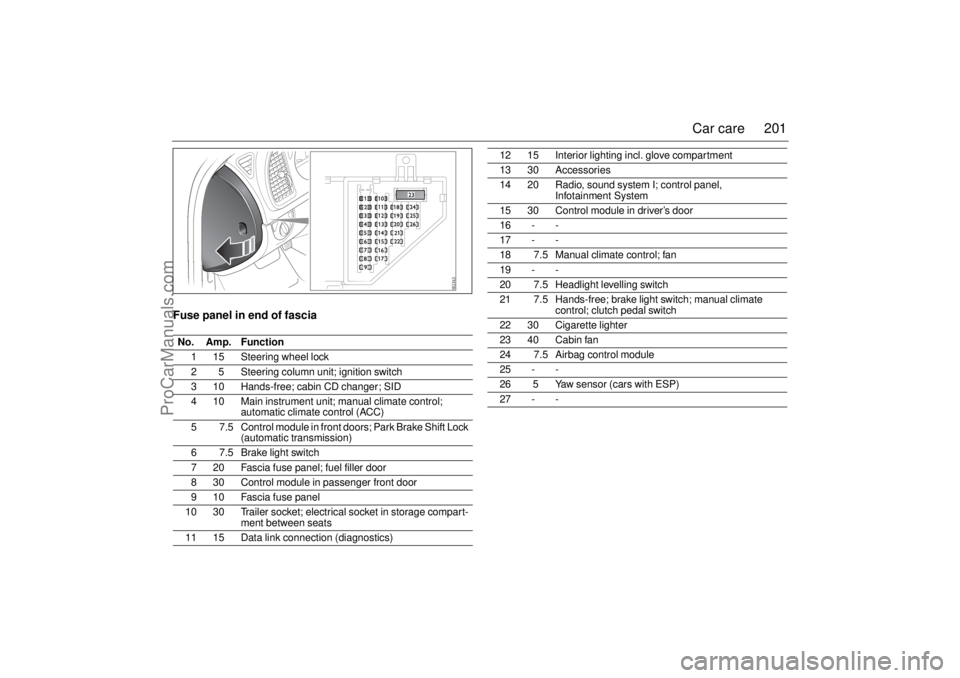
Fuse panel in end of fasciaNo. Amp. Function
1 15 Steering wheel lock
2 5 Steering column unit; ignition switch
3 10 Hands-free; cabin CD changer; SID
4 10 Main instrument unit; manual climate control;
automatic climate control (ACC)
5 7.5 Control module in front doors; Park Brake Shift Lock
(automatic transmission)
6 7.5 Brake light switch
7 20 Fascia fuse panel; fuel filler door
8 30 Control module in passenger front door
9 10 Fascia fuse panel
10 30 Trailer socket; electrical socket in storage compart-
ment between seats
11 15 Data link connection (diagnostics)
12 15 Interior lighting incl. glove compartment
13 30 Accessories
14 20 Radio, sound system I; control panel,
Infotainment System
15 30 Control module in driver’s door
16 - -
17 - -
18 7.5 Manual climate control; fan
19 - -
20 7.5 Headlight levelling switch
21 7.5 Hands-free; brake light switch; manual climate
control; clutch pedal switch
22 30 Cigarette lighter
23 40 Cabin fan
24 7.5 Airbag control module
25 - -
26 5 Yaw sensor (cars with ESP)
27 - -
ProCarManuals.com
Page 217 of 256

217 Car care
Flat spottingAll tires get hot, especially on long journeys
or when the car is driven hard. After the car
has been parked with hot tires and the tires
have cooled down, a flat spot can form in the
tire, where it is in contact with the ground.
The same can occur if the car has not been
moved for a long time.
Flat spots can cause vibration that can be
felt through the steering wheel, similar to
that experienced when the wheels need bal-
ancing.
Flat spots of this type disappear once the
tires get hot again, usually after 10–15 miles
(20–25 km) of driving at cruising speed.
Safety beltsCheck the function of the safety belts regu-
larly as follows:
Hold the diagonal strap and pull it sharply.
The safety belt should lock and it should
not be possible to withdraw it further.
Check the anchorage points in the floor.
They must not have suffered rust damage.
If a belt is worn or has any fraying edges, it
should be replaced.
Safety belts must not come into contact with
substances such as polishes, oil or chemi-
cals. If the belts get dirty, wash them with
warm water and a detergent or have them
replaced.
Upholstery and trimTo remove fluff and hairs from the seats,
door armrests and headlining, use a
vacuum cleaner, a moist lint-free cloth, or a
clothes brush. Remove spots and dirt using
a cloth moistened with lukewarm soapy
water.
When using a stain remover, always work
from the outside towards the centre to avoid
leaving a ring. If a soiled ring or spot should
remain, it can usually be removed using
lukewarm soapy water or water alone.
Spots left by liquids, such as soft drinks or
thin oil, must be removed at once with an
absorbent material, such as kitchen towel-
ling. Then clean with a stain remover.
White spirit is recommended for removing
grease and oil stains. A medium stiff brush
may also be used.
WARNING
If the car is involved in a crash, the safety
belts, belt pretensioners and other asso-
ciated components must be inspected at
a Saab dealer.
Never make any alterations or repairs to
the safetybelts yourself but visit a Saab
dealer.
ProCarManuals.com
Page 248 of 256

248 Technical dataSeveral of the systems in your Saab
can be customized to better suit
your individual needs. Contact your
Saab dealerCentral locking system
Some functions are governed by legal
requirements and cannot therefore be
reprogrammed.
Consult a Saab dealer for further informa-
tion.
Listed below are a number of examples of
programmable functions.
Audible confirmation of arming/disarming
the car alarm.
Automatic unlocking when car stopped
and remote control removed from the igni-
tion switch.
Trunk lid locked when car driven off or
30 s after being shut.
Length of audible and visual acknowl-
edgements.
Possibility to have the trunk lid unlocked
when doors unlocked, yes/no.
Central locking relocks the car automati-
cally if a door or the trunk lid is not opened,
yes/no. If the car has an alarm, this is
rearmed.Car alarm
Listed below are a number of examples of
programmable functions.
Cabin lighting switched on when the car
alarm is tripped.
Sensitivity of the movement sensor.
Audible signal produced by horn or car
alarm siren.
ProCarManuals.com