roof SAAB 9-3 2003 User Guide
[x] Cancel search | Manufacturer: SAAB, Model Year: 2003, Model line: 9-3, Model: SAAB 9-3 2003Pages: 256, PDF Size: 21.66 MB
Page 100 of 256

100 Interior equipmentTo closeRaise the front edge of the button one step.
The window will stop when it is fully closed
or when the button is released.
Automatic closing (option): Raise the
button all the way and release it. If the
window does not close automatically, refer
to Calibration on page 101.
Comfort closing (option)Comfort closing is the remote closing of
open windows and the sunroof, and the
retracting of electrically retractable door
mirrors.
Press and hold the locking button on the
remote control until the windows are closed
and door mirrors retracted (takes roughly
2 s). The doors must be shut.
Confirmation that closing has finished is
provided by the direction indicators, which
flash once. No confirmation indicates that
closing was not possible. This may be due
to a door being open or a window requiring
calibration.
Pinch protectionOn certain model variants, the electric win-
dows are equipped with pinch protection.
This is activated if something gets trapped
between the window pane and door frame
when the window is closed. The window will
stop and lower slightly.
WARNING
Take care when closing a window to
ensure that no one gets caught.
WARNING
Make sure no one is so close to the car
that they can be injured if comfort closing
is activated.
ProCarManuals.com
Page 102 of 256
102 Interior equipmentSunroofThe sunroof is operated by the control in the
roof console. For the sunroof to work, the
remote control must be in the ON position in
the ignition switch.
At the end of a journey and having removed
the remote control, you can still operate the
sunroof, so long as neither of the front doors
has been opened.
If the car is equipped with windows having
the automatic closing function, the sunroof
can be opened and closed so long as the car
is unlocked until 20 minutes has passed
since the remote control was removed from
the ignition switch.
To openManually controlled opening
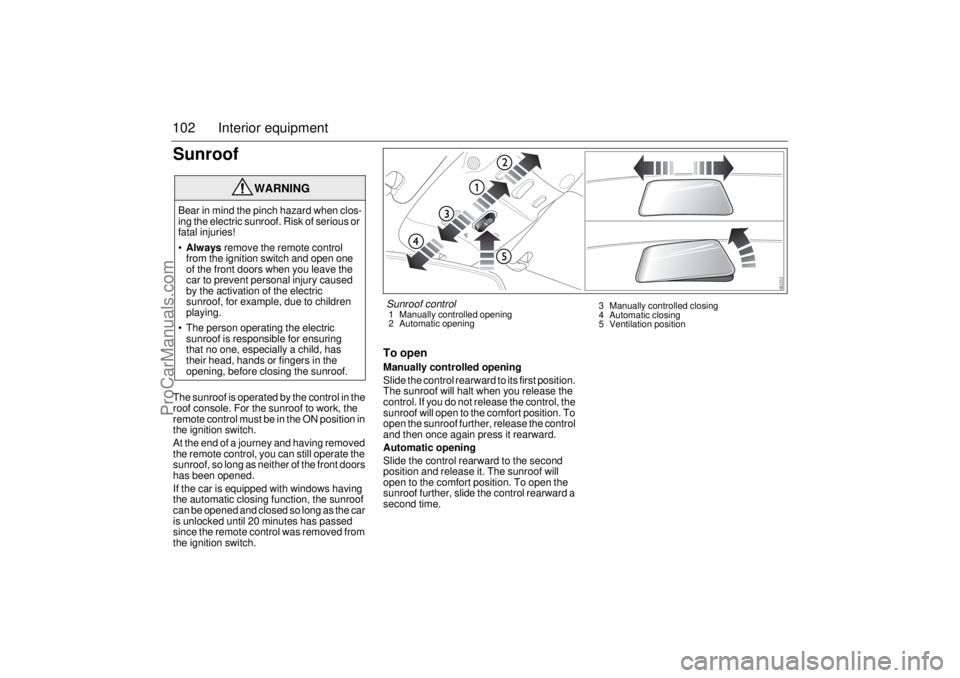
Slide the control rearward to its first position.
The sunroof will halt when you release the
control. If you do not release the control, the
sunroof will open to the comfort position. To
open the sunroof further, release the control
and then once again press it rearward.
Automatic opening
Slide the control rearward to the second
position and release it. The sunroof will
open to the comfort position. To open the
sunroof further, slide the control rearward a
second time.
WARNING
Bear in mind the pinch hazard when clos-
ing the electric sunroof. Risk of serious or
fatal injuries!
Always remove the remote control
from the ignition switch and open one
of the front doors when you leave the
car to prevent personal injury caused
by the activation of the electric
sunroof, for example, due to children
playing.
The person operating the electric
sunroof is responsible for ensuring
that no one, especially a child, has
their head, hands or fingers in the
opening, before closing the sunroof.
Sunroof control1 Manually controlled opening
2 Automatic opening3 Manually controlled closing
4 Automatic closing
5 Ventilation position
ProCarManuals.com
Page 103 of 256

103 Interior equipment
To closeManually controlled closing
Slide the control forward to its first position.
The sunroof will halt when you release the
control.
Automatic closing
Slide the control forward to its second posi-
tion and release it. The sunroof will close
fully.
The sunroof pinch protection halts closing
and opens the sunroof slightly if something
obstructs closing.Ventilation position (rear edge of
sunroof open)
To open – press in the control.
To close – slide the control forward to the
second position.
It is also possible to select the ventilation
position when the sunroof is open by press-
ing in the control. The sunroof will then close
automatically. Press the control once
more to open the sunroof to its ventilation
position.
If you wish to open the sunroof fully from
the ventilation position, you must first close
it (slide the control forward). You can then
slide the control rearward to open the sun-
roof.
The sunroof incorporates an interior, man-
ual, sliding sun blind.
Comfort opening (option)Comfort opening is the remote opening of
windows and the sunroof.
Press and hold the unlocking button on the
remote control until the windows and sun-
roof start to open (approx. 2 s).
If the sunroof is in the ventilation position, it
will not open.
Comfort closing (option)Comfort closing is the remote closing of
open windows and the sunroof, and the
retracting of electrically retractable door
mirrors.
Press and hold the locking button on the
remote control until the windows are closed
and door mirrors retracted (takes roughly
2 s). The doors must be shut.
WARNING
Exercise great care when closing the
sunroof to ensure that nothing gets
trapped.
WARNING
Make sure no one is so close to the car
that they can be injured if comfort closing
is activated.
ProCarManuals.com
Page 104 of 256

104 Interior equipmentPinch protectionThe sunroof is equipped with pinch protec-
tion. This is activated if something gets
trapped when the sunroof is being closed.
The sunroof will stop and open slightly.
Overriding the pinch protection
If dirt, ice or similar create so much resis-
tance that the pinch protection cuts in (sun-
roof cannot be closed), the pinch protection
can be temporarily disengaged.
1 Make sure the ignition is ON.
2 Press and hold the button on the
driver’s door while operating the window
in question.
3 Close the sunroof with the button on the
roof console.
The pinch protection will be operative the
next time the sunroof is operated.
Emergency operation of the sunroofIn an emergency, such as if there is an elec-
trical failure, the sunroof can be operated
with a screwdriver.
Remove the lens from the roof console. Use
a screwdriver to press in the pin in the slot
in the center of the motor shaft and turn the
screwdriver.
Turn clockwise to close the sunroof.
If the rear edge of the sunroof is open (ven-
tilation position), turn the screwdriver
counter-clockwise.
WARNING
Make sure nothing obstructs the sunroof
when it is closed without pinch protection.
Button for overriding the sunroof pinch
protection
ProCarManuals.com
Page 105 of 256
105 Interior equipment
Interior lightingThe interior lighting consists of one front and
one rear roof light, floor lighting, and cour-
tesy lights in the doors. The light switch for
the interior lighting is located on the roof
console by the rearview mirror.When the switch is in the mid-position (door-
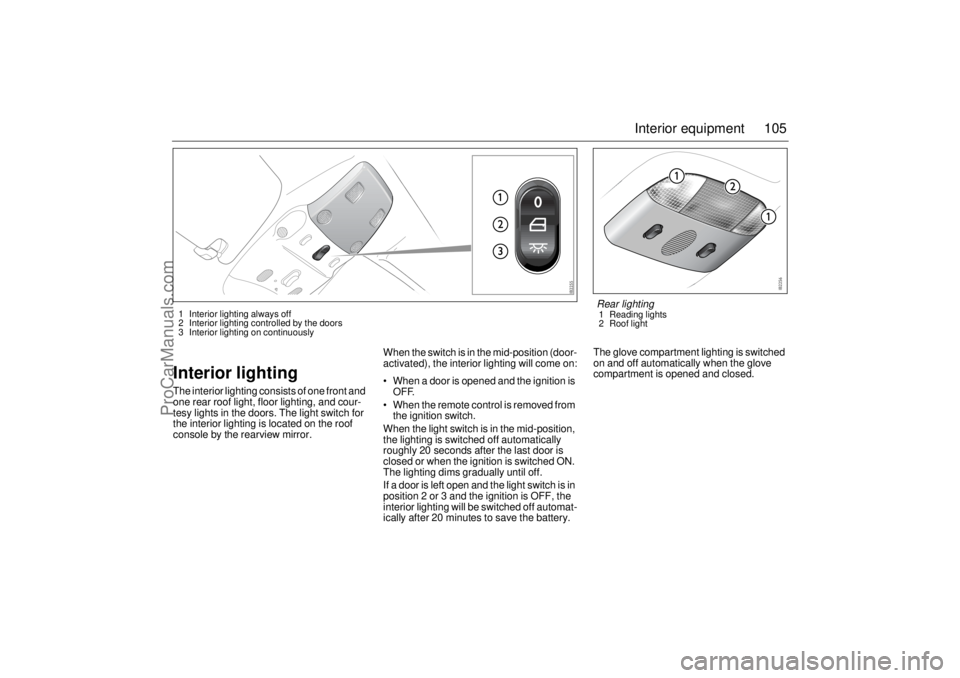
activated), the interior lighting will come on:
When a door is opened and the ignition is
OFF.
When the remote control is removed from
the ignition switch.
When the light switch is in the mid-position,
the lighting is switched off automatically
roughly 20 seconds after the last door is
closed or when the ignition is switched ON.
The lighting dims gradually until off.
If a door is left open and the light switch is in
position 2 or 3 and the ignition is OFF, the
interior lighting will be switched off automat-
ically after 20 minutes to save the battery.The glove compartment lighting is switched
on and off automatically when the glove
compartment is opened and closed.1 Interior lighting always off
2 Interior lighting controlled by the doors
3 Interior lighting on continuously
Rear lighting1 Reading lights
2 Roof light
ProCarManuals.com
Page 121 of 256
121 Starting and driving
Ignition switch ________ 122
Steering wheel lock ____ 123
Starting the engine ____ 123
Important considerations
for driving __________ 125
Refueling ____________ 128
Engine Break-in Period _ 132
Manual transmission___ 133
Automatic transmission 134
Cruise control ________ 140
Braking ______________ 141
Traction Control System
(TCS) ______________ 144
Electronic Stability
Program (ESP) ______ 146
Parking brake_________ 148
Parking ______________ 148 Economical driving _____ 153
Driving in cold weather__ 155
Driving in hot climates __ 156
Towing a trailer ________ 157
Driving with a roof rack
load ________________ 161
Driving with a load _____ 162
Driving with the trunk lid
open________________ 163
Driving in deep water ___ 163
Driving at night ________ 163
Towing the car _________ 164
Driving with the compact
spare wheel__________ 167
Jump starting _________ 168
For long trips __________ 170
Starting and driving
ProCarManuals.com
Page 153 of 256

153 Starting and driving
Economical drivingFactors affecting fuel consumptionThe fuel consumption of a car is greatly
affected by driving conditions, climate, road
conditions, speed, driving technique, and
so on.Breaking-inFuel consumption may be somewhat
higher during the break-in period (the
first 3,000–4,000 miles (5,000–7,000 km)).Weather conditionsSummer temperatures give better fuel
economy than winter ones. The difference
can be as much as about 10%. Consump-
tion increases in cold weather because the
engine takes longer to reach its normal
operating temperature. The transmission
and wheel bearings also take longer to
warm up. Even distance affects consump-
tion: short journeys of 3–5 miles (5–8 km)
do not give the engine enough time to
reach its optimum temperature. Wind con-
ditions also have a marked effect on fuel
consumption.How to read the diagram:
If fuel consumption with the engine at
normal temperature is 28 mpg (10 l/
100 km), the actual fuel consumption
3 miles (5 km) after the engine has started
from cold will be:
– 23.5 mpg (12 l/100 km) at outside temp.
of 68°F (+20°C) (increase of 20%).
– 17.7 mpg (16 l/100 km) at outside temp.
of 32°F (0°C) (increase of 60%).
– 14 mpg (20 l/100 km) at outside temp.
of –4°F (–20°C) (increase of 100%).
It is clear from the diagram that both dis-
tance driven and outside temperature have
a significant impact on fuel consumption,
after a cold start.
If the car is normally driven on short jour-
neys, 3–5 miles (5–8 km), for example to
and from work, the average consumption
will be 60–80% above the normal level.
Driving techniques To obtain the best running economy, with
regard to fuel consumption and general
wear, the car must be serviced regularly.
High speed, unnecessary acceleration,
frequent braking and much changing
down all give higher fuel consumption.
Frequent gear changing in traffic, starting
in cold weather, the use of studded tires
and roof racks, and towing a caravan all
increase fuel consumption.
Do not warm up the engine while the car
is stationary.
If idling, the engine will take much longer
to reach its optimum temperature, and Percentage increase in fuel consumption
of engine starting from cold compared to
engine at normal temperature.
ProCarManuals.com
Page 161 of 256
161 Starting and driving
Driving with a roof rack
loadThe maximum permissible roof load is
220 lbs. (100 kg). Note that the roof load
must be included in the car’s maximum per-
missible payload and axle load.
Strong, sturdy roof carriers designed spe-
cially for your car are available from your
Saab dealer. Always secure roof loads
securely.
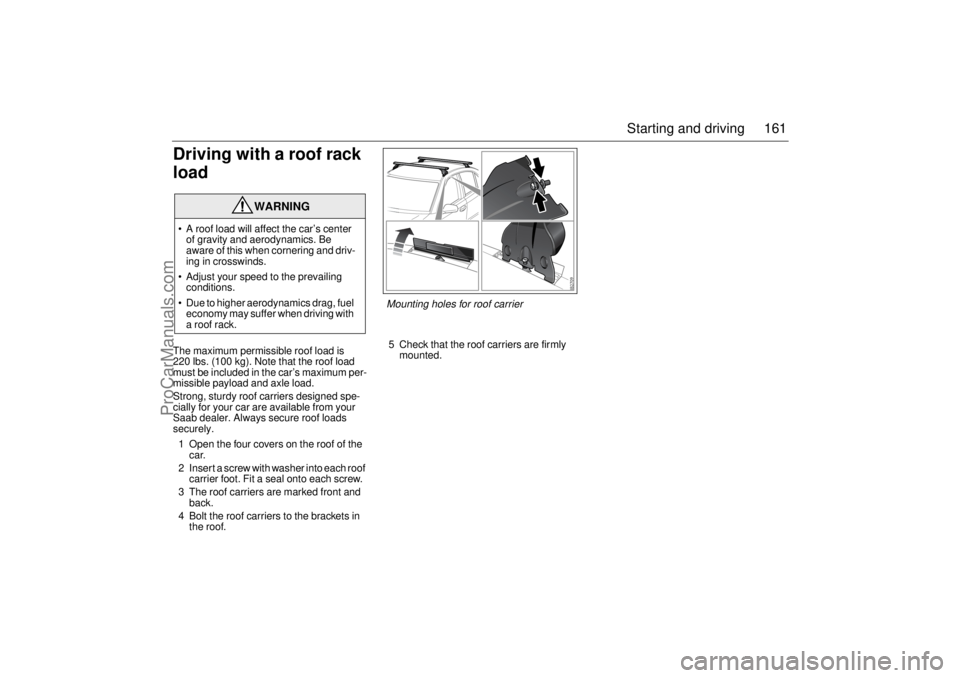
1 Open the four covers on the roof of the
car.
2 Insert a screw with washer into each roof
carrier foot. Fit a seal onto each screw.
3 The roof carriers are marked front and
back.
4 Bolt the roof carriers to the brackets in
the roof.5 Check that the roof carriers are firmly
mounted.
WARNING
A roof load will affect the car’s center
of gravity and aerodynamics. Be
aware of this when cornering and driv-
ing in crosswinds.
Adjust your speed to the prevailing
conditions.
Due to higher aerodynamics drag, fuel
economy may suffer when driving with
a roof rack.
Mounting holes for roof carrier
ProCarManuals.com
Page 162 of 256

162 Starting and drivingDriving with a loadThe handling characteristics are affected by
how the car is loaded.
Place the heaviest load as far forward and
as low as possible in the trunk.
Secure the load to the lashing eyes (see
page 118).
Heavy loads mean that the car’s center of
gravity is further back. As a result, the car
will sway more during evasive steering.
Never exceed the permissible load of the
roof box, even if there is room for more.
Ensure that the tire pressure is correct –
slight overinflation is preferable to under-
inflation.
The braking distance of a loaded car is
always greater. Keep your distance from
the vehicle in front.
Do not exceed the car’s permissible
gross vehicle weight or axle load (see
page 236).
Roof loads can negatively affect telecom-
munication.
TiresNote: Low tire pressure also causes prema-
ture tire wear and increased fuel consump-
tion.
Tire pressure should match the current load
and speed of the car (see page 245).
The tire pressures given apply to cold tires,
that is tires that are the same temperature
as the outside air temperature.
The tire pressure increases approximately
4 psi/27 kPa as the tires become warm (e.g.
during highway driving). When the temper-
ature of the tires changes by 50°F (10°C),
the tire pressure will change 2 psi/13 kPa.Never reduce the pressure of a hot tire. If the
tires are hot when you check them, only
increase the pressure, if necessary.
Underinflated tires wear more quickly than
slightly overinflated tires.
If a valve is leaking, simply unscrew it and fit
a new one.
Note: Remember to adjust the tire pres-
sures if you change the load in the car sig-
nificantly or intend to drive at substantially
lower or higher speeds than normal.
Automatic tire pressure monitoring, see
page 207.
WARNING
Check the tire pressure at least once a
month and before long journeys. Under-
inflation can result in:
punctures
separation of the tire and tread
damage to the sidewalls
damage to the rims on poor roads
poor handling characteristics
premature tire wear
increased fuel consumption.
ProCarManuals.com
Page 163 of 256

163 Starting and driving
Driving with the trunk lid
openAvoid driving with the trunk lid partly or fully
open, since exhaust fumes can be drawn
into the cabin.
If you must drive with the trunk lid open,
close all windows and the sunroof (if fitted)
and set the cabin fan to its highest speed
setting.
Driving in deep water Driving at night
Bear in mind the following points, especially
when driving at night:
Nighttime driving requires your full
concentration
Do not rush. Count on your journey taking
slightly longer.
The number of drivers under the influence
of drugs is likely to be greater at night than
during the day.
Do not stare at the headlights of oncom-
ing vehicles.
Avoid driving at night if you have poor
eyesight. Night vision deteriorates with
age.
Keep your car’s headlights, windows and
mirrors clean. Also, if you wear glasses,
make sure they are clean.
Make sure you are well rested before
starting a long journey. Take a break
every other hour.
Only eat light meals. Heavy meals have a
tendency to induce tiredness.
Wild animals prefer to move at dusk and
dawn.
Check the headlight levelling setting (see
page 73).
NOTICEDo not drive in puddles or water deeper
than 7 in. (20 cm) and do not drive faster
than at idling speed. Water can otherwise
be sucked into the engine. The engine will
be damaged if water enters the intake
system.
ProCarManuals.com