automatic transmission SAAB 9-3 2004 User Guide
[x] Cancel search | Manufacturer: SAAB, Model Year: 2004, Model line: 9-3, Model: SAAB 9-3 2004Pages: 288, PDF Size: 23.54 MB
Page 153 of 288
153 Starting and driving
Automatic transmissionThe automatic transmission has an elec-
tronic control module. The control module
receives information including accelerator
position and road speed. Using this and
other information, it controls the hydraulic
pressure of the transmission to ensure that
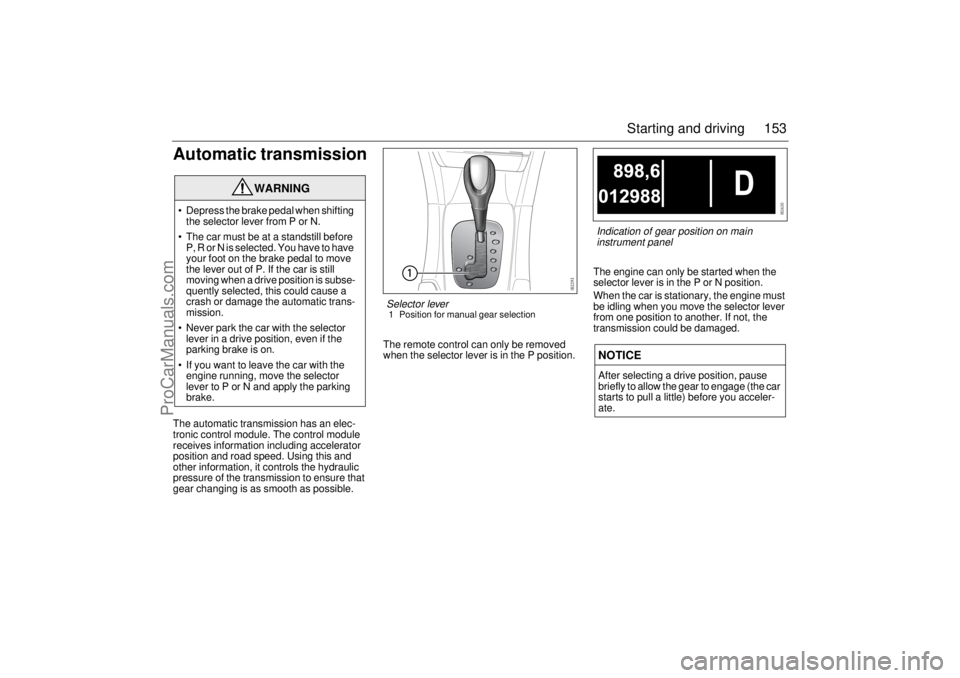
gear changing is as smooth as possible.The remote control can only be removed
when the selector lever is in the P position.The engine can only be started when the
selector lever is in the P or N position.
When the car is stationary, the engine must
be idling when you move the selector lever
from one position to another. If not, the
transmission could be damaged.
WARNING
Depress the brake pedal when shifting
the selector lever from P or N.
The car must be at a standstill before
P, R or N is selected. You have to have
your foot on the brake pedal to move
the lever out of P. If the car is still
moving when a drive position is subse-
quently selected, this could cause a
crash or damage the automatic trans-
mission.
Never park the car with the selector
lever in a drive position, even if the
parking brake is on.
If you want to leave the car with the
engine running, move the selector
lever to P or N and apply the parking
brake.
NOTICEAfter selecting a drive position, pause
briefly to allow the gear to engage (the car
starts to pull a little) before you acceler-
ate.
Selector lever1 Position for manual gear selection
Indication of gear position on main
instrument panel
ProCarManuals.com
Page 154 of 288
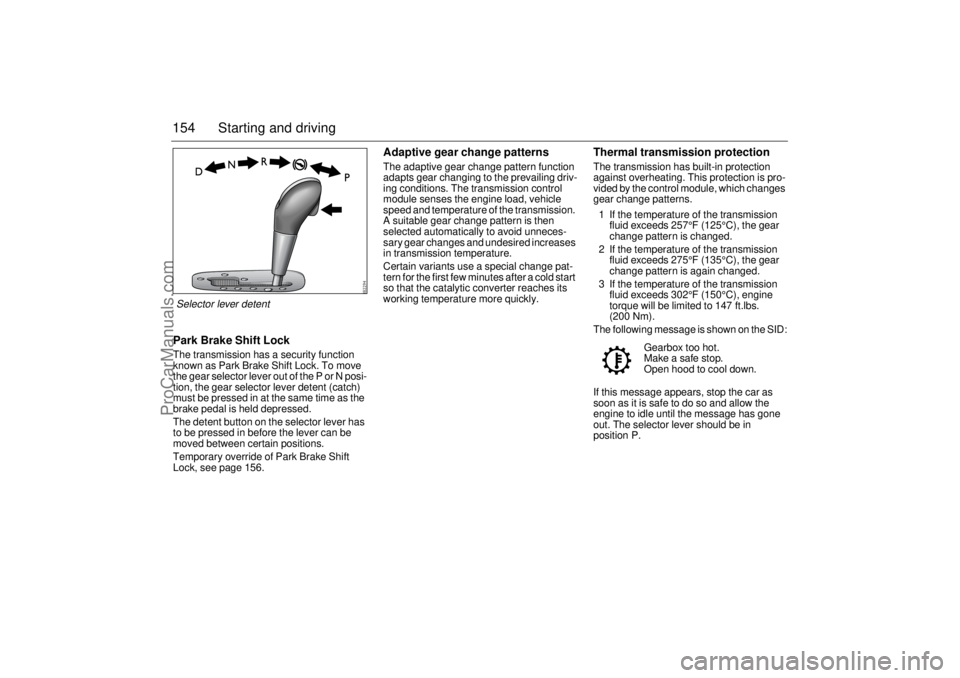
154 Starting and drivingPark Brake Shift LockThe transmission has a security function
known as Park Brake Shift Lock. To move
the gear selector lever out of the P or N posi-
tion, the gear selector lever detent (catch)
must be pressed in at the same time as the
brake pedal is held depressed.
The detent button on the selector lever has
to be pressed in before the lever can be
moved between certain positions.
Temporary override of Park Brake Shift
Lock, see page 156.
Adaptive gear change patternsThe adaptive gear change pattern function
adapts gear changing to the prevailing driv-
ing conditions. The transmission control
module senses the engine load, vehicle
speed and temperature of the transmission.
A suitable gear change pattern is then
selected automatically to avoid unneces-
sary gear changes and undesired increases
in transmission temperature.
Certain variants use a special change pat-
tern for the first few minutes after a cold start
so that the catalytic converter reaches its
working temperature more quickly.
Thermal transmission protectionThe transmission has built-in protection
against overheating. This protection is pro-
vided by the control module, which changes
gear change patterns.
1 If the temperature of the transmission
fluid exceeds 257°F (125°C), the gear
change pattern is changed.
2 If the temperature of the transmission
fluid exceeds 275°F (135°C), the gear
change pattern is again changed.
3 If the temperature of the transmission
fluid exceeds 302°F (150°C), engine
torque will be limited to 147 ft.lbs.
(200 Nm).
The following message is shown on the SID:
If this message appears, stop the car as
soon as it is safe to do so and allow the
engine to idle until the message has gone
out. The selector lever should be in
position P.Gearbox too hot.
Make a safe stop.
Open hood to cool down.
Selector lever detent
ProCarManuals.com
Page 155 of 288

155 Starting and driving
Lock-upThe transmission’s torque converter has a
lock-up function. This can lock the torque
converter in 3rd, 4th and 5th gears, thus
reducing the engine speed and fuel con-
sumption.Kick-downWhen the accelerator is pressed down fully,
a down change is made to optimize acceler-
ation, e.g. for overtaking.
Following this, the next higher gear will be
selected at the optimum engine speed,
unless you ease off the accelerator before
reaching this. Kick-down works in manual
mode in 4th and 5th gears if the engine
speed is lower than 2,000 rpm.
Driving in hilly country with a heavy
loadThe transmission fluid can overheat when
the gearbox is strained, for example, when
driving with a trailer on hilly roads. To avoid
the transmission fluid overheating, always
drive with the selector lever in the D posi-
tion. The adaptive gear change patterns are
then active.
High air temperatures or a faulty oil cooler
can also cause the transmission fluid to
overheat. Overheating reduces the service
life of the fluid.TowingTowing of cars with automatic transmission,
see page 184.
Descending hillsIf the speed of the car increases while
descending a steep hill, despite the acceler-
ator being released, the control module will
change down to 4th gear. If you desire more
powerful engine braking, manually select a
lower gear (see page 158).
WARNING
Remember to use the braking effect of the
engine (1st, 2nd or 3rd gear) when you
are descending long or steep hills to
spare the brakes.
Overheating can cause the brakes to
fade!
ProCarManuals.com
Page 157 of 288
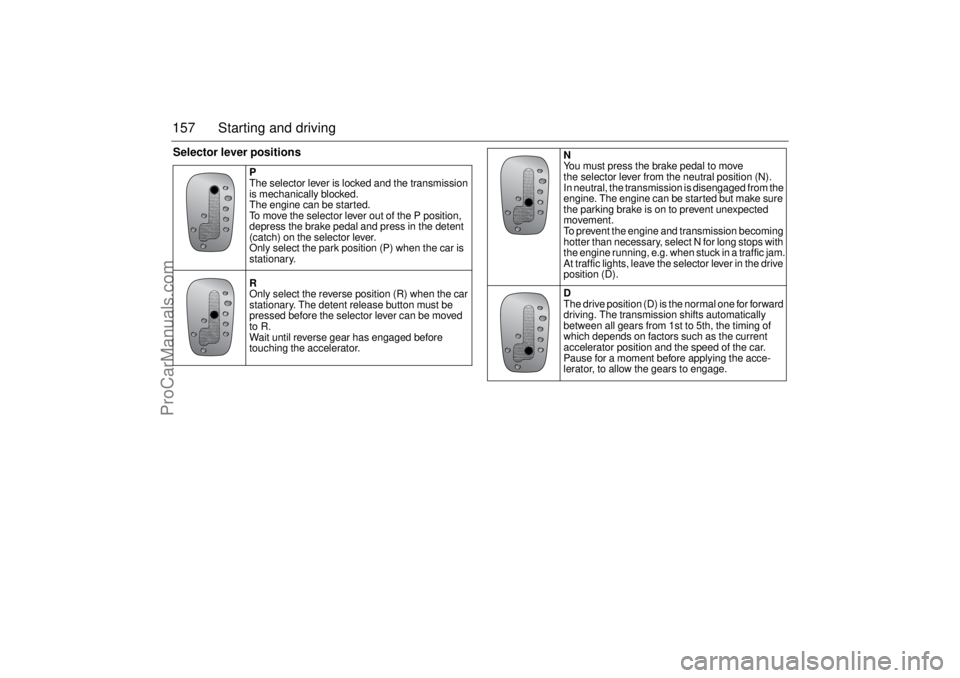
157 Starting and drivingSelector lever positions
P
The selector lever is locked and the transmission
is mechanically blocked.
The engine can be started.
To move the selector lever out of the P position,
depress the brake pedal and press in the detent
(catch) on the selector lever.
Only select the park position (P) when the car is
stationary.
R
Only select the reverse position (R) when the car
stationary. The detent release button must be
pressed before the selector lever can be moved
to R.
Wait until reverse gear has engaged before
touching the accelerator.
N
You must press the brake pedal to move
the selector lever from the neutral position (N).
In neutral, the transmission is disengaged from the
engine. The engine can be started but make sure
the parking brake is on to prevent unexpected
movement.
To prevent the engine and transmission becoming
hotter than necessary, select N for long stops with
the engine running, e.g. when stuck in a traffic jam.
At traffic lights, leave the selector lever in the drive
position (D).
D
The drive position (D) is the normal one for forward
driving. The transmission shifts automatically
between all gears from 1st to 5th, the timing of
which depends on factors such as the current
accelerator position and the speed of the car.
Pause for a moment before applying the acce-
lerator, to allow the gears to engage.
ProCarManuals.com
Page 160 of 288

160 Starting and drivingTo reduce the preset speedYou can reduce speed in any of the follow-
ing ways:
Brake to the desired speed. Jog the
control to SET/+ or SET/–.
Jog the control to SET/– to reduce the
speed by 1 mph (1.6 km/h).
Hold the control in the SET/– position until
the desired speed is reached.Temporary increase in speedAccelerate, without shifting down (manual
transmission), to exceed the set speed such
as for overtaking. When you release the
accelerator, the car will return to the set
speed.To disengage the system
temporarilySlide the switch to the left towards OFF, but
only as far as to disengage the cruise con-
trol. Allow the switch to spring back.
To re-engage the systemSlide the switch to RESUME. The car will
return to the previously set speed. Vehicle
speed must exceed 15 mph (25 km/h).To disengage the systemThe system will be disengaged:
As soon as the brake or clutch pedal is
depressed (cars with manual transmis-
sion).
When the switch is slid to To disengage
the system temporarily.
When the switch is slid to OFF.
When the TCS/ESP system is operative.
When position N is selected (cars with
automatic transmission).
BrakingIt is good practice to try your brakes period-
ically while driving. This is particularly
important when driving in heavy rain, on
roads with a lot of surface water, in snow or
in salty slush. In such conditions a slight
delay in the braking effect may be noticed.
To minimize this delay, dry the brakes by
applying them lightly now and again. This
should also be done after the car has been
washed, and in extremely damp weather.
To avoid the brakes becoming overheated,
such as when negotiating long descents
with a drop of several hundred yards (hun-
dred metres), select a low gear to utilize the
braking effect of the engine. If the car has
automatic transmission, select 1st or 2nd
gear.
You can help to prolong the life of the brakes
by thinking ahead and braking harder over
short periods, rather than braking more
moderately over long stretches.
ProCarManuals.com
Page 176 of 288

176 Starting and drivingRemember that tires age: it may therefore
be necessary to change winter tires before
they reach the legal wear limit, as they grad-
ually lose their friction properties with age.
If you get into a front wheel skid and the car
has a manual transmission, the best
response is to freewheel, which means
declutching so that the wheels neither drive
nor brake, and to cautiously steer in the
desired direction.
If the car has automatic transmission, ease
off the accelerator slightly and steer cau-
tiously in the desired direction.
If you get into a rear wheel skid, steer in the
same direction as the movement of the rear
of the car.
Driving with tire chainsSnow chains must only be fitted to the wheel
and tire dimensions that Saab recommends
in "Technical data" on page 267.
Contact a Saab dealer regarding approved
tire chains. See also page 237.
WARNING
Do not drive at speeds above 30 mph
(50 km/h) when tire chains are fitted.
Tire chains can reduce directional
stability.
Do not fit tire chains to the car’s rear
wheels.NOTICE Check the links frequently for wear.
Check that the chains do not foul the
wheel arch liner at full lock.
Refer to the "Technical data" section
on page 267, for information on wheel
and tire dimensions approved for the
fitting of tire chains.
ProCarManuals.com
Page 179 of 288
179 Starting and driving
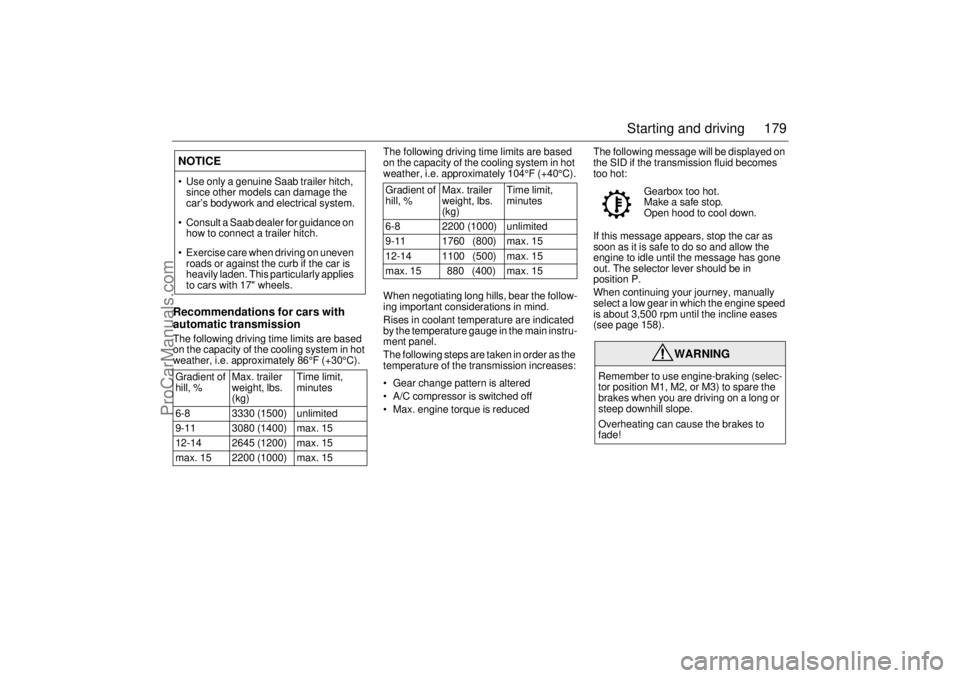
Recommendations for cars with
automatic transmissionThe following driving time limits are based
on the capacity of the cooling system in hot
weather, i.e. approximately 86°F (+30°C).The following driving time limits are based
on the capacity of the cooling system in hot
weather, i.e. approximately 104°F (+40°C).
When negotiating long hills, bear the follow-
ing important considerations in mind.
Rises in coolant temperature are indicated
by the temperature gauge in the main instru-
ment panel.
The following steps are taken in order as the
temperature of the transmission increases:
Gear change pattern is altered
A/C compressor is switched off
Max. engine torque is reducedThe following message will be displayed on
the SID if the transmission fluid becomes
too hot:
If this message appears, stop the car as
soon as it is safe to do so and allow the
engine to idle until the message has gone
out. The selector lever should be in
position P.
When continuing your journey, manually
select a low gear in which the engine speed
is about 3,500 rpm until the incline eases
(see page 158).NOTICE Use only a genuine Saab trailer hitch,
since other models can damage the
car’s bodywork and electrical system.
Consult a Saab dealer for guidance on
how to connect a trailer hitch.
Exercise care when driving on uneven
roads or against the curb if the car is
heavily laden. This particularly applies
to cars with 17" wheels.
Gradient of
hill, %Max. trailer
weight, lbs.
(kg)Time limit,
minutes
6-8 3330 (1500) unlimited
9-11 3080 (1400) max. 15
12-14 2645 (1200) max. 15
max. 15 2200 (1000) max. 15
Gradient of
hill, %Max. trailer
weight, lbs.
(kg)Time limit,
minutes
6-8 2200 (1000) unlimited
9-11 1760 (800) max. 15
12-14 1100 (500) max. 15
max. 15 880 (400) max. 15
Gearbox too hot.
Make a safe stop.
Open hood to cool down.
WARNING
Remember to use engine-braking (selec-
tor position M1, M2, or M3) to spare the
brakes when you are driving on a long or
steep downhill slope.
Overheating can cause the brakes to
fade!
ProCarManuals.com
Page 181 of 288

181 Starting and driving
Checks before drivingMake sure that the car and trailer are in
good working order. This is essential since
towing a trailer increases the strain on the
car.
Check and if necessary adjust the tire
pressure of the car and trailer.
Make sure all wheel bolts are properly
tightened.
Make sure that the equipment joining the
car and trailer is properly secured and
adjusted.
Make sure the trailer’s electrical cable is
properly connected and is not so long that
it drags along the ground. Also, make
sure the cable is not too short and risks
breaking when turning a corner.
Check all bulbs.
Check the car and trailer brakes.
Make sure that all items on or in the
camper or trailer are properly secured.
Make sure that the trailer’s jockey wheel
is raised and locked.
Check the distribution of the load so that
the car and trailer are well balanced.
Check that the rearview mirrors provide
the best possible rearward vision.
Make sure the trailer’s safety cable is
correctly attached.
Driving considerationsAlways take extra care when towing a
trailer, as the car’s handling will be different
and its braking performance reduced. The
trailer’s braking system and suspension
also have a considerable effect on these
characteristics. See also "Driving with a
load" on page 183.
Drive carefully:
descending hills
on uneven roads
over railway crossings
when meeting large vehicles
If the car has automatic transmission, select
gear M1 when ascending or descending
steep hills.ReversingGet someone to help you keep an eye out
behind the trailer as the door mirrors do not
always provide sufficient rearward vision
when reversing.
NOTICEIf the camper or trailer has additional elec-
trical equipment, besides the standard
exterior lighting (e.g. interior lighting, a
fan or a charger for a separate battery)
and it is connected to the car via the trailer
connector, to be provided with a separate
power supply, the camper or trailer must
have a 13-pin connector as specified in
ISO 11446.
ProCarManuals.com
Page 185 of 288
185 Starting and driving
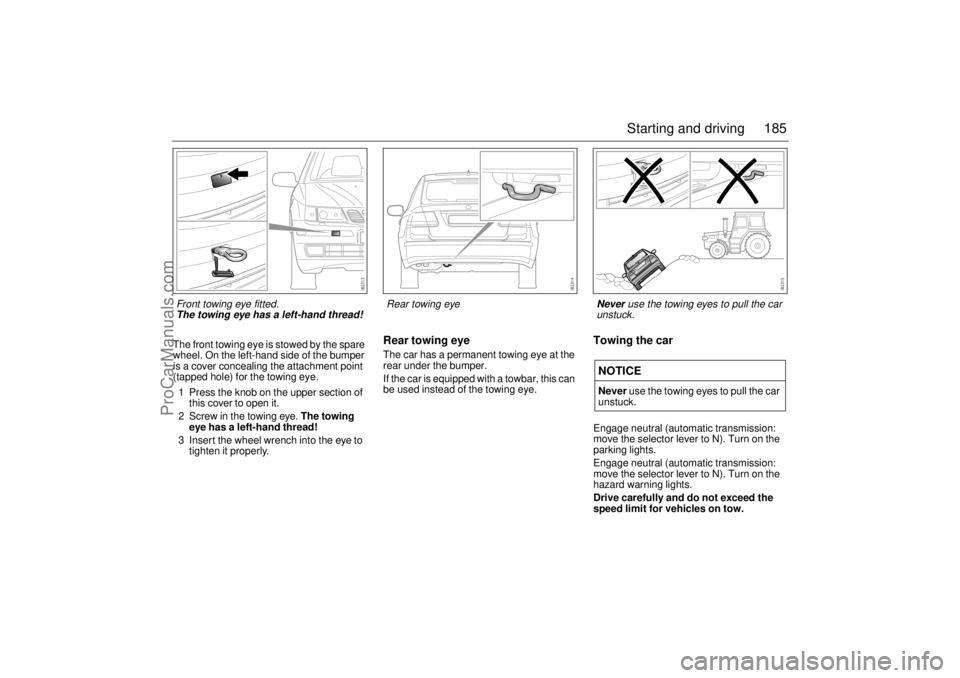
The front towing eye is stowed by the spare
wheel. On the left-hand side of the bumper
is a cover concealing the attachment point
(tapped hole) for the towing eye.
1 Press the knob on the upper section of
this cover to open it.
2 Screw in the towing eye. The towing
eye has a left-hand thread!
3 Insert the wheel wrench into the eye to
tighten it properly.
Rear towing eyeThe car has a permanent towing eye at the
rear under the bumper.
If the car is equipped with a towbar, this can
be used instead of the towing eye.
Towing the carEngage neutral (automatic transmission:
move the selector lever to N). Turn on the
parking lights.
Engage neutral (automatic transmission:
move the selector lever to N). Turn on the
hazard warning lights.
Drive carefully and do not exceed the
speed limit for vehicles on tow.NOTICENever use the towing eyes to pull the car
unstuck.
Front towing eye fitted.
The towing eye has a left-hand thread!
Rear towing eye
Never use the towing eyes to pull the car
unstuck.
ProCarManuals.com
Page 186 of 288
186 Starting and drivingAlways try to keep the towrope taut by
gently applying the brake of the car on tow,
as necessary. This will avoid the towrope
being jerked violently.
Cars with automatic transmission:
Always observe the speed limit for vehicles
on tow. Whatever the speed limit, the car
must not be towed at speeds exceeding
30 mph (50 km/h) nor for a distance of more
than 30 miles (50 km). If the car needs to be
transported over a longer distance, a tow
truck or flatbed truck must be called out.
The engine cannot be started by towing or
pushing the car. In an emergency, the
engine can be started as described under
"Jump starting" on page 187.
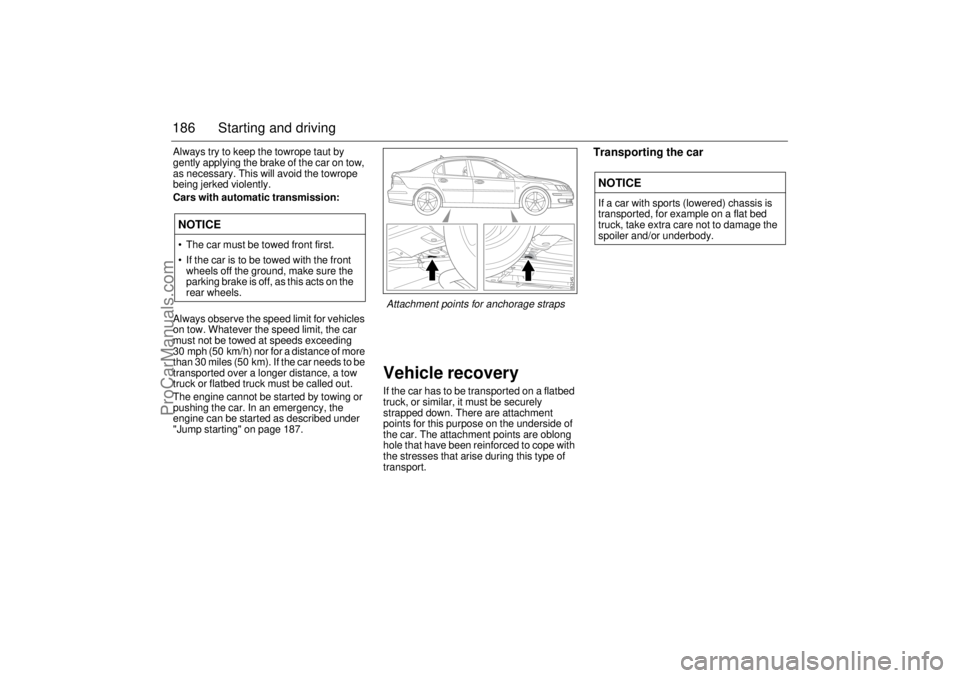
Vehicle recoveryIf the car has to be transported on a flatbed
truck, or similar, it must be securely
strapped down. There are attachment
points for this purpose on the underside of
the car. The attachment points are oblong
hole that have been reinforced to cope with
the stresses that arise during this type of
transport.
Transporting the car
NOTICE
The car must be towed front first.
If the car is to be towed with the front
wheels off the ground, make sure the
parking brake is off, as this acts on the
rear wheels.
NOTICEIf a car with sports (lowered) chassis is
transported, for example on a flat bed
truck, take extra care not to damage the
spoiler and/or underbody.
Attachment points for anchorage straps
ProCarManuals.com