automatic transmission SAAB 9-3 2004 Owner's Manual
[x] Cancel search | Manufacturer: SAAB, Model Year: 2004, Model line: 9-3, Model: SAAB 9-3 2004Pages: 288, PDF Size: 23.54 MB
Page 188 of 288
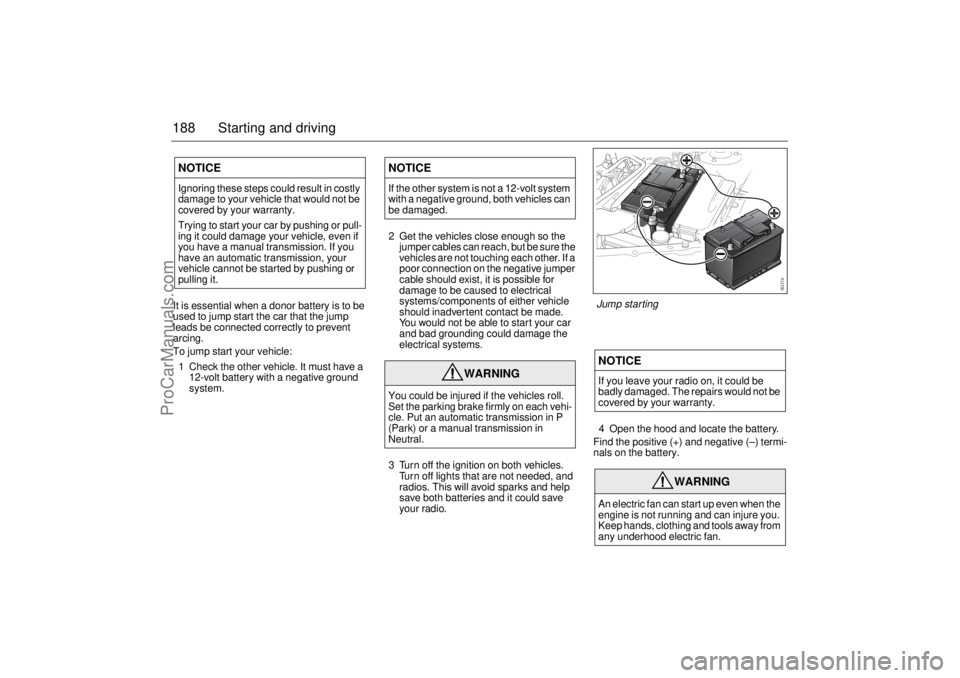
188 Starting and drivingIt is essential when a donor battery is to be
used to jump start the car that the jump
leads be connected correctly to prevent
arcing.
To jump start your vehicle:
1 Check the other vehicle. It must have a
12-volt battery with a negative ground
system.2 Get the vehicles close enough so the
jumper cables can reach, but be sure the
vehicles are not touching each other. If a
poor connection on the negative jumper
cable should exist, it is possible for
damage to be caused to electrical
systems/components of either vehicle
should inadvertent contact be made.
You would not be able to start your car
and bad grounding could damage the
electrical systems.
3 Turn off the ignition on both vehicles.
Turn off lights that are not needed, and
radios. This will avoid sparks and help
save both batteries and it could save
your radio.4 Open the hood and locate the battery.
Find the positive (+) and negative (–) termi-
nals on the battery.NOTICEIgnoring these steps could result in costly
damage to your vehicle that would not be
covered by your warranty.
Trying to start your car by pushing or pull-
ing it could damage your vehicle, even if
you have a manual transmission. If you
have an automatic transmission, your
vehicle cannot be started by pushing or
pulling it.
NOTICEIf the other system is not a 12-volt system
with a negative ground, both vehicles can
be damaged.
WARNING
You could be injured if the vehicles roll.
Set the parking brake firmly on each vehi-
cle. Put an automatic transmission in P
(Park) or a manual transmission in
Neutral.
NOTICEIf you leave your radio on, it could be
badly damaged. The repairs would not be
covered by your warranty.
WARNING
An electric fan can start up even when the
engine is not running and can injure you.
Keep hands, clothing and tools away from
any underhood electric fan.Jump starting
ProCarManuals.com
Page 191 of 288
191 Car care
Hood ________________ 192
Engine ______________ 193
Engine bay ___________ 195
Engine oil ____________ 196
Air filter______________ 198
Transmission fluid ____ 198
Coolant ______________ 199
Brake/clutch fluid and
brake pads__________ 200
Power steering________ 201
Battery ______________ 202
Drive belt ____________ 205
Wipers and washers ___ 206
Wiper blades _________ 206
Changing bulbs _______ 208 Fuses ________________ 222
Automatic tire pressure
monitoring __________ 229
Tires _________________ 231
Compact spare tire _____ 243
Changing a tire ________ 245
Safety belts ___________ 248
Upholstery and trim ____ 249
Textile carpeting _______ 249
Engine bay ____________ 249
Washing ______________ 250
Waxing and polishing ___ 251
Touching up the paint___ 251
Anti-corrosion treatment 253
Recovery and/or
recycling of automotive
materials ____________ 255
Air conditioning (A/C) ___ 255
Car care
ProCarManuals.com
Page 198 of 288
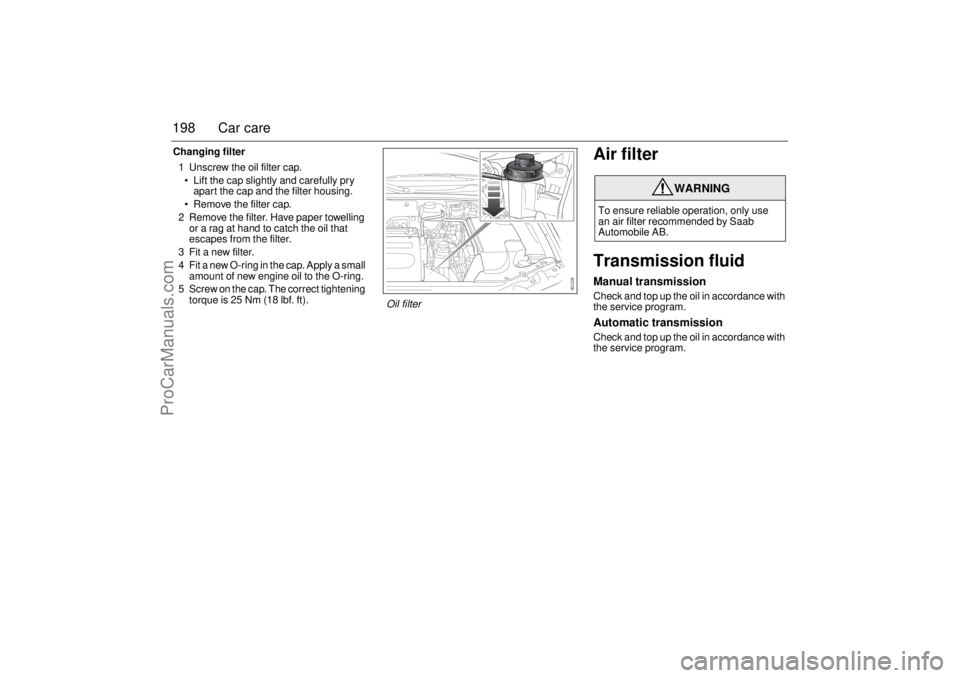
198 Car careChanging filter
1 Unscrew the oil filter cap.
Lift the cap slightly and carefully pry
apart the cap and the filter housing.
Remove the filter cap.
2 Remove the filter. Have paper towelling
or a rag at hand to catch the oil that
escapes from the filter.
3 Fit a new filter.
4 Fit a new O-ring in the cap. Apply a small
amount of new engine oil to the O-ring.
5 Screw on the cap. The correct tightening
torque is 25 Nm (18 lbf. ft).
Air filter
Transmission fluidManual transmissionCheck and top up the oil in accordance with
the service program.Automatic transmissionCheck and top up the oil in accordance with
the service program.
WARNING
To ensure reliable operation, only use
an air filter recommended by Saab
Automobile AB.
Oil filter
ProCarManuals.com
Page 224 of 288
224 Car care
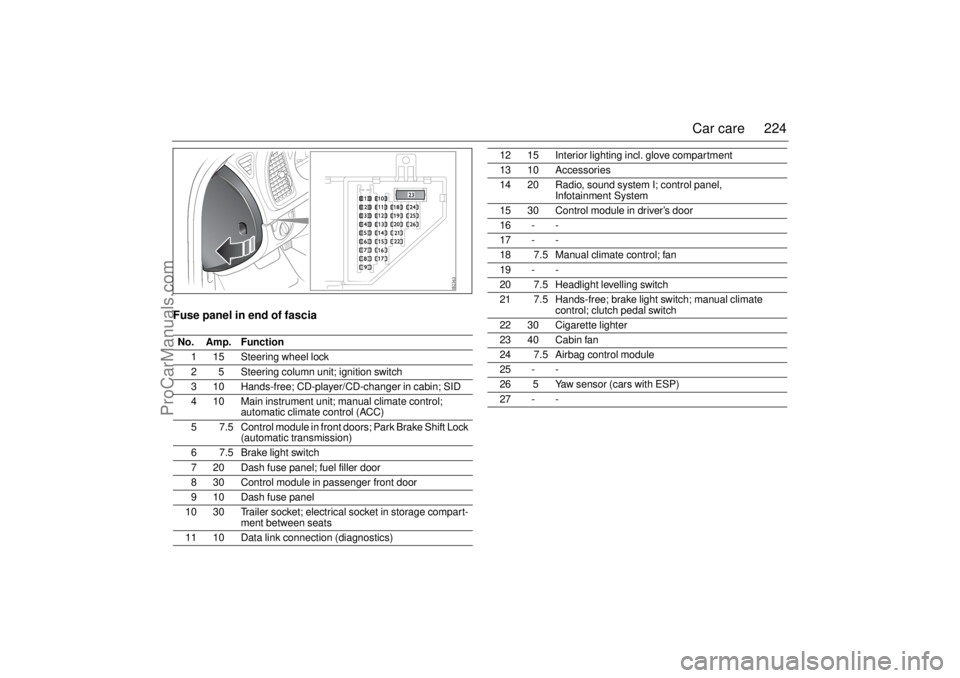
Fuse panel in end of fasciaNo. Amp. Function
1 15 Steering wheel lock
2 5 Steering column unit; ignition switch
3 10 Hands-free; CD-player/CD-changer in cabin; SID
4 10 Main instrument unit; manual climate control;
automatic climate control (ACC)
5 7.5 Control module in front doors; Park Brake Shift Lock
(automatic transmission)
6 7.5 Brake light switch
7 20 Dash fuse panel; fuel filler door
8 30 Control module in passenger front door
9 10 Dash fuse panel
10 30 Trailer socket; electrical socket in storage compart-
ment between seats
11 10 Data link connection (diagnostics)
12 15 Interior lighting incl. glove compartment
13 10 Accessories
14 20 Radio, sound system I; control panel,
Infotainment System
15 30 Control module in driver’s door
16 - -
17 - -
18 7.5 Manual climate control; fan
19 - -
20 7.5 Headlight levelling switch
21 7.5 Hands-free; brake light switch; manual climate
control; clutch pedal switch
22 30 Cigarette lighter
23 40 Cabin fan
24 7.5 Airbag control module
25 - -
26 5 Yaw sensor (cars with ESP)
27 - -
ProCarManuals.com
Page 227 of 288
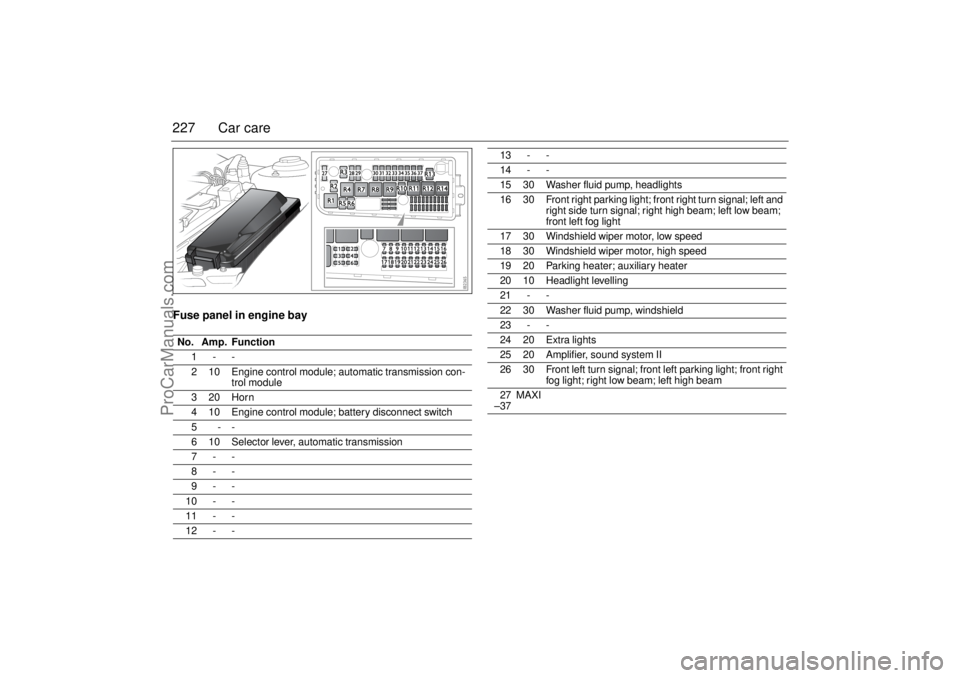
227 Car careFuse panel in engine bayNo. Amp. Function
1--
2 10 Engine control module; automatic transmission con-
trol module
320Horn
4 10 Engine control module; battery disconnect switch
5--
6 10 Selector lever, automatic transmission
7--
8--
9--
10 - -
11 - -
12 - -
13 - -
14 - -
15 30 Washer fluid pump, headlights
16 30 Front right parking light; front right turn signal; left and
right side turn signal; right high beam; left low beam;
front left fog light
17 30 Windshield wiper motor, low speed
18 30 Windshield wiper motor, high speed
19 20 Parking heater; auxiliary heater
20 10 Headlight levelling
21 - -
22 30 Washer fluid pump, windshield
23 - -
24 20 Extra lights
25 20 Amplifier, sound system II
26 30 Front left turn signal; front left parking light; front right
fog light; right low beam; left high beam
27
–37MAXI
ProCarManuals.com
Page 240 of 288
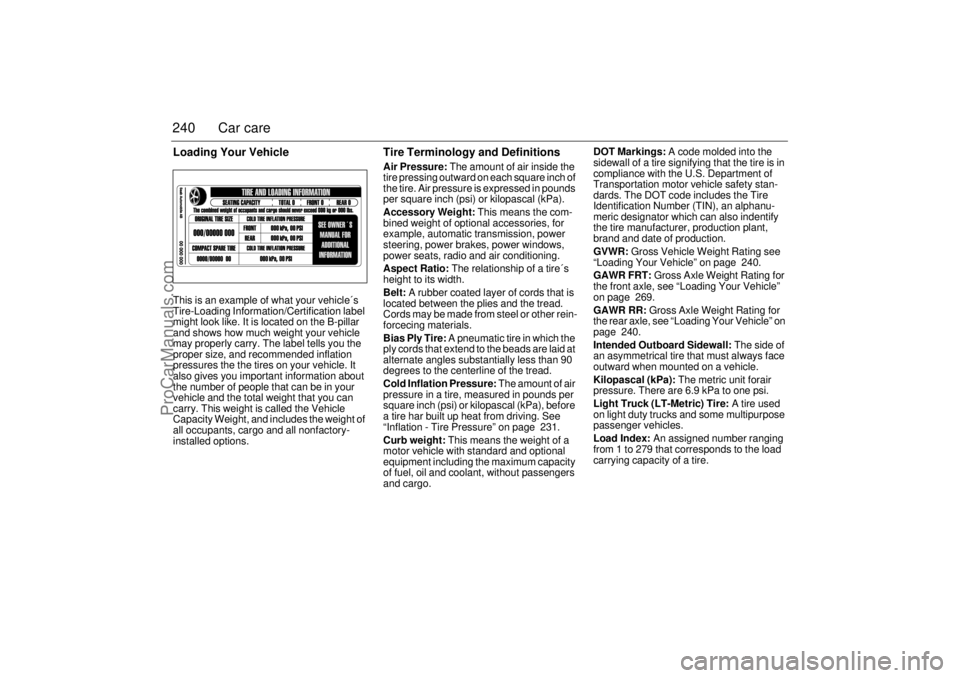
240 Car careLoading Your VehicleThis is an example of what your vehicle´s
Tire-Loading Information/Certification label
might look like. It is located on the B-pillar
and shows how much weight your vehicle
may properly carry. The label tells you the
proper size, and recommended inflation
pressures the the tires on your vehicle. It
also gives you important information about
the number of people that can be in your
vehicle and the total weight that you can
carry. This weight is called the Vehicle
Capacity Weight, and includes the weight of
all occupants, cargo and all nonfactory-
installed options.
Tire Terminology and DefinitionsAir Pressure: The amount of air inside the
tire pressing outward on each square inch of
the tire. Air pressure is expressed in pounds
per square inch (psi) or kilopascal (kPa).
Accessory Weight: This means the com-
bined weight of optional accessories, for
example, automatic transmission, power
steering, power brakes, power windows,
power seats, radio and air conditioning.
Aspect Ratio: The relationship of a tire´s
height to its width.
Belt: A rubber coated layer of cords that is
located between the plies and the tread.
Cords may be made from steel or other rein-
forcecing materials.
Bias Ply Tire: A pneumatic tire in which the
ply cords that extend to the beads are laid at
alternate angles substantially less than 90
degrees to the centerline of the tread.
Cold Inflation Pressure: The amount of air
pressure in a tire, measured in pounds per
square inch (psi) or kilopascal (kPa), before
a tire har built up heat from driving. See
“Inflation - Tire Pressure” on page 231.
Curb weight: This means the weight of a
motor vehicle with standard and optional
equipment including the maximum capacity
of fuel, oil and coolant, without passengers
and cargo.DOT Markings: A code molded into the
sidewall of a tire signifying that the tire is in
compliance with the U.S. Department of
Transportation motor vehicle safety stan-
dards. The DOT code includes the Tire
Identification Number (TIN), an alphanu-
meric designator which can also indentify
the tire manufacturer, production plant,
brand and date of production.
GVWR: Gross Vehicle Weight Rating see
“Loading Your Vehicle” on page 240.
GAWR FRT: Gross Axle Weight Rating for
the front axle, see “Loading Your Vehicle”
on page 269.
GAWR RR: Gross Axle Weight Rating for
the rear axle, see “Loading Your Vehicle” on
page 240.
Intended Outboard Sidewall: The side of
an asymmetrical tire that must always face
outward when mounted on a vehicle.
Kilopascal (kPa): The metric unit forair
pressure. There are 6.9 kPa to one psi.
Light Truck (LT-Metric) Tire: A tire used
on light duty trucks and some multipurpose
passenger vehicles.
Load Index: An assigned number ranging
from 1 to 279 that corresponds to the load
carrying capacity of a tire.
ProCarManuals.com
Page 245 of 288
245 Car care
Changing a tire
WARNING
The car jack is designed solely for use
in changing a tire or fitting snow
chains. It must not be used to
support the car during repair work
or servicing.
Never crawl under a car that is
supported only by a jack.
Special care must be taken if the car is
on a slope - use wedge-shaped wheel
chocks!
Position chocks, one ahead and one
behind, the wheel that is diagonally
opposite to the one to be changed.
Switch on the hazard warning lights if
the car is on a road.
Apply the parking brake and leave the
car in gear (1st or reverse). Automatic
transmission: move the selector lever
to the P position.
Ensure that everybody is out of the car
before jacking it up.
Never start the engine while the car is
jacked up.
If possible, make sure the jack is
standing on a firm, level surface.
The jack should be stored correctly
under the carpeting in the trunk. If it
lies loose in the car, it could thrown
forward and cause personal injury in
the event of a crash or if the car rolls
over.
Do not use the jack on a car other than
your Saab 9-3.
Grit, salt and rust can clog the inner
threads of the wheel bolts if the car has
been driven for several years exclu-
sively with alloy wheels.
If steel wheels are being installed, the
bolt hole threads in the brake hubs
should be cleaned before the thinner
steel wheels are fitted. It may other-
wise not be possible to achieve the
correct clamping force, despite tight-
ening the wheel bolts to the correct
torque.
WARNING
Changing a tire can cause an injury. The
vehicle can slip off the jack and roll over
you or other people. You and they could
be badly injured. Find a level place to
change your tire. To help prevent the
vehicle from moving:
1 Set the parking brake firmly.
2 Put the shift lever in PARK (P) (auto-
matic transmission;
engage 1st gear (manual transmis-
sion).
3 Turn off the engine.
To be even more certain the vehicle won’t
move, you can put blocks at the front and
rear of the tire farthest away from the one
being changed. That would be the tire on
the other side of the vehicle, at the oppo-
site end.
ProCarManuals.com
Page 263 of 288

263 Customer Assistance and Information
Engine oil and filter changesChanging the engine oil and filter is required
at every service point. Use only a Saab
approved long-life oil filter and engine oils
meeting the SAE viscosity ratings and API
service classifications stated in the “Techni-
cal data” section of this Owner’s Manual.
The use of extra additives in the oil is not
necessary and is not recommended, and
may be harmful to turbochargers.
More frequent oil changes are recom-
mended if your vehicle is operated under
any of the following conditions:
Most trips are less than 5–10 miles (8–
16 km). This is particularly important
when outside temperatures are below
freezing.
Most trips include extensive idling
(frequent stop-and-go traffic).
Most trips are through dusty areas (such
as construction zones).
If the vehicle is used for delivery service,
police, taxi or other commercial applica-
tions.
If your driving habits match this description,
have the engine oil and filter changed in-
between normal services. These conditions
cause the engine oil to break down faster.
The Warranties and Service Record Book-
let has provisions to record extra oil
changes.
Service record retentionIt is the owner’s responsibility to retain ser-
vice records. If possible, you should keep
copies of all shop work orders for all service
and repairs, whenever performed. As indi-
cated in the new car and emission control
system warranties, it is important to docu-
ment that all necessary maintenance has
been done.
HOW THE SERVICE RECORD IS ORGA-
NIZED
The service record is comprised of a series
of coupons on which to record services as
they are performed. There are additional
coupons for documenting extra engine oil
and filter changes, extra automatic trans-
mission fluid services necessary for severe
service conditions, and brake fluid changes.
HOW TO USE THE SERVICE RECORD
COUPONS
When the car is brought to a Saab dealer for
scheduled maintenance, present the War-
ranties & Service Record Booklet to the ser-
vice manager. When the technician has
completed the service, the technician will
sign the maintenance record. The person
responsible for quality assurance at the
dealership will also sign and stamp the
record with the dealer identification stamp.
Service costsDealer pricing practices and labor for ser-
vice work vary. Saab’s recommended ser-
vice times for each service point do not
include the labor required to replace wear
items, such as wiper blades, brake pads or
tires. Nor is labor to perform other service or
repairs found to be necessary as a result of
the inspections included in these times.
Additional labor and parts will be charged
for such work when necessary, except as
covered under an applicable Saab warranty
or any optional extended service contract.
Transmission fluid changes or suspension
alignment, when necessary, are also addi-
tional.
Dealer charges for general shop material,
regulated hazardous waste removal, recy-
cling expenses or other operation costs may
also be applied to service and repair
invoices and are apt to vary by dealer and
location.
ProCarManuals.com
Page 267 of 288
267 Technical data
General data __________ 268
Engine _______________ 270
Engine oil _____________ 270
Fuel__________________ 271
Engines ______________ 271
Electrical system_______ 272
Drive belt _____________ 272
Manual transmission ___ 272
Automatic transmission _ 273
Suspension ___________ 273
Steering ______________ 273
Brake system__________ 274
Wheels and tires _______ 275
Plates and labels _______ 278
Technical data
ProCarManuals.com
Page 273 of 288

273 Technical data
Automatic transmission Suspension
SteeringType _____________________________ Electronically con-
trolled, 5-speed,
fully-automatic with
hydraulic torque
converter, planetary
gears and integral
final drive.
Lock-up function in
selector positions 3,
4 and 5.
Selector lever positions _______________ P, R, N, D, M
Oil capacity, total ____________________ 7.6 qts. (7.2 litres)
Oil type ___________________________ Saab 3309
Clutch type ________________________ Hydraulic plate
clutches, brake
bands and one-way
couplings
Speed (mph/km/h) at 1000 rpm in top gear:
2.0t and 2.0T _____________________ 28–30/46–49Spring type, front and rear ____________ Coil springs
Maximum deflection of springs:
Front ____________________________ 7.0'' (178 mm)
Rear ____________________________ 8.3'' (212 mm)
Dampers, front and rear ______________ Gas-filled dampers
Steering __________________________ Power-assisted
steering gear of
rack-pinion type and
telescopic jointed
steering column
Number of turns, lock to lock___________ 3.0
Oil type ___________________________ Power steering fluid
CHF 11S
ProCarManuals.com