automatic transmission SAAB 9-3 2004 Owners Manual
[x] Cancel search | Manufacturer: SAAB, Model Year: 2004, Model line: 9-3, Model: SAAB 9-3 2004Pages: 288, PDF Size: 23.54 MB
Page 5 of 288
5
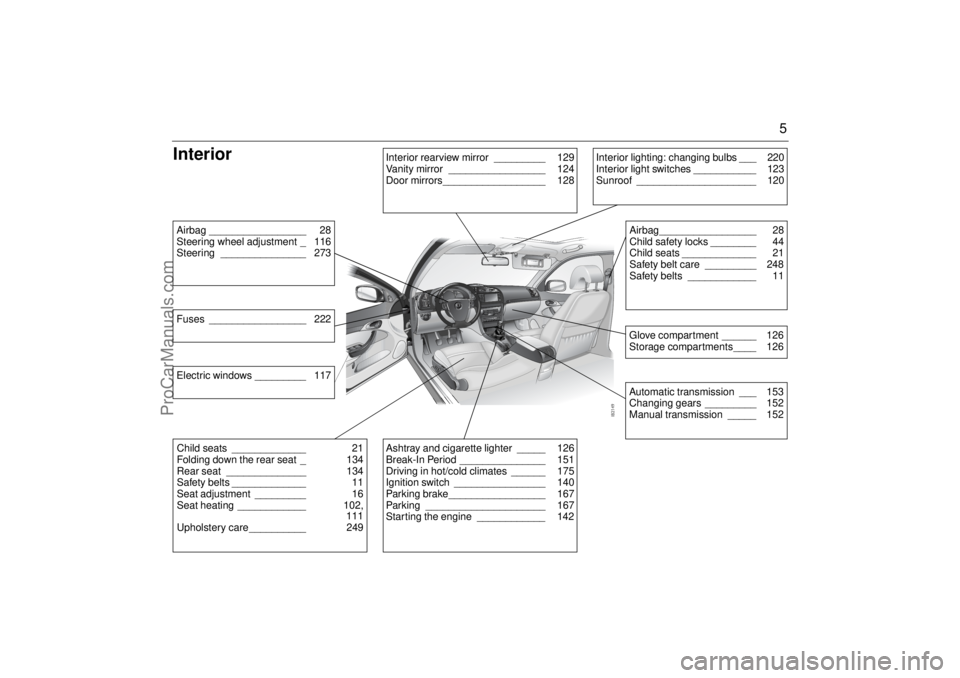
InteriorAirbag _________________ 28
Steering wheel adjustment _ 116
Steering _______________ 273
Interior rearview mirror _________ 129
Vanity mirror _________________ 124
Door mirrors__________________ 128
Airbag_________________ 28
Child safety locks ________ 44
Child seats _____________ 21
Safety belt care _________ 248
Safety belts ____________ 11Glove compartment ______ 126
Storage compartments____ 126Automatic transmission ___ 153
Changing gears _________ 152
Manual transmission _____ 152
Child seats _____________ 21
Folding down the rear seat _ 134
Rear seat ______________ 134
Safety belts _____________ 11
Seat adjustment _________ 16
Seat heating ____________ 102,
111
Upholstery care__________ 249
Interior lighting: changing bulbs ___ 220
Interior light switches ___________ 123
Sunroof _____________________ 120
Ashtray and cigarette lighter _____ 126
Break-In Period _______________ 151
Driving in hot/cold climates ______ 175
Ignition switch ________________ 140
Parking brake_________________ 167
Parking _____________________ 167
Starting the engine ____________ 142
Fuses _________________ 222Electric windows _________ 117
ProCarManuals.com
Page 6 of 288
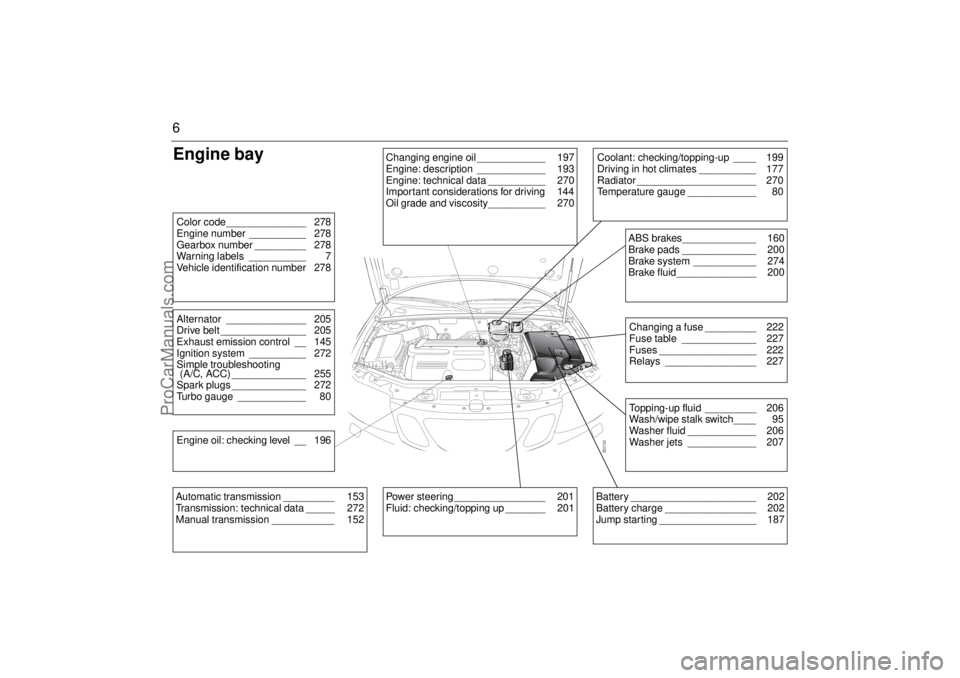
6Engine bayColor code______________ 278
Engine number __________ 278
Gearbox number _________ 278
Warning labels __________ 7
Vehicle identification number 278Alternator ______________ 205
Drive belt _______________ 205
Exhaust emission control __ 145
Ignition system __________ 272
Simple troubleshooting
(A/C, ACC) _____________ 255
Spark plugs _____________ 272
Turbo gauge ____________ 80Engine oil: checking level __ 196Automatic transmission _________ 153
Transmission: technical data _____ 272
Manual transmission ___________ 152
Battery ______________________ 202
Battery charge ________________ 202
Jump starting _________________ 187
Changing engine oil ____________ 197
Engine: description ____________ 193
Engine: technical data __________ 270
Important considerations for driving 144
Oil grade and viscosity__________ 270
Topping-up fluid _________ 206
Wash/wipe stalk switch____ 95
Washer fluid ____________ 206
Washer jets ____________ 207
Power steering ________________ 201
Fluid: checking/topping up _______ 201
Coolant: checking/topping-up ____ 199
Driving in hot climates __________ 177
Radiator _____________________ 270
Temperature gauge ____________ 80
Changing a fuse _________ 222
Fuse table _____________ 227
Fuses _________________ 222
Relays ________________ 227ABS brakes_____________ 160
Brake pads _____________ 200
Brake system ___________ 274
Brake fluid______________ 200
ProCarManuals.com
Page 79 of 288
79 Instruments and controls
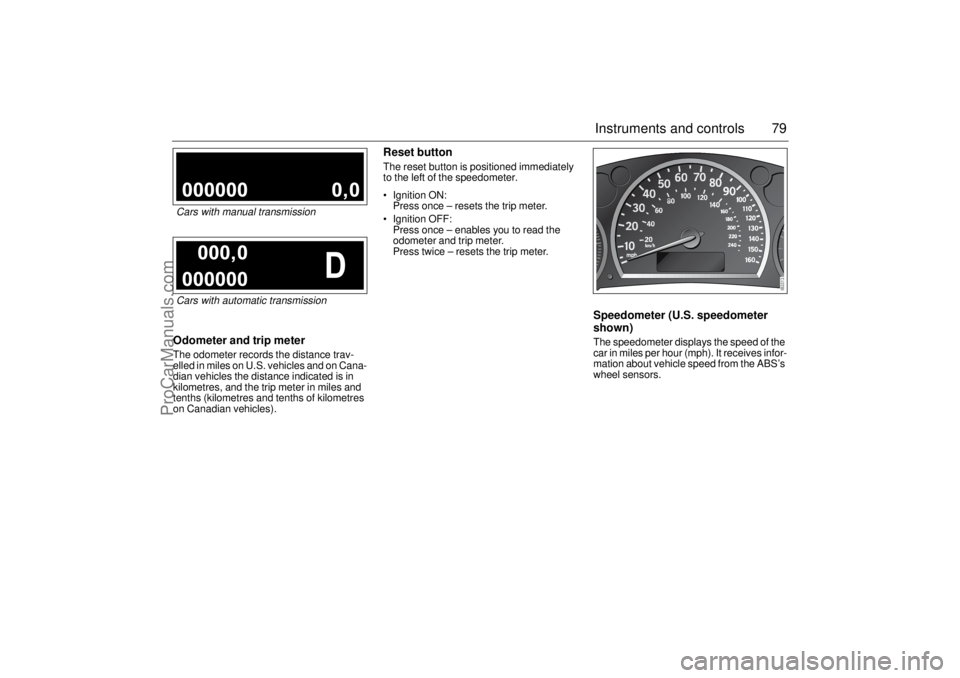
Odometer and trip meterThe odometer records the distance trav-
elled in miles on U.S. vehicles and on Cana-
dian vehicles the distance indicated is in
kilometres, and the trip meter in miles and
tenths (kilometres and tenths of kilometres
on Canadian vehicles).
Reset buttonThe reset button is positioned immediately
to the left of the speedometer.
Ignition ON:
Press once – resets the trip meter.
Ignition OFF:
Press once – enables you to read the
odometer and trip meter.
Press twice – resets the trip meter.
Speedometer (U.S. speedometer
shown)The speedometer displays the speed of the
car in miles per hour (mph). It receives infor-
mation about vehicle speed from the ABS’s
wheel sensors.
Cars with manual transmissionCars with automatic transmission
ProCarManuals.com
Page 81 of 288
81 Instruments and controls
If the needle repeatedly enters the red zone
and the engine at the same time loses
power, because the monitoring system is
limiting the boost pressure, you should
contact a Saab dealer as soon as possible.
When the speed of the car exceeds
143 mph (230 km/h), acceleration is limited
by reducing the boost pressure. The pres-
sure gauge then moves towards the middle
of the white field, indicating a drop in engine
power and consequently the car’s speed.
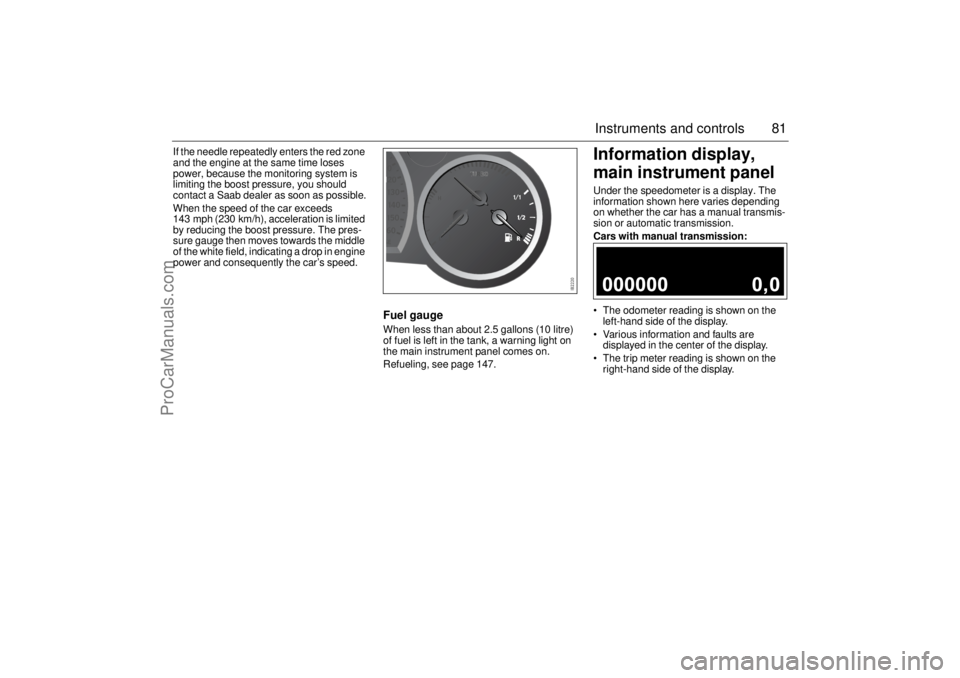
Fuel gaugeWhen less than about 2.5 gallons (10 litre)
of fuel is left in the tank, a warning light on
the main instrument panel comes on.
Refueling, see page 147.
Information display,
main instrument panelUnder the speedometer is a display. The
information shown here varies depending
on whether the car has a manual transmis-
sion or automatic transmission.
Cars with manual transmission:
The odometer reading is shown on the
left-hand side of the display.
Various information and faults are
displayed in the center of the display.
The trip meter reading is shown on the
right-hand side of the display.
ProCarManuals.com
Page 82 of 288
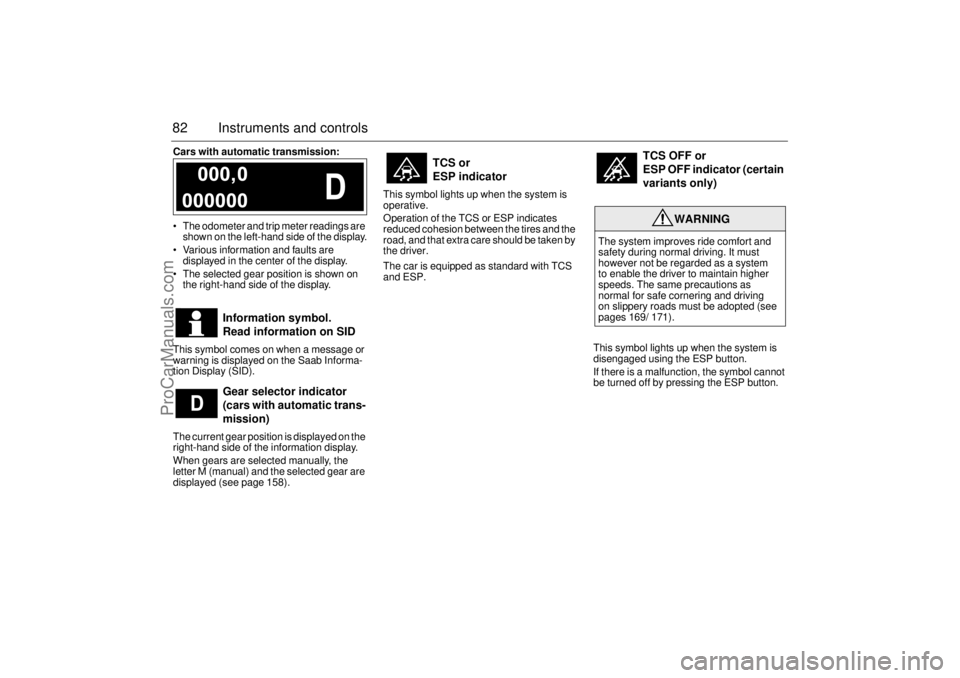
82 Instruments and controlsCars with automatic transmission:
The odometer and trip meter readings are
shown on the left-hand side of the display.
Various information and faults are
displayed in the center of the display.
The selected gear position is shown on
the right-hand side of the display.
This symbol comes on when a message or
warning is displayed on the Saab Informa-
tion Display (SID).
The current gear position is displayed on the
right-hand side of the information display.
When gears are selected manually, the
letter M (manual) and the selected gear are
displayed (see page 158).This symbol lights up when the system is
operative.
Operation of the TCS or ESP indicates
reduced cohesion between the tires and the
road, and that extra care should be taken by
the driver.
The car is equipped as standard with TCS
and ESP.
This symbol lights up when the system is
disengaged using the ESP button.
If there is a malfunction, the symbol cannot
be turned off by pressing the ESP button.
Information symbol.
Read information on SID
Gear selector indicator
(cars with automatic trans-
mission)
TCS or
ESP indicator
TCS OFF or
ESP OFF indicator (certain
variants only)
WARNING
The system improves ride comfort and
safety during normal driving. It must
however not be regarded as a system
to enable the driver to maintain higher
speeds. The same precautions as
normal for safe cornering and driving
on slippery roads must be adopted (see
pages 169/ 171).
ProCarManuals.com
Page 139 of 288
139 Starting and driving
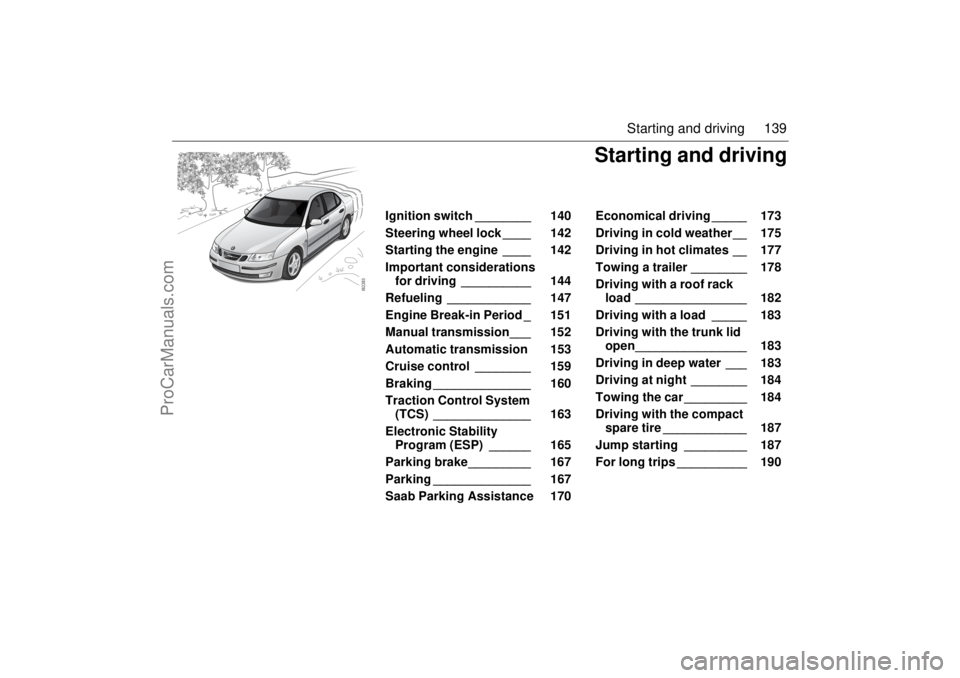
Ignition switch ________ 140
Steering wheel lock ____ 142
Starting the engine ____ 142
Important considerations
for driving __________ 144
Refueling ____________ 147
Engine Break-in Period _ 151
Manual transmission___ 152
Automatic transmission 153
Cruise control ________ 159
Braking ______________ 160
Traction Control System
(TCS) ______________ 163
Electronic Stability
Program (ESP) ______ 165
Parking brake_________ 167
Parking ______________ 167
Saab Parking Assistance 170 Economical driving _____ 173
Driving in cold weather__ 175
Driving in hot climates __ 177
Towing a trailer ________ 178
Driving with a roof rack
load ________________ 182
Driving with a load _____ 183
Driving with the trunk lid
open________________ 183
Driving in deep water ___ 183
Driving at night ________ 184
Towing the car _________ 184
Driving with the compact
spare tire ____________ 187
Jump starting _________ 187
For long trips __________ 190
Starting and driving
ProCarManuals.com
Page 140 of 288
140 Starting and drivingIgnition switchThe ignition switch is located on the center
console between the front seats. In cars
with automatic transmission, the remote
control can only be removed when the
selector lever is in position P.NOTICETake care not to spill drinks or to drop
crumbs over the ignition switch. If dirt or
liquid gets into it, the switch may not
operate properly.
If snow from clothing falls into the ignition
switch and melts, the ignition switch can
seize (freeze). Brush snow off clothing
before getting into the car.
WARNING
• Always remove the remote control
before leaving children unattended in
the car.
Apply the parking brake before remov-
ing the remote control.
Never remove the remote control
while the car is moving. This will acti-
vate the steering wheel lock and make
it impossible to steer the car.
ProCarManuals.com
Page 141 of 288

141 Starting and driving
To allow the various systems in the car time
to register that the remote control has been
inserted into the ignition switch, do not turn
the remote control for roughly half a second. LOCK position
The position lights, hazard warning lights and interior lighting can be
turned on.
Cars with automatic transmission: Move the gear lever to P.
The gear lever is locked in position. This is the only position in which the
remote control can be removed.
Cars with manual transmission: The remote control can be removed
regardless of the position of the gear lever.
OFF position
Parts of the electrical system are operative.
Do not leave the remote control in the OFF position with the engine
not running as this could cause the battery to run flat in a matter of
hours.
Cars with automatic transmission: The gear lever is not locked. See
also page 154.
ON position
The entire electrical system is operative.
Do not leave the remote control in the ON position when the engine
is not running.
Turn the remote control to the OFF position to disconnect the electrical
system.
When you turn the remote control to ON, some indicator and warning lights
will come on in the main instrument panel. These should go out after about
3 seconds.
ST - starter position
The starter motor operates (automatic transmission: selector lever must
be in P or N) when the remote control is turned to this position. When
released, the remote control will spring back to the ON position.
The car has an electronic restart lock. If the engine fails to start, the remote
control must first be turned back to a position between OFF and LOCK
before the starter motor can be operated again.
ProCarManuals.com
Page 142 of 288
142 Starting and drivingSteering wheel lockThe steering wheel lock is electronic. The
lock engages when the remote control is
removed from the ignition and unlocks when
the remote control is inserted. A click can be
heard when the steering wheel lock locks
and unlocks.
If the car is parked with one front wheel
touching the curb, for example, you may
need to turn the steering wheel slightly
when you insert the remote control to allow
the steering wheel lock to unlock. If you do
not succeed on first attempt you must
remove the remote control before trying
again. Turn the steering wheel and insert
the remote control into the ignition switch.
If the steering wheel lock does not disen-
gage it will not be possible to turn the remote
control in the ignition switch.
The following message is shown on the SID:If a fault arises affecting the steering wheel
lock, the following message will be
displayed on the SID:
If the steering wheel lock malfunctions while
the remote control is in the ignition switch,
this may prevent the removal of the remote
control or prevent the car from being
restarted once the engine has been
switched off.
If you have to leave the car, lock the car by
pressing down the lock buttons on the
doors. Lock the front left door from outside
with the traditional key (see page 42). The
car is now locked but the alarm is inactive.
Starting the engine
Steering wheel locked.
Pull out key, turn steering
wheel. Try again.
Steering lock malfunc.
Make a safe stop.
Contact Saab dealer.
WARNING
When starting the engine:
- Sit down in the driver’s seat.
- Depress the clutch pedal fully. If the
gear lever is not in the neutral position,
the clutch pedal must be fully
depressed or the car will jump
forwards or backwards, which may
cause a crash.
- Never start the car from outside the
vehicle, e.g. through a window that is
down. This could lead to serious
personal injury.
Cars with automatic transmission:
select position P to remove the ignition
key. The key can only be removed in
this gear position.
Carbon monoxide (CO) is a colorless,
odorless, poisonous gas. Be alert to
the danger of CO – always open the
garage doors before starting the
engine in the garage.
Do not rest or sleep in the car when
parked with the engine running. There
is a risk of depressing the accelerator
which could lead to engine damage.
There is also a danger of CO poison-
ing if the exhaust system is leaking.
ProCarManuals.com
Page 143 of 288

143 Starting and driving
Starting the engineAvoid racing the engine or loading it heavily
before it has warmed up. Do not drive away
before the warning and indicator lights have
gone out.
The engine has an automatic choke and
should be started as follows:
Cars with manual transmission
To start the engine the clutch pedal must
be fully depressed.
1 Make sure the parking brake is applied.
2 Depress the clutch pedal but do not
touch the accelerator.
3 Start the engine. Let the remote control
spring back as soon as the engine has
started and is running smoothly.
Allow the engine to idle for about
10 seconds. Do not apply full throttle for at
least 3 minutes after starting.Cars with automatic transmission
The selector lever must be in the P or N
position.
1 The selector lever must be in the P or N
position.
2 Keep your foot on the brake pedal.
Note! Once the engine has started, the
brake pedal will sink. This is perfectly
normal.
3 Start the engine. Let the remote control
spring back as soon as the engine has
started and is running smoothly.
Allow the engine to idle for about
10 seconds. Do not apply full throttle for at
least 3 minutes after starting.
Useful tips on starting the engineIf the engine has failed to start after several
attempts in very cold weather, proceed as
follows:
1 Turn the ignition switch to ON (it is
essential that you turn the ignition to
ON before depressing the accelerator).
2 Press the accelerator to the floor and run
the starter motor for 5-10 seconds. This
will prevent the engine being flooded
(fully depressed accelerator cuts off the
fuel supply).
3 Now start the engine in the normal way
- do not touch the accelerator.
If the engine stalls immediately after starting
(e.g. if the clutch was released too quickly),
do not touch the accelerator when restarting
the engine.
ProCarManuals.com