engine SAAB 9-3 2004 Owner's Manual
[x] Cancel search | Manufacturer: SAAB, Model Year: 2004, Model line: 9-3, Model: SAAB 9-3 2004Pages: 288, PDF Size: 23.54 MB
Page 94 of 288
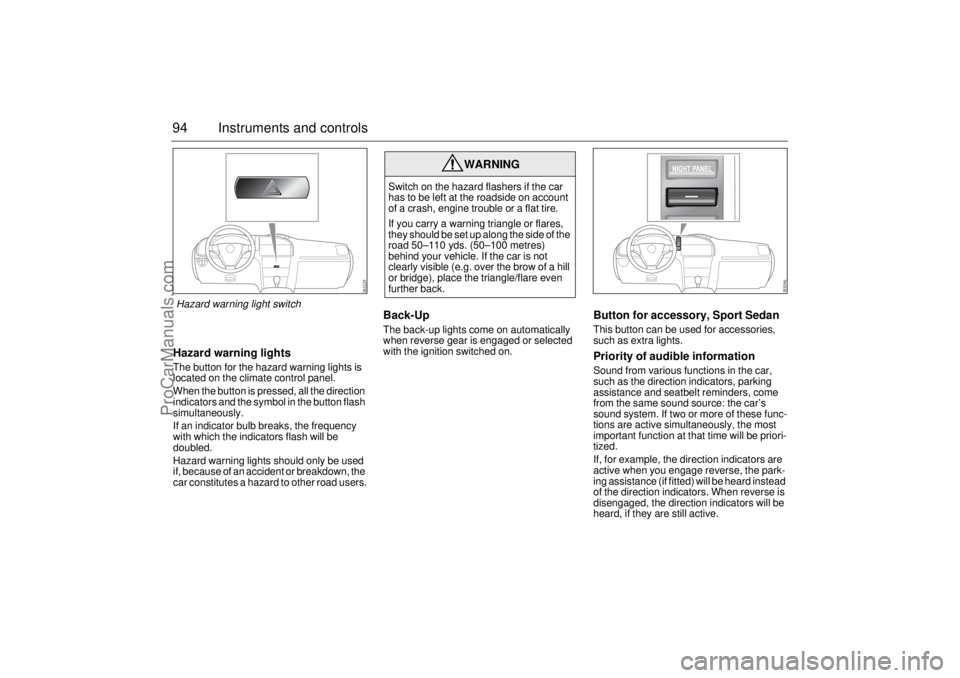
94 Instruments and controlsHazard warning lightsThe button for the hazard warning lights is
located on the climate control panel.
When the button is pressed, all the direction
indicators and the symbol in the button flash
simultaneously.
If an indicator bulb breaks, the frequency
with which the indicators flash will be
doubled.
Hazard warning lights should only be used
if, because of an accident or breakdown, the
car constitutes a hazard to other road users.
Back-Up The back-up lights come on automatically
when reverse gear is engaged or selected
with the ignition switched on.
Button for accessory, Sport SedanThis button can be used for accessories,
such as extra lights.Priority of audible informationSound from various functions in the car,
such as the direction indicators, parking
assistance and seatbelt reminders, come
from the same sound source: the car’s
sound system. If two or more of these func-
tions are active simultaneously, the most
important function at that time will be priori-
tized.
If, for example, the direction indicators are
active when you engage reverse, the park-
ing assistance (if fitted) will be heard instead
of the direction indicators. When reverse is
disengaged, the direction indicators will be
heard, if they are still active.
WARNING
Switch on the hazard flashers if the car
has to be left at the roadside on account
of a crash, engine trouble or a flat tire.
If you carry a warning triangle or flares,
they should be set up along the side of the
road 50–110 yds. (50–100 metres)
behind your vehicle. If the car is not
clearly visible (e.g. over the brow of a hill
or bridge), place the triangle/flare even
further back.
Hazard warning light switch
ProCarManuals.com
Page 95 of 288
95 Instruments and controls
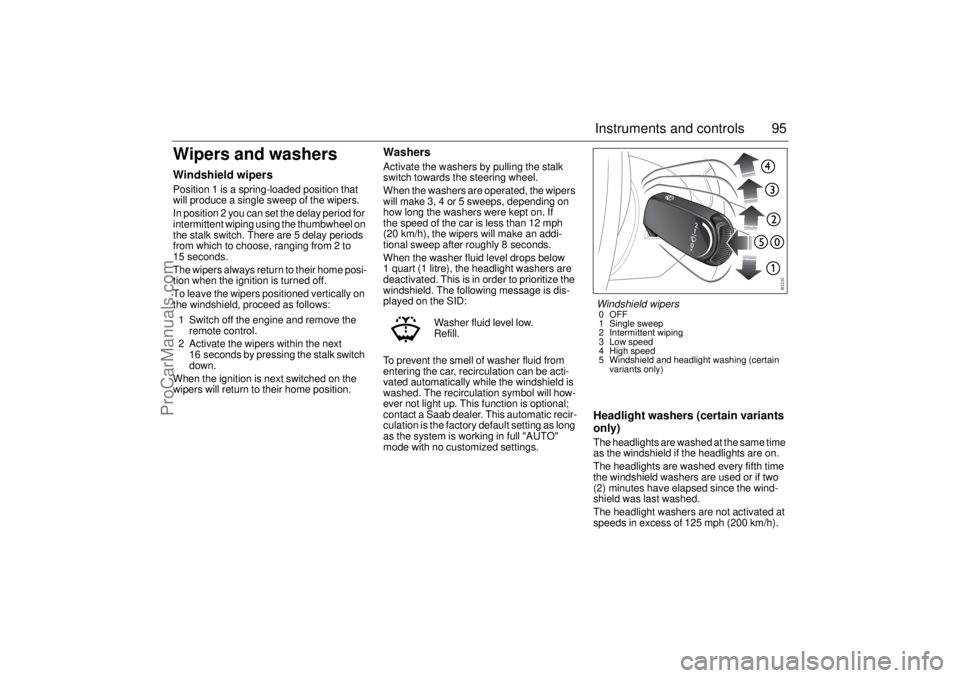
Wipers and washersWindshield wipersPosition 1 is a spring-loaded position that
will produce a single sweep of the wipers.
In position 2 you can set the delay period for
intermittent wiping using the thumbwheel on
the stalk switch. There are 5 delay periods
from which to choose, ranging from 2 to
15 seconds.
The wipers always return to their home posi-
tion when the ignition is turned off.
To leave the wipers positioned vertically on
the windshield, proceed as follows:
1 Switch off the engine and remove the
remote control.
2 Activate the wipers within the next
16 seconds by pressing the stalk switch
down.
When the ignition is next switched on the
wipers will return to their home position.
WashersActivate the washers by pulling the stalk
switch towards the steering wheel.
When the washers are operated, the wipers
will make 3, 4 or 5 sweeps, depending on
how long the washers were kept on. If
the speed of the car is less than 12 mph
(20 km/h), the wipers will make an addi-
tional sweep after roughly 8 seconds.
When the washer fluid level drops below
1 quart (1 litre), the headlight washers are
deactivated. This is in order to prioritize the
windshield. The following message is dis-
played on the SID:
To prevent the smell of washer fluid from
entering the car, recirculation can be acti-
vated automatically while the windshield is
washed. The recirculation symbol will how-
ever not light up. This function is optional;
contact a Saab dealer. This automatic recir-
culation is the factory default setting as long
as the system is working in full "AUTO"
mode with no customized settings.
Headlight washers (certain variants
only)The headlights are washed at the same time
as the windshield if the headlights are on.
The headlights are washed every fifth time
the windshield washers are used or if two
(2) minutes have elapsed since the wind-
shield was last washed.
The headlight washers are not activated at
speeds in excess of 125 mph (200 km/h). Washer fluid level low.
Refill.Windshield wipers0OFF
1 Single sweep
2 Intermittent wiping
3 Low speed
4 High speed
5 Windshield and headlight washing (certain
variants only)
ProCarManuals.com
Page 96 of 288
96 Instruments and controls
Rain sensor (option)The rain sensor automatically controls the
windshield wipers. The sensor is located on
the windshield beside the rearview mirror.
The system varies the frequency of wiping
between single sweeps and continuous
wiping, depending on the amount of pre-
cipitation.
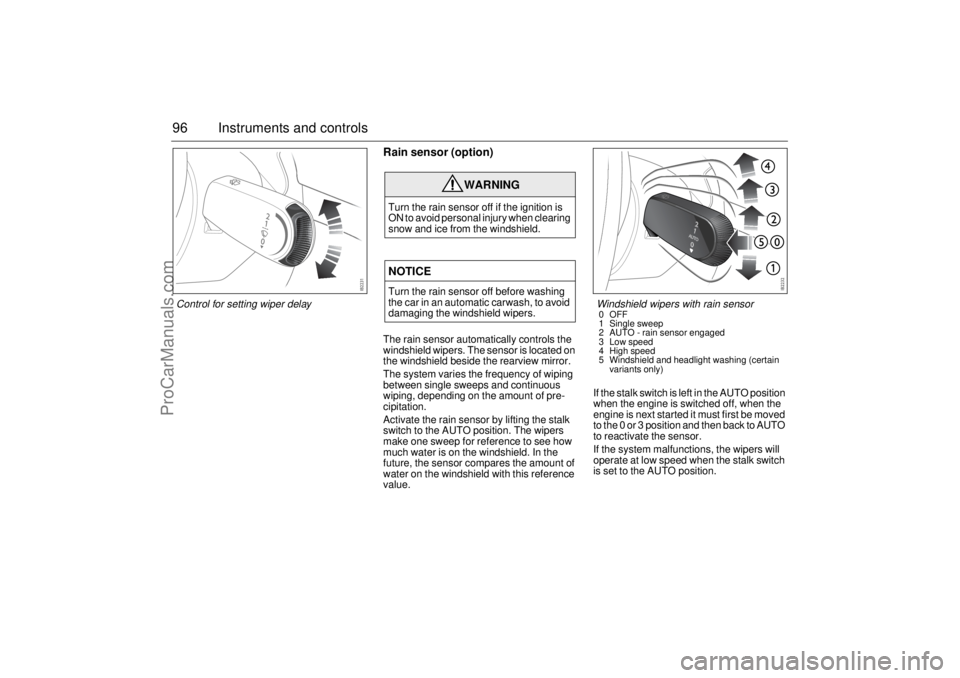
Activate the rain sensor by lifting the stalk
switch to the AUTO position. The wipers
make one sweep for reference to see how
much water is on the windshield. In the
future, the sensor compares the amount of
water on the windshield with this reference
value.If the stalk switch is left in the AUTO position
when the engine is switched off, when the
engine is next started it must first be moved
to the 0 or 3 position and then back to AUTO
to reactivate the sensor.
If the system malfunctions, the wipers will
operate at low speed when the stalk switch
is set to the AUTO position.
WARNING
Turn the rain sensor off if the ignition is
ON to avoid personal injury when clearing
snow and ice from the windshield.NOTICETurn the rain sensor off before washing
the car in an automatic carwash, to avoid
damaging the windshield wipers.
Control for setting wiper delay
Windshield wipers with rain sensor0OFF
1 Single sweep
2 AUTO - rain sensor engaged
3 Low speed
4 High speed
5 Windshield and headlight washing (certain
variants only)
ProCarManuals.com
Page 99 of 288

99 Instruments and controls
Air distributionThe air distribution control is used to direct the flow of air to the
defroster, panel and floor vents.
The control also permits settings in between the three main settings
defroster, panel and floor:
defroster and floor
panel and floor
defroster, panel and floor (11 o’clock position)
To counter cold drafts from the front side windows when the control
has been set to defroster or floor, a small flow of air issues from
the outer vents on the fascia.
As the winter comfort setting, we recommend that the distribution
knob be turned to .
Recommended settings in severe coldOn starting with a cold engine, set the fan speed to 2 or 3 and select
maximum heat and defroster to heat the cabin and demist the wind-
shield as quickly as possible.
When the engine is warmer and the temperature gauge starts to
rise, fan setting 4 may be chosen. Once the windshield is clear, the
air distribution control should be turned to .
If the rear seat passengers desire more warmth to the feet, turn the
distribution knob one step clockwise.
How quickly the engine warms up will depend on how the car is
driven. It will take longer for the engine to warm up if the car is driven
in a high gear at low engine speeds, such as in town, than if it is
driven at high engine speeds on a highway, for example.
Do not use fan speed 5. This is primarily intended for rapid cooling
during the summer.
ProCarManuals.com
Page 101 of 288
101 Instruments and controls
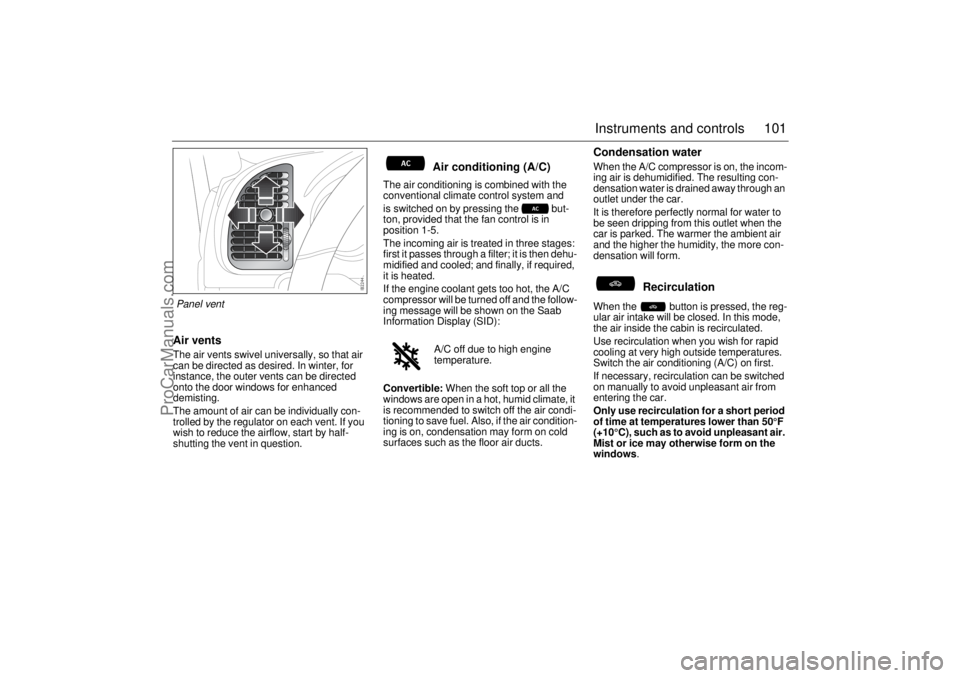
Air ventsThe air vents swivel universally, so that air
can be directed as desired. In winter, for
instance, the outer vents can be directed
onto the door windows for enhanced
demisting.
The amount of air can be individually con-
trolled by the regulator on each vent. If you
wish to reduce the airflow, start by half-
shutting the vent in question.The air conditioning is combined with the
conventional climate control system and
is switched on by pressing the but-
ton, provided that the fan control is in
position 1-5.
The incoming air is treated in three stages:
first it passes through a filter; it is then dehu-
midified and cooled; and finally, if required,
it is heated.
If the engine coolant gets too hot, the A/C
compressor will be turned off and the follow-
ing message will be shown on the Saab
Information Display (SID):
Convertible: When the soft top or all the
windows are open in a hot, humid climate, it
is recommended to switch off the air condi-
tioning to save fuel. Also, if the air condition-
ing is on, condensation may form on cold
surfaces such as the floor air ducts.
Condensation waterWhen the A/C compressor is on, the incom-
ing air is dehumidified. The resulting con-
densation water is drained away through an
outlet under the car.
It is therefore perfectly normal for water to
be seen dripping from this outlet when the
car is parked. The warmer the ambient air
and the higher the humidity, the more con-
densation will form.
When the button is pressed, the reg-
ular air intake will be closed. In this mode,
the air inside the cabin is recirculated.
Use recirculation when you wish for rapid
cooling at very high outside temperatures.
Switch the air conditioning (A/C) on first.
If necessary, recirculation can be switched
on manually to avoid unpleasant air from
entering the car.
Only use recirculation for a short period
of time at temperatures lower than 50°F
(+10°C), such as to avoid unpleasant air.
Mist or ice may otherwise form on the
windows.
Air conditioning (A/C)A/C off due to high engine
temperature.
Recirculation
Panel vent
ProCarManuals.com
Page 106 of 288
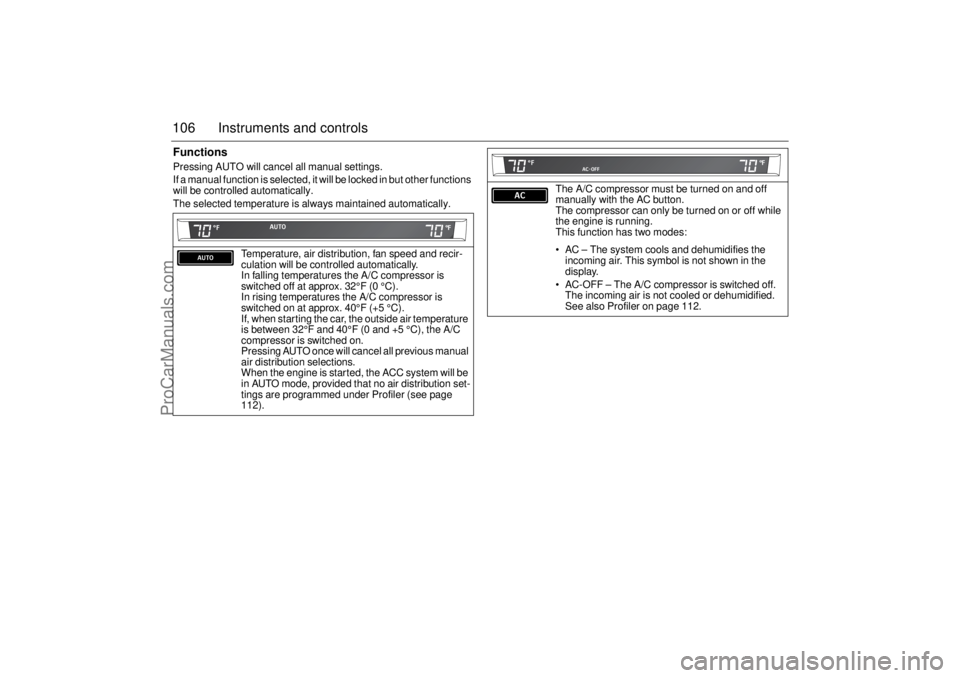
106 Instruments and controlsFunctionsPressing AUTO will cancel all manual settings.
If a manual function is selected, it will be locked in but other functions
will be controlled automatically.
The selected temperature is always maintained automatically.
Temperature, air distribution, fan speed and recir-
culation will be controlled automatically.
In falling temperatures the A/C compressor is
switched off at approx. 32°F (0 °C).
In rising temperatures the A/C compressor is
switched on at approx. 40°F (+5 °C).
If, when starting the car, the outside air temperature
is between 32°F and 40°F (0 and +5 °C), the A/C
compressor is switched on.
Pressing AUTO once will cancel all previous manual
air distribution selections.
When the engine is started, the ACC system will be
in AUTO mode, provided that no air distribution set-
tings are programmed under Profiler (see page
112).
The A/C compressor must be turned on and off
manually with the AC button.
The compressor can only be turned on or off while
the engine is running.
This function has two modes:
AC – The system cools and dehumidifies the
incoming air. This symbol is not shown in the
display.
AC-OFF – The A/C compressor is switched off.
The incoming air is not cooled or dehumidified.
See also Profiler on page 112.
ProCarManuals.com
Page 108 of 288
108 Instruments and controls
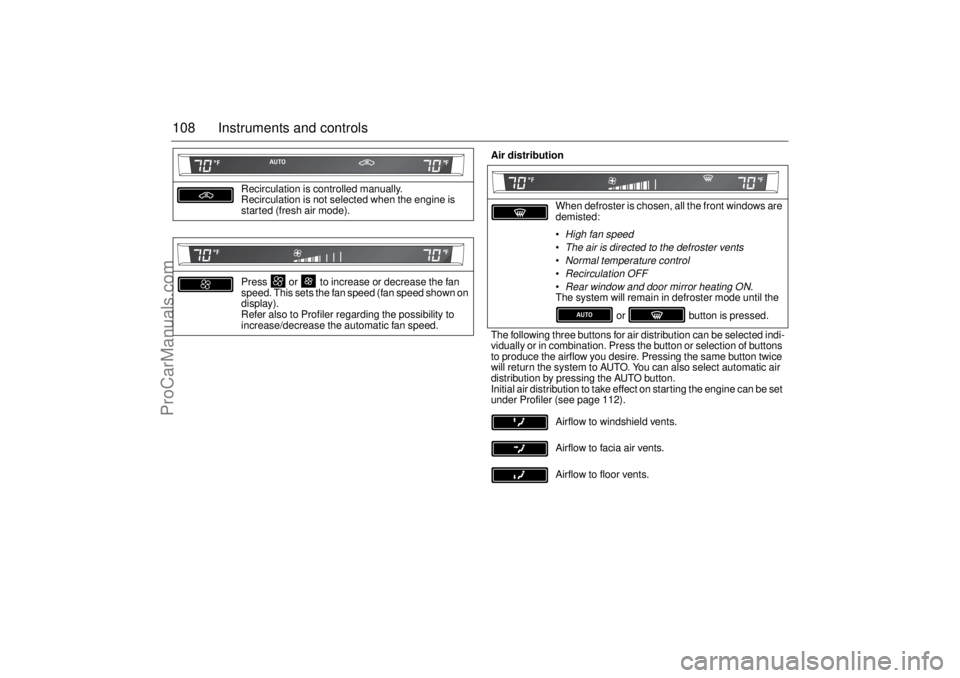
Recirculation is controlled manually.
Recirculation is not selected when the engine is
started (fresh air mode).
Press or to increase or decrease the fan
speed. This sets the fan speed (fan speed shown on
display).
Refer also to Profiler regarding the possibility to
increase/decrease the automatic fan speed.
Air distribution
When defroster is chosen, all the front windows are
demisted:
High fan speedThe air is directed to the defroster ventsNormal temperature controlRecirculation OFFRear window and door mirror heating ON
.
The system will remain in defroster mode until the
or button is pressed.
The following three buttons for air distribution can be selected indi-
vidually or in combination. Press the button or selection of buttons
to produce the airflow you desire. Pressing the same button twice
will return the system to AUTO. You can also select automatic air
distribution by pressing the AUTO button.
Initial air distribution to take effect on starting the engine can be set
under Profiler (see page 112).
Airflow to windshield vents.
Airflow to facia air vents.
Airflow to floor vents.
ProCarManuals.com
Page 113 of 288
113 Instruments and controls
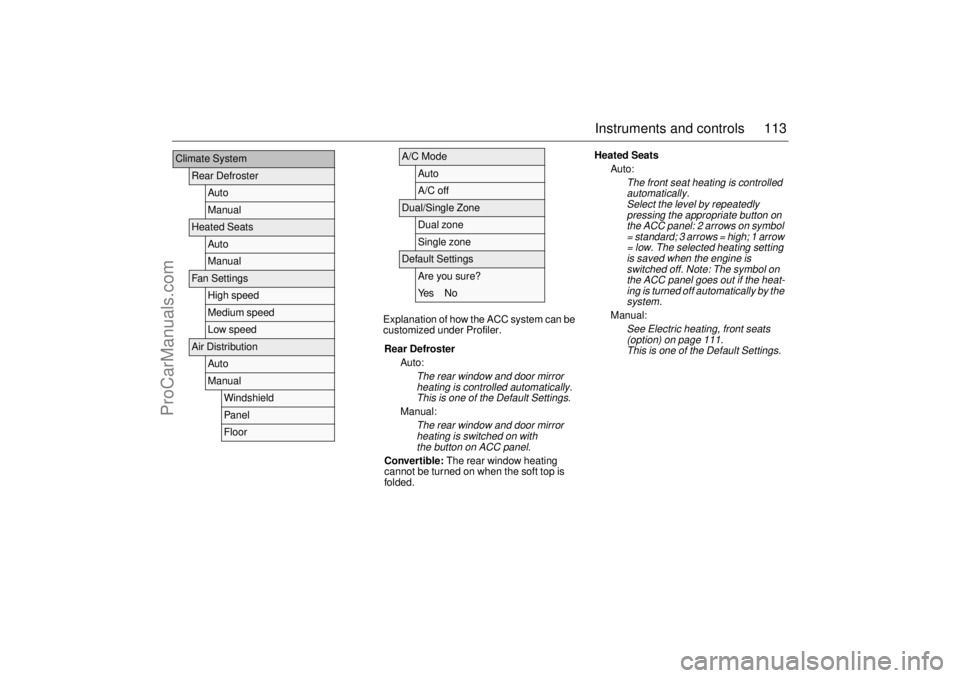
Explanation of how the ACC system can be
customized under Profiler.
Climate System
Rear Defroster
AutoManual
Heated Seats
AutoManual
Fan Settings
High speedMedium speedLow speed
Air Distribution
AutoManual
WindshieldPanelFloor
A/C Mode
AutoA/C off
Dual/Single Zone
Dual zoneSingle zone
Default Settings
Are you sure?Ye s N o
Rear Defroster
Auto:The rear window and door mirror
heating is controlled automatically.
This is one of the Default Settings.
Manual:
The rear window and door mirror
heating is switched on with
the button on ACC panel.
Convertible: The rear window heating
cannot be turned on when the soft top is
folded.
Heated Seats
Auto:
The front seat heating is controlled
automatically.
Select the level by repeatedly
pressing the appropriate button on
the ACC panel: 2 arrows on symbol
= standard; 3 arrows = high; 1 arrow
= low. The selected heating setting
is saved when the engine is
switched off. Note: The symbol on
the ACC panel goes out if the heat-
ing is turned off automatically by the
system.
Manual:
See Electric heating, front seats
(option) on page 111
.
This is one of the Default Settings.
ProCarManuals.com
Page 114 of 288

114 Instruments and controlsFan Settings
High speed:
This selection give a slightly higher
fan speed than Medium speed
though with continued automatic
regulation.
Medium speed:
Normal automatic fan speed. This is
one of the Default Settings.
Low speed:
This selection give a slightly lower
fan speed than Medium speed
though with continued automatic
regulation.
Convertible: Fan speed is not regulated
automatically when the soft top is open.
Air Distribution
Auto:
The ACC system adapts air tem-
perature and distribution to the pre-
vailing conditions. This is one of the
Default Settings
.
Manual:
Windshield:
The ACC system directs almost
all air to the windshield.
Panel:
The ACC system directs almost
all air to air vents in the fascia.
Floor:
The ACC system directs almost
all air to the floor.
A/C Mode
Auto:
Automatic engagement and disen-
gagement of the A/C. This is one of
the Default Settings.
A/C off:
A/C compressor OFF (see also
page 106). The A/C compressor
can be activated temporarily by
pressing the AC or AUTO button
while on the road and if the outside
temperature is above 41°F (+5°C).
The A/C will be off the next time the
engine is started, if the engine has
been switched off for more than
2hours.
Convertible: The A/C compressor is
switched off when the soft top is folded
down.
Further customizations to this function can
be made at a Saab dealer.
The A/C compressor can be on even
when the soft top is folded down.
The A/C compressor can be set to
operate as when the soft top was last
folded down.Dual/Single Zone
Dual zone:
Individual temperature setting for
each zone (see page 104). The sys-
tem saves the settings when the
engine is switched off. This is one of
the Default Settings.
Single zone:
Common temperature setting when
the engine is started. If the temper-
ature setting for the passenger zone
is changed, the system will switch to
Dual zone control. Single zone con-
trol will return the next time the
engine is started having been
switched off for more than 2 hours.
ProCarManuals.com
Page 136 of 288
136 Interior equipmentLoad-through hatch, Sport SedanConvertible: There are no load-through hatch.
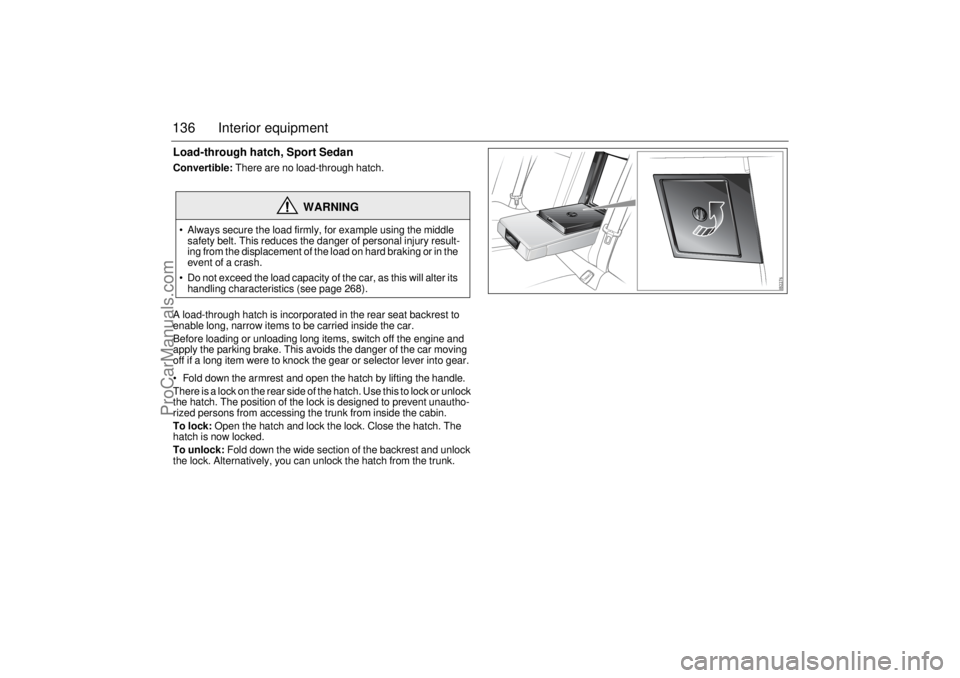
A load-through hatch is incorporated in the rear seat backrest to
enable long, narrow items to be carried inside the car.
Before loading or unloading long items, switch off the engine and
apply the parking brake. This avoids the danger of the car moving
off if a long item were to knock the gear or selector lever into gear.
Fold down the armrest and open the hatch by lifting the handle.
There is a lock on the rear side of the hatch. Use this to lock or unlock
the hatch. The position of the lock is designed to prevent unautho-
rized persons from accessing the trunk from inside the cabin.
To lock: Open the hatch and lock the lock. Close the hatch. The
hatch is now locked.
To unlock: Fold down the wide section of the backrest and unlock
the lock. Alternatively, you can unlock the hatch from the trunk.
WARNING
Always secure the load firmly, for example using the middle
safety belt. This reduces the danger of personal injury result-
ing from the displacement of the load on hard braking or in the
event of a crash.
Do not exceed the load capacity of the car, as this will alter its
handling characteristics (see page 268).
ProCarManuals.com