amp SAAB 9-3 2004 Workshop Manual
[x] Cancel search | Manufacturer: SAAB, Model Year: 2004, Model line: 9-3, Model: SAAB 9-3 2004Pages: 288, PDF Size: 23.54 MB
Page 225 of 288
225 Car care
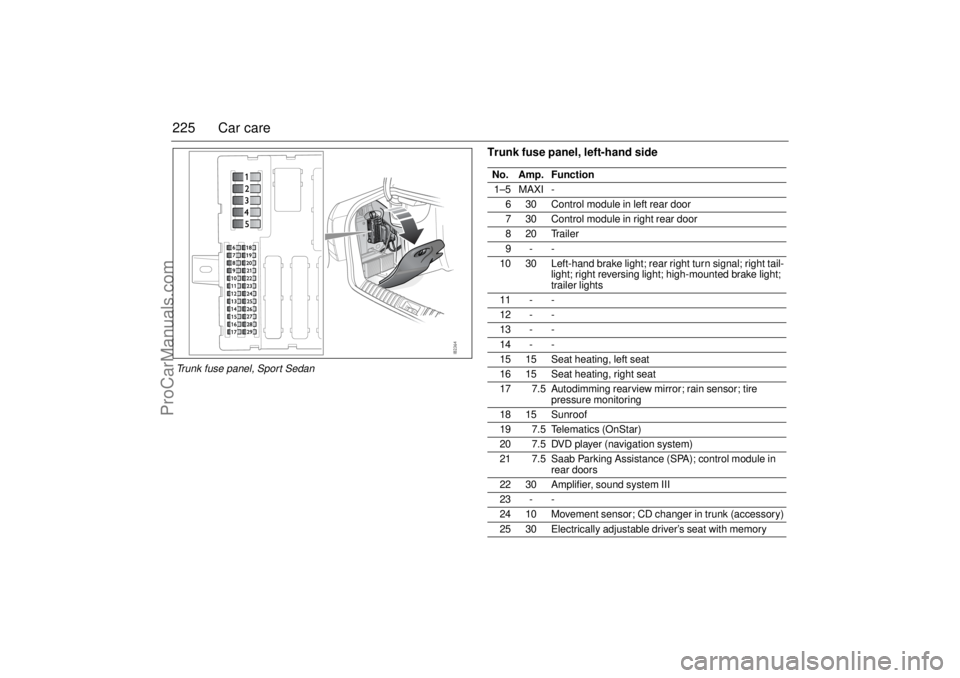
Trunk fuse panel, left-hand sideNo. Amp. Function
1–5 MAXI -
6 30 Control module in left rear door
7 30 Control module in right rear door
820Trailer
9--
10 30 Left-hand brake light; rear right turn signal; right tail-
light; right reversing light; high-mounted brake light;
trailer lights
11 - -
12 - -
13 - -
14 - -
15 15 Seat heating, left seat
16 15 Seat heating, right seat
17 7.5 Autodimming rearview mirror; rain sensor; tire
pressure monitoring
18 15 Sunroof
19 7.5 Telematics (OnStar)
20 7.5 DVD player (navigation system)
21 7.5 Saab Parking Assistance (SPA); control module in
rear doors
22 30 Amplifier, sound system III
23 - -
24 10 Movement sensor; CD changer in trunk (accessory)
25 30 Electrically adjustable driver’s seat with memory
Trunk fuse panel, Sport Sedan
ProCarManuals.com
Page 227 of 288
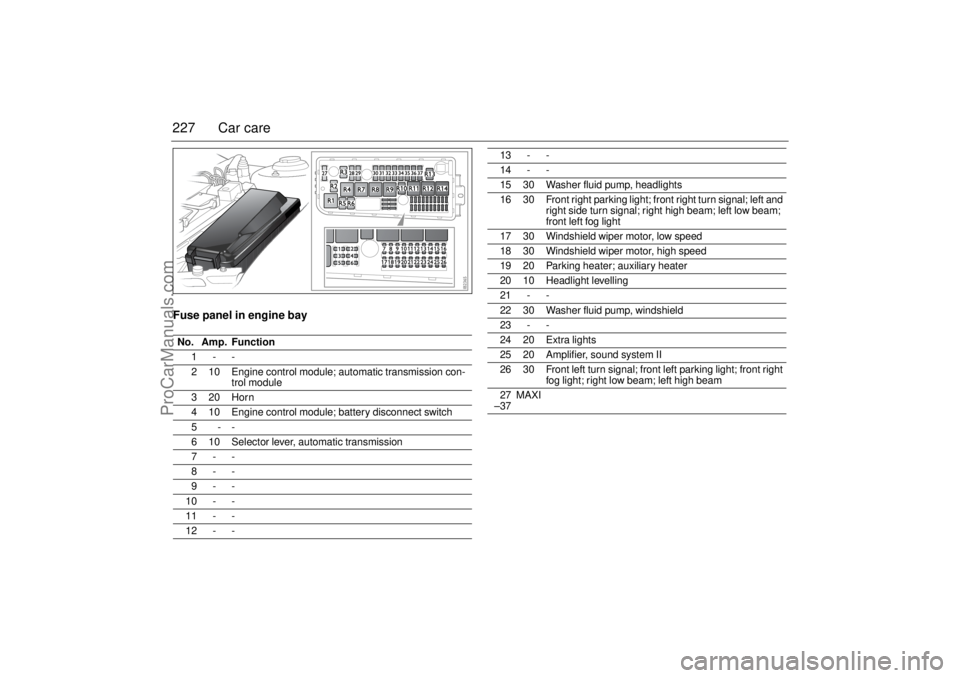
227 Car careFuse panel in engine bayNo. Amp. Function
1--
2 10 Engine control module; automatic transmission con-
trol module
320Horn
4 10 Engine control module; battery disconnect switch
5--
6 10 Selector lever, automatic transmission
7--
8--
9--
10 - -
11 - -
12 - -
13 - -
14 - -
15 30 Washer fluid pump, headlights
16 30 Front right parking light; front right turn signal; left and
right side turn signal; right high beam; left low beam;
front left fog light
17 30 Windshield wiper motor, low speed
18 30 Windshield wiper motor, high speed
19 20 Parking heater; auxiliary heater
20 10 Headlight levelling
21 - -
22 30 Washer fluid pump, windshield
23 - -
24 20 Extra lights
25 20 Amplifier, sound system II
26 30 Front left turn signal; front left parking light; front right
fog light; right low beam; left high beam
27
–37MAXI
ProCarManuals.com
Page 228 of 288
228 Car care
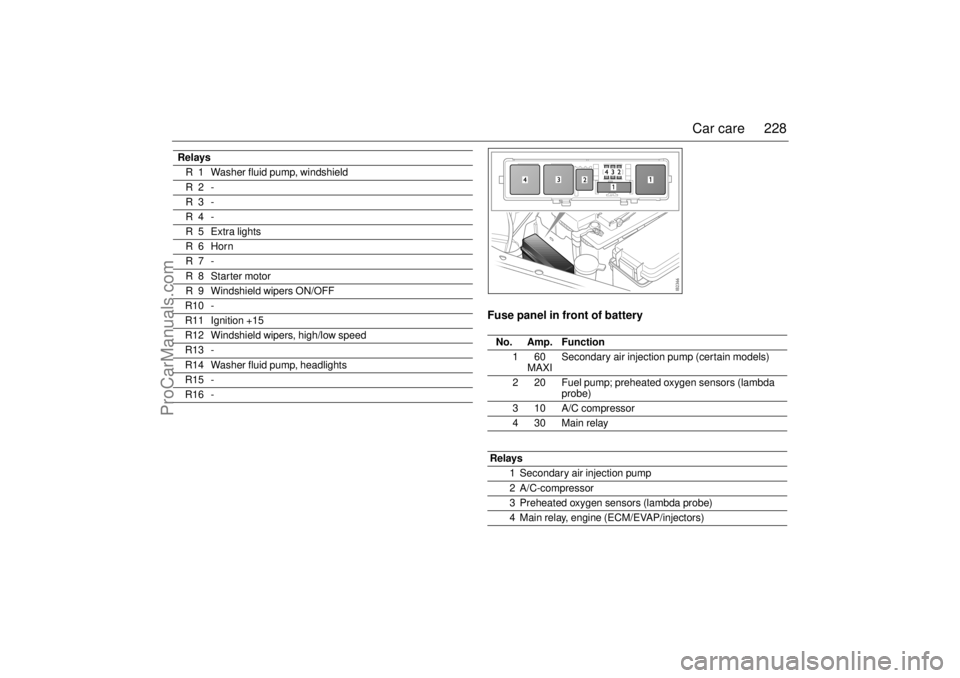
Fuse panel in front of battery
Relays
R 1 Washer fluid pump, windshield
R2 -
R3 -
R4 -
R 5 Extra lights
R6 Horn
R7 -
R8 Starter motor
R 9 Windshield wipers ON/OFF
R10 -
R11 Ignition +15
R12 Windshield wipers, high/low speed
R13 -
R14 Washer fluid pump, headlights
R15 -
R16 -
No. Amp. Function
160
MAXISecondary air injection pump (certain models)
2 20 Fuel pump; preheated oxygen sensors (lambda
probe)
310A/C compressor
430Main relay
Relays
1 Secondary air injection pump
2 A/C-compressor
3 Preheated oxygen sensors (lambda probe)
4 Main relay, engine (ECM/EVAP/injectors)
ProCarManuals.com
Page 235 of 288

235 Car care
Uniform Tire Quality GradingQuality grades can be found where applica-
ble on the tire sidewall between tread shoul-
der and maximum section width. For exam-
ple:
Treadwear 200 Traction AA Temperature
A
The following information relates to the
system developed by the United States
National Highway Traffic Safety Administra-
tion, which grades tires by treadwear, trac-
tion and temperature performance. (This
applies only to vehicles sold in the United
States.) The grades are molded on the side-
walls of most passenger car tires. The Uni-
form Tire Quality Grading system does not
apply to deep tread, winter-type snow tires,
space-saver or temporary use spare tires,
tires with nominal rim diameters of 10 to 12
inches (25 to 30 cm), or to some limited-pro-
duction tires.
While the tires available on General Motors
passenger cars and light trucks may vary
with respect to these grades, they must also
conform to federal safety requirements and
additional General Motors Tire Perfor-
mance Criteria (TPC) standards.Treadwear
The treadwear grade is a comparative
rating based on the wear rate of the tire
when tested under controlled conditions on
a specified government test course. For
example, a tire graded 150 would wear one
and a half (1.5) times as well on the govern-
ment course as a tire graded 100. The rela-
tive performance of tires depends upon the
actual conditions of their use, however, and
may depart significantly from the norm due
to variations in driving habits, service prac-
tices and differences in road characteristics
and climate.
Traction – AA, A, B, C
The traction grades, from highest to lowest,
are AA, A, B, and C. Those grades repre-
sent the tire’s ability to stop on wet pave-
ment as measured under controlled condi-
tions on specified government test surfaces
of asphalt and concrete. A tire marked C
may have poor traction performance. Warn-
ing: The traction grade assigned to this tire
is based on straight-ahead braking traction
tests, and does not include acceleration,
cornering, hydroplaning, or peak traction
characteristics.Temperature – A, B, C
The temperature grades are A (the highest),
B, and C, representing the tire’s resistance
to the generation of heat and its ability to dis-
sipate heat when tested under controlled
conditions on a specified indoor laboratory
test wheel. Sustained high temperature can
cause the material of the tire to degenerate
and reduce tire life, and excessive temper-
ature can lead to sudden tire failure. The
grade C corresponds to a level of perfor-
mance which all passenger car tires must
meet under the Federal Motor Vehicle
Safety Standard No. 109. Grades B and A
represent higher levels of performance on
the laboratory test wheel than the minimum
required by law.
Warning: The temperature grade for this tire
is established for a tire that is properly
inflated and not overloaded. Excessive
speed, underinflation, or excessive loading,
either separately or in combination, can
cause heat buildup and possible tire failure.
ProCarManuals.com
Page 236 of 288
236 Car careWheel Alignment and Tire Balance
The wheels on your vehicle were aligned
and balanced carefully at the factory to give
you the longest tire life and best overall per-
formance.
Scheduled wheel alignment and wheel bal-
ancing are not needed. However, if you
notice unusual tire wear or your vehicle pull-
ing one way or the other, the alignment may
need to be reset. If you notice your vehicle
vibrating when driving on a smooth road,
your wheels may need to be rebalanced.
Wheel Replacement
Replace any wheel that is bent, cracked or
badly rusted or corroded. If wheel nuts keep
coming loose, the wheel, wheel bolts and
wheel nuts should be replaced. If the wheel
leaks air, replace it (except some aluminum
wheels, which can sometimes be repaired).
See your dealer if any of these conditions
exist.
Your dealer will know the kind of wheel you
need.
Each new wheel should have the same
load-carrying capacity, diameter, width,
offset and be mounted the same way as the
one it replaces.
If you need to replace any of your wheels,
wheel bolts or wheel nuts, replace them only
with new Saab original equipment parts.
This way, you will be sure to have the right
wheel, wheel bolts and wheel nuts for your
vehicle.
Notice:
The wrong wheel can also cause
problems with bearing life, brake cool-
ing, speedometer or odometer calibra-
tion, headlamp aim, bumper height, vehi-
cle ground clearance and tire or tire
chain clearance to the body and chassis.
See “Changing a tire” on page 245.Used Replacement Wheels
WARNING
Using the wrong replacement wheels,
wheel bolts or wheel nuts on your vehicle
can be dangerous. It could affect the
braking and handling of your vehicle,
make your tires lose air and make you
lose control. You could have a collision in
which you or others could be injured.
Always use the correct wheel, wheel bolts
and wheel nuts for replacement.
WARNING
When fitting just one new pair of tires,
these should be fitted to the rear wheels,
as these are more critical to the direc-
tional stability of the car (e.g. on braking
or in a skid). The existing rear wheels
should therefore be moved to the front.
WARNING
Putting a used wheel on your vehicle is
dangerous. You can’t know how it’s been
used or how far it’s been driven. It could
fail suddenly and cause a crash. If you
have to replace a wheel, use a new GM
original equipment wheel.
ProCarManuals.com
Page 238 of 288

238 Car careTire Sidewall LabelingUseful information about a tire is molded
into it´s sidewall.
Tire size: The tire size ia a combination of
letters and numbers used to define a partic-
ular tire´s width, height, aspect ratio, con-
struction type and service description.
Department of Transportation (DOT):
The Department of Transportation (DOT)
code indicates that the tire is in compliance
with the U.S. Department of Transportation
Motor Vehicle Safety standards.
Tire Identification Number (TIN): The let-
ters and numbers following DOT code are
the Tire Identification Number (TIN). The
TIN shows the manufacturer and plant
code, tire size, and and date the tire was
manufactured. The TIN is molded onto both
sides of the tire.
Tire Ply Material: The type of cord and
number of plies in the sidewall and under
the tread.Uniform Tire Quality Grading (UTQG):
Tire manufacturers are required to grade
tires based on ee performance factors:
treadwear, traction and temperature resis-
tance. For more information see “Uniform
Tire Quality Grading” on page 235.
Maximum Cold Inflation Load Limit: Max-
imum load that can be carried and the max-
imum pressure needed to support that load.
For information on recommended tire pres-
sure see “Recommended lowest tire pres-
sure, cold tires” on page 277 and “Loading
Your Vehicle” on page 240.
Tire SizeThe following illustration shows an example
of a typical passenger car tire size.
Passenger (P-Metric) Tire: The United
States version of a metric tire sizing system.
The letter “P” as the first character in the tire
size means a passenger vehicle tire engi-
neered to standards set by the U.S Tire and
Rim Association.
Tire Width: The three-digit number indi-
cates the tire section width in millimeters
from sidewall to sidewall.P215/55 R 16 93 H
|| |||||
ab c d e f g
a Passenger (P-Metric) Tire
bTire Width
c Aspect Ratio
d Belt Rating
e Rim diameter
f Load range
g Speed rating
ProCarManuals.com
Page 239 of 288
239 Car care
Aspect ratio: A two-digit number that indi-
cates the tire height-to-width measure-
ments. For example, if the tire size aspect
ratio is “55”, as shown in item “C” of the illus-
tration, it would mean that the tire´s sidewall
is 55% as high as it is wide.
Belt Rating: A letter code is used to indicate
the type of ply construction in the tire. The
letter “R” means radial ply construction; the
letter “D” means diagonal or bias ply con-
struction; and the letter “B” means belted-
bias ply construction.
Rim Diameter: Diameter of the wheel in
inches.
Load range: The load range represents the
load carry capacity a tire is certified to carry.
Speed Rating: The maximum speed that a
tire is certified to carry a load. Speed ratings
range from “A” to “Z”.
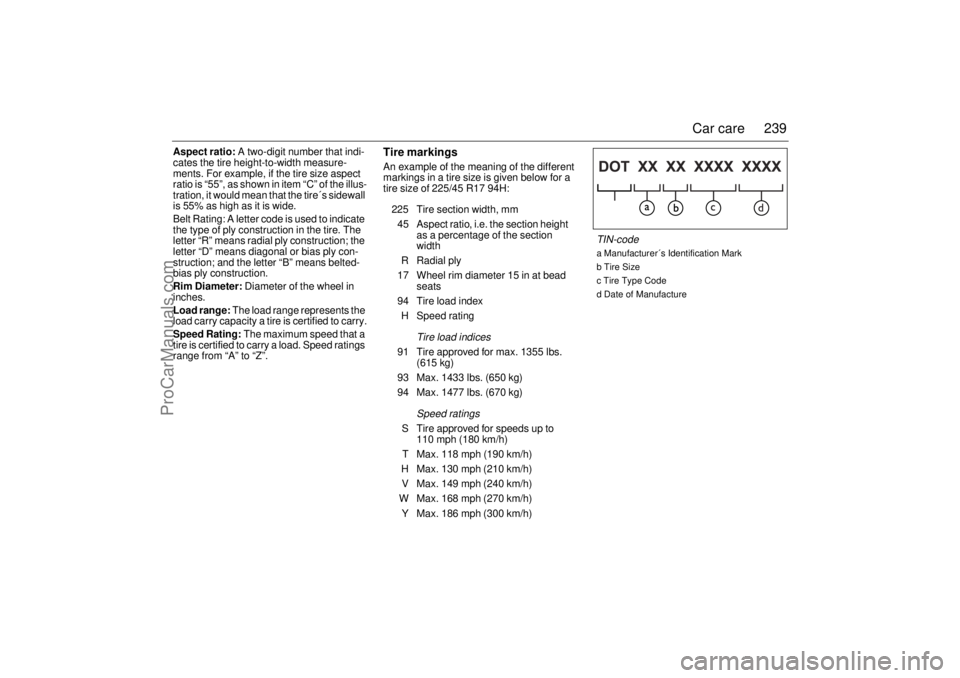
Tire markingsAn example of the meaning of the different
markings in a tire size is given below for a
tire size of 225/45 R17 94H:
225 Tire section width, mm
45 Aspect ratio, i.e. the section height
as a percentage of the section
width
R Radial ply
17 Wheel rim diameter 15 in at bead
seats
94 Tire load index
H Speed rating
Tire load indices
91 Tire approved for max. 1355 lbs.
(615 kg)
93 Max. 1433 lbs. (650 kg)
94 Max. 1477 lbs. (670 kg)
Speed ratings
S Tire approved for speeds up to
110 mph (180 km/h)
T Max. 118 mph (190 km/h)
H Max. 130 mph (210 km/h)
V Max. 149 mph (240 km/h)
W Max. 168 mph (270 km/h)
Y Max. 186 mph (300 km/h)
TIN-codea Manufacturer´s Identification Mark
b Tire Size
c Tire Type Code
d Date of Manufacture
ProCarManuals.com
Page 240 of 288
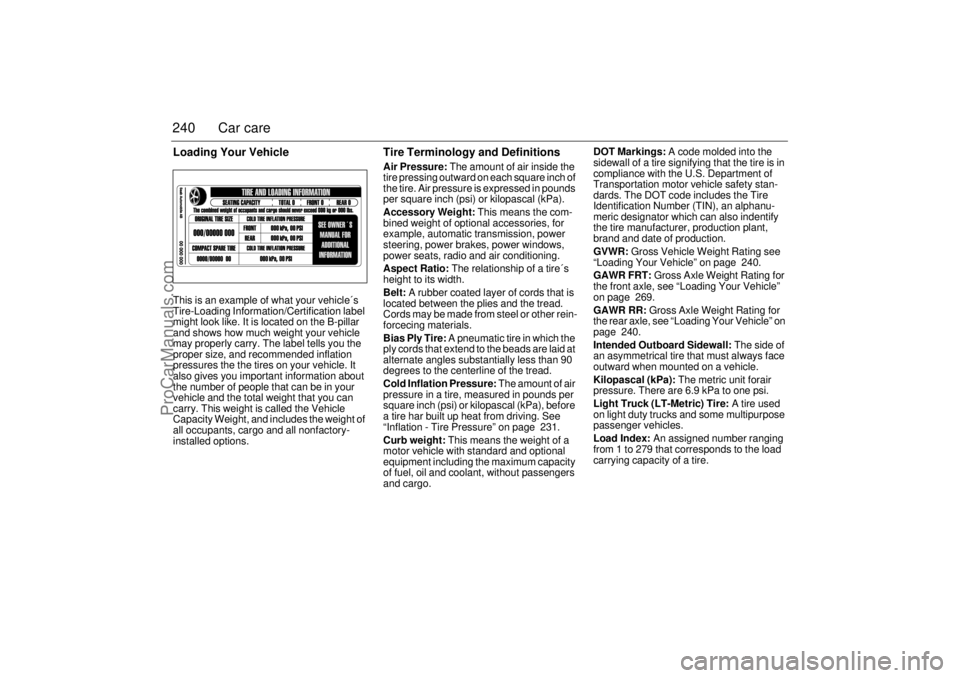
240 Car careLoading Your VehicleThis is an example of what your vehicle´s
Tire-Loading Information/Certification label
might look like. It is located on the B-pillar
and shows how much weight your vehicle
may properly carry. The label tells you the
proper size, and recommended inflation
pressures the the tires on your vehicle. It
also gives you important information about
the number of people that can be in your
vehicle and the total weight that you can
carry. This weight is called the Vehicle
Capacity Weight, and includes the weight of
all occupants, cargo and all nonfactory-
installed options.
Tire Terminology and DefinitionsAir Pressure: The amount of air inside the
tire pressing outward on each square inch of
the tire. Air pressure is expressed in pounds
per square inch (psi) or kilopascal (kPa).
Accessory Weight: This means the com-
bined weight of optional accessories, for
example, automatic transmission, power
steering, power brakes, power windows,
power seats, radio and air conditioning.
Aspect Ratio: The relationship of a tire´s
height to its width.
Belt: A rubber coated layer of cords that is
located between the plies and the tread.
Cords may be made from steel or other rein-
forcecing materials.
Bias Ply Tire: A pneumatic tire in which the
ply cords that extend to the beads are laid at
alternate angles substantially less than 90
degrees to the centerline of the tread.
Cold Inflation Pressure: The amount of air
pressure in a tire, measured in pounds per
square inch (psi) or kilopascal (kPa), before
a tire har built up heat from driving. See
“Inflation - Tire Pressure” on page 231.
Curb weight: This means the weight of a
motor vehicle with standard and optional
equipment including the maximum capacity
of fuel, oil and coolant, without passengers
and cargo.DOT Markings: A code molded into the
sidewall of a tire signifying that the tire is in
compliance with the U.S. Department of
Transportation motor vehicle safety stan-
dards. The DOT code includes the Tire
Identification Number (TIN), an alphanu-
meric designator which can also indentify
the tire manufacturer, production plant,
brand and date of production.
GVWR: Gross Vehicle Weight Rating see
“Loading Your Vehicle” on page 240.
GAWR FRT: Gross Axle Weight Rating for
the front axle, see “Loading Your Vehicle”
on page 269.
GAWR RR: Gross Axle Weight Rating for
the rear axle, see “Loading Your Vehicle” on
page 240.
Intended Outboard Sidewall: The side of
an asymmetrical tire that must always face
outward when mounted on a vehicle.
Kilopascal (kPa): The metric unit forair
pressure. There are 6.9 kPa to one psi.
Light Truck (LT-Metric) Tire: A tire used
on light duty trucks and some multipurpose
passenger vehicles.
Load Index: An assigned number ranging
from 1 to 279 that corresponds to the load
carrying capacity of a tire.
ProCarManuals.com
Page 242 of 288

242 Car careSteps for Determining Correct Load
Limit
1 Locate the statement “The
combined weight of occupants and
cargo should never exceed
XXX pounds” on your vehicle´s
placard.
2 Determine the combined weight of
the driver and passengers that will
be riding in your vehicle.
3 Substract the combined weight of
the driver and passengers from
XXX kilograms or XXX pounds.
4 The resulting figure equals the avail-
able amount of cargo and luggage
load capacity. For example, if the
“XXX” amount equals 1400 lbs. and
there will be five 150 lb. passengers
in your vehicle, the amount of avail-
able cargo and luggage load capac-
ity is 650 lbs. (1400–750 (5x150) =
650 lbs.).5 Determine the combined weight of
luggage and cargo being loaded on
the vehicle. That weight may not
safely exceed the available cargo
and luggage load capacity calcu-
lated in Step 4.
6 If your vehicle will be towing a trailer,
load from your trailer will be trans-
ferred to your vehicle. Consult this
manual to determine how this
reduces the available cargo and
luggage load capacity of your vehi-
cle.Winter tires
Winter (snow) tires are recommended for
winter climates where the majority of your
driving will be done on snow and ice. Winter
tires should be fitted to all four wheels to
maintain a proper balance. Your Saab
dealer can advise you of to the correct size
tire for your car (if different from the original
size) and also supply Saab approved winter
tires pre-mounted on steel or alloy rims.
ProCarManuals.com
Page 245 of 288

245 Car care
Changing a tire
WARNING
The car jack is designed solely for use
in changing a tire or fitting snow
chains. It must not be used to
support the car during repair work
or servicing.
Never crawl under a car that is
supported only by a jack.
Special care must be taken if the car is
on a slope - use wedge-shaped wheel
chocks!
Position chocks, one ahead and one
behind, the wheel that is diagonally
opposite to the one to be changed.
Switch on the hazard warning lights if
the car is on a road.
Apply the parking brake and leave the
car in gear (1st or reverse). Automatic
transmission: move the selector lever
to the P position.
Ensure that everybody is out of the car
before jacking it up.
Never start the engine while the car is
jacked up.
If possible, make sure the jack is
standing on a firm, level surface.
The jack should be stored correctly
under the carpeting in the trunk. If it
lies loose in the car, it could thrown
forward and cause personal injury in
the event of a crash or if the car rolls
over.
Do not use the jack on a car other than
your Saab 9-3.
Grit, salt and rust can clog the inner
threads of the wheel bolts if the car has
been driven for several years exclu-
sively with alloy wheels.
If steel wheels are being installed, the
bolt hole threads in the brake hubs
should be cleaned before the thinner
steel wheels are fitted. It may other-
wise not be possible to achieve the
correct clamping force, despite tight-
ening the wheel bolts to the correct
torque.
WARNING
Changing a tire can cause an injury. The
vehicle can slip off the jack and roll over
you or other people. You and they could
be badly injured. Find a level place to
change your tire. To help prevent the
vehicle from moving:
1 Set the parking brake firmly.
2 Put the shift lever in PARK (P) (auto-
matic transmission;
engage 1st gear (manual transmis-
sion).
3 Turn off the engine.
To be even more certain the vehicle won’t
move, you can put blocks at the front and
rear of the tire farthest away from the one
being changed. That would be the tire on
the other side of the vehicle, at the oppo-
site end.
ProCarManuals.com