service SAAB 9-3 2005 User Guide
[x] Cancel search | Manufacturer: SAAB, Model Year: 2005, Model line: 9-3, Model: SAAB 9-3 2005Pages: 292, PDF Size: 23 MB
Page 97 of 292

95 Instruments and controls
Explanation of the various selections under
System Settings.
Language
Select the desired language. The num-
ber of languages can vary between
markets.
Unit
Select the desired group of units.
Speed Scale Illum.
Select the proportion of the speedo-
meter to be illuminated in NIGHT-
PANEL mode.
Service Info
Service Data:
The approximate condition of the oil
is shown here. 100% is equivalent
to new engine oil.
Service Type:
The type of service that is required
is shown here.
Reset Service Ind.:
The service indicator can be reset
here. This is normally done at the
dealer in connection with a service.
ProCarManuals.com
Page 153 of 292

151 Starting and driving
If the diagnosis function detects a fault in the
engine management system, the light
"Engine malfunction (CHECK ENGINE)" in
the instrument panel will come on (see
page 79). Have the car checked at a Saab
dealer as soon as possible.
Important considerations with
catalytic convertersThe catalytic converter is an emission con-
trol device incorporated in the car’s exhaust
system. It consists of a metal canister with a
honeycomb insert, the cells of which have
walls coated in a catalytic layer (precious
metal alloy).
To ensure that the catalytic converter con-
tinues to function properly, and also to avoid
damage to the converter and its associated
components, the following points must be
observed: Have the car serviced regularly in accor-
dance with the service program.
Always be alert to any misfiring of the
engine (not running on all cylinders) and
any loss of power or performance. At the
first sign of a malfunction, reduce speed
and take the car to a Saab dealer.
If the engine fails to start (in severe cold
or if the battery is flat), the car can be
bump started (manual transmission only)
or started using jump leads to a donor
battery. However, as soon as you have
started the engine, it is important that it
runs on all cylinders. If it is misfiring, allow
it to idle for up to 5 minutes to give it time
to settle and run smoothly. If, after this
time, the engine still fails to run properly,
switch off the engine to avoid serious
damage to the catalytic converter.
Contact a Saab dealer for advice.
NOTICEIf "Engine malfunction (CHECK
ENGINE)" warning light starts to flash
(indicating that the engine is misfiring and
the catalytic converter can be damaged),
ease off the accelerator slightly. The light
should go out or start to shine constantly.
If the light continues to flash despite
easing off the accelerator, you may
continue to drive the car but at the mini-
mum throttle permitted by the current traf-
fic situation. Have the car checked as
soon as possible at a Saab dealer.
NOTICEUse only unleaded gasoline. Leaded
gasoline is detrimental to the catalyst and
oxygen sensor and will seriously impair
the function of the catalytic converter.
ProCarManuals.com
Page 157 of 292
155 Starting and driving
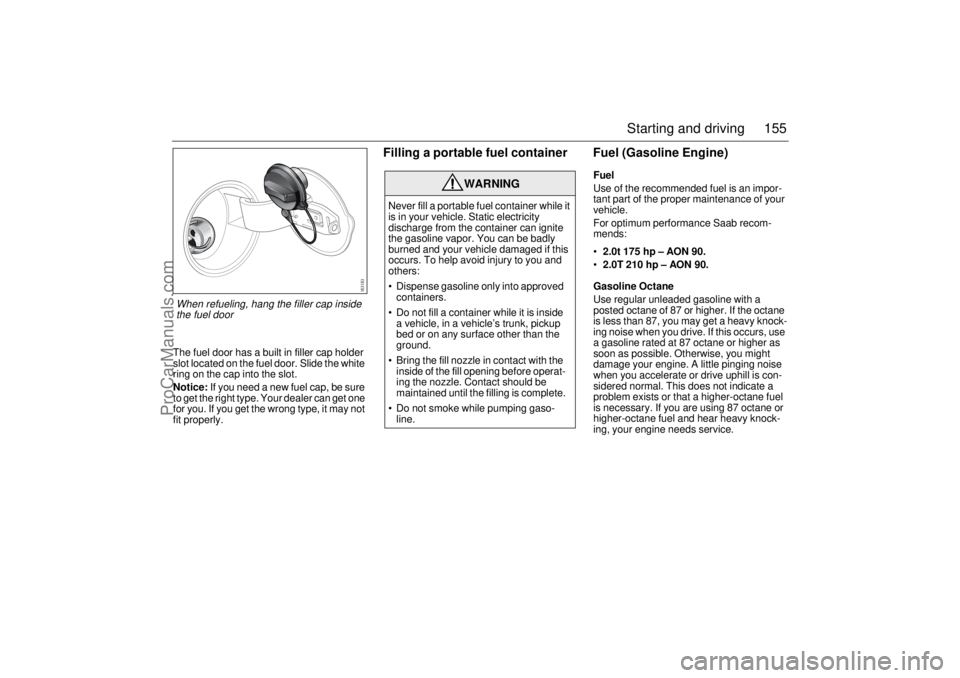
The fuel door has a built in filler cap holder
slot located on the fuel door. Slide the white
ring on the cap into the slot.
Notice: If you need a new fuel cap, be sure
to get the right type. Your dealer can get one
for you. If you get the wrong type, it may not
fit properly.
Filling a portable fuel container Fuel (Gasoline Engine)
Fuel
Use of the recommended fuel is an impor-
tant part of the proper maintenance of your
vehicle.
For optimum performance Saab recom-
mends:
2.0t 175 hp – AON 90.
2.0T 210 hp – AON 90.
Gasoline Octane
Use regular unleaded gasoline with a
posted octane of 87 or higher. If the octane
is less than 87, you may get a heavy knock-
ing noise when you drive. If this occurs, use
a gasoline rated at 87 octane or higher as
soon as possible. Otherwise, you might
damage your engine. A little pinging noise
when you accelerate or drive uphill is con-
sidered normal. This does not indicate a
problem exists or that a higher-octane fuel
is necessary. If you are using 87 octane or
higher-octane fuel and hear heavy knock-
ing, your engine needs service.
WARNING
Never fill a portable fuel container while it
is in your vehicle. Static electricity
discharge from the container can ignite
the gasoline vapor. You can be badly
burned and your vehicle damaged if this
occurs. To help avoid injury to you and
others:
Dispense gasoline only into approved
containers.
Do not fill a container while it is inside
a vehicle, in a vehicle’s trunk, pickup
bed or on any surface other than the
ground.
Bring the fill nozzle in contact with the
inside of the fill opening before operat-
ing the nozzle. Contact should be
maintained until the filling is complete.
Do not smoke while pumping gaso-
line.
When refueling, hang the filler cap inside
the fuel door
ProCarManuals.com
Page 159 of 292

157 Starting and driving
whether the fuel contains MMT. Saab does
not recommend the use of such gasolines.
Fuels containing MMT can reduce the life of
spark plugs and the performance of the
emission control system may be affected.
The malfunction indicator lamp may turn on.
If this occurs, return to your authorized Saab
dealer for service.
Fuels in Foreign Countries
If you plan on driving in another country out-
side the United States or Canada, the
proper fuel may be hard to find. Never use
leaded gasoline or any other fuel not recom-
mended in the previous text on fuel. Costly
repairs caused by use of improper fuel
would not be covered by your warranty.
To check the fuel availability, ask an auto
club, or contact a major oil company that
does business in the country where you will
be driving.
Engine Break-in PeriodPistons, cylinder bores and bearings need
time to obtain uniform, wear-resistant
surfaces.
If a new engine is driven too hard, this grad-
ual process of bedding-in will not be possi-
ble and the life of the engine will be short-
ened.
During the first 1,200 miles (2,000 km),
do not exceed 5,000 rpm.
In addition, refrain from driving the car at full
throttle, other than for brief instances,
during the first 1,800 miles (3,000 km).
Wearing in new brake padsNew brake pads take time to bed in, about
90 miles (150 km) if the car is driven largely
under stop-and-go conditions or about
300 miles (500 km) of highway driving.
To extend the useful life of the pads, avoid
hard braking as much as possible.
ProCarManuals.com
Page 163 of 292
161 Starting and driving
Lock-upThe transmission’s torque converter has a
lock-up function. This can lock the torque
converter, thus reducing the engine speed
and fuel consumption.Kick-downWhen the accelerator is pressed down fully,
a down change is made to optimize acceler-
ation, e.g. for overtaking.
Following this, the next higher gear will be
selected at the optimum engine speed,
unless you ease off the accelerator before
reaching this.
Driving in hilly country with a
heavy loadThe transmission fluid can overheat when
the gearbox is strained, for example, when
driving with a trailer on hilly roads. To avoid
the transmission fluid overheating, always
drive with the selector lever in the D posi-
tion. The adaptive gear change patterns are
then active.
High air temperatures or a faulty oil cooler
can also cause the transmission fluid to
overheat. Overheating reduces the service
life of the fluid.
TowingTowing of cars with automatic transmission,
see page 190.Descending hillsIf the speed of the car increases while
descending a steep hill, despite the acceler-
ator being released, the control module will
change down. If you desire more powerful
engine braking, manually select a lower
gear (see page 164).
WARNING
Remember to use the braking effect of the
engine (1st, 2nd or 3rd gear) when you
are descending long or steep hills to
spare the brakes.
Overheating can cause the brakes to
fade!
ProCarManuals.com
Page 181 of 292
179 Starting and driving
Economical drivingFactors affecting fuel
consumptionThe fuel consumption of a car is greatly
affected by driving conditions, climate, road
conditions, speed, driving technique, etc.Breaking-inFuel consumption may be somewhat
higher during the break-in period (the
first 3,000–4,000 miles (5,000–7,000 km)).Weather conditionsSummer temperatures give better fuel
economy than winter ones. The difference
can be as much as about 10%. Consump-
tion increases in cold weather because the
engine takes longer to reach its normal
operating temperature. The transmission
and wheel bearings also take longer to
warm up. Even distance affects consump-
tion: short journeys of 3–5 miles (5–8 km)
do not give the engine enough time to
reach its optimum temperature. Wind con-
ditions also have a marked effect on fuel
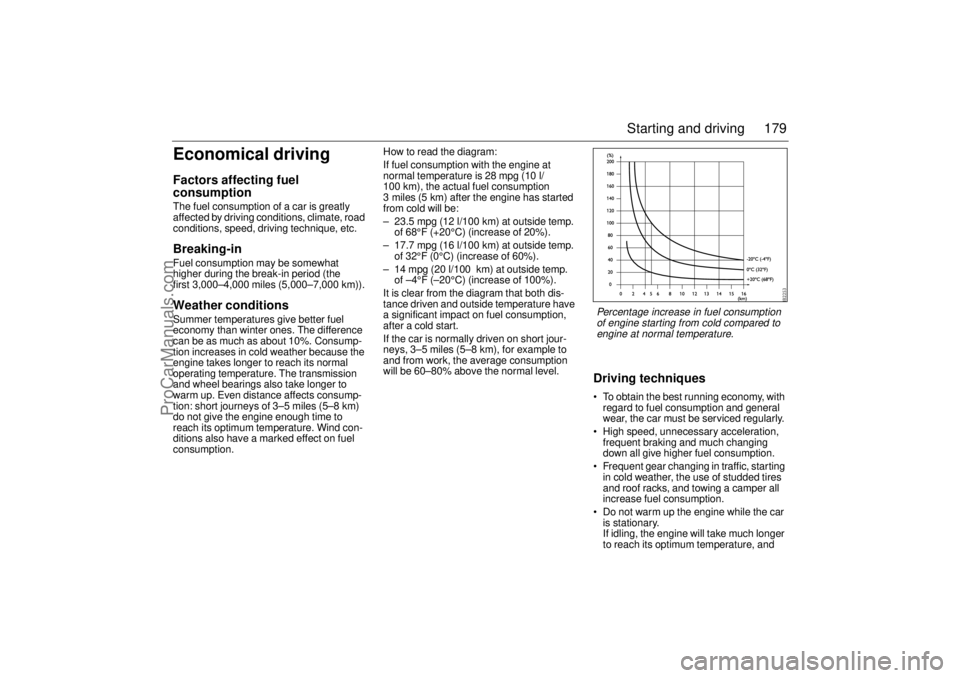
consumption.How to read the diagram:
If fuel consumption with the engine at
normal temperature is 28 mpg (10 l/
100 km), the actual fuel consumption
3 miles (5 km) after the engine has started
from cold will be:
– 23.5 mpg (12 l/100 km) at outside temp.
of 68°F (+20°C) (increase of 20%).
– 17.7 mpg (16 l/100 km) at outside temp.
of 32°F (0°C) (increase of 60%).
– 14 mpg (20 l/100 km) at outside temp.
of –4°F (–20°C) (increase of 100%).
It is clear from the diagram that both dis-
tance driven and outside temperature have
a significant impact on fuel consumption,
after a cold start.
If the car is normally driven on short jour-
neys, 3–5 miles (5–8 km), for example to
and from work, the average consumption
will be 60–80% above the normal level.
Driving techniques To obtain the best running economy, with
regard to fuel consumption and general
wear, the car must be serviced regularly.
High speed, unnecessary acceleration,
frequent braking and much changing
down all give higher fuel consumption.
Frequent gear changing in traffic, starting
in cold weather, the use of studded tires
and roof racks, and towing a camper all
increase fuel consumption.
Do not warm up the engine while the car
is stationary.
If idling, the engine will take much longer
to reach its optimum temperature, and Percentage increase in fuel consumption
of engine starting from cold compared to
engine at normal temperature.
ProCarManuals.com
Page 197 of 292
195 Starting and driving
5 Check that the jumper cables do not
have loose or missing insulation. If they
do, you could get a shock and also the
vehicles could be damaged.
Before you connect the cables, here are
some basic things you should know.
Positive (+) will go to positive (+) and
negative (–) will go to negative (–). Do
not connect (+) to (–) or you will get a
short that could injure you or would
damage the battery and maybe other
parts as well.
6 Connect the red positive (+) cable to the
positive (+) terminal of the vehicle with
the discharged battery.7 Do not let the other end touch metal.
Connect it to the positive (+) terminal of
the good battery. Use a remote positive
(+) terminal if the vehicle has one.
8 Now connect the negative (–) cable to
the good battery’s negative terminal.
9 Attach the cable to the discharged
battery’s negative terminal.
10 Start the vehicle with the good battery
and run the engine for a while.
11 Try to start the vehicle with the
discharged battery. If it does not start
after a few tries, it probably needs
service.
Note. If the current in the low battery is
too low it might be necessary to wait
several minutes with the cables
connected before you can start the
engine with the low battery.
12 Remove the cables in reverse order to
prevent electrical shorting. Take care
that they do not touch each other or any
other metal.
Using a battery charger/starter
unitTo avoid damaging the car’s electrical
system and electronics, the following rules
must be followed when charging the battery
or jump starting the car.
If the charger or starter unit can be set to
different voltages (6V/12V/18V/24V), 12V
must be selected.
Follow the manufacturer’s instructions
supplied with the charger or starter unit.
No other apparatus that are grounded or
connected to the mains must be
connected to the car during charging or
jump starting.
The charger or starter unit must under no
conditions produce a voltage greater
than:
16V continuous
18V for 60 min.
If you are unsure about the charge rating of
the unit, disconnect the battery clamp from
the positive terminal before connecting the
unit to the battery.
WARNING
Using a match or flame of any kind near a
battery can cause battery gas to explode.
You can suffer burns or be blinded. Use a
flashlight if you need more light.
Be sure the electrolyte in the battery is not
frozen. Discharged batteries will freeze.
When connecting jumper cables to a
frozen battery, gas from the chemical
reaction inside the battery can build up
under the ice and cause an explosion.
Battery fluid contains acid that can burn
you. Do not get it on you. If you acciden-
tally get it in your eyes or on your skin,
flush the area with water and get medical
help immediately.
ProCarManuals.com
Page 201 of 292
199 Car care
EngineThe engine is a transverse four-cylinder in-
line engine with twin overhead camshafts
and 16 valves.
The engine is equipped with two balance-
shafts that reduce engine vibrations to a
minimum.
The balance shafts are chain-driven and
rotate at twice the speed of the crankshaft.
They produce forces and torques that are
opposed to those generated by the pistons
and connecting rods. The effect occurs
twice in each revolution of the engine, coun-
teracting the vibration from its moving parts,
and at the same time reducing unwanted
engine noise.
The gearbox, located on the right (viewed
from the front), is integrated with the engine.
Engine familiesSaab cars imported into the United States
and Canada meet all applicable emission
control standards. The engine family and
appropriate tune-up specifications are iden-
tified on a label affixed to the left front inner
fender.
These engine families meet applicable EPA
Federal Standards, California State Stan-
dards and Canadian Federal Standards and
are equipped with the following systems:
sequential multiport fuel injection system
three way catalytic converter
crankcase emissions control system
evaporative emission system.
Emission control
systemsThe systems for controlling emissions to the
atmosphere require regular checking and
adjustment at the intervals specified in the
service program.
In addition to meeting the exhaust emission
regulations and thereby helping to keep the
environment clean, a correctly tuned engine
will also give maximum fuel economy.
WARNING
Engine exhaust, some of its constituents,
and certain vehicle components contain
or emit chemicals known to the State of
California to cause cancer and birth
defects and reproductive harm. In addi-
tion, certain fluids contained in vehicles
and certain products of component wear
contain or emit chemicals known to the
State of California to cause cancer and
birth defects or other reproductive harm.
ProCarManuals.com
Page 204 of 292
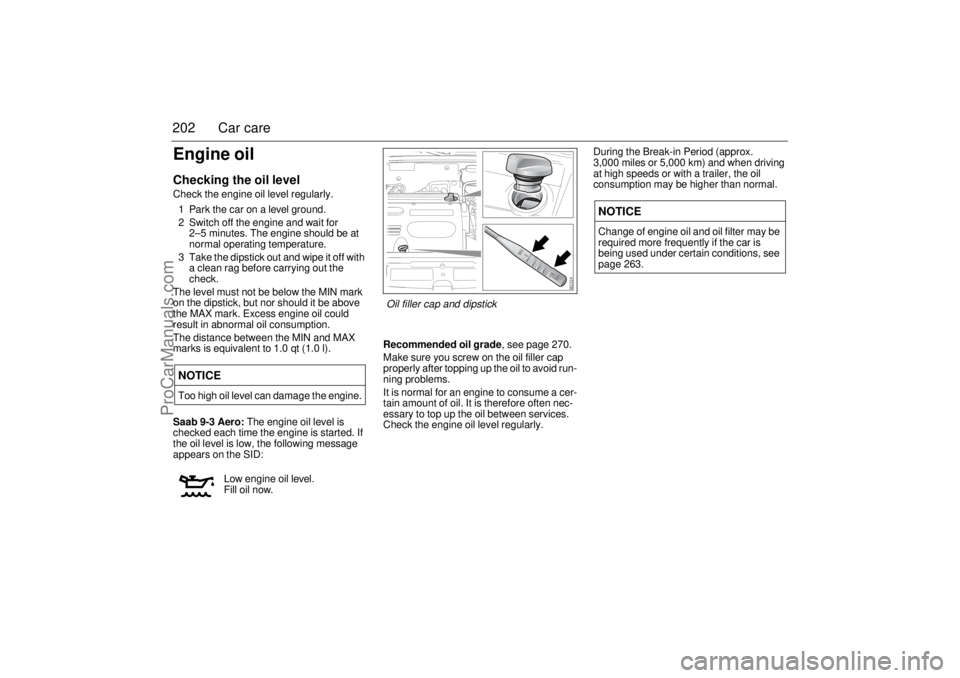
202 Car careEngine oilChecking the oil levelCheck the engine oil level regularly.
1 Park the car on a level ground.
2 Switch off the engine and wait for
2–5 minutes. The engine should be at
normal operating temperature.
3 Take the dipstick out and wipe it off with
a clean rag before carrying out the
check.
The level must not be below the MIN mark
on the dipstick, but nor should it be above
the MAX mark. Excess engine oil could
result in abnormal oil consumption.
The distance between the MIN and MAX
marks is equivalent to 1.0 qt (1.0 l).
Saab 9-3 Aero: The engine oil level is
checked each time the engine is started. If
the oil level is low, the following message
appears on the SID:Recommended oil grade, see page 270.
Make sure you screw on the oil filler cap
properly after topping up the oil to avoid run-
ning problems.
It is normal for an engine to consume a cer-
tain amount of oil. It is therefore often nec-
essary to top up the oil between services.
Check the engine oil level regularly.During the Break-in Period (approx.
3,000 miles or 5,000 km) and when driving
at high speeds or with a trailer, the oil
consumption may be higher than normal.NOTICEToo high oil level can damage the engine.
Low engine oil level.
Fill oil now.
NOTICEChange of engine oil and oil filter may be
required more frequently if the car is
being used under certain conditions, see
page 263.
Oil filler cap and dipstick
ProCarManuals.com
Page 205 of 292
203 Car care
Changing engine oil
Engine oil and oil filter should be changed
according to the service program.
For oil volumes and grades, refer to “Tech-
nical data”.
The oil should be drained when the engine
is warm. The car must stand on level
ground.
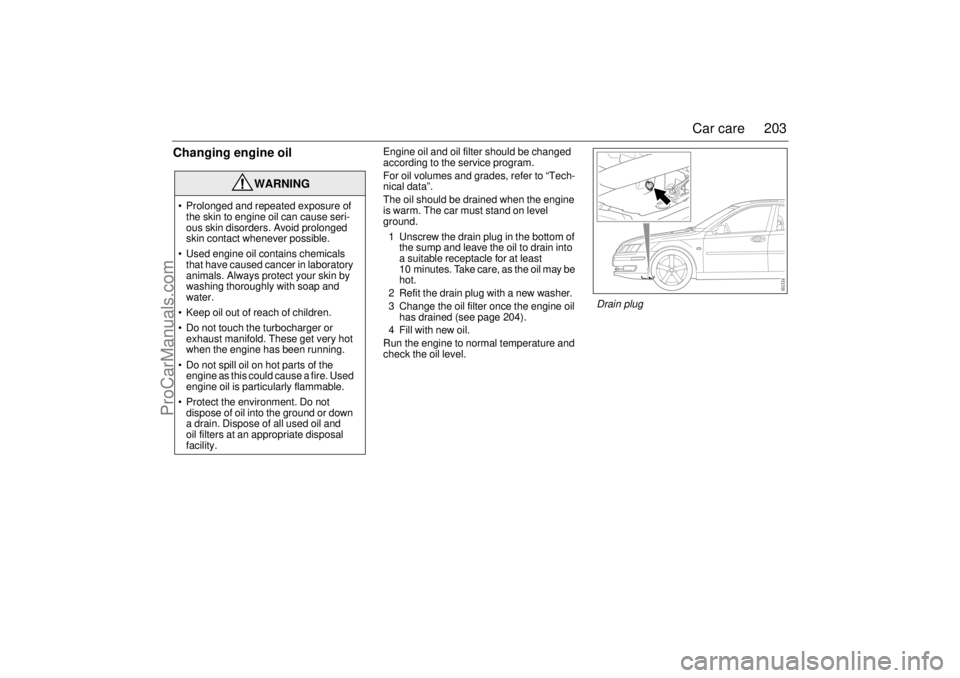
1 Unscrew the drain plug in the bottom of
the sump and leave the oil to drain into
a suitable receptacle for at least
10 minutes. Take care, as the oil may be
hot.
2 Refit the drain plug with a new washer.
3 Change the oil filter once the engine oil
has drained (see page 204).
4 Fill with new oil.
Run the engine to normal temperature and
check the oil level.
WARNING
Prolonged and repeated exposure of
the skin to engine oil can cause seri-
ous skin disorders. Avoid prolonged
skin contact whenever possible.
Used engine oil contains chemicals
that have caused cancer in laboratory
animals. Always protect your skin by
washing thoroughly with soap and
water.
Keep oil out of reach of children.
Do not touch the turbocharger or
exhaust manifold. These get very hot
when the engine has been running.
Do not spill oil on hot parts of the
engine as this could cause a fire. Used
engine oil is particularly flammable.
Protect the environment. Do not
dispose of oil into the ground or down
a drain. Dispose of all used oil and
oil filters at an appropriate disposal
facility.
Drain plug
ProCarManuals.com