belt SAAB 9-3 2005 Service Manual
[x] Cancel search | Manufacturer: SAAB, Model Year: 2005, Model line: 9-3, Model: SAAB 9-3 2005Pages: 292, PDF Size: 23 MB
Page 239 of 292
237 Car care
The wheels and tires have been carefully
matched to the characteristics of the car and
play a key role in its outstanding roadhold-
ing and handling.
Do not take it for granted that a wheel/tire
combination will work in the best possible
way, just because it can be fitted to the car.
To ensure that the speedometer is as accu-
rate as possible it should be reprogrammed
if wheels of a different dimension are fitted.
Contact a Saab dealer.
Because of front wheel drive, the front tires
tend to wear faster than the rear ones. New
tires should always be fitted in pairs, so that
tires on the same axle have the same
amount of tread.
Store wheels lying flat or hanging – never
standing upright.
NOTICEAlways consult your Saab dealer before
changing the car’s wheels or tires on your
Saab.
Wide wheels and tires with side walls that
are too low can:
be damaged in potholes, etc.
cause springs, shock absorbers and
wheel bearings and body mountings
to be overloaded.
affect the function of the Electronic
Stability Program (ESP).
The speed and load limits of the tires
must not be exceeded; see page 242.
Wheels larger than 17" must not be fitted
on the Saab 9-3 for reasons above. The
permissible offset is 1.61 inch (41 mm).
WARNING
Mixing tires could cause you to lose
control while driving. If you mix tires of
different sizes or types (radial and bias-
belted tires), the vehicle may not handle
properly, and you could have a crash.
Using tires of different sizes may also
cause damage to your vehicle. Be sure to
use the same size and type tires on all
wheels. It’s all right to drive with your
compact spare temporarily, it was devel-
oped for use on your vehicle. See
“Compact spare” on page 246.
WARNING
If you use bias-ply tires on your vehicle,
the wheel rim flanges could develop
cracks after many miles of driving. A tire
and/or wheel could fail suddenly, causing
a crash. Use only radial-ply tires with the
wheels on your vehicle.
ProCarManuals.com
Page 243 of 292

241 Car care
Tire Sidewall LabelingUseful information about a tire is molded
into it´s sidewall.
Tire size: The tire size ia a combination of
letters and numbers used to define a partic-
ular tire´s width, height, aspect ratio, con-
struction type and service description.
Department of Transportation (DOT):
The Department of Transportation (DOT)
code indicates that the tire is in compliance
with the U.S. Department of Transportation
Motor Vehicle Safety standards.
Tire Identification Number (TIN): The let-
ters and numbers following DOT code are
the Tire Identification Number (TIN). The
TIN shows the manufacturer and plant
code, tire size, and date the tire was manu-
factured. The TIN is molded onto both sides
of the tire.
Tire Ply Material: The type of cord and
number of plies in the sidewall and under
the tread.Uniform Tire Quality Grading (UTQG):
Tire manufacturers are required to grade
tires based on the performance factors:
treadwear, traction and temperature resis-
tance. For more information see “Uniform
Tire Quality Grading” on page 238.
Maximum Cold Inflation Load Limit: Max-
imum load that can be carried and the max-
imum pressure needed to support that load.
For information on recommended tire pres-
sure see “Recommended lowest tire pres-
sure, cold tires” on page 277 and “Loading
Your Vehicle” on page 243.
Tire SizeThe following illustration shows an example
of a typical passenger car tire size.
Tire Width: The three-digit number indi-
cates the tire section width in millimeters
from sidewall to sidewall.215/55 R 16 93 H
||||||
abcdef
aTire Width
b Aspect Ratio
c Belt Rating
d Rim diameter
e Load range
f Speed rating
ProCarManuals.com
Page 244 of 292
242 Car careAspect ratio: A two-digit number that indi-
cates the tire height-to-width measure-
ments. For example, if the tire size aspect
ratio is “55”, as shown in item “C” of the illus-
tration, it would mean that the tire´s sidewall
is 55% as high as it is wide.
Belt Rating: A letter code is used to indicate
the type of ply construction in the tire. The
letter “R” means radial ply construction; the
letter “D” means diagonal or bias ply con-
struction; and the letter “B” means belted-
bias ply construction.
Rim Diameter: Diameter of the wheel in
inches.
Load range: The load range represents the
load carry capacity a tire is certified to carry.
Speed Rating: The maximum speed that a
tire is certified to carry a load. Speed ratings
range from “A” to “Z”.
Tire markingsAn example of the meaning of the different
markings in a tire size is given below for a
tire size of 225/45 R17 94H:
225 Tire section width, mm
45 Aspect ratio, i.e. the section height
as a percentage of the section
width
R Radial ply
17 Wheel rim diameter 17 in at bead
seats
94 Tire load index
H Speed rating
Tire load indices
91 Tire approved for max. 1355 lbs.
(615 kg)
93 Max. 1433 lbs. (650 kg)
94 Max. 1477 lbs. (670 kg)
Speed ratings
Q Tire approved for speeds up to
100 mph (160 km/h)
S Max. 112 mph (180 km/h)
T Max. 118 mph (190 km/h)
H Max. 130 mph (210 km/h)
V Max. 149 mph (240 km/h)
W Max. 168 mph (270 km/h)
Y Max. 186 mph (300 km/h)
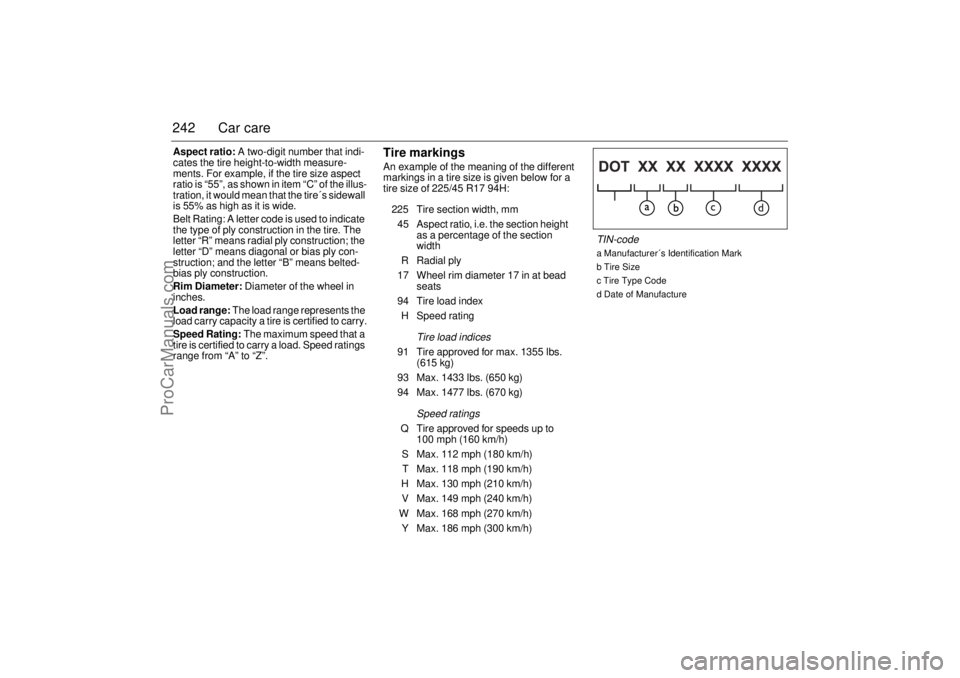
TIN-codea Manufacturer´s Identification Mark
b Tire Size
c Tire Type Code
d Date of Manufacture
ProCarManuals.com
Page 245 of 292
243 Car care
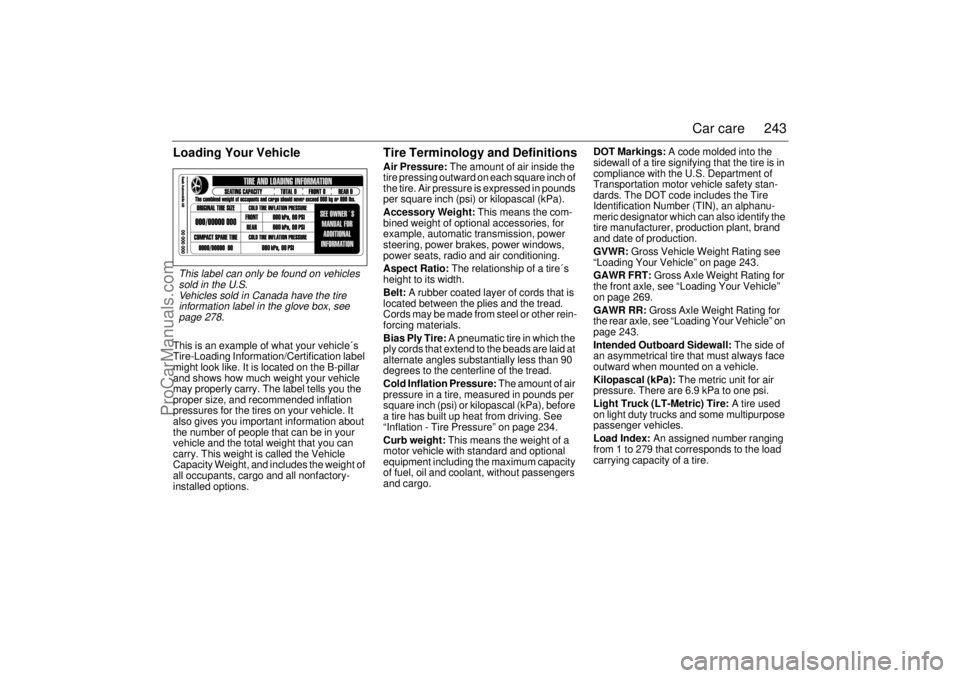
Loading Your VehicleThis is an example of what your vehicle´s
Tire-Loading Information/Certification label
might look like. It is located on the B-pillar
and shows how much weight your vehicle
may properly carry. The label tells you the
proper size, and recommended inflation
pressures for the tires on your vehicle. It
also gives you important information about
the number of people that can be in your
vehicle and the total weight that you can
carry. This weight is called the Vehicle
Capacity Weight, and includes the weight of
all occupants, cargo and all nonfactory-
installed options.
Tire Terminology and DefinitionsAir Pressure: The amount of air inside the
tire pressing outward on each square inch of
the tire. Air pressure is expressed in pounds
per square inch (psi) or kilopascal (kPa).
Accessory Weight: This means the com-
bined weight of optional accessories, for
example, automatic transmission, power
steering, power brakes, power windows,
power seats, radio and air conditioning.
Aspect Ratio: The relationship of a tire´s
height to its width.
Belt: A rubber coated layer of cords that is
located between the plies and the tread.
Cords may be made from steel or other rein-
forcing materials.
Bias Ply Tire: A pneumatic tire in which the
ply cords that extend to the beads are laid at
alternate angles substantially less than 90
degrees to the centerline of the tread.
Cold Inflation Pressure: The amount of air
pressure in a tire, measured in pounds per
square inch (psi) or kilopascal (kPa), before
a tire has built up heat from driving. See
“Inflation - Tire Pressure” on page 234.
Curb weight: This means the weight of a
motor vehicle with standard and optional
equipment including the maximum capacity
of fuel, oil and coolant, without passengers
and cargo.DOT Markings: A code molded into the
sidewall of a tire signifying that the tire is in
compliance with the U.S. Department of
Transportation motor vehicle safety stan-
dards. The DOT code includes the Tire
Identification Number (TIN), an alphanu-
meric designator which can also identify the
tire manufacturer, production plant, brand
and date of production.
GVWR: Gross Vehicle Weight Rating see
“Loading Your Vehicle” on page 243.
GAWR FRT: Gross Axle Weight Rating for
the front axle, see “Loading Your Vehicle”
on page 269.
GAWR RR: Gross Axle Weight Rating for
the rear axle, see “Loading Your Vehicle” on
page 243.
Intended Outboard Sidewall: The side of
an asymmetrical tire that must always face
outward when mounted on a vehicle.
Kilopascal (kPa): The metric unit for air
pressure. There are 6.9 kPa to one psi.
Light Truck (LT-Metric) Tire: A tire used
on light duty trucks and some multipurpose
passenger vehicles.
Load Index: An assigned number ranging
from 1 to 279 that corresponds to the load
carrying capacity of a tire.
This label can only be found on vehicles
sold in the U.S.
Vehicles sold in Canada have the tire
information label in the glove box, see
page 278.
ProCarManuals.com
Page 253 of 292
251 Car care
Safety beltsCheck the function of the safety belts regu-
larly as follows:
Hold the diagonal strap and pull it sharply.
The safety belt should lock and it should
not be possible to withdraw it further.
Check the anchorage points in the floor.
They must not have suffered rust damage.
If a belt is worn or has any fraying edges, it
should be replaced.
Safety belts must not come into contact with
substances such as polishes, oil or chemi-
cals. If the belts get dirty, wash them with
warm water and a detergent or have them
replaced.
Upholstery and trimTo remove fluff and hairs from the seats,
door armrests and headlining, use a
vacuum cleaner, a moist lint-free cloth, or a
clothes brush. Remove spots and dirt using
a cloth moistened with lukewarm soapy
water.
When using a stain remover, always work
from the outside towards the centre to avoid
leaving a ring. If a soiled ring or spot should
remain, it can usually be removed using
lukewarm soapy water or water alone.
Spots left by liquids, such as soft drinks or
thin oil, must be removed at once with an
absorbent material, such as kitchen towel-
ling. Then clean with a stain remover.
White spirit is recommended for removing
grease and oil stains. A medium stiff brush
may also be used.Cleaning and caring for leather
upholsteryThe principal reason for treating leather
upholstery is to maintain its elegant appear-
ance and to provide it with a protective film.
Disco lour at ion caused by dust and wear
mainly affects the lighter shades, although
this is not detrimental to the leather, indeed,
the patina resulting from use is often consid-
ered desirable in leather. But if the leather is
allowed to become too grubby, it can start to
look shabby.
The leather upholstery should be cleaned
and reconditioned twice a year in conjunc-
tion with spring and autumn inspections. In
WARNING
If the car is involved in a crash, the safety
belts, belt pretensioners and other asso-
ciated components must be inspected at
a Saab dealer.
Never make any alterations or repairs to
the safety belts yourself but visit a Saab
dealer.
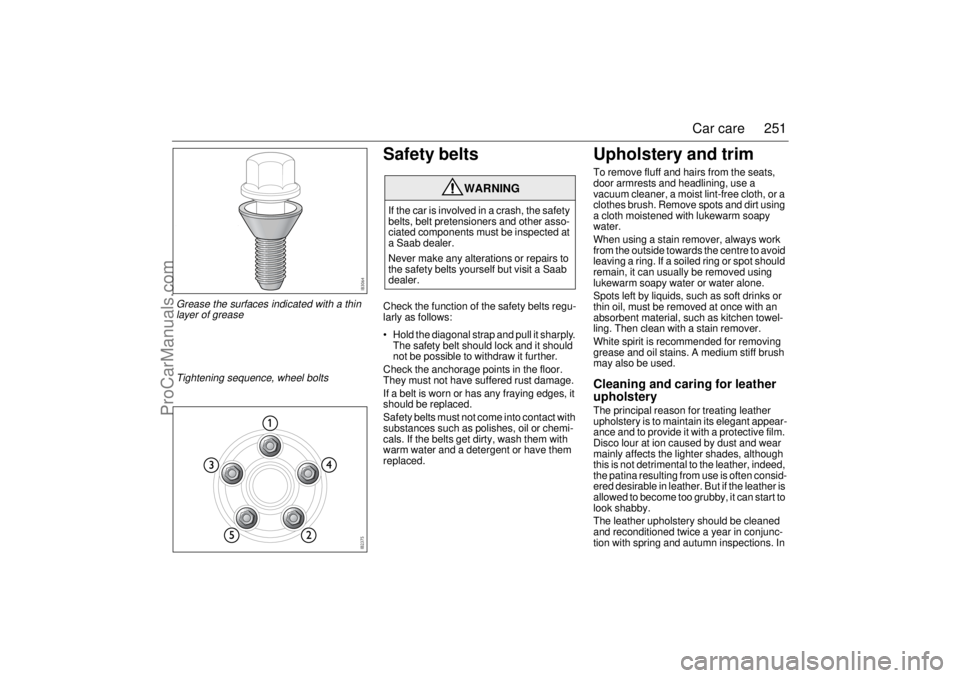
Tightening sequence, wheel boltsGrease the surfaces indicated with a thin
layer of grease
ProCarManuals.com
Page 259 of 292

257 Car care
Air conditioning (A/C)
TroubleshootingIf a fault occurs in the A/C system, there are
a number of checks you can perform your-
self. If the fault persists, however, have the
system checked at a Saab dealer.
Note:
When the A/C system is running, the intake
air is dehumidified. The resultant condensa-
tion that forms on the evaporator is drained
off under the car. When the car is parked,
this may result in a small puddle forming on
the ground. The warmer the air and the
higher the relative humidity, the more con-
densation will be produced.Inadequate coolinga Check that the controls for temperature
and air distribution are correctly set; see
“Manual climate-control system” on
page 103.
b Check that the condenser (in front of the
radiator) has not become clogged with
dirt and insects.
c Make sure that the compressor drive
belt does not slip (see page 210).
d Check the fuses for the ventilation fans
and compressor (see page 229).
Maintenance The compressor drive belt should be
inspected under the regular service
program.
Clean away dirt and insects from the
condenser and radiator to prevent clog-
ging. When washing the car, use the hose
to spray the radiator and condenser
(located in front of the radiator) from both
sides (both from the front of the car and
from inside the engine bay). Do not use a
pressure washer.
Caution: Do not hose down the radia-
tor and condenser while the engine is
hot.
Other than in extremely cold weather, do not
screen the radiator, e.g. with netting, as this
will greatly diminish its cooling capacity.
Applicable to the manual climate control
system - During cold months the air condi-
tioning should be switched on once or
twice a month and run for 5–10 minutes
during highway driving once the engine is
warm.
This action saves the gaskets in the
compressor from being spoiled. The
compressor uses a lubricant that circu-
lates with the coolant.
WARNING
All repairs and adjustments to the A/C
system must be carried out at a Saab
dealer authorized for this kind of work.
The A/C system is pressurized. Do not
break any connections or undo A/C
system components.
Escaping gas can cause eye injury or
other personal injury.NOTICE The A/C system is designed for use
with R134a refrigerant.
Refrigerant handling requires special
equipment and special procedures for
charging and draining the system.
Never mix R 134a with other refriger-
ants.
NOTICEDo not use a pressure washer when
cleaning the condenser or radiator due to
the risk of damage.
ProCarManuals.com
Page 268 of 292

266 Customer Assistance and InformationVehicle Data Collection and
Event Data RecordersYour vehicle, like other modern motor vehi-
cles, has a number of sophisticated com-
puter systems that monitor and control sev-
eral aspects of the vehicle’s performance.
Your vehicle uses on-board vehicle comput-
ers to monitor emission control components
to optimize fuel economy, to monitor condi-
tions for air bag deployment and, if so
equipped, to provide anti-lock braking and
to help the driver control the vehicle in diffi-
cult driving situations. Some information
may be stored during regular operations to
facilitate repair of detected malfunctions;
other information is stored only in a crash
event by computer systems commonly
called event data recorders (EDR).
In a crash event, computer systems, such
as the Air Bag Sensing and Diagnostic
Module (SDM) in your vehicle may record
information about the condition of the vehi-
cle and how it was operated, such as data
related to engine speed, brake application,
throttle position, vehicle speed, steering
wheel angle, lateral acceleration, safety belt
usage, air bag readiness, air bag perfor-
mance, and the severity of a collision. This
information has been used to improve vehi-
cle crash performance and may be used to
improve crash performance of future vehi-
cles and driving safety. Unlike the data
recorders on many airplanes, these on-
board systems do not record sounds, such
as conversation of vehicle occupants.To read this information, special equipment
is needed and access to the vehicle or the
SDM is required.
Saab will not access information about a
crash event or share it with others other than
with the consent of the vehicle owner or, if
the vehicle is leased, with the consent of
the lessee,
in response to an official request of police
or similar government office,
as part of Saab’s defense of litigation
through the discovery process, or
as required by law.
In addition, once Saab collects or receives
data, Saab may
use the data for Saab research needs,
make it available for research where
appropriate confidentiality is to be main-
tained and need is shown, or
share summary data which is not tied to a
specific vehicle with non-Saab organiza-
tions for research purposes.
Others, such as law enforcement, may have
access to the special equipment that can
read the information if they have access to
the vehicle or SDM.
If your vehicle is equipped with OnStar®,
please check the OnStar® subscription ser-
vice agreement or manual for information
on its operations and data collection.
ProCarManuals.com
Page 269 of 292
267 Technical data
General data __________ 268
Engine _______________ 270
Engine oil _____________ 270
Fuel__________________ 271
Engines ______________ 271
Electrical system_______ 272
Drive belt _____________ 272
Manual transmission ___ 272
Automatic transmission _ 273
Suspension ___________ 273
Steering ______________ 273
Brake system__________ 274
Wheels and tires _______ 275
Plates and labels _______ 278
Technical data
ProCarManuals.com
Page 274 of 292

272 Technical dataElectrical system
Drive belt Manual transmissionVoltage ________________________ 12 V
Battery capacity _________________ 60 Ah
Starter motor ____________________ 1.8 kW
Alternator rating:
Manual gearbox ___________________ 120 A/14 V
Automatic gearbox _________________ 140 A/14 V
Firing order _____________________ 1-3-4-2
Spark plugs:
Type ____________________________ NGK PFR6T-10G
Electrode gap _____________________ 0.9–1.0 mm
Tightening torque __________________ 20 ft.lb. (28 Nm)
Outside length ___________________ 40.472'' (1028 mm)Drive belt
Type __________________________ Fully synchronized
with final drive gear
and differential
Oil type (for topping up)____________ Saab MTF 0063
Oil capacity:
5-speed _________________________ 1.9 qts. (1.8 l), to
level plug
6-speed, 2.0 Turbo _________________ 3.15 qts. (3.0 l)
Speed, mph (km/h) at 1000 rpm in highest
gear (5th gear) _________________ 27–30 (43–48)
Speed, mph (km/h) at 1000 rpm in highest
gear (6th gear) _________________ 29–34 (46–55)
ProCarManuals.com
Page 283 of 292
281 Technical data
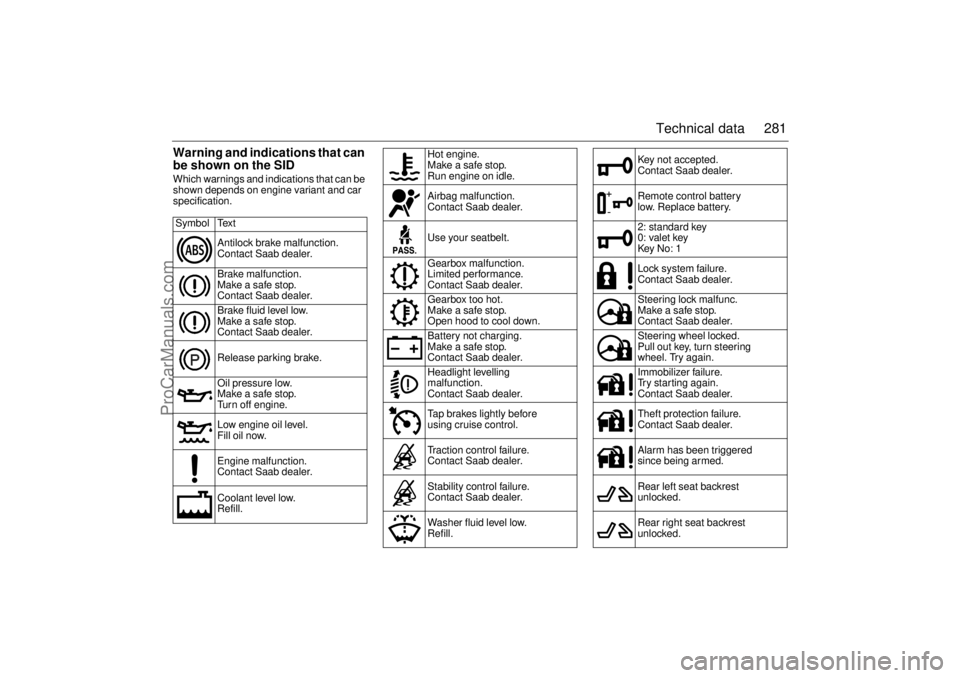
Warning and indications that can
be shown on the SIDWhich warnings and indications that can be
shown depends on engine variant and car
specification.
Symbol Text
Antilock brake malfunction.
Contact Saab dealer.
Brake malfunction.
Make a safe stop.
Contact Saab dealer.
Brake fluid level low.
Make a safe stop.
Contact Saab dealer.
Release parking brake.
Oil pressure low.
Make a safe stop.
Turn off engine.
Low engine oil level.
Fill oil now.
Engine malfunction.
Contact Saab dealer.
Coolant level low.
Refill.
Hot engine.
Make a safe stop.
Run engine on idle.
Airbag malfunction.
Contact Saab dealer.
Use your seatbelt.
Gearbox malfunction.
Limited performance.
Contact Saab dealer.
Gearbox too hot.
Make a safe stop.
Open hood to cool down.
Battery not charging.
Make a safe stop.
Contact Saab dealer.
Headlight levelling
malfunction.
Contact Saab dealer.
Tap brakes lightly before
using cruise control.
Traction control failure.
Contact Saab dealer.
Stability control failure.
Contact Saab dealer.
Washer fluid level low.
Refill.
Key not accepted.
Contact Saab dealer.
Remote control battery
low. Replace battery.
2: standard key
0: valet key
Key No: 1
Lock system failure.
Contact Saab dealer.
Steering lock malfunc.
Make a safe stop.
Contact Saab dealer.
Steering wheel locked.
Pull out key, turn steering
wheel. Try again.
Immobilizer failure.
Try starting again.
Contact Saab dealer.
Theft protection failure.
Contact Saab dealer.
Alarm has been triggered
since being armed.
Rear left seat backrest
unlocked.
Rear right seat backrest
unlocked.
ProCarManuals.com