brake SAAB 9-3 2005 Workshop Manual
[x] Cancel search | Manufacturer: SAAB, Model Year: 2005, Model line: 9-3, Model: SAAB 9-3 2005Pages: 292, PDF Size: 23 MB
Page 245 of 292
243 Car care
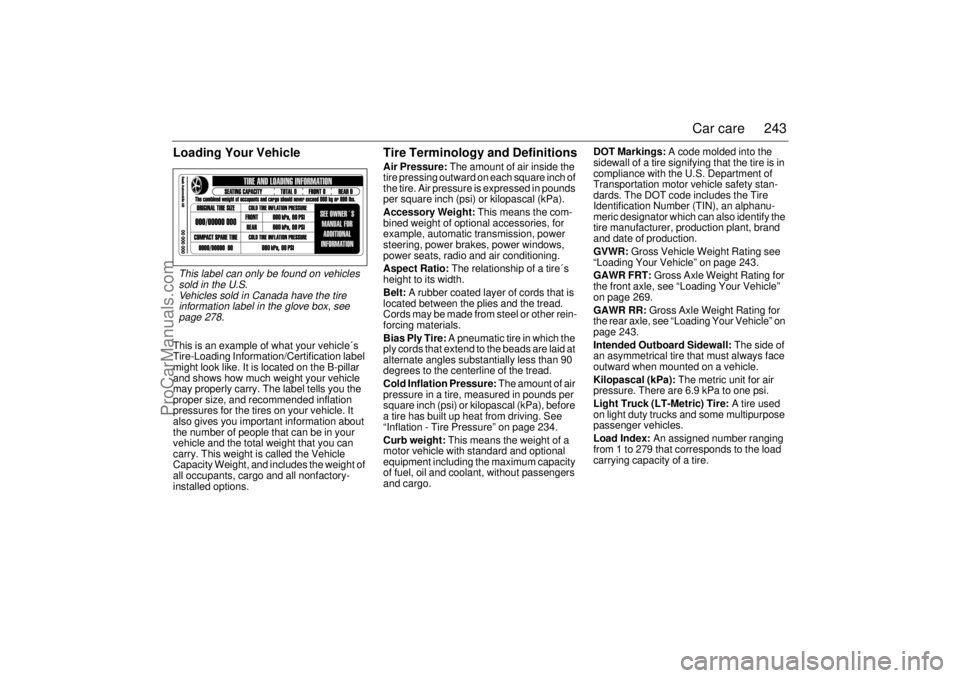
Loading Your VehicleThis is an example of what your vehicle´s
Tire-Loading Information/Certification label
might look like. It is located on the B-pillar
and shows how much weight your vehicle
may properly carry. The label tells you the
proper size, and recommended inflation
pressures for the tires on your vehicle. It
also gives you important information about
the number of people that can be in your
vehicle and the total weight that you can
carry. This weight is called the Vehicle
Capacity Weight, and includes the weight of
all occupants, cargo and all nonfactory-
installed options.
Tire Terminology and DefinitionsAir Pressure: The amount of air inside the
tire pressing outward on each square inch of
the tire. Air pressure is expressed in pounds
per square inch (psi) or kilopascal (kPa).
Accessory Weight: This means the com-
bined weight of optional accessories, for
example, automatic transmission, power
steering, power brakes, power windows,
power seats, radio and air conditioning.
Aspect Ratio: The relationship of a tire´s
height to its width.
Belt: A rubber coated layer of cords that is
located between the plies and the tread.
Cords may be made from steel or other rein-
forcing materials.
Bias Ply Tire: A pneumatic tire in which the
ply cords that extend to the beads are laid at
alternate angles substantially less than 90
degrees to the centerline of the tread.
Cold Inflation Pressure: The amount of air
pressure in a tire, measured in pounds per
square inch (psi) or kilopascal (kPa), before
a tire has built up heat from driving. See
“Inflation - Tire Pressure” on page 234.
Curb weight: This means the weight of a
motor vehicle with standard and optional
equipment including the maximum capacity
of fuel, oil and coolant, without passengers
and cargo.DOT Markings: A code molded into the
sidewall of a tire signifying that the tire is in
compliance with the U.S. Department of
Transportation motor vehicle safety stan-
dards. The DOT code includes the Tire
Identification Number (TIN), an alphanu-
meric designator which can also identify the
tire manufacturer, production plant, brand
and date of production.
GVWR: Gross Vehicle Weight Rating see
“Loading Your Vehicle” on page 243.
GAWR FRT: Gross Axle Weight Rating for
the front axle, see “Loading Your Vehicle”
on page 269.
GAWR RR: Gross Axle Weight Rating for
the rear axle, see “Loading Your Vehicle” on
page 243.
Intended Outboard Sidewall: The side of
an asymmetrical tire that must always face
outward when mounted on a vehicle.
Kilopascal (kPa): The metric unit for air
pressure. There are 6.9 kPa to one psi.
Light Truck (LT-Metric) Tire: A tire used
on light duty trucks and some multipurpose
passenger vehicles.
Load Index: An assigned number ranging
from 1 to 279 that corresponds to the load
carrying capacity of a tire.
This label can only be found on vehicles
sold in the U.S.
Vehicles sold in Canada have the tire
information label in the glove box, see
page 278.
ProCarManuals.com
Page 250 of 292

248 Car careChanging a tire
WARNING
Lifting a vehicle and getting under it to do
maintenance or repairs is dangerous
without the appropriate safety equipment
and training. The jack provided with your
vehicle is designed only for changing a
flat tire. If it is used for anything else, you
or others could be badly injured or killed if
the vehicle slips off the jack. Use the jack
provided with your vehicle only for chang-
ing a flat tire.
Changing a tire can be dangerous. The
vehicle can slip off the jack and roll over
or fall on you or other people. You and
they could be badly injured or even killed.
Find a level place to change your tire. To
help prevent the vehicle from moving:
1 Set the parking brake firmly.
2 If you have an automatic transmis-
sion, put the shift lever in PARK (P).
For a manual transmission, leave the
car in gear (1st or REVERSE (R)).
3 Turn off the engine and do not restart
while the vehicle is raised.
4 Do not allow passengers to remain in
the vehicle.
To be even more certain the vehicle won't
move, you should put blocks at the front
and rear of the tire farthest away from the
one being changed. That would be the
tire, on the other side, at the opposite end
of the vehicle.
The car jack is designed solely for use
in changing a tire or fitting snow
chains. It must not be used to
support the car during repair work
or servicing.
Never crawl under a car that is
supported only by a jack. Always use
axle stands.
Raising your vehicle too high or with
the jack improperly positioned can
damage the vehicle and even make
the vehicle fall. To help avoid personal
injury and vehicle damage, be sure to
fit the jack lift head into the proper
location before raising the vehicle, and
raise the vehicle only far enough off
the ground so there is enough room for
the spare tire to fit (no more than
25 mm or 1 inch clearance between
the ground and the bottom of the tire).
Switch on the hazard warning lights if
the car is on a road.
The jack should be stored correctly
under the carpeting in the trunk. If it
lies loose in the car, it could thrown
forward and cause personal injury in
the event of a crash or if the car rolls
over.
Grit, salt and rust can clog the inner
threads of the wheel bolts if the car has
been driven for several years exclu-
sively with alloy wheels.
If steel wheels are being installed, the
bolt hole threads in the brake hubs
should be cleaned before the thinner
steel wheels are fitted. It may other-
wise not be possible to achieve the
correct clamping force, despite tight-
ening the wheel bolts to the correct
torque.
ProCarManuals.com
Page 251 of 292
249 Car care
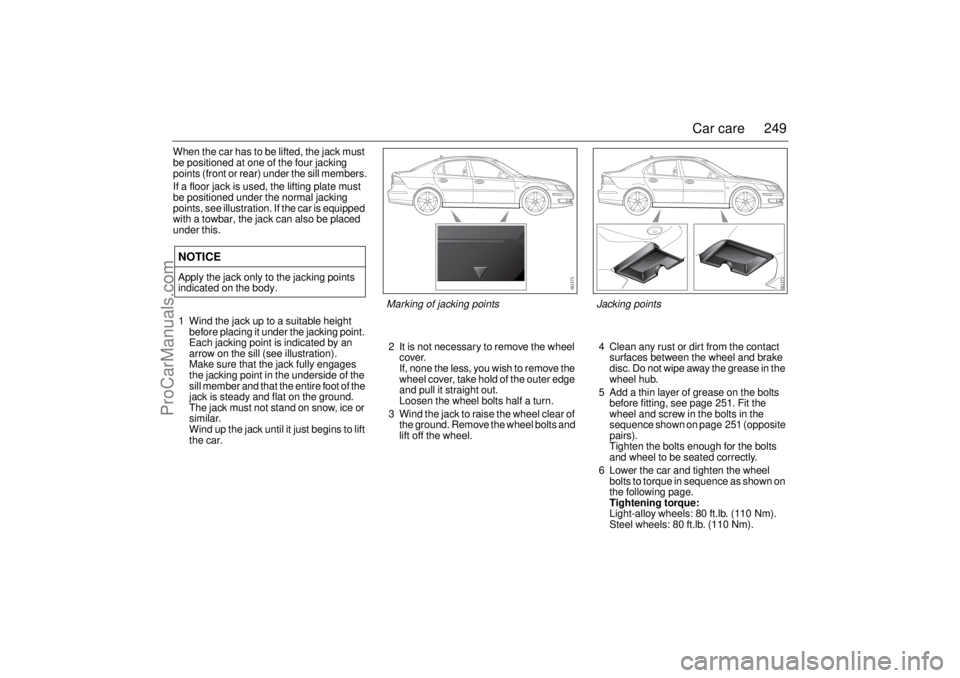
When the car has to be lifted, the jack must
be positioned at one of the four jacking
points (front or rear) under the sill members.
If a floor jack is used, the lifting plate must
be positioned under the normal jacking
points, see illustration. If the car is equipped
with a towbar, the jack can also be placed
under this.
1 Wind the jack up to a suitable height
before placing it under the jacking point.
Each jacking point is indicated by an
arrow on the sill (see illustration).
Make sure that the jack fully engages
the jacking point in the underside of the
sill member and that the entire foot of the
jack is steady and flat on the ground.
The jack must not stand on snow, ice or
similar.
Wind up the jack until it just begins to lift
the car.2 It is not necessary to remove the wheel
cover.
If, none the less, you wish to remove the
wheel cover, take hold of the outer edge
and pull it straight out.
Loosen the wheel bolts half a turn.
3 Wind the jack to raise the wheel clear of
the ground. Remove the wheel bolts and
lift off the wheel.4 Clean any rust or dirt from the contact
surfaces between the wheel and brake
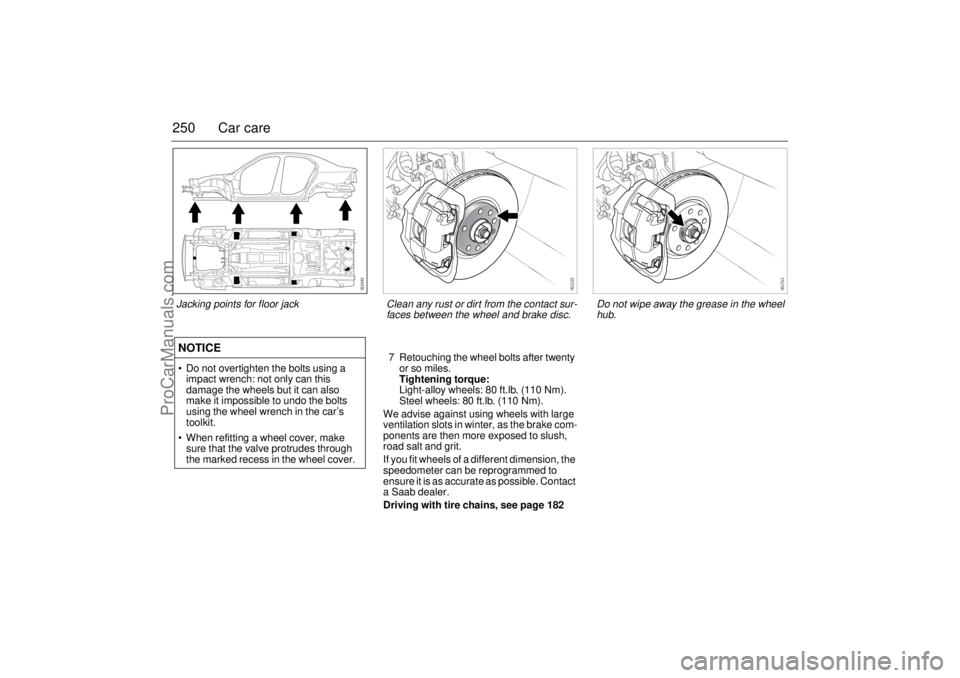
disc. Do not wipe away the grease in the
wheel hub.
5 Add a thin layer of grease on the bolts
before fitting, see page 251. Fit the
wheel and screw in the bolts in the
sequence shown on page 251 (opposite
pairs).
Tighten the bolts enough for the bolts
and wheel to be seated correctly.
6 Lower the car and tighten the wheel
bolts to torque in sequence as shown on
the following page.
Tightening torque:
Light-alloy wheels: 80 ft.lb. (110 Nm).
Steel wheels: 80 ft.lb. (110 Nm).NOTICEApply the jack only to the jacking points
indicated on the body.
Jacking points
Marking of jacking points
ProCarManuals.com
Page 252 of 292
250 Car care
7 Retouching the wheel bolts after twenty
or so miles.
Tightening torque:
Light-alloy wheels: 80 ft.lb. (110 Nm).
Steel wheels: 80 ft.lb. (110 Nm).
We advise against using wheels with large
ventilation slots in winter, as the brake com-
ponents are then more exposed to slush,
road salt and grit.
If you fit wheels of a different dimension, the
speedometer can be reprogrammed to
ensure it is as accurate as possible. Contact
a Saab dealer.
Driving with tire chains, see page 182
NOTICE Do not overtighten the bolts using a
impact wrench: not only can this
damage the wheels but it can also
make it impossible to undo the bolts
using the wheel wrench in the car’s
toolkit.
When refitting a wheel cover, make
sure that the valve protrudes through
the marked recess in the wheel cover.
Do not wipe away the grease in the wheel
hub.
Clean any rust or dirt from the contact sur-
faces between the wheel and brake disc.
Jacking points for floor jack
ProCarManuals.com
Page 255 of 292

253 Car care
In the U.S., Saab offers a full complement of
car care products. See your dealer or visit
us at www.saabcatalog.com.
Convertible:
Wash the soft top with a mild soap solu-
tion and lukewarm water. For spot clean-
ing the top, a finger nail brush can also be
used. Stroke the brush in the direction of
the fabric, not across the threads.
If a pressure washer is used be heedful of
the following recommendations:
on the lower part of the car (not higher
than the door handles): max pressure
of 100 bar and not closer than 8 in.
(20 cm).
on the upper part of the car: tax pres-
sure of 100 bar and not closer than
32 in. (80 cm).
Do not use any drying chemicals or water-
proofing agents.
Avoid automatic car washes.
Waxing and polishingDo not wax a new car during the first three
or four months. In fact, there is no need to
polish the car before the paintwork has
started to dull through oxidation. Other than
in exceptional cases, do not use abrasive
polishes containing a cutting agent on a new
car. Always wash the car thoroughly before
waxing or polishing.Touching up the paintDamaged paintwork should be treated as
soon as it is discovered: the longer it is left,
the greater the risk of corrosion. The anti-
corrosion warranty does not cover corrosion
resulting from untreated defects.
Paintwork damage sustained in a crash is
usually extensive and can only be properly
restored by professionals.
However, you can repair small scratches
and stone chip damage yourself. The nec-
essary tools and materials, such as primer,
touch-up paint and brushes, are available
from your Saab dealer.
In the case of minor flaws in the paintwork,
where the metal has not been exposed and
an undamaged layer of paint remains,
touch-up paint can usually be applied
directly, after any dirt has been scraped
away using a pointed knife.
If corrosion has already set in, such as the
result of stone-chip damage, use a pointed
knife to scrape off all surface rust. If possi-
ble, the damaged area should be taken
back to the bare metal. The metal should
NOTICE Try your brakes on leaving a car wash.
Wet brake discs reduce the perfor-
mance of the brakes.
Fixed antennae, such as for a mobile
phone, must be removed if the car
goes through an automatic car wash.
Cars with Saab Parking Assistance:
Do not spray the sensors or closer
than 8 in. (20 cm) to the sensors with
a pressure washer, as this can
damage them.
ProCarManuals.com
Page 265 of 292

263 Customer Assistance and Information
Engine oil and filter changesChanging the engine oil and filter is required
at every service point. Use only a Saab
approved long-life oil filter and engine oils
meeting the SAE viscosity ratings and API
service classifications stated in the “Techni-
cal data” section of this Owner’s Manual.
The use of extra additives in the oil is not
necessary and is not recommended, and
may be harmful to turbochargers.
More frequent oil changes are recom-
mended if your vehicle is operated under
any of the following conditions:
Most trips are less than 5–10 miles (8–
16 km). This is particularly important
when outside temperatures are below
freezing.
Most trips include extensive idling
(frequent stop-and-go traffic).
Most trips are through dusty areas (such
as construction zones).
If the vehicle is used for delivery service,
police, taxi or other commercial applica-
tions.
If your driving habits match this description,
have the engine oil and filter changed in-
between normal services. These conditions
cause the engine oil to break down faster.
The Warranties and Service Record Book-
let has provisions to record extra oil
changes.
Service record retentionIt is the owner’s responsibility to retain ser-
vice records. If possible, you should keep
copies of all shop work orders for all service
and repairs, whenever performed. As indi-
cated in the new car and emission control
system warranties, it is important to docu-
ment that all necessary maintenance has
been done.
HOW THE SERVICE RECORD IS ORGA-
NIZED
The service record is comprised of a series
of coupons on which to record services as
they are performed. There are additional
coupons for documenting extra engine oil
and filter changes, extra automatic trans-
mission fluid services necessary for severe
service conditions, and brake fluid changes.
HOW TO USE THE SERVICE RECORD
COUPONS
When the car is brought to a Saab dealer for
scheduled maintenance, present the War-
ranties & Service Record Booklet to the ser-
vice manager. When the technician has
completed the service, the technician will
sign the maintenance record. The person
responsible for quality assurance at the
dealership will also sign and stamp the
record with the dealer identification stamp.
Service costsDealer pricing practices and labor for ser-
vice work vary. Saab’s recommended ser-
vice times for each service point do not
include the labor required to replace wear
items, such as wiper blades, brake pads or
tires. Nor is labor to perform other service or
repairs found to be necessary as a result of
the inspections included in these times.
Additional labor and parts will be charged
for such work when necessary, except as
covered under an applicable Saab warranty
or any optional extended service contract.
Transmission fluid changes or suspension
alignment, when necessary, are also addi-
tional.
Dealer charges for general shop material,
regulated hazardous waste removal, recy-
cling expenses or other operation costs may
also be applied to service and repair
invoices and are apt to vary by dealer and
location.
ProCarManuals.com
Page 268 of 292

266 Customer Assistance and InformationVehicle Data Collection and
Event Data RecordersYour vehicle, like other modern motor vehi-
cles, has a number of sophisticated com-
puter systems that monitor and control sev-
eral aspects of the vehicle’s performance.
Your vehicle uses on-board vehicle comput-
ers to monitor emission control components
to optimize fuel economy, to monitor condi-
tions for air bag deployment and, if so
equipped, to provide anti-lock braking and
to help the driver control the vehicle in diffi-
cult driving situations. Some information
may be stored during regular operations to
facilitate repair of detected malfunctions;
other information is stored only in a crash
event by computer systems commonly
called event data recorders (EDR).
In a crash event, computer systems, such
as the Air Bag Sensing and Diagnostic
Module (SDM) in your vehicle may record
information about the condition of the vehi-
cle and how it was operated, such as data
related to engine speed, brake application,
throttle position, vehicle speed, steering
wheel angle, lateral acceleration, safety belt
usage, air bag readiness, air bag perfor-
mance, and the severity of a collision. This
information has been used to improve vehi-
cle crash performance and may be used to
improve crash performance of future vehi-
cles and driving safety. Unlike the data
recorders on many airplanes, these on-
board systems do not record sounds, such
as conversation of vehicle occupants.To read this information, special equipment
is needed and access to the vehicle or the
SDM is required.
Saab will not access information about a
crash event or share it with others other than
with the consent of the vehicle owner or, if
the vehicle is leased, with the consent of
the lessee,
in response to an official request of police
or similar government office,
as part of Saab’s defense of litigation
through the discovery process, or
as required by law.
In addition, once Saab collects or receives
data, Saab may
use the data for Saab research needs,
make it available for research where
appropriate confidentiality is to be main-
tained and need is shown, or
share summary data which is not tied to a
specific vehicle with non-Saab organiza-
tions for research purposes.
Others, such as law enforcement, may have
access to the special equipment that can
read the information if they have access to
the vehicle or SDM.
If your vehicle is equipped with OnStar®,
please check the OnStar® subscription ser-
vice agreement or manual for information
on its operations and data collection.
ProCarManuals.com
Page 269 of 292
267 Technical data
General data __________ 268
Engine _______________ 270
Engine oil _____________ 270
Fuel__________________ 271
Engines ______________ 271
Electrical system_______ 272
Drive belt _____________ 272
Manual transmission ___ 272
Automatic transmission _ 273
Suspension ___________ 273
Steering ______________ 273
Brake system__________ 274
Wheels and tires _______ 275
Plates and labels _______ 278
Technical data
ProCarManuals.com
Page 271 of 292

269 Technical data
Maximum axle load:
Sport Sedan, front _________________ 2480 lbs. (1125 kg)
Sport Sedan, rear __________________ 2230 lbs. (1010 kg)
Convertible, front __________________ 2540 lbs. (1150 kg)
Convertible, rear ___________________ 2310 lbs. (1050 kg)
Weight distribution:
Curb weight + driver (150 lbs. (68 kg)),
front/rear (Sport Sedan and Convertible) approx. 60/40 %
GVW, front/rear (Sport Sedan and Con-
vertible) __________________________ approx. 50/50 %
Maximum roof load, Sport Sedan ____ 220 lbs. (100 kg)
Maximum load in trunk:
Sport Sedan ______________________ 175 lbs. (80 kg)
Convertible _______________________ 220 lbs. (100 kg)
The combined weight of occupants and
cargo should never exceed:
Sport Sedan ______________________ 925 lbs. (420 kg)
Convertible _______________________ 820 lbs. (372 kg)
Maximum combined weight of driver and
passengers ___________________
Sport Sedan (5x150 lbs.) ____________ 750 lbs. (340 kg)
Convertible (4x150 lbs.) _____________ 600 lbs. (272 kg)
WARNING
The GVW and maximum axle loads must not be exceeded.
Note that if some accessories (e.g. towbar, CD changer) are
fitted, the available load capacity is reduced by the weight of
these.
When carrying a load in the trunk, make sure that it is lashed
down securely, particularly when part or all of the rear seat is
folded down.
Trailer:
Trailer with brakes ________________ Max. 3500 lbs.
(1588 kg)
Trailer without brakes _____________ Max. 1000 lbs.
(450 kg)
Recommended towball load ________ 110–165 lbs.
(50–75 kg)
See also page 186.
Maximum theoretical towing speed, trailer
with brakes ____________________ 60 mph (100 km/h)
When towing a trailer, increase the pressure
of the rear tires by 20 kPa (3 psi).
The above speed and weight restrictions are those specified by
Saab Automobile AB.
Note that national restrictions may apply to trailer speeds and
weights (see page 184).
ProCarManuals.com
Page 275 of 292

273 Technical data
Automatic transmission Suspension
SteeringType __________________________ Electronically con-
trolled, 5-speed,
fully-automatic with
hydraulic torque
converter, planetary
gears and integral
final drive.
Lock-up function in
selector positions 3,
4 and 5.
Selector lever positions ____________ P, R, N, D, M
Oil capacity, total _________________ 7.6 qts. (7.2 litres)
Oil type ________________________ Saab 3309
Clutch type _____________________ Hydraulic plate
clutches, brake
bands and one-way
couplings
Speed (mph/km/h) at 1000 rpm in top gear:
2.0t and 2.0T _____________________ 28–29/46–47Spring type, front and rear _________ Coil springs
Maximum deflection of springs:
Front ____________________________ 7.0'' (178 mm)
Rear ____________________________ 8.3'' (212 mm)
Dampers, front and rear ___________ Gas-filled dampers
Steering _______________________ Power-assisted
steering gear of
rack-pinion type and
telescopic jointed
steering column
Number of turns, lock to lock________ 2.97
Oil type ________________________ Power steering fluid
CHF 11S or
CHF 202
ProCarManuals.com