ABS SAAB 9-3 2007 User Guide
[x] Cancel search | Manufacturer: SAAB, Model Year: 2007, Model line: 9-3, Model: SAAB 9-3 2007Pages: 304, PDF Size: 26.16 MB
Page 173 of 304
173 Starting and driving
Traction Control
System (TCS)Anti-spin systemHow the system worksThe Traction Control System (TCS) is
designed to prevent wheelspin. This
enables the car to achieve the best possible
grip and, hence, maximum tractive effort,
together with greater stability.The TCS uses information from the ABS
wheel sensors to detect when the front (driv-
ing) wheels are rotating faster then the rear
wheels.
If the two front wheels are rotating faster
than the rear wheels, the torque from the
engine is reduced to eliminate the differ-
ence.
The process continues until all the wheels
are rotating at the same speed.
The advantages of the TCS become most
apparent when the cohesion between the
front wheels and the road surface is so low
that one or both of the wheels would lose
their grip were the car not equipped with the
TCS, e.g.:
When the car is pulling away or accelerat-
ing with the front wheels on different
surfaces (e.g. one slippery and one dry),
the TCS functions like an electronic differ-
ential lock, making sure that both wheels
rotate at the same speed. The system
also functions when the car is reversing.
When cornering, if the inside front wheel
rotates faster than the other wheels.
TCS OFF
lights up if:
a fault has been detected and the system
has therefore been switched off
there is a fault in the ABS system
the system has been switched off
manually.
WARNING
When driving normally, the TCS system
helps to improve the car’s directional
stability. The TCS must not be regarded
as a system to enable the driver to main-
tain higher speeds. The same precau-
tions must be adopted as normal for safe
cornering and driving on slippery roads.93_U S _M 07.book Page 173 W ednesday, April 12, 2006 9:30 AM
ProCarManuals.com
Page 174 of 304
174 Starting and drivingTCS indicatorWhen the remote control is turned to the ON
position, the lamp is lit for about 4 seconds
while the system performs self-diagnosis.
The light comes on when the TCS is
operative, that is when one of the wheels
has lost its grip.
The fact that the TCS is operative indicates
that the limit for grip has been exceeded and
that the driver must exercise greater care.
Turning the TCS offThe TCS is switched on automatically when
the engine is started.
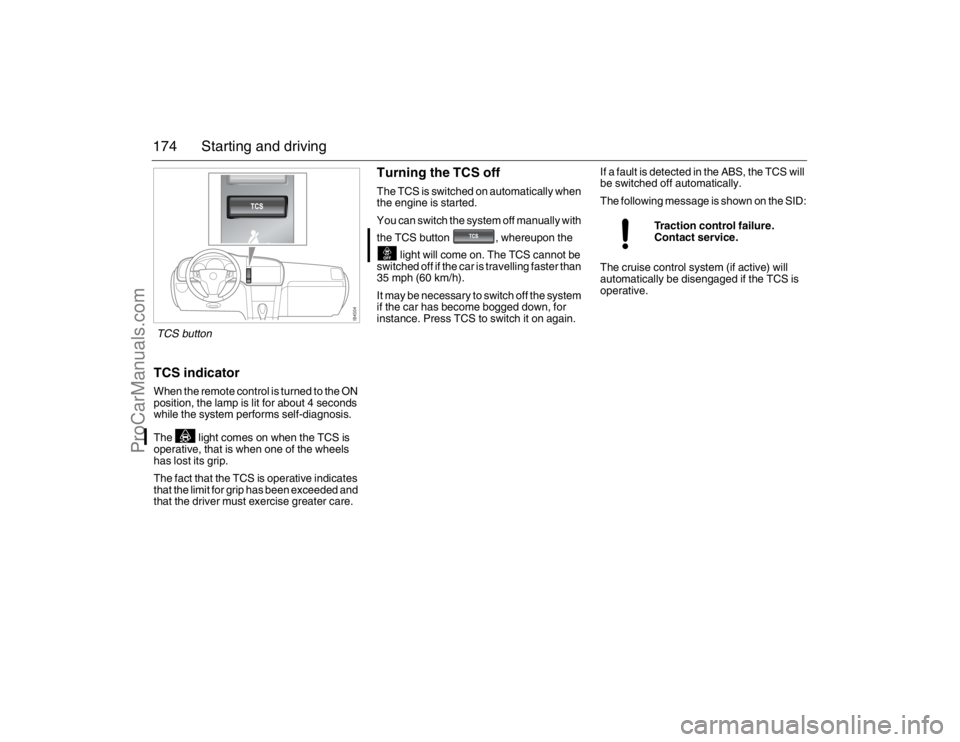
You can switch the system off manually with
the TCS button , whereupon the
light will come on. The TCS cannot be
switched off if the car is travelling faster than
35 mph (60 km/h).
It may be necessary to switch off the system
if the car has become bogged down, for
instance. Press TCS to switch it on again.If a fault is detected in the ABS, the TCS will
be switched off automatically.
The following message is shown on the SID:
The cruise control system (if active) will
automatically be disengaged if the TCS is
operative.
Traction control failure.
Contact service.
TCS button93_U S _M 07.book Page 174 W ednesday, April 12, 2006 9:30 AM
ProCarManuals.com
Page 175 of 304
175 Starting and driving
Electronic Stability
Program (ESP
®)3
Anti-skid system
The Electronic Stability Program employs
both the antilock braking system (ABS) and
the traction control system (TCS). It is a
system that helps the driver to stabilize the
car in unusual circumstances that can oth-
erwise be more difficult to handle.
How the ESP
® system works
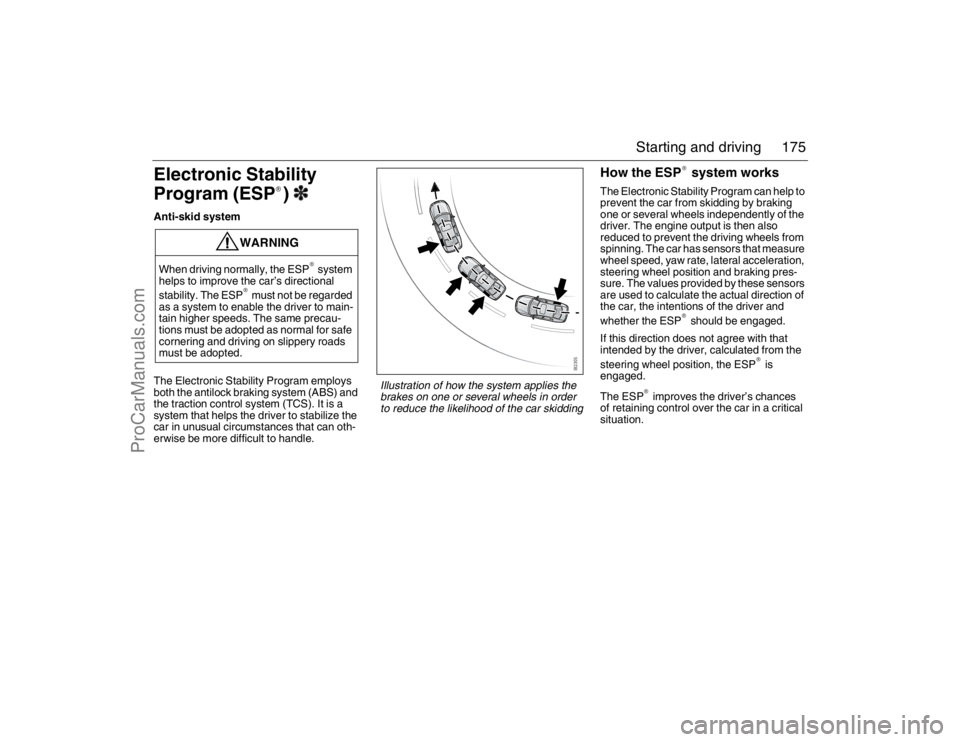
The Electronic Stability Program can help to
prevent the car from skidding by braking
one or several wheels independently of the
driver. The engine output is then also
reduced to prevent the driving wheels from
spinning. The car has sensors that measure
wheel speed, yaw rate, lateral acceleration,
steering wheel position and braking pres-
sure. The values provided by these sensors
are used to calculate the actual direction of
the car, the intentions of the driver and
whether the ESP
® should be engaged.
If this direction does not agree with that
intended by the driver, calculated from the
steering wheel position, the ESP
® is
engaged.
The ESP
® improves the driver’s chances
of retaining control over the car in a critical
situation.
WARNING
When driving normally, the ESP
® system
helps to improve the car’s directional
stability. The ESP
® must not be regarded
as a system to enable the driver to main-
tain higher speeds. The same precau-
tions must be adopted as normal for safe
cornering and driving on slippery roads
must be adopted.
Illustration of how the system applies the
brakes on one or several wheels in order
to reduce the likelihood of the car skidding
93_U S _M 07.book Page 175 W ednesday, April 12, 2006 9:30 AM
ProCarManuals.com
Page 176 of 304
176 Starting and drivingESP
® OFF
lights up if:
a fault has been detected and the system
has therefore been switched off
the system has been switched off
manually
ESP
® indicator light
When the remote control is turned to the ON
position, the lamp is lit for about 4 seconds
while the system performs self-diagnosis.
The light comes on for a short period of
time when the ESP
® system is operative.
Operation of the ESP® indicates reduced
cohesion between the tires and the road,
and that extra care should be taken by the
driver during continued driving.
Turning ESP
® system off
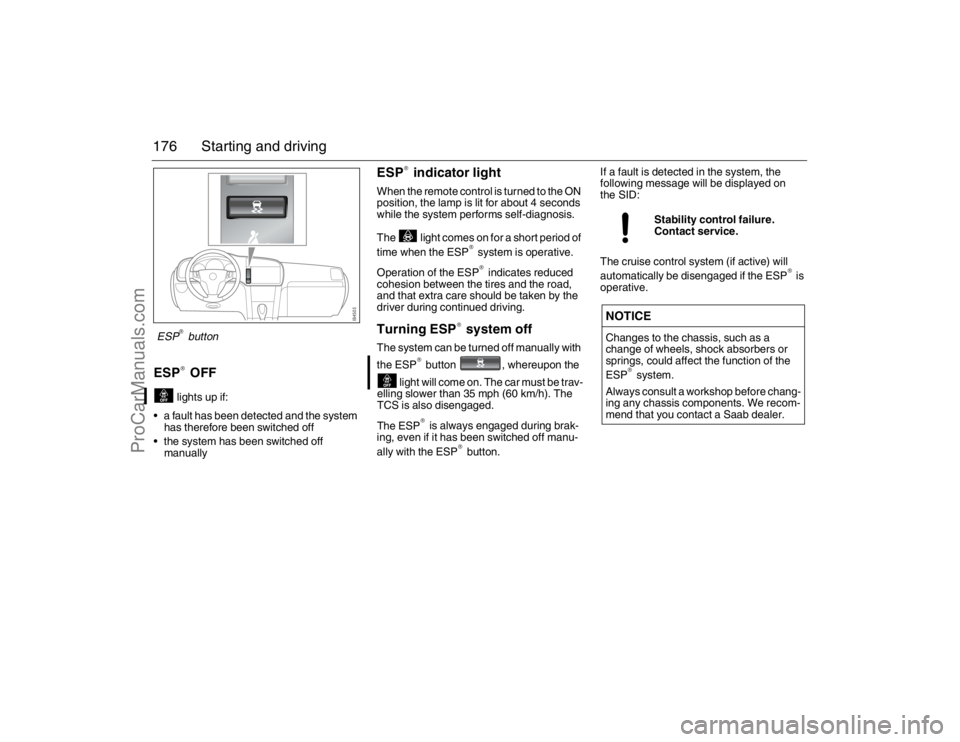
The system can be turned off manually with
the ESP
® button , whereupon the
light will come on. The car must be trav-
elling slower than 35 mph (60 km/h). The
TCS is also disengaged.
The ESP® is always engaged during brak-
ing, even if it has been switched off manu-
ally with the ESP
® button.If a fault is detected in the system, the
following message will be displayed on
the SID:
The cruise control system (if active) will
automatically be disengaged if the ESP
® is
operative.
Stability control failure.
Contact service.
NOTICEChanges to the chassis, such as a
change of wheels, shock absorbers or
springs, could affect the function of the
ESP
® system.
Always consult a workshop before chang-
ing any chassis components. We recom-
mend that you contact a Saab dealer.
ESP
® button
93_U S _M 07.book Page 176 W ednesday, April 12, 2006 9:30 AM
ProCarManuals.com
Page 204 of 304

204 Car careBosch ME9 engine management
system, V6 engineThe Bosch ME9 engine management
system is a system that combines sequen-
tial multiport fuel injection, electronic distrib-
utorless ignition and turbocharger boost
pressure control into one system and intake
camshaft phasing control.
The ME9 engine control module (ECM)
monitors many different engine parameters
such as:
Charge air pressure.
Intake air temperature.
Crankshaft position.
Engine coolant temperature.
Throttle position.
The oxygen content of the exhaust gases.By processing all of this information, the
ME9 system can control fuel injector open-
ing duration, ignition timing, intake camshaft
phasing and turbocharger boost pressure to
provide excellent engine performance while
maintaining low emissions and fuel con-
sumption.
ORVR (Onboard Refueling Vapor
Recovery)All hydrocarbons formed when refueling will
be recovered by the car and not released
into the atmosphere. The hydrocarbons are
absorbed in an evaporative emission canis-
ter. When the engine is subsequently
started, the evaporative emission canister is
gradually purged as air is sucked into it
through a shut-off valve. The hydrocar-
bon/air mixture passes through the evap
canister purge valve and into the engine
where it is burned. “Refueling”, see
page 157.
When refueling, make sure you screw the
filler cap on and keep turning until it has
clicked 3 times.
NOTICEThe Trionic engine management system
continuously monitors the operation of
these systems and has on-board diag-
nostic capabilities (OBD II). If the Engine
malfunction (CHECK ENGINE) light in
the main instrument illuminates, the
Trionic ECM has detected a problem. The
car will continue to operate, but perfor-
mance may be diminished. You should
have your car checked by a workshop as
soon as possible. We recommend that
you contact a Saab dealer.
NOTICEThe ME9 engine management system
continuously monitors the operation of
these systems and has on-board diag-
nostic capabilities (OBD II). If the Engine
malfunction (CHECK ENGINE) light in
the main instrument illuminates, the ME9
ECM has detected a problem. The car will
continue to operate, but performance
may be diminished. You should have your
car checked by a workshop as soon as
possible. We recommend that you
contact a Saab dealer.
93_U S _M 07.book Page 204 W ednesday, April 12, 2006 9:30 AM
ProCarManuals.com
Page 211 of 304
211 Car care
Brake/clutch fluid and
brake padsCheckingBrake fluid should be changed according to
the service program. Refer to the Warranty
and Service Book.
The brake and clutch fluid reservoir is trans-
parent to facilitate checking of the fluid level.
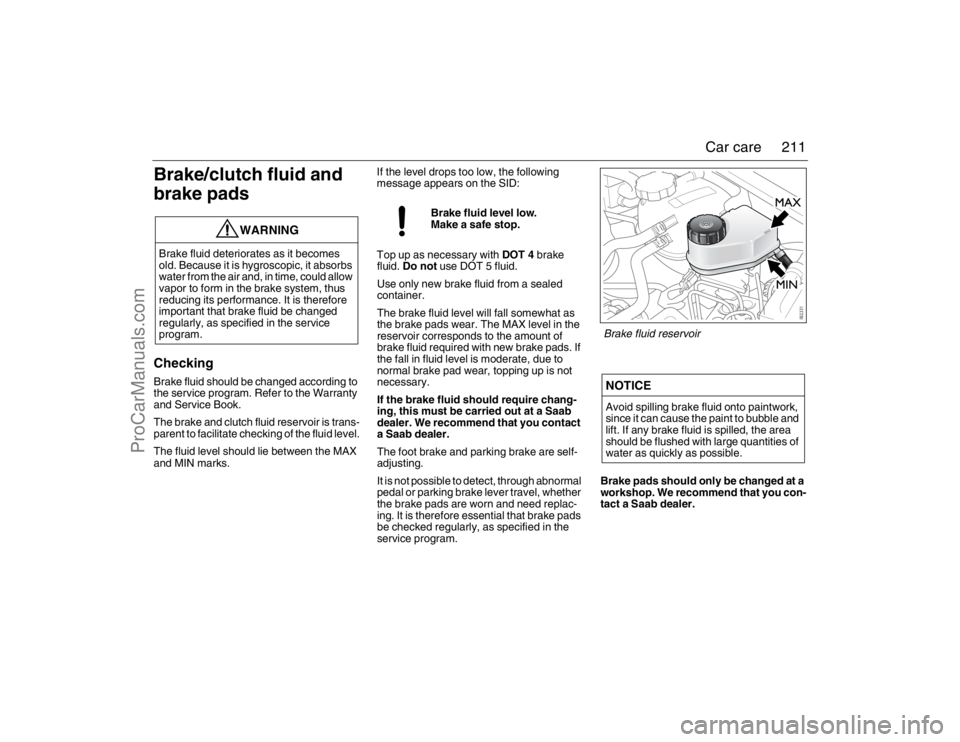
The fluid level should lie between the MAX
and MIN marks.If the level drops too low, the following
message appears on the SID:
Top up as necessary with DOT 4 brake
fluid. Do not use DOT 5 fluid.
Use only new brake fluid from a sealed
container.
The brake fluid level will fall somewhat as
the brake pads wear. The MAX level in the
reservoir corresponds to the amount of
brake fluid required with new brake pads. If
the fall in fluid level is moderate, due to
normal brake pad wear, topping up is not
necessary.
If the brake fluid should require chang-
ing, this must be carried out at a Saab
dealer. We recommend that you contact
a Saab dealer.
The foot brake and parking brake are self-
adjusting.
It is not possible to detect, through abnormal
pedal or parking brake lever travel, whether
the brake pads are worn and need replac-
ing. It is therefore essential that brake pads
be checked regularly, as specified in the
service program.Brake pads should only be changed at a
workshop. We recommend that you con-
tact a Saab dealer.
WARNING
Brake fluid deteriorates as it becomes
old. Because it is hygroscopic, it absorbs
water from the air and, in time, could allow
vapor to form in the brake system, thus
reducing its performance. It is therefore
important that brake fluid be changed
regularly, as specified in the service
program.
Brake fluid level low.
Make a safe stop.
NOTICEAvoid spilling brake fluid onto paintwork,
since it can cause the paint to bubble and
lift. If any brake fluid is spilled, the area
should be flushed with large quantities of
water as quickly as possible.Brake fluid reservoir
93_U S _M 07.book Page 211 W ednesday, April 12, 2006 9:30 AM
ProCarManuals.com
Page 245 of 304

245 Car care
Uniform Tire Quality GradingQuality grades can be found where applica-
ble on the tire sidewall between tread shoul-
der and maximum section width. For exam-
ple:
Treadwear 200 Traction AA
Temperature A
The following information relates to the
system developed by the United States
National Highway Traffic Safety Administra-
tion, which grades tires by treadwear, trac-
tion and temperature performance. (This
applies only to vehicles sold in the United
States.) The grades are molded on the side-
walls of most passenger car tires. The Uni-
form Tire Quality Grading system does not
apply to deep tread, winter-type snow tires,
space-saver or temporary use spare tires,
tires with nominal rim diameters of 10 to 12
inches (25 to 30 cm), or to some limited-pro-
duction tires.
While the tires available on General Motors
passenger cars and light trucks may vary
with respect to these grades, they must also
conform to federal safety requirements and
additional General Motors Tire Perfor-
mance Criteria (TPC) standards.
NOTICEWide wheels and tires with side walls that
are too low can:
be damaged in potholes, etc.
cause springs, shock absorbers and
wheel bearings and body mountings
to be overloaded.
affect the function of the Electronic
Stability Program (ESP
®).
The speed and load limits of the tires
must not be exceeded; see page 250.
Wheels larger than 17" must not be fitted
on the Saab 9-3 for reasons above. The
permissible offset is 1.61 inch (41 mm).
WARNING
Mixing tires could cause you to lose
control while driving. If you mix tires of
different sizes or types (radial and bias-
belted tires), the vehicle may not handle
properly, and you could have a crash.
Using tires of different sizes may also
cause damage to your vehicle. Be sure to
use the same size and type tires on all
wheels. It’s all right to drive with your
compact spare temporarily, it was devel-
oped for use on your vehicle. See
“Compact spare” on page 254.
WARNING
If you use bias-ply tires on your vehicle,
the wheel rim flanges could develop
cracks after many miles of driving. A tire
and/or wheel could fail suddenly, causing
a crash. Use only radial-ply tires with the
wheels on your vehicle.
93_U S _M 07.book Page 245 W ednesday, April 12, 2006 9:30 AM
ProCarManuals.com
Page 260 of 304
260 Car care
Safety beltsCheck the function of the safety belts regu-
larly as follows:
Hold the diagonal strap and pull it sharply.
The safety belt should lock and it should
not be possible to withdraw it further.
Check the anchorage points in the floor.
They must not have suffered rust damage.
If a belt is worn or has any fraying edges, it
should be replaced.
Safety belts must not come into contact with
substances such as polishes, oil or chemi-
cals. If the belts get dirty, wash them with
warm water and a detergent or have them
replaced.
Upholstery and trimTo remove fluff and hairs from the seats,
door armrests and headlining, use a
vacuum cleaner, a moist lint-free cloth, or a
clothes brush. Remove spots and dirt using
a cloth moistened with lukewarm soapy
water.
When using a stain remover, always work
from the outside towards the centre to avoid
leaving a ring. If a soiled ring or spot should
remain, it can usually be removed using
lukewarm soapy water or water alone.
Spots left by liquids, such as soft drinks or
thin oil, must be removed at once with an
absorbent material, such as kitchen towel-
ling. Then clean with a stain remover.
White spirit is recommended for removing
grease and oil stains. A medium stiff brush
may also be used.
WARNING
If the car is involved in a crash, the safety
belts, belt pretensioners and other asso-
ciated components must be inspected.
We recommend that you contact a Saab
dealer.
Never make any alterations or repairs to
the safety belts yourself. We recommend
that you contact a Saab dealer dealer.
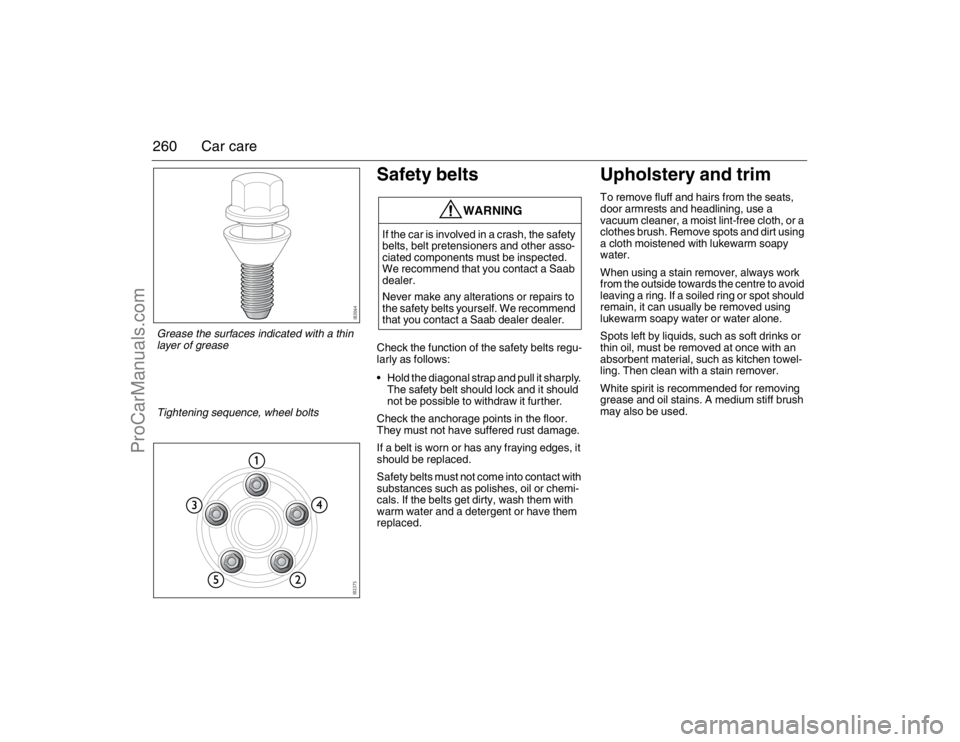
Tightening sequence, wheel boltsGrease the surfaces indicated with a thin
layer of grease93_U S _M 07.book Page 260 W ednesday, April 12, 2006 9:30 AM
ProCarManuals.com
Page 289 of 304

289 Technical data
Brake system
Hydraulic unit for soft top, ConvertibleFoot brake (ABS)____________________ Hydraulic disc
brakes with vacuum
servo unit. Diago-
nally split circuits;
ventilated discs on
front wheels (some
variants also have
ventilated rear
discs). EBD function
(see page 171).
Park brake _________________________ Acts on rear wheels
Brake fluid _________________________ To DOT 4.
Do not use DOT 5.Disc diameter:
Front ____________________________ 11.22 in.
(285 mm) **)
Fr o nt3 *) ________________________ 11.81 in.
(300 mm) **)
Rear ____________________________ 10.94 in. (278 mm)
Rear3 *) ________________________ 11.42 in.
(290 mm) **)
Total friction area of brake pads:
Front ____________________________ 9.30 in.² (60 cm²)
Fr o nt3__________________________ 9.61 in.² (62 cm²)
Rear ____________________________ 4.96 in.² (32 cm²)
*)15" wheels and 16" aluminium wheels
must not be fitted to these variants since
the diameter of the brake discs does not
allow this.
**) ventilated
Oil capacity _______________________ 0.6 qt. (0.6 l)
Oil type __________________________ CHF 11S93_U S _M 07.book Page 289 W ednesday, April 12, 2006 9:30 AM
ProCarManuals.com
Page 299 of 304

299 Index
Index
AABS brakes
____________________ 173
ACC
_________________________ 107
Adjustment, steering wheel
________ 120
Air filter
_______________________ 211
Airbag
_________________________ 32
Anchorage eyes, Sport Sedan
_____ 141
Anti-corrosion treatment
__________ 267
Antilock braking system __________ 173
Anti-spin
______________________ 175
Ashtrays ______________________ 136
Autochecking of lights, warning and
indicator lights
__________________ 89
Autodimming
_______________ 125
, 126
Automatic climate control (ACC)
____ 107
Automatic closing of moonroof
_____ 131
Automatic closing of windows,
Sport Sedan and SportCombi _____ 122
Automatic transmission
___________ 165
BBattery
_______________________ 215
Bedding-in of new brake pads
_____ 163
Before towing a trailer
____________ 193
Belt height, Sport Sedan and
SportCombi
____________________ 14
Brake fluid, grade
_______________ 289Brakes
________________________ 172
Braking _______________________ 172
Bulb changing
__________________ 221
Bulb table
_____________________ 235
Buying new tires
________________ 246
CCabin lighting, Convertible
_________ 80
Cabin lighting, Sport Sedan and
SportCombi
___________________ 133
Calibrating front electric windows
with pinch protection
_____________ 80
Calibration of windows, Sport Sedan
and SportCombi
_______________ 123
Car alarm
______________________ 58
Car transport ___________________ 199
Care of air conditioning
___________ 270
Cargo guard
___________________ 150
Cargo guard, SportWagon
________ 150
Cargo net, SportCombi
___________ 147
Change of address notification
_____ 276
Changing a tire
_________________ 259
Changing bulbs _________________ 221
Changing the battery, remote control
_56
Changing wiper blades
___________ 219
Checking the number of remote
controls
_______________________ 55
Checks before towing a trailer
_____ 193
Child safety
_____________________ 24
Child safety locks, rear doors
_______ 54
Child seats
_____________________ 24Cigarette lighter
_________________ 136
Cleaning the engine bay
__________ 263
Cleaning upholstery
______________ 262
Closing the soft top manually,
Convertible
____________________ 70
Closing the soft top, Convertible
_____ 66
Clutch interlock
_________________ 164
Comfort opening of moonroof
______ 131
Comfort opening of windows,
Sport Sedan and SportCombi _____ 121
Compact spare
_________________ 256
Compact spare wheel fitted, driving
with
_________________________ 257
Compass
______________________ 129
Convertible _____________________ 63
Convertible, washing
_____________ 264
Coolant
_______________________ 211
Crash memory, see EDR
_________ 278
Cruise control
__________________ 171
Cup holder
_____________________ 134
DDate codes, tires
________________ 256
Deactivating rear windows,
Sport Sedan and SportCombi
_____ 123
Deactivating the passenger door
window button, Convertible
________ 79
Deactivating the rear window
switches
_____________________ 123
Deep water, driving through
_______ 196
Definitions and terminology, tire ____ 253
93_U S _M 07.book Page 299 W ednesday, April 12, 2006 9:30 AM
ProCarManuals.com