trunk SAAB 9-3 2007 Service Manual
[x] Cancel search | Manufacturer: SAAB, Model Year: 2007, Model line: 9-3, Model: SAAB 9-3 2007Pages: 304, PDF Size: 26.16 MB
Page 232 of 304
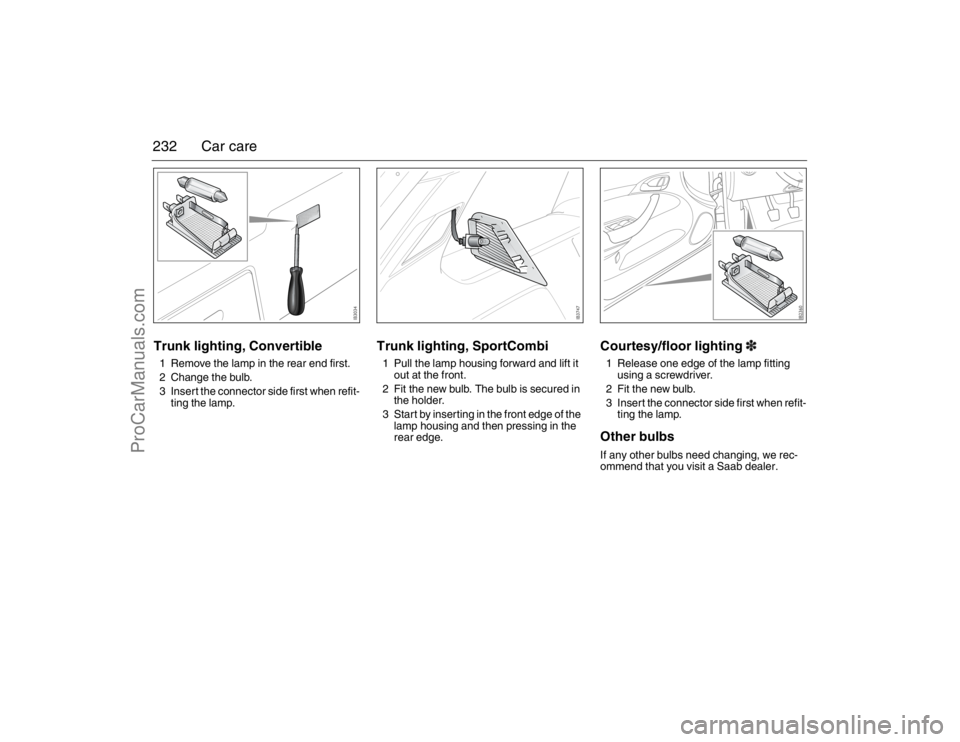
232 Car careTrunk lighting, Convertible1 Remove the lamp in the rear end first.
2 Change the bulb.
3 Insert the connector side first when refit-
ting the lamp.
Trunk lighting, SportCombi1 Pull the lamp housing forward and lift it
out at the front.
2 Fit the new bulb. The bulb is secured in
the holder.
3 Start by inserting in the front edge of the
lamp housing and then pressing in the
rear edge.
Courtesy/floor lighting31 Release one edge of the lamp fitting
using a screwdriver.
2 Fit the new bulb.
3 Insert the connector side first when refit-
ting the lamp.Other bulbsIf any other bulbs need changing, we rec-
ommend that you visit a Saab dealer.
93_U S _M 07.book Page 232 W ednesday, April 12, 2006 9:30 AM
ProCarManuals.com
Page 233 of 304
233 Car care
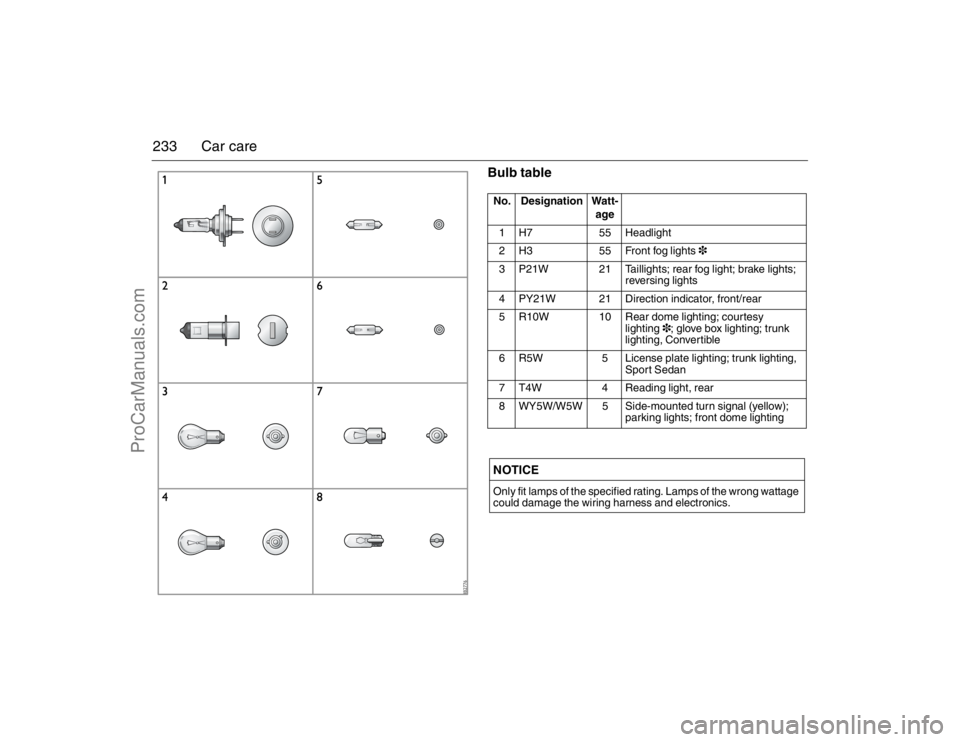
Bulb tableNo. Designation Watt-
age
1 H7 55 Headlight
2 H3 55 Front fog lights3
3 P21W 21 Taillights; rear fog light; brake lights;
reversing lights
4 PY21W 21 Direction indicator, front/rear
5 R10W 10 Rear dome lighting; courtesy
lighting3; glove box lighting; trunk
lighting, Convertible
6 R5W 5 License plate lighting; trunk lighting,
Sport Sedan
7 T4W 4 Reading light, rear
8 WY5W/W5W 5 Side-mounted turn signal (yellow);
parking lights; front dome lightingNOTICEOnly fit lamps of the specified rating. Lamps of the wrong wattage
could damage the wiring harness and electronics.
93_U S _M 07.book Page 233 W ednesday, April 12, 2006 9:30 AM
ProCarManuals.com
Page 234 of 304
234 Car careFuses
The fuses are housed in three fuse panels:
one behind a hatch on the left-hand end of
the dash, one in the engine bay (additional
small unit in front of battery) and one on the
left-hand side of the trunk. There is space
for spare fuses in the hatch on the left-hand
end of the dash.
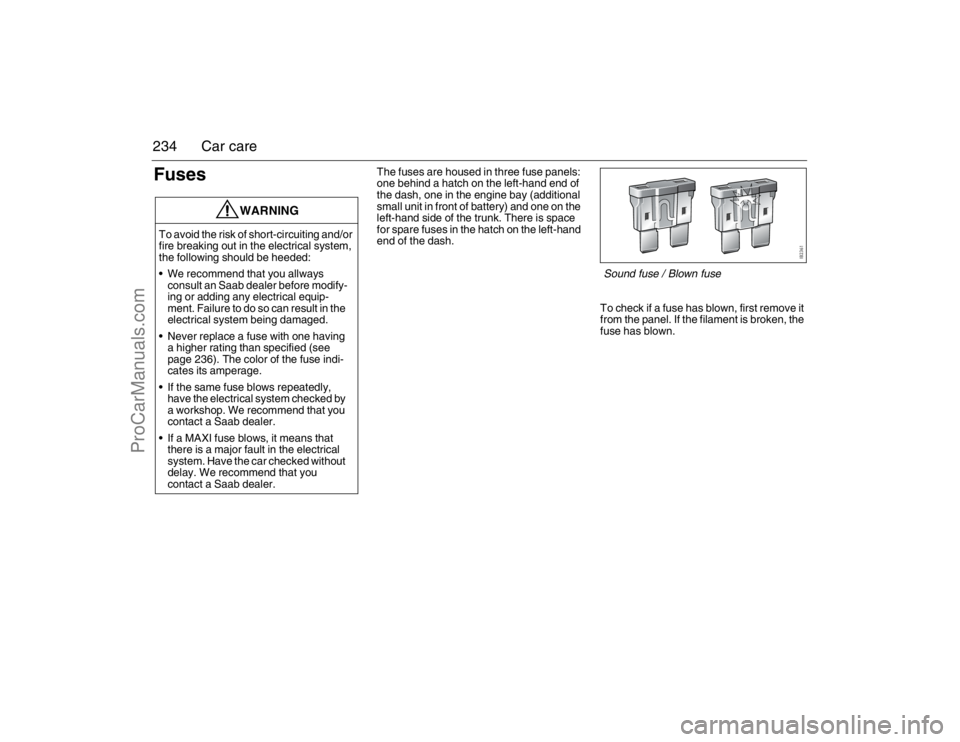
To check if a fuse has blown, first remove it
from the panel. If the filament is broken, the
fuse has blown.
WARNING
To avoid the risk of short-circuiting and/or
fire breaking out in the electrical system,
the following should be heeded:
We recommend that you allways
consult an Saab dealer before modify-
ing or adding any electrical equip-
ment. Failure to do so can result in the
electrical system being damaged.
Never replace a fuse with one having
a higher rating than specified (see
page 236). The color of the fuse indi-
cates its amperage.
If the same fuse blows repeatedly,
have the electrical system checked by
a workshop. We recommend that you
contact a Saab dealer.
If a MAXI fuse blows, it means that
there is a major fault in the electrical
system. Have the car checked without
delay. We recommend that you
contact a Saab dealer.
Sound fuse / Blown fuse
93_U S _M 07.book Page 234 W ednesday, April 12, 2006 9:30 AM
ProCarManuals.com
Page 237 of 304
237 Car care
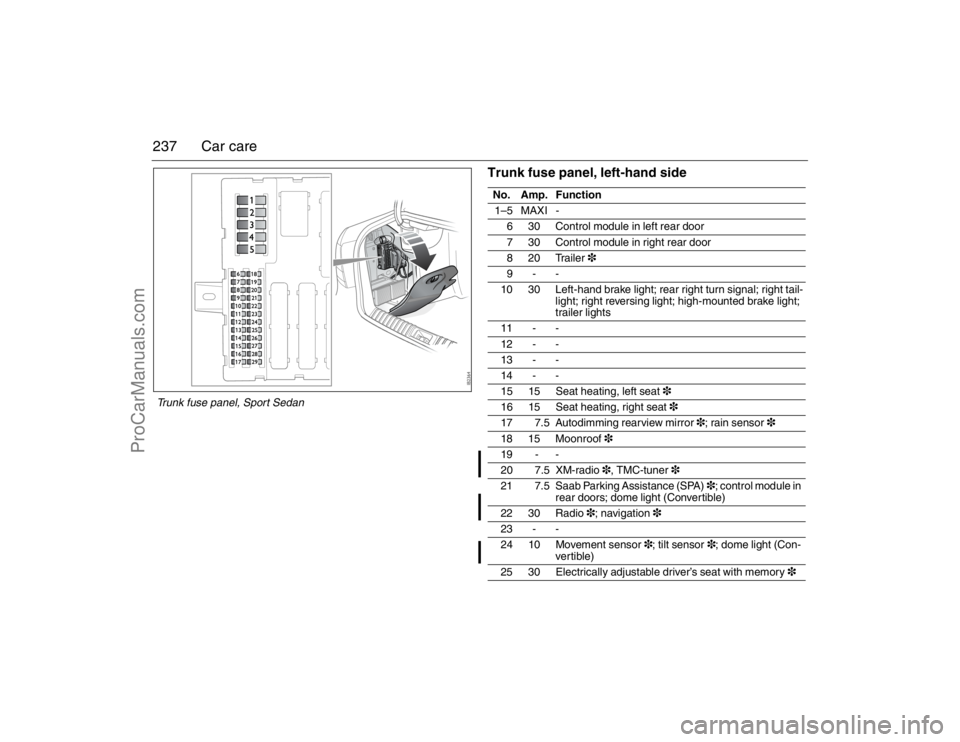
Trunk fuse panel, left-hand sideNo. Amp. Function
1–5 MAXI -
6 30 Control module in left rear door
7 30 Control module in right rear door
820Trailer3
9--
10 30 Left-hand brake light; rear right turn signal; right tail-
light; right reversing light; high-mounted brake light;
trailer lights
11 - -
12 - -
13 - -
14 - -
15 15 Seat heating, left seat3
16 15 Seat heating, right seat3
17 7.5 Autodimming rearview mirror3; rain sensor3
18 15 Moonroof3
19 - -
20 7.5 XM-radio3, TMC-tuner3
21 7.5 Saab Parking Assistance (SPA)3; control module in
rear doors; dome light (Convertible)
22 30 Radio3; navigation3
23 - -
24 10 Movement sensor3; tilt sensor3; dome light (Con-
ver tible)
25 30 Electrically adjustable driver’s seat with memory3
Trunk fuse panel, Sport Sedan93_U S _M 07.book Page 237 W ednesday, April 12, 2006 9:30 AM
ProCarManuals.com
Page 238 of 304
238 Car care
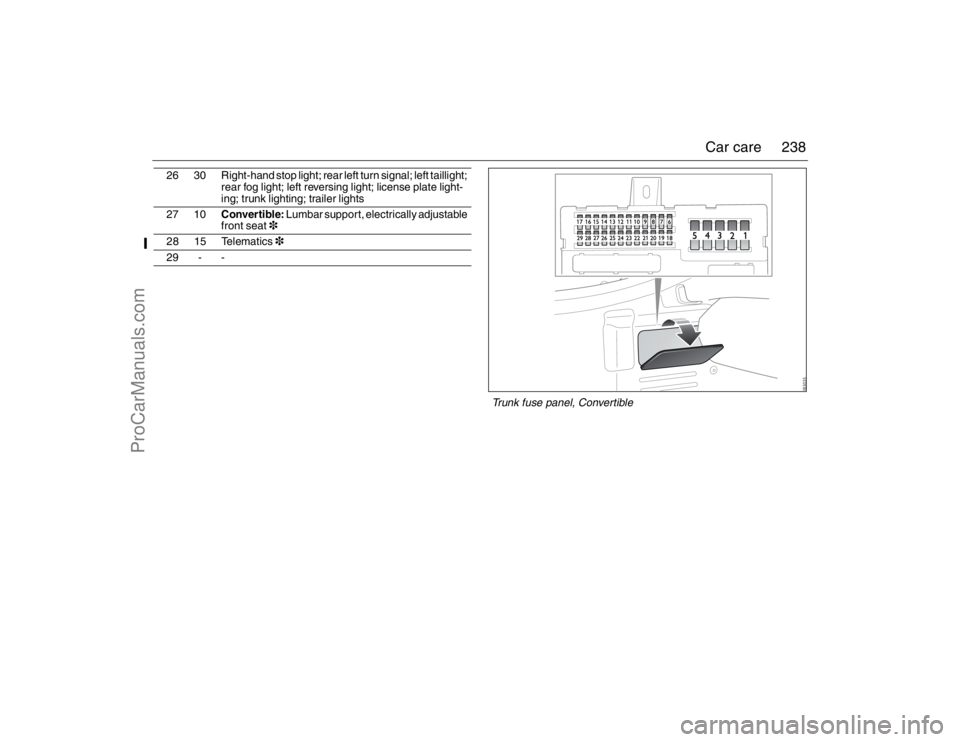
26 30 Right-hand stop light; rear left turn signal; left taillight;
rear fog light; left reversing light; license plate light-
ing; trunk lighting; trailer lights
27 10Convertible: Lumbar support, electrically adjustable
front seat3
28 15 Telematics3
29 - -
Trunk fuse panel, Convertible
93_U S _M 07.book Page 238 W ednesday, April 12, 2006 9:30 AM
ProCarManuals.com
Page 254 of 304

254 Car careWinter tiresWinter (snow) tires are recommended for
winter climates where the majority of your
driving will be done on snow and ice. Winter
tires should be fitted to all four wheels to
maintain a proper balance. Your Saab
dealer can advise you of to the correct size
tire for your car (if different from the original
size) and also supply Saab approved winter
tires pre-mounted on steel or alloy rims.
Winter tires normally use a different speed
rating compared to summer/all season tires.
Make sure not to exceed the stated speed
rating on the tires you use.Tire date codeTires should be regarded as perishable
goods. As the tires age, the rubber becomes
progressively harder, and the roadholding
ability of the tires diminishes. This is partic-
ularly true on winter tires.
Tires have a code that specifies their date of
manufacture. The first two digits denote the
week number and the last two digits the year
followed by a filled triangle.
Compact spareThe compact spare is light and easy to
handle when changing the tire. Its use is
only permitted when a standard tire has sus-
tained a puncture. The maximum life of the
tire is only just over 2,000 miles (3,500 km).
Do not exceed 50 mph (80 km/h) with the
compact spare fitted.
The tire pressure should be 60 psi
(420 kPa). Put the punctured tire in the
spare wheel well under the trunk floor.
Have the standard tire repaired and refitted
as soon as possible.The spare tire, the tools and the jack with its
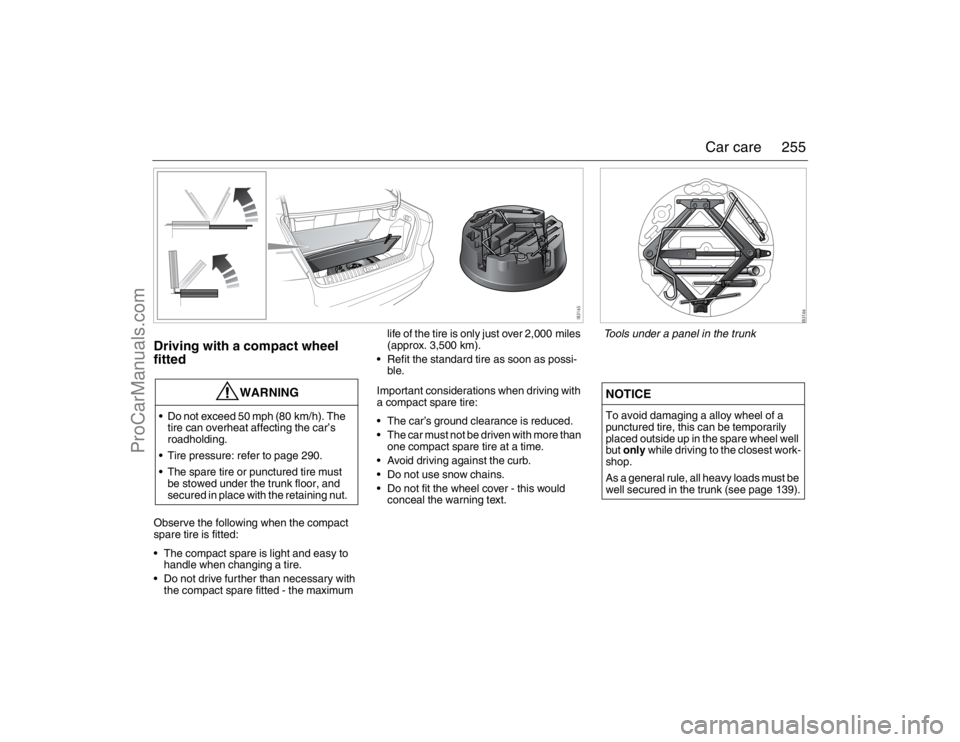
crank are carried under a panel in the trunk.
Fold the carpeting forward to ease access to
the tools and spare tire.
The screwdriver handle has a “button” for
removing plastic rivets. This type of rivet
must be removed when changing the light
bulb in the trunk lid (see page 228).
Your Saab is equipped with a trip computer
and you can use its “Speed warning” func-
tion, to monitor driving speed since you
must not exceed 50 mph (80 km/h), see
page 90.
WARNING
The spare tire or punctured tire must be
stowed under the trunk floor, and secured
in place with the retaining nut.
93_U S _M 07.book Page 254 W ednesday, April 12, 2006 9:30 AM
ProCarManuals.com
Page 255 of 304
255 Car care
Driving with a compact wheel
fittedObserve the following when the compact
spare tire is fitted:
The compact spare is light and easy to
handle when changing a tire.
Do not drive further than necessary with
the compact spare fitted - the maximum life of the tire is only just over 2,000 miles
(approx. 3,500 km).
Refit the standard tire as soon as possi-
ble.
Important considerations when driving with
a compact spare tire:
The car’s ground clearance is reduced.
The car must not be driven with more than
one compact spare tire at a time.
Avoid driving against the curb.
Do not use snow chains.
Do not fit the wheel cover - this would
conceal the warning text.
WARNING
Do not exceed 50 mph (80 km/h). The
tire can overheat affecting the car’s
roadholding.
Tire pressure: refer to page 290.
The spare tire or punctured tire must
be stowed under the trunk floor, and
secured in place with the retaining nut.
NOTICETo avoid damaging a alloy wheel of a
punctured tire, this can be temporarily
placed outside up in the spare wheel well
but only while driving to the closest work-
shop.
As a general rule, all heavy loads must be
well secured in the trunk (see page 139).Tools under a panel in the trunk
93_U S _M 07.book Page 255 W ednesday, April 12, 2006 9:30 AM
ProCarManuals.com
Page 257 of 304

257 Car care
Changing a tire
WARNING
Lifting a vehicle and getting under it to do
maintenance or repairs is dangerous
without the appropriate safety equipment
and training. The jack provided with your
vehicle is designed only for changing a
flat tire. If it is used for anything else, you
or others could be badly injured or killed if
the vehicle slips off the jack. Use the jack
provided with your vehicle only for chang-
ing a flat tire.
Changing a tire can be dangerous. The
vehicle can slip off the jack and roll over
or fall on you or other people. You and
they could be badly injured or even killed.
Find a level place to change your tire. To
help prevent the vehicle from moving:
1 Set the parking brake firmly.
2 If you have an automatic transmis-
sion, put the shift lever in PARK (P).
For a manual transmission, leave the
car in gear (1st or REVERSE (R)).
3 Turn off the engine and do not restart
while the vehicle is raised.
4 Do not allow passengers to remain in
the vehicle.
To be even more certain the vehicle won't
move, you should put blocks at the front
and rear of the tire farthest away from the
one being changed. That would be the
tire, on the other side, at the opposite end
of the vehicle.
The car jack is designed solely for use
in changing a tire or fitting snow
chains. It must not be used to
support the car during repair work
or servicing.
Never crawl under a car that is
supported only by a jack. Always use
axle stands.
Raising your vehicle too high or with
the jack improperly positioned can
damage the vehicle and even make
the vehicle fall. To help avoid personal
injury and vehicle damage, be sure to
fit the jack lift head into the proper
location before raising the vehicle, and
raise the vehicle only far enough off
the ground so there is enough room for
the spare tire to fit (no more than
25 mm or 1 inch clearance between
the ground and the bottom of the tire).
Switch on the hazard warning lights if
the car is on a road.
The jack should be stored correctly
under the carpeting in the trunk. If it
lies loose in the car, it could thrown
forward and cause personal injury in
the event of a crash or if the car rolls
over.
Grit, salt and rust can clog the inner
threads of the wheel bolts if the car has
been driven for several years exclu-
sively with alloy wheels.
If steel wheels are being installed, the
bolt hole threads in the brake hubs
should be cleaned before the thinner
steel wheels are fitted. It may other-
wise not be possible to achieve the
correct clamping force, despite tight-
ening the wheel bolts to the correct
torque.
93_U S _M 07.book Page 257 W ednesday, April 12, 2006 9:30 AM
ProCarManuals.com
Page 265 of 304
265 Car care
Anti-corrosion
treatmentThe entire car undergoes a series of anti-
corrosion processes during production.
These include electrophoretic priming,
PVC-based coating to protect against stone
chip damage and corrosion, and treatment
of body cavities and members with thin,
penetrating rustproofing oil.
In addition, most body panels, such as the
hood, doors and floor pan are galvanized.
The anti-corrosion treatment on some parts
of the car is constantly exposed to wear and
prone to damage. This applies particularly
to the underside of the car and inside the
wheel arches, where grit, road salt and the
like that are thrown up can give rise to cor-
rosion where the underseal has worn away.
The extent of this obviously depends on the
conditions in which the car is used.
Accordingly, make it a habit to hose the
underside of the car often and to inspect the
condition of the underseal. The anti-corro-
sion warranty does not relieve the car owner
of the need to carry out normal maintenance
to the rustproofing and to make good any
damage.Use a hose to clean the underside of the car
thoroughly. After it has dried, use a brush or
spray to apply a viscous anti-corrosion
agent to any worn or damaged areas, to
prevent the onset of corrosion.
Even after the anti-corrosion warranty has
expired, it makes good sense to continue to
maintain the rustproofing.
Seams in the body, especially those in the
doors and trunk lid, are particularly vulnera-
ble to corrosion from the outside, caused by
grit and salt thrown up from the road, and to
corrosion from the inside, largely as a result
of condensation. Keep the seams clean and
at the first sign of any rust, apply a thin, pen-
etrating, anti-corrosion oil. Your Saab
dealer will be pleased to give you further
advice.
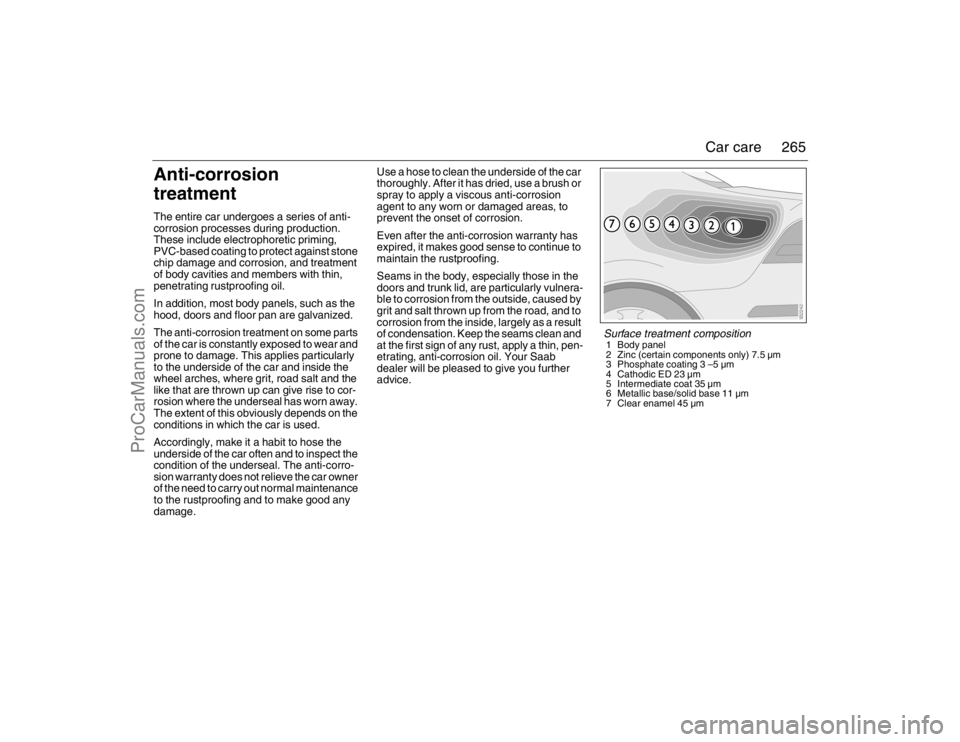
Surface treatment composition1 Body panel
2 Zinc (certain components only) 7.5 µm
3 Phosphate coating 3 –5 µm
4 Cathodic ED 23 µm
5 Intermediate coat 35 µm
6 Metallic base/solid base 11 µm
7 Clear enamel 45 µm
93_U S _M 07.book Page 265 W ednesday, April 12, 2006 9:30 AM
ProCarManuals.com
Page 280 of 304
280 Technical dataGeneral dataOverall length, including bumpers: ______
Sport Sedan and Convertible _________ 182.5'' (4635 mm)
SportCombi_______________________ 183.2'' (4654 mm)
Overall width, including door mirrors _____ 80.2'' (2038 mm)
Maximum height ____________________ 60.6'' (1539 mm)
Wheelbase ________________________ 105.3'' (2675 mm)
Tr a c k :
Front ____________________________ 59.8'' (1524 mm)
Rear ____________________________ 59.3'' (1506 mm)
Ground clearance at GVW ____________ approx. 4.7''
(120 mm)
Number of seats (incl. driver):
Sport Sedan and SportCombi ________ 5
Convertible _______________________ 4
Turning circle:
Measured at vehicle extremities _______ 39.0 ft. (11.9 m)
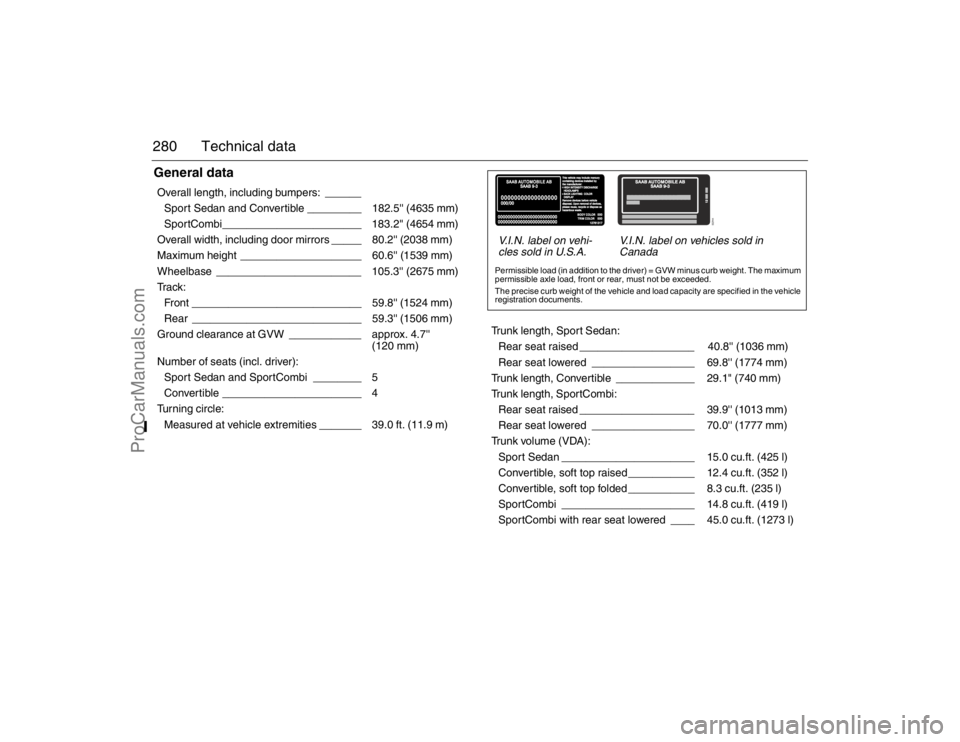
V.I.N. label on vehi-
cles sold in U.S.A.V.I.N. label on vehicles sold in
CanadaPermissible load (in addition to the driver) = GVW minus curb weight. The maximum
permissible axle load, front or rear, must not be exceeded.
The precise curb weight of the vehicle and load capacity are specified in the vehicle
registration documents.Trunk length, Sport Sedan:
Rear seat raised ___________________ 40.8'' (1036 mm)
Rear seat lowered _________________ 69.8'' (1774 mm)
Trunk length, Convertible _____________ 29.1" (740 mm)
Trunk length, SportCombi:
Rear seat raised ___________________ 39.9'' (1013 mm)
Rear seat lowered _________________ 70.0'' (1777 mm)
Trunk volume (VDA):
Sport Sedan ______________________ 15.0 cu.ft. (425 l)
Convertible, soft top raised ___________ 12.4 cu.ft. (352 l)
Convertible, soft top folded ___________ 8.3 cu.ft. (235 l)
SportCombi ______________________ 14.8 cu.ft. (419 l)
SportCombi with rear seat lowered ____ 45.0 cu.ft. (1273 l)
93_U S _M 07.book Page 280 W ednesday, April 12, 2006 9:30 AM
ProCarManuals.com