battery SAAB 9-3 2008 Owner's Guide
[x] Cancel search | Manufacturer: SAAB, Model Year: 2008, Model line: 9-3, Model: SAAB 9-3 2008Pages: 320, PDF Size: 56.39 MB
Page 197 of 320
197 Starting and driving
Driving at nightBear in mind the following points, especially
when driving at night:
Nighttime driving requires your full
concentration
Do not rush. Count on your journey taking
slightly longer.
The number of drivers under the influence
of drugs is likely to be greater at night than
during the day.
Do not stare at the headlights of oncom-
ing vehicles.
Avoid driving at night if you have poor
eyesight. Night vision deteriorates with
age.
Keep your car’s headlights, windows and
mirrors clean. Also, if you wear glasses,
make sure they are clean.
Make sure you are well rested before
starting a long journey. Take a break every
other hour.
Only eat light meals. Heavy meals have a
tendency to induce tiredness.
Wild animals prefer to move at dusk and
dawn.
Check the headlight levelling setting (see
page 98).
Towing the car
Front towing eye
WARNING
Remember that the brake servo does
not operate when the engine is off.
Much greater pressure than normal
will therefore be required to operate
the brake pedal.
Nor does the steering servo operate
when the engine is off. The steering
will therefore be much heavier than
usual.
The towing vehicle should always be
heavier than the vehicle on tow.
Never allow passengers to ride in the
car when it is on tow.
Always seek professional help if the
car needs to be recovered.
The ignition switch must be in the ON
position if the car is moved with the
engine not running.
The steering wheel lock must be dis-
engaged before towing the car.
The steering wheel lock disengages
when the remote control is inserted
into the ignition switch, if the battery
has sufficient charge.
WARNING
Make sure that the towing eye is
screwed in tightly. It has a left-hand
thread!
The towing eye is only designed for
towing the car on roads. It must not
be used to pull the car out of a ditch,
for example.
Make sure that all bystanders keep a
suitable distance, in case the towing
eye or tow rope should snap. The
towing eye or tow rope could catapult
off and cause seriously injury.
Never drive with the towing eye fitted
to the front bumper. Return it to its des-
ignated storage space.
93_US_M08.book Page 197 Friday, May 11, 2007 11:37 AM
ProCarManuals.com
Page 200 of 320
200 Starting and drivingJump starting
It is essential when a donor battery is to be
used to jump start the car that the jump
leads be connected correctly to prevent
arcing.
To jump start your vehicle
1 Check the other vehicle. It must have a
12-volt battery with a negative ground
system.2 Get the vehicles close enough so the
jumper cables can reach, but be sure the
vehicles are not touching each other. If a
poor connection on the negative jumper
cable should exist, it is possible for
damage to be caused to electrical
systems/components of either vehicle
should inadvertent contact be made.
You would not be able to start your car
and bad grounding could damage the
electrical systems.
3 Turn off the ignition on both vehicles.
Turn off lights that are not needed, and
radios. This will avoid sparks and help
save both batteries and it could save
your radio.
WARNING
When working on the battery, highly
explosive gas can build up. A spark
could ignite this gas that collects
around the battery. Therefore, always
avoid sparks and open flames in the
vicinity of the battery.
The battery contains corrosive sulphu-
ric acid. Always wear a face mask or
goggles when working on the battery.
If battery acid gets into the eyes or
splashes onto skin or clothing, wash
the affected area liberally with water. If
acid gets into the eyes or a large quan-
tity makes contact with the skin, seek
medical help.
NOTEIgnoring these steps could result in costly
damage to your vehicle that would not be
covered by your warranty.
Trying to start your car by pushing or pull-
ing it could damage your vehicle, even if
you have a manual transmission. If you
have an automatic transmission, your
vehicle cannot be started by pushing or
pulling it.
NOTEIf the other system is not a 12-volt system
with a negative ground, both vehicles can
be damaged.
WARNING
You could be injured if the vehicles roll.
Set the parking brake firmly on each vehi-
cle. Put an automatic transmission in P
(Park) or a manual transmission in Neu-
tral.
93_US_M08.book Page 200 Friday, May 11, 2007 11:37 AM
ProCarManuals.com
Page 201 of 320
201 Starting and driving
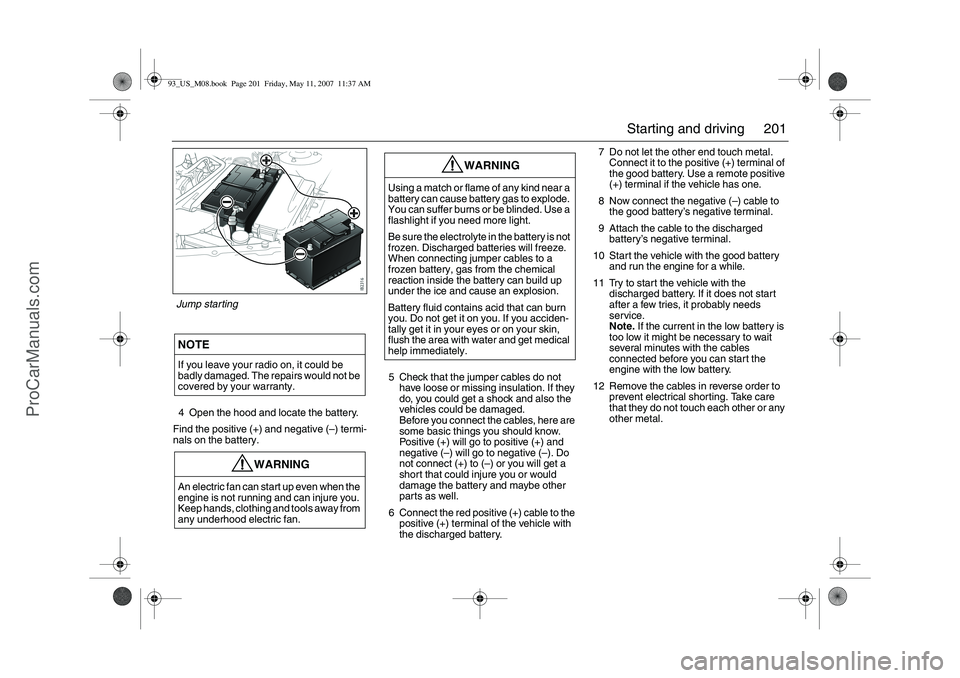
4 Open the hood and locate the battery.
Find the positive (+) and negative (–) termi-
nals on the battery.5 Check that the jumper cables do not
have loose or missing insulation. If they
do, you could get a shock and also the
vehicles could be damaged.
Before you connect the cables, here are
some basic things you should know.
Positive (+) will go to positive (+) and
negative (–) will go to negative (–). Do
not connect (+) to (–) or you will get a
short that could injure you or would
damage the battery and maybe other
parts as well.
6 Connect the red positive (+) cable to the
positive (+) terminal of the vehicle with
the discharged battery.7 Do not let the other end touch metal.
Connect it to the positive (+) terminal of
the good battery. Use a remote positive
(+) terminal if the vehicle has one.
8 Now connect the negative (–) cable to
the good battery’s negative terminal.
9 Attach the cable to the discharged
battery’s negative terminal.
10 Start the vehicle with the good battery
and run the engine for a while.
11 Try to start the vehicle with the
discharged battery. If it does not start
after a few tries, it probably needs
service.
Note. If the current in the low battery is
too low it might be necessary to wait
several minutes with the cables
connected before you can start the
engine with the low battery.
12 Remove the cables in reverse order to
prevent electrical shorting. Take care
that they do not touch each other or any
other metal.NOTEIf you leave your radio on, it could be
badly damaged. The repairs would not be
covered by your warranty.
WARNING
An electric fan can start up even when the
engine is not running and can injure you.
Keep hands, clothing and tools away from
any underhood electric fan.
WARNING
Using a match or flame of any kind near a
battery can cause battery gas to explode.
You can suffer burns or be blinded. Use a
flashlight if you need more light.
Be sure the electrolyte in the battery is not
frozen. Discharged batteries will freeze.
When connecting jumper cables to a
frozen battery, gas from the chemical
reaction inside the battery can build up
under the ice and cause an explosion.
Battery fluid contains acid that can burn
you. Do not get it on you. If you acciden-
tally get it in your eyes or on your skin,
flush the area with water and get medical
help immediately.
Jump starting93_US_M08.book Page 201 Friday, May 11, 2007 11:37 AM
ProCarManuals.com
Page 202 of 320
202 Starting and drivingUsing a battery charger3
33 3/starter
unitTo avoid damaging the car’s electrical
system and electronics, the following rules
must be followed when charging the battery
or jump starting the car.
If the charger or starter unit can be set to
different voltages (6 V/12 V/18 V/24 V),
12V must be selected.
Follow the manufacturer’s instructions
supplied with the charger or starter unit.
No other apparatus that are grounded or
connected to the mains must be
connected to the car during charging or
jump starting.
The charger or starter unit must under no
conditions produce a voltage greater
than:
16 V continuous
18 V for 60 minutes.
If you are unsure about the charge rating of
the unit, disconnect the battery clamp from
the positive terminal before connecting the
unit to the battery.
For long tripsBefore starting off on a long journey, it is
advisable to have your car inspected by
your Saab dealer.
Obtain a few important items to take along
on your journey, such as spare bulbs, wiper
blades, fuses, a drive belt (poly-V-belt) and
the like.
You can check some points yourself before-
hand:
Check that no oil or fuel leaks out of the
engine or gearbox/transmission.
Check the coolant and power steering
fluid levels. Check also for leaks.
Inspect the drive belt (poly-V-belt) and
replace if it shows any signs of wear.
Check the battery charge.
Check the tires for tread pattern and air
pressure, including the compact spare
tire.
Take an extra remote control and keep it
separate.
Check the brakes.
Check all bulbs.
Check for the presence of the tool kit and
jack in the car.
93_US_M08.book Page 202 Friday, May 11, 2007 11:37 AM
ProCarManuals.com
Page 203 of 320
203 Car care
Hood ________________ 204
Engine ______________ 205
Engine bay, 4-cyl engine 208
Engine bay, V6 engine _ 209
Engine oil ____________ 210
Air filter______________ 211
Transmission fluid ____ 212
Coolant ______________ 212
Brake/clutch fluid and
brake pads__________ 214
Power steering________ 215
Battery ______________ 216
Drive belt ____________ 219
Wipers and washers ___ 220
Wiper blades _________ 220
Changing bulbs _______ 222
Fuses _______________ 237 Tires _________________ 244
Automatic tire pressure
monitoring system ____ 257
Compact spare ________ 260
Changing a tire ________ 262
Safety belts ___________ 266
Upholstery and trim ____ 266
Textile carpeting _______ 267
Engine bay ____________ 267
Washing ______________ 267
Waxing and polishing ___ 270
Touching up the paint___ 270
Anti-corrosion treatment 271
Recovery and/or
recycling of automotive
materials ____________ 273
Air conditioning (A/C) ___ 274
Car care
3Asterisk means: equipment not fitted in all cars
(can depend on model variant, engine variant,
market specification, options or accessories).93_US_M08.book Page 203 Friday, May 11, 2007 11:37 AM
ProCarManuals.com
Page 208 of 320
208 Car care
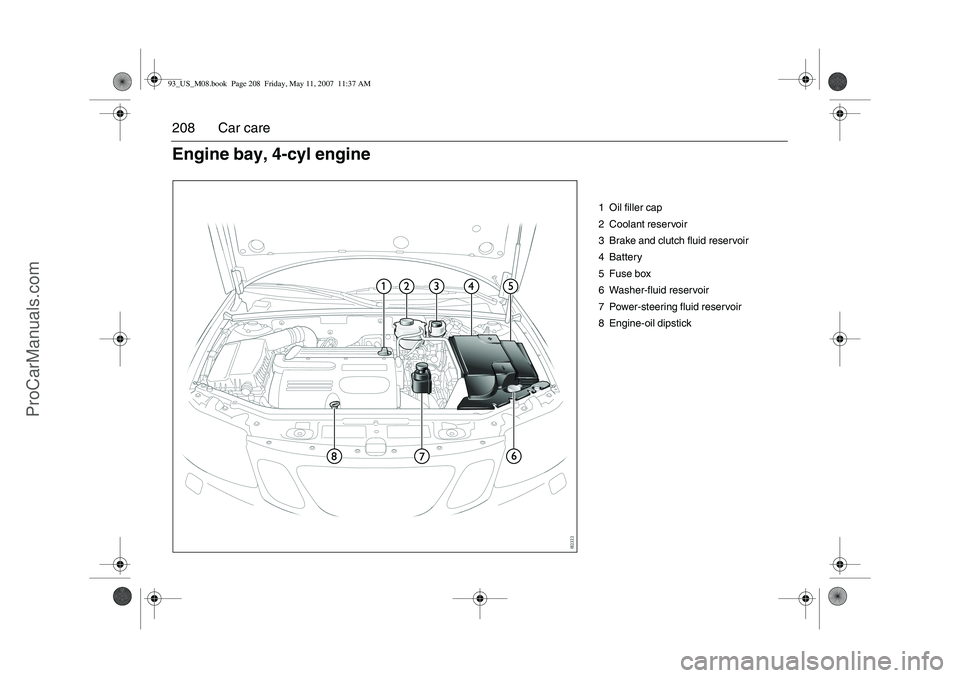
1 Oil filler cap
2 Coolant reservoir
3 Brake and clutch fluid reservoir
4Battery
5 Fuse box
6 Washer-fluid reservoir
7 Power-steering fluid reservoir
8 Engine-oil dipstick
Engine bay, 4-cyl engine93_US_M08.book Page 208 Friday, May 11, 2007 11:37 AM
ProCarManuals.com
Page 209 of 320
209 Car care
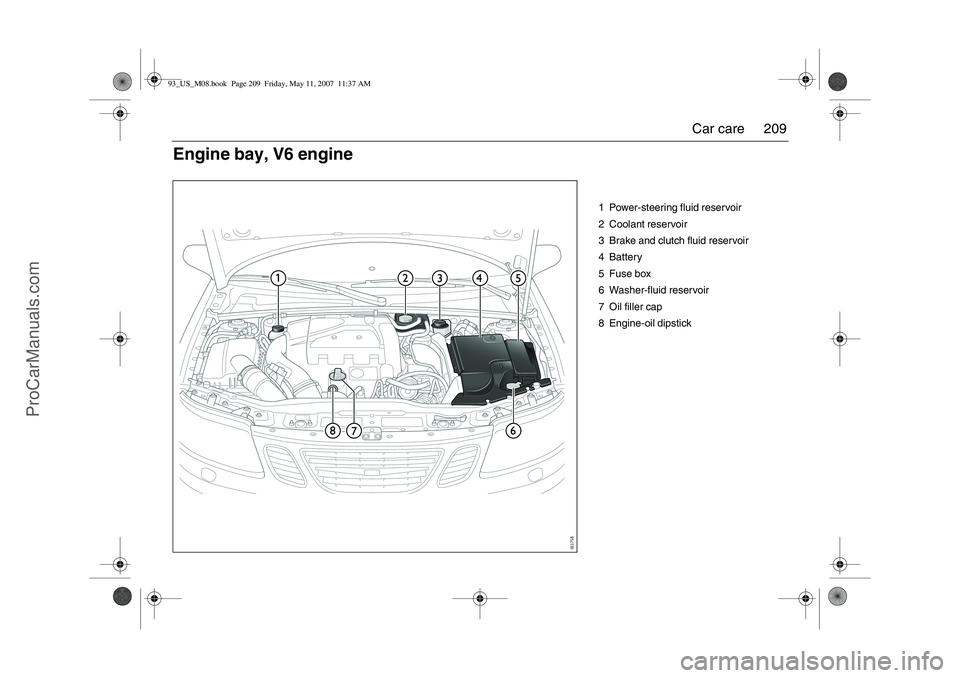
1 Power-steering fluid reservoir
2 Coolant reservoir
3 Brake and clutch fluid reservoir
4Battery
5 Fuse box
6 Washer-fluid reservoir
7 Oil filler cap
8 Engine-oil dipstick
Engine bay, V6 engine93_US_M08.book Page 209 Friday, May 11, 2007 11:37 AM
ProCarManuals.com
Page 216 of 320
216 Car careBattery
Check the charge state and electrolyte level
of the battery regularly.
If frequent short journeys are made, the bat-
tery may need extra charging. This can be
done with a battery charger or by taking the
car for a long run.
If the battery is not being charged while the
engine is running, the following message
will appear on the SID:
Check the drive belt (see page 219). If the
belt is damaged, the engine may overheat,
the battery may not be charged and the A/C
compressor may not work.
WARNING
When working on the battery, highly
explosive gas can build up. A spark
could ignite this gas that collects
around the battery.
Therefore, always avoid sparks and
open flames in the vicinity of the bat-
tery.
The battery contains corrosive sulphu-
ric acid. Always wear a face mask or
goggles when working on the battery.
If battery acid gets into the eyes or
splashes onto skin or clothing, wash
the affected area liberally with water.
If acid gets into the eyes or a large
quantity makes contact with the skin,
seek medical help.
Battery posts, terminals and related
accessories contain lead and lead
compounds. Wash your hands after
handling
NOTEA discharged battery can freeze and frac-
ture. Batteries should therefore always be
stored away from sub-zero temperatures.
Battery not charging.
Make a safe stop.
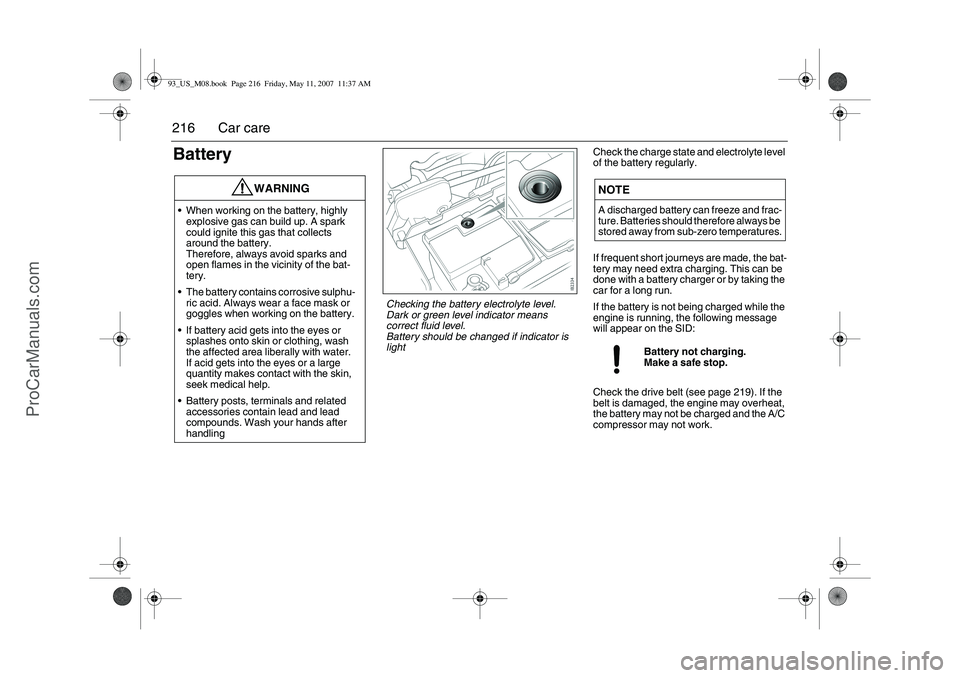
Checking the battery electrolyte level.
Dark or green level indicator means
correct fluid level.
Battery should be changed if indicator is
light
93_US_M08.book Page 216 Friday, May 11, 2007 11:37 AM
ProCarManuals.com
Page 217 of 320
217 Car care
Always connect the positive (red) cable to
the battery’s positive (+) terminal, and the
negative (black) cable to the negative (-)
terminal of the battery. Always disconnect
both battery leads when boost charging the
battery.
A car with standard equipment specifica-
tions and a fully charged battery can be left
for up to 40 days and still have a sufficient
charge for starting. If extra equipment is fit-
ted, such as a mobile phone, the charge
may only be sufficient for about 15 days.NOTEIf boost charging never use anything
but a 12-volt charger, see page 200.
Do not connect the battery termi-
nals, + and –, incorrectly.
Serious damage can occur to the car’s
electrical system if a battery or alterna-
tor lead is disconnected while the
engine is running.
Exercise special care when removing
and fitting the positive (+) cable so as
not to damage the battery disconnect
switch.
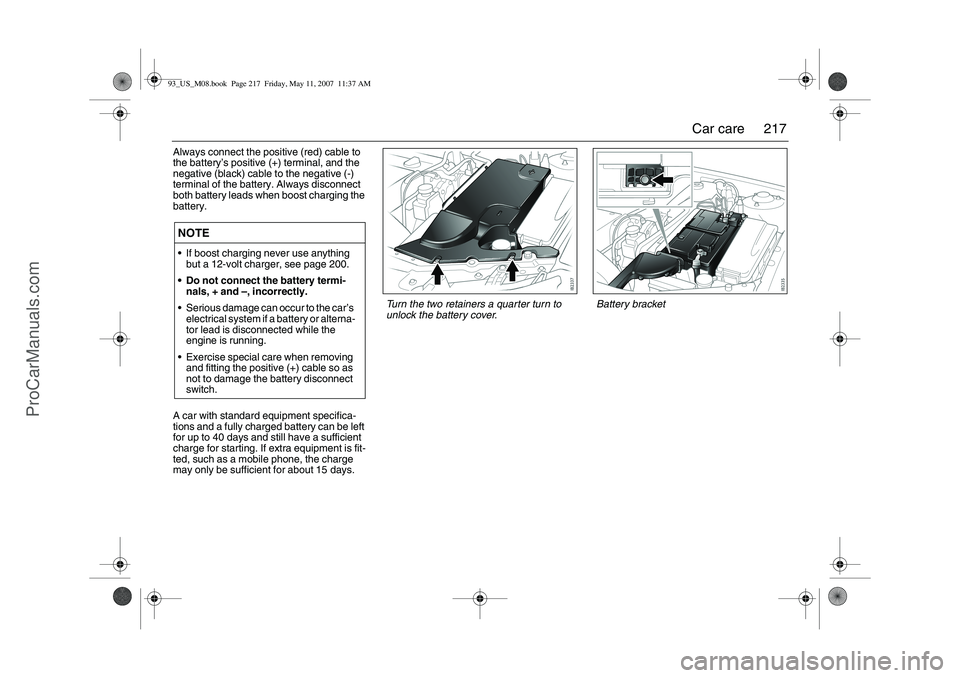
Turn the two retainers a quarter turn to
unlock the battery cover.
Battery bracket
93_US_M08.book Page 217 Friday, May 11, 2007 11:37 AM
ProCarManuals.com
Page 218 of 320
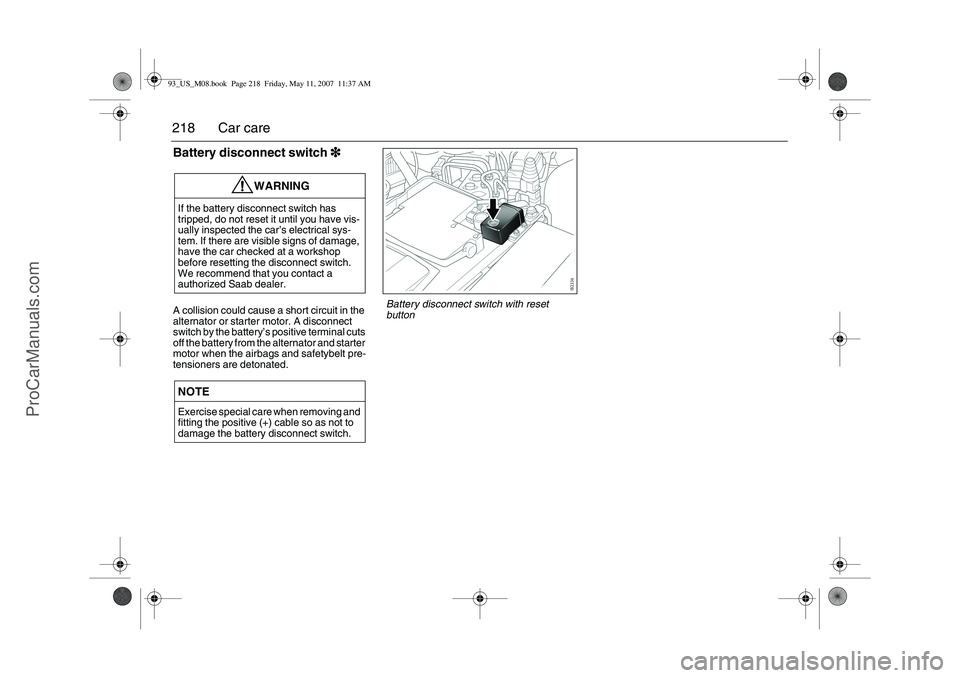
218 Car careBattery disconnect switch3
33 3A collision could cause a short circuit in the
alternator or starter motor. A disconnect
switch by the battery’s positive terminal cuts
off the battery from the alternator and starter
motor when the airbags and safetybelt pre-
tensioners are detonated.
WARNING
If the battery disconnect switch has
tripped, do not reset it until you have vis-
ually inspected the car’s electrical sys-
tem. If there are visible signs of damage,
have the car checked at a workshop
before resetting the disconnect switch.
We recommend that you contact a
authorized Saab dealer.NOTEExercise special care when removing and
fitting the positive (+) cable so as not to
damage the battery disconnect switch.
Battery disconnect switch with reset
button
93_US_M08.book Page 218 Friday, May 11, 2007 11:37 AM
ProCarManuals.com