warning SAAB 9-3 2009 Owners Manual
[x] Cancel search | Manufacturer: SAAB, Model Year: 2009, Model line: 9-3, Model: SAAB 9-3 2009Pages: 304, PDF Size: 44.31 MB
Page 254 of 304
254 Car careThe system does not warn if the tire pres-
sure is too high.
If the system has warned or triggered an
alarm due to inadequate pressure then
the pressure must be reset to the recom-
mended pressure so that the warning/alarm
is cleared.If the tire pressure decreasesIf the tire pressure decreases to 6 psi
(40 kPa) below the recommended pressure
then a warning is shown on the SID as to
which tires are affected.
Adjust the pressure as soon as possible. If the tire pressure continues to decrease
then an alarm is shown on the SID when the
pressure has decreased to 23 psi (160 kPa)
which is the lowest permitted pressure for
the tire.
An alarm is also received when leakage is
greater than 3 psi/min. (20 kPa/min.).
Reduce speed (avoid heavy braking and
significant steering wheel movement) and
stop the car as soon as possible at a suita-
ble location. Replace the defective wheel.
The fault message can remain for up to
10 minutes after restarting the car. Then it
disappears if the tire pressure is correct.Check/adjust the pressure in the other tires
when a fault message is shown.
Note that the tire pressure can decrease
without a puncture. The pressure could
decrease around 3 psi (20 kPa) during a
three month period.
The outside temperature could also affect
tire pressure.
The temperature in the
tire also affects the
tire pressure. The spec ified tyre pressures
are valid for cold tyres. The increased tyre
pressure resulting from extensive driving
must not be reduced. For further informa-
tion on tire air pressure , see page 240.
Allow 10 minutes for the system to recog-
nize the wheel/sensors positions after fitting
a new set of tires. During this period no low
pressure warning or alarm can be triggered.
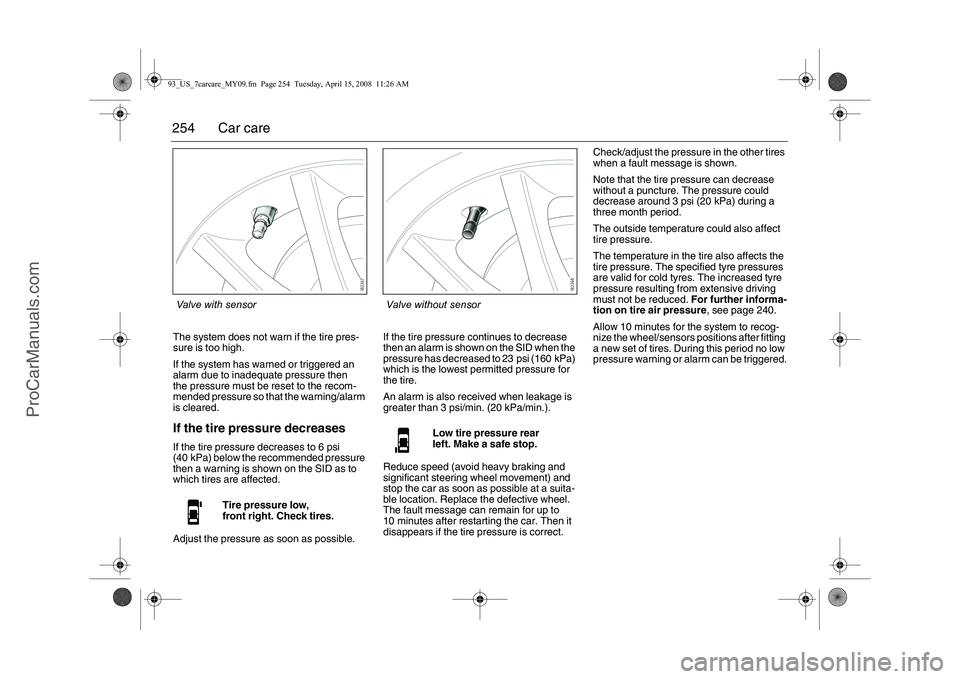
Tire pressure low,
front right. Check tires.
Low tire pressure rear
left. Make a safe stop.
Valve with sensor
Valve without sensor
93_US_7carcare_MY09.fm Page 254 Tuesday, April 15, 2008 11:26 AM
ProCarManuals.com
Page 256 of 304
256 Car careCompact spareThe compact spare is light and easy to
handle when changing the tire. Its use is
only permitted when a standard tire has sus-
tained a puncture. The maximum life of the
tire is only just over 2,000 miles (3,500 km).
Do not exceed 50 mph (80 km/h) with the
compact spare fitted.
The tire pressure should be 60 psi
(420 kPa). Put the punctured tire in the
spare wheel well under the trunk floor.
Have the standard tire repaired and refitted
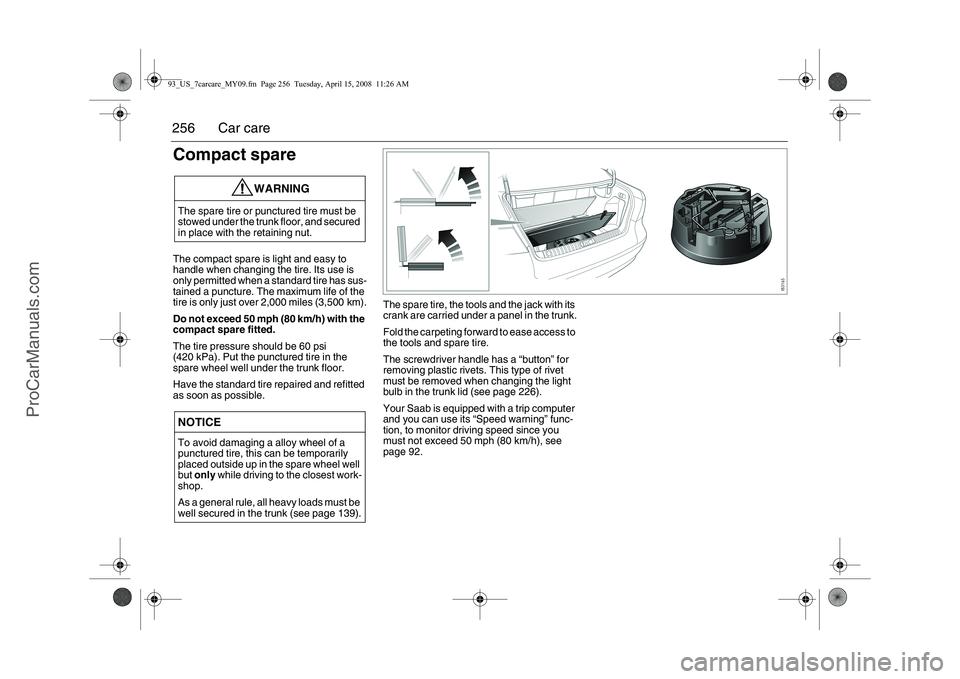
as soon as possible.The spare tire, the tools and the jack with its
crank are carried under a panel in the trunk.
Fold the carpeting forward to ease access to
the tools and spare tire.
The screwdriver handle has a “button” for
removing plastic rivets. This type of rivet
must be removed when changing the light
bulb in the trunk lid (see page 226).
Your Saab is equipped with a trip computer
and you can use its “Speed warning” func-
tion, to monitor driving speed since you
must not exceed 50 mph (80 km/h), see
page 92.
WARNING
The spare tire or punctured tire must be
stowed under the trunk floor, and secured
in place with the retaining nut.NOTICETo avoid damaging a alloy wheel of a
punctured tire, this can be temporarily
placed outside up in the spare wheel well
but
only while driving to the closest work-
shop.
As a general rule, all heavy loads must be
well secured in the trunk (see page 139).93_US_7carcare_MY09.fm Page 256 Tuesday, April 15, 2008 11:26 AM
ProCarManuals.com
Page 258 of 304
258 Car careDriving with a compact wheel
fittedObserve the following when the compact
spare tire is fitted:
The compact spare is light and easy to handle when changing a tire.
Do not drive further than necessary with the compact spare fitted - the maximum
life of the tire is only just over 2,000 miles
(approx. 3,500 km).
Refit the standard tire as soon as possi- ble.
Fitting a spare tire/wheel without pressure sensor will trigger a malfunction
message, see page 255.
Important considerations when driving with
a compact spare tire:
The car’s ground clearance is reduced. The car must not be driven with more than
one compact spare tire at a time.
Avoid driving against the curb.
Do not use snow chains.
Do not fit the wheel cover - this would conceal the warning text.
Changing a tire
WARNING
Do not exceed 50 mph (80 km/h). The
tire can overheat affecting the car’s
road holding.
Tire pressure: refer to page 291.
The spare tire or punctured tire must be stowed under the trunk floor, and
secured in place with the retaining nut.
WARNING
Lifting a vehicle and getting under it to do
maintenance or repairs is dangerous
without the appropriate safety equipment
and training. The jack provided with your
vehicle is designed only for changing a
flat tire. If it is used for anything else, you
or others could be badly injured or killed if
the vehicle slips off the jack. Use the jack
provided with your vehicle only for chang-
ing a flat tire.
Changing a tire can be dangerous. The
vehicle can slip off the jack and roll over
or fall on you or other people. You and
they could be badly injured or even killed.
Find a level place to change your tire. To
help prevent the vehicle from moving:
1 Set the parking brake firmly.
2 If you have an automatic transmis- sion, put the shift lever in PARK (P).
For a manual transmission, leave the
car in gear (1st or REVERSE (R)).
3 Turn off the engine and do not restart while the vehicle is raised.
4 Do not allow passengers to remain in the vehicle.
93_US_7carcare_MY09.fm Page 258 Tuesday, April 15, 2008 11:26 AM
ProCarManuals.com
Page 259 of 304
259
Car care
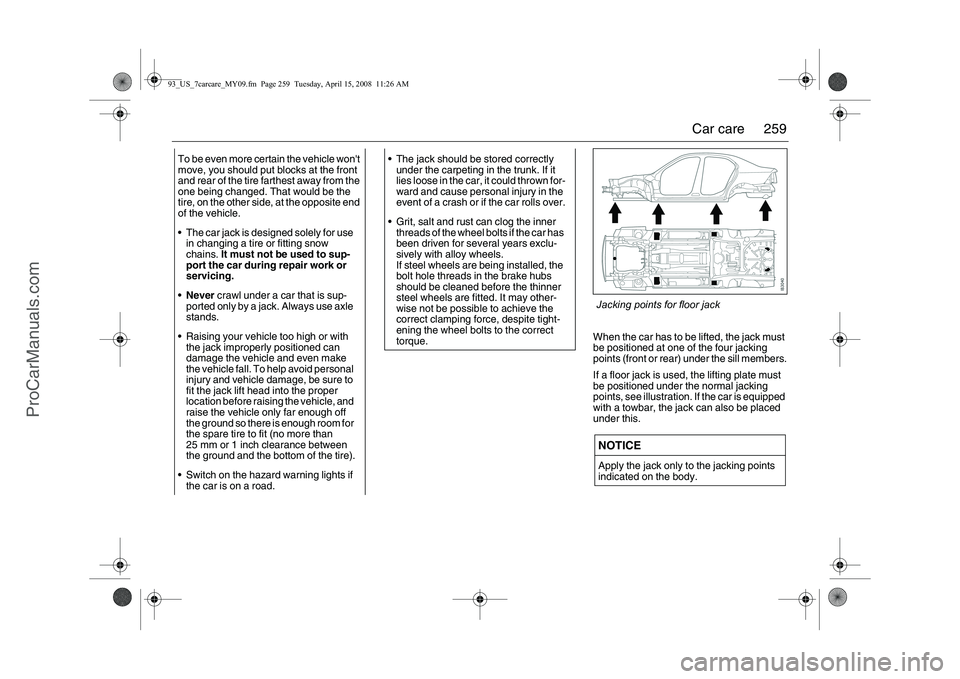
When the car has to be lifted, the jack must
be positioned at one of the four jacking
points (front or rear) under the sill members.
If a floor jack is used, the lifting plate must
be positioned under the normal jacking
points, see illustration. If the car is equipped
with a towbar, the jack can also be placed
under this.
To be even more certain the vehicle won't
move, you should put blocks at the front
and rear of the tire farthest away from the
one being changed. That would be the
tire, on the other side, at the opposite end
of the vehicle.
The car jack is designed solely for use
in changing a tire or fitting snow
chains. It must not be used to sup-
port the car during repair work or
servicing.
Never crawl under a car that is sup-
ported only by a jack. Always use axle
stands.
Raising your vehicle too high or with the jack improperly positioned can
damage the vehicle and even make
the vehicle fall. To help avoid personal
injury and vehicle damage, be sure to
fit the jack lift head into the proper
location before raising the vehicle, and
raise the vehicle only far enough off
the ground so there is enough room for
the spare tire to fit (no more than
25 mm or 1 inch clearance between
the ground and the bottom of the tire).
Switch on the hazard warning lights if the car is on a road.
The jack should be stored correctly under the carpeting in the trunk. If it
lies loose in the car, it could thrown for-
ward and cause personal injury in the
event of a crash or if the car rolls over.
Grit, salt and rust can clog the inner threads of the wheel bolts if the car has
been driven for several years exclu-
sively with alloy wheels.
If steel wheels are being installed, the
bolt hole threads in the brake hubs
should be cleaned before the thinner
steel wheels are fitted. It may other-
wise not be possible to achieve the
correct clamping force, despite tight-
ening the wheel bolts to the correct
torque.
NOTICEApply the jack only to the jacking points
indicated on the body.Jacking points for floor jack
93_US_7carcare_MY09.fm Page 259 Tuesday, April 15, 2008 11:26 AM
ProCarManuals.com
Page 262 of 304
262 Car care
Tire repair kit3
The tire repair kit re places the spare wheel.
The repair kit allows a punctured tire to be
temporarily repaired and reinflated without
needing to remove the wheel.
Minor damage to the tire, such as a foreign
object that has penetrated the tread, can be
temporarily repaired with the repair kit.
Do not remove the foreign object. Damage
larger than 0.16 in. (4 mm) and damage to
the sidewalls cannot be repaired with the
repair kit.
Follow the instructions supplied with the
repair kit carefully.
If the compressor sounds strange or
becomes abnormally hot, leave it switched
off for at least 30 minutes.
WARNING
Make sure no one can jog the gear lever,
for example, as the engine must be idling
when the tire is repaired. There is other-
wise a risk of personal injury.
Do not use the repair kit if:
the damage to the tire is larger than 0.16 in. (4 mm).
the wheel is damaged.
Do not exceed 50 mph (80 km/h) after
repairing one of the car tires with the
repair kit.
WARNING
Change the punctured tire as soon as
possible.
Replenish the repair kit at a workshop.
We recommend that you contact an
authorized Saab workshop. The canister
of sealant must be changed once every
four years. See the date on the canister.
The handling characteristics of the car
may be impaired.
Driving with a tire that is underinflated or
has a puncture can damage the tire in
such a way that it is not possible to repair
it with the sealant.
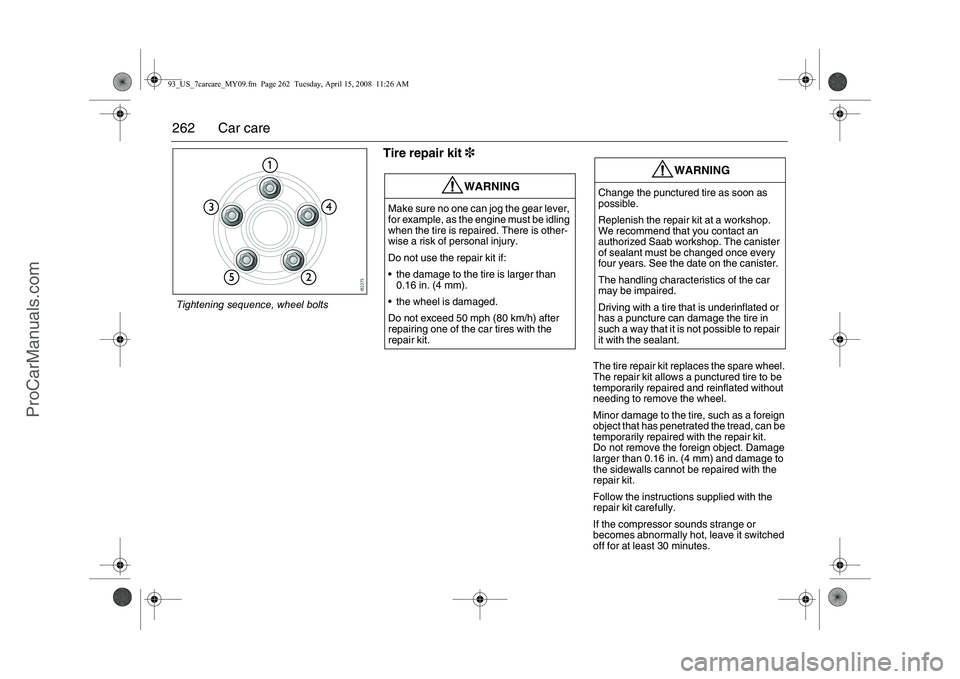
Tightening sequence, wheel bolts93_US_7carcare_MY09.fm Page 262 Tuesday, April 15, 2008 11:26 AM
ProCarManuals.com
Page 263 of 304
263
Car care
Prevent the compressor getting wet.
The canister of seal ant can only be used
once. Replace a used canister at a work-
shop. We recommend that you contact an
authorised Saab workshop.
The tire repair kit can be used at tempera-
tures down to –22°F (–30 °C). At low tem-
peratures the sealant is more viscous and
so is less able to seal slightly larger
damage.
If a punctured tire is to be repaired:
Allow the engine to idle. The compressor will consume some energy.
Apply the handbrake.
Turn on the hazard warning light.
Position the warning triangle to warn other drivers.
The repair kit is stowed under the luggage
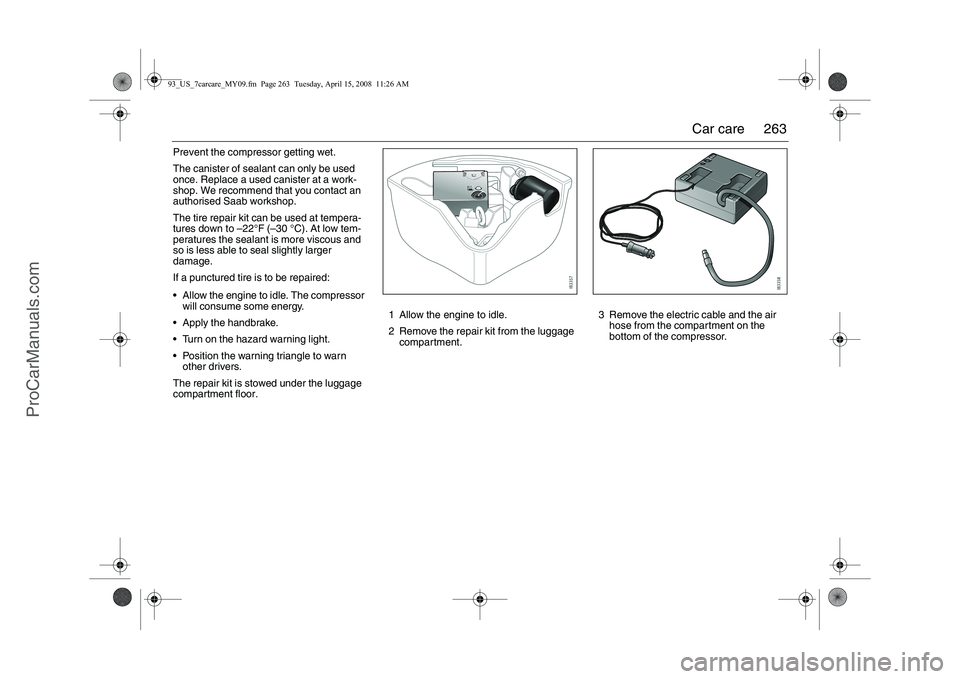
compartment floor. 1 Allow the engine to idle.
2 Remove the repair kit from the luggage
compartment. 3 Remove the electric cable and the air
hose from the compartment on the
bottom of the compressor.93_US_7carcare_MY09.fm Page 263 Tuesday, April 15, 2008 11:26 AM
ProCarManuals.com
Page 265 of 304
265
Car care
If the correct pressure is not reached
within 10 minutes, the damage to the tire is
too large to be repaired with the sealant.
Park the car in a suitable place and call for
assistance.
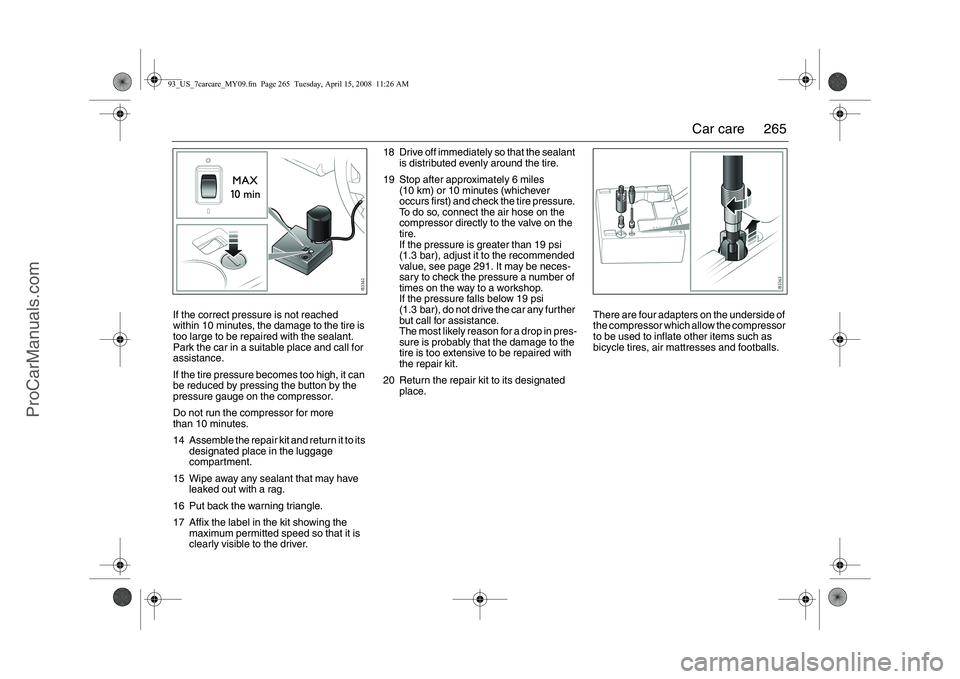
If the tire pressure becomes too high, it can
be reduced by pressing the button by the
pressure gauge on the compressor.
Do not run the co mpressor for more
than 10 minutes.
14 Assemble the repair kit and return it to its designated place in the luggage
compartment.
15 Wipe away any sealant that may have leaked out with a rag.
16 Put back the warning triangle.
17 Affix the label in the kit showing the maximum permitted speed so that it is
clearly visible to the driver. 18 Drive off immediately so that the sealant
is distributed evenly around the tire.
19 Stop after approximately 6 miles (10 km) or 10 minutes (whichever
occurs first) and check the tire pressure.
To do so, connect the air hose on the
compressor directly to the valve on the
tire.
If the pressure is greater than 19 psi
(1.3 bar), adjust it to the recommended
value, see page 291. It may be neces-
sary to check the pressure a number of
times on the way to a workshop.
If the pressure falls below 19 psi
(1.3 bar), do not drive the car any further
but call for assistance.
The most likely reason for a drop in pres-
sure is probably that the damage to the
tire is too extensive to be repaired with
the repair kit.
20 Return the repair kit to its designated place. There are four adapters on the underside of
the compressor which allow the compressor
to be used to inflate other items such as
bicycle tires, air mattresses and footballs.93_US_7carcare_MY09.fm
Page 265 Tuesday, April 15, 2008 11:26 AM
ProCarManuals.com
Page 266 of 304
266 Car careSafety beltsCheck the function of the safety belts regu-
larly as follows:
Hold the diagonal strap and pull it sharply. The safety belt should lock and it should
not be possible to withdraw it further.
Check the anchorage points in the floor.
They must not have suffered rust damage.
If a belt is worn or has any fraying edges, it
should be replaced.
Safety belts must not co me into contact with
substances such as polishes, oil or chemi-
cals. If the belts get dirty, wash them with
warm water and a detergent or have them
replaced.
Upholstery and trimTo remove fluff and hairs from the seats,
door armrests and headlining, use a
vacuum cleaner, a moist lint-free cloth, or a
clothes brush. Remove spots and dirt using
a cloth moistened with lukewarm soapy
water.
When using a stain remover, always work
from the outside toward s the center to avoid
leaving a ring. If a soiled ring or spot should
remain, it can usually be removed using
lukewarm soapy water or water alone.
Spots left by liquids, such as soft drinks or
thin oil, must be removed at once with an
absorbent material, such as kitchen towel-
ling. Then clean with a stain remover.
White spirit is recommended for removing
grease and oil stains. A medium stiff brush
may also be used.
Cleaning and caring for leather
upholsteryThe principal reason for treating leather
upholstery is to maintain its elegant appear-
ance and to provide it with a protective film.
Discolor at ion caused by dust and wear
mainly affects the lighter shades, although
this is not detrimental to the leather, indeed,
the patina resulting from use is often consid-
ered desirable in leather. But if the leather is
allowed to become too grubby, it can start to
look shabby. Vacuum the leather regularly
with a soft brush attachment to remove
loose dirt and dust.
The leather upholstery should be cleaned
and reconditioned twice a year in conjunc-
tion with spring and autumn inspections. In
very warm, dry climates the leather may
need more regular reconditioning. Use con-
ventional leather care products. Follow the
instructions on the packaging.
Do not use harsh polishing agents, cleaning
agents, sprays, coarse soap or hot water.
Semi-Anilin is a leather that is colored
throughout which only has a thin protective
finish and is accordingly more sensitive than
a surface colored l eather and therefore
need more care to keep the protection and
ageing properties.
WARNING
If the car is involved in a crash, the safety
belts, belt pretensioners and other asso-
ciated components must be inspected.
We recommend that you contact a Saab
dealer.
Never make any alterations or repairs to
the safety belts your self. We recommend
that you contact a Saab dealer.93_US_7carcare_MY09.fm Page 266 Tuesday, April 15, 2008 11:26 AM
ProCarManuals.com
Page 268 of 304
268 Car careThe underside of the car also needs wash-
ing regularly, and this should be done extra
thoroughly at the end of winter. Clean the
underside of the car by hand if the car is
usually washed in an automatic car wash
without special facilities for underbody
cleaning.
Never wash or leave the car to dry in the
sun, but wipe it dry with a chamois leather
immediately after washing to avoid smears
and streaks.
Clean the inside of window glass using a
proprietary window cleaner. This is particu-
larly important when the car is new, as
upholstery and trim have a tendency to
sweat a little at first.
Keep the glass well polished, as this helps
to prevent misting.
Clean the outside of the windows with Saab
washer fluid. This is especially important if
the car has been washed in an automatic
car wash, as sometimes a wax treatment is
used that can contaminate the windshield
and impair the performance of the wipers.
Saab offers a full co mplement of car care
products. See your dealer or visit us at our
website. Convertible
If a pressure washer is used be heedful of
the following recommendations:
On the lower part of the car (not higher than the door handles): max pressure
of 100 bar and not closer than 8 in.
(20 cm).
On the upper part of the car: tax pres- sure of 100 bar and not closer than
32 in. (80 cm).
Do not use any drying chemicals or water- proofing agents.
Avoid automatic car washes.
WARNING
Read and follow the instructions on the packaging of the recommended
cleaning agents and waterproofing
agents. We recommend that you con-
tact an authorized Saab dealer
regarding recommended cleaning
agents and waterproofing agents.
Never treat the soft top with hot wax or similar.
Never use petrochemical based sol-
vents for cleaning. Only use water with
a recommended cleaning agent. Pet-
rochemical based solvents can cause
irreparable damage to the soft top.
Never use a pressure washer to clean the soft top. Only use normal house-
hold water pressure.NOTICE Only operate the soft top when it is clean and dry.
Do not lower the so ft top when it is
damp. This can cause folds and pres-
sure marks. If the soft top is heavily
soiled, the dirt may cause irreparable
visible chafe marks.
Only use water, recommended clean- ing agents and a microfibre cloth if the
soft top is already damaged, other-
wise the damage can become worse.
At creases, seams and window edges the cleaning motion should be away
from the crease, seam or window
edge in to the soft top.
93_US_7carcare_MY09.fm Page 268 Tuesday, April 15, 2008 11:26 AM
ProCarManuals.com
Page 269 of 304
269
Car care
When the soft top is only slightly soiled,
follow the directions on the cleaning agent
packaging. No brushing is necessary.
Check the soft top for water penetration
from time to time by spraying a small
amount of water on it. If water does not form
droplets but disappear into the material, it is
recommended to wash normally and then
waterproof.
If the soft top is heavily soiled and normal
recommended cleaning does not produce a
noticeable improvement, carry out the fol-
lowing.
The following cleaning method must be only
used if the soft top is heavily soiled and must
not be carried out more than twice a year.
1 Stop normal cleaning.
2 Rinse off the thick dirt thoroughly with water.
3 Spray the newly rinsed soft top with the recommended cleaning agent and allow
it to work in for 15-20 minutes. 4 Move the washing brush backwards and
forwards, not diagonally, from side to
side or in circles. Use a soft brush, like a
clothes brush or a micro fibre cloth so
that the cleaning agent foams. Never
use a wire brush.
5 Then rinse the soft top with warm water and brush using a soft brush in the direc-
tion of the vehicle until all foam has
disappeared. Brush carefully to prevent
damaging the material.
6 Dry the soft top using a clean chamois leather or a cloth that does not leave lint
on the soft top.
7 Allow the soft top to dry fully. Touch with a hand after a while, if the material feels
damp, allow it to dry for longer. 8 If spots are still visible, repeat the treat-
ment on these spots as before. Press
lightly with the brush to prevent damag-
ing the material. Do not use the brush
excessively. This can irreparably
damage the material. Do not repeat the
treatment more than twice.
9 When the soft top has fully dried, it must be waterproofed immediately. Only use
the recommended waterproofing agent.
Follow the instructions on the packag-
ing.
10 To obtain even and optimum waterproof- ing, the car must be closed for 24 hours
after treatment. Do not touch the mate-
rial and do not place any objects on it.
WARNING
Water hotter than 37 °C can burn the skin,
cause skin irritation and/or cause injuries.
Use suitable protection.
93_US_7carcare_MY09.fm Page 269 Tuesday, April 15, 2008 11:26 AM
ProCarManuals.com