Climate SAAB 9-3 2009 User Guide
[x] Cancel search | Manufacturer: SAAB, Model Year: 2009, Model line: 9-3, Model: SAAB 9-3 2009Pages: 304, PDF Size: 44.31 MB
Page 108 of 304
108 Instruments and controls
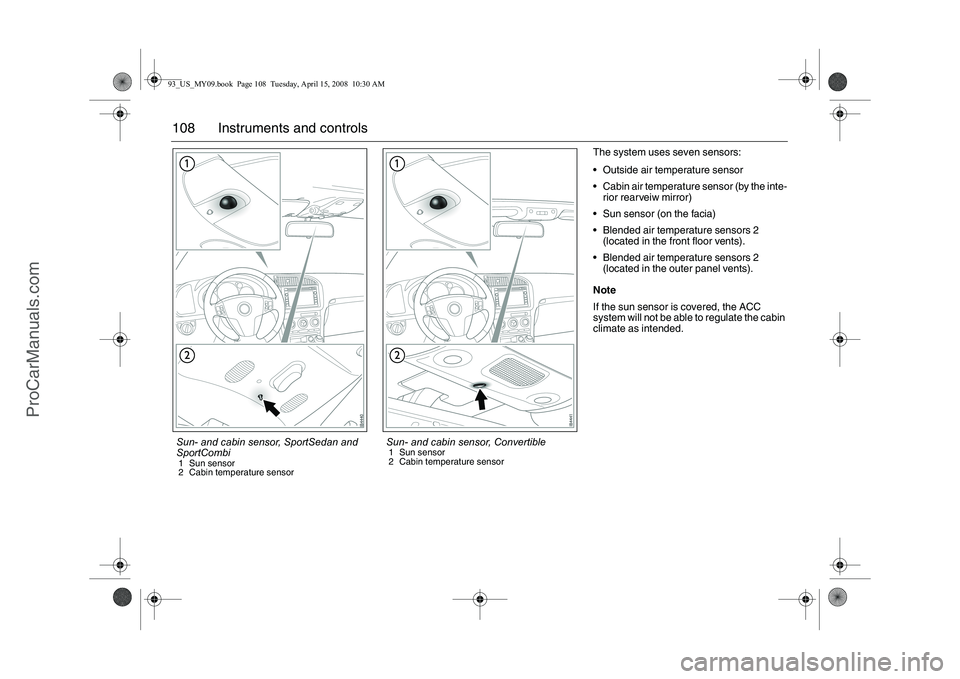
The system uses seven sensors:
Outside air temperature sensor
Cabin air temperature sensor (by the inte-
rior rearveiw mirror)
Sun sensor (on the facia)
Blended air temperature sensors 2
(located in the front floor vents).
Blended air temperature sensors 2
(located in the outer panel vents).
Note
If the sun sensor is covered, the ACC
system will not be able to regulate the cabin
climate as intended.
Sun- and cabin sensor, SportSedan and
SportCombi1 Sun sensor
2 Cabin temperature sensor
Sun- and cabin sensor, Convertible1 Sun sensor
2 Cabin temperature sensor
93_US_MY09.book Page 108 Tuesday, April 15, 2008 10:30 AM
ProCarManuals.com
Page 114 of 304
114 Instruments and controlsFormation of ice and mist in
extreme weather conditionsIt is only in the most extreme conditions that
icing and misting of window glass are likely
to be a problem, such as in torrential rain or
severe cold coupled with high relative
humidity, or when passengers are perspir-
ing heavily or wearing wet clothes. The fol-
lowing measures are recommended if such
problems should occur:
1 Select AUTO and set the temperature to
70 °F (21 °C)
2 Push one time on the defroster button. If
this is not enough...
3 Increase the fan speed. If this is not
enough...
4 Select a higher temperature.The seat cushions and backrests of the front
seats are heated.
Heating is thermostatically controlled.
The heating has two effect steps.
We do not recommend prolonged use of the
higher level for people with sensitive skin.
Heating is controlled manually but can also
be automatic. Refer to Settings on
page 115.
CalibrationCalibration is performed automatically
every 40:th time the car is started after
having been switched off for more than
2 hours or if the battery has been discon-
nected.ProgrammingA number of functions can be customized
under Settings (see page 115).Tips(before contacting a dealer. We recom-
mend that you contact a Saab dealer)
If you feel that the ACC system is not func-
tioning satisfactorily, select "Default
Settings" under Settings, see page 115.
ACC- ConvertibleWhen the soft top is folded, several func-
tions in the ACC-system is effected.
The system adjusts itself as follows:
the sensitivity of the temperature knob
changes
air distribution and fan speed can only be
adjusted manually
Recirculation and rear window heating
are cut out
The A/C compressor is switched off
(manual activation is possible by pressing
the AC OFF button).
All manual selections are possible with the
exception of rear window heating and
defroster function.
When the soft top is raised, the system
reverts to the AUTO mode and the set tem-
perature.
Note: When the soft top or all the windows
are open in a hot, humid climate, turning the
air conditioning on manually can cause con-
densation to form on cold surfaces, such as
the air ducts.
Electric heating, front
seats3
93_US_MY09.book Page 114 Tuesday, April 15, 2008 10:30 AM
ProCarManuals.com
Page 115 of 304
115 Instruments and controls
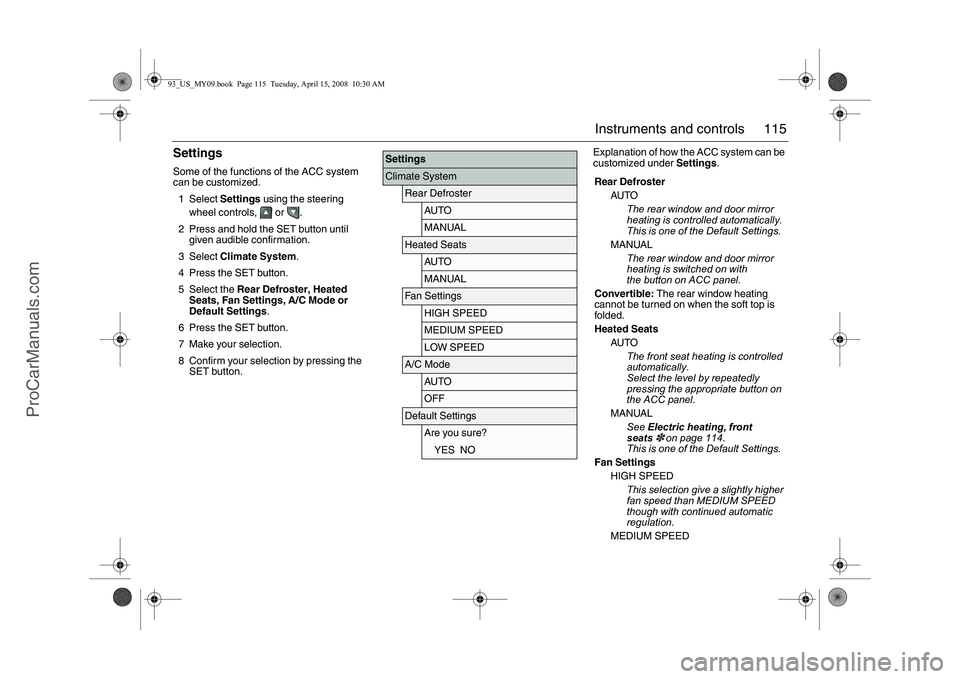
SettingsSome of the functions of the ACC system
can be customized.
1Select Settings using the steering
wheel controls, or .
2 Press and hold the SET button until
given audible confirmation.
3Select Climate System.
4 Press the SET button.
5 Select the Rear Defroster, Heated
Seats, Fan Settings, A/C Mode or
Default Settings.
6 Press the SET button.
7 Make your selection.
8 Confirm your selection by pressing the
SET button.Explanation of how the ACC system can be
customized under Settings.
SettingsClimate System
Rear Defroster
AUTOMANUAL
Heated Seats
AUTOMANUAL
Fan Settings
HIGH SPEEDMEDIUM SPEEDLOW SPEED
A/C Mode
AUTOOFF
Default Settings
Are you sure?YES NO
Rear Defroster
AUTO
The rear window and door mirror
heating is controlled automatically.
This is one of the Default Settings.
MANUAL
The rear window and door mirror
heating is switched on with
the button on ACC panel.
Convertible: The rear window heating
cannot be turned on when the soft top is
folded.
Heated Seats
AUTO
The front seat heating is controlled
automatically.
Select the level by repeatedly
pressing the appropriate button on
the ACC panel.
MANUAL
See Electric heating, front
seats
3 on page 114.
This is one of the Default Settings.
Fan Settings
HIGH SPEED
This selection give a slightly higher
fan speed than MEDIUM SPEED
though with continued automatic
regulation.
MEDIUM SPEED
93_US_MY09.book Page 115 Tuesday, April 15, 2008 10:30 AM
ProCarManuals.com
Page 149 of 304

149 Starting and driving
Ignition switch ________ 150
Steering wheel lock ____ 151
Starting the engine ____ 152
Important considerations
for driving __________ 153
Refueling ____________ 156
Engine Break-in Period _ 160
Manual transmission___ 161
Automatic
transmission3______ 162
Cruise Control ________ 169
Braking ______________ 170
All-wheel drive (XWD)3173
Traction Control System
(TCS) ______________ 173
Electronic Stability
Program ESP
®
______ 175
Parking brake_________ 177 Parking _______________ 177
Saab Parking
Assistance3________ 180
Economical driving _____ 183
Driving in cold weather__ 185
Driving in hot climates __ 187
Towing a trailer3______ 188
Driving with a roof rack
load ________________ 192
Driving with a load _____ 192
Driving with the trunk lid
open________________ 193
Driving in deep water ___ 193
Towing the car _________ 193
Jump starting _________ 197
For long trips __________ 199
Starting and driving
3Asterisk means: equipment not fitted in all cars
(can depend on model variant, engine variant,
market specification, options or accessories).93_US_MY09.book Page 149 Tuesday, April 15, 2008 10:30 AM
ProCarManuals.com
Page 183 of 304
183 Starting and driving
Economical drivingFactors affecting fuel
consumptionThe fuel consumption of a car is greatly
affected by driving conditions, climate, road
conditions, speed, driving technique, etc.Breaking-inFuel consumption may be somewhat
higher during the break-in period (the
first 3,000–4,000 miles (5,000–7,000 km)).Weather conditionsSummer temperatures give better fuel
economy than winter ones. The difference
can be as much as about 10%. Consump-
tion increases in cold weather because the
engine takes longer to reach its normal
operating temperature. The transmission
and wheel bearings also take longer to
warm up. Even distance affects consump-
tion: short journeys of 3–5 miles (5–8 km)
do not give the engine enough time to
reach its optimum temperature. Wind con-
ditions also have a marked effect on fuel
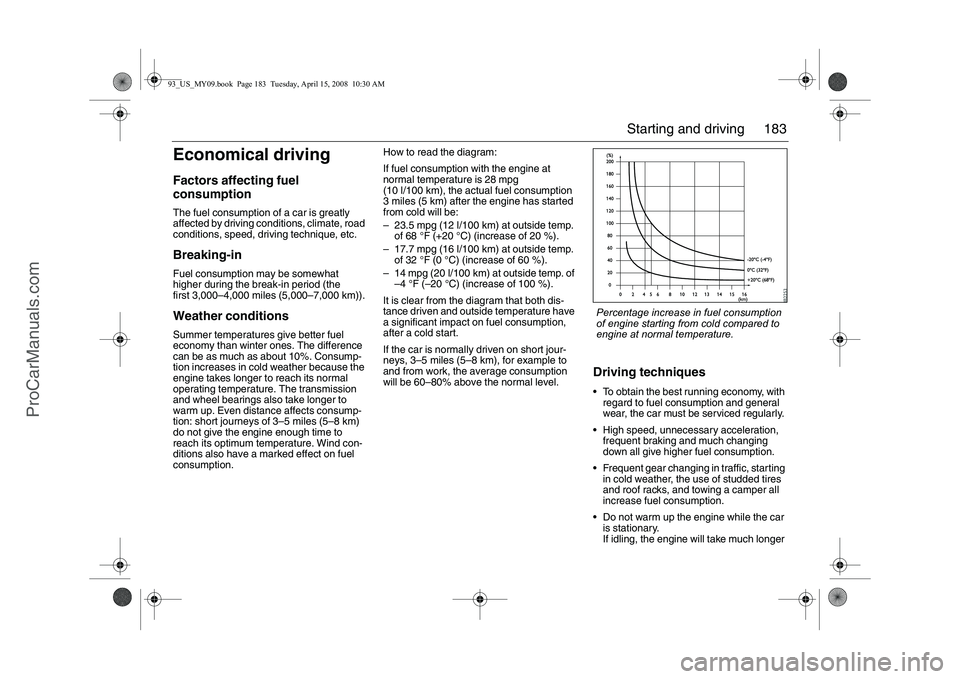
consumption.How to read the diagram:
If fuel consumption with the engine at
normal temperature is 28 mpg
(10 l/100 km), the actual fuel consumption
3 miles (5 km) after the engine has started
from cold will be:
– 23.5 mpg (12 l/100 km) at outside temp.
of 68 °F (+20 °C) (increase of 20 %).
– 17.7 mpg (16 l/100 km) at outside temp.
of 32 °F (0 °C) (increase of 60 %).
– 14 mpg (20 l/100 km) at outside temp. of
–4 °F (–20 °C) (increase of 100 %).
It is clear from the diagram that both dis-
tance driven and outside temperature have
a significant impact on fuel consumption,
after a cold start.
If the car is normally driven on short jour-
neys, 3–5 miles (5–8 km), for example to
and from work, the average consumption
will be 60–80% above the normal level.
Driving techniques To obtain the best running economy, with
regard to fuel consumption and general
wear, the car must be serviced regularly.
High speed, unnecessary acceleration,
frequent braking and much changing
down all give higher fuel consumption.
Frequent gear changing in traffic, starting
in cold weather, the use of studded tires
and roof racks, and towing a camper all
increase fuel consumption.
Do not warm up the engine while the car
is stationary.
If idling, the engine will take much longer Percentage increase in fuel consumption
of engine starting from cold compared to
engine at normal temperature.
93_US_MY09.book Page 183 Tuesday, April 15, 2008 10:30 AM
ProCarManuals.com
Page 187 of 304
187 Starting and driving
Driving in hot climatesAlways check the coolant level before start-
ing a journey. When the engine is cold, the
coolant shall lie on or just above the
KALT/COLD mark on the expansion tank
(boundary between the upper and lower
sections of the tank).
At the end of a journey, allow the engine to
idle for 2–3 minutes before switching it off.
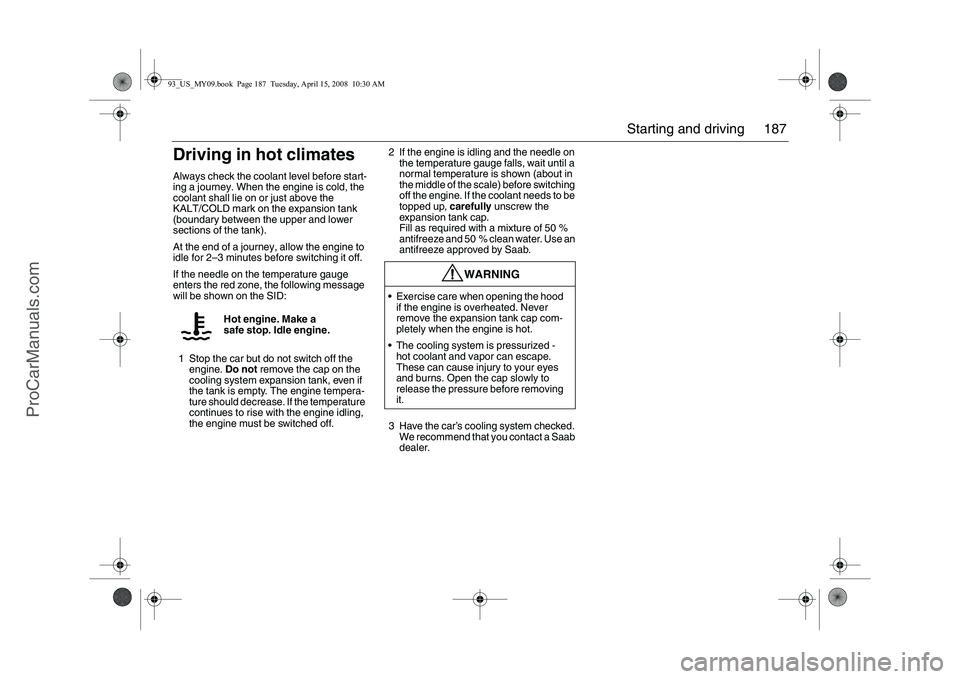
If the needle on the temperature gauge
enters the red zone, the following message
will be shown on the SID:
1 Stop the car but do not switch off the
engine. Do not remove the cap on the
cooling system expansion tank, even if
the tank is empty. The engine tempera-
ture should decrease. If the temperature
continues to rise with the engine idling,
the engine must be switched off.2 If the engine is idling and the needle on
the temperature gauge falls, wait until a
normal temperature is shown (about in
the middle of the scale) before switching
off the engine. If the coolant needs to be
topped up, carefully unscrew the
expansion tank cap.
Fill as required with a mixture of 50 %
antifreeze and 50 % clean water. Use an
antifreeze approved by Saab.
3 Have the car’s cooling system checked.
We recommend that you contact a Saab
dealer. Hot engine. Make a
safe stop. Idle engine.
WARNING
Exercise care when opening the hood
if the engine is overheated. Never
remove the expansion tank cap com-
pletely when the engine is hot.
The cooling system is pressurized -
hot coolant and vapor can escape.
These can cause injury to your eyes
and burns. Open the cap slowly to
release the pressure before removing
it.
93_US_MY09.book Page 187 Tuesday, April 15, 2008 10:30 AM
ProCarManuals.com
Page 235 of 304
235
Car care
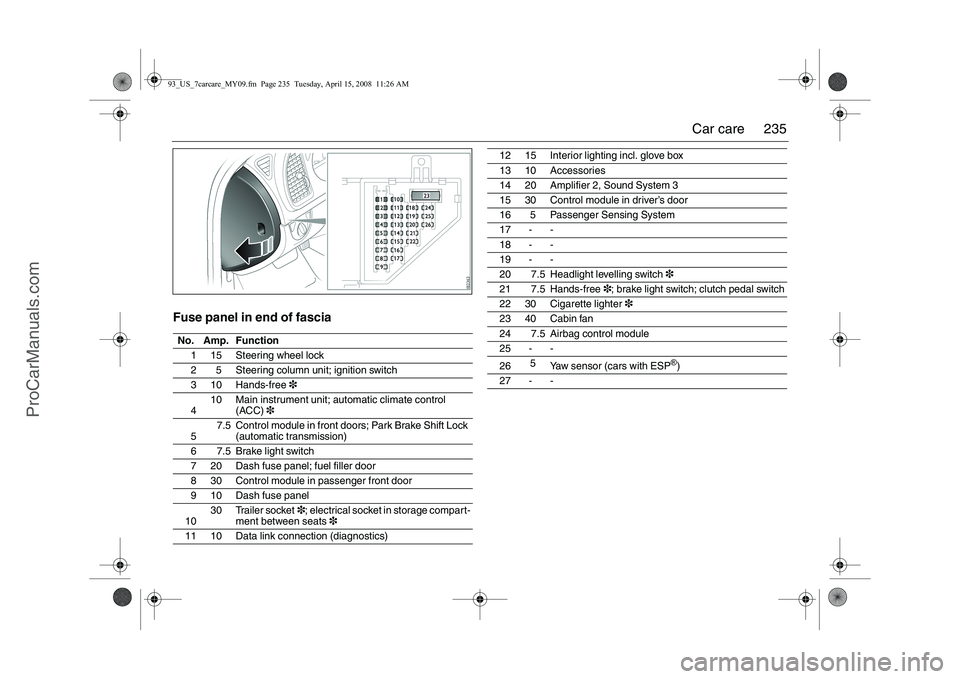
Fuse panel in end of fasciaNo. Amp. Function
1 15 Steering wheel lock
2 5 Steering column unit; ignition switch
3 10 Hands-free 3
4 10 Main instrument unit;
automatic climate control
(ACC) 3
5 7.5 Control module in front doors; Park Brake Shift Lock
(automatic transmission)
6 7.5 Brake light switch
7 20 Dash fuse panel; fuel filler door
8 30 Control module in passenger front door
9 10 Dash fuse panel
10 30 Trailer socket
3; electrical socket in storage compart-
ment between seats 3
11 10 Data link connection (diagnostics)
12 15 Interior lighting incl. glove box
13 10 Accessories
14 20 Amplifier 2, Sound System 3
15 30 Control module in driver’s door
16 5 Passenger Sensing System
17 - -
18 - -
19 - -
20 7.5 Headlight levelling switch 3
21 7.5 Hands-free 3; brake light switch; clutch pedal switch
22 30 Cigarette lighter 3
23 40 Cabin fan
24 7.5 Airbag control module
25 - -
26 5
Yaw sensor (cars with ESP
®)
27 - -
93_US_7carcare_MY09.fm Page 235 Tuesday, April 15, 2008 11:26 AM
ProCarManuals.com
Page 245 of 304
245
Car care
Treadwear
The treadwear grade is a comparative
rating based on the wear rate of the tire
when tested under controlled conditions on
a specified government test course. For
example, a tire graded 150 would wear one
and a half (1.5) times as well on the govern-
ment course as a tire graded 100. The rela-
tive performance of tires depends upon the
actual conditions of their use, however, and
may depart significantly from the norm due
to variations in driving habits, service prac-
tices and differences in road characteristics
and climate.
Traction – AA, A, B, C
The traction grades, from highest to lowest,
are AA, A, B, and C. Those grades repre-
sent the tire’s ability to stop on wet pave-
ment as measured under controlled condi-
tions on specified government test surfaces
of asphalt and concrete. A tire marked C
may have poor traction performance. Warn-
ing: The traction grade assigned to this tire
is based on straight-ahead braking traction
tests, and does not include acceleration,
cornering, hydroplaning, or peak traction
characteristics. Temperature – A, B, C
The temperature grades are A (the highest),
B, and C, representing
the tire’s resistance
to the generation of heat and its ability to dis-
sipate heat when tested under controlled
conditions on a specified indoor laboratory
test wheel. Sustained high temperature can
cause the material of the tire to degenerate
and reduce tire life, and excessive temper-
ature can lead to sudden tire failure. The
grade C corresponds to a level of perfor-
mance which all passenger car tires must
meet under the Federal Motor Vehicle
Safety Standard No. 109. Grades B and A
represent higher levels of performance on
the laboratory test wheel than the minimum
required by law.
Warning: The temperature grade for this tire
is established for a tire that is properly
inflated and not overloaded. Excessive
speed, underinflation, or excessive loading,
either separately or in combination, can
cause heat buildup and possible tire failure.
Wheel Alignment and Tire
BalanceThe wheels on your vehicle were aligned
and balanced carefully at the factory to give
you the longest tire life and best overall per-
formance.
Scheduled wheel alignment and wheel bal-
ancing are not needed. However, if you
notice unusual tire wear or your vehicle pull-
ing one way or the other, the alignment may
need to be reset. If yo u notice your vehicle
vibrating when driving on a smooth road,
your wheels may need to be rebalanced.
93_US_7carcare_MY09.fm Page 245 Tuesday, April 15, 2008 11:26 AM
ProCarManuals.com
Page 253 of 304
253
Car care
Winter tiresWinter (snow) tires are recommended for
winter climates where the majority of your
driving will be done on snow and ice. Winter
tires should be fitted to all four wheels to
maintain a proper balance. Your Saab
dealer can advise you of to the correct size
tire for your car (if different from the original
size) and also supply Saab approved winter
tires pre-mounted on steel or alloy rims.
Winter tires normally use a different speed
rating compared to summer/all season tires.
Make sure not to exce ed the stated speed
rating on the tires you use.
Make sure that wheels with sensors for tire
pressure monitoring are fitted during
replacement if the car has automatic tire
pressure monitoring.Tire date codeTires should be regarded as perishable
goods. As the tires age, the rubber becomes
progressively harder, and the road holding
ability of the tires diminishes. This is partic-
ularly true on winter tires.
Tires have a code that specifies their date of
manufacture. The first two digits denote the
week number and the last two digits the year
followed by a filled triangle.
Automatic tire pressure
monitoring systemThe system consists of a sensor in each
wheel and a common receiver. The sensors
are located inside the tire in direct connec-
tion with the air pressure valves.
Make sure that wheels with sensors for tire
pressure monitoring are fitted during
replacement if the car has automatic tire
pressure monitoring.
The system will trigger a warning/alarm if
the spare wheel is fitted because it has no
sensor. Tire pressure informa
tion is transmitted
wireless to the receiver.
The system checks the tire pressures when
speed exceeds 19 mph (30 km/h).
The system is self-programming which
means that the wheels can be shifted
around without any need for adjustment.
The sensor batteries last for 10 years or
around 160 000 km. The battery cannot be
replaced. The whole sensor must be
replaced.
WARNING
The system is an aid to the driver. The
driver always has the responsibility that
the tires have the correct air pressure.
For optimum safety, economy and com-
fort tire pressures should be checked reg-
ularly even if the automatic tire pressure
monitoring has not alarmed.
NOTICETire replacement must take place with
great care to avoid damaging the sensors
that are built together with the valves.
Remove the rear side first, see page 255.
Start to remove the tire opposite the valve.
During removal the tire machine must not come closer than ±10° from the
valve.
During fitting, start 20° after the valve and finish 20° before the valve.
Do not inflate the tire with pressure higher than 102 psi (700 kPa).
93_US_7carcare_MY09.fm Page 253 Tuesday, April 15, 2008 11:26 AM
ProCarManuals.com
Page 266 of 304
266 Car careSafety beltsCheck the function of the safety belts regu-
larly as follows:
Hold the diagonal strap and pull it sharply. The safety belt should lock and it should
not be possible to withdraw it further.
Check the anchorage points in the floor.
They must not have suffered rust damage.
If a belt is worn or has any fraying edges, it
should be replaced.
Safety belts must not co me into contact with
substances such as polishes, oil or chemi-
cals. If the belts get dirty, wash them with
warm water and a detergent or have them
replaced.
Upholstery and trimTo remove fluff and hairs from the seats,
door armrests and headlining, use a
vacuum cleaner, a moist lint-free cloth, or a
clothes brush. Remove spots and dirt using
a cloth moistened with lukewarm soapy
water.
When using a stain remover, always work
from the outside toward s the center to avoid
leaving a ring. If a soiled ring or spot should
remain, it can usually be removed using
lukewarm soapy water or water alone.
Spots left by liquids, such as soft drinks or
thin oil, must be removed at once with an
absorbent material, such as kitchen towel-
ling. Then clean with a stain remover.
White spirit is recommended for removing
grease and oil stains. A medium stiff brush
may also be used.
Cleaning and caring for leather
upholsteryThe principal reason for treating leather
upholstery is to maintain its elegant appear-
ance and to provide it with a protective film.
Discolor at ion caused by dust and wear
mainly affects the lighter shades, although
this is not detrimental to the leather, indeed,
the patina resulting from use is often consid-
ered desirable in leather. But if the leather is
allowed to become too grubby, it can start to
look shabby. Vacuum the leather regularly
with a soft brush attachment to remove
loose dirt and dust.
The leather upholstery should be cleaned
and reconditioned twice a year in conjunc-
tion with spring and autumn inspections. In
very warm, dry climates the leather may
need more regular reconditioning. Use con-
ventional leather care products. Follow the
instructions on the packaging.
Do not use harsh polishing agents, cleaning
agents, sprays, coarse soap or hot water.
Semi-Anilin is a leather that is colored
throughout which only has a thin protective
finish and is accordingly more sensitive than
a surface colored l eather and therefore
need more care to keep the protection and
ageing properties.
WARNING
If the car is involved in a crash, the safety
belts, belt pretensioners and other asso-
ciated components must be inspected.
We recommend that you contact a Saab
dealer.
Never make any alterations or repairs to
the safety belts your self. We recommend
that you contact a Saab dealer.93_US_7carcare_MY09.fm Page 266 Tuesday, April 15, 2008 11:26 AM
ProCarManuals.com