ignition SAAB 9-3 2009 Owner's Manual
[x] Cancel search | Manufacturer: SAAB, Model Year: 2009, Model line: 9-3, Model: SAAB 9-3 2009Pages: 304, PDF Size: 44.31 MB
Page 84 of 304
84 Instruments and controlscap will allow fuel to evaporate into the
atmosphere. A few driving trips with the cap
properly installed should turn the light off.
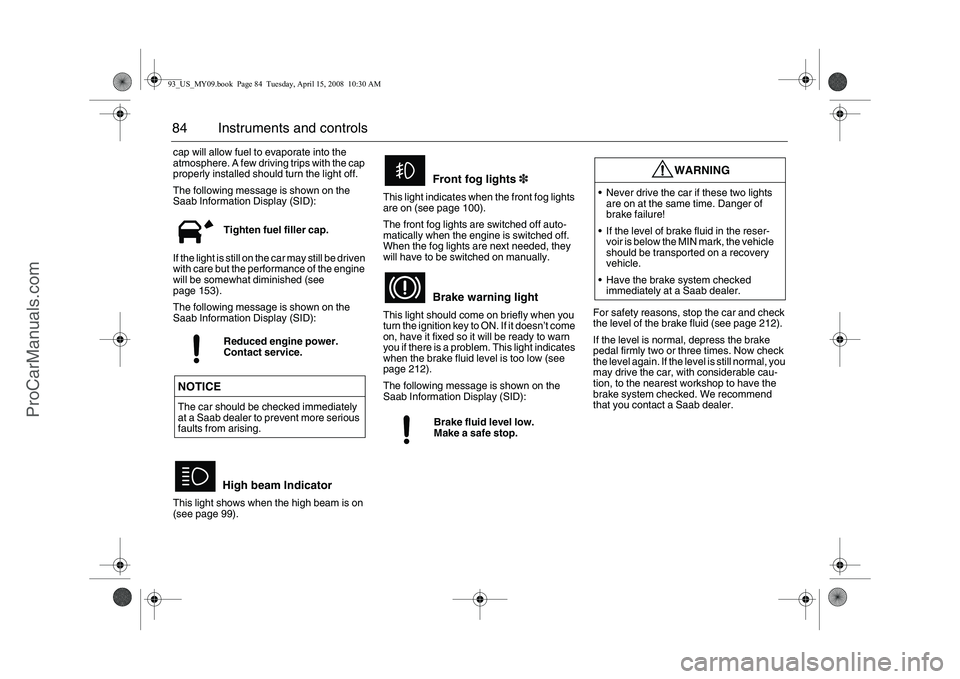
The following message is shown on the
Saab Information Display (SID):
If the light is still on the car may still be driven
with care but the performance of the engine
will be somewhat diminished (see
page 153).
The following message is shown on the
Saab Information Display (SID):
This light shows when the high beam is on
(see page 99).This light indicates when the front fog lights
are on (see page 100).
The front fog lights are switched off auto-
matically when the engine is switched off.
When the fog lights are next needed, they
will have to be switched on manually.
This light should come on briefly when you
turn the ignition key to ON. If it doesn’t come
on, have it fixed so it will be ready to warn
you if there is a problem. This light indicates
when the brake fluid level is too low (see
page 212).
The following message is shown on the
Saab Information Display (SID):For safety reasons, stop the car and check
the level of the brake fluid (see page 212).
If the level is normal, depress the brake
pedal firmly two or three times. Now check
the level again. If the level is still normal, you
may drive the car, with considerable cau-
tion, to the nearest workshop to have the
brake system checked. We recommend
that you contact a Saab dealer. Tighten fuel filler cap.
Reduced engine power.
Contact service.NOTICEThe car should be checked immediately
at a Saab dealer to prevent more serious
faults from arising.
High beam Indicator
Front fog lights3
Brake warning lightBrake fluid level low.
Make a safe stop.
WARNING
Never drive the car if these two lights
are on at the same time. Danger of
brake failure!
If the level of brake fluid in the reser-
voir is below the MIN mark, the vehicle
should be transported on a recovery
vehicle.
Have the brake system checked
immediately at a Saab dealer.
93_US_MY09.book Page 84 Tuesday, April 15, 2008 10:30 AM
ProCarManuals.com
Page 85 of 304
85 Instruments and controls
The brake system provides Electronic
Brakeforce Distribution (EBD). This distrib-
utes the brake pressure between the front
and rear wheels, in such a way as to achieve
optimum braking performance irrespective
of the car’s load.
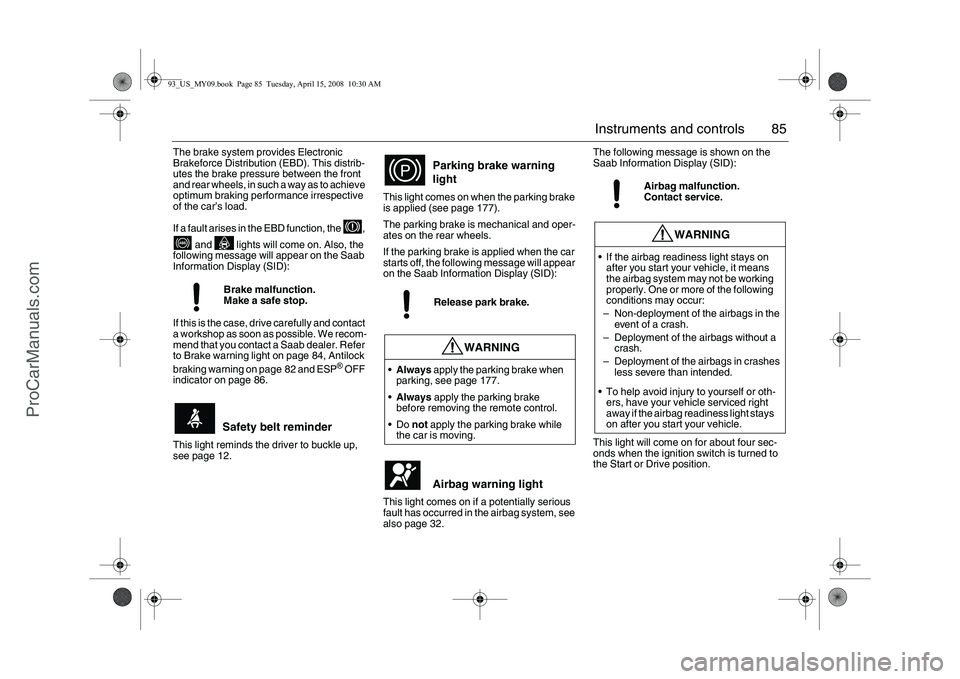
If a fault arises in the EBD function, the ,
and lights will come on. Also, the
following message will appear on the Saab
Information Display (SID):
If this is the case, drive carefully and contact
a workshop as soon as possible. We recom-
mend that you contact a Saab dealer. Refer
to Brake warning light on page 84, Antilock
braking warning on page 82 and ESP
® OFF
indicator on page 86.
This light reminds the driver to buckle up,
see page 12.This light comes on when the parking brake
is applied (see page 177).
The parking brake is mechanical and oper-
ates on the rear wheels.
If the parking brake is applied when the car
starts off, the following message will appear
on the Saab Information Display (SID):
This light comes on if a potentially serious
fault has occurred in the airbag system, see
also page 32.The following message is shown on the
Saab Information Display (SID):
This light will come on for about four sec-
onds when the ignition switch is turned to
the Start or Drive position. Brake malfunction.
Make a safe stop.
Safety belt reminder
Parking brake warning
lightRelease park brake.
WARNING
Always apply the parking brake when
parking, see page 177.
Always apply the parking brake
before removing the remote control.
Do not apply the parking brake while
the car is moving.
Airbag warning light
Airbag malfunction.
Contact service.
WARNING
If the airbag readiness light stays on
after you start your vehicle, it means
the airbag system may not be working
properly. One or more of the following
conditions may occur:
– Non-deployment of the airbags in the
event of a crash.
– Deployment of the airbags without a
crash.
– Deployment of the airbags in crashes
less severe than intended.
To help avoid injury to yourself or oth-
ers, have your vehicle serviced right
away if the airbag readiness light stays
on after you start your vehicle.
93_US_MY09.book Page 85 Tuesday, April 15, 2008 10:30 AM
ProCarManuals.com
Page 87 of 304
87 Instruments and controls
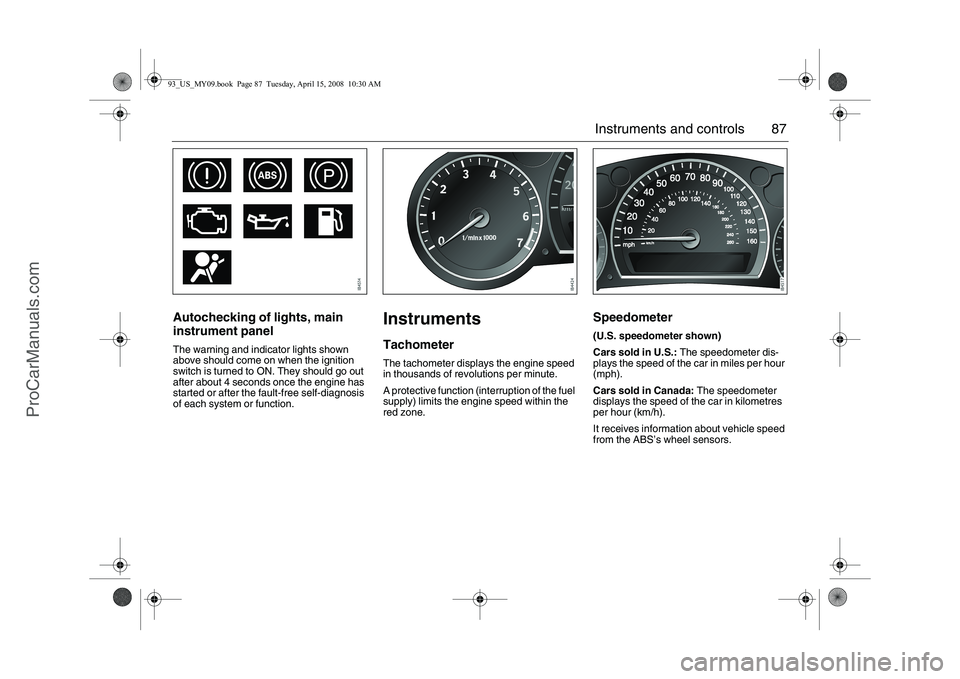
Autochecking of lights, main
instrument panelThe warning and indicator lights shown
above should come on when the ignition
switch is turned to ON. They should go out
after about 4 seconds once the engine has
started or after the fault-free self-diagnosis
of each system or function.
InstrumentsTachometerThe tachometer displays the engine speed
in thousands of revolutions per minute.
A protective function (interruption of the fuel
supply) limits the engine speed within the
red zone.
Speedometer (U.S. speedometer shown)
Cars sold in U.S.: The speedometer dis-
plays the speed of the car in miles per hour
(mph).
Cars sold in Canada: The speedometer
displays the speed of the car in kilometres
per hour (km/h).
It receives information about vehicle speed
from the ABS’s wheel sensors.
93_US_MY09.book Page 87 Tuesday, April 15, 2008 10:30 AM
ProCarManuals.com
Page 96 of 304
96 Instruments and controls
Resetting the service indication
Reset the service indication in accordance
with the following:
1 Turn the ignition switch to the ON posi-
tion, the engine must be switched off.
2Select Settings using the steering
wheel controls, or .
3 Press and hold the SET button until
given audible confirmation.
4Select Time for Service.
5 Press the SET button.
6 To the question Reset Service Ind?
select YES (Press CLR button to undo).ClockAdjustments can be made in the Infotain-
ment system.
See separate Manual. Unit
Select the desired group of units.
Next Service: xx%
The SID includes two mutually inde-
pendent counters, one for the main
service and one for the intermediate
service. When a service is carried out,
e.g. intermediate service, the counter is
reset for the intermediate service. The
counter for the other service type, main
service, continues unaffected. This
means that once a service has been
carried out, the counter may show e.g.
47% even though a service has just
been carried out. The percentage
refers, then, to the other service type.
MAIN
Main services are carried out at specific
meter settings. This interval varies
depending on market and engine var-
iant. Contact a workshop for more infor-
mation. We recommend that you con-
tact an authorised Saab workshop.INTERMEDIATE
The intermediate service, on the other
hand, is carried out depending on the
number of cold starts and the climate
conditions in which the car is driven, for
example. This is why the interval for
this type of service varies.
MAIN & INTERMED
A combined service is carried out when
the counters of both service types are
close to one another.
Time for Service.
A service indication must only be reset
after the service has been performed.
TCS/ESP
Select whether the system shall be on
or off. The car has either TCS or ESP.
93_US_MY09.book Page 96 Tuesday, April 15, 2008 10:30 AM
ProCarManuals.com
Page 97 of 304
97 Instruments and controls
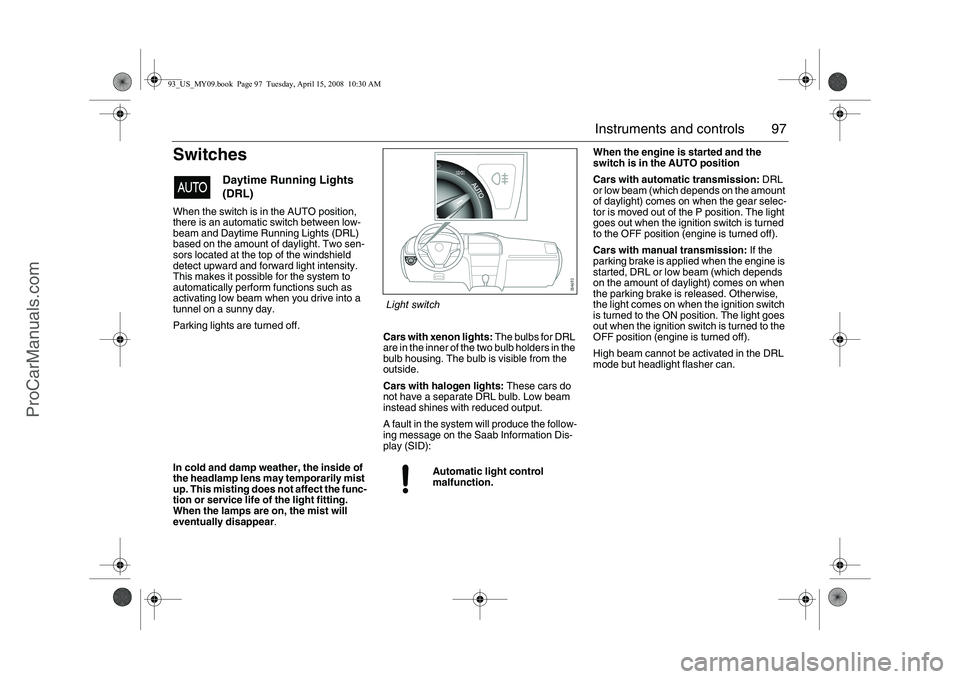
SwitchesWhen the switch is in the AUTO position,
there is an automatic switch between low-
beam and Daytime Running Lights (DRL)
based on the amount of daylight. Two sen-
sors located at the top of the windshield
detect upward and forward light intensity.
This makes it possible for the system to
automatically perform functions such as
activating low beam when you drive into a
tunnel on a sunny day.
Parking lights are turned off.
Cars with xenon lights: The bulbs for DRL
are in the inner of the two bulb holders in the
bulb housing. The bulb is visible from the
outside.
Cars with halogen lights: These cars do
not have a separate DRL bulb. Low beam
instead shines with reduced output.
A fault in the system will produce the follow-
ing message on the Saab Information Dis-
play (SID):When the engine is started and the
switch is in the AUTO position
Cars with automatic transmission: DRL
or low beam (which depends on the amount
of daylight) comes on when the gear selec-
tor is moved out of the P position. The light
goes out when the ignition switch is turned
to the OFF position (engine is turned off).
Cars with manual transmission: If the
parking brake is applied when the engine is
started, DRL or low beam (which depends
on the amount of daylight) comes on when
the parking brake is released. Otherwise,
the light comes on when the ignition switch
is turned to the ON position. The light goes
out when the ignition switch is turned to the
OFF position (engine is turned off).
High beam cannot be activated in the DRL
mode but headlight flasher can.
Daytime Running Lights
(DRL)
Automatic light control
malfunction.
In cold and damp weather, the inside of
the headlamp lens may temporarily mist
up. This misting does not affect the func-
tion or service life of the light fitting.
When the lamps are on, the mist will
eventually disappear.
Light switch
93_US_MY09.book Page 97 Tuesday, April 15, 2008 10:30 AM
ProCarManuals.com
Page 98 of 304
98 Instruments and controlsThe parking lights can be turned on irre-
spective of the position of the ignition
switch. If the parking lights are on and the
driver’s door is opened, a reminder to turn
them off will sound.
Do not use the parking lights alone while
driving.
When the switch is in the position, there
is no automatic shift between low beam and
DRL.
When it is time to turn on low beam the fol-
lowing message appears in SID:Low beam headlights are turned on when
the ignition switch is turned to ON and
turned off when the switch is turned back to
LOCK.
If the switch is in the position, there is
no automatic switch between DRL and low
beam. Low beam comes on when the igni-
tion switch is in the ON position.
Headlight levelling3Cars with xenon headlights are equipped
with an automatic headlight levelling sys-
tem, which self-calibrates each time the
vehicle is started.
If a fault arises in the automatic headlight
levelling system, the headlights will be
angled down to avoid dazzling drivers in
oncoming traffic. Adjust your speed accord-
ingly as the range of the headlights will be
reduced. Check fuse 20 in the engine bay
fuse box (see page 238).
A fault in the system will produce the follow-
ing message on the Saab Information Dis-
play (SID):
Special equipment is required for adjusting
the basic headlight alignment.
Parking lightsTurn on the lights.
Headlights
Headlight levelling
malfunction.
93_US_MY09.book Page 98 Tuesday, April 15, 2008 10:30 AM
ProCarManuals.com
Page 102 of 304
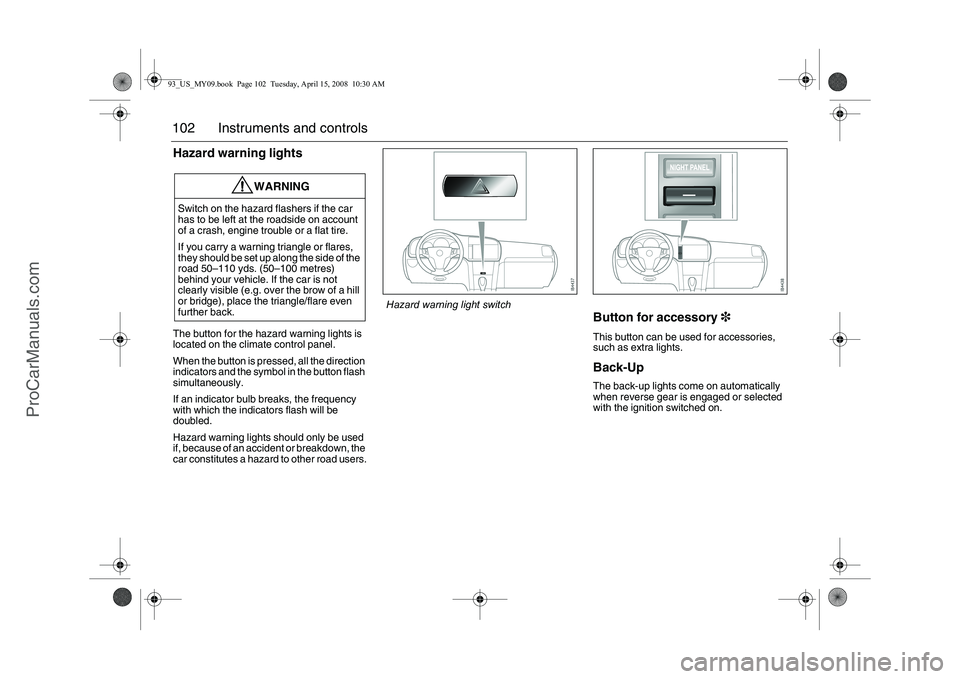
102 Instruments and controlsHazard warning lightsThe button for the hazard warning lights is
located on the climate control panel.
When the button is pressed, all the direction
indicators and the symbol in the button flash
simultaneously.
If an indicator bulb breaks, the frequency
with which the indicators flash will be
doubled.
Hazard warning lights should only be used
if, because of an accident or breakdown, the
car constitutes a hazard to other road users.
Button for accessory3This button can be used for accessories,
such as extra lights.Back-Up The back-up lights come on automatically
when reverse gear is engaged or selected
with the ignition switched on.
WARNING
Switch on the hazard flashers if the car
has to be left at the roadside on account
of a crash, engine trouble or a flat tire.
If you carry a warning triangle or flares,
they should be set up along the side of the
road 50–110 yds. (50–100 metres)
behind your vehicle. If the car is not
clearly visible (e.g. over the brow of a hill
or bridge), place the triangle/flare even
further back.
Hazard warning light switch
93_US_MY09.book Page 102 Tuesday, April 15, 2008 10:30 AM
ProCarManuals.com
Page 103 of 304
103 Instruments and controls
Priority of audible informationIf two or more functions are active simulta-
neously, the most important function at that
time will be prioritized.
If, for example, the direction indicators are
active when you engage reverse, the park-
ing assistance (if fitted) will be heard instead
of the direction indicators. When reverse is
disengaged, the direction indicators will be
heard, if they are still active.
Wipers and washersWindshield wipersPosition 1 is a spring-loaded position that
will produce a single sweep of the wipers.
The wipers always return to their home posi-
tion when the ignition is turned off.
To leave the wipers positioned vertically on
the windshield, proceed as follows:
1 Switch off the engine and remove the
remote control.
2 Activate the wipers within the next
16 seconds by pressing the stalk switch
down.
When the ignition is next switched on the
wipers will return to their home position.
Changing wipers blades, see page 216.
Rain sensorWhen the rain sensor is activated the follow-
ing symbol is displayed in SID .
The rain sensor automatically controls the
windshield wipers. The sensor is located on
the windshield beside the rearview mirror.
The system varies the frequency of wiping
between single sweeps and continuous
wiping, depending on the amount of pre-
cipitation.
WARNING
Turn the rain sensor off if the ignition is
ON to avoid personal injury when clearing
snow and ice from the windshield.NOTICETurn the rain sensor off before washing
the car in an automatic carwash, to avoid
damaging the windshield wipers.
93_US_MY09.book Page 103 Tuesday, April 15, 2008 10:30 AM
ProCarManuals.com
Page 109 of 304
109 Instruments and controls
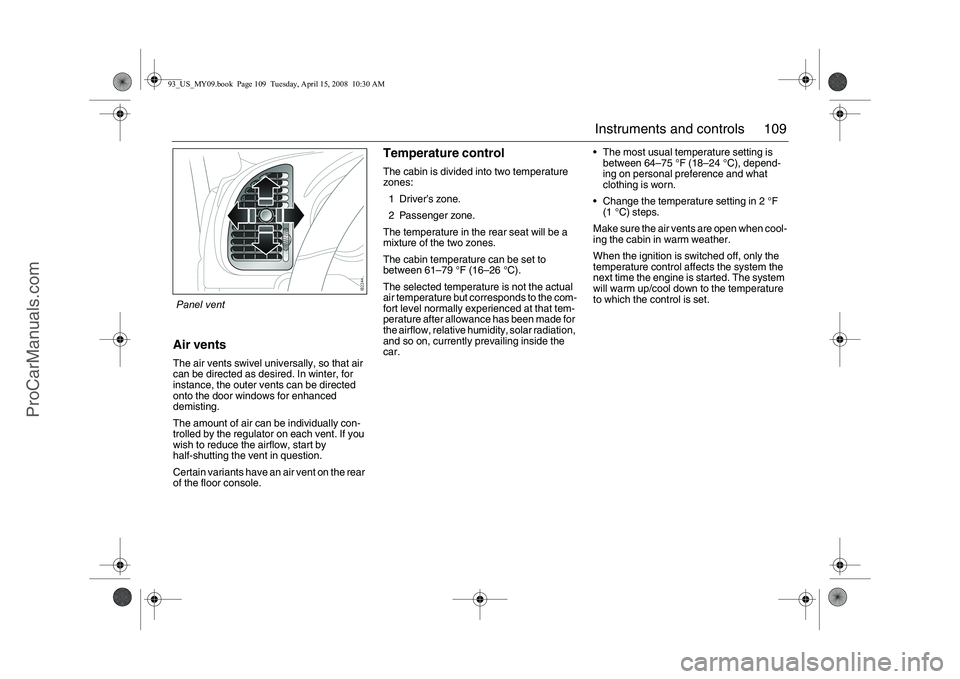
Air ventsThe air vents swivel universally, so that air
can be directed as desired. In winter, for
instance, the outer vents can be directed
onto the door windows for enhanced
demisting.
The amount of air can be individually con-
trolled by the regulator on each vent. If you
wish to reduce the airflow, start by
half-shutting the vent in question.
Certain variants have an air vent on the rear
of the floor console.
Temperature controlThe cabin is divided into two temperature
zones:
1 Driver’s zone.
2 Passenger zone.
The temperature in the rear seat will be a
mixture of the two zones.
The cabin temperature can be set to
between 61–79 °F (16–26 °C).
The selected temperature is not the actual
air temperature but corresponds to the com-
fort level normally experienced at that tem-
perature after allowance has been made for
the airflow, relative humidity, solar radiation,
and so on, currently prevailing inside the
car. The most usual temperature setting is
between 64–75 °F (18–24 °C), depend-
ing on personal preference and what
clothing is worn.
Change the temperature setting in 2 °F
(1 °C) steps.
Make sure the air vents are open when cool-
ing the cabin in warm weather.
When the ignition is switched off, only the
temperature control affects the system the
next time the engine is started. The system
will warm up/cool down to the temperature
to which the control is set.
Panel vent93_US_MY09.book Page 109 Tuesday, April 15, 2008 10:30 AM
ProCarManuals.com
Page 119 of 304
119 Interior equipment
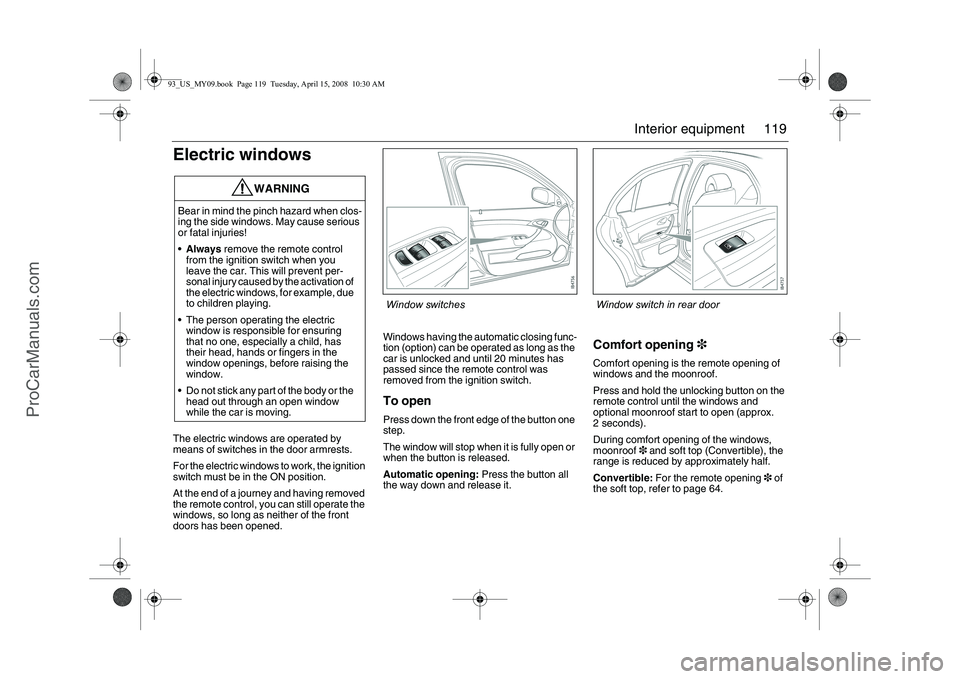
Electric windowsThe electric windows are operated by
means of switches in the door armrests.
For the electric windows to work, the ignition
switch must be in the ON position.
At the end of a journey and having removed
the remote control, you can still operate the
windows, so long as neither of the front
doors has been opened.Windows having the automatic closing func-
tion (option) can be operated as long as the
car is unlocked and until 20 minutes has
passed since the remote control was
removed from the ignition switch.
To openPress down the front edge of the button one
step.
The window will stop when it is fully open or
when the button is released.
Automatic opening: Press the button all
the way down and release it.
Comfort opening3Comfort opening is the remote opening of
windows and the moonroof.
Press and hold the unlocking button on the
remote control until the windows and
optional moonroof start to open (approx.
2 seconds).
During comfort opening of the windows,
moonroof3 and soft top (Convertible), the
range is reduced by approximately half.
Convertible: For the remote opening3 of
the soft top, refer to page 64.
WARNING
Bear in mind the pinch hazard when clos-
ing the side windows. May cause serious
or fatal injuries!
Always remove the remote control
from the ignition switch when you
leave the car. This will prevent per-
sonal injury caused by the activation of
the electric windows, for example, due
to children playing.
The person operating the electric
window is responsible for ensuring
that no one, especially a child, has
their head, hands or fingers in the
window openings, before raising the
window.
Do not stick any part of the body or the
head out through an open window
while the car is moving.
Window switches
Window switch in rear door
93_US_MY09.book Page 119 Tuesday, April 15, 2008 10:30 AM
ProCarManuals.com