ignition SAAB 9-3 2009 Service Manual
[x] Cancel search | Manufacturer: SAAB, Model Year: 2009, Model line: 9-3, Model: SAAB 9-3 2009Pages: 304, PDF Size: 44.31 MB
Page 153 of 304

153 Starting and driving
Useful tips on starting the engineIf the engine has failed to start after several
attempts in very cold weather, proceed as
follows:
1 Turn the ignition switch to ON (it is
essential that you turn the ignition to
ON before depressing the accelerator).
2 Press the accelerator to the floor and run
the starter motor for 5-10 seconds. This
will prevent the engine being flooded
(fully depressed accelerator cuts off the
fuel supply).
3 Now start the engine in the normal way
- do not touch the accelerator.
If the engine stalls immediately after starting
(e.g. if the clutch was released too quickly),
do not touch the accelerator when restarting
the engine.
Important
considerations for
driving1 Starting and driving
Do not use full throttle until the engine
is warm, so as to avoid unnecessary
wear. If the needle of the turbo gauge
repeatedly enters the red zone, the
engine may suddenly lose power, due
to the initiation of a monitoring system
that limits the boost pressure. We
recommend that you contact a Saab
dealer as soon as possible.
Under certain barometric conditions
(high outside temperature and/or high
altitude) the needle may enter the first
part of the red zone without necessarily
indicating that a fault has arisen.
A protective function (interruption of the
fuel supply) limits the engine speed.2 Stopping the engine
Do not rev the engine immediately
before switching it off - stop the engine
when it is idling.
3 Regulating the boost pressure
One of the advantages of boost pres-
sure regulation is that the engine can
also be run safely on gasoline with a
lower octane rating, although not lower
than AON 87. However, engine perfor-
mance will fall slightly and heavy load-
ing and laboring should be avoided. For
optimum performance, use the recom-
mended grade of fuel.
The maximum boost pressure is regu-
lated according to the tendency of the
engine to knock. Short-lived knocking
is perfectly normal. This can occur
when the engine is running at about
3,000 rpm under a heavy load. The
extent of this knocking will depend on
the grade of fuel in the tank.
Isolated instances of knocking can
occur with low-octane fuel. This
controlled form of knocking, followed by
a reduction in the boost pressure, is a
sign that the control system is working
normally, and is perfectly safe for the
engine.
93_US_MY09.book Page 153 Tuesday, April 15, 2008 10:30 AM
ProCarManuals.com
Page 154 of 304
154 Starting and drivingThe light comes on in the event of an engine
or gearbox fault (cars with automatic gear-
box), which may cause driveability prob-
lems but that does not affect exhaust emis-
sion. The car can still be driven but perhaps
with limited performance.
Contact a dealer whenever an opportunity
occurs. We recommend that you contact a
Saab dealer.
Limp-homeThe engine management system has a
diagnostic feature that checks a number of
internal functions. If a fault is detected in the
throttle valve, the engine management
system will set the throttle system to the
limp-home mode. This means:
idling control will be poor (uneven idling
since regulated by ignition and fuel
supply)
engine performance will be reduced
the cruise control will not function
the capacity of the A/C compressor will be
limited.
If the diagnosis function detects a fault in the
engine management system, the light
"Service Engine Light also known as
CHECK ENGINE" indicator light in the
instrument panel will come on (see
page 83). Have the car checked at a work-
shop as soon as possible. We recommend
that you contact a Saab dealer.
Important considerations with
catalytic convertersThe catalytic converter is an emission con-
trol device incorporated in the car’s exhaust
system. It consists of a metal canister with a
honeycomb insert, the cells of which have
walls coated in a catalytic layer (precious
metal alloy).
NOTICE If the engine sounds strange there is a
malfunction. We recommend that you
contact a Saab dealer immediately.
The use of fuel with too low an octane
rating can cause serious engine dam-
age.
Limited performance.
NOTICEIf "Service Engine Light also known
as CHECK ENGINE" indicator light warn-
ing light starts to flash (indicating that the
engine is misfiring and the catalytic con-
verter can be damaged), ease off the
accelerator slightly. The light should go
out or start to shine constantly. If the light
continues to flash despite easing off the
accelerator, you may continue to drive the
car but at the minimum throttle permitted
by the current traffic situation. Have the
car checked as soon as possible. We rec-
ommend that you contact a Saab dealer.NOTICEUse only unleaded gasoline. Leaded gas-
oline is detrimental to the catalyst and
oxygen sensor and will seriously impair
the function of the catalytic converter.
93_US_MY09.book Page 154 Tuesday, April 15, 2008 10:30 AM
ProCarManuals.com
Page 166 of 304
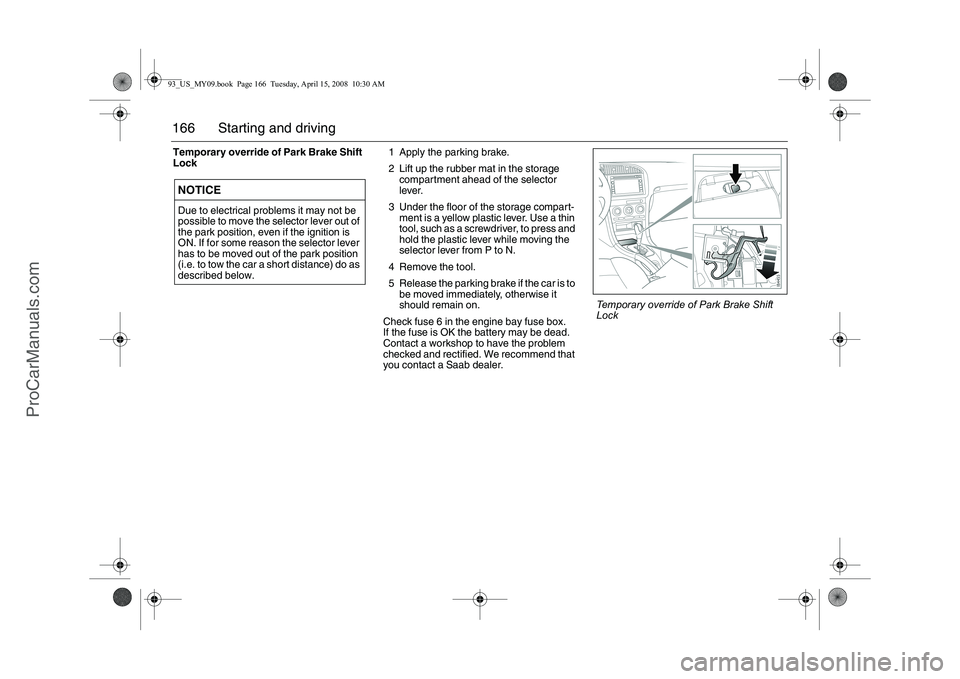
166 Starting and drivingTemporary override of Park Brake Shift
Lock1 Apply the parking brake.
2 Lift up the rubber mat in the storage
compartment ahead of the selector
lever.
3 Under the floor of the storage compart-
ment is a yellow plastic lever. Use a thin
tool, such as a screwdriver, to press and
hold the plastic lever while moving the
selector lever from P to N.
4 Remove the tool.
5 Release the parking brake if the car is to
be moved immediately, otherwise it
should remain on.
Check fuse 6 in the engine bay fuse box.
If the fuse is OK the battery may be dead.
Contact a workshop to have the problem
checked and rectified. We recommend that
you contact a Saab dealer.NOTICEDue to electrical problems it may not be
possible to move the selector lever out of
the park position, even if the ignition is
ON. If for some reason the selector lever
has to be moved out of the park position
(i.e. to tow the car a short distance) do as
described below.
Temporary override of Park Brake Shift
Lock
93_US_MY09.book Page 166 Tuesday, April 15, 2008 10:30 AM
ProCarManuals.com
Page 174 of 304
174 Starting and drivingThe advantages of the TCS system are
most apparent when road surface friction is
so low that a lot of wheelspin can occur rap-
idly:
When the car is pulling away or accelerat-
ing with the front wheels on different
surfaces (e.g. one slippery and one dry),
the TCS functions like an electronic differ-
ential lock, making sure that both wheels
rotate at the same speed. The system
also functions when the car is reversing.
When cornering, if the inside front wheel
rotates faster than the other wheels.TCS OFF
lights up if:
The system has been switched off
manually. It cannot be switched off if the
car is travelling faster than 35 mph
(60 km/h).
There is a fault in the ABS system
A fault has been detected and the
system has therefore been switched
off and at the same time the following
message is shown on the SID:
TCS indicatorWhen the ignition switch is turned to the ON
position, the lamp is lit for about 4 seconds
while the system performs self-diagnosis.
The light comes on when the TCS is
operative, that is when one of the wheels
has lost its grip.
The fact that the TCS is operative indicates
that the limit for grip has been exceeded and
that the driver must exercise greater care.Temporarily turning the TCS offThe TCS is switched on automatically when
the engine is started.
It may be necessary to switch off the system
if the car has become bogged down, for
instance.
If a fault is detected in the ABS, the TCS will
be switched off automatically.
The cruise control system (if active) will
automatically be disengaged if the TCS is
operative.Disengage the system in Settings.
1Select Settings using the steering
wheel buttons, or .
2 Hold the SET button depressed until a
chime sounds.
3Select TCS.
4 Press the SET button.
5Select ON or OFF.
End by pressing the SET-button.
Go back/undo using the CLR-button.
Traction control failure.
Contact service.
93_US_MY09.book Page 174 Tuesday, April 15, 2008 10:30 AM
ProCarManuals.com
Page 176 of 304
176 Starting and drivingESP
® system OFF
lights up if:
The system is turned off manually. The
car must be travelling slower than 35 mph
(60 km/h). The TCS is also disengaged.
A fault is detected in the ABS-system.
A fault has been detected in the
system and the system has therefore
been switched off. The following
message will be displayed on the SID:
ESP
® system indicator light
When the ignition switch is turned to the ON
position, the lamp is lit for about 4 seconds
while the system performs self-diagnosis.
The light comes on for a short period of
time when the ESP
® system is operative.
Operation of the ESP® system indicates
reduced cohesion between the tires and the
road, and that extra care should be taken by
the driver during continued driving.
Temporarily turning ESP
®
system off
The ESP
® is switched on automatically
when the engine is started.
It may be necessary to switch off the system
if the car has become bogged down, for
instance.
The ESP® system is always engaged
during braking, even if it has been switched
off manually with the ESP
® button.
The cruise control system (if active) will
automatically be disengaged if the ESP
®
system is operative.Disengage the system in Settings.
1Select Settings using the steering
wheel buttons, or .
2 Hold the SET button depressed until a
chime sounds.
3Select ESP.
4 Press the SET button.
5Select ON or OFF.
End by pressing the SET-button.
Go back/modify using the CLR-button.
Stability control failure.
Contact service.
NOTICEChanges to the chassis, such as a
change of wheels, shock absorbers or
springs, could affect the function of the
ESP
® system.
Always consult a workshop before chang-
ing any chassis components. We recom-
mend that you contact a Saab dealer.
93_US_MY09.book Page 176 Tuesday, April 15, 2008 10:30 AM
ProCarManuals.com
Page 188 of 304
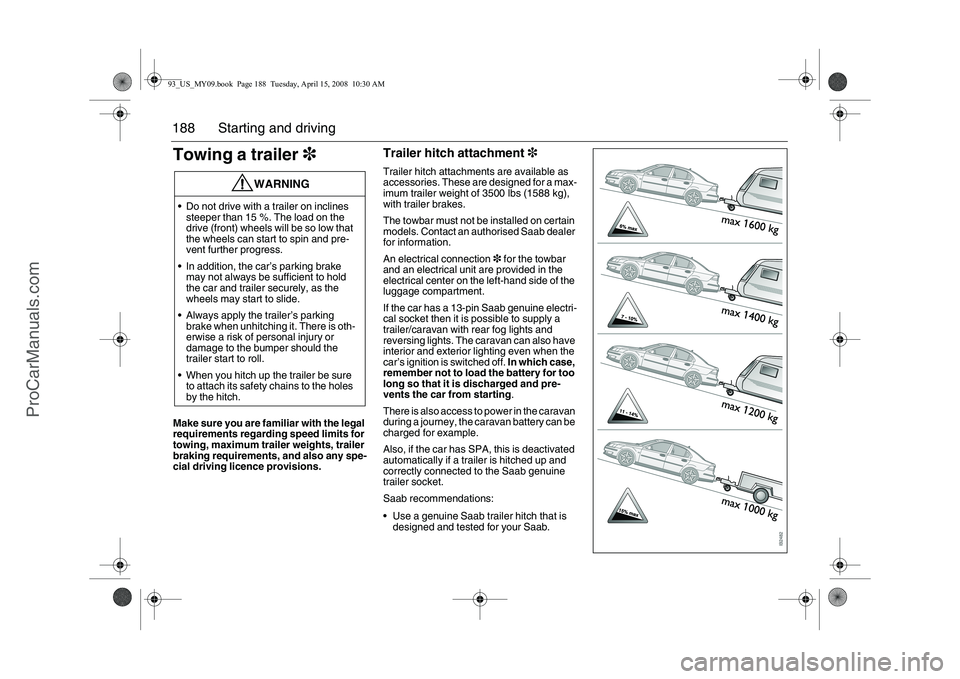
188 Starting and drivingTowing a trailer3Make sure you are familiar with the legal
requirements regarding speed limits for
towing, maximum trailer weights, trailer
braking requirements, and also any spe-
cial driving licence provisions.
Trailer hitch attachment3Trailer hitch attachments are available as
accessories. These are designed for a max-
imum trailer weight of 3500 lbs (1588 kg),
with trailer brakes.
The towbar must not be installed on certain
models. Contact an authorised Saab dealer
for information.
An electrical connection3 for the towbar
and an electrical unit are provided in the
electrical center on the left-hand side of the
luggage compartment.
If the car has a 13-pin Saab genuine electri-
cal socket then it is possible to supply a
trailer/caravan with rear fog lights and
reversing lights. The caravan can also have
interior and exterior lighting even when the
car’s ignition is switched off. In which case,
remember not to load the battery for too
long so that it is discharged and pre-
vents the car from starting.
There is also access to power in the caravan
during a journey, the caravan battery can be
charged for example.
Also, if the car has SPA, this is deactivated
automatically if a trailer is hitched up and
correctly connected to the Saab genuine
trailer socket.
Saab recommendations:
Use a genuine Saab trailer hitch that is
designed and tested for your Saab.
WARNING
Do not drive with a trailer on inclines
steeper than 15 %. The load on the
drive (front) wheels will be so low that
the wheels can start to spin and pre-
vent further progress.
In addition, the car’s parking brake
may not always be sufficient to hold
the car and trailer securely, as the
wheels may start to slide.
Always apply the trailer’s parking
brake when unhitching it. There is oth-
erwise a risk of personal injury or
damage to the bumper should the
trailer start to roll.
When you hitch up the trailer be sure
to attach its safety chains to the holes
by the hitch.93_US_MY09.book Page 188 Tuesday, April 15, 2008 10:30 AM
ProCarManuals.com
Page 193 of 304
193 Starting and driving
Driving with the trunk lid
openIf you must drive with the trunk lid open,
close all windows and the moonroof (if
equipped) and set the cabin fan to its high-
est speed setting.Driving in deep waterTowing the car
WARNING
Avoid driving with the trunk lid partly or
fully open, since exhaust fumes can be
drawn into the cabin.NOTICEDo not drive in puddles or water deeper
than 7 in. (20 cm) and do not drive faster
than 3–4 mph. Water can otherwise be
sucked into the engine. The engine will be
seriously damaged if water enters the
intake system.
WARNING
Remember that the brake servo does
not operate when the engine is off.
Much greater pressure than normal
will therefore be required to operate
the brake pedal.
Nor does the steering servo operate
when the engine is off. The steering
will therefore be much heavier than
usual.
The towing vehicle should always be
heavier than the vehicle on tow.
Never allow passengers to ride in the
car when it is on tow.
Always seek professional help if the
car needs to be recovered.
The ignition switch must be in the ON
position if the car is moved with the
engine not running.
The steering wheel lock must be dis-
engaged before towing the car.
The steering wheel lock disengages
when the remote control is inserted
into the ignition switch, if the battery
has sufficient charge.
93_US_MY09.book Page 193 Tuesday, April 15, 2008 10:30 AM
ProCarManuals.com
Page 197 of 304
197 Starting and driving
Jump starting
It is essential when a donor battery is to be
used to jump start the car that the jump
leads be connected correctly to prevent
arcing.
To jump start your vehicle
1 Check the other vehicle. It must have a
12-volt battery with a negative ground
system.2 Get the vehicles close enough so the
jumper cables can reach, but be sure the
vehicles are not touching each other. If a
poor connection on the negative jumper
cable should exist, it is possible for
damage to be caused to electrical
systems/components of either vehicle
should inadvertent contact be made.
You would not be able to start your car
and bad grounding could damage the
electrical systems.
3 Turn off the ignition on both vehicles.
Turn off lights that are not needed, and
radios. This will avoid sparks and help
save both batteries and it could save
your radio.
WARNING
When working on the battery, highly
explosive gas can build up. A spark
could ignite this gas that collects
around the battery. Therefore, always
avoid sparks and open flames in the
vicinity of the battery.
The battery contains corrosive sulfuric
acid. Always wear a face mask or gog-
gles when working on the battery.
If battery acid gets into the eyes or
splashes onto skin or clothing, wash
the affected area liberally with water. If
acid gets into the eyes or a large quan-
tity makes contact with the skin, seek
medical help.
NOTICEIgnoring these steps could result in costly
damage to your vehicle that would not be
covered by your warranty.
Trying to start your car by pushing or pull-
ing it could damage your vehicle, even if
you have a manual transmission. If you
have an automatic transmission, your
vehicle cannot be started by pushing or
pulling it.
NOTICEIf the other system is not a 12-volt system
with a negative ground, both vehicles can
be damaged.
WARNING
You could be injured if the vehicles roll.
Set the parking brake firmly on each vehi-
cle. Put an automatic transmission in P
(Park) or a manual transmission in Neu-
tral.
93_US_MY09.book Page 197 Tuesday, April 15, 2008 10:30 AM
ProCarManuals.com
Page 204 of 304
204 Car careEmission control
systemsThe systems for controlling emissions to the
atmosphere require regular checking and
adjustment at the intervals specified in the
service program.
In addition to meeting the exhaust emission
regulations and thereby helping to keep the
environment clean, a correctly tuned engine
will also give maximum fuel economy.
Saab Trionic engine
management system, 4-cyl
engineThe Saab Trionic engine management
system is a unique Saab development that
combines sequential mult iport fuel injection,
electronic distributorless ignition and turbo-
charger boost pressure control into one sys-
tem.
The Trionic engine control module (ECM)
monitors many different engine parameters
such as:
Intake manifold pressure
Intake air temperature
Crankshaft position
Engine coolant temperature
Throttle position
The oxygen content of the exhaust gases.
The ECM receives information regarding
engine knocking from a sophisticated feed-
back function in the ignition discharge unit.
By processing all of this information, the Tri-
onic system can control fuel injector open-
ing duration, ignition timing and turbo-
charger boost pressure to provide excellent
engine performance while maintaining low
emissions and fuel consumption.
WARNING
Engine exhaust, some of its constituents,
and certain vehicle components contain
or emit chemicals known to the State of
California to cause cancer and birth
defects and reproductive harm. In addi-
tion, certain fluids contained in vehicles
and certain products of component wear
contain or emit chemicals known to the
State of California to cause cancer and
birth defects or other reproductive harm.
NOTICEThe Trionic engine management system
continuously monitors the operation of
these systems and has on-board diag-
nostic capabilities (OBD II). If the Service
Engine Light also known as CHECK
ENGINE light in the main instrument illu-
minates, the Trionic ECM has detected a
problem. The car will continue to operate,
but performance may be diminished. You
should have your car checked by a work-
shop as soon as possible. We recom-
mend that you contact a Saab dealer.
93_US_7carcare_MY09.fm Page 204 Tuesday, April 15, 2008 11:26 AM
ProCarManuals.com
Page 205 of 304
205
Car care
Bosch ME9 engine management
system, V6 engineThe Bosch ME9 engine management
system is a system that combines sequen-
tial multiport fuel injection, electronic distrib-
utorless ignition and turbocharger boost
pressure control into one system and intake
camshaft phasing control.
The ME9 engine control module (ECM)
monitors many different engine parameters
such as:
Charge air pressure
Intake air temperature
Crankshaft position
Engine coolant temperature
Throttle position
The oxygen content of the exhaust gases.
By processing all of this information, the
ME9 system can contro l fuel injector open-
ing duration, ignition timing, intake camshaft
phasing and turbocharger boost pressure to
provide excellent engine performance while
maintaining low emissions and fuel con-
sumption.
ORVR (Onboard Refueling Vapor
Recovery)All hydrocarbons formed when refueling will
be recovered by the car and not released
into the atmosphere. The hydrocarbons are
absorbed in an evaporative emission canis-
ter. When the engine is subsequently
started, the evaporative emission canister is
gradually purged as air is sucked into it
through a shut-off va lve. The hydrocar-
bon/air mixture passes through the evap
canister purge valve and into the engine
where it is burned. “ Refueling”, see
page 156.
When refueling, make sure you screw the
filler cap on and keep turning until it has
clicked 3 times.
NOTICEThe ME9 engine management system
continuously monitors the operation of
these systems and has on-board diag-
nostic capabilities (OBD II). If the Service
Engine Light also known as CHECK
ENGINE light in the main instrument illu-
minates, the ME9 ECM has detected a
problem. The car will continue to operate,
but performance may be diminished. You
should have your car checked by a work-
shop as soon as possible. We recom-
mend that you contact a Saab dealer.
93_US_7carcare_MY09.fm Page 205 Tuesday, April 15, 2008 11:26 AM
ProCarManuals.com