instrument panel SAAB 9-3 2009 Owner's Manual
[x] Cancel search | Manufacturer: SAAB, Model Year: 2009, Model line: 9-3, Model: SAAB 9-3 2009Pages: 304, PDF Size: 44.31 MB
Page 102 of 304
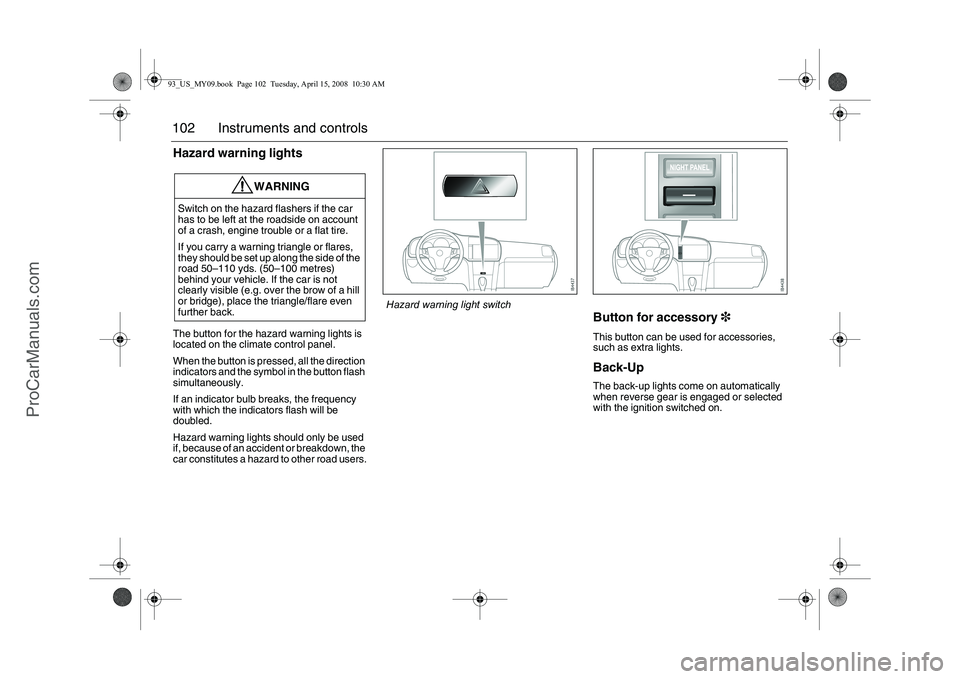
102 Instruments and controlsHazard warning lightsThe button for the hazard warning lights is
located on the climate control panel.
When the button is pressed, all the direction
indicators and the symbol in the button flash
simultaneously.
If an indicator bulb breaks, the frequency
with which the indicators flash will be
doubled.
Hazard warning lights should only be used
if, because of an accident or breakdown, the
car constitutes a hazard to other road users.
Button for accessory3This button can be used for accessories,
such as extra lights.Back-Up The back-up lights come on automatically
when reverse gear is engaged or selected
with the ignition switched on.
WARNING
Switch on the hazard flashers if the car
has to be left at the roadside on account
of a crash, engine trouble or a flat tire.
If you carry a warning triangle or flares,
they should be set up along the side of the
road 50–110 yds. (50–100 metres)
behind your vehicle. If the car is not
clearly visible (e.g. over the brow of a hill
or bridge), place the triangle/flare even
further back.
Hazard warning light switch
93_US_MY09.book Page 102 Tuesday, April 15, 2008 10:30 AM
ProCarManuals.com
Page 107 of 304
107 Instruments and controls
Automatic climate-
control system (ACC)Fresh air for the cabin is drawn in through an
inlet at the bottom edge of the windshield. It
passes through an effective filter before
reaching the climate control system and
delivery into the cabin. The air is evacuated
via openings in the parcel shelf. It is then led
through outlets on either side of the car
behind the rear bumper.
The Automatic Climate-Control system
(ACC) automatically maintains the desired
cabin temperature, regardless of the
weather outside.
The system will achieve the desired temper-
ature in the quickest possible way.
Note that heating or cooling is not more
rapid by setting the temperature higher
or lower than the final temperature you
desire.
To optimize the performance of the air con-
ditioning system, all windows and the
moonroof3 should be shut. The air vents in
the fascia must be open.The incoming air is treated in three stages:
first it passes through a filter; it is then dehu-
midified and cooled; and finally, if required,
it is heated.
The filter is a combined particle and char-
coal filter. It is so efficient that levels of nox-
ious substances such as benzene and tolu-
ene are also reduced.To reduce potential misting on the insides of
the windows, the glass should be cleaned
with a quality glass cleaner. How often this
will need to be done depends on how clean
the air is - if there are smokers in the car, the
windows will need to be cleaned more
frequently.
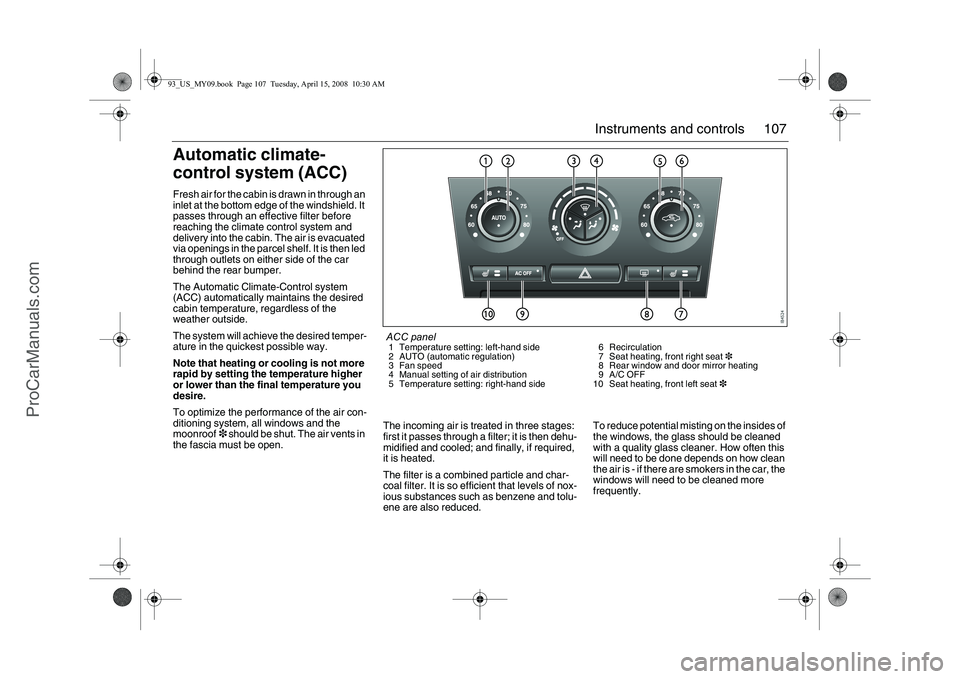
ACC panel1 Temperature setting: left-hand side
2 AUTO (automatic regulation)
3 Fan speed
4 Manual setting of air distribution
5 Temperature setting: right-hand side6 Recirculation
7 Seat heating, front right seat3
8 Rear window and door mirror heating
9A/C OFF
10 Seat heating, front left seat3
93_US_MY09.book Page 107 Tuesday, April 15, 2008 10:30 AM
ProCarManuals.com
Page 108 of 304
108 Instruments and controls
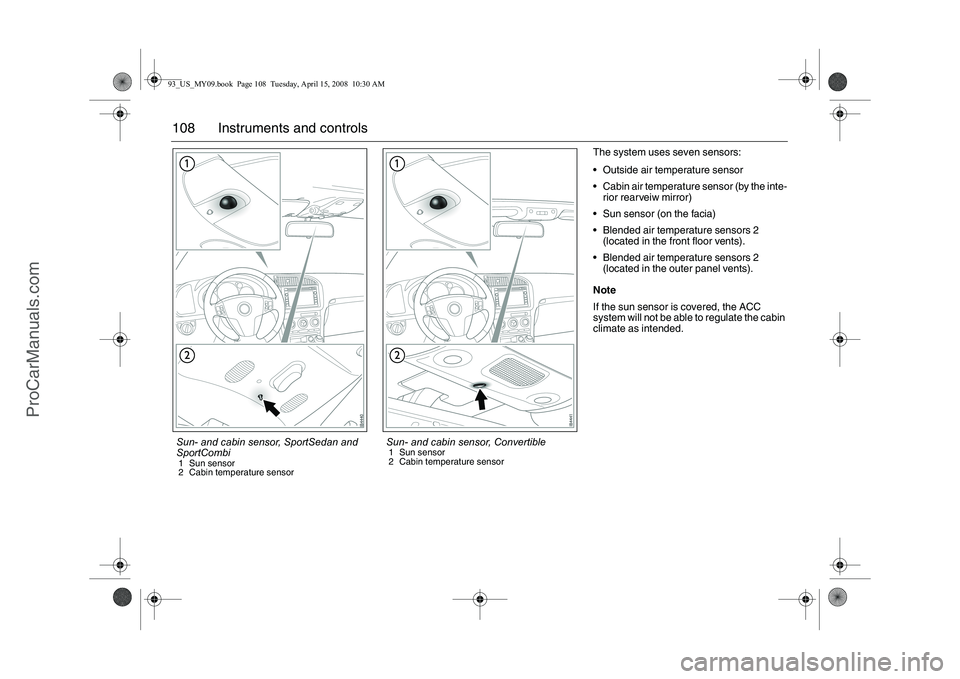
The system uses seven sensors:
Outside air temperature sensor
Cabin air temperature sensor (by the inte-
rior rearveiw mirror)
Sun sensor (on the facia)
Blended air temperature sensors 2
(located in the front floor vents).
Blended air temperature sensors 2
(located in the outer panel vents).
Note
If the sun sensor is covered, the ACC
system will not be able to regulate the cabin
climate as intended.
Sun- and cabin sensor, SportSedan and
SportCombi1 Sun sensor
2 Cabin temperature sensor
Sun- and cabin sensor, Convertible1 Sun sensor
2 Cabin temperature sensor
93_US_MY09.book Page 108 Tuesday, April 15, 2008 10:30 AM
ProCarManuals.com
Page 109 of 304
109 Instruments and controls
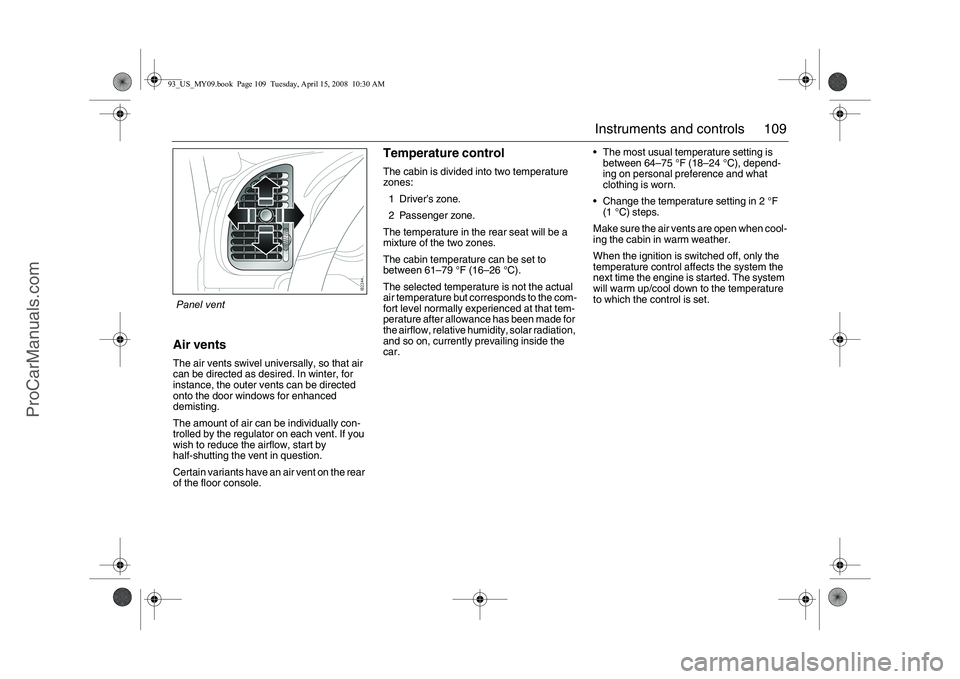
Air ventsThe air vents swivel universally, so that air
can be directed as desired. In winter, for
instance, the outer vents can be directed
onto the door windows for enhanced
demisting.
The amount of air can be individually con-
trolled by the regulator on each vent. If you
wish to reduce the airflow, start by
half-shutting the vent in question.
Certain variants have an air vent on the rear
of the floor console.
Temperature controlThe cabin is divided into two temperature
zones:
1 Driver’s zone.
2 Passenger zone.
The temperature in the rear seat will be a
mixture of the two zones.
The cabin temperature can be set to
between 61–79 °F (16–26 °C).
The selected temperature is not the actual
air temperature but corresponds to the com-
fort level normally experienced at that tem-
perature after allowance has been made for
the airflow, relative humidity, solar radiation,
and so on, currently prevailing inside the
car. The most usual temperature setting is
between 64–75 °F (18–24 °C), depend-
ing on personal preference and what
clothing is worn.
Change the temperature setting in 2 °F
(1 °C) steps.
Make sure the air vents are open when cool-
ing the cabin in warm weather.
When the ignition is switched off, only the
temperature control affects the system the
next time the engine is started. The system
will warm up/cool down to the temperature
to which the control is set.
Panel vent93_US_MY09.book Page 109 Tuesday, April 15, 2008 10:30 AM
ProCarManuals.com
Page 110 of 304
110 Instruments and controlsMAX heat (red indicator):
MAX heating is obtained when the temper-
ature knob is turned to the first position past
79 (to the red LED).
The driver’s side selection controls air distri-
bution and the recirculation status. The tem-
perature can be adjusted on the passenger
side.
MAX heating produces:
Max heat
Air distribution to windscreen and floor
Recirculation OFF
High fan speed.MAX cooling (blue indicator):
MAX cooling is obtained when the tempera-
ture knob is turned to the first position past
61 (to the blue LED).
The driver’s side selection controls air distri-
bution and the recirculation status. The tem-
perature can be adjusted on the passenger
side.
MAX cooling produces:
Max cooling effect (A/C compressor will
run even if AC OFF has been selected)
Air distribution through panel vents
Max fan speed
Recirculation ON.
Condensation waterWhen the A/C compressor is on, the incom-
ing air is dehumidified. The resulting con-
densation water is drained away through an
outlet under the car.
It is therefore perfectly normal for water to
be seen dripping from this outlet when the
car is parked. The warmer the ambient air
and the higher the humidity, the more con-
densation will form.
93_US_MY09.book Page 110 Tuesday, April 15, 2008 10:30 AM
ProCarManuals.com
Page 112 of 304
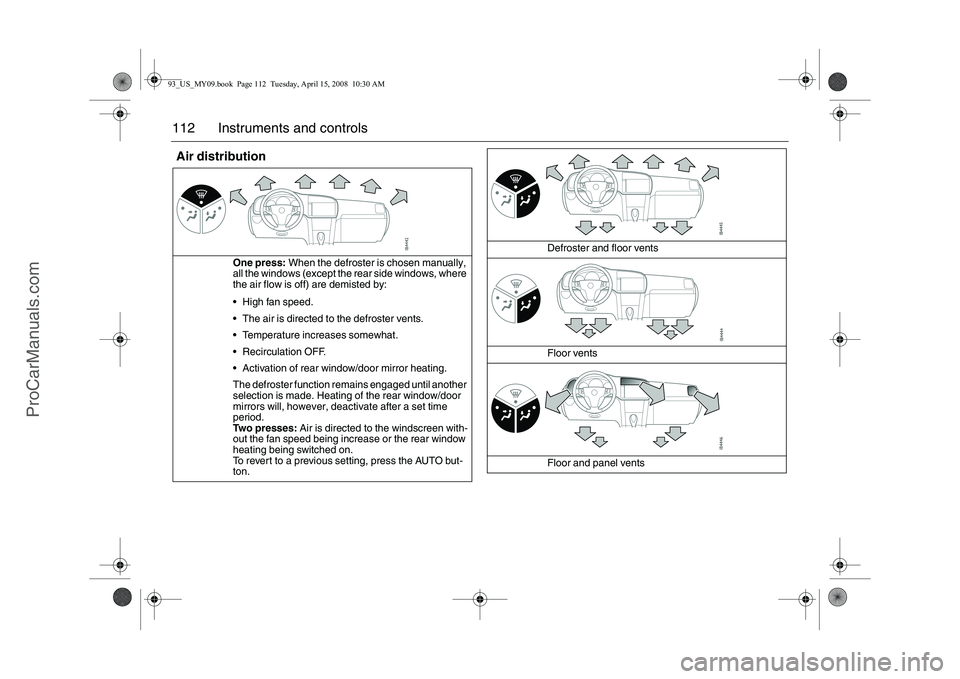
112 Instruments and controlsAir distribution
One press: When the defroster is chosen manually,
all the windows (except the rear side windows, where
the air flow is off) are demisted by:
High fan speed.
The air is directed to the defroster vents.
Temperature increases somewhat.
Recirculation OFF.
Activation of rear window/door mirror heating.
The defroster function remains engaged until another
selection is made. Heating of the rear window/door
mirrors will, however, deactivate after a set time
period.
Two presses: Air is directed to the windscreen with-
out the fan speed being increase or the rear window
heating being switched on.
To revert to a previous setting, press the AUTO but-
ton.
Defroster and floor vents
Floor vents
Floor and panel vents
93_US_MY09.book Page 112 Tuesday, April 15, 2008 10:30 AM
ProCarManuals.com
Page 113 of 304
113 Instruments and controls
Start in cold weather
To start with, the system will automatically select the defroster set-
ting, maximum heat and low fan speed.
As the engine warms up, air will also be distributed through the floor
vents and the fan speed will be increased.
As the temperature inside the car nears the selected value, both the
fan speed and the heat will be decreased to a level determined by
the system.
Start in warm weather
The system will automatically distribute air through the panel vents
at high fan speed and will activate the A/C compressor (unless the
AC OFF switch has been pressed).
If the ambient air temperature is over 77 °F (25 °C), the recirculation
cuts in after 0-15 seconds, if this is required in order to reach the
desired temperature.
As the temperature inside the car nears the selected value, the fan
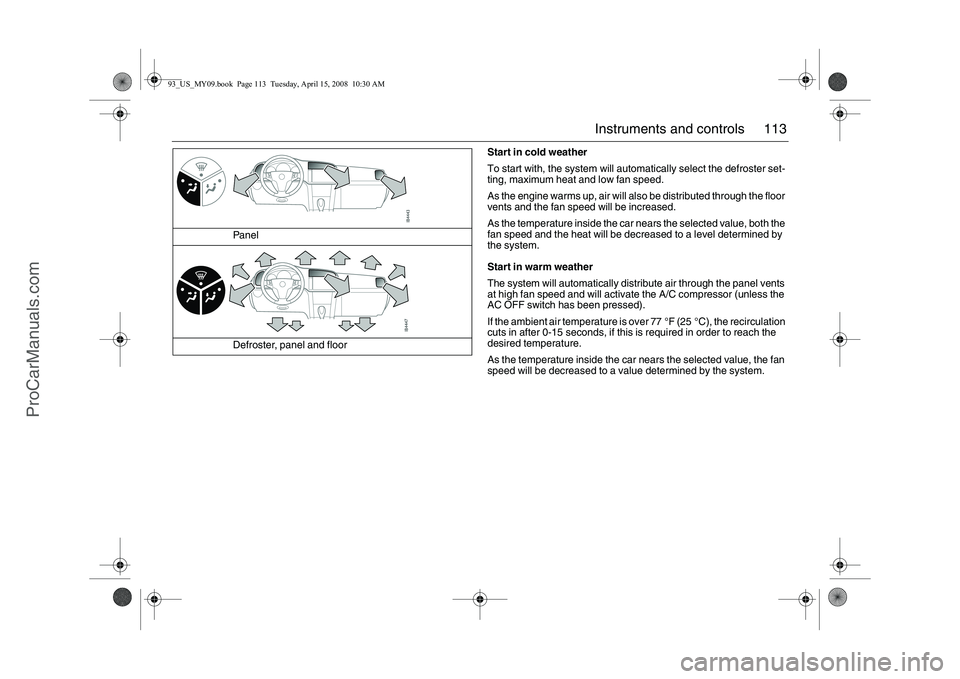
speed will be decreased to a value determined by the system. Panel
Defroster, panel and floor
93_US_MY09.book Page 113 Tuesday, April 15, 2008 10:30 AM
ProCarManuals.com
Page 115 of 304
115 Instruments and controls
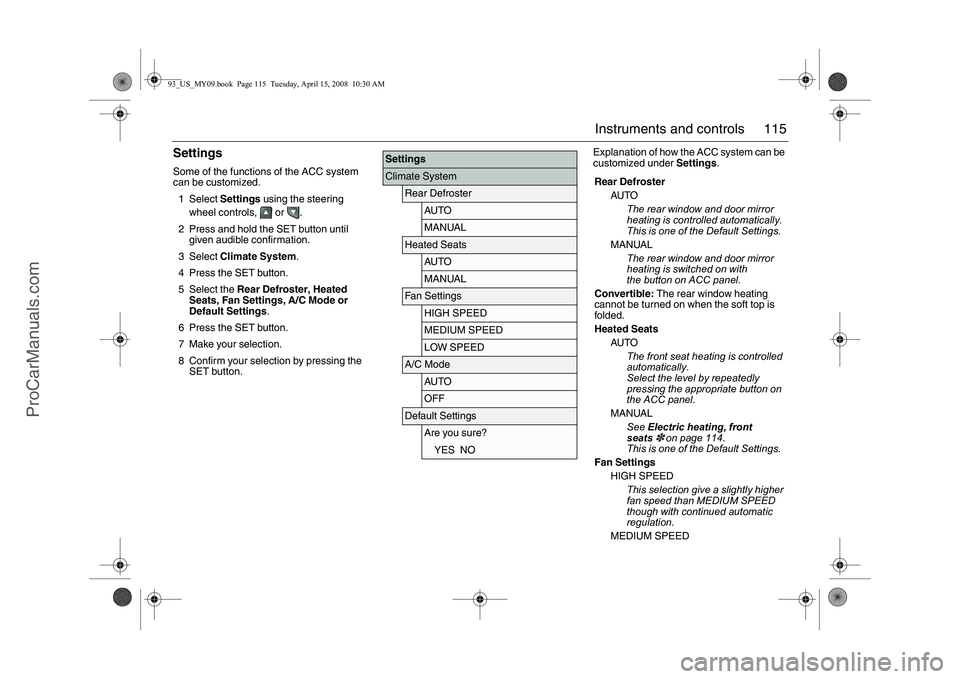
SettingsSome of the functions of the ACC system
can be customized.
1Select Settings using the steering
wheel controls, or .
2 Press and hold the SET button until
given audible confirmation.
3Select Climate System.
4 Press the SET button.
5 Select the Rear Defroster, Heated
Seats, Fan Settings, A/C Mode or
Default Settings.
6 Press the SET button.
7 Make your selection.
8 Confirm your selection by pressing the
SET button.Explanation of how the ACC system can be
customized under Settings.
SettingsClimate System
Rear Defroster
AUTOMANUAL
Heated Seats
AUTOMANUAL
Fan Settings
HIGH SPEEDMEDIUM SPEEDLOW SPEED
A/C Mode
AUTOOFF
Default Settings
Are you sure?YES NO
Rear Defroster
AUTO
The rear window and door mirror
heating is controlled automatically.
This is one of the Default Settings.
MANUAL
The rear window and door mirror
heating is switched on with
the button on ACC panel.
Convertible: The rear window heating
cannot be turned on when the soft top is
folded.
Heated Seats
AUTO
The front seat heating is controlled
automatically.
Select the level by repeatedly
pressing the appropriate button on
the ACC panel.
MANUAL
See Electric heating, front
seats
3 on page 114.
This is one of the Default Settings.
Fan Settings
HIGH SPEED
This selection give a slightly higher
fan speed than MEDIUM SPEED
though with continued automatic
regulation.
MEDIUM SPEED
93_US_MY09.book Page 115 Tuesday, April 15, 2008 10:30 AM
ProCarManuals.com
Page 151 of 304
151 Starting and driving
approx. 2 seconds. Following which, turn it
back to OFF.ON positionThe entire electrical system is operative.
Do not leave the remote control in the ON
position when the engine is not running.
Turn the ignition switch to the OFF position
to disconnect the electrical system.
When you turn the ignition switch to ON,
some indicator and warning lights will come
on in the main instrument panel. These
should go out after about 3 seconds.ST - starter positionThe starter motor operates (automatic
transmission: selector lever must be in P or
N) when the ignition switch is turned to this
position. When released, the ignition switch
will spring back to the ON position.
The car has an electronic restart lock. If the
engine fails to start, the ignition switch must
first be turned back to a position between
OFF and LOCK before the starter motor can
be operated again.
Steering wheel lockThe steering wheel lock is electronic. The
lock engages when the remote control is
removed from the ignition and unlocks when
the remote control is inserted. A click can be
heard when the steering wheel lock locks
and unlocks.
If the car is parked with one front wheel
touching the curb, for example, you may
need to turn the steering wheel slightly
when you insert the remote control to allow
the steering wheel lock to unlock. If you do
not succeed on first attempt you must
remove the remote control before trying
again. Turn the steering wheel and insert
the remote control into the ignition switch.
If the steering wheel lock does not disen-
gage it will not be possible to turn the remote
control in the ignition switch.
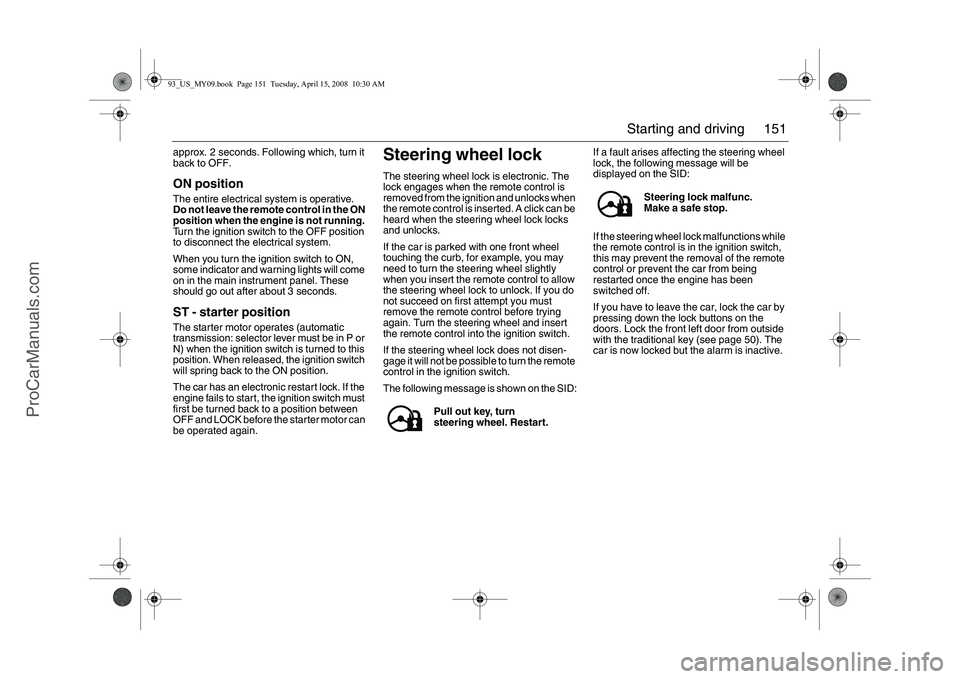
The following message is shown on the SID:If a fault arises affecting the steering wheel
lock, the following message will be
displayed on the SID:
If the steering wheel lock malfunctions while
the remote control is in the ignition switch,
this may prevent the removal of the remote
control or prevent the car from being
restarted once the engine has been
switched off.
If you have to leave the car, lock the car by
pressing down the lock buttons on the
doors. Lock the front left door from outside
with the traditional key (see page 50). The
car is now locked but the alarm is inactive.
Pull out key, turn
steering wheel. Restart.
Steering lock malfunc.
Make a safe stop.
93_US_MY09.book Page 151 Tuesday, April 15, 2008 10:30 AM
ProCarManuals.com
Page 154 of 304
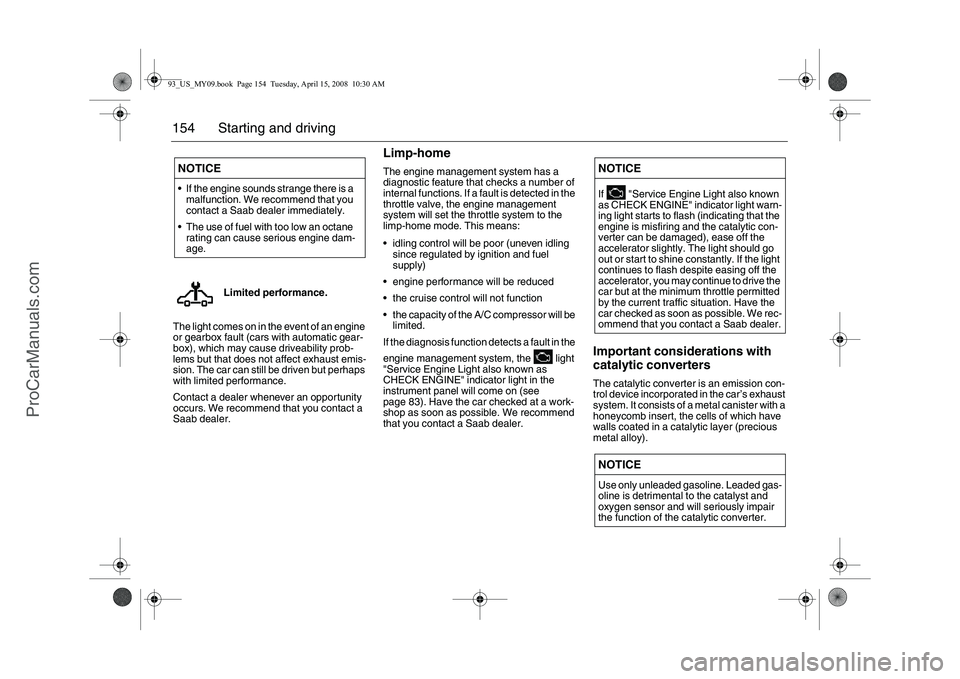
154 Starting and drivingThe light comes on in the event of an engine
or gearbox fault (cars with automatic gear-
box), which may cause driveability prob-
lems but that does not affect exhaust emis-
sion. The car can still be driven but perhaps
with limited performance.
Contact a dealer whenever an opportunity
occurs. We recommend that you contact a
Saab dealer.
Limp-homeThe engine management system has a
diagnostic feature that checks a number of
internal functions. If a fault is detected in the
throttle valve, the engine management
system will set the throttle system to the
limp-home mode. This means:
idling control will be poor (uneven idling
since regulated by ignition and fuel
supply)
engine performance will be reduced
the cruise control will not function
the capacity of the A/C compressor will be
limited.
If the diagnosis function detects a fault in the
engine management system, the light
"Service Engine Light also known as
CHECK ENGINE" indicator light in the
instrument panel will come on (see
page 83). Have the car checked at a work-
shop as soon as possible. We recommend
that you contact a Saab dealer.
Important considerations with
catalytic convertersThe catalytic converter is an emission con-
trol device incorporated in the car’s exhaust
system. It consists of a metal canister with a
honeycomb insert, the cells of which have
walls coated in a catalytic layer (precious
metal alloy).
NOTICE If the engine sounds strange there is a
malfunction. We recommend that you
contact a Saab dealer immediately.
The use of fuel with too low an octane
rating can cause serious engine dam-
age.
Limited performance.
NOTICEIf "Service Engine Light also known
as CHECK ENGINE" indicator light warn-
ing light starts to flash (indicating that the
engine is misfiring and the catalytic con-
verter can be damaged), ease off the
accelerator slightly. The light should go
out or start to shine constantly. If the light
continues to flash despite easing off the
accelerator, you may continue to drive the
car but at the minimum throttle permitted
by the current traffic situation. Have the
car checked as soon as possible. We rec-
ommend that you contact a Saab dealer.NOTICEUse only unleaded gasoline. Leaded gas-
oline is detrimental to the catalyst and
oxygen sensor and will seriously impair
the function of the catalytic converter.
93_US_MY09.book Page 154 Tuesday, April 15, 2008 10:30 AM
ProCarManuals.com