tires SAAB 9-3 2009 Owner's Manual
[x] Cancel search | Manufacturer: SAAB, Model Year: 2009, Model line: 9-3, Model: SAAB 9-3 2009Pages: 304, PDF Size: 44.31 MB
Page 250 of 304
250 Car care
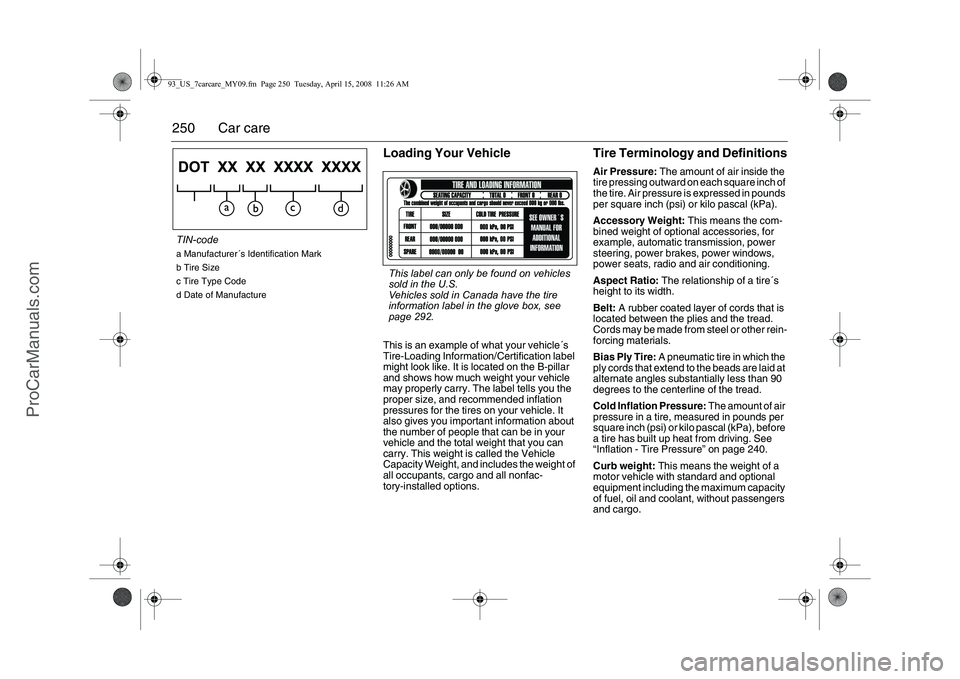
Loading Your VehicleThis is an example of what your vehicle´s
Tire-Loading Information/Certification label
might look like. It is located on the B-pillar
and shows how much weight your vehicle
may properly carry. The label tells you the
proper size, and recommended inflation
pressures for the tires on your vehicle. It
also gives you important information about
the number of people that can be in your
vehicle and the total weight that you can
carry. This weight is called the Vehicle
Capacity Weight, and includes the weight of
all occupants, cargo and all nonfac-
tory-installed options.
Tire Terminology and DefinitionsAir Pressure: The amount of air inside the
tire pressing outward on each square inch of
the tire. Air pressure is expressed in pounds
per square inch (psi) or kilo pascal (kPa).
Accessory Weight: This means the com-
bined weight of optional accessories, for
example, automatic transmission, power
steering, power brakes, power windows,
power seats, radio and air conditioning.
Aspect Ratio: The relationship of a tire´s
height to its width.
Belt: A rubber coated layer of cords that is
located between the plies and the tread.
Cords may be made from steel or other rein-
forcing materials.
Bias Ply Tire: A pneumatic tire in which the
ply cords that extend to the beads are laid at
alternate angles substantially less than 90
degrees to the centerline of the tread.
Cold Inflation Pressure: The amount of air
pressure in a tire, measured in pounds per
square inch (psi) or ki lo pascal (kPa), before
a tire has built up heat from driving. See
“Inflation - Tire Pressure” on page 240.
Curb weight: This means the weight of a
motor vehicle with standard and optional
equipment including the maximum capacity
of fuel, oil and coolant, without passengers
and cargo.
This label can only be found on vehicles
sold in the U.S.
Vehicles sold in Canada have the tire
information label in the glove box, see
page 292.
TIN-codea Manufacturer´s Identification Mark
b Tire Size
c Tire Type Code
d Date of Manufacture93_US_7carcare_MY09.fm
Page 250 Tuesday, April 15, 2008 11:26 AM
ProCarManuals.com
Page 251 of 304
251
Car care
DOT Markings: A code molded into the
sidewall of a tire signifying that the tire is in
compliance with the U.S. Department of
Transportation motor vehicle safety stan-
dards. The DOT code includes the Tire
Identification Number (TIN), an alphanu-
meric designator which can also identify the
tire manufacturer, production plant, brand
and date of production.
GVWR: Gross Vehicle Weight Rating see
page 285.
GAWR FRT: Gross Axle Weight Rating for
the front axle, see page 285.
GAWR RR: Gross Axle Weight Rating for
the rear axle, see page 285.
Intended Outboard Sidewall: The side of
an asymmetrical tire that must always face
outward when mounted on a vehicle.
Kilo pascal (kPa): The metric unit for air
pressure. There are 6.9 kPa to one psi.
Light Truck (LT -Metric) Tire: A tire used
on light duty trucks and some multipurpose
passenger vehicles.
Load Index: An assigned number ranging
from 1 to 279 that corresponds to the load
carrying capacity of a tire. Maximum Load rating:
The load rating for
a tire at the maximum permissible inflation
pressure for that tire.
Maximum Loaded Vehicle Weight: The
sum of curb weight; a ccessory weight; vehi-
cle capacity weight; and production options
weight.
Maximum Permissible Inflation Pres-
sure: The maximum cold inflation pressure
to which a tire may be inflated.
Normal occupant weight: The number of
occupants a vehicle is designed to seat mul-
tiplied by 150 pounds (68 kg). See “Loading
Your Vehicle” on page 250.
Occupant Distribution: Designated seat-
ing positions.
Outward Facing Sidewall: The side of a
asymmetrical tire that has a particular side
that faces outward when mounted on a vehi-
cle. The side of the tire that contains a white-
wall bears white letter ing or bears manufac-
turer, brand and or model name molding on
the other sidewall of the tire.
Passenger (P-Metric) Tire: A tire used on
passenger cars and some light duty trucks
and multipurpose vehicles. Recommended Inflation Pressure:
Vehi-
cle manufacturer´s recommended tire infla-
tion pressure shown on the tire placard, see
“Inflation - Tire Pressure” on page 240 and
“Loading Your Vehicle” on page 250.
Radial Ply Tire: A pneumatic tire in which
the ply cords that extend to the beads are
laid at substantially 90 degrees to the cen-
terline of the tread.
Rim: A metal support for a tire or a tire and
tube assembly upon which the tire beads
are seated.
Sidewall: The portion of a tire between the
tread and the bead.
Speed rating: An alphanumeric code
assigned to a tire indicating the maximum
speed at which a tire can operate.
Traction: The friction between the tire and
the road surface. The amount of grip pro-
vided.
Treadwear Indicators: Narrow bands,
sometimes called “wear bars”, that show
across the tread of a tire when only
2/32 inch of tread remains. See “When It Is
Time for New Tires” on page 242.93_US_7carcare_MY09.fm Page 251 Tuesday, April 15, 2008 11:26 AM
ProCarManuals.com
Page 253 of 304
253
Car care
Winter tiresWinter (snow) tires are recommended for
winter climates where the majority of your
driving will be done on snow and ice. Winter
tires should be fitted to all four wheels to
maintain a proper balance. Your Saab
dealer can advise you of to the correct size
tire for your car (if different from the original
size) and also supply Saab approved winter
tires pre-mounted on steel or alloy rims.
Winter tires normally use a different speed
rating compared to summer/all season tires.
Make sure not to exce ed the stated speed
rating on the tires you use.
Make sure that wheels with sensors for tire
pressure monitoring are fitted during
replacement if the car has automatic tire
pressure monitoring.Tire date codeTires should be regarded as perishable
goods. As the tires age, the rubber becomes
progressively harder, and the road holding
ability of the tires diminishes. This is partic-
ularly true on winter tires.
Tires have a code that specifies their date of
manufacture. The first two digits denote the
week number and the last two digits the year
followed by a filled triangle.
Automatic tire pressure
monitoring systemThe system consists of a sensor in each
wheel and a common receiver. The sensors
are located inside the tire in direct connec-
tion with the air pressure valves.
Make sure that wheels with sensors for tire
pressure monitoring are fitted during
replacement if the car has automatic tire
pressure monitoring.
The system will trigger a warning/alarm if
the spare wheel is fitted because it has no
sensor. Tire pressure informa
tion is transmitted
wireless to the receiver.
The system checks the tire pressures when
speed exceeds 19 mph (30 km/h).
The system is self-programming which
means that the wheels can be shifted
around without any need for adjustment.
The sensor batteries last for 10 years or
around 160 000 km. The battery cannot be
replaced. The whole sensor must be
replaced.
WARNING
The system is an aid to the driver. The
driver always has the responsibility that
the tires have the correct air pressure.
For optimum safety, economy and com-
fort tire pressures should be checked reg-
ularly even if the automatic tire pressure
monitoring has not alarmed.
NOTICETire replacement must take place with
great care to avoid damaging the sensors
that are built together with the valves.
Remove the rear side first, see page 255.
Start to remove the tire opposite the valve.
During removal the tire machine must not come closer than ±10° from the
valve.
During fitting, start 20° after the valve and finish 20° before the valve.
Do not inflate the tire with pressure higher than 102 psi (700 kPa).
93_US_7carcare_MY09.fm Page 253 Tuesday, April 15, 2008 11:26 AM
ProCarManuals.com
Page 254 of 304
254 Car careThe system does not warn if the tire pres-
sure is too high.
If the system has warned or triggered an
alarm due to inadequate pressure then
the pressure must be reset to the recom-
mended pressure so that the warning/alarm
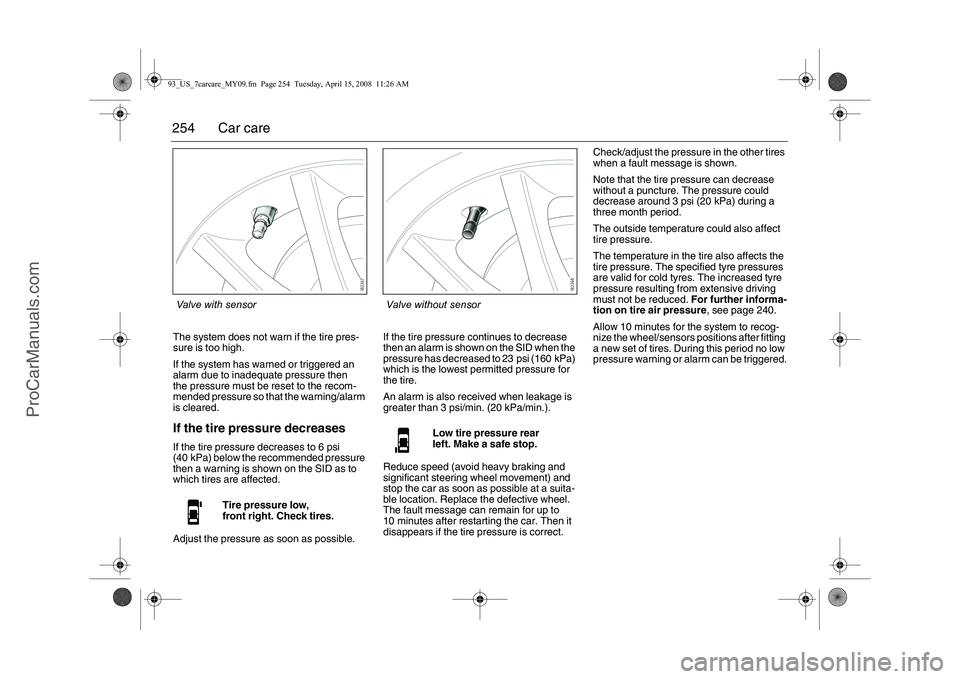
is cleared.If the tire pressure decreasesIf the tire pressure decreases to 6 psi
(40 kPa) below the recommended pressure
then a warning is shown on the SID as to
which tires are affected.
Adjust the pressure as soon as possible. If the tire pressure continues to decrease
then an alarm is shown on the SID when the
pressure has decreased to 23 psi (160 kPa)
which is the lowest permitted pressure for
the tire.
An alarm is also received when leakage is
greater than 3 psi/min. (20 kPa/min.).
Reduce speed (avoid heavy braking and
significant steering wheel movement) and
stop the car as soon as possible at a suita-
ble location. Replace the defective wheel.
The fault message can remain for up to
10 minutes after restarting the car. Then it
disappears if the tire pressure is correct.Check/adjust the pressure in the other tires
when a fault message is shown.
Note that the tire pressure can decrease
without a puncture. The pressure could
decrease around 3 psi (20 kPa) during a
three month period.
The outside temperature could also affect
tire pressure.
The temperature in the
tire also affects the
tire pressure. The spec ified tyre pressures
are valid for cold tyres. The increased tyre
pressure resulting from extensive driving
must not be reduced. For further informa-
tion on tire air pressure , see page 240.
Allow 10 minutes for the system to recog-
nize the wheel/sensors positions after fitting
a new set of tires. During this period no low
pressure warning or alarm can be triggered.
Tire pressure low,
front right. Check tires.
Low tire pressure rear
left. Make a safe stop.
Valve with sensor
Valve without sensor
93_US_7carcare_MY09.fm Page 254 Tuesday, April 15, 2008 11:26 AM
ProCarManuals.com
Page 262 of 304
262 Car care
Tire repair kit3
The tire repair kit re places the spare wheel.
The repair kit allows a punctured tire to be
temporarily repaired and reinflated without
needing to remove the wheel.
Minor damage to the tire, such as a foreign
object that has penetrated the tread, can be
temporarily repaired with the repair kit.
Do not remove the foreign object. Damage
larger than 0.16 in. (4 mm) and damage to
the sidewalls cannot be repaired with the
repair kit.
Follow the instructions supplied with the
repair kit carefully.
If the compressor sounds strange or
becomes abnormally hot, leave it switched
off for at least 30 minutes.
WARNING
Make sure no one can jog the gear lever,
for example, as the engine must be idling
when the tire is repaired. There is other-
wise a risk of personal injury.
Do not use the repair kit if:
the damage to the tire is larger than 0.16 in. (4 mm).
the wheel is damaged.
Do not exceed 50 mph (80 km/h) after
repairing one of the car tires with the
repair kit.
WARNING
Change the punctured tire as soon as
possible.
Replenish the repair kit at a workshop.
We recommend that you contact an
authorized Saab workshop. The canister
of sealant must be changed once every
four years. See the date on the canister.
The handling characteristics of the car
may be impaired.
Driving with a tire that is underinflated or
has a puncture can damage the tire in
such a way that it is not possible to repair
it with the sealant.
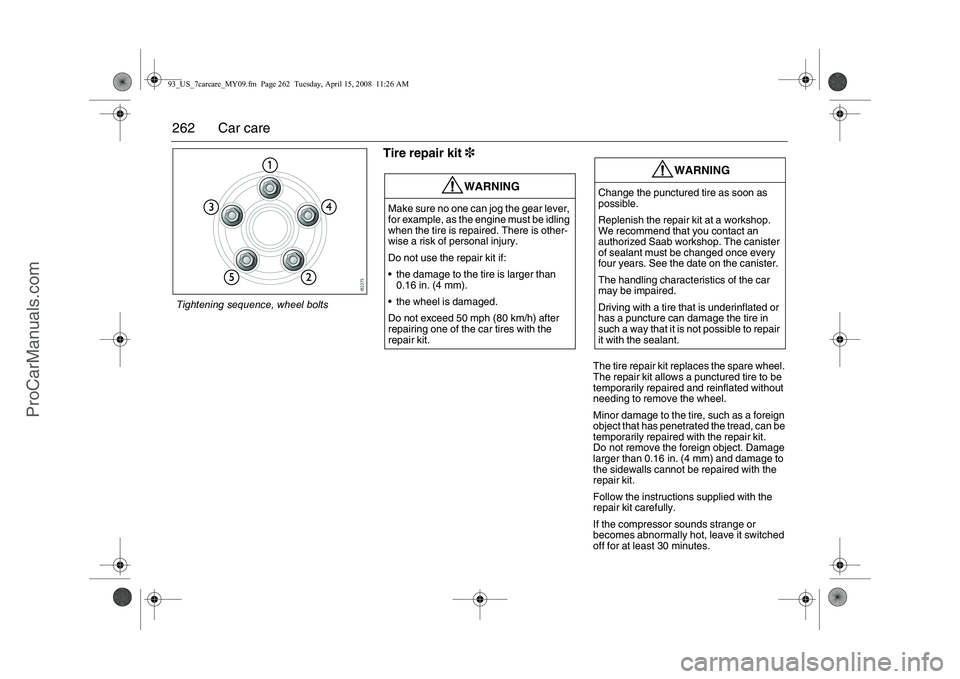
Tightening sequence, wheel bolts93_US_7carcare_MY09.fm Page 262 Tuesday, April 15, 2008 11:26 AM
ProCarManuals.com
Page 265 of 304
265
Car care
If the correct pressure is not reached
within 10 minutes, the damage to the tire is
too large to be repaired with the sealant.
Park the car in a suitable place and call for
assistance.
If the tire pressure becomes too high, it can
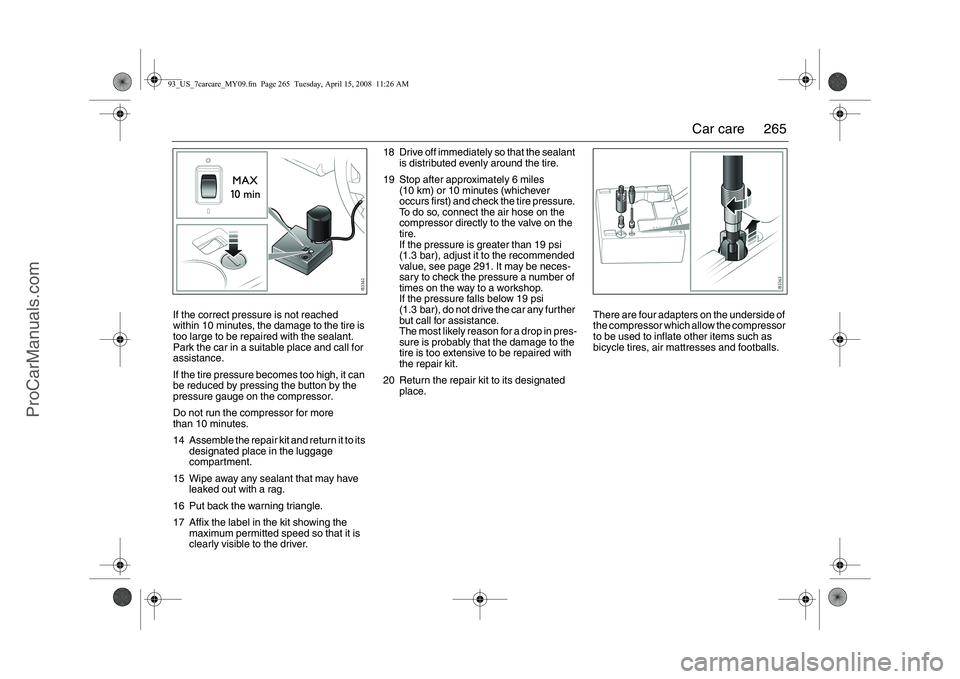
be reduced by pressing the button by the
pressure gauge on the compressor.
Do not run the co mpressor for more
than 10 minutes.
14 Assemble the repair kit and return it to its designated place in the luggage
compartment.
15 Wipe away any sealant that may have leaked out with a rag.
16 Put back the warning triangle.
17 Affix the label in the kit showing the maximum permitted speed so that it is
clearly visible to the driver. 18 Drive off immediately so that the sealant
is distributed evenly around the tire.
19 Stop after approximately 6 miles (10 km) or 10 minutes (whichever
occurs first) and check the tire pressure.
To do so, connect the air hose on the
compressor directly to the valve on the
tire.
If the pressure is greater than 19 psi
(1.3 bar), adjust it to the recommended
value, see page 291. It may be neces-
sary to check the pressure a number of
times on the way to a workshop.
If the pressure falls below 19 psi
(1.3 bar), do not drive the car any further
but call for assistance.
The most likely reason for a drop in pres-
sure is probably that the damage to the
tire is too extensive to be repaired with
the repair kit.
20 Return the repair kit to its designated place. There are four adapters on the underside of
the compressor which allow the compressor
to be used to inflate other items such as
bicycle tires, air mattresses and footballs.93_US_7carcare_MY09.fm
Page 265 Tuesday, April 15, 2008 11:26 AM
ProCarManuals.com
Page 274 of 304
274 Car carecompressor uses a lubricant that circu-
lates with the coolant.
Note
The A/C system cannot be switched on
when the outside temperature is below 32°F
(0°C). Turn on the A/ C system when the car
is standing in a warm place. Simplest is to
always have the A/C button pressed in. The
A/C system will then cu t in automatically
when the outside temperature is high
enough.
Headlight aimingThe vehicle has a visual optical headlight
aiming system equippe d with vertical
aiming device. The aim has been preset at
the factory and should normally not need
further adjustments.
If your headlights are damaged in a crash,
the headlight aim may be affected. If you
believe your headlights need to be
re-aimed, we recommend that you take it to
your Saab dealer for service. However, it is
possible for you to re-aim your headlights as
described in the following procedure. To check the aim, the vehicle should be
properly prepared as follows:
The vehicle shall be placed so that the
headlights are 25 ft (7.6 m) from a light
colored wall or other flat surface. The
aiming area should be darkened, this will
improve your ability to see the beam of the
low beam headlight being aimed.
An optical headlamp aimer can also be
used and will than replace the wall.
The vehicle must have all four wheels on a perfectly level surface which is level all
the way to the wall or other flat surface.
The vehicle should be placed so it is perpendicular to the wall or other flat
surface.
The vehicle should be unloaded and fuel tank full, and one person or 160 lbs.
(75 kg) on the drivers seat.
The vehicle should be fully assembled and all other work stopped while headlight
aiming is being done.
The vehicle should not have any snow, ice or mud attached to it.
Tires should be inflated to the prescribed pressure.
Close all doors.
Rock the vehicle to stabilize the suspen- sion.
Headlight aiming is done with the vehicle
low beam lamps. The high beam lamps will
WARNING
Before checking/adjusting the headlight
aiming, switch off the engine to avoid
danger of fingers and hands being injured
by moving parts.
The radiator fan can start up even when
the engine is switched off.NOTICETo make sure that your headlights are
aimed properly read all instructions
before beginning. Failure to follow these
instructions could cause damage to
headlight parts or a not correctly aimed
headlight.
93_US_7carcare_MY09.fm Page 274 Tuesday, April 15, 2008 11:26 AM
ProCarManuals.com
Page 279 of 304
279 Customer Assistance and Information
Engine oil and filter changesChanging the engine oil and filter is required
at every service point. Use only a Saab
approved long-life oil filter and engine oils
meeting the classifications stated in the
Warranty and Service Record Booklet. The
use of extra additives in the oil is not neces-
sary and is not recommended, and may be
harmful to turbochargers.
More frequent oil changes are recom-
mended if your vehicle is operated under
any of the following conditions:
Most trips are less than 5–10 miles (8–
16 km). This is particularly important
when outside temperatures are below
freezing.
Most trips include extensive idling
(frequent stop-and-go traffic).
Most trips are through dusty areas (such
as construction zones).
If the vehicle is used for delivery service,
police, taxi or other commercial applica-
tions.
If your driving habits match this description,
have the engine oil and filter changed in-
between normal services. These conditions
cause the engine oil to break down faster.
The Warranties and Service Record Book-
let has provisions to record extra oil
changes.
Service record retentionIt is the owner’s responsibility to retain ser-
vice records. If possible, you should keep
copies of all shop work orders for all service
and repairs, whenever performed. As indi-
cated in the new car and emission control
system warranties, it is important to docu-
ment that all necessary maintenance has
been done.
HOW THE SERVICE RECORD IS ORGA-
NIZED
The service record is comprised of a series
of coupons on which to record services as
they are performed. There are additional
coupons for documenting extra engine oil
and filter changes, extra automatic trans-
mission fluid services necessary for severe
service conditions, and brake fluid changes.
HOW TO USE THE SERVICE RECORD
COUPONS
When the car is brought to a Saab dealer for
scheduled maintenance, present the War-
ranties & Service Record Booklet to the ser-
vice manager. When the technician has
completed the service, the technician will
sign the maintenance record. The person
responsible for quality assurance at the
dealership will also sign and stamp the
record with the dealer identification stamp.
Service costsDealer pricing practices and labor for ser-
vice work vary. Saab’s recommended ser-
vice times for each service point do not
include the labor required to replace wear
items, such as wiper blades, brake pads or
tires. Nor is labor to perform other service or
repairs found to be necessary as a result of
the inspections included in these times.
Additional labor and parts will be charged
for such work when necessary, except as
covered under an applicable Saab warranty
or any optional extended service contract.
Transmission fluid changes or suspension
alignment, when necessary, are also addi-
tional.
Dealer charges for general shop material,
regulated hazardous waste removal, recy-
cling expenses or other operation costs may
also be applied to service and repair
invoices and are apt to vary by dealer and
location.
93_US_MY09.book Page 279 Tuesday, April 15, 2008 10:30 AM
ProCarManuals.com
Page 283 of 304
283 Technical data
General data __________ 284
Engine _______________ 286
Engine oil _____________ 286
Fuel__________________ 287
Engines ______________ 287
Electrical system_______ 287
Brake system__________ 287
Wheels and tires _______ 288
Plates and labels _______ 292
Technical data
3Asterisk means: equipment not fitted in all cars
(can depend on model variant, engine variant,
market specification, options or accessories).93_US_MY09.book Page 283 Tuesday, April 15, 2008 10:30 AM
ProCarManuals.com
Page 286 of 304
286 Technical data
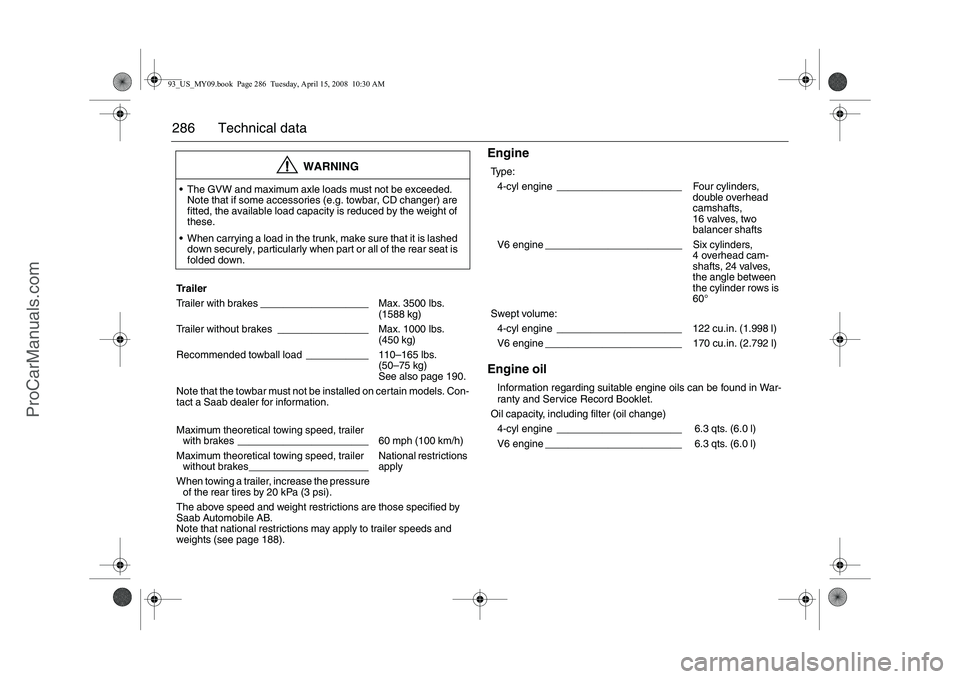
Engine
Engine oil
WARNING
The GVW and maximum axle loads must not be exceeded.
Note that if some accessories (e.g. towbar, CD changer) are
fitted, the available load capacity is reduced by the weight of
these.
When carrying a load in the trunk, make sure that it is lashed
down securely, particularly when part or all of the rear seat is
folded down.
Trailer
Trailer with brakes ___________________ Max. 3500 lbs.
(1588 kg)
Trailer without brakes ________________ Max. 1000 lbs.
(450 kg)
Recommended towball load ___________ 110–165 lbs.
(50–75 kg)
See also page 190.
Note that the towbar must not be installed on certain models. Con-
tact a Saab dealer for information.
Maximum theoretical towing speed, trailer
with brakes _______________________ 60 mph (100 km/h)
Maximum theoretical towing speed, trailer
without brakes _____________________National restrictions
apply
When towing a trailer, increase the pressure
of the rear tires by 20 kPa (3 psi).
The above speed and weight restrictions are those specified by
Saab Automobile AB.
Note that national restrictions may apply to trailer speeds and
weights (see page 188).
Type:
4-cyl engine ______________________ Four cylinders,
double overhead
camshafts,
16 valves, two
balancer shafts
V6 engine ________________________ Six cylinders,
4 overhead cam-
shafts, 24 valves,
the angle between
the cylinder rows is
60°
Swept volume:
4-cyl engine ______________________ 122 cu.in. (1.998 l)
V6 engine ________________________ 170 cu.in. (2.792 l)
Information regarding suitable engine oils can be found in War-
ranty and Service Record Booklet.
Oil capacity, including filter (oil change)
4-cyl engine ______________________ 6.3 qts. (6.0 l)
V6 engine ________________________ 6.3 qts. (6.0 l)
93_US_MY09.book Page 286 Tuesday, April 15, 2008 10:30 AM
ProCarManuals.com