steering SAAB 9-3 2009 Owner's Guide
[x] Cancel search | Manufacturer: SAAB, Model Year: 2009, Model line: 9-3, Model: SAAB 9-3 2009Pages: 304, PDF Size: 44.31 MB
Page 168 of 304
168 Starting and driving
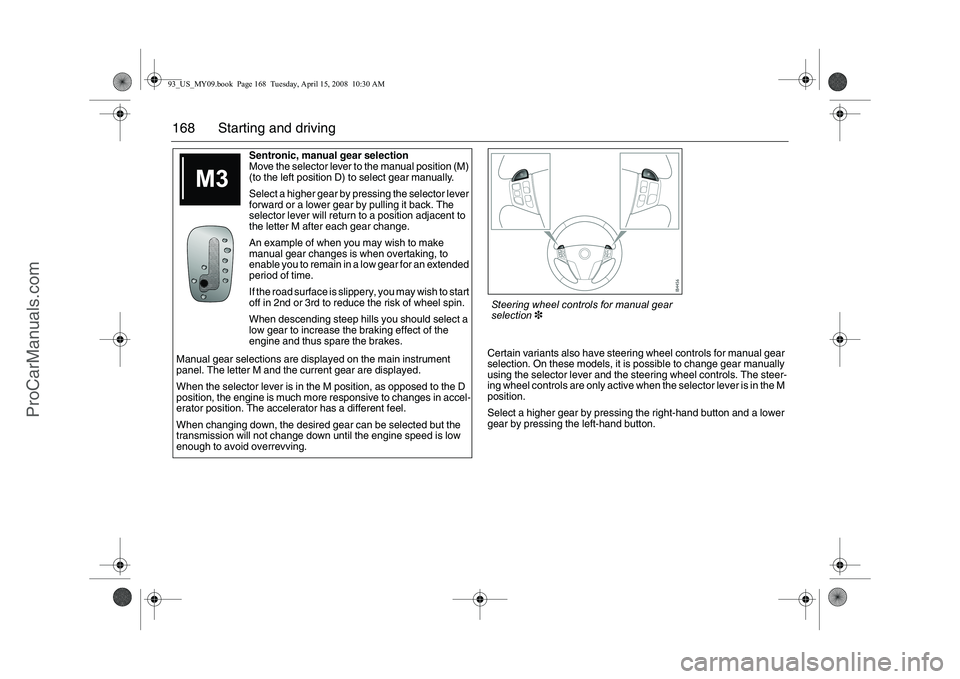
Certain variants also have steering wheel controls for manual gear
selection. On these models, it is possible to change gear manually
using the selector lever and the steering wheel controls. The steer-
ing wheel controls are only active when the selector lever is in the M
position.
Select a higher gear by pressing the right-hand button and a lower
gear by pressing the left-hand button. Sentronic, manual gear selection
Move the selector lever to the manual position (M)
(to the left position D) to select gear manually.
Select a higher gear by pressing the selector lever
forward or a lower gear by pulling it back. The
selector lever will return to a position adjacent to
the letter M after each gear change.
An example of when you may wish to make
manual gear changes is when overtaking, to
enable you to remain in a low gear for an extended
period of time.
If the road surface is slippery, you may wish to start
off in 2nd or 3rd to reduce the risk of wheel spin.
When descending steep hills you should select a
low gear to increase the braking effect of the
engine and thus spare the brakes.
Manual gear selections are displayed on the main instrument
panel. The letter M and the current gear are displayed.
When the selector lever is in the M position, as opposed to the D
position, the engine is much more responsive to changes in accel-
erator position. The accelerator has a different feel.
When changing down, the desired gear can be selected but the
transmission will not change down until the engine speed is low
enough to avoid overrevving.Steering wheel controls for manual gear
selection3
93_US_MY09.book Page 168 Tuesday, April 15, 2008 10:30 AM
ProCarManuals.com
Page 172 of 304
172 Starting and drivingThe ABS system will not reduce the braking
distance on loose gravel, snow or ice but,
because the wheels cannot lock up, steer-
ing control is retained.
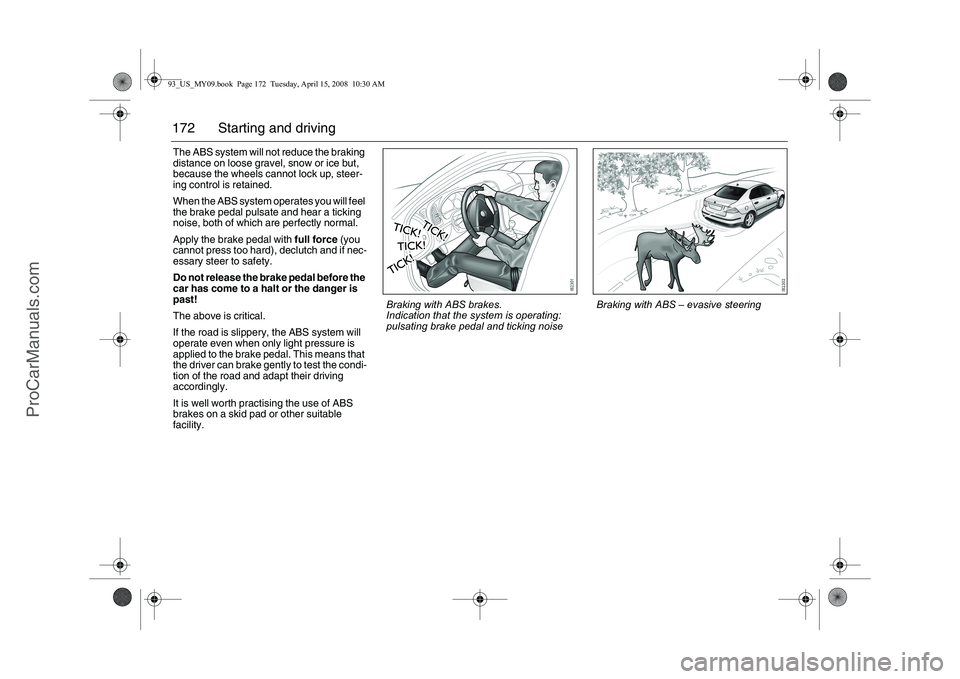
When the ABS system operates you will feel
the brake pedal pulsate and hear a ticking
noise, both of which are perfectly normal.
Apply the brake pedal with full force (you
cannot press too hard), declutch and if nec-
essary steer to safety.
Do not release the brake pedal before the
car has come to a halt or the danger is
past!
The above is critical.
If the road is slippery, the ABS system will
operate even when only light pressure is
applied to the brake pedal. This means that
the driver can brake gently to test the condi-
tion of the road and adapt their driving
accordingly.
It is well worth practising the use of ABS
brakes on a skid pad or other suitable
facility.
Braking with ABS – evasive steering
Braking with ABS brakes.
Indication that the system is operating:
pulsating brake pedal and ticking noise
93_US_MY09.book Page 172 Tuesday, April 15, 2008 10:30 AM
ProCarManuals.com
Page 174 of 304
174 Starting and drivingThe advantages of the TCS system are
most apparent when road surface friction is
so low that a lot of wheelspin can occur rap-
idly:
When the car is pulling away or accelerat-
ing with the front wheels on different
surfaces (e.g. one slippery and one dry),
the TCS functions like an electronic differ-
ential lock, making sure that both wheels
rotate at the same speed. The system
also functions when the car is reversing.
When cornering, if the inside front wheel
rotates faster than the other wheels.TCS OFF
lights up if:
The system has been switched off
manually. It cannot be switched off if the
car is travelling faster than 35 mph
(60 km/h).
There is a fault in the ABS system
A fault has been detected and the
system has therefore been switched
off and at the same time the following
message is shown on the SID:
TCS indicatorWhen the ignition switch is turned to the ON
position, the lamp is lit for about 4 seconds
while the system performs self-diagnosis.
The light comes on when the TCS is
operative, that is when one of the wheels
has lost its grip.
The fact that the TCS is operative indicates
that the limit for grip has been exceeded and
that the driver must exercise greater care.Temporarily turning the TCS offThe TCS is switched on automatically when
the engine is started.
It may be necessary to switch off the system
if the car has become bogged down, for
instance.
If a fault is detected in the ABS, the TCS will
be switched off automatically.
The cruise control system (if active) will
automatically be disengaged if the TCS is
operative.Disengage the system in Settings.
1Select Settings using the steering
wheel buttons, or .
2 Hold the SET button depressed until a
chime sounds.
3Select TCS.
4 Press the SET button.
5Select ON or OFF.
End by pressing the SET-button.
Go back/undo using the CLR-button.
Traction control failure.
Contact service.
93_US_MY09.book Page 174 Tuesday, April 15, 2008 10:30 AM
ProCarManuals.com
Page 175 of 304
175 Starting and driving
Electronic Stability
Program ESP
®
Anti-skid system
The ESP
® system employs both the
antilock braking system (ABS) and the trac-
tion control system (TCS). It is a system that
helps the driver to stabilize the car in
unusual circumstances that can otherwise
be more difficult to handle.
How the ESP
® system works
The ESP
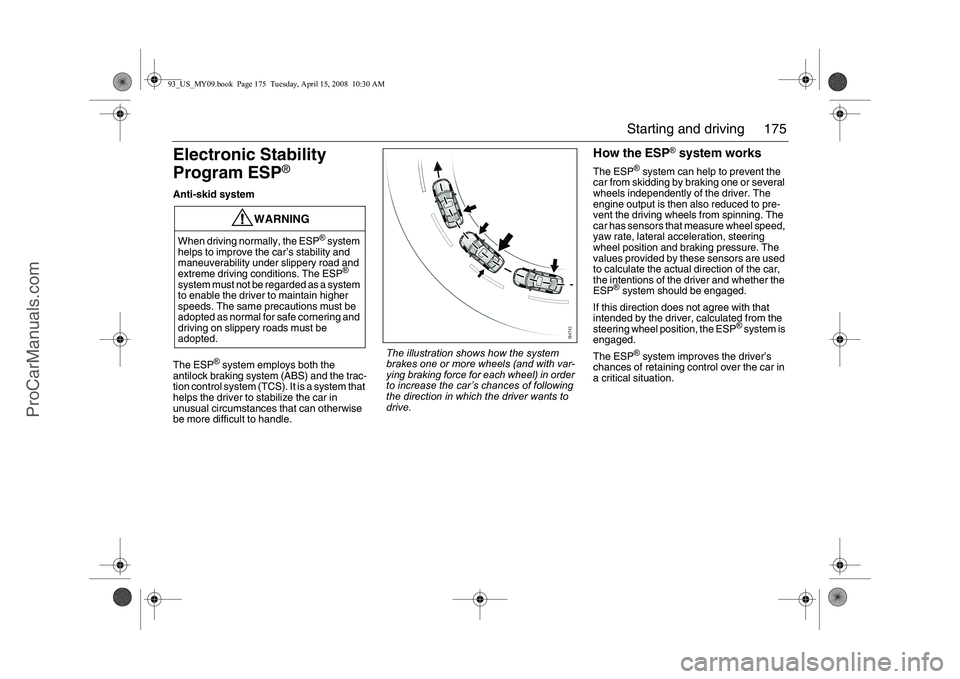
® system can help to prevent the
car from skidding by braking one or several
wheels independently of the driver. The
engine output is then also reduced to pre-
vent the driving wheels from spinning. The
car has sensors that measure wheel speed,
yaw rate, lateral acceleration, steering
wheel position and braking pressure. The
values provided by these sensors are used
to calculate the actual direction of the car,
the intentions of the driver and whether the
ESP
® system should be engaged.
If this direction does not agree with that
intended by the driver, calculated from the
steering wheel position, the ESP
® system is
engaged.
The ESP
® system improves the driver’s
chances of retaining control over the car in
a critical situation.
WARNING
When driving normally, the ESP
® system
helps to improve the car’s stability and
maneuverability under slippery road and
extreme driving conditions. The ESP
®
system must not be regarded as a system
to enable the driver to maintain higher
speeds. The same precautions must be
adopted as normal for safe cornering and
driving on slippery roads must be
adopted.
The illustration shows how the system
brakes one or more wheels (and with var-
ying braking force for each wheel) in order
to increase the car’s chances of following
the direction in which the driver wants to
drive.
93_US_MY09.book Page 175 Tuesday, April 15, 2008 10:30 AM
ProCarManuals.com
Page 176 of 304
176 Starting and drivingESP
® system OFF
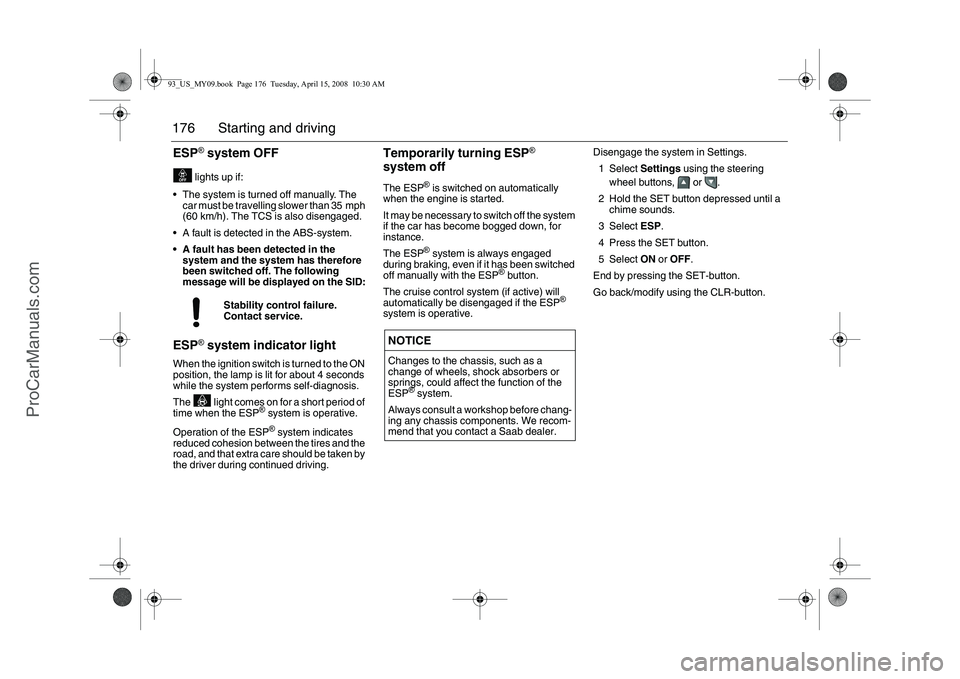
lights up if:
The system is turned off manually. The
car must be travelling slower than 35 mph
(60 km/h). The TCS is also disengaged.
A fault is detected in the ABS-system.
A fault has been detected in the
system and the system has therefore
been switched off. The following
message will be displayed on the SID:
ESP
® system indicator light
When the ignition switch is turned to the ON
position, the lamp is lit for about 4 seconds
while the system performs self-diagnosis.
The light comes on for a short period of
time when the ESP
® system is operative.
Operation of the ESP® system indicates
reduced cohesion between the tires and the
road, and that extra care should be taken by
the driver during continued driving.
Temporarily turning ESP
®
system off
The ESP
® is switched on automatically
when the engine is started.
It may be necessary to switch off the system
if the car has become bogged down, for
instance.
The ESP® system is always engaged
during braking, even if it has been switched
off manually with the ESP
® button.
The cruise control system (if active) will
automatically be disengaged if the ESP
®
system is operative.Disengage the system in Settings.
1Select Settings using the steering
wheel buttons, or .
2 Hold the SET button depressed until a
chime sounds.
3Select ESP.
4 Press the SET button.
5Select ON or OFF.
End by pressing the SET-button.
Go back/modify using the CLR-button.
Stability control failure.
Contact service.
NOTICEChanges to the chassis, such as a
change of wheels, shock absorbers or
springs, could affect the function of the
ESP
® system.
Always consult a workshop before chang-
ing any chassis components. We recom-
mend that you contact a Saab dealer.
93_US_MY09.book Page 176 Tuesday, April 15, 2008 10:30 AM
ProCarManuals.com
Page 178 of 304
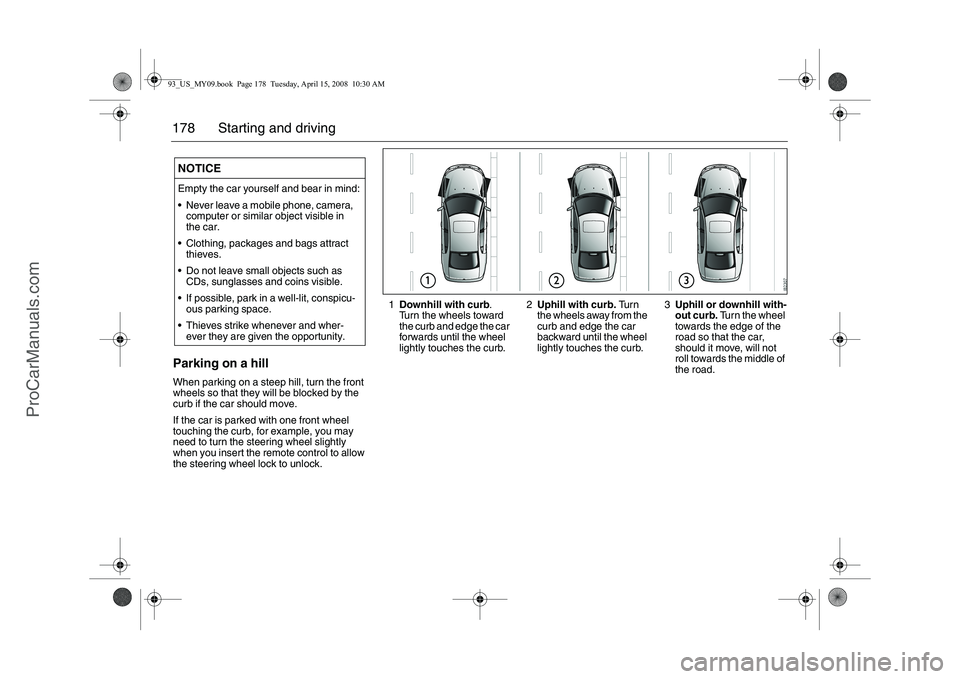
178 Starting and drivingParking on a hillWhen parking on a steep hill, turn the front
wheels so that they will be blocked by the
curb if the car should move.
If the car is parked with one front wheel
touching the curb, for example, you may
need to turn the steering wheel slightly
when you insert the remote control to allow
the steering wheel lock to unlock.NOTICEEmpty the car yourself and bear in mind:
Never leave a mobile phone, camera,
computer or similar object visible in
the car.
Clothing, packages and bags attract
thieves.
Do not leave small objects such as
CDs, sunglasses and coins visible.
If possible, park in a well-lit, conspicu-
ous parking space.
Thieves strike whenever and wher-
ever they are given the opportunity.
1Downhill with curb
.
Turn the wheels toward
the curb and edge the car
forwards until the wheel
lightly touches the curb.2Uphill with curb. Tu r n
the wheels away from the
curb and edge the car
backward until the wheel
lightly touches the curb.3Uphill or downhill with-
out curb. Turn the wheel
towards the edge of the
road so that the car,
should it move, will not
roll towards the middle of
the road.
93_US_MY09.book Page 178 Tuesday, April 15, 2008 10:30 AM
ProCarManuals.com
Page 181 of 304
181 Starting and driving
increases as the car comes closer to the
object.
If you stop the car with reverse gear
engaged, the sound pulse will stop after
2 seconds. The sound pulses will return if
you continue to reverse. If the car rolls for-
ward while reverse is engaged, the system
is silenced.
When the distance to the object is less
than 1 ft. (30 cm), a continuous tone will
be heard.
When an object is approximately 3 ft.
(90 cm) from the car, the sound pulses
change character markedly (frequency
increases). A distance of about 3 ft. (90 cm)
is suitable if you wish to load or unload the
trunk.
If the distance between an object and a
corner sensor does not change for
3 seconds, for example if you are reversing
alongside a wall, the system will switch to
monitoring straight back. The system indi-
cates if the distance to the wall decreases
again.
If a trailer is hitched up and correctly con-
nected to the trailer contact by the towbar,
the system is automatically deactivated.Reversing alongside a wall
If the distance between an object and a
corner sensor does not change for
2 seconds, for example if you are reversing
alongside a wall, the system will switch to
monitoring straight back. The system indi-
cates if the distance to the wall decreases
again.Cars with trailer hitch
If the car has a trailer hitch and its wiring is
correctly connected to the car’s electrical
system, the Saab Parking Assistance auto-
matically compensates for the protrusion of
the towbar.
If a camper or trailer is hitched up and the
trailer hitch wiring is correctly connected to
the car’s electrics, the system is automati-
cally deactivated.
You can temporarily deactivate the Saab
Parking Assistance as follows:
Engage reverse and press the CLR button
on the steering wheel.
The system will be reactivated the next time
you engage reverse.
NOTICEThe sensors must be kept clean to func-
tion well. Ice, snow and dirt can affect
their sensitivity.
Large quantities of snow or dirt covering
the sensors can prevent the parking
assistance system from detecting any
objects.
Do not spray the sensors with a pressure
washer, as this can damage them.
93_US_MY09.book Page 181 Tuesday, April 15, 2008 10:30 AM
ProCarManuals.com
Page 182 of 304
182 Starting and drivingError messages
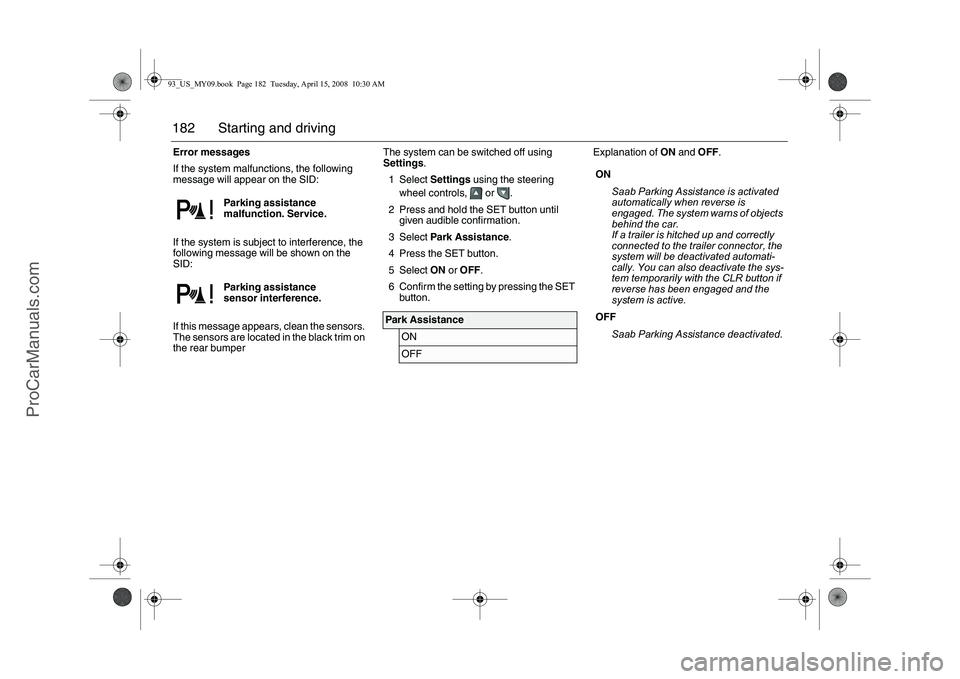
If the system malfunctions, the following
message will appear on the SID:
If the system is subject to interference, the
following message will be shown on the
SID:
If this message appears, clean the sensors.
The sensors are located in the black trim on
the rear bumper The system can be switched off using
Settings.
1Select Settings using the steering
wheel controls, or .
2 Press and hold the SET button until
given audible confirmation.
3Select Park Assistance.
4 Press the SET button.
5Select ON or OFF.
6 Confirm the setting by pressing the SET
button.Explanation of ON and OFF.
Parking assistance
malfunction. Service.
Parking assistance
sensor interference.
Park Assistance
ONOFF
ON
Saab Parking Assistance is activated
automatically when reverse is
engaged. The system warns of objects
behind the car.
If a trailer is hitched up and correctly
connected to the trailer connector, the
system will be deactivated automati-
cally. You can also deactivate the sys-
tem temporarily with the CLR button if
reverse has been engaged and the
system is active.
OFF
Saab Parking Assistance deactivated.
93_US_MY09.book Page 182 Tuesday, April 15, 2008 10:30 AM
ProCarManuals.com
Page 184 of 304
184 Starting and drivingto reach its optimum temperature, and
engine wear is at its greatest during this
period. Drive off as soon as possible after
starting the engine and avoid high engine
speeds.
Drive as smoothly and thoughtfully as
possible. Match your driving to the prevail-
ing traffic conditions.
Driving in a low gear gives rise to higher
fuel consumption than driving in a high
gear because of the higher engine speed
for any given road speed. Always shift up
as soon as traffic conditions allow and
drive in the highest gear as much as
possible.
Check the tire pressure once a month.
Incorrect tire pressure increases tire
wear. It is preferable for the tire pressure
to be slightly high than too low. Under-
pressure increases fuel consumption.
Check the fuel consumption regularly.
Increased fuel consumption can indicate
that something is wrong and that the car
needs to be checked. We recommend
that you contact a Saab dealer.
Practical road tests have demonstrated that
substantial savings in fuel consumption can
be made if the above advice is followed.
Road conditionsWet roads increase fuel consumption, as do
unpaved roads and driving in hilly country
(the amount of fuel saved driving downhill is
less than the additional amount required to
climb the hill).Engine block heater3If block heater is installed the cord can be
found coiled in the engine compartment.
The following are just some of the benefits
to the car and the environment of using an
engine block heater:
Lower fuel consumption
Reduced wear on the engine
Inside of car warms up faster
Exhaust emissions substantially reduced
over short runs.
The engine heater is effective at outside
temperatures up to 60–70 °F (+15 –
+20 °C). The warmer it is outside, the
shorter the time the engine heater needs to
be connected.
If the outside temperature is -22 °F
(-30 °C) the heater needs to be
connected at least 3 h.
If the outside temperature is -14 °F
(-10 °C) the heater needs to be
connected at least 2 h. If the outside temperature is 32 °F (-0 °C)
the heater needs to be connected at least
1.5 h.
To have the heater connected less than
0.5 h is no use but can lead to driveabilitiy
problems.
If the car is equipped with a removable,
electric cabin heater that is not in use, store
this in the trunk.
WARNING
Never switch off the engine while driving
as the effect of the brakes and power
steering will be greatly reduced.93_US_MY09.book Page 184 Tuesday, April 15, 2008 10:30 AM
ProCarManuals.com
Page 192 of 304
192 Starting and drivingDriving with a roof rack
loadThe maximum permissible roof load is
220 lbs. (100 kg). Note that the roof load
must be included in the car’s maximum per-
missible payload and axle load.
Strong, sturdy roof carriers designed spe-
cially for your car are available from your
Saab dealer. Always secure roof loads
securely.
Driving with a loadThe handling characteristics are affected by
how the car is loaded.
WARNING
A roof load will affect the car’s center
of gravity and aerodynamics. Be
aware of this when cornering and driv-
ing in crosswinds.
Adjust your speed to the prevailing
conditions.
Due to higher aerodynamics drag, fuel
economy may suffer when driving with
a roof rack.
NOTICE Place the heaviest load as far forward
and as low as possible in the trunk.
Secure the load to the lashing eyes
(see page 139).
Heavy loads mean that the car’s
center of gravity is further back. As a
result, the car will sway more during
evasive steering.
Never exceed the permissible load of
the roof box, even if there is room for
more.
Ensure that the tire pressure is correct
– slight overinflation is preferable to
underinflation.
The braking distance of a loaded car is
always greater. Keep your distance
from the vehicle in front.
Do not exceed the car’s permissible
gross vehicle weight or axle load (see
page 284).
Roof loads can negatively affect tele-
communication.
For further information on tires see
page 240.
93_US_MY09.book Page 192 Tuesday, April 15, 2008 10:30 AM
ProCarManuals.com