ECU SAAB 9-5 2000 Owner's Guide
[x] Cancel search | Manufacturer: SAAB, Model Year: 2000, Model line: 9-5, Model: SAAB 9-5 2000Pages: 256, PDF Size: 14.24 MB
Page 124 of 256

124 Interior equipment and trunkSliding floor (accessory)
The function of the sliding floor is to facilitate
loading and unloading.
Securing loads, see page 118.
When the car is parked and the floor is
pulled out, it can bear the weight of two
people (maximum 440 lbs./200 kg).
The maximum load that can be anchored by
anchorage straps and cargo bolts is
170 lbs./80 kg.Setting up
1 Lift up the floor.
2 Fold out the support wheels.
3 Set the floor down on the support
wheels.
WARNING
To avoid personal injury take note of the
following:
Do not leave children unsupervised
when the sliding floor is drawn out.
Be aware of the risk of pinching when
handling the sliding floor.
Never drive the car with the sliding
floor pulled out.
Always use the car’s regular cargo
anchoring when transporting a cargo.
Provide protection on sharp edges to
prevent damage to the anchoring
straps.
The sliding floor must not be changed
or modified in any way.
Put the sliding floor in the folded- down
position when it is not in use.
IB1220
Setting up the sliding floor
ProCarManuals.com
Page 152 of 256

152 Starting and driving3 As soon as possible, have the cooling
system checked by an authorized Saab
dealer.
Towing a trailerTrailer hitch attachmentTrailer hitch attachments are available as
accessories. These are designed for a max-
imum trailer weight of 2000 lbs. (900 kg).
Use only the electrical trailer hitch socket
provided in the spare wheel area in the lug-
gage compartment for connecting the trailer
electrics.
Trailer weightMaximum recommended trailer weights for
different gradients, with a view to comfort
and drivability for manual and automatic
cars, are shown on the drawing.
Make sure you are familiar with the law
regarding speed limits for towing, maxi-
mum trailer weights, trailer-braking
requirements, and also any special
driving-licence provisions
(see also page 227).
The specified trailer weights and gradients
assume that the journey starts at the hill and
therefore apply only to short periods.
WARNING
Always undo the expansion tank filler cap
carefully, releasing the pressure and any
vapor before removing the cap com-
pletely.
NOTEUse only a genuine Saab trailer hitch,
since other models can damage the car’s
bodywork and electrical system (or in
Canada, a high quality hitch designed to
fit the car, available from a trailer hitch
specialist).
Consult an authorized Saab dealer for
guidance on how to connect the trailer
hitch electrical system.
WARNING
When towing a trailer, do not attempt to
negotiate a hill having a gradient in
excess of 15%. The weight distribution
over the front wheels of the car will be
insufficient to prevent wheelspin, making
further progress impossible.
In addition, the parking brake may not
always be able to hold the car and trailer
securely, with the result that the wheels
can start to slide downhill.
ProCarManuals.com
Page 154 of 256
154 Starting and drivingDriving considerations
with compact spare
wheel/tire fittedThe following should be observed when the
compact spare wheel (T115/70 R16) is
fitted:
The compact spare is light and easy to
handle when changing the wheel. Do not
drive further than necessary with the com-
pact spare fitted – the maximum life of the
wheel is only just over 2000 miles
(3,500 km). Have the standard wheel
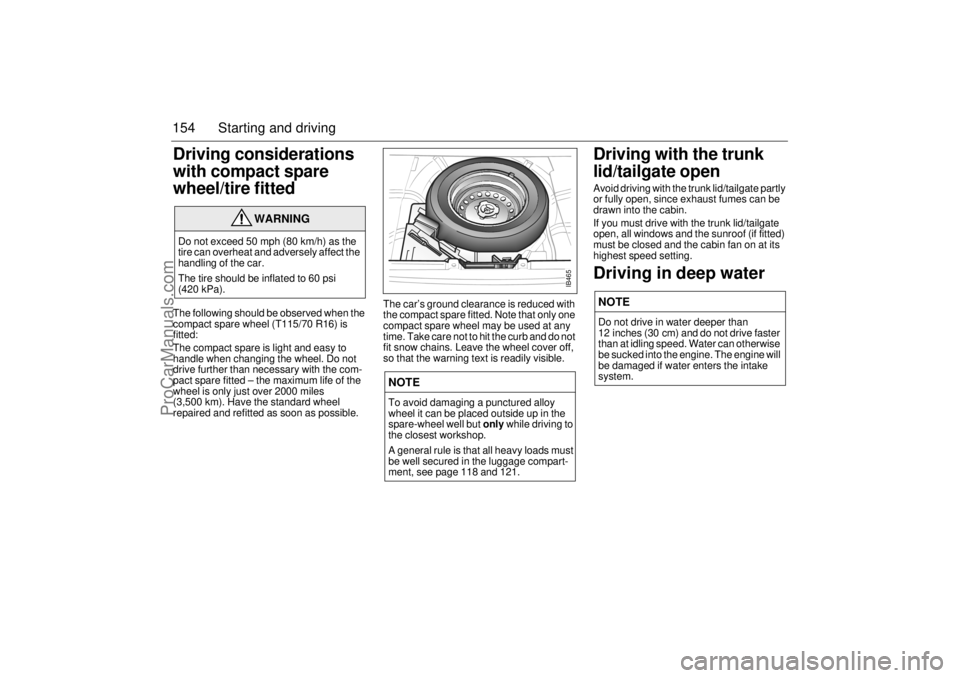
repaired and refitted as soon as possible. The car’s ground clearance is reduced with
the compact spare fitted. Note that only one
compact spare wheel may be used at any
time. Take care not to hit the curb and do not
fit snow chains. Leave the wheel cover off,
so that the warning text is readily visible.
Driving with the trunk
lid/tailgate openAvoid driving with the trunk lid/tailgate partly
or fully open, since exhaust fumes can be
drawn into the cabin.
If you must drive with the trunk lid/tailgate
open, all windows and the sunroof (if fitted)
must be closed and the cabin fan on at its
highest speed setting.Driving in deep water
WARNING
Do not exceed 50 mph (80 km/h) as the
tire can overheat and adversely affect the
handling of the car.
The tire should be inflated to 60 psi
(420 kPa).
NOTETo avoid damaging a punctured alloy
wheel it can be placed outside up in the
spare-wheel well but only while driving to
the closest workshop.
A general rule is that all heavy loads must
be well secured in the luggage compart-
ment, see page 118 and 121.
NOTEDo not drive in water deeper than
12 inches (30 cm) and do not drive faster
than at idling speed. Water can otherwise
be sucked into the engine. The engine will
be damaged if water enters the intake
system.
IB465
ProCarManuals.com
Page 155 of 256

155 Starting and driving
Driving with a roof rack
loadThe maximum permissible roof load is
220 lbs. (100 kg).
Note that the roof load is included in the
car’s maximum permissible load (see page
226).
Strong, sturdy roof carriers designed spe-
cially for the car are available from your
Saab dealer. Always secure the roof load
safely. Fitting the roof carriers (accessory)
9-5 SedanThe carrier feet are marked with a top view
of the car and arrow indicating their posi-
tions.
1 Slip the plastic cover onto the adjustable
foot of the carrier (foot with knob for
tightening) to protect the paintwork
during assembly.
2 Open all the doors.
Fold back the rubber strip and find the
fixing holes. 3 Start on the left-hand side of the car.
Rest the carrier carefully across the roof,
with the rigid foot towards you. Hold the
foot clear of the roof to avoid damaging
the paintwork.
Fold back the rubber strip and insert the
pins on the foot into the fixing holes.
Make sure that the rubber strip comes
inside the plastic cover on the carrier.
Repeat the procedure with the other car-
rier.
4 Close the doors on the left-hand side of
the car gently, to hold the carrier feet in
place.
5 Now go around to the other side of the
car and remove the plastic cover from
the carrier’s adjustable foot. Fold back
the rubber strip and insert the pins on
the foot into the fixing holes. Do the
same with the other carrier and close the
doors gently. 6 Tighten each carrier by turning the knob
clockwise (by hand). Tighten just
enough to bring the foot up against the
edges of the fixing holes.
Remove the carriers when not in use, as
they increase fuel consumption.
The instructions that accompany the carri-
ers also include advice on driving with a roof
load - we strongly recommend that you read
them carefully.
WARNING
A roof load will affect the car’s center
of gravity and aerodynamics. Be
aware of this when cornering and driv-
ing in crosswinds.
Suit your speed to the prevailing con-
ditions.
IB480
IB481
ProCarManuals.com
Page 156 of 256

156 Starting and drivingFitting the roof carriers (accessory)
9-5 Wagon1 Clean the car’s roof rails.
2 Check the markings on the cross mem-
bers to see which is the front and which
is the rear roof carrier.
3 Place the cross members on the roof
rails, on their respective sides of the
centre supports. The cross members
must not be placed beyond the front or
rear joint on the rail. Ensure that the dis-
tance between the cross members is at
least 28 inches (700 mm).
If a roof box is to be fitted, the cross
members must be positioned so that the
tailgate can be opened fully without hit-
ting the roof box.
4 Using your thumb, press the bracket so
that it lies snugly against the outside of
the roof rail. Make sure that the roof car-
riers are seated centrally on the rubber
spacers and that these sit correctly on
the roof rail. Pull the spacers down
slightly on the inside of the roof rail.
5 Center the roof carriers so that they pro-
trude equally on both sides.
6 Tighten the roof carriers by hand.
Ensure that the tightening knobs are
upright once the roof carriers have been
tightened.
7 Make sure the roof carriers are securely
in place.
IB1294
IB1295
ProCarManuals.com
Page 157 of 256

157 Starting and driving
Driving with a loadThe driving characteristics of the car are
affected by the way it is loaded.
Place heavy loads as far forward and as
low as possible in the trunk.
Secure the load to the tie downs, see
page 118.
The load should be such that the car´s
total weight or axle weight are not
exceeded, see page 226.
Heavy loads mean that the car’s centre of
gravity is further back. As a result, the car
will sway more during evasive steering.
Never exceed the permissible load in the
roof box, even if there is room for more.
Ensure that the tire pressure is correct –
slight overinflation is preferable to under-
inflation.
The braking distance of a loaded car is
always greater. Keep your distance from
the vehicle in front.
Tire pressure, see page 235 and back
cover.
TiresThe tire pressure should match the current
load and speed of the car; see the back
cover or the tire pressure label on
page 235.
The tire pressures given apply to cold tires,
that is tires that are the same temperature
as the outside air temperature.
The tire pressure increases as the tires
become warm (e.g. during highway driving)
with approximately 0.3 bar (4 psi). When
the temperature of the tires changes by 50°
(10°C), the tire pressure will change 0.1 bar
(2 psi).Never reduce the pressure of a hot tire. If the
tires are hot when you check them, only
increase the pressure, if necessary.
Underinflated tires wear more quickly than
slightly overinflated tires.
If a valve is leaking, simply unscrew it and fit
a new one.
Important! Remember to adjust the tire
pressures if you change the load in the car
or intend to drive at substantially lower or
higher speeds than normal.NOTECheck the tire pressure at least once a
month. Underinflation is the main cause
of:
Damage to the wheels.
Premature tire wear.
Damage to the sidewalls.
ProCarManuals.com
Page 158 of 256
158 Starting and drivingTowing the car
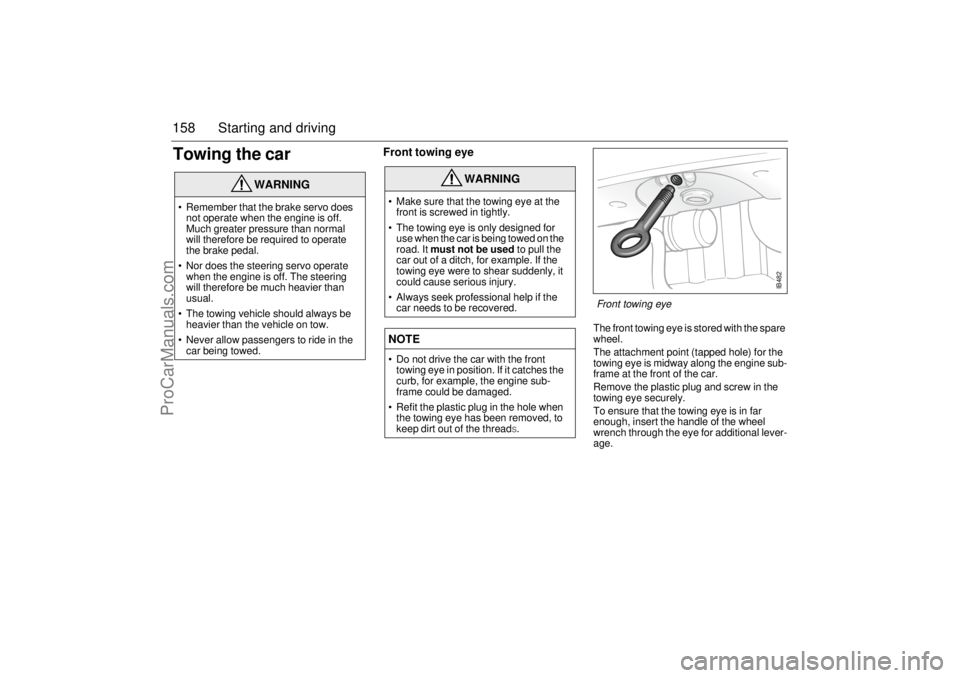
Front towing eye
The front towing eye is stored with the spare
wheel.
The attachment point (tapped hole) for the
towing eye is midway along the engine sub-
frame at the front of the car.
Remove the plastic plug and screw in the
towing eye securely.
To ensure that the towing eye is in far
enough, insert the handle of the wheel
wrench through the eye for additional lever-
age.
WARNING
Remember that the brake servo does
not operate when the engine is off.
Much greater pressure than normal
will therefore be required to operate
the brake pedal.
Nor does the steering servo operate
when the engine is off. The steering
will therefore be much heavier than
usual.
The towing vehicle should always be
heavier than the vehicle on tow.
Never allow passengers to ride in the
car being towed.
WARNING
Make sure that the towing eye at the
front is screwed in tightly.
The towing eye is only designed for
use when the car is being towed on the
road. It must not be used to pull the
car out of a ditch, for example. If the
towing eye were to shear suddenly, it
could cause serious injury.
Always seek professional help if the
car needs to be recovered. NOTE Do not drive the car with the front
towing eye in position. If it catches the
curb, for example, the engine sub-
frame could be damaged.
Refit the plastic plug in the hole when
the towing eye has been removed, to
keep dirt out of the threads.
IB482
Front towing eye
ProCarManuals.com
Page 166 of 256
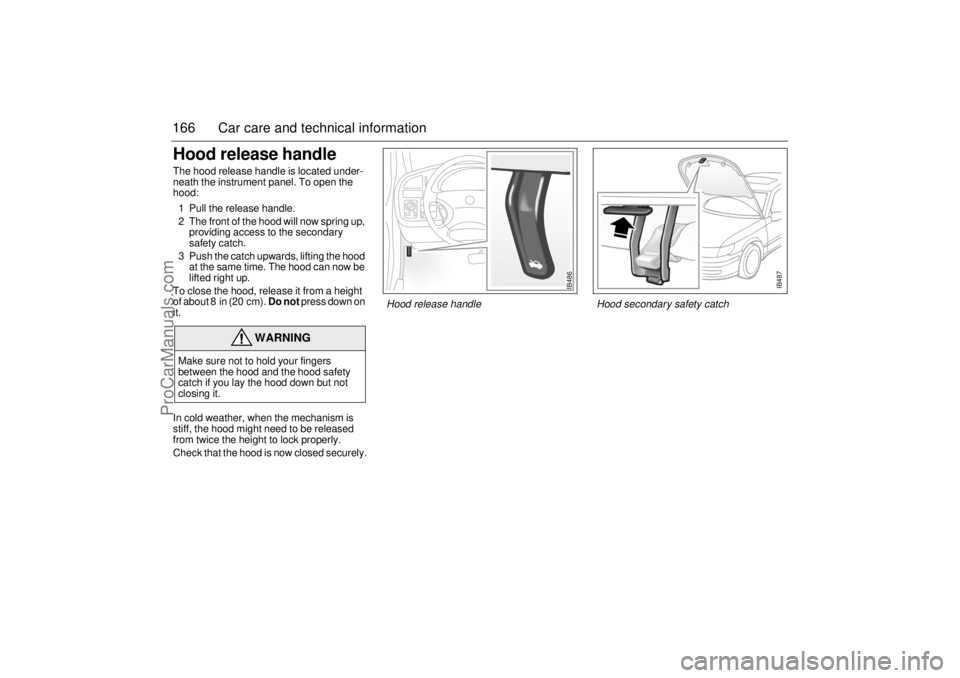
166 Car care and technical informationHood release handleThe hood release handle is located under-
neath the instrument panel. To open the
hood:
1 Pull the release handle.
2 The front of the hood will now spring up,
providing access to the secondary
safety catch.
3 Push the catch upwards, lifting the hood
at the same time. The hood can now be
lifted right up.
To close the hood, release it from a height
of about 8 in (20 cm). Do not press down on
it.
In cold weather, when the mechanism is
stiff, the hood might need to be released
from twice the height to lock properly.
Check that the hood is now closed securely.
WARNING
Make sure not to hold your fingers
between the hood and the hood safety
catch if you lay the hood down but not
closing it.
IB487
IB486
Hood release handle Hood secondary safety catch
ProCarManuals.com
Page 182 of 256

182 Car care and technical informationChanging bulbs Check that the new bulb is working when finished.
Some bulbs are of the ”Long-Life” type. Make sure the same type is
fitted when changing one of these.
Headlamp aiming, see page 214.
Headlamp bulb for high beam1 Unscrew the cover from the back of the lamp unit.
2 Unplug the connector.
3 To remove the spring clip, push it in and then move it to the right.
4 Remove the bulb.
5 Without touching the glass with your fingers, insert the new bulb.
6 Line up the bulb with the guide in the reflector and secure it with
the spring clip.
7 Plug in the connector.
8 Screw on the cover.
WARNING
Before changing a bulb in the engine bay, switch off the engine to
avoid danger of fingers and hands being injured by moving parts.
The radiator fan can start up even when the engine is switched off.
NOTE Do not fit bulbs with a higher rating than 55 W.
Switch off the ignition before changing a bulb, to avoid possible
short-circuiting.
IB510
ProCarManuals.com
Page 183 of 256
183 Car care and technical information
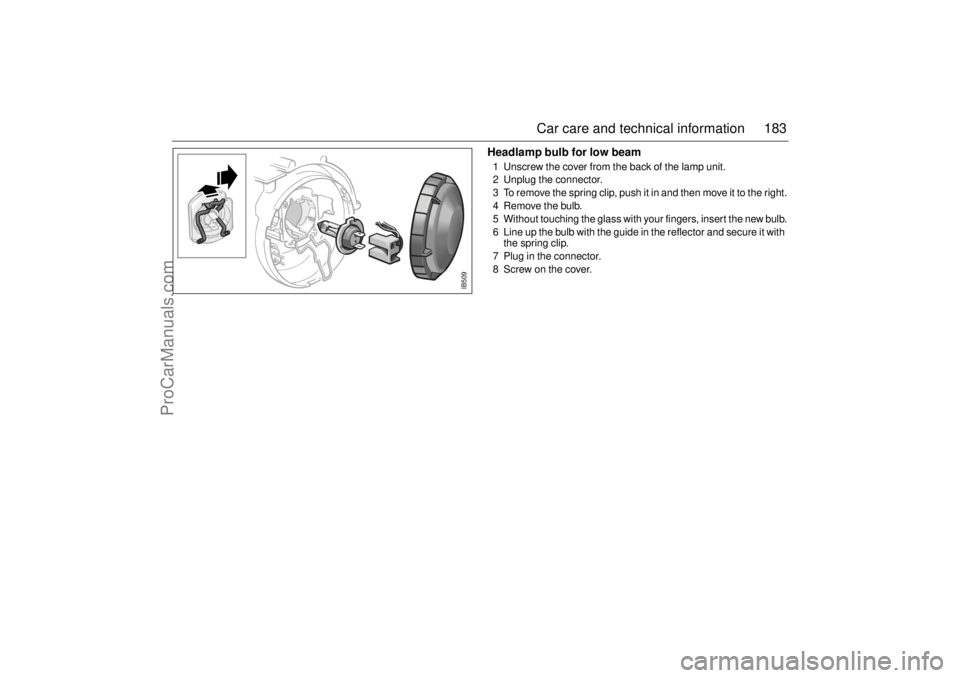
Headlamp bulb for low beam1 Unscrew the cover from the back of the lamp unit.
2 Unplug the connector.
3 To remove the spring clip, push it in and then move it to the right.
4 Remove the bulb.
5 Without touching the glass with your fingers, insert the new bulb.
6 Line up the bulb with the guide in the reflector and secure it with
the spring clip.
7 Plug in the connector.
8 Screw on the cover.
IB509
ProCarManuals.com