wheel SAAB 9-5 2000 Service Manual
[x] Cancel search | Manufacturer: SAAB, Model Year: 2000, Model line: 9-5, Model: SAAB 9-5 2000Pages: 256, PDF Size: 14.24 MB
Page 176 of 256
176 Car care and technical informationThe level should be between the MAX and
MIN marks. Top up, as necessary, with
DOT 4 fluid. Do
not
use DOT 5 brake fluid.
Use only new brake fluid from a sealed con-
tainer.
Check that there are no leaks in the brake
system.
The brake fluid level will fall somewhat as
the brake pads wear. The MAX level in the
reservoir corresponds to the amount of
brake fluid required with new brake pads. If
the fall in fluid level is moderate, due to
normal brake pad wear, topping up is not
necessary.
Changing of the brake fluid should be
carried out by an authorized Saab dealer.
The vehicle´s regular braking system is
adjusted automatically, but the parking
brake has to be adjusted manually. This
work, involving adjustment of the parking
brake cables and brake pads, must only be
carried out by an authorized Saab dealer.
It is not possible to detect, through abnormal
pedal or parking brake-lever travel, whether
brake pads are worn and need replacing. It
is therefore essential that brake pads be
checked regularly, as specified in the ser-
vice program.
Brake pad wear indicators The outboard brake pads on the front
wheels incorporate pad-wear indicators.
When the lining is down to 0.11 in (3 mm),
the pad will produce a screeching, squeal-
ing or scraping noise when the brakes are
applied. New pads should be fitted without
delay.
Brake pads should only be changed by
an authorized Saab dealer. To ensure
optimum brake performance, use only
Saab original brake pads.
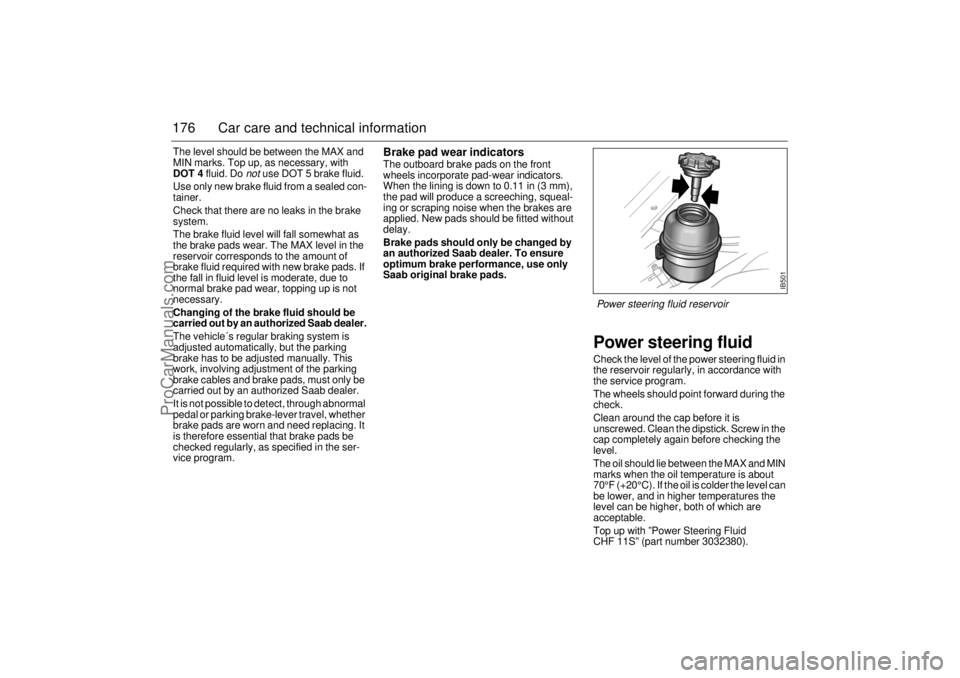
Power steering fluidCheck the level of the power steering fluid in
the reservoir regularly, in accordance with
the service program.
The wheels should point forward during the
check.
Clean around the cap before it is
unscrewed. Clean the dipstick. Screw in the
cap completely again before checking the
level.
The oil should lie between the MAX and MIN
marks when the oil temperature is about
70°F (+20°C). If the oil is colder the level can
be lower, and in higher temperatures the
level can be higher, both of which are
acceptable.
Top up with ”Power Steering Fluid
CHF 11S” (part number 3032380).
IB501
Power steering fluid reservoir
ProCarManuals.com
Page 198 of 256

198 Car care and technical informationWheels Alternative wheels and tiresIf you wish to fit other tires or wheels than
those supplied with the car, consult your
Saab dealer first as to the possibilities avail-
able.
Wheels/tires combinations that are not
approved by Saab can negatively affect the
car´s directional stability, steering and brak-
ing in both wet and dry conditions.
Do not assume that a wheel/tire combina-
tion will function properly just because it will
bolt on.The wheels and tires have been carefully
matched to the characteristics of the car and
play a key role in its outstanding roadhold-
ing and handling.
Tire pressureTires need to be inflated to suit the load car-
ried and the maximum speed the car will be
driven (see the recommended tire pres-
sures on the back cover). Note that all
values apply to cold tires. For tires with an
aspect ratio less than /60, increase the tire
pressure by 3 psi (20 kPa) for rough roads
with potholes to minimize the risk of rim
damage.Never reduce the pressure of a hot tire. If the
tires are hot when you check them, only
increase the pressure, if necessary.
Soft tires will cause faster wear than
over-pressurized tires. They also increase
fuel consumption.
If a valve is leaking, simply unscrew it and fit
a new one.
Important! Remember to adjust the tire
pressures if you change the load in the car
or intend to cruise at a substantially higher
or lower speed than normal.
NOTEFor wide wheels and/or low-profile tires,
bear in mind the following:
Tires and wheels can be damaged in
potholes etc.
Springs and dampers can be over-
loaded.
The wheels can come into contact with
chassis and body components.
The speed and load limits for the tires
must not be exceeded; see page 199.
Wheels larger than 17” must not be fit-
ted. The maximum permissible offset
is 49 mm.
NOTECheck the tire pressures at least once
per month.
Underinflation is the main cause of:
Tires wearing out prematurely.
Damage to the sidewalls.
Damage to the wheels.
ProCarManuals.com
Page 199 of 256

199 Car care and technical information
Rotating tiresBecause the car has front-wheel drive, the
front tires tend to wear faster than the rear
ones. New tires should always be fitted in
pairs, so that tires on the same axle have the
same amount of tread.
If swapping the complete set, e.g. winter
tires for summer tires, mark the tires
removed to ensure that they go back in the
same position (e.g. FL for front left, RL rear
left, etc.).
Store wheels lying flat or hanging – never
standing upright.
Tire markingsAn example of the meaning of the different
markings in a tire size is given below for a
tire size of:
205/65 R15 94 V
Winter tiresWinter (snow) tires are recommended for
winter climates where the majority of your
driving will be done on snow and ice. Winter
tires should be fitted to all four wheels to
maintain a proper balance. Your Saab
dealer can advise you as to the correct size
tire for your car (if different from the original
size) and also supply Saab approved winter
tires.Tire quality grading (cars sold in
U.S.)New tires must be graded and labeled in
accordance with new Federal regulations.
Standard tests are conducted to measure
performance in the areas of traction and
temperature resistance. Refer to the tire
sidewall for the specific quality grades of the
tires provided on your new Saab. Compact
spare tires are exempt.
DOT QUALITY GRADES
Treadwear
Traction AA, A, B, C
Temperature A, B, C
All passenger car tires must conform to Fed-
eral safety requirements in addition to these
grades.
WARNING
When fitting just one new pair of tires,
these should be fitted to the rear wheels,
as these are more critical to the direc-
tional stability of the car (e.g. on braking
or in a skid). The existing rear wheels
should therefore be moved to the front.
Always move left rear to left front and right
rear to right front, so that the direction of
rotation remains the same.
205 Tire section width, mm
65 Aspect ratio, i.e. the section height
is 65% of the section width
R Radial ply
15 Wheel rim diameter 15 in at bead
seats
94 Tire load code
V Speed marking
Speed ratings S Tire approved for speeds up to
100 mph (180 km/h)
T Tire approved for speeds up to
118 mph (190 km/h)
H Tire approved for speeds up to
130 mph (210 km/h)
V Tire approved for speeds up to
150 mph (240 km/h)
W Tire approved for speeds up to
167 mph (270 km/h)
Y Tire approved for speeds up to
186 mph (300 km/h)
ProCarManuals.com
Page 201 of 256
201 Car care and technical information
TemperatureThe temperature grades are A (the highest),
B, and C, representing the tire’s resistance
to the generation of heat and its ability to dis-
sipate heat when tested under controlled
conditions on a specified indoor laboratory
test wheel. Sustained high temperature can
cause the material of the tire to degenerate
and reduce tire life, and excessive temper-
ature can lead to sudden tire failure. The
grade C corresponds to a level of perfor-
mance which all passenger car tires must
meet under the Federal Motor Vehicle
Safety Standard No. 109.
Grades B and A represent higher levels of
performance on the laboratory test wheel
than the minimum required by law.
Date codeTires should be regarded as perishable
goods. As the tires age, the rubber becomes
progressively harder, and the roadholding
ability of the tires diminishes. This is partic-
ularly on winter tires.
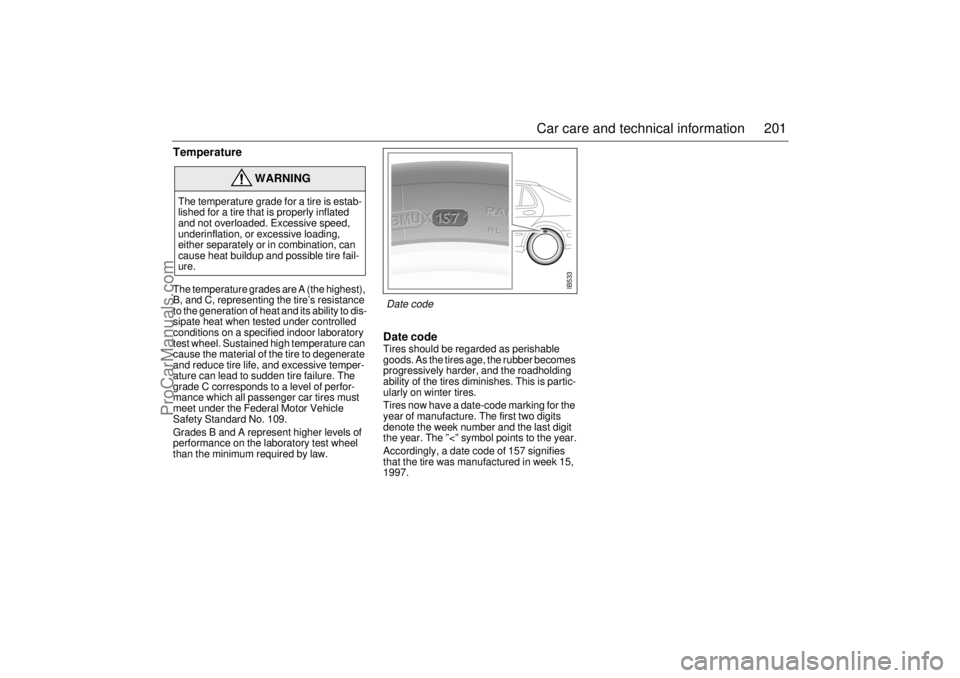
Tires now have a date-code marking for the
year of manufacture. The first two digits
denote the week number and the last digit
the year. The ”<” symbol points to the year.
Accordingly, a date code of 157 signifies
that the tire was manufactured in week 15,
1997.
WARNING
The temperature grade for a tire is estab-
lished for a tire that is properly inflated
and not overloaded. Excessive speed,
underinflation, or excessive loading,
either separately or in combination, can
cause heat buildup and possible tire fail-
ure.
IB533
Date code
ProCarManuals.com
Page 202 of 256
202 Car care and technical informationCompact spare wheelThe compact spare is light and easy to
handle when changing the tire. Its use is
only permitted when a standard tire has sus-
tained a puncture. The maximum life of the
tire is only 2000 miles (3,500 km).
Do not exceed 50 mph (80 km/h) with the
compact spare fitted.
The compact spare should be inflated to
60 psi (420 kPa). Carry the punctured tire in
the spare-wheel well under the luggage-
compartment floor.
Have the standard tire repaired and refitted
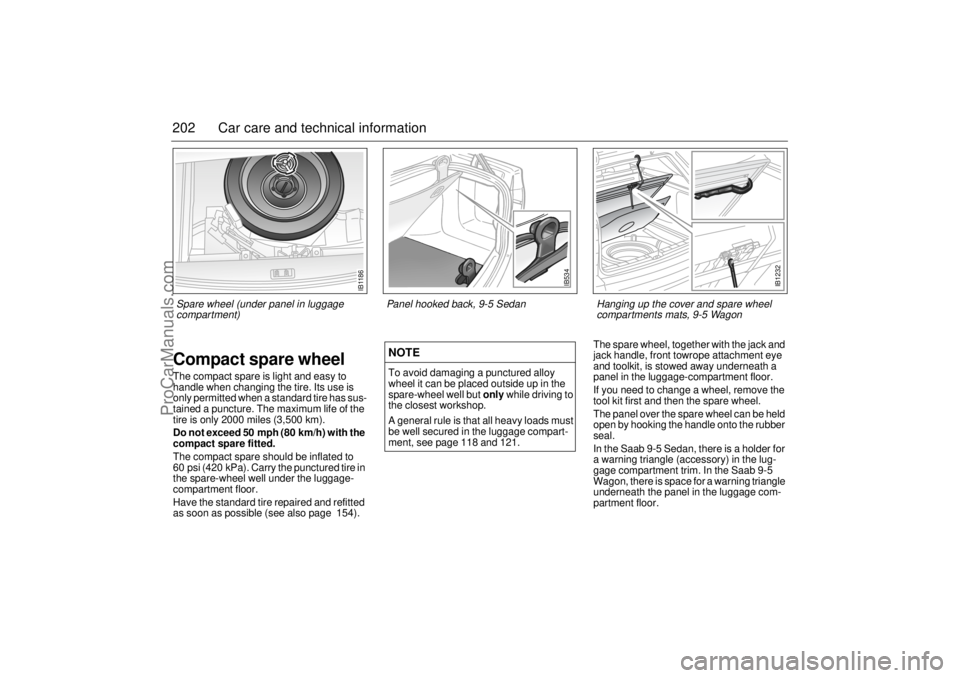
as soon as possible (see also page 154).The spare wheel, together with the jack and
jack handle, front towrope attachment eye
and toolkit, is stowed away underneath a
panel in the luggage-compartment floor.
If you need to change a wheel, remove the
tool kit first and then the spare wheel.
The panel over the spare wheel can be held
open by hooking the handle onto the rubber
seal.
In the Saab 9-5 Sedan, there is a holder for
a warning triangle (accessory) in the lug-
gage compartment trim. In the Saab 9-5
Wagon, there is space for a warning triangle
underneath the panel in the luggage com-
partment floor.
NOTETo avoid damaging a punctured alloy
wheel it can be placed outside up in the
spare-wheel well but only while driving to
the closest workshop.
A general rule is that all heavy loads must
be well secured in the luggage compart-
ment, see page 118 and 121.
IB534
Panel hooked back, 9-5 Sedan
IB1232
Hanging up the cover and spare wheel
compartments mats, 9-5 Wagon
IB1186
Spare wheel (under panel in luggage
compartment)
ProCarManuals.com
Page 203 of 256

203 Car care and technical information
Changing a wheel
WARNING
The car jack is designed solely for use
in changing a wheel or fitting snow
chains. It must not be used to support
the car during repair work or servicing.
Never crawl under a car that is
supported only by a jack.
Special care must be taken if the car is
on a slope – use wheel chocks!
Position chocks, one ahead and one
behind, the wheel that is diagonally
opposite to the one to be changed.
Switch on the hazard warning lights if
the car is on a road.
Apply the handbrake and leave the car
in gear (1st or reverse). Automatic
transmission: move selector to the
P position.
Ensure that everybody is out of the car
before jacking it up.
Never start the engine while the car is
jacked up.
The jack must stand on a firm, level
surface.
Stow the jack in the place provided for
it under the panel in the floor of the lug-
gage compartment. Secure it properly
to avert injury to passengers in the
event of an accident.
Do not use the jack for any purpose
other than for jacking up the car.
ProCarManuals.com
Page 204 of 256
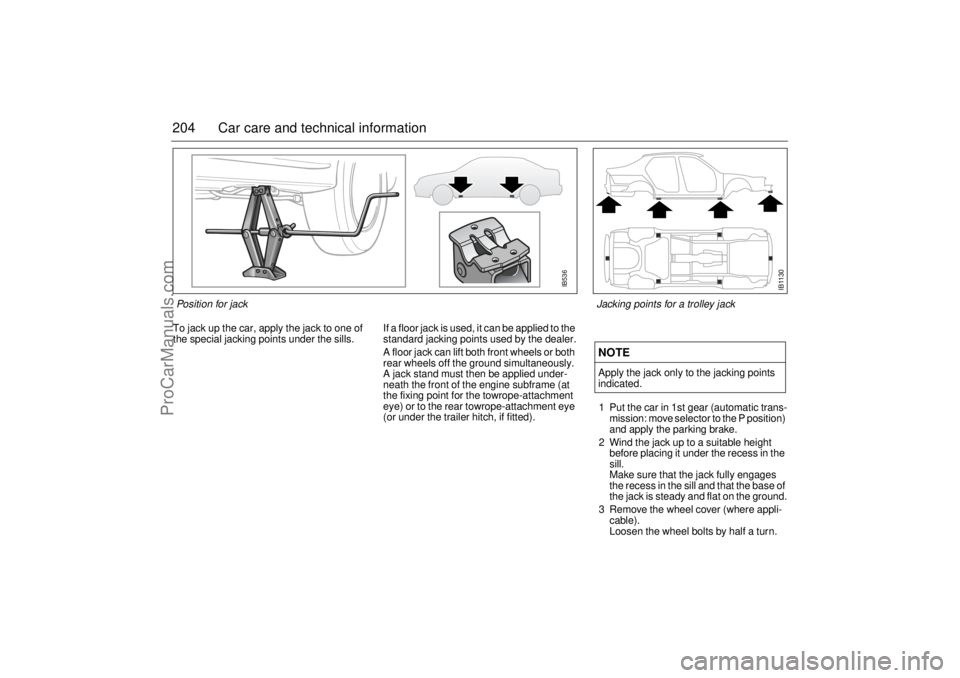
204 Car care and technical informationTo jack up the car, apply the jack to one of
the special jacking points under the sills.If a floor jack is used, it can be applied to the
standard jacking points used by the dealer.
A floor jack can lift both front wheels or both
rear wheels off the ground simultaneously.
A jack stand must then be applied under-
neath the front of the engine subframe (at
the fixing point for the towrope-attachment
eye) or to the rear towrope-attachment eye
(or under the trailer hitch, if fitted).1 Put the car in 1st gear (automatic trans-
mission: move selector to the P position)
and apply the parking brake.
2 Wind the jack up to a suitable height
before placing it under the recess in the
sill.
Make sure that the jack fully engages
the recess in the sill and that the base of
the jack is steady and flat on the ground.
3 Remove the wheel cover (where appli-
cable).
Loosen the wheel bolts by half a turn.
NOTEApply the jack only to the jacking points
indicated.
Pos i ti o n for j ack
IB1130
Jacking points for a trolley jack
IB536
ProCarManuals.com
Page 205 of 256
205 Car care and technical information
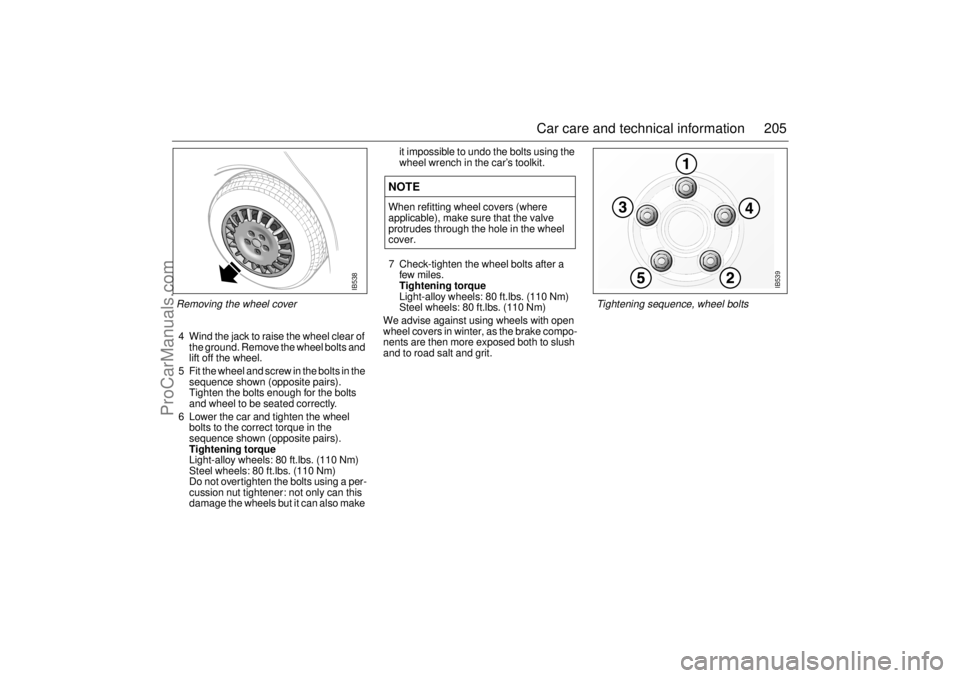
4 Wind the jack to raise the wheel clear of
the ground. Remove the wheel bolts and
lift off the wheel.
5 Fit the wheel and screw in the bolts in the
sequence shown (opposite pairs).
Tighten the bolts enough for the bolts
and wheel to be seated correctly.
6 Lower the car and tighten the wheel
bolts to the correct torque in the
sequence shown (opposite pairs).
Tightening torque
Light-alloy wheels: 80 ft.lbs. (110 Nm)
Steel wheels: 80 ft.lbs. (110 Nm)
Do not overtighten the bolts using a per-
cussion nut tightener: not only can this
damage the wheels but it can also make it impossible to undo the bolts using the
wheel wrench in the car’s toolkit.
7 Check-tighten the wheel bolts after a
few miles.
Tightening torque
Light-alloy wheels: 80 ft.lbs. (110 Nm)
Steel wheels: 80 ft.lbs. (110 Nm)
We advise against using wheels with open
wheel covers in winter, as the brake compo-
nents are then more exposed both to slush
and to road salt and grit.
NOTEWhen refitting wheel covers (where
applicable), make sure that the valve
protrudes through the hole in the wheel
cover.
IB538
Removing the wheel cover
IB539
Tightening sequence, wheel bolts
ProCarManuals.com
Page 206 of 256

206 Car care and technical informationFlat spottingAll tires get hot, especially on long journeys
or when the car is driven hard. After the car
has been parked with hot tires and the tires
have cooled down, a flat spot can appear in
the tire, where it is in contact with the
ground. The same can occur if the car has
not been moved for a long time.
Flat spots can give rise to vibration that can
be felt through the steering wheel, similar to
that experienced when the wheels need bal-
ancing. Flat spots of this type disappear
once the tires get hot again, usually after
10–15 miles (20–25 km) of driving at cruis-
ing speed.
Air conditioning
(A/C system)
Fault diagnosis If a fault occurs in the A/C system, there are
a number of checks you can perform your-
self. If the fault persists, however, have the
system checked by an authorized Saab
dealer.
Important!
When the A/C system is running, the intake
air is dehumidified, and the resultant con-
densation is drained off through two outlets
underneath the floor of the car in the vicinity
of the front doors. It is therefore perfectly
normal for water to be seen dripping from
these outlets when the car is parked. The
warmer the ambient air and the higher the
humidity, the greater will be the amount of
condensation formed.
Inadequate cooling:
a Make sure that the temperature and
air-distribution controls are in the
appropriate settings.
b Check that the condenser (forward of
the radiator) has not become clogged
with dirt and insects.
c Make sure that the drive belt for the com-
pressor is not slipping.
d Check the fuses for the ventilation fans
and compressor.
NOTE The A/C system is designed for use
with R134a refrigerant.
Refrigerant handling requires special
equipment and special procedures for
charging and draining the system.
All repairs and adjustments on the A/C
system must be carried out by a Saab
dealer authorized for this kind of work.
Never mix R134a and R12 refriger-
ants.
WARNING
The A/C system is pressurized. Do not
break any connections or undo A/C
system components.
Escaping gas can cause blindness or
other injury.
ProCarManuals.com
Page 211 of 256

211 Car care and technical information
Stir both primer and touch-up enamel thor-
oughly before use and allow each coat to
dry before applying the next.Two-coat enamel As the name implies, two-coat enamel is
applied in two operations. The first coat, the
base color, contains the pigment, metal
flakes and binder. The second coat consists
of a clear enamel, which provides the final
gloss for the paintwork and protects the
base from moisture and environmental con-
taminants.
Touch-up stone-chip damage as follows:
1 Thoroughly clean the damaged area.
2 Apply the primer, base color and finally,
the enamel. To achieve the best finish,
apply two or three coats of primer.
Anticorrosion treatmentThe entire car is corrosion-protected at the
factory in different stages by an electrolytic
immersion coating and a polyester-based
protective coating to protect against corro-
sion caused by stones flung up by the
wheels. A thin penetrating anti-rust oil is
also applied in cavities and body members.
In addition to conventional anti-corrosion
treatment like painting, underbody treat-
ment and cavity treatment, most of the body
panel surfaces are galvanized. These
include the hood, the doors and the under-
body.
The anti-corrosion treatment on the under-
side of the car and inside the wheel arches
is particularly exposed to constant wear and
possible damage, the degree of which will
obviously depend on driving conditions.
What causes rust?Steel body panels of automobiles are sub-
ject to rusting whenever air and moisture
manage to penetrate the protective finish,
and body panels may rust through if the pro-
cess is unchecked. Rusting can occur wher-
ever water is trapped or where the car’s
panels are continuously damp. Damage to
paint and undercoating by stones, gravel
and minor accidents immediately exposes
metal to air and moisture. Road salts used
for de-icing will collect on the bottom of the
car and promote rusting. Areas of the coun-
try with high humidity have great potential
for rust problems, especially where salt is
used on roads or there is moist sea air.
Industrial pollution (fallout) may also
damage paint and promote rusting.
ProCarManuals.com