brakes SAAB 9-5 2000 Owners Manual
[x] Cancel search | Manufacturer: SAAB, Model Year: 2000, Model line: 9-5, Model: SAAB 9-5 2000Pages: 256, PDF Size: 14.24 MB
Page 4 of 256
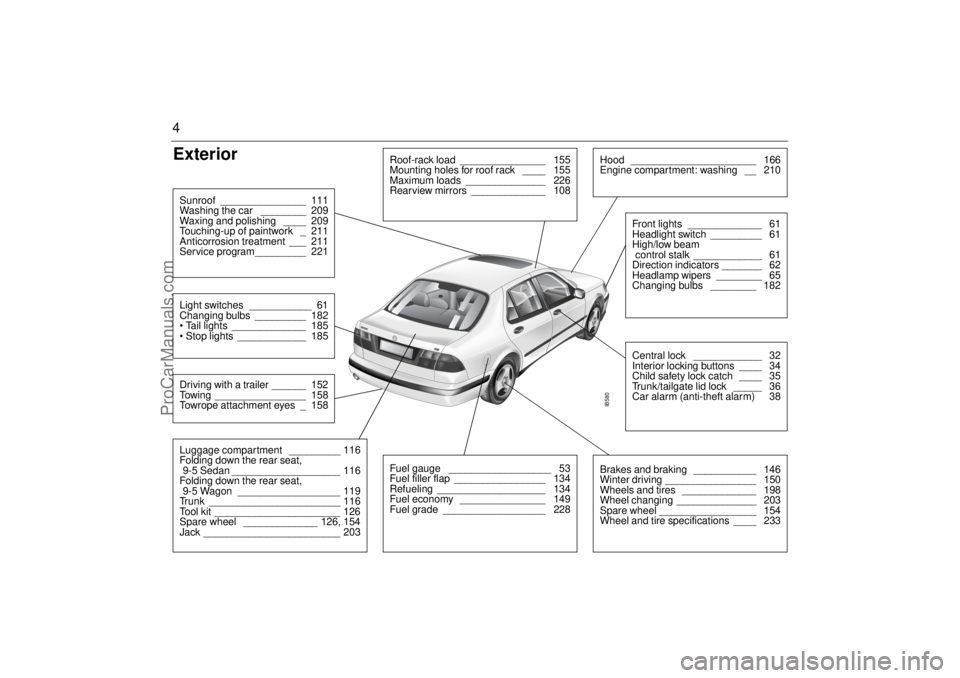
4Exterior
IB580
Roof-rack load _______________ 155
Mounting holes for roof rack ____ 155
Maximum loads ______________ 226
Rearview mirrors _____________ 108
Hood ______________________ 166
Engine compartment: washing __ 210
Central lock ____________ 32
Interior locking buttons ____ 34
Child safety lock catch ____ 35
Trunk/tailgate lid lock _____ 36
Car alarm (anti-theft alarm) 38Front lights _____________ 61
Headlight switch _________ 61
High/low beam
control stalk ____________ 61
Direction indicators _______ 62
Headlamp wipers ________ 65
Changing bulbs ________ 182
Fuel gauge __________________ 53
Fuel filler flap ________________ 134
Refueling ___________________ 134
Fuel economy _______________ 149
Fuel grade __________________ 228
Brakes and braking ___________ 146
Winter driving ________________ 150
Wheels and tires _____________ 198
Wheel changing ______________ 203
Spare wheel _________________ 154
Wheel and tire specifications ____ 233
Luggage compartment _________ 116
Folding down the rear seat,
9-5 Sedan ___________________ 116
Folding down the rear seat,
9-5 Wagon __________________ 119
Trunk _______________________ 116
Tool kit ______________________ 126
Spare wheel _____________ 126, 154
Jack ________________________ 203Driving with a trailer ______ 152
Towing ________________ 158
Towrope attachment eyes _ 158Light switches ___________ 61
Changing bulbs _________ 182
Tail lights _____________ 185
Stop lights ____________ 185Sunroof _______________ 111
Washing the car ________ 209
Waxing and polishing ____ 209
Touching-up of paintwork _ 211
Anticorrosion treatment ___ 211
Service program_________ 221
ProCarManuals.com
Page 6 of 256
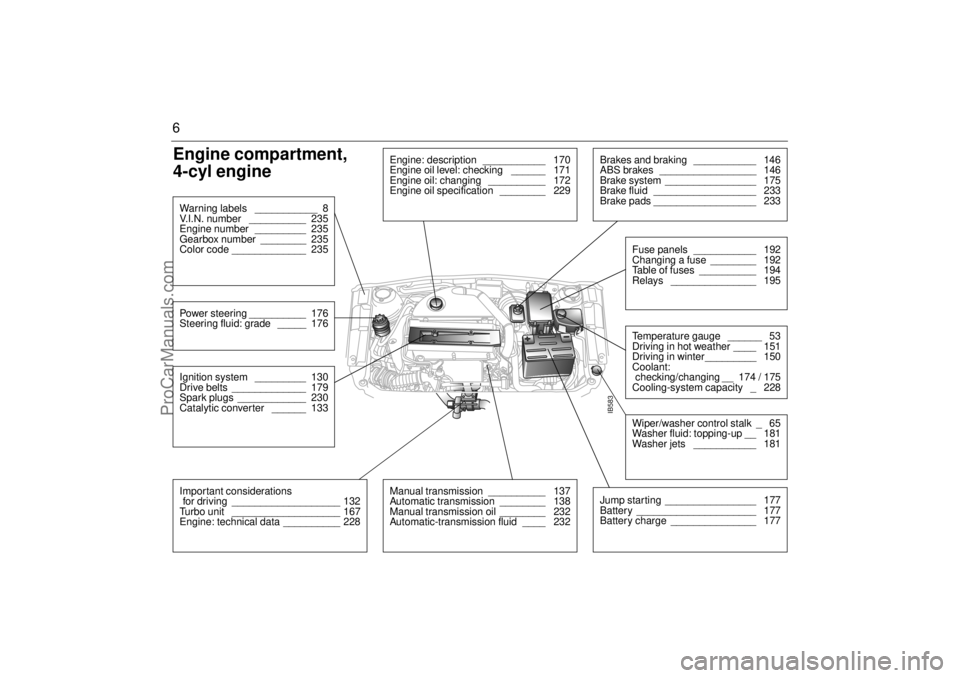
6Engine compartment,
4-cyl engine
IB583
Engine: description ___________ 170
Engine oil level: checking ______ 171
Engine oil: changing __________ 172
Engine oil specification ________ 229
Brakes and braking ___________ 146
ABS brakes _________________ 146
Brake system ________________ 175
Brake fluid __________________ 233
Brake pads __________________ 233
Fuse panels ___________ 192
Changing a fuse ________ 192
Table of fuses __________ 194
Relays _______________ 195Temperature gauge ______ 53
Driving in hot weather ____ 151
Driving in winter_________ 150
Coolant:
checking/changing __ 174 / 175
Cooling-system capacity _ 228
Power steering __________ 176
Steering fluid: grade _____ 176
Wiper/washer control stalk _ 65
Washer fluid: topping-up __ 181
Washer jets ___________ 181
Jump starting ________________ 177
Battery _____________________ 177
Battery charge _______________ 177
Manual transmission __________ 137
Automatic transmission ________ 138
Manual transmission oil ________ 232
Automatic-transmission fluid ____ 232
Important considerations
for driving ___________________ 132
Turbo unit ___________________ 167
Engine: technical data __________ 228Ignition system _________ 130
Drive belts _____________ 179
Spark plugs ____________ 230
Catalytic converter ______ 133Warning labels ___________ 8
V.I.N. number __________ 235
Engine number _________ 235
Gearbox number ________ 235
Color code _____________ 235
ProCarManuals.com
Page 7 of 256
7
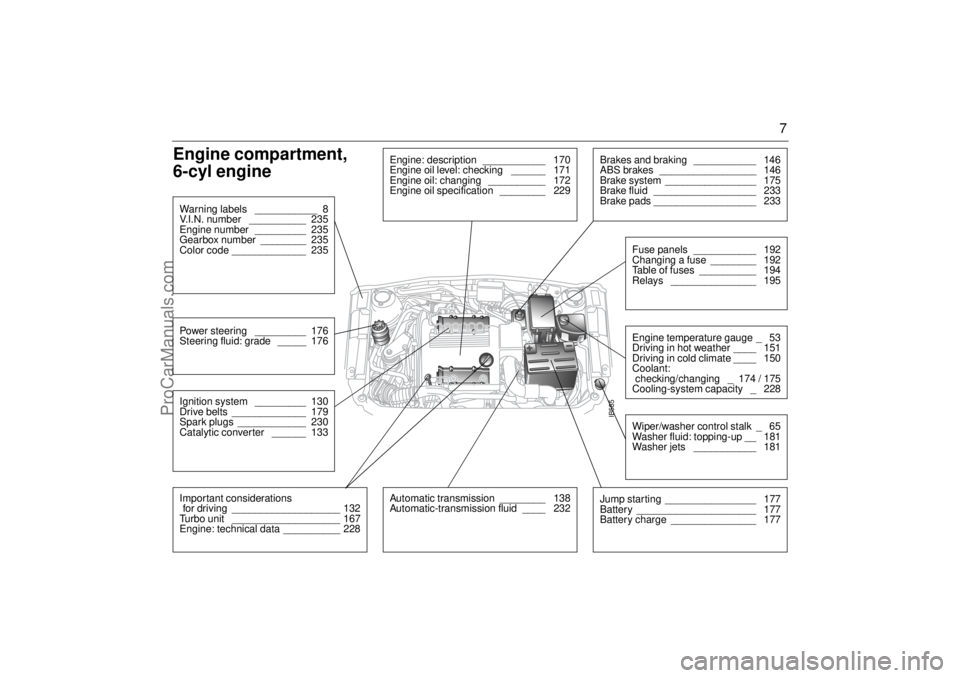
Engine compartment,
6-cyl engine
IB585
Warning labels ___________ 8
V.I.N. number __________ 235
Engine number _________ 235
Gearbox number ________ 235
Color code _____________ 235Ignition system _________ 130
Drive belts _____________ 179
Spark plugs ____________ 230
Catalytic converter ______ 133Important considerations
for driving ___________________ 132
Turbo unit ___________________ 167
Engine: technical data __________ 228
Automatic transmission ________ 138
Automatic-transmission fluid ____ 232
Brakes and braking ___________ 146
ABS brakes _________________ 146
Brake system ________________ 175
Brake fluid __________________ 233
Brake pads __________________ 233Jump starting ________________ 177
Battery _____________________ 177
Battery charge _______________ 177
Fuse panels ___________ 192
Changing a fuse ________ 192
Table of fuses __________ 194
Relays _______________ 195Engine temperature gauge _ 53
Driving in hot weather ____ 151
Driving in cold climate ____ 150
Coolant:
checking/changing _ 174 / 175
Cooling-system capacity _ 228
Power steering _________ 176
Steering fluid: grade _____ 176
Wiper/washer control stalk _ 65
Washer fluid: topping-up __ 181
Washer jets ___________ 181
Engine: description ___________ 170
Engine oil level: checking ______ 171
Engine oil: changing __________ 172
Engine oil specification ________ 229
ProCarManuals.com
Page 13 of 256
13 Safety
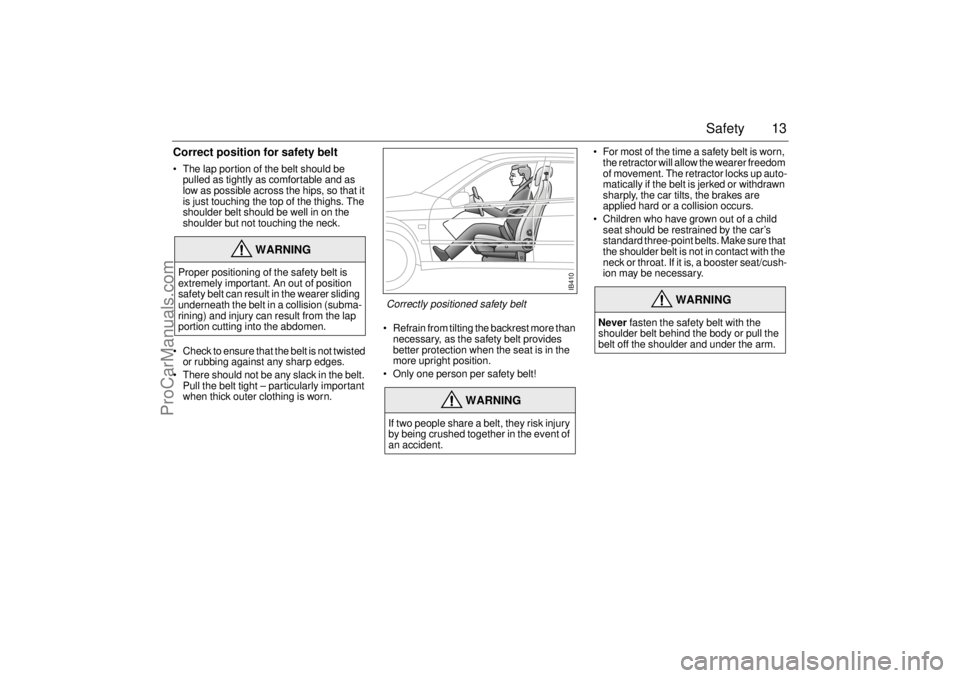
Correct position for safety belt The lap portion of the belt should be
pulled as tightly as comfortable and as
low as possible across the hips, so that it
is just touching the top of the thighs. The
shoulder belt should be well in on the
shoulder but not touching the neck.
Check to ensure that the belt is not twisted
or rubbing against any sharp edges.
There should not be any slack in the belt.
Pull the belt tight – particularly important
when thick outer clothing is worn. Refrain from tilting the backrest more than
necessary, as the safety belt provides
better protection when the seat is in the
more upright position.
Only one person per safety belt! For most of the time a safety belt is worn,
the retractor will allow the wearer freedom
of movement. The retractor locks up auto-
matically if the belt is jerked or withdrawn
sharply, the car tilts, the brakes are
applied hard or a collision occurs.
Children who have grown out of a child
seat should be restrained by the car’s
standard three-point belts. Make sure that
the shoulder belt is not in contact with the
neck or throat. If it is, a booster seat/cush-
ion may be necessary.
WARNING
Proper positioning of the safety belt is
extremely important. An out of position
safety belt can result in the wearer sliding
underneath the belt in a collision (subma-
rining) and injury can result from the lap
portion cutting into the abdomen.
WARNING
If two people share a belt, they risk injury
by being crushed together in the event of
an accident.
WARNING
Never fasten the safety belt with the
shoulder belt behind the body or pull the
belt off the shoulder and under the arm.
IB410
Correctly positioned safety belt
ProCarManuals.com
Page 49 of 256
49 Instruments and controls
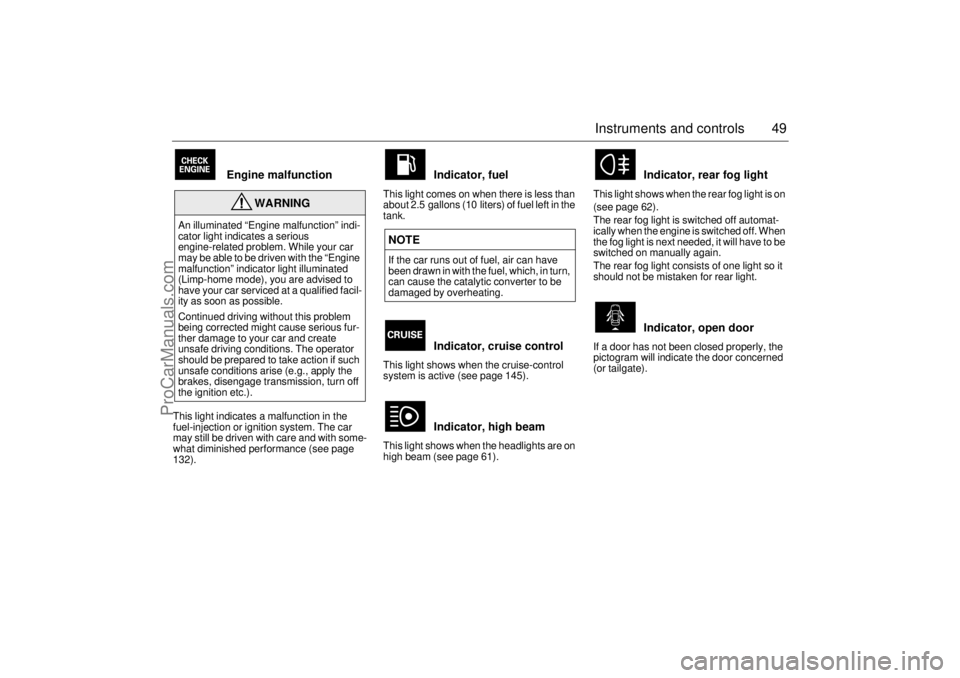
Engine malfunction
This light indicates a malfunction in the
fuel-injection or ignition system. The car
may still be driven with care and with some-
what diminished performance (see page
132).
Indicator, fuel
This light comes on when there is less than
about 2.5 gallons (10 liters) of fuel left in the
tank.
Indicator, cruise control
This light shows when the cruise-control
system is active (see page 145).
Indicator, high beam
This light shows when the headlights are on
high beam (see page 61).
Indicator, rear fog light
This light shows when the rear fog light is on
(see page 62).
The rear fog light is switched off automat-
ically when the engine is switched off. When
the fog light is next needed, it will have to be
switched on manually again.
The rear fog light consists of one light so it
should not be mistaken for rear light.
Indicator, open door
If a door has not been closed properly, the
pictogram will indicate the door concerned
(or tailgate).
WARNING
An illuminated “Engine malfunction” indi-
cator light indicates a serious
engine-related problem. While your car
may be able to be driven with the “Engine
malfunction” indicator light illuminated
(Limp-home mode), you are advised to
have your car serviced at a qualified facil-
ity as soon as possible.
Continued driving without this problem
being corrected might cause serious fur-
ther damage to your car and create
unsafe driving conditions. The operator
should be prepared to take action if such
unsafe conditions arise (e.g., apply the
brakes, disengage transmission, turn off
the ignition etc.).
NOTEIf the car runs out of fuel, air can have
been drawn in with the fuel, which, in turn,
can cause the catalytic converter to be
damaged by overheating.
ProCarManuals.com
Page 141 of 256

141 Starting and driving
Overheated transmission fluid If the automatic-transmission fluid should
overheat, the following message will appear
on the SID:
”TRANSMISSION OVERHEATING”. If this
happens, stop the car and wait for the mes-
sage to be extinguished. Continue driving in
a locked gear that produces an engine
speed of about 3,000 rpm.
Overheating of the automatic-transmission
fluid can occur when the car is towing a
heavy load, such as a camping trailer in hilly
country, with the wrong gear selected,
resulting in abnormally frequent gear
changing. Try selecting position 1, 2 or 3.
High ambient temperatures can also
increase the temperature of the transmis-
sion fluid or the oil cooler may be faulty.
Contact an authorized Saab dealer (see
also page 152).
Towing Towing of cars with automatic transmission,
see page 158.
NOTEIf the control module has actuated the
Limp-home function for the automatic
transmission, the car will remain in 4th
gear when D is selected, making it very
sluggish. To overcome this, move the
selector lever to position 2.
WARNING
Remember to use engine-braking (selec-
tor position 1, 2, or 3) to spare the brakes
when you are driving on a long or steep
downhill slope. Select the same gear as
you would on the corresponding uphill
slope.
Brake failure can result from overheated
brakes!
ProCarManuals.com
Page 146 of 256

146 Starting and drivingBrakingTo avoid the brakes becoming overheated,
(e.g. when negotiating long descents with a
drop of several hundred feet), select a low
gear to use the braking effect of the engine.
If the car has automatic transmission, move
the selector lever to position 1 or 2.
When driving fast, you can help to prolong
the life of the brakes by thinking ahead and
braking harder for short periods, rather than
braking more moderately over long
stretches. Brake pad wear indicatorsThe outboard brake pads on the front
wheels incorporate pad-wear indicators.
When the lining is down to 3 mm, the pad
will produce a screeching, squealing or
scraping noise when the brakes are applied.
New pads should be fitted without delay.
Brake pads should only be replaced by
an authorized Saab dealer. To ensure optimum brake performance,
it is recommended that you use only
Saab original brake pads.
ABS brakesABS (antilock braking system) modulates
the brake pressure to the respective
wheels. Wheel sensors detect if a wheel is
about to lock, and the control module
reduces the pressure to that wheel and then
increases it once more until the tendency is
detected again.
The brake system is equipped with an Elec-
tronic Brake-force Distribution device
(EBD), which distributes the brake pressure
between the front and rear wheels, in such
a way as to achieve optimum braking perfor-
mance irrespective of the car’s speed and
load.
The ABS system has a built-in diagnostic
function which will switch on the Anti-lock
brake warning light if a fault is detected in
the system (see page 48).
WARNING
It is prudent to try your brakes from
time to time, especially when driving in
heavy rain, on roads with a lot of sur-
face water, or in snow or slush. In such
conditions, the brakes may take
longer than normal to take effect. To
rectify this, touch the brake pedal peri-
odically to dry the brakes out.
The same applies after the car has
been washed or when the weather is
very humid.
The brakes are power assisted and it
should be kept in mind that the servo
unit only provides the power assis-
tance when the engine is running.
The brake pressure required when the
engine is off,( e.g. when the car is on
tow) is roughly four times the normal
pedal force required. The pedal also
feels hard and unresponsive.
We advise against using wheels with
open wheel covers in winter, as the
brake components are then more
exposed both to slush, road salt and
grit.
WARNING
The additional safety afforded by the
ABS system is not designed to allow
drivers to drive faster but to make
normal driving safer.
To stop as quickly as possible, without
loss of directional stability, whether
the road surface is dry, wet or slippery,
press the brake pedal down hard-
without letting up, declutching
simultaneously, and steer the car to
safety.
ProCarManuals.com
Page 147 of 256

147 Starting and driving
The ABS system will not reduce the braking
distance on loose gravel or on snow or ice
but, because the wheels cannot lock up,
some steering control is retained.
When the ABS system is working, i.e. mod-
ulation of the brake pressure is in progress,
the brake pedal will pulsate and a ticking
noise will be heard. All this is perfectly nor-
mal.
Press the pedal down hard (you cannot
press too hard) and steer the car to safety. Do not release the brake pedal before the
car has come to a halt or the danger is
past!
That is critical.
If the road is slippery, the ABS system will
operate even when only light pressure is
applied to the pedal. This means that you
can brake gently to test the condition of the
road and adapt your driving accordingly.
It is well worth practicing the use of ABS
brakes on a skid pan or other suitable facil-
ity.
Traction Control SystemHow the system works The traction control system (TCS) is
designed to prevent wheelspin. This
enables the car to achieve the best possible
grip and, hence, maximum tractive effort,
together with greater stability.
The TCS system uses information from the
ABS system’s wheel sensors to detect
when the front (driving) wheels are rotating
faster then the rear wheels. It then monitors
whether one driving wheel is rotating faster
than the other. If so, the faster wheel is
retarded until both wheels are rotating at the
same speed.
If the two front wheels are rotating at the
same speed but are turning faster than the
rear wheels, the torque from the engine is
reduced to eliminate the difference.
The process continues until all the wheels
are rotating at the same speed.
The advantages of the TCS system become
most apparent when the cohesion between
the front wheels and the road surface is so
low that one or both of the wheels would
lose their grip were the car not equipped
with the TCS, e.g.:
When the car is pulling away or accelerat-
ing with the front wheels on different sur-
faces (e.g. one slippery and one dry). The
TCS then functions like an electronic dif-
ferential lock.
When the car is pulling away or accelerat-
ing on a slippery road, in which case the
Braking with ABS brakes
When the system is operating, the brake
pedal will pulsate gently and the system
will make a ticking noise
IB476
IB477
Braking with ABS – evasive steering
ProCarManuals.com
Page 150 of 256

150 Starting and drivingIf idling, it will take much longer before the
engine becomes hot. Engine wear is
greatest during this warming-up phase.
Therefore drive away as soon as possible
after the engine is started and avoid high
revving.
Driving in a low gear results in higher fuel
consumption than in a high gear because
of the higher engine speed for a given
road speed. Always change up to a higher
gear as soon as traffic conditions allow
and use the highest gear as much as pos-
sible.
Check the air pressure in the tires once a
month. Incorrect pressures increase tire
wear. It is better to have slightly higher
pressure than lower.
Check fuel consumption regularly.
Increased consumption can indicate that
something is wrong and that the car
needs to be checked by an authorized
Saab dealer.
Practical trials on the roads have demon-
strated that substantial savings in fuel con-
sumption can be made if the above advice
is heeded.
Road conditions Wet roads increase fuel consumption, as do
unpaved roads and driving in hilly country
(the amount of fuel saved driving downhill is
less than the additional amount required to
climb the hill). Engine block heater (standard
equipment in Canada, accessory in
U.S.)The following are just some of the benefits
to the car and the environment of using an
engine block heater:
Lower fuel consumption.
Reduced wear on the engine.
Inside of car warms up faster.
Exhaust emissions substantially reduced
over short runs.
The engine heater is effective at outside
temperatures up to +15-20°C. The warmer
it is outside, the shorter the time the engine
heater needs to be connected. Longer than
1.5 hours is unnecessary.
If the car is equipped with a removable,
electrical cabin heater that is not in use, this
should be stored in the luggage compart-
ment.
Driving in winterBefore starting a journey in cold weather,
check that the wiper blades have not
become frozen to the glass. Brush any snow
away from the air intake for the heater
system (opening between hood and wind-
shield).
Periodically during the winter, add gasoline
anti-freeze to the fuel to dispel any conden-
sation in the fuel tank which could freeze
and cause problems in the system. Keep
the tank well filled to reduce the risk of con-
densation forming.
If the car is parked outside in freezing
weather, fuel additives (gasoline
anti-freeze) will not do any good as any con-
densation in the fuel tank will freeze. Con-
densation is caused by changes in the out-
door temperature or by the car being parked
alternately in a garage and outside.
It is particularly important when the roads
are slippery that the brakes and tires be in
good condition.
The car is equipped with tires designed to
provide optimum grip on both wet and dry
roads, although this has been achieved at
the expense of somewhat reduced grip on
snow and ice. For regular driving on snow
and ice, we therefore recommend that
winter (snow) tires be fitted.
Winter (snow) tires, particularly studded
tires (where use is legally permitted), gener-
ally make driving safer on snow and ice.
If winter tires are fitted, the same type must
be fitted on all wheels. Your Saab dealer will
ProCarManuals.com
Page 163 of 256
163 Starting and driving
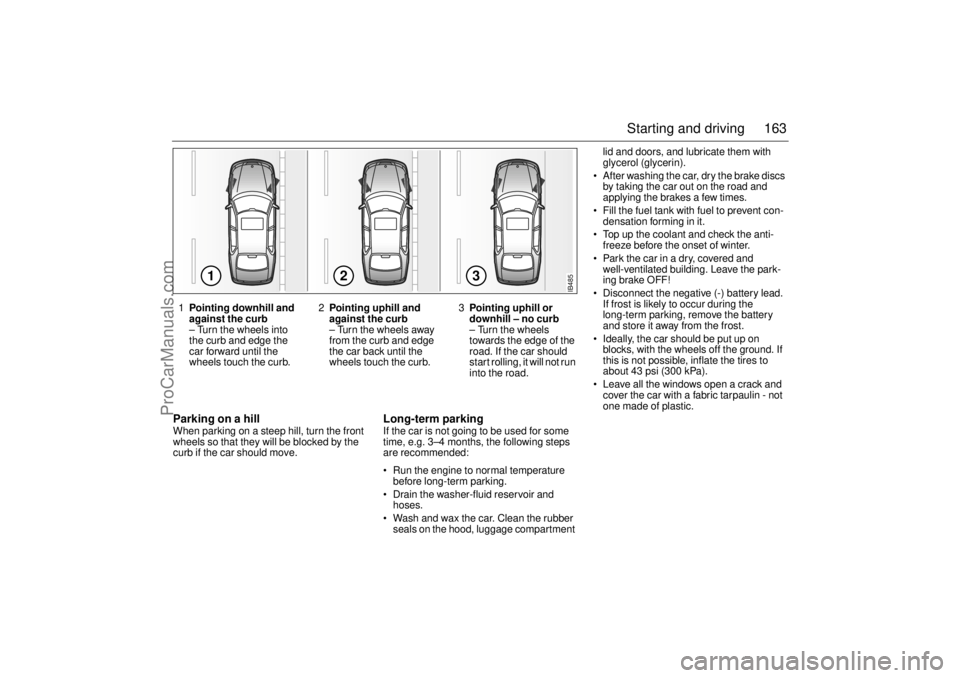
Parking on a hillWhen parking on a steep hill, turn the front
wheels so that they will be blocked by the
curb if the car should move.
Long-term parkingIf the car is not going to be used for some
time, e.g. 3–4 months, the following steps
are recommended:
Run the engine to normal temperature
before long-term parking.
Drain the washer-fluid reservoir and
hoses.
Wash and wax the car. Clean the rubber
seals on the hood, luggage compartment lid and doors, and lubricate them with
glycerol (glycerin).
After washing the car, dry the brake discs
by taking the car out on the road and
applying the brakes a few times.
Fill the fuel tank with fuel to prevent con-
densation forming in it.
Top up the coolant and check the anti-
freeze before the onset of winter.
Park the car in a dry, covered and
well-ventilated building. Leave the park-
ing brake OFF!
Disconnect the negative (-) battery lead.
If frost is likely to occur during the
long-term parking, remove the battery
and store it away from the frost.
Ideally, the car should be put up on
blocks, with the wheels off the ground. If
this is not possible, inflate the tires to
about 43 psi (300 kPa).
Leave all the windows open a crack and
cover the car with a fabric tarpaulin - not
one made of plastic.
123
IB485
1Pointing downhill and
against the curb
– Turn the wheels into
the curb and edge the
car forward until the
wheels touch the curb.2Pointing uphill and
against the curb
– Turn the wheels away
from the curb and edge
the car back until the
wheels touch the curb.3Pointing uphill or
downhill – no curb
– Turn the wheels
towards the edge of the
road. If the car should
start rolling, it will not run
into the road.
ProCarManuals.com