wheel SAAB 9-5 2001 Owner's Manual
[x] Cancel search | Manufacturer: SAAB, Model Year: 2001, Model line: 9-5, Model: SAAB 9-5 2001Pages: 272, PDF Size: 14.83 MB
Page 120 of 272
120 Interior equipment and trunkSeats Both front seats are electrically operated.
On certain models the driver´s seat is
equipped with a memory function.
To facilitate getting into the car, both seats
can be adjusted when either of the front
doors is open.
For safety reasons, if the door is closed, the
seat can only be adjusted when the ignition
is ON.
Note, however, that both seats can be
adjusted for 30 seconds after both doors
have been closed. The following seat adjustments can be
made to achieve a comfortable driving
position:
Height.
Legroom.
Backrest rake angle.
Lumbar support.
Head-restraint height.
We recommend that adjustments to the
driver’s seat be performed in the following
order:
1Height.
2 Legroom.
3 Seat tilt angle.
4 Backrest rake angle.
Lastly, adjust the steering wheel (see page
124).
Side airbags (see page 28).Head restraint(see page 18).
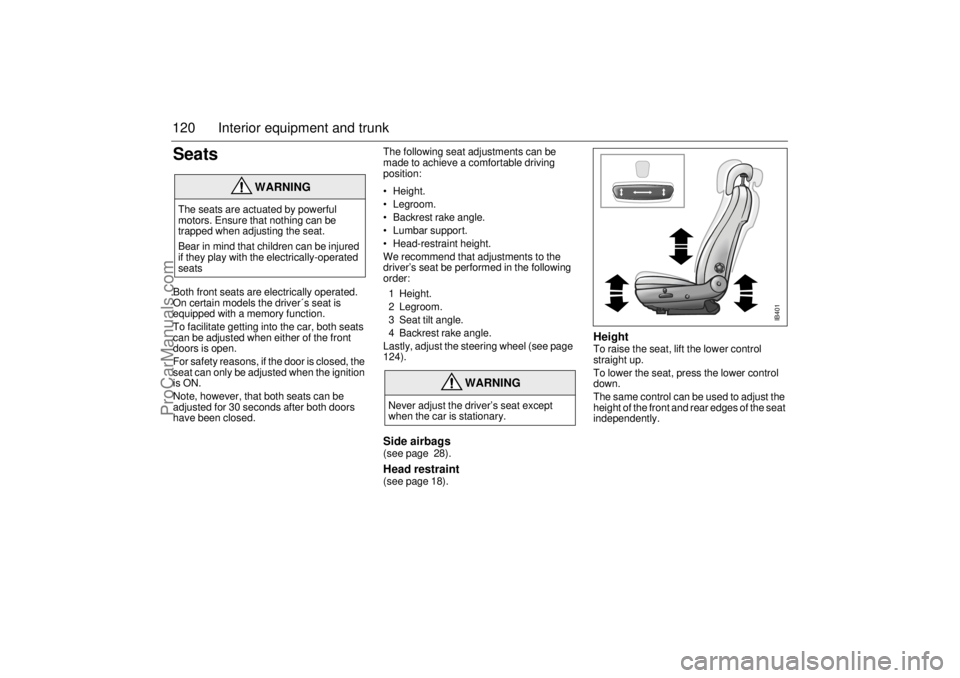
Height To raise the seat, lift the lower control
straight up.
To lower the seat, press the lower control
down.
The same control can be used to adjust the
height of the front and rear edges of the seat
independently.
WARNING
The seats are actuated by powerful
motors. Ensure that nothing can be
trapped when adjusting the seat.
Bear in mind that children can be injured
if they play with the electrically-operated
seats
WARNING
Never adjust the driver’s seat except
when the car is stationary.
IB401
ProCarManuals.com
Page 121 of 272
121 Interior equipment and trunk
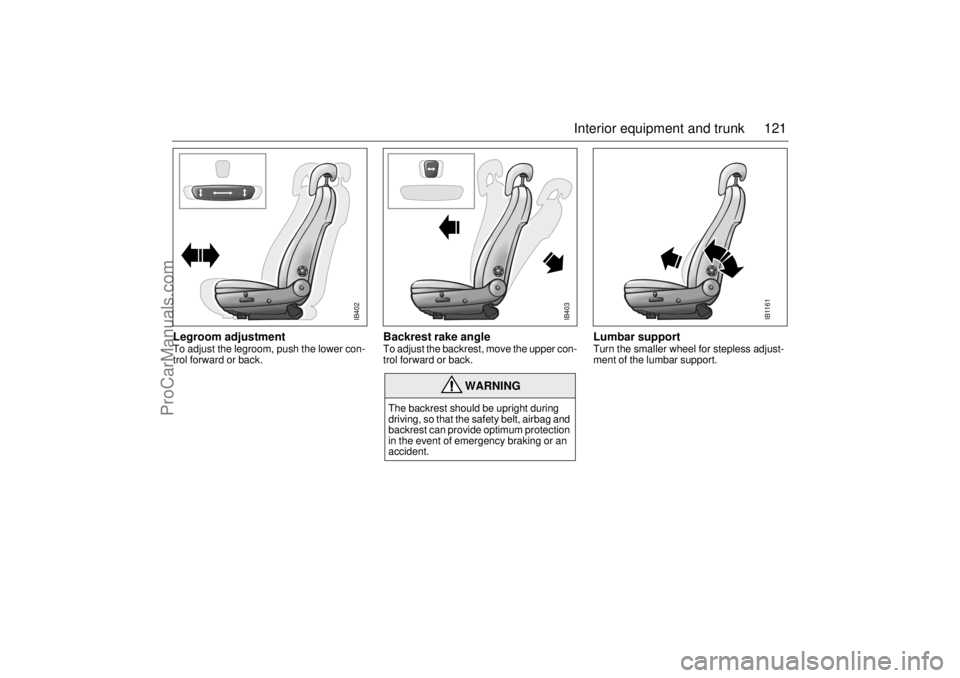
Legroom adjustment To adjust the legroom, push the lower con-
trol forward or back.
Backrest rake angle To adjust the backrest, move the upper con-
trol forward or back.
Lumbar supportTurn the smaller wheel for stepless adjust-
ment of the lumbar support.
WARNING
The backrest should be upright during
driving, so that the safety belt, airbag and
backrest can provide optimum protection
in the event of emergency braking or an
accident.
IB403
IB402
IB1161
ProCarManuals.com
Page 124 of 272
124 Interior equipment and trunkSteering-wheel
adjustment Fore-and-aft and tilt adjustment of the steer-
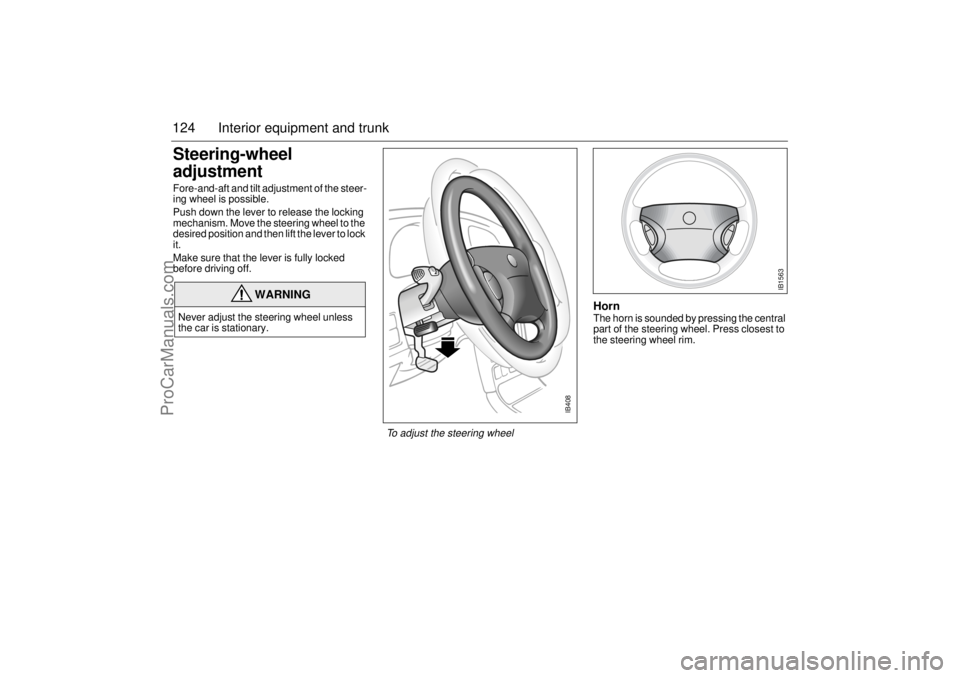
ing wheel is possible.
Push down the lever to release the locking
mechanism. Move the steering wheel to the
desired position and then lift the lever to lock
it.
Make sure that the lever is fully locked
before driving off.
HornThe horn is sounded by pressing the central
part of the steering wheel. Press closest to
the steering wheel rim.
WARNING
Never adjust the steering wheel unless
the car is stationary.
IB408
To adjust the steering wheel
IB1563
ProCarManuals.com
Page 142 of 272
142 Interior equipment and trunkSliding floor (accessory)
The function of the sliding floor is to facilitate
loading and unloading.
Securing loads, see page 136.
When the car is parked and the floor is
pulled out, it can bear the weight of two
people (maximum 440 lbs./200 kg).
The maximum load that can be anchored by
anchorage straps and cargo bolts is
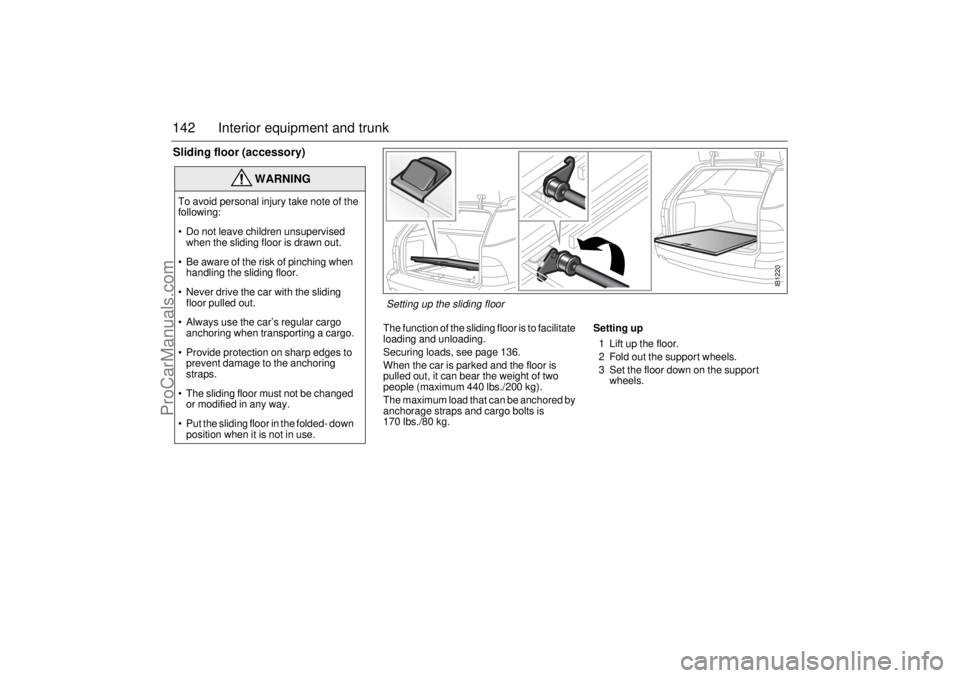
170 lbs./80 kg.Setting up
1 Lift up the floor.
2 Fold out the support wheels.
3 Set the floor down on the support
wheels.
WARNING
To avoid personal injury take note of the
following:
Do not leave children unsupervised
when the sliding floor is drawn out.
Be aware of the risk of pinching when
handling the sliding floor.
Never drive the car with the sliding
floor pulled out.
Always use the car’s regular cargo
anchoring when transporting a cargo.
Provide protection on sharp edges to
prevent damage to the anchoring
straps.
The sliding floor must not be changed
or modified in any way.
Put the sliding floor in the folded- down
position when it is not in use.
IB1220
Setting up the sliding floor
ProCarManuals.com
Page 143 of 272
143 Interior equipment and trunk
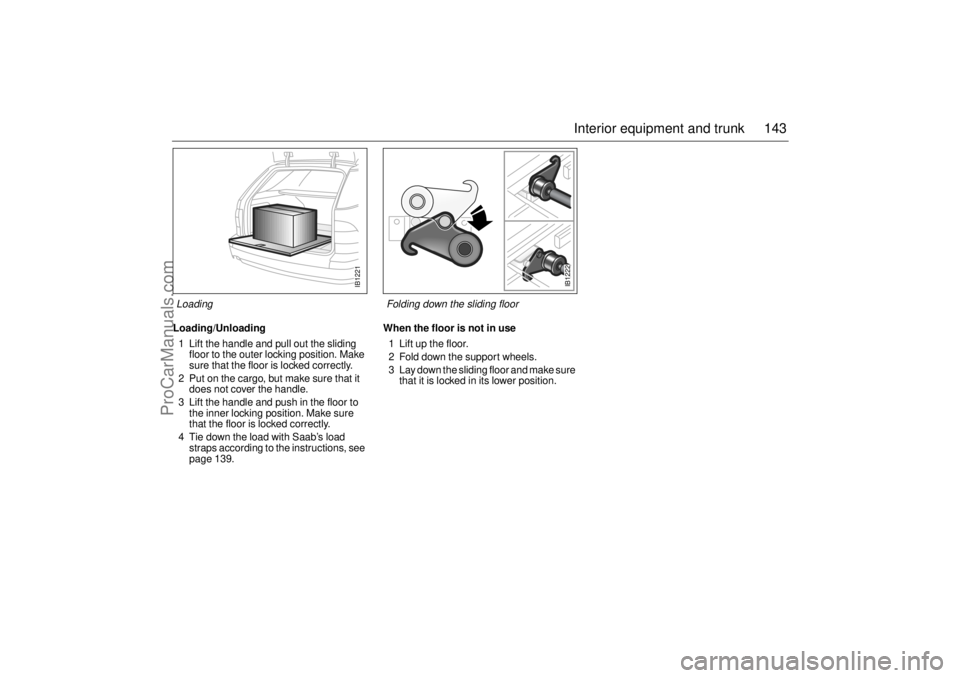
Loading/Unloading
1 Lift the handle and pull out the sliding
floor to the outer locking position. Make
sure that the floor is locked correctly.
2 Put on the cargo, but make sure that it
does not cover the handle.
3 Lift the handle and push in the floor to
the inner locking position. Make sure
that the floor is locked correctly.
4 Tie down the load with Saab’s load
straps according to the instructions, see
page 139.When the floor is not in use
1 Lift up the floor.
2 Fold down the support wheels.
3 Lay down the sliding floor and make sure
that it is locked in its lower position.
IB1221
Loading
IB1222
Folding down the sliding floor
ProCarManuals.com
Page 144 of 272
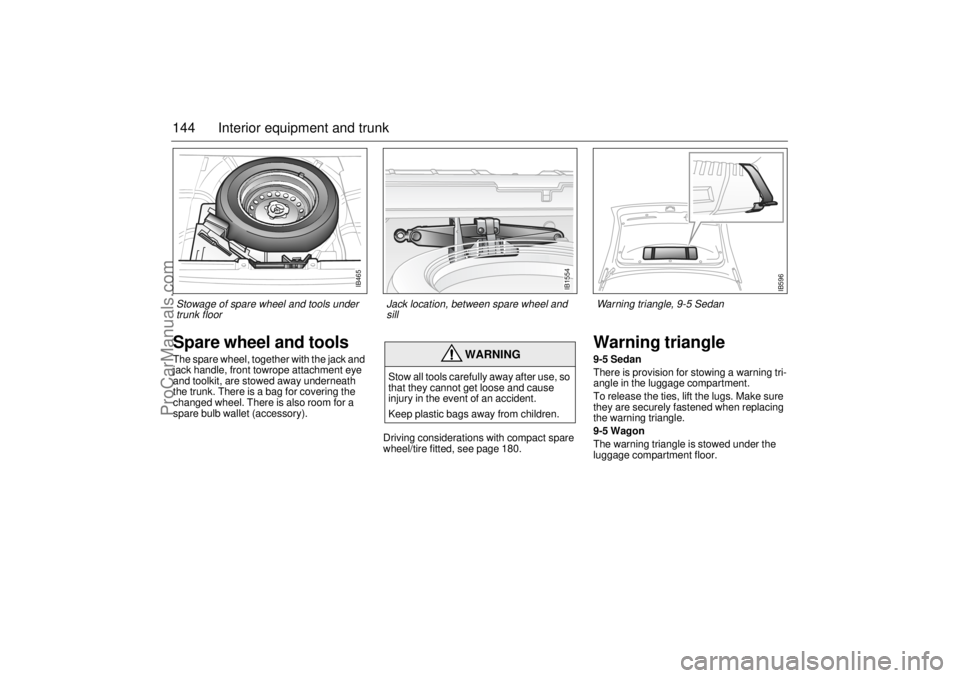
144 Interior equipment and trunkSpare wheel and toolsThe spare wheel, together with the jack and
jack handle, front towrope attachment eye
and toolkit, are stowed away underneath
the trunk. There is a bag for covering the
changed wheel. There is also room for a
spare bulb wallet (accessory).
Driving considerations with compact spare
wheel/tire fitted, see page 180.
Warning triangle9-5 Sedan
There is provision for stowing a warning tri-
angle in the luggage compartment.
To release the ties, lift the lugs. Make sure
they are securely fastened when replacing
the warning triangle.
9-5 Wagon
The warning triangle is stowed under the
luggage compartment floor.
WARNING
Stow all tools carefully away after use, so
that they cannot get loose and cause
injury in the event of an accident.
Keep plastic bags away from children.
IB465
Stowage of spare wheel and tools under
trunk floor
IB1554
IB596
Jack location, between spare wheel and
sillWarning triangle, 9-5 Sedan
ProCarManuals.com
Page 147 of 272
147 Starting and driving
Starting and driving
IB597
Ignition switch ................. 148
Starting the engine .......... 149
Important considerations
for driving ....................... 151
Refueling .......................... 154
Engine Break-In Period ... 157
Gear changing ................. 158
Cruise control .................. 166
Braking ............................. 167
Traction Control System . 169
Economical motoring ...... 170
Driving in cold weather ... 172 Driving in hot weather .... 173
Towing a trailer ................ 174
Driving with a roof rack
load ................................. 176
Driving with a load .......... 179
Driving considerations
with compact spare
wheel/tire fitted .............. 180
Driving with the trunk
lid/tailgate open ............. 180
Driving in deep water ...... 180
Towing the car ................. 181 Jump starting ................... 183
Parking brake ................... 185
Parking .............................. 185
ProCarManuals.com
Page 165 of 272
165 Starting and driving
SPORT and WINTER modes
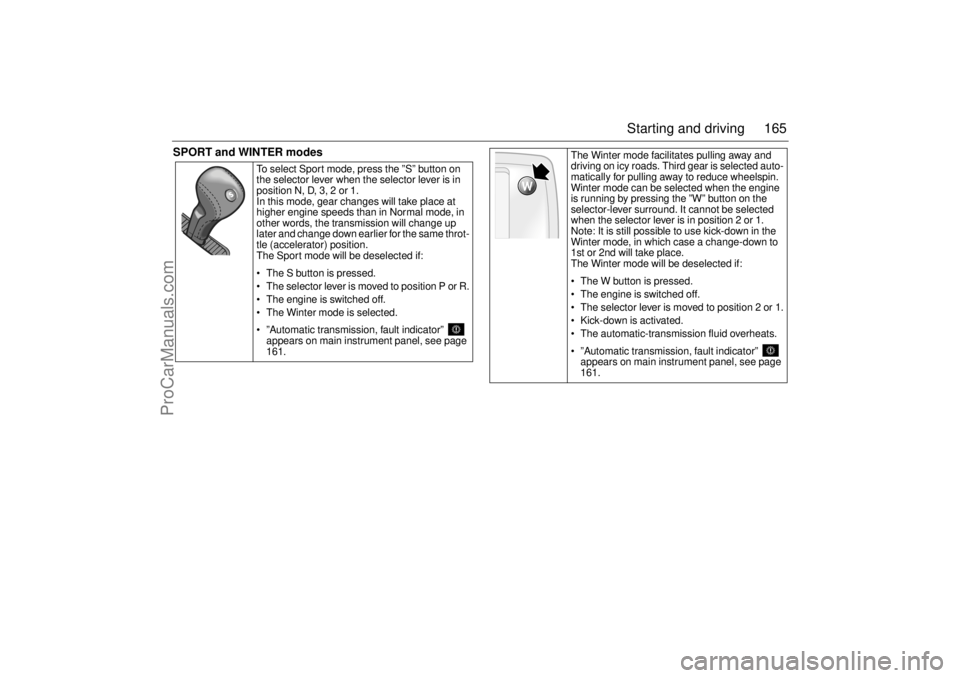
To select Sport mode, press the ”S” button on
the selector lever when the selector lever is in
position N, D, 3, 2 or 1.
In this mode, gear changes will take place at
higher engine speeds than in Normal mode, in
other words, the transmission will change up
later and change down earlier for the same throt-
tle (accelerator) position.
The Sport mode will be deselected if:
The S button is pressed.
The selector lever is moved to position P or R.
The engine is switched off.
The Winter mode is selected.
”Automatic transmission, fault indicator”
appears on main instrument panel, see page
161.
The Winter mode facilitates pulling away and
driving on icy roads. Third gear is selected auto-
matically for pulling away to reduce wheelspin.
Winter mode can be selected when the engine
is running by pressing the ”W” button on the
selector-lever surround. It cannot be selected
when the selector lever is in position 2 or 1.
Note: It is still possible to use kick-down in the
Winter mode, in which case a change-down to
1st or 2nd will take place.
The Winter mode will be deselected if:
The W button is pressed.
The engine is switched off.
The selector lever is moved to position 2 or 1.
Kick-down is activated.
The automatic-transmission fluid overheats.
”Automatic transmission, fault indicator”
appears on main instrument panel, see page
161.
ProCarManuals.com
Page 167 of 272
167 Starting and driving
BrakingTo avoid the brakes becoming overheated,
(e.g. when negotiating long descents with a
drop of several hundred feet), select a low
gear to use the braking effect of the engine.
If the car has automatic transmission, move
the selector lever to position 1 or 2.
When driving fast, you can help to prolong
the life of the brakes by thinking ahead and
braking harder for short periods, rather than
braking more moderately over long
stretches. Brake pad wear indicatorsThe outboard brake pads on the front
wheels incorporate pad-wear indicators.
When the lining is down to 3 mm, the pad
will produce a screeching, squealing or
scraping noise when the brakes are applied.
New pads should be fitted without delay.
Brake pads should only be replaced by
an authorized Saab dealer.
To ensure optimum brake performance,
it is recommended that you use only
Saab original brake pads.
ABS brakesABS (antilock braking system) modulates
the brake pressure to the respective
wheels. Wheel sensors detect if a wheel is
about to lock, and the control module
reduces the pressure to that wheel and then
increases it once more until the tendency is
detected again.
The brake system is equipped with an Elec-
tronic Brake-force Distribution device
(EBD), which distributes the brake pressure
between the front and rear wheels, in such
a way as to achieve optimum braking perfor-
mance irrespective of the car’s speed and
load.
The ABS system has a built-in diagnostic
function which will switch on the Anti-lock
brake warning light if a fault is detected in
the system (see page 50).
WARNING
It is prudent to try your brakes from
time to time, especially when driving in
heavy rain, through water collected on
the road, in snow, on a wet road sur-
face or in salty slush. In such condi-
tions, the brakes may take longer than
normal to take effect. To rectify this,
touch the brake pedal periodically to
dry the brakes out.
The same applies after the car has
been washed or when the weather is
very humid.
Avoid parking the car with wet brakes.
Before parking, and if the traffic condi-
tions allow, brake quite heavily so that
the brake discs and pads warm up and
dry.
The brakes are power assisted and it
should be kept in mind that the servo
unit only provides the power assis-
tance when the engine is running.
The brake pressure required when the
engine is off,(e.g. when the car is on
tow) is roughly four times the normal
pedal force required. The pedal also
feels hard and unresponsive.
WARNING
The additional safety afforded by the
ABS system is not designed to allow
drivers to drive faster but to make
normal driving safer.
To stop as quickly as possible, without
loss of directional stability, whether
the road surface is dry, wet or slippery,
press the brake pedal down hard-
without letting up, declutching
simultaneously, and steer the car to
safety.
ProCarManuals.com
Page 168 of 272
168 Starting and drivingThe ABS system will not reduce the braking
distance on loose gravel or on snow or ice
but, because the wheels cannot lock up,
some steering control is retained.
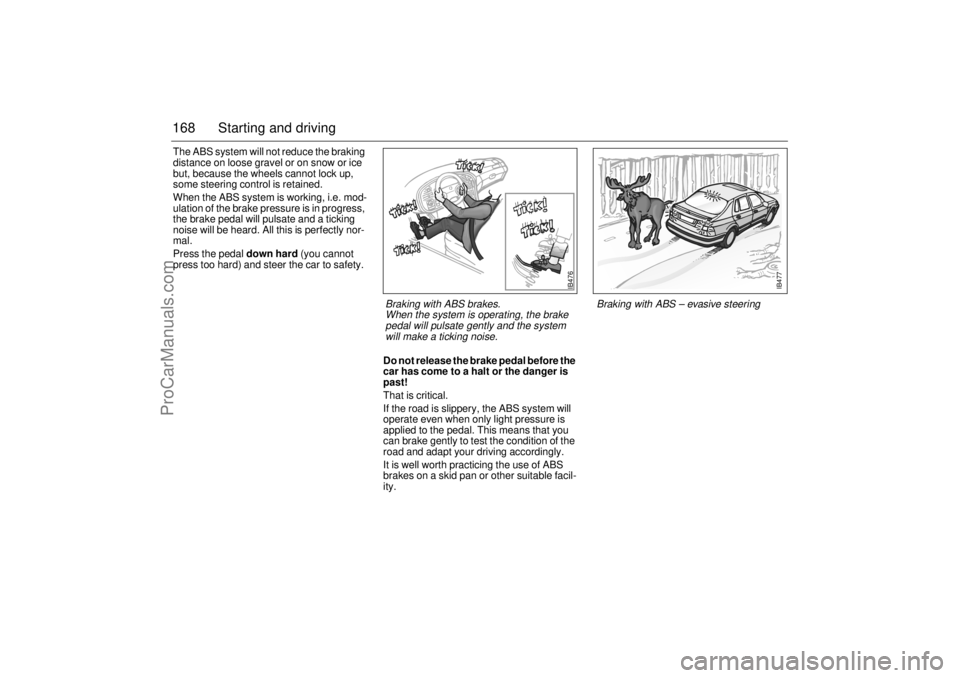
When the ABS system is working, i.e. mod-
ulation of the brake pressure is in progress,
the brake pedal will pulsate and a ticking
noise will be heard. All this is perfectly nor-
mal.
Press the pedal down hard (you cannot
press too hard) and steer the car to safety.
Do not release the brake pedal before the
car has come to a halt or the danger is
past!
That is critical.
If the road is slippery, the ABS system will
operate even when only light pressure is
applied to the pedal. This means that you
can brake gently to test the condition of the
road and adapt your driving accordingly.
It is well worth practicing the use of ABS
brakes on a skid pan or other suitable facil-
ity.
IB476
Braking with ABS brakes.
When the system is operating, the brake
pedal will pulsate gently and the system
will make a ticking noise.
IB477
Braking with ABS – evasive steering
ProCarManuals.com