wheel SAAB 9-5 2001 Owners Manual
[x] Cancel search | Manufacturer: SAAB, Model Year: 2001, Model line: 9-5, Model: SAAB 9-5 2001Pages: 272, PDF Size: 14.83 MB
Page 3 of 272
3
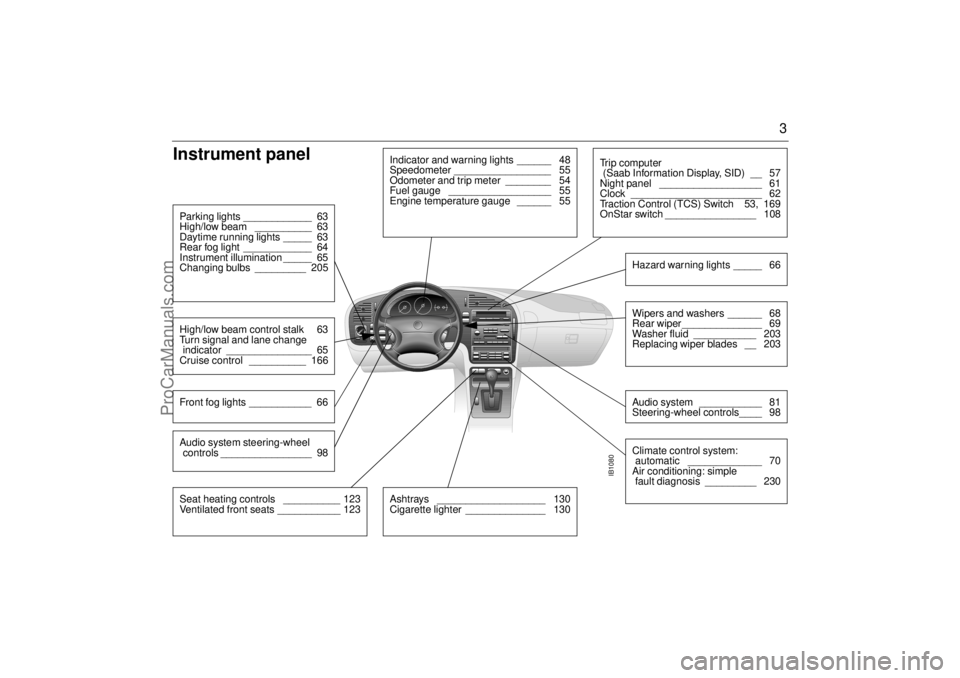
Instrument panel
IB1080
Indicator and warning lights ______ 48
Speedometer _________________ 55
Odometer and trip meter ________ 54
Fuel gauge __________________ 55
Engine temperature gauge ______ 55
Parking lights ____________ 63
High/low beam __________ 63
Daytime running lights _____ 63
Rear fog light ____________ 64
Instrument illumination _____ 65
Changing bulbs _________ 205High/low beam control stalk 63
Turn signal and lane change
indicator _______________ 65
Cruise control __________ 166Front fog lights ___________ 66
Ashtrays ___________________ 130
Cigarette lighter ______________ 130
Tr i p c o m p u t e r
(Saab Information Display, SID) __ 57
Night panel __________________ 61
Clock _______________________ 62
Traction Control (TCS) Switch 53, 169
OnStar switch ________________ 108
Wipers and washers ______ 68
Rear wiper ______________ 69
Washer fluid ___________ 203
Replacing wiper blades __ 203Audio system ___________ 81
Steering-wheel controls____ 98Hazard warning lights _____ 66Climate control system:
automatic _____________ 70
Air conditioning: simple
fault diagnosis _________ 230
Seat heating controls __________ 123
Ventilated front seats ___________ 123Audio system steering-wheel
controls ________________ 98
ProCarManuals.com
Page 4 of 272
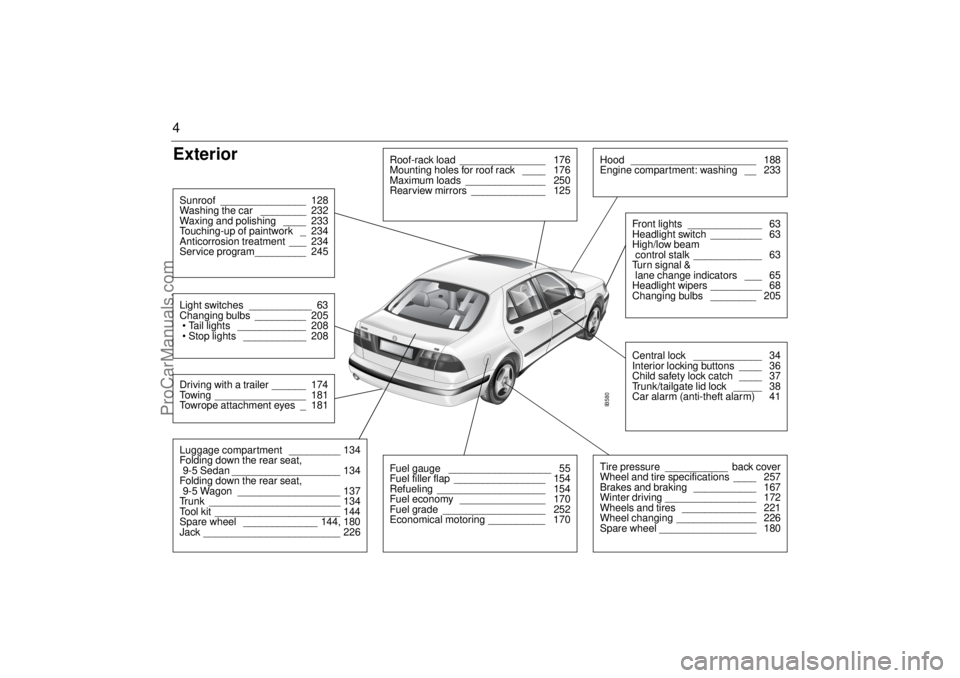
4Exterior
IB580
Roof-rack load _______________ 176
Mounting holes for roof rack ____ 176
Maximum loads ______________ 250
Rearview mirrors _____________ 125
Hood ______________________ 188
Engine compartment: washing __ 233
Central lock ____________ 34
Interior locking buttons ____ 36
Child safety lock catch ____ 37
Trunk/tailgate lid lock _____ 38
Car alarm (anti-theft alarm) 41Front lights _____________ 63
Headlight switch _________ 63
High/low beam
control stalk ____________ 63
Turn signal &
lane change indicators ___ 65
Headlight wipers _________ 68
Changing bulbs ________ 205
Fuel gauge __________________ 55
Fuel filler flap ________________ 154
Refueling ___________________ 154
Fuel economy _______________ 170
Fuel grade __________________ 252
Economical motoring __________ 170
Tire pressure ___________ back cover
Wheel and tire specifications ____ 257
Brakes and braking ___________ 167
Winter driving ________________ 172
Wheels and tires _____________ 221
Wheel changing ______________ 226
Spare wheel _________________ 180
Luggage compartment _________ 134
Folding down the rear seat,
9-5 Sedan ___________________ 134
Folding down the rear seat,
9-5 Wagon __________________ 137
Trunk _______________________ 134
Tool kit ______________________ 144
Spare wheel _____________ 144, 180
Jack ________________________ 226Driving with a trailer ______ 174
Towing ________________ 181
Towrope attachment eyes _ 181Light switches ___________ 63
Changing bulbs _________ 205
Tail lights ____________ 208
Stop lights ___________ 208Sunroof _______________ 128
Washing the car ________ 232
Waxing and polishing ____ 233
Touching-up of paintwork _ 234
Anticorrosion treatment ___ 234
Service program_________ 245
ProCarManuals.com
Page 5 of 272
5
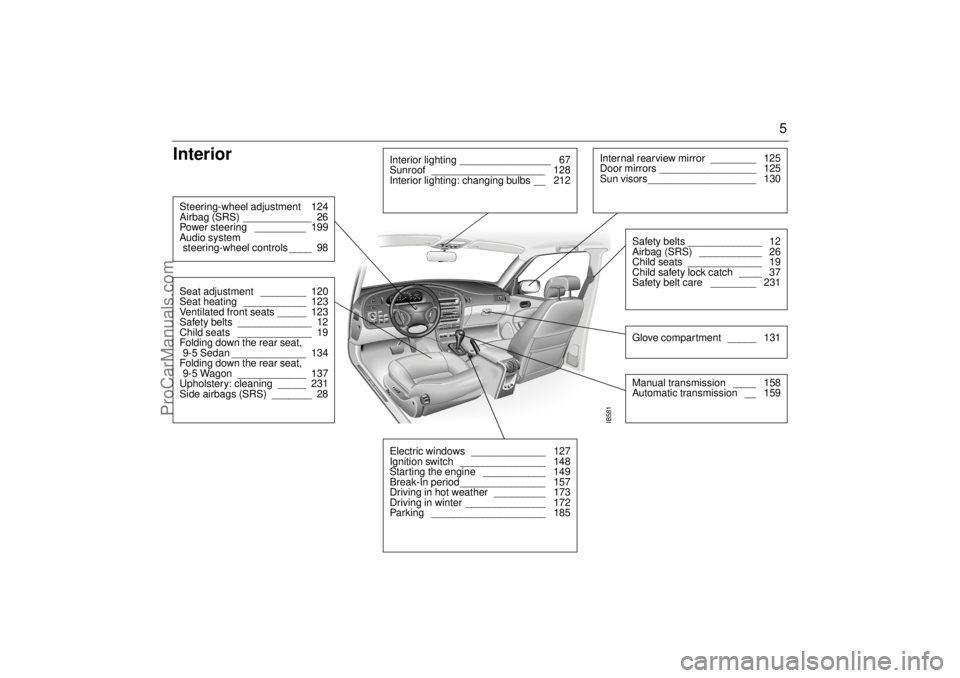
Interior
IB581Internal rearview mirror ________ 125
Door mirrors _________________ 125
Sun visors___________________ 130
Safety belts _____________ 12
Airbag (SRS) ___________ 26
Child seats _____________ 19
Child safety lock catch ____ 37
Safety belt care ________ 231Glove compartment _____ 131Manual transmission ____ 158
Automatic transmission __ 159
Electric windows _____________ 127
Ignition switch _______________ 148
Starting the engine ___________ 149
Break-In period_______________ 157
Driving in hot weather _________ 173
Driving in winter ______________ 172
Parking ____________________ 185
Steering-wheel adjustment 124
Airbag (SRS) ____________ 26
Power steering _________ 199
Audio system
steering-wheel controls ____ 98Seat adjustment ________ 120
Seat heating ___________ 123
Ventilated front seats _____ 123
Safety belts _____________ 12
Child seats _____________ 19
Folding down the rear seat,
9-5 Sedan _____________ 134
Folding down the rear seat,
9-5 Wagon ____________ 137
Upholstery: cleaning _____ 231
Side airbags (SRS) _______ 28
Interior lighting ________________ 67
Sunroof ____________________ 128
Interior lighting: changing bulbs __ 212
ProCarManuals.com
Page 10 of 272
10
IB336
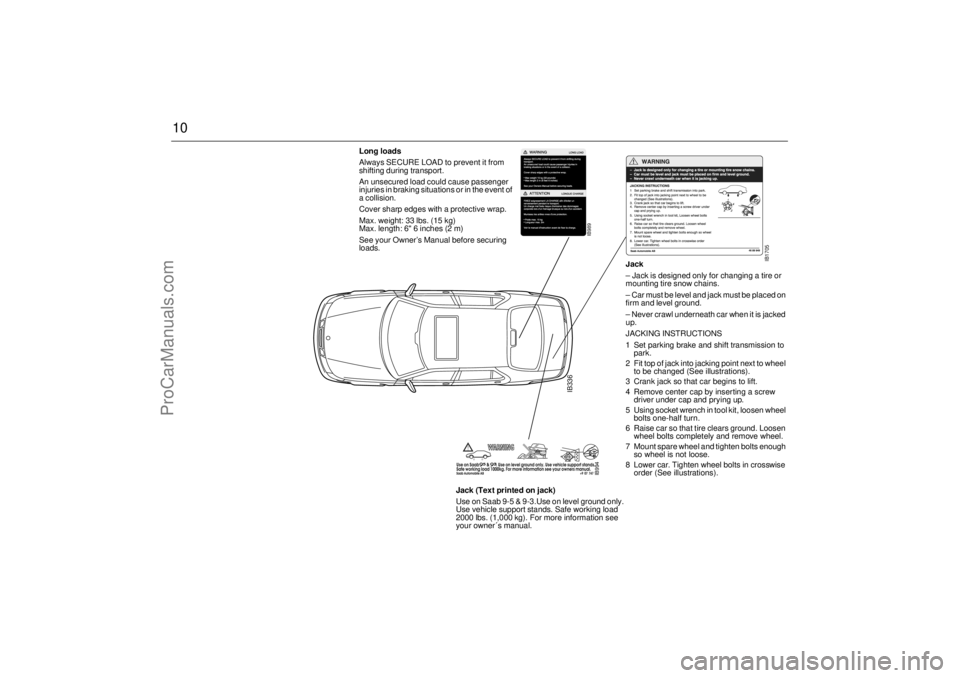
Jack
– Jack is designed only for changing a tire or
mounting tire snow chains.
– Car must be level and jack must be placed on
firm and level ground.
– Never crawl underneath car when it is jacked
up.
JACKING INSTRUCTIONS
1 Set parking brake and shift transmission to
park.
2 Fit top of jack into jacking point next to wheel
to be changed (See illustrations).
3 Crank jack so that car begins to lift.
4 Remove center cap by inserting a screw
driver under cap and prying up.
5 Using socket wrench in tool kit, loosen wheel
bolts one-half turn.
6 Raise car so that tire clears ground. Loosen
wheel bolts completely and remove wheel.
7 Mount spare wheel and tighten bolts enough
so wheel is not loose.
8 Lower car. Tighten wheel bolts in crosswise
order (See illustrations).
IB1705
Jack (Text printed on jack)
Use on Saab 9-5 & 9-3.Use on level ground only.
Use vehicle support stands. Safe working load
2000 lbs. (1,000 kg). For more information see
your owner´s manual.
IB994IB989
Long loads
Always SECURE LOAD to prevent it from
shifting during transport.
An unsecured load could cause passenger
injuries in braking situations or in the event of
a collision.
Cover sharp edges with a protective wrap.
Max. weight: 33 lbs. (15 kg)
Max. length: 6" 6 inches (2 m)
See your Owner’s Manual before securing
loads.
ProCarManuals.com
Page 26 of 272
26 SafetyAirbag (Supplemental
Restraint System
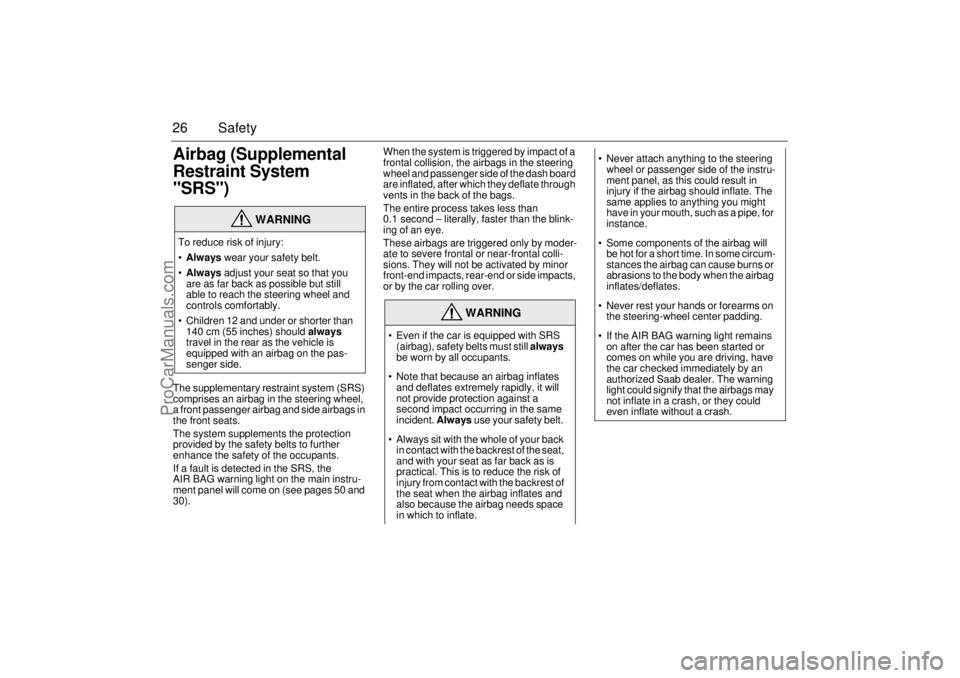
"SRS") The supplementary restraint system (SRS)
comprises an airbag in the steering wheel,
a front passenger airbag and side airbags in
the front seats.
The system supplements the protection
provided by the safety belts to further
enhance the safety of the occupants.
If a fault is detected in the SRS, the
AIR BAG warning light on the main instru-
ment panel will come on (see pages 50 and
30). When the system is triggered by impact of a
frontal collision, the airbags in the steering
wheel and passenger side of the dash board
are inflated, after which they deflate through
vents in the back of the bags.
The entire process takes less than
0.1 second – literally, faster than the blink-
ing of an eye.
These airbags are triggered only by moder-
ate to severe frontal or near-frontal colli-
sions. They will not be activated by minor
front-end impacts, rear-end or side impacts,
or by the car rolling over.
WARNING
To reduce risk of injury:
Always wear your safety belt.
Always adjust your seat so that you
are as far back as possible but still
able to reach the steering wheel and
controls comfortably.
Children 12 and under or shorter than
140 cm (55 inches) should always
travel in the rear as the vehicle is
equipped with an airbag on the pas-
senger side.
WARNING
Even if the car is equipped with SRS
(airbag), safety belts must still always
be worn by all occupants.
Note that because an airbag inflates
and deflates extremely rapidly, it will
not provide protection against a
second impact occurring in the same
incident. Always use your safety belt.
Always sit with the whole of your back
in contact with the backrest of the seat,
and with your seat as far back as is
practical. This is to reduce the risk of
injury from contact with the backrest of
the seat when the airbag inflates and
also because the airbag needs space
in which to inflate.
Never attach anything to the steering
wheel or passenger side of the instru-
ment panel, as this could result in
injury if the airbag should inflate. The
same applies to anything you might
have in your mouth, such as a pipe, for
instance.
Some components of the airbag will
be hot for a short time. In some circum-
stances the airbag can cause burns or
abrasions to the body when the airbag
inflates/deflates.
Never rest your hands or forearms on
the steering-wheel center padding.
If the AIR BAG warning light remains
on after the car has been started or
comes on while you are driving, have
the car checked immediately by an
authorized Saab dealer. The warning
light could signify that the airbags may
not inflate in a crash, or they could
even inflate without a crash.
ProCarManuals.com
Page 27 of 272

27 Safety
IB417Moment of impact.
Sensor detects decel-
eration and sends a
signal via the control
module to a gas gen-
erator that inflates the
airbag.
The inflating airbag
cushions the driver.
Airbag now fully
inflated.
The airbag starts to
deflate.
IB419
Inflated airbag (driver side) Inflation and deflation together take less than
0.1 second.
IB418
5
1
4
2
6
3
2
6
5
SRS (airbag) system with belt
pretensioners 1 Electronic control module and sensor
2 Belt pretensioners (for both front safety belts)
3 Steering wheel with integral airbag
4 Passenger airbag
5 Side-airbag sensor
6 Side airbag
ProCarManuals.com
Page 30 of 272
30 SafetyAIR BAG warning light
SRS servicingThe SRS must be inspected as part of the
normal service program but otherwise may
be regarded as maintenance-free.
Scrapping or working on airbags
and belt pretensioners Frequently asked questions on func-
tion of airbags
Do you still need to wear a
safety b
elt if air-
bags are fitted?
Yes, always! The airbag merely supple-
ments the car’s normal safety system.
Moreover, the airbag will only be actuated in
a moderate to severe frontal, or near-frontal
collision, which means, of course, that it pro-
vides no protection in minor frontal colli-
sions, major rear-end or side-on collisions
or if the car rolls over.
The safety belts help reduce the chance of
the car occupants from being thrown around
and injured inside the car.
But they also ensure that, if a collision
occurs in which the airbags are inflated, the
airbag will make the optimum contact with
the occupant, i.e. square on from the front.
If the occupant meets the airbag in an offset
position, the protection afforded will be
reduced.
In addition, airbags provide no protection
against a secondary impact occurring in the
same incident. So there is no doubt about
the benefit of wearing safety belts at all
times.
Do not sit too close to the airbag: it needs
room to inflate.
The airbag inflates very quickly and power-
fully in order to protect an adult person in a
serious frontal collision.
WARNING
If the air bag readiness light stays on
after you start your vehicle, it means
the air bag system may not be working
properly.
The air bags in your vehicle may not
inflate in a crash, or they could even
inflate without a crash.
To help avoid injury to yourself or oth-
ers, have your vehicle serviced right
away if the air bag readiness light
stays on after you start your vehicle.
WARNING
Under no circumstances may any
modifications be made that affect the
steering wheel or the airbag’s electri-
cal circuitry.
Before starting any welding work on
the car, always disconnect the nega-
tive (–) battery lead and cover the con-
ductor.
Airbags and belt pretensioners must
be deployed under controlled condi-
tions before the car is scrapped or any
of the system’s components are
removed. Airbags or belt pretension-
ers that have been deployed as a
result of an accident must be replaced
by new ones.
Airbag-system components must
never be transferred for use in another
vehicle.
All work involving the scrapping or
replacement of airbags or belt preten-
sioners must only be carried out by
knowledgeable personnel.
ProCarManuals.com
Page 49 of 272
49 Instruments and controls
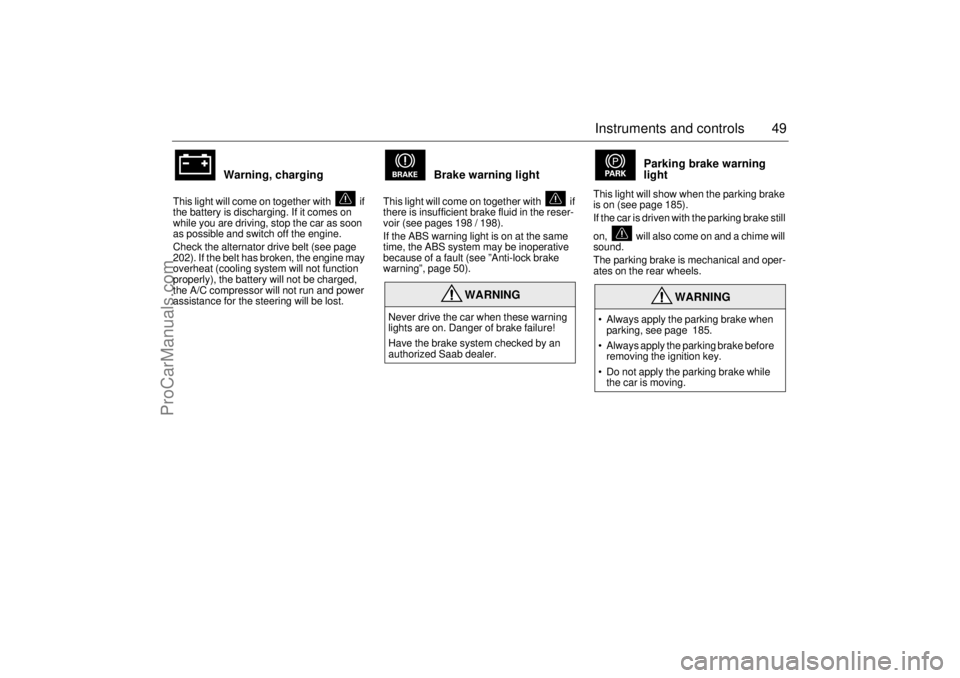
Warning, charging
This light will come on together with if
the battery is discharging. If it comes on
while you are driving, stop the car as soon
as possible and switch off the engine.
Check the alternator drive belt (see page
202). If the belt has broken, the engine may
overheat (cooling system will not function
properly), the battery will not be charged,
the A/C compressor will not run and power
assistance for the steering will be lost.
Brake warning light
This light will come on together with if
there is insufficient brake fluid in the reser-
voir (see pages 198 / 198).
If the ABS warning light is on at the same
time, the ABS system may be inoperative
because of a fault (see ”Anti-lock brake
warning”, page 50).
Parking brake warning
light
This light will show when the parking brake
is on (see page 185).
If the car is driven with the parking brake still
on, will also come on and a chime will
sound.
The parking brake is mechanical and oper-
ates on the rear wheels.
WARNING
Never drive the car when these warning
lights are on. Danger of brake failure!
Have the brake system checked by an
authorized Saab dealer.
WARNING
Always apply the parking brake when
parking, see page 185.
Always apply the parking brake before
removing the ignition key.
Do not apply the parking brake while
the car is moving.
ProCarManuals.com
Page 50 of 272
50 Instruments and controls
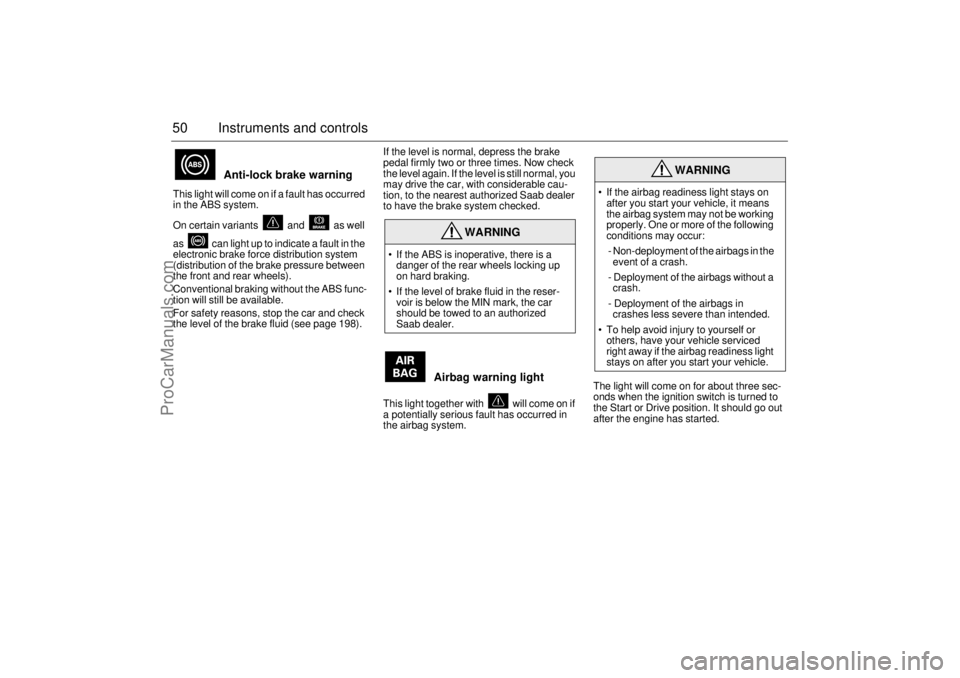
Anti-lock brake warning
This light will come on if a fault has occurred
in the ABS system.
On certain variants and as well
as can light up to indicate a fault in the
electronic brake force distribution system
(distribution of the brake pressure between
the front and rear wheels).
Conventional braking without the ABS func-
tion will still be available.
For safety reasons, stop the car and check
the level of the brake fluid (see page 198).If the level is normal, depress the brake
pedal firmly two or three times. Now check
the level again. If the level is still normal, you
may drive the car, with considerable cau-
tion, to the nearest authorized Saab dealer
to have the brake system checked.
Airbag warning light
This light together with will come on if
a potentially serious fault has occurred in
the airbag system.
The light will come on for about three sec-
onds when the ignition switch is turned to
the Start or Drive position. It should go out
after the engine has started.
WARNING
If the ABS is inoperative, there is a
danger of the rear wheels locking up
on hard braking.
If the level of brake fluid in the reser-
voir is below the MIN mark, the car
should be towed to an authorized
Saab dealer.
WARNING
If the airbag readiness light stays on
after you start your vehicle, it means
the airbag system may not be working
properly. One or more of the following
conditions may occur:
- Non-deployment of the airbags in the
event of a crash.
- Deployment of the airbags without a
crash.
- Deployment of the airbags in
crashes less severe than intended.
To help avoid injury to yourself or
others, have your vehicle serviced
right away if the airbag readiness light
stays on after you start your vehicle.
ProCarManuals.com
Page 51 of 272
51 Instruments and controls
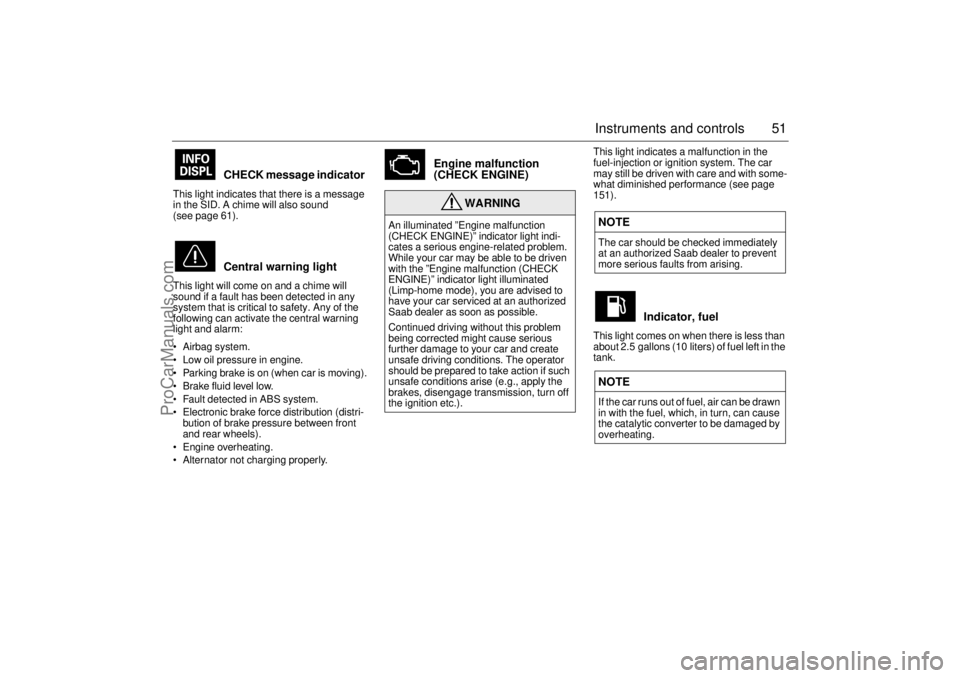
CHECK message indicator
This light indicates that there is a message
in the SID. A chime will also sound
(see page 61).
Central warning light
This light will come on and a chime will
sound if a fault has been detected in any
system that is critical to safety. Any of the
following can activate the central warning
light and alarm:
Airbag system.
Low oil pressure in engine.
Parking brake is on (when car is moving).
Brake fluid level low.
Fault detected in ABS system.
Electronic brake force distribution (distri-
bution of brake pressure between front
and rear wheels).
Engine overheating.
Alternator not charging properly.
Engine malfunction
(CHECK ENGINE)
This light indicates a malfunction in the
fuel-injection or ignition system. The car
may still be driven with care and with some-
what diminished performance (see page
151).
Indicator, fuel
This light comes on when there is less than
about 2.5 gallons (10 liters) of fuel left in the
tank.
WARNING
An illuminated ”Engine malfunction
(CHECK ENGINE)” indicator light indi-
cates a serious engine-related problem.
While your car may be able to be driven
with the ”Engine malfunction (CHECK
ENGINE)” indicator light illuminated
(Limp-home mode), you are advised to
have your car serviced at an authorized
Saab dealer as soon as possible.
Continued driving without this problem
being corrected might cause serious
further damage to your car and create
unsafe driving conditions. The operator
should be prepared to take action if such
unsafe conditions arise (e.g., apply the
brakes, disengage transmission, turn off
the ignition etc.).
NOTEThe car should be checked immediately
at an authorized Saab dealer to prevent
more serious faults from arising.NOTEIf the car runs out of fuel, air can be drawn
in with the fuel, which, in turn, can cause
the catalytic converter to be damaged by
overheating.
ProCarManuals.com