battery SAAB 9-5 2004 Owner's Manual
[x] Cancel search | Manufacturer: SAAB, Model Year: 2004, Model line: 9-5, Model: SAAB 9-5 2004Pages: 288, PDF Size: 16.91 MB
Page 161 of 288
161 Starting and driving
Park Brake Shift lockThe transmission has a security function
known as Park Brake Shift Lock. To move
the gear selector out of the P position, the
brake pedal must be depressed at the same
time as the gear selector catch (detente) is
pressed in.
Shift Lock overrideCheck fuse No. 1 (see page 229). If the
problem was cured by changing the fuse or
battery, you do not have to contact a Saab
dealer.
If the fuse blows again as soon as the Shift
Lock feature is activated you should contact
your Saab dealer.
If the fuse is OK, check the battery regarding
the voltage.
1 Apply the parking brake
2 Make sure the key is in position ON
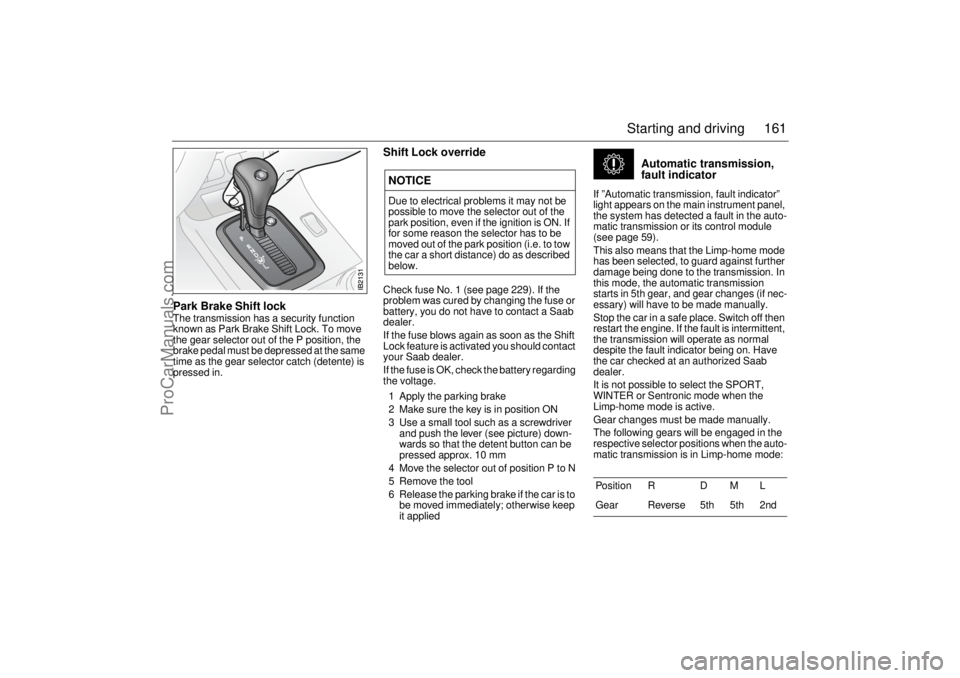
3 Use a small tool such as a screwdriver
and push the lever (see picture) down-
wards so that the detent button can be
pressed approx. 10 mm
4 Move the selector out of position P to N
5 Remove the tool
6 Release the parking brake if the car is to
be moved immediately; otherwise keep
it applied
Automatic transmission,
fault indicator
If ”Automatic transmission, fault indicator”
light appears on the main instrument panel,
the system has detected a fault in the auto-
matic transmission or its control module
(see page 59).
This also means that the Limp-home mode
has been selected, to guard against further
damage being done to the transmission. In
this mode, the automatic transmission
starts in 5th gear, and gear changes (if nec-
essary) will have to be made manually.
Stop the car in a safe place. Switch off then
restart the engine. If the fault is intermittent,
the transmission will operate as normal
despite the fault indicator being on. Have
the car checked at an authorized Saab
dealer.
It is not possible to select the SPORT,
WINTER or Sentronic mode when the
Limp-home mode is active.
Gear changes must be made manually.
The following gears will be engaged in the
respective selector positions when the auto-
matic transmission is in Limp-home mode:
NOTICEDue to electrical problems it may not be
possible to move the selector out of the
park position, even if the ignition is ON. If
for some reason the selector has to be
moved out of the park position (i.e. to tow
the car a short distance) do as described
below.
Position R D M L
Gear Reverse 5th 5th 2nd
ProCarManuals.com
Page 191 of 288
191 Starting and driving
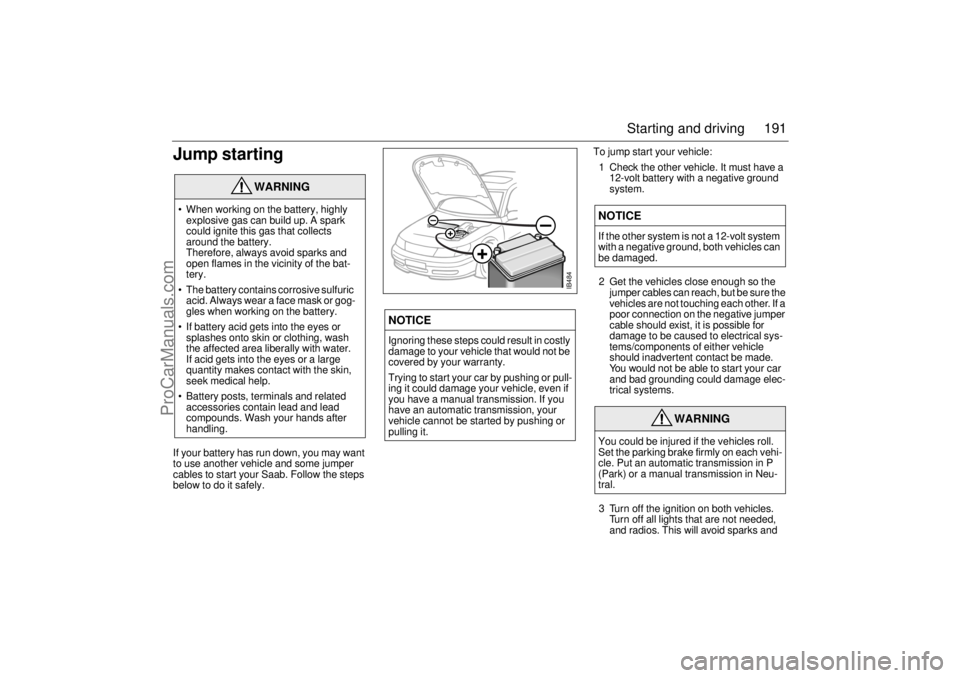
Jump startingIf your battery has run down, you may want
to use another vehicle and some jumper
cables to start your Saab. Follow the steps
below to do it safely.To jump start your vehicle:
1 Check the other vehicle. It must have a
12-volt battery with a negative ground
system.
2 Get the vehicles close enough so the
jumper cables can reach, but be sure the
vehicles are not touching each other. If a
poor connection on the negative jumper
cable should exist, it is possible for
damage to be caused to electrical sys-
tems/components of either vehicle
should inadvertent contact be made.
You would not be able to start your car
and bad grounding could damage elec-
trical systems.
3 Turn off the ignition on both vehicles.
Turn off all lights that are not needed,
and radios. This will avoid sparks and
WARNING
When working on the battery, highly
explosive gas can build up. A spark
could ignite this gas that collects
around the battery.
Therefore, always avoid sparks and
open flames in the vicinity of the bat-
tery.
The battery contains corrosive sulfuric
acid. Always wear a face mask or gog-
gles when working on the battery.
If battery acid gets into the eyes or
splashes onto skin or clothing, wash
the affected area liberally with water.
If acid gets into the eyes or a large
quantity makes contact with the skin,
seek medical help.
Battery posts, terminals and related
accessories contain lead and lead
compounds. Wash your hands after
handling.
NOTICEIgnoring these steps could result in costly
damage to your vehicle that would not be
covered by your warranty.
Trying to start your car by pushing or pull-
ing it could damage your vehicle, even if
you have a manual transmission. If you
have an automatic transmission, your
vehicle cannot be started by pushing or
pulling it.
NOTICEIf the other system is not a 12-volt system
with a negative ground, both vehicles can
be damaged.
WARNING
You could be injured if the vehicles roll.
Set the parking brake firmly on each vehi-
cle. Put an automatic transmission in P
(Park) or a manual transmission in Neu-
tral.
+
–
+
–
IB484
ProCarManuals.com
Page 192 of 288
192 Starting and driving
help save both batteries and it could
save your radio.
4 Open the hood and locate the battery.
Find the positive (+) and negative (–) termi-
nals on the battery.5 Check that the jumper cables do not
have loose or missing insulation. If they
do, you could get a shock and also the
vehicles could be damaged.
Before you connect the cables, here are
some basic things you should know.
Positive (+) will go to positive (+) and
negative (–) will go to a major metal
engine part with a good ground. Do not
connect (+) to (–) or you will get a short
that could injure you or would damage
the battery and maybe other parts as
well.
6 Connect the red positive (+) cable to the
positive (+) terminal of the vehicle with
the discharged battery.
7 Do not let the other end touch metal.
Connect it to the positive (+) terminal of
the good battery. Use a remote positive
(+) terminal if the vehicle has one.
8 Now connect the black negative (–)
cable to the good battery’s negative ter-
minal.NOTICEIf you leave your radio on, it could be
badly damaged. The repairs would not be
covered by your warranty.
WARNING
An electric fan can start up even when the
engine is not running and can injure you.
Keep hands, clothing and tools away from
any underhood electric fan.
WARNING
Using a match or flame of any kind near a
battery can cause battery gas to explode.
You can suffer burns or be blinded. Use a
flashlight if you need more light.
Be sure the battery has enough water.
The battery installed in your new Saab
has filler caps. Be sure the right amount
of water is there. Add distilled or boiled
water if the level is too low. If you don’t,
explosive gas could be present.
Be sure the electrolyte in the battery is not
frozen. Discharged batteries will freeze.
When connecting jumper cables to a
frozen battery, gas from the chemical
reaction inside the battery can build up
under the ice and cause an explosion.
Battery fluid contains acid that can burn
you. Do not get it on you. If you acciden-
tally get it in your eyes or on your skin,
flush the area with water and get medical
help immediately.
ProCarManuals.com
Page 193 of 288

193 Starting and driving
9 Attach the cable at least 18 inches
(45 cm) away from the discharged bat-
tery, but not near engine parts that
move. To avoid an arc which could deto-
nate the hydrogen gas around the bat-
tery, the final connection must be at least
18” from the battery.
10 Start the vehicle with the good battery
and run the engine for a while.
11 Try to start the vehicle with the dis-
charged battery. If it does not start after
a few tries, it probably needs service.
12 Remove the cables in reverse order to
prevent electrical shorting. Take care
that they do not touch each other or any
other metal.
Charging the battery/Jump startingTo avoid damaging the car’s electrical
system and electronics, the following rules
must be followed when charging the battery
or jump starting the car.
If the charger or starter unit can be set to
different voltages (6V/12V/18V/24V), 12V
must be selected.
Follow the manufacturer’s instructions
supplied with the charger or starter unit.
No other apparatus that are grounded or
connected to the mains must be
connected to the car during charging or
jump starting.
The charger or starter unit must under no
conditions produce a voltage greater
than:
16V continuous
18V for 60 min.
If you are unsure about the charge rating
of the unit, disconnect the battery clamp
from the positive terminal before connect-
ing the unit to the battery.
WARNING
Do not let the other end touch anything
until the next step. The other end of the
negative cable does not go to the dead
battery. It goes to a major metal part with
a good ground on the engine of the vehi-
cle with the discharged battery.
ProCarManuals.com
Page 197 of 288
197 Starting and driving
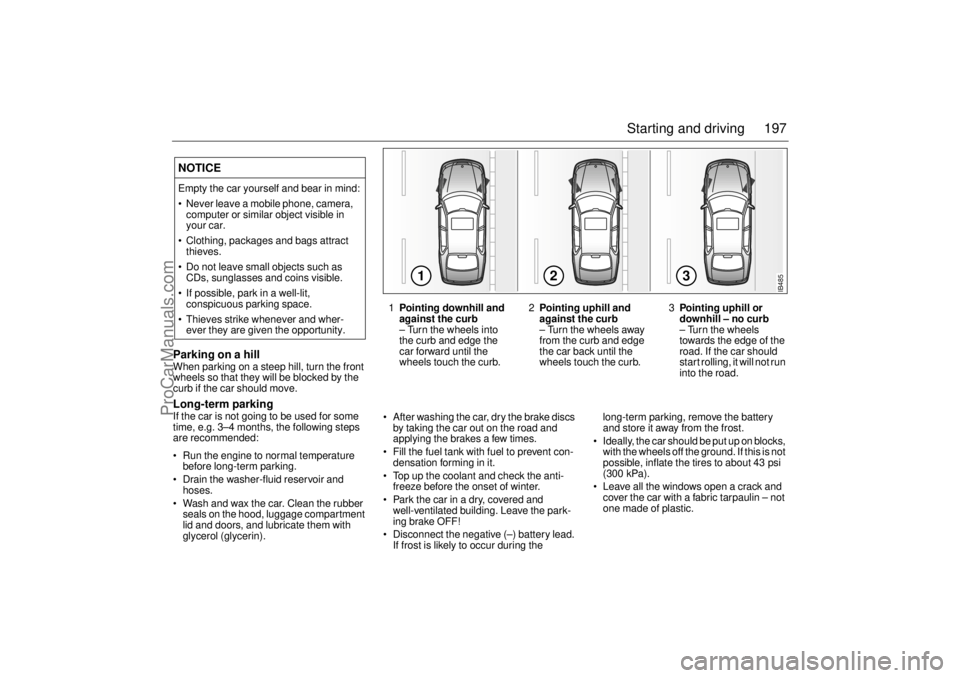
Parking on a hillWhen parking on a steep hill, turn the front
wheels so that they will be blocked by the
curb if the car should move. Long-term parkingIf the car is not going to be used for some
time, e.g. 3–4 months, the following steps
are recommended:
Run the engine to normal temperature
before long-term parking.
Drain the washer-fluid reservoir and
hoses.
Wash and wax the car. Clean the rubber
seals on the hood, luggage compartment
lid and doors, and lubricate them with
glycerol (glycerin). After washing the car, dry the brake discs
by taking the car out on the road and
applying the brakes a few times.
Fill the fuel tank with fuel to prevent con-
densation forming in it.
Top up the coolant and check the anti-
freeze before the onset of winter.
Park the car in a dry, covered and
well-ventilated building. Leave the park-
ing brake OFF!
Disconnect the negative (–) battery lead.
If frost is likely to occur during the long-term parking, remove the battery
and store it away from the frost.
Ideally, the car should be put up on blocks,
with the wheels off the ground. If this is not
possible, inflate the tires to about 43 psi
(300 kPa).
Leave all the windows open a crack and
cover the car with a fabric tarpaulin – not
one made of plastic.NOTICEEmpty the car yourself and bear in mind:
Never leave a mobile phone, camera,
computer or similar object visible in
your car.
Clothing, packages and bags attract
thieves.
Do not leave small objects such as
CDs, sunglasses and coins visible.
If possible, park in a well-lit,
conspicuous parking space.
Thieves strike whenever and wher-
ever they are given the opportunity.
123
IB485
1Pointing downhill and
against the curb
– Turn the wheels into
the curb and edge the
car forward until the
wheels touch the curb.2Pointing uphill and
against the curb
– Turn the wheels away
from the curb and edge
the car back until the
wheels touch the curb.3Pointing uphill or
downhill – no curb
– Turn the wheels
towards the edge of the
road. If the car should
start rolling, it will not run
into the road.
ProCarManuals.com
Page 199 of 288
199 Car care and technical information
Car care and
technical
information
IB1772
Hood ________________ 200
Engine compartment ___ 201
Emission control systems 202
Engine_______________ 203
Engine oil ____________ 204
Transmission fluid_____ 206
Coolant ______________ 207
Brake and clutch fluid __ 208
Power steering fluid ___ 209
Air filter ______________ 209
Battery ______________ 210
Drive belts ___________ 212
Wipers and washers ___ 213 Changing bulbs _______ 215
Fuses _______________ 227
Tires ________________ 233
Compact spare tire ____ 246
Air conditioning (ACC) _ 252
Safety belts __________ 253
Upholstery and trim ___ 253
Textile carpeting ______ 253
Washing the car ______ 254
Waxing and polishing __ 255
Engine compartment __ 255
Touching up the paint__ 255
Anti-corrosion treatment 256 For long trips _________ 258
Recovery and/or recycling
of automotive materials 258
Headlight aiming ______ 259
ProCarManuals.com
Page 201 of 288
201 Car care and technical information
Engine compartment
10
9
6
7
8
1
2
4
3
5
IB1773
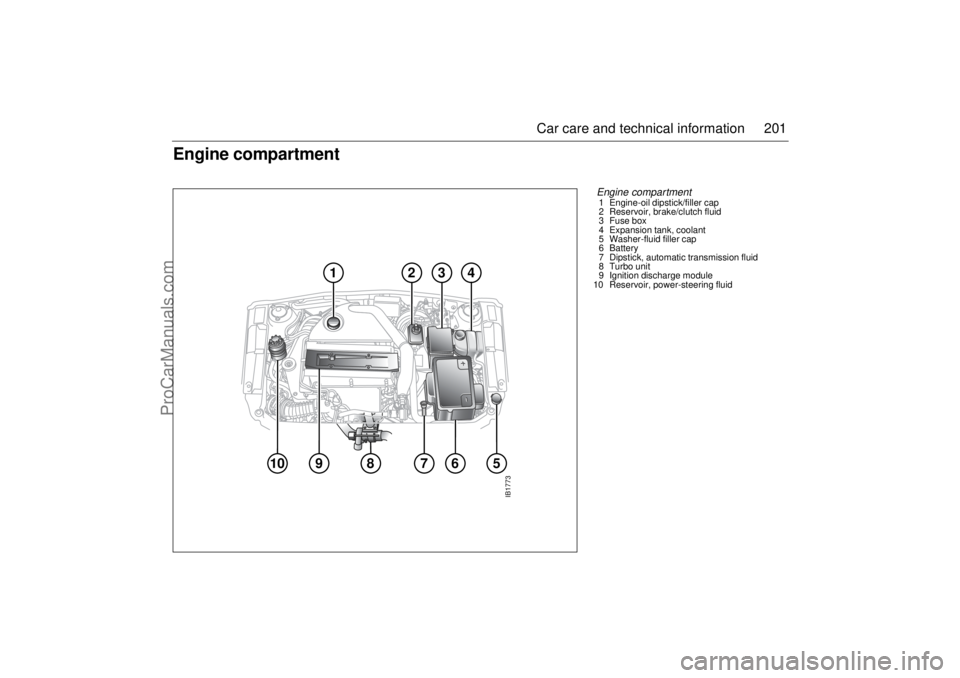
Engine compartment1 Engine-oil dipstick/filler cap
2 Reservoir, brake/clutch fluid
3 Fuse box
4 Expansion tank, coolant
5 Washer-fluid filler cap
6Battery
7 Dipstick, automatic transmission fluid
8 Turbo unit
9 Ignition discharge module
10 Reservoir, power-steering fluid
ProCarManuals.com
Page 210 of 288
210 Car care and technical informationBattery
The battery is provided with a cover to pro-
tect it from radiated heat. If the battery is
exposed to high temperatures, its life will be
shortened. To remove the cover, release
the two clips along its long sides.
The cover fits the standard battery installed
in the car. If a new battery is to be fitted,
make sure that its dimensions are the same
as the standard one.
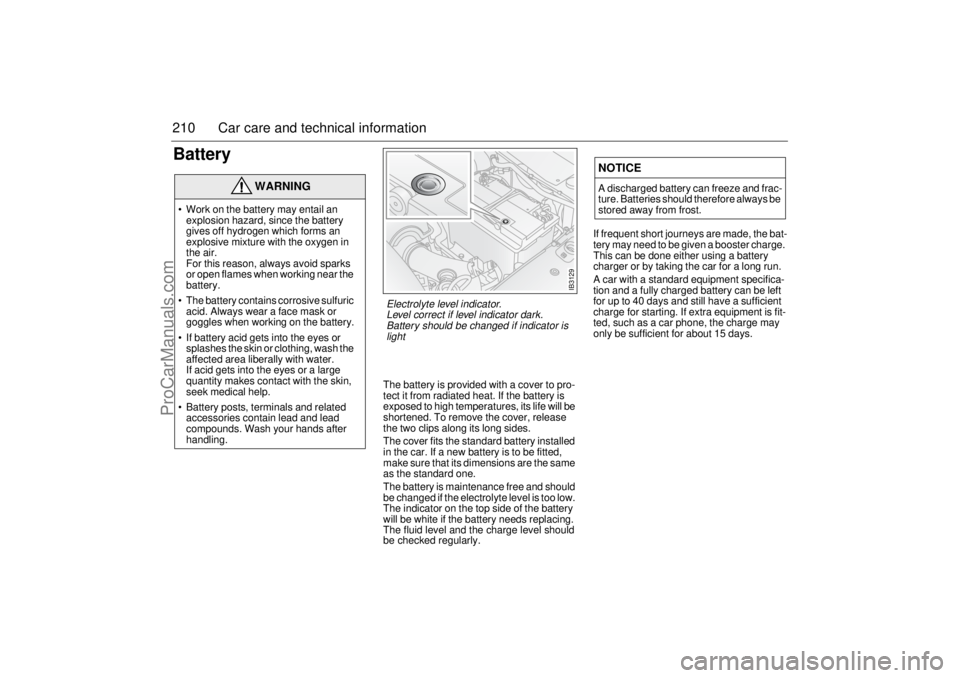
The battery is maintenance free and should
be changed if the electrolyte level is too low.
The indicator on the top side of the battery
will be white if the battery needs replacing.
The fluid level and the charge level should
be checked regularly.
If frequent short journeys are made, the bat-
tery may need to be given a booster charge.
This can be done either using a battery
charger or by taking the car for a long run.
A car with a standard equipment specifica-
tion and a fully charged battery can be left
for up to 40 days and still have a sufficient
charge for starting. If extra equipment is fit-
ted, such as a car phone, the charge may
only be sufficient for about 15 days.
WARNING
Work on the battery may entail an
explosion hazard, since the battery
gives off hydrogen which forms an
explosive mixture with the oxygen in
the air.
For this reason, always avoid sparks
or open flames when working near the
battery.
The battery contains corrosive sulfuric
acid. Always wear a face mask or
goggles when working on the battery.
If battery acid gets into the eyes or
splashes the skin or clothing, wash the
affected area liberally with water.
If acid gets into the eyes or a large
quantity makes contact with the skin,
seek medical help.
Battery posts, terminals and related
accessories contain lead and lead
compounds. Wash your hands after
handling.
NOTICEA discharged battery can freeze and frac-
ture. Batteries should therefore always be
stored away from frost.
IB3129
Electrolyte level indicator.
Level correct if level indicator dark.
Battery should be changed if indicator is
light
ProCarManuals.com
Page 211 of 288
211 Car care and technical information
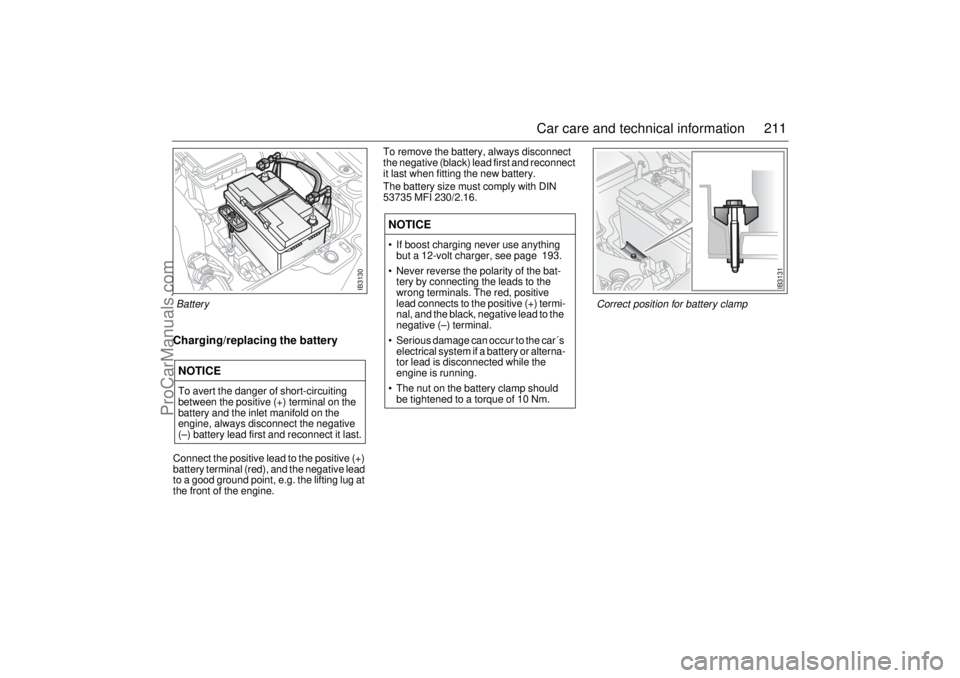
Charging/replacing the battery Connect the positive lead to the positive (+)
battery terminal (red), and the negative lead
to a good ground point, e.g. the lifting lug at
the front of the engine.To remove the battery, always disconnect
the negative (black) lead first and reconnect
it last when fitting the new battery.
The battery size must comply with DIN
53735 MFI 230/2.16.
NOTICETo avert the danger of short-circuiting
between the positive (+) terminal on the
battery and the inlet manifold on the
engine, always disconnect the negative
(–) battery lead first and reconnect it last.
NOTICE If boost charging never use anything
but a 12-volt charger, see page 193.
Never reverse the polarity of the bat-
tery by connecting the leads to the
wrong terminals. The red, positive
lead connects to the positive (+) termi-
nal, and the black, negative lead to the
negative (–) terminal.
Serious damage can occur to the car´s
electrical system if a battery or alterna-
tor lead is disconnected while the
engine is running.
The nut on the battery clamp should
be tightened to a torque of 10 Nm.
IB3131
Correct position for battery clamp
IB3130
Battery
ProCarManuals.com
Page 216 of 288
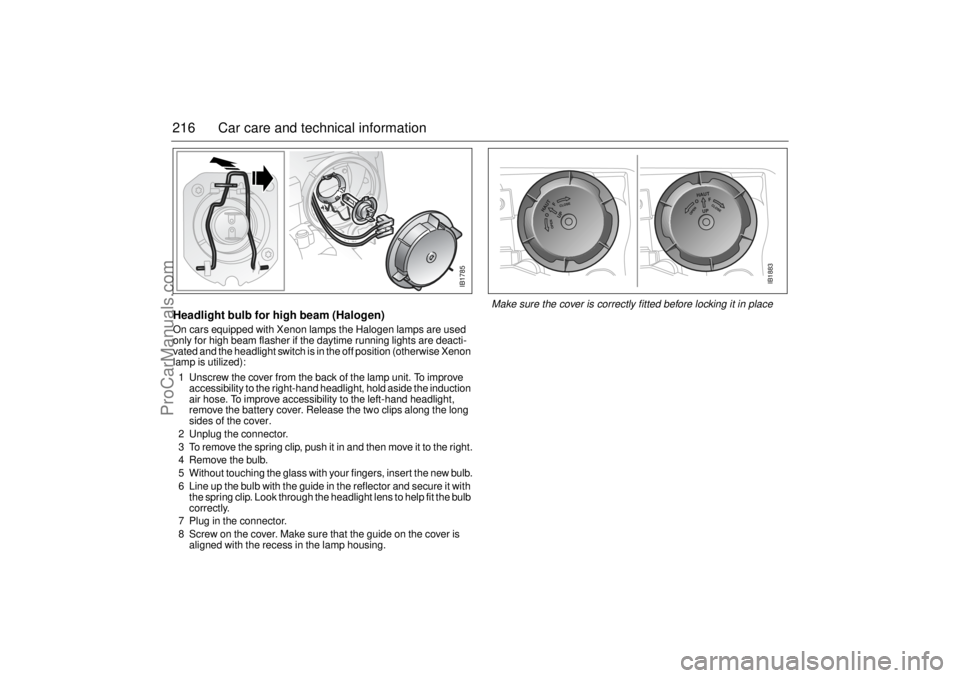
216 Car care and technical informationHeadlight bulb for high beam (Halogen)On cars equipped with Xenon lamps the Halogen lamps are used
only for high beam flasher if the daytime running lights are deacti-
vated and the headlight switch is in the off position (otherwise Xenon
lamp is utilized):
1 Unscrew the cover from the back of the lamp unit. To improve
accessibility to the right-hand headlight, hold aside the induction
air hose. To improve accessibility to the left-hand headlight,
remove the battery cover. Release the two clips along the long
sides of the cover.
2 Unplug the connector.
3 To remove the spring clip, push it in and then move it to the right.
4 Remove the bulb.
5 Without touching the glass with your fingers, insert the new bulb.
6 Line up the bulb with the guide in the reflector and secure it with
the spring clip. Look through the headlight lens to help fit the bulb
correctly.
7 Plug in the connector.
8 Screw on the cover. Make sure that the guide on the cover is
aligned with the recess in the lamp housing.
IB1785
IB1883
Make sure the cover is correctly fitted before locking it in place
ProCarManuals.com