steering wheel SAAB 9-5 2004 Owner's Manual
[x] Cancel search | Manufacturer: SAAB, Model Year: 2004, Model line: 9-5, Model: SAAB 9-5 2004Pages: 288, PDF Size: 16.91 MB
Page 235 of 288
235 Car care and technical information
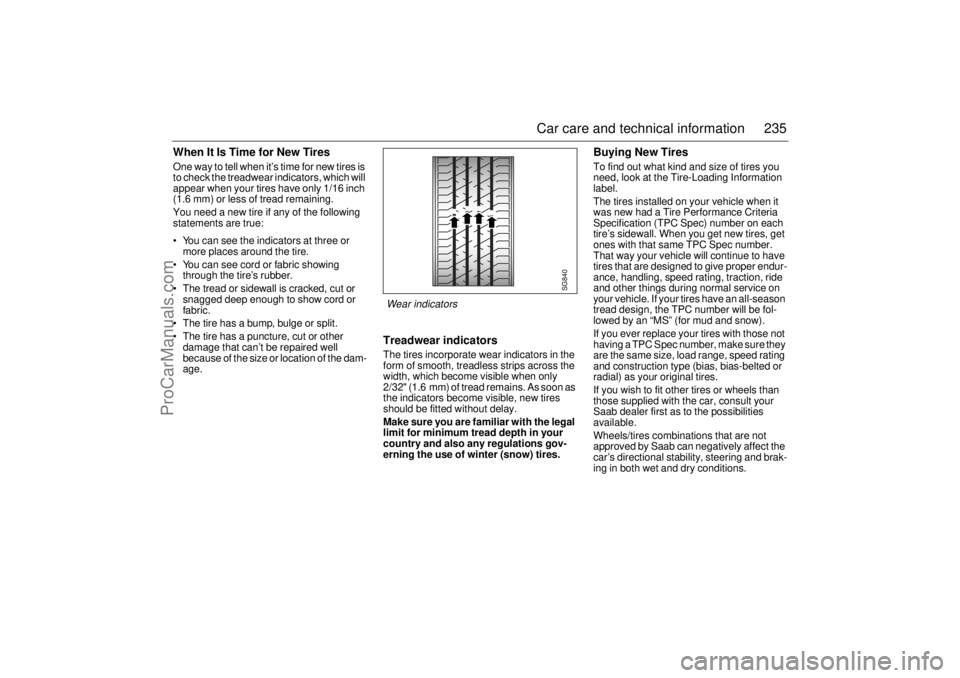
When It Is Time for New TiresOne way to tell when it’s time for new tires is
to check the treadwear indicators, which will
appear when your tires have only 1/16 inch
(1.6 mm) or less of tread remaining.
You need a new tire if any of the following
statements are true:
You can see the indicators at three or
more places around the tire.
You can see cord or fabric showing
through the tire’s rubber.
The tread or sidewall is cracked, cut or
snagged deep enough to show cord or
fabric.
The tire has a bump, bulge or split.
The tire has a puncture, cut or other
damage that can’t be repaired well
because of the size or location of the dam-
age.
Treadwear indicatorsThe tires incorporate wear indicators in the
form of smooth, treadless strips across the
width, which become visible when only
2/32" (1.6 mm) of tread remains. As soon as
the indicators become visible, new tires
should be fitted without delay.
Make sure you are familiar with the legal
limit for minimum tread depth in your
country and also any regulations gov-
erning the use of winter (snow) tires.
Buying New TiresTo find out what kind and size of tires you
need, look at the Tire-Loading Information
label.
The tires installed on your vehicle when it
was new had a Tire Performance Criteria
Specification (TPC Spec) number on each
tire’s sidewall. When you get new tires, get
ones with that same TPC Spec number.
That way your vehicle will continue to have
tires that are designed to give proper endur-
ance, handling, speed rating, traction, ride
and other things during normal service on
your vehicle. If your tires have an all-season
tread design, the TPC number will be fol-
lowed by an “MS” (for mud and snow).
If you ever replace your tires with those not
having a TPC Spec number, make sure they
are the same size, load range, speed rating
and construction type (bias, bias-belted or
radial) as your original tires.
If you wish to fit other tires or wheels than
those supplied with the car, consult your
Saab dealer first as to the possibilities
available.
Wheels/tires combinations that are not
approved by Saab can negatively affect the
car’s directional stability, steering and brak-
ing in both wet and dry conditions.
SG840
Wear indicators
ProCarManuals.com
Page 239 of 288

239 Car care and technical information
Tire Chains
Notice:
If your vehicle does not have
P225/45R17 size tires, use tire chains
only where legal and only when you
must. Use only SAE Class ²S² type
chains that are the proper size for your
tires. Install them on the front tires and
tighten them as tightly as possible with
the ends securely fastened. Drive slowly
and follow the chain manufacturer’s
instructions. If you can hear the chains
contacting your vehicle, stop and
retighten them. If the contact continues,
slow down until it stops. Driving too fast
or spinning the wheels with chains on
will damage your vehicle.If a Tire Goes Flat
It’s unusual for a tire to “blowout” while
you’re driving, especially if you maintain
your tires properly. If air goes out of a tire,
it’s much more likely to leak out slowly. But
if you should ever have a “blowout”, here are
a few tips about what to expect and what to
do:
If a front tire fails, the flat tire will create a
drag that pulls the vehicle toward that side.
Take your foot off the accelerator pedal and
grip the steering wheel firmly. Steer to main-
tain lane position, and then gently brake to
a stop well out of the traffic lane.
A rear blowout, particularly on a curve, acts
much like a skid and may require the same
correction you’d use in a skid. In any rear
blowout, remove your foot from the acceler-
ator pedal. Get the vehicle under control by
steering the way you want the vehicle to go.
It may be very bumpy and noisy, but you can
still steer. Gently brake to a stop – well off
the road if possible.
If a tire goes flat, the next part shows how to
use your jacking equipment to change a flat
tire safely.
WARNING
If your vehicle has P225/45 R17 size tires,
don’t use tire chains, there’s not enough
clearance.
Tire chains used on a vehicle without the
proper amount of clearance can cause
damage to the brakes, suspension or
other vehicle parts. The area damaged by
the tire chains could cause you to lose
control of your vehicle and you or others
may be injured in a crash.
Use another type of traction device only if
its manufacturer recommends it for use
on your vehicle and tire size combination
and road conditions. Follow that manu-
facturer’s instructions. To help avoid
damage to your vehicle, drive slowly,
readjust or remove the device if it’s con-
tacting your vehicle, and don’t spin your
wheels.
If you do find traction devices that will fit,
install them on the front tires.
ProCarManuals.com
Page 258 of 288

258 Car care and technical information4Inspect the undercoating and touch
up if necessary.
Pay particular atten-
tion to the fenders and wheel housings,
which are exposed to abrasion by flying
gravel, etc. If the composition has worn
or flaked off, the steel must be thor-
oughly cleaned and dried before a fresh
coat is applied. The cleaning is best
done with a scraper and a steel wire
brush, followed by washing with solvent.
Apply the new coating thinly, as other-
wise it may run off or fall off when dry.
For long tripsBefore setting off on a long journey, it is
advisable to have your car checked over by
your Saab dealer.
Obtain a few important items to take along
on your journey such as spare bulbs, wiper
blades, fuses, a Poly-V-belt and the like.
You can check some points yourself before-
hand:
Make sure that the engine is in good con-
dition.
Check that no oil or gasoline leaks out of
the engine or gearbox/transmission.
Check the coolant and power steering
fluid levels. Check also for leaks.
Inspect the Poly-V-belt and replace it if it
shows any signs of hard wear.
Check the battery charge.
Check the tires for tread pattern and air
pressure, including the compact spare
wheel.
Check the brakes.
Check all bulbs.
Check for the presence of the tool kit and
the jack in the car.
Recovery and/or
recycling of automotive
materialsA typical car consists of metals (65–75 %),
plastics (10–15 %), rubber (5 %) and small
quantities of glass, wood, paper and tex-
tiles. The recycling of metals has been com-
monplace for a long time now.
To facilitate sorting of other materials for
recycling, plastic parts, for instance, have
been marked to identify the precise nature
of the plastic.
The quantity of materials in the car that can
be recycled or recovered depends on the
scrapping facilities in different countries. EU
legislation that comes into force in 2006 will
require a minimum of 85 % of the total
weight of materials to be recycled. How-
ever, every major car salvage yard in each
market will receive details from Saab of how
the highest percentage of materials can be
reclaimed.
ProCarManuals.com
Page 269 of 288
269 Specifications
Specifications General______________ 270
Engine ______________ 272
Fuel_________________ 272
Engine oil ____________ 273
Engine variants _______ 274
Electrical system______ 275
Drive belts ___________ 275
Manual gearbox_______ 276
Automatic transmission 276
Suspension __________ 277
Steering _____________ 277
Brake system_________ 277
Wheels and tires ______ 278
Plates and labels ______ 280
IB603
ProCarManuals.com
Page 277 of 288

277 Specifications
Suspension
Steering Brake system Spring type, front and rear ___________ Coil springs
Maximum deflection of springs:
Front __________________________ 7.09 in (180 mm)
Rear ___________________________ 7.87 in (200 mm)
Dampers, front and rear _____________ Gas-filled dampers
Steering _________________________ Power-assisted
steering of
rack-and-pinion
type; telescopic
steering-column
shaft with universal
joints
Number of turns, lock to lock __________ 2,9
Power-steering fluid ________________ Power-steering fluid
CHF 11S Footbrake (ABS) ____________________ Hydraulic, dual-cir-
cuit brake system.
Diagonally split cir-
cuit with vacuum
servo unit. Disc
brakes front and
rear. EBD, see page
168.
Handbrake ________________________ Acts on rear wheels
Brake fluid _________________________ DOT 4
Brake-fluid capacity _________________ 0.925 qts (900 ml)
Disc diameter:
Front, ventilated ___________________ 11.34 in (288 mm)
Front, ventilated, certain variants *) ____ 12.05 in (306 mm)
Rear, solid _______________________ 11.26 in (286 mm)
Rear, ventilated, certain variants *) ____ 11.81 in (300 mm)
*) 15” wheel must not be used on these
variants.
Total friction area of brake pads:
Front ___________________________ 36.3 in
2 (234 cm
2)
Rear ___________________________ 15.5 in
2 (100 cm
2)
ProCarManuals.com
Page 283 of 288

283 Index
Index
AA/C system, fault diagnosis
_______ 252
A/C system, maintenance
_________ 252
ABS brakes
____________________ 168
ACC
__________________________ 75
ACC functions
___________________ 78
ACC, automatic climate control
_____ 75
ACC, calibration
_________________ 83
ACC, condensation _______________ 84
ACC, programming _______________ 81
ACC, useful tips
_________________ 83
Adjusting the steering wheel
_______ 120
Adjustment, seats
________________ 12
Air conditioning (A/C), fault diagnosis
and maintenance ______________ 252
Air distribution, ACC ______________ 80
Airbag
_________________________ 31
Alarm _________________________ 46
Alarm functions
__________________ 49
Alarm signals
________________ 46
, 49
Alternator
_____________________ 212
Alternator drive belt
__________ 212
, 275
Alternator rating
________________ 275
Anticorrosion treatment
___________ 256
Antidazzle rear-view mirror
________ 125
Ashtrays
______________________ 131
Audio System
___________________ 85
Audio System, quick guide
_________ 87
Autochecking of lights on starting
____ 60Automatic climate control (ACC)
_____ 75
Automatic transmission, technical
data
_________________________ 276
Aviod theft, tip
__________________ 197
BBattery
________________________ 210
Battery charging/replacing
________ 211
Battery, boost starting
____________ 191
Before a long journey ____________ 258
Before towing a camper or trailer
___ 181
Belt guide
______________________ 17
Boost starting using jump leads
____ 191
Brake and clutch fluid
____________ 208
Brake-fluid reservoir
_____________ 208
Brakes, technical data ____________ 277
Bulbs, changing
________________ 215
Bulbs, table of
__________________ 226
Buying new tires ________________ 235
CCD changer
_____________________ 97
CD player
______________________ 95
CHECK messages
_______________ 67
CHECKING
_____________________ 67
Calibration, ACC
_________________ 83
Cancelling the programmed settings
_81
Car alarm
______________________ 46
Car care
______________________ 199
Cargo net, 9-5 Wagon
____________ 142Carpeting, care of
_______________ 253
Cassette player
__________________ 92
Catalytic converter, important
considerations _________________ 152
Central locking ___________________ 40
Change language in SID
___________ 68
Change of address notification
_____ 266
Changing a wheel
_______________ 247
Changing bulbs
_________________ 215
Changing wiper blades
___________ 213
Charger/Jump starting ____________ 193
Charging the battery/Jump starting
__ 193
Chassis number
________________ 280
Chassis number, key to
___________ 281
Checks before towing a camper or
trailer
________________________ 181
Child safety
_____________________ 23
Child safety locks, rear doors
_______ 43
Cleaning, engine bay
_____________ 255
Clock
_______________________ 67
, 68
Color code, body
________________ 280
Color code, trim _________________ 280
Compact spare wheel
____________ 246
Compass
______________________ 126
Condensation, ACC
_______________ 84
Coolant
_______________________ 207
Courtesy Headlight Feature
________ 70
Cruise control
__________________ 167
Cup holder
_____________________ 134
ProCarManuals.com
Page 285 of 288

285 Index
JJack
_________________________ 249
KKey
___________________________ 40
Key to chassis number
___________ 281
Key, remove
___________________ 148
LLATCH (child safety)
______________ 24
Labeling, tire sidewall ____________ 240
Labels
__________________________ 7
Leather upholstery, care of
________ 253
Light horn
______________________ 69
Light switches ___________________ 69
Loading your vehicle
_____________ 242
Luggage-compartment lighting
_____ 130
MMain instrument panel
____________ 54
Main/dipped beam
_______________ 69
Maintenance schedule ___________ 264
Maintenance, A/C-system _________ 252
Manual gearbox, technical data
____ 276
Maxi fuses
_____________________ 228
Milometer ______________________ 60
Motoring abroad
________________ 258
NNew tires, buying
_______________ 235
Night Panel
_____________________ 67
OOil capacity, engine
______________ 272
Oil change, engine ______________ 204
Oil specification
_________________ 272
OnStar
________________________ 107
Outdoor temperature
______________ 63
Owner assistance
_______________ 265
PPaintwork, touching-in
____________ 255
Parking Assistance
______________ 194
Parking lights
___________________ 69
Plates and labels ________________ 280
Poly-V-belt
____________________ 212
Power steering _________________ 209
Power-steering fluid
_____________ 209
Pressure gauge
__________________ 62
Programming I, ACC
______________ 81
Programming II, ACC _____________ 82
Programming the ACC ____________ 81
QQuality grading, tires
_____________ 237
Questions on function of airbag
______ 37
Quick guide, Audio System
_________ 87
RRadiator fan
____________________ 212
Radio
__________________________ 90
Rain sensor
_____________________ 73
Rear fog light ____________________ 70
Rear seat, 9-5 Sedan, folding
______ 135
Rear seat, 9-5 Wagon, folding ______ 138
Rear-seat head restraints
__________ 16
Rear-view mirror, antidazzle _______ 125
Rearview mirrors
________________ 121
Reclamation
___________________ 258
Recommendations for cars with
automatic transmission, towing a
camper or trailer
_______________ 179
Refuelling
_____________________ 154
Relay panel ____________________ 230
Remote control __________________ 40
Remote-control battery, changing
____ 43
Remove the key
________________ 148
Replacement, wheel _____________ 238
Reporting safety defects __________ 266
Reprogramming of systems _______ 282
Reservoir, power-steering fluid _____ 209
Rev counter
_____________________ 60
Reversing lights
__________________ 72
ProCarManuals.com
Page 286 of 288

286 IndexRoof load
_____________________ 183
Running-in ____________________ 174
SSDM
_________________________ 267
SID
___________________________ 63
Saab 9-5 Audio System
___________ 85
Saab Information Display (SID)
_____ 63
Saab Parking Assistance
_________ 194
Safety belts
_____________________ 17
Safety belts, care of
_____________ 253
Safety-belt pretensioners
__________ 18
Safety-belt reminder
______________ 17
Seats
__________________________ 12
Securing a load
__________________ 44
Selector lever indication, automatic
transmission
___________________ 63
Sentronic, manual mode
__________ 163
Service costs
__________________ 265
Service information
______________ 266
Service intervals
________________ 264
Service record retention
__________ 265
Settings, seats
__________________ 12
Side airbags
____________________ 35
Signalling, horn _________________ 120
Sliding floor, 9-5 Wagon
__________ 143
Snow chains
___________________ 176
Spare wheel ___________________ 246
Spare wheel and tools
___________ 145
Spark plugs
____________________ 275
Speedometer ________________ 60
, 61Starting in cold weather, ACC
_______ 81
Starting in hot weather, ACC _______ 81
Steering wheel adjustment
________ 120
Steering, technical data
__________ 277
Steps for determining correct load
limit
_________________________ 244
Stone-chip damage, repairing
______ 255
Storage compartments
___________ 132
Sun visors
_____________________ 131
Sunroof
_______________________ 128
Suspension ____________________ 277
Suspension, technical data
________ 277
Switches
_______________________ 69
Symboler ________________________ 9
Systems, adjustment
_____________ 282
TTCS OFF
_______________________ 59
Table of fuses
__________________ 229
Tachometer
_____________________ 60
Tailgate, opening
________________ 44
Tank gauge
_____________________ 61
Technical data __________________ 269
Telematics
_____________________ 107
Temperature control, ACC
_________ 77
Temperature gauge, engine ________ 61
Temperature zones, ACC
__________ 77
Textile carpeting
________________ 253
Through-load hatch ______________ 137
Tie Downs
_____________________ 137
Tightening torque, wheel studs
_____ 247Tip, driving at night
______________ 185
Tip, to avoid theft
________________ 197
Tire chains
_____________________ 239
Tire date code __________________ 245
Tire inspection and rotation
________ 234
Tire markings
___________________ 241
Tire pressure ___________________ 186
Tire sidewall labeling
_____________ 240
Tire terminology and definitions
____ 242
Tire, compact spare
______________ 246
Tires
_____________________ 233
, 278
Tires, winter
____________________ 278
Tools
_________________________ 145
Touching-in the paintwork
_________ 255
Towbar attachment
______________ 178
Towbar load
____________________ 182
Towing the car __________________ 188
Towing, automatics
______________ 188
Traction
_______________________ 171
Trailer weights
__________________ 271
Treadwear indicators
_____________ 235
Trionic
________________________ 202
Trip computer
___________________ 63
Trip meter
______________________ 60
Trunk
_________________________ 135
Trunk lid, opening
________________ 44
Turbo gauge
____________________ 62
Turbo, points to note
_____________ 151
ProCarManuals.com