winter tires SAAB 9-5 2004 Owners Manual
[x] Cancel search | Manufacturer: SAAB, Model Year: 2004, Model line: 9-5, Model: SAAB 9-5 2004Pages: 288, PDF Size: 16.91 MB
Page 176 of 288

176 Starting and drivingEngine block heater (standard
equipment in Canada, accessory in
U.S.)The following are just some of the benefits
to the car and the environment of using an
engine block heater:
Lower fuel consumption.
Exhaust emissions substantially reduced
over short runs.
Reduced wear on the engine.
Inside of car warms up faster.
The engine heater is effective at outside
temperatures up to +15–20°C. The warmer
it is outside, the shorter the time the engine
heater needs to be connected. Longer than
1.5 hours is unnecessary.
If the car is equipped with a removable,
electrical cabin heater that is not in use, this
should be stored in the luggage compart-
ment.
Driving in cold weatherBefore starting a journey in cold weather
you should check the following:
That the wiper blades have not become
frozen to the windshield/glass.
Brush any snow away from the air intake
for the heater system (opening between
hood and windshield).
It may be advisable to lubricate the
door-lock cylinder (use molybdenum
disulphide, MoS
2) to prevent its freezing.
If the lock has frozen, take care not to
break the key (or use the remote control)
– heat it first or spray it with de-icer.
Periodically during the winter, add gaso-
line anti-freeze to the fuel to dispel any
condensation in the fuel tank which could
freeze and cause problems in the system.
Keep the tank well filled to reduce the risk
of condensation forming.
If the car is parked outside in freezing
weather, fuel additives (gasoline
anti-freeze) will not do any good as it
cannot remove water that has already fro-
zen. Park the car in a warm place so that
any ice that may have built up melts, then
add gasoline anti-freeze when filling up
the tank. Condensation is caused by
changes in the outdoor temperature or by
the car being parked alternately in a
garage and outside.
It is particularly important when the roads
are slippery that the brakes and tires be in
good condition. Check the anti-freeze in the engine cool-
ant, see page 207.
The car´s trip computer will warn you when
there is a risk of slippery conditions. For fur-
ther information on this function, see page
64.
The car is equipped with tires designed to
provide optimum grip on both wet and dry
roads, although this has been achieved at
the expense of somewhat reduced grip on
snow and ice. For regular driving on snow
and ice, we therefore recommend that
winter (snow) tires be fitted.
Winter (snow) tires, particularly studded
tires (where use is legally permitted), gener-
ally make driving safer on snow and ice.
Acquaint yourself with the legal provi-
sions governing the use of different
types of winter tires and snow chains.
Studded tires are not allowed in some
countries.
ProCarManuals.com
Page 177 of 288

177 Starting and driving
If winter tires are fitted, the same type must
be fitted on all wheels. Your Saab dealer will
be pleased to advise you on the best tires for
your car.
Remember that tires age. It may therefore
be necessary to change them before they
reach the legal wear limit, as they gradually
lose their friction properties.
The best response if the car gets into a
front-wheel skid is to freewheel (manual
gearbox only), i.e. disengage the clutch (so
that the wheels are neither driven or
retarded by the engine.
If the car has automatic transmission, ease
up on the accelerator and steer carefully in
the desired direction.
In a rear-wheel skid, steer in the same direc-
tion that the rear of the car is moving.
Tire chainsIf you want to fit tire chains (where legally
permitted) they should only be fitted to the
tires recommended under ”Specifications”
(see page 278).
Consult your Saab dealer for details of
approved tire chains.
Driving in hot weather Always check the coolant level before
starting a journey. The level should be just
below the MAX mark.
At the end of a journey, if the engine has
worked hard, allow it to idle for two or
three minutes before switching it off.
If the needle on the temperature gauge
enters the red zone:
1 Bring the car to a standstill but leave the
engine running. Do not remove the cap
on the expansion tank even if the tank is
empty. If the needle on the temperature
gauge continues to rise while the engine
is idling, switch off the engine.
WARNING
Do not exceed 30 mph (50 km/h)
when tire chains are fitted.
Tire chains can reduce the directional
stability of the car.
Tire chains must not be used on the
rear wheels. NOTICE Check the links frequently for wear.
Check that the chains do not contact
the wheel-arch liner at full lock.
See section ”Specifications”, page
278, for information on allowable
wheel dimensions for the fitting of tire
chains.
ProCarManuals.com
Page 197 of 288
197 Starting and driving
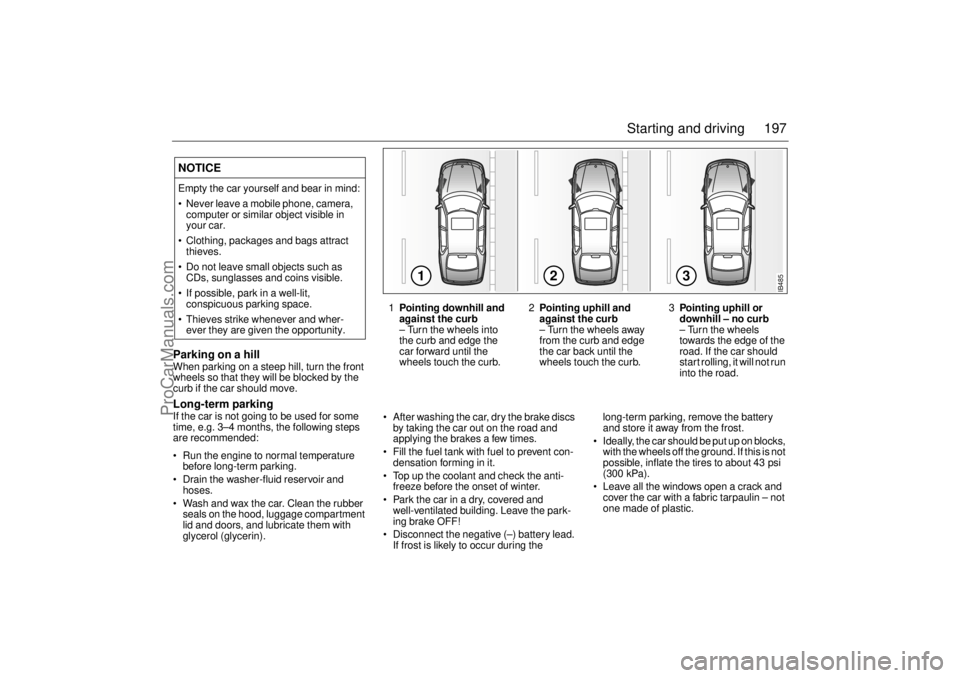
Parking on a hillWhen parking on a steep hill, turn the front
wheels so that they will be blocked by the
curb if the car should move. Long-term parkingIf the car is not going to be used for some
time, e.g. 3–4 months, the following steps
are recommended:
Run the engine to normal temperature
before long-term parking.
Drain the washer-fluid reservoir and
hoses.
Wash and wax the car. Clean the rubber
seals on the hood, luggage compartment
lid and doors, and lubricate them with
glycerol (glycerin). After washing the car, dry the brake discs
by taking the car out on the road and
applying the brakes a few times.
Fill the fuel tank with fuel to prevent con-
densation forming in it.
Top up the coolant and check the anti-
freeze before the onset of winter.
Park the car in a dry, covered and
well-ventilated building. Leave the park-
ing brake OFF!
Disconnect the negative (–) battery lead.
If frost is likely to occur during the long-term parking, remove the battery
and store it away from the frost.
Ideally, the car should be put up on blocks,
with the wheels off the ground. If this is not
possible, inflate the tires to about 43 psi
(300 kPa).
Leave all the windows open a crack and
cover the car with a fabric tarpaulin – not
one made of plastic.NOTICEEmpty the car yourself and bear in mind:
Never leave a mobile phone, camera,
computer or similar object visible in
your car.
Clothing, packages and bags attract
thieves.
Do not leave small objects such as
CDs, sunglasses and coins visible.
If possible, park in a well-lit,
conspicuous parking space.
Thieves strike whenever and wher-
ever they are given the opportunity.
123
IB485
1Pointing downhill and
against the curb
– Turn the wheels into
the curb and edge the
car forward until the
wheels touch the curb.2Pointing uphill and
against the curb
– Turn the wheels away
from the curb and edge
the car back until the
wheels touch the curb.3Pointing uphill or
downhill – no curb
– Turn the wheels
towards the edge of the
road. If the car should
start rolling, it will not run
into the road.
ProCarManuals.com
Page 235 of 288

235 Car care and technical information
When It Is Time for New TiresOne way to tell when it’s time for new tires is
to check the treadwear indicators, which will
appear when your tires have only 1/16 inch
(1.6 mm) or less of tread remaining.
You need a new tire if any of the following
statements are true:
You can see the indicators at three or
more places around the tire.
You can see cord or fabric showing
through the tire’s rubber.
The tread or sidewall is cracked, cut or
snagged deep enough to show cord or
fabric.
The tire has a bump, bulge or split.
The tire has a puncture, cut or other
damage that can’t be repaired well
because of the size or location of the dam-
age.
Treadwear indicatorsThe tires incorporate wear indicators in the
form of smooth, treadless strips across the
width, which become visible when only
2/32" (1.6 mm) of tread remains. As soon as
the indicators become visible, new tires
should be fitted without delay.
Make sure you are familiar with the legal
limit for minimum tread depth in your
country and also any regulations gov-
erning the use of winter (snow) tires.
Buying New TiresTo find out what kind and size of tires you
need, look at the Tire-Loading Information
label.
The tires installed on your vehicle when it
was new had a Tire Performance Criteria
Specification (TPC Spec) number on each
tire’s sidewall. When you get new tires, get
ones with that same TPC Spec number.
That way your vehicle will continue to have
tires that are designed to give proper endur-
ance, handling, speed rating, traction, ride
and other things during normal service on
your vehicle. If your tires have an all-season
tread design, the TPC number will be fol-
lowed by an “MS” (for mud and snow).
If you ever replace your tires with those not
having a TPC Spec number, make sure they
are the same size, load range, speed rating
and construction type (bias, bias-belted or
radial) as your original tires.
If you wish to fit other tires or wheels than
those supplied with the car, consult your
Saab dealer first as to the possibilities
available.
Wheels/tires combinations that are not
approved by Saab can negatively affect the
car’s directional stability, steering and brak-
ing in both wet and dry conditions.
SG840
Wear indicators
ProCarManuals.com
Page 237 of 288

237 Car care and technical information
Uniform Tire Quality GradingQuality grades can be found where applica-
ble on the tire sidewall between tread shoul-
der and maximum section width. For exam-
ple:
Treadwear 200 Traction AA Temperature
A
The following information relates to the
system developed by the United States
National Highway Traffic Safety Administra-
tion, which grades tires by treadwear, trac-
tion and temperature performance. (This
applies only to vehicles sold in the United
States.) The grades are molded on the side-
walls of most passenger car tires. The Uni-
form Tire Quality Grading system does not
apply to deep tread, winter-type snow tires,
space-saver or temporary use spare tires,
tires with nominal rim diameters of 10 to 12
inches (25 to 30 cm), or to some limited-pro-
duction tires.
While the tires available on General Motors
passenger cars and light trucks may vary
with respect to these grades, they must also
conform to federal safety requirements and
additional General Motors Tire Perfor-
mance Criteria (TPC) standards.Treadwear
The treadwear grade is a comparative
rating based on the wear rate of the tire
when tested under controlled conditions on
a specified government test course. For
example, a tire graded 150 would wear one
and a half (1.5) times as well on the govern-
ment course as a tire graded 100. The rela-
tive performance of tires depends upon the
actual conditions of their use, however, and
may depart significantly from the norm due
to variations in driving habits, service prac-
tices and differences in road characteristics
and climate.
Traction – AA, A, B, C
The traction grades, from highest to lowest,
are AA, A, B, and C. Those grades repre-
sent the tire’s ability to stop on wet pave-
ment as measured under controlled condi-
tions on specified government test surfaces
of asphalt and concrete. A tire marked C
may have poor traction performance. Warn-
ing: The traction grade assigned to this tire
is based on straight-ahead braking traction
tests, and does not include acceleration,
cornering, hydroplaning, or peak traction
characteristics.Temperature – A, B, C
The temperature grades are A (the highest),
B, and C, representing the tire’s resistance
to the generation of heat and its ability to dis-
sipate heat when tested under controlled
conditions on a specified indoor laboratory
test wheel. Sustained high temperature can
cause the material of the tire to degenerate
and reduce tire life, and excessive temper-
ature can lead to sudden tire failure. The
grade C corresponds to a level of perfor-
mance which all passenger car tires must
meet under the Federal Motor Vehicle
Safety Standard No. 109. Grades B and A
represent higher levels of performance on
the laboratory test wheel than the minimum
required by law.
Warning: The temperature grade for this tire
is established for a tire that is properly
inflated and not overloaded. Excessive
speed, underinflation, or excessive loading,
either separately or in combination, can
cause heat buildup and possible tire failure.
ProCarManuals.com
Page 244 of 288

244 Car care and technical informationSteps for Determining Correct Load
Limit
1 Locate the statement “The
combined weight of occupants and
cargo should never exceed
XXX pounds” on your vehicle´s
placard.
2 Determine the combined weight of
the driver and passengers that will
be riding in your vehicle.
3 Substract the combined weight of
the driver and passengers from
XXX kilograms or XXX pounds.
4 The resulting figure equals the avail-
able amount of cargo and luggage
load capacity. For example, if the
“XXX” amount equals 1400 lbs. and
there will be five 150 lb. passengers
in your vehicle, the amount of avail-
able cargo and luggage load capac-
ity is 650 lbs. (1400–750 (5x150) =
650 lbs.).5 Determine the combined weight of
luggage and cargo being loaded on
the vehicle. That weight may not
safely exceed the available cargo
and luggage load capacity calcu-
lated in Step 4.
6 If your vehicle will be towing a trailer,
load from your trailer will be trans-
ferred to your vehicle. Consult this
manual to determine how this
reduces the available cargo and
luggage load capacity of your vehi-
cle.Winter tires
Winter (snow) tires are recommended for
winter climates where the majority of your
driving will be done on snow and ice. Winter
tires should be fitted to all four wheels to
maintain a proper balance. Your Saab
dealer can advise you of to the correct size
tire for your car (if different from the original
size) and also supply Saab approved winter
tires pre-mounted on steel or alloy rims.
ProCarManuals.com
Page 245 of 288
245 Car care and technical information
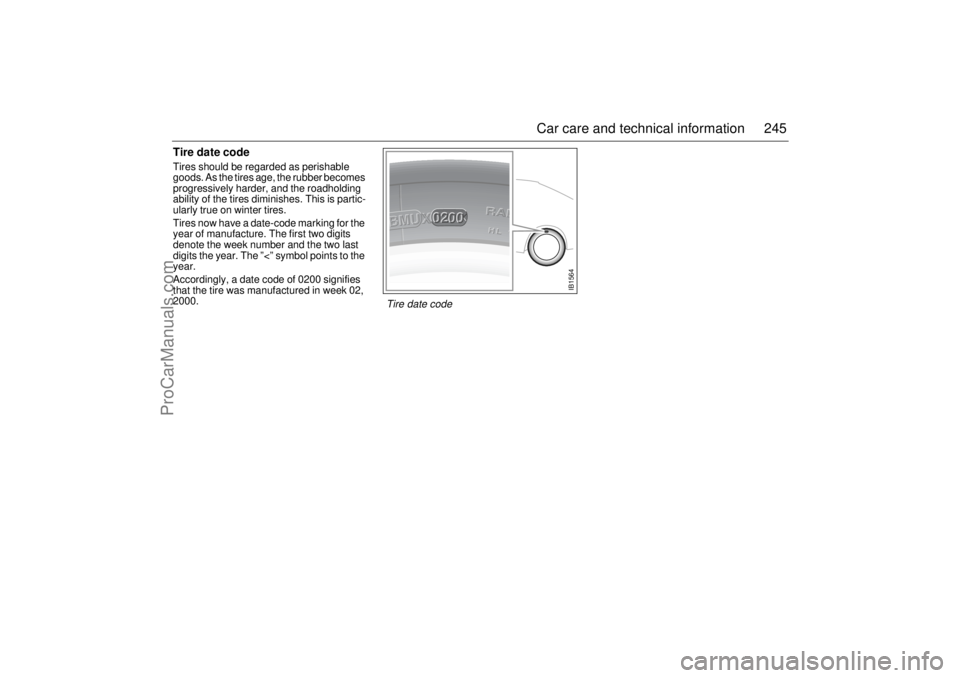
Tire date codeTires should be regarded as perishable
goods. As the tires age, the rubber becomes
progressively harder, and the roadholding
ability of the tires diminishes. This is partic-
ularly true on winter tires.
Tires now have a date-code marking for the
year of manufacture. The first two digits
denote the week number and the two last
digits the year. The ”<” symbol points to the
year.
Accordingly, a date code of 0200 signifies
that the tire was manufactured in week 02,
2000.
IB1564
Tire date code
ProCarManuals.com
Page 278 of 288

278 SpecificationsWheels and tires
(recommended dimensions)
2.3t 2.3 Turbo 2.3T
Summer tires205/65 R15 94 V X – –
215/55 R16 93 V X X X
225/45 R17 94 W XL/RF X X XWinter tires205/65 R15 94 Q X – –
205/55 R16 91 Q X X X
215/55 R16 93 Q X X X
225/45 R17 94 Q XL/RF X X XWheel sizes6 x 15” X – –
6,5 x 16” X X X
7 x 17” X X X15" wheels must not be fitted to the 2.3 Turbo and 2.3T since the size of
the brake discs prohibits this.
Speed ratings and load indices, see page 241.
Always contact an authorized Saab dealer if you wish to fit other wheels
or tires than those fitted as standard.
Compact spare:
Wheel ___________________________ 4 x 16
Tire _____________________________ T115/70 R16
Pressure_________________________ 60 psi (420 kPa)
Maximum life _____________________ 2,200 miles
(3500 km)
Maximum speed __________________ 50 mph (80 km/h)NOTICESnow chains:
Snow chains must not be fitted to the rear wheels, and may only
be used with the following wheel-tire combinations:
Wheels Tires
6 x 15*)_____ 205/65 R15
6.5 x 16_____205/55 R16 M+S or
215/55 R16
Snow chains must not be fitted to 17" wheels.
Max. permissible speed with snow chains fitted is 30 mph
(50 km/h).
Contact an authorized Saab dealer for advice on snow chains.NOTICEWheels larger than 17” must not be fitted.
Wheel offset must be 49 mm.
Vehicles with 12.05 in (306 mm) front brake discs must not use
15” rims.
ProCarManuals.com
Page 279 of 288

279 Specifications
Lowest recommended tire pressure, cold tiresTire size Load/speed
mph (km/h)
1)
Fr o nt
kPa/psiRear
kPa/psi
205/65 R15 94 V 1–3 pers./0–100 (0–160) 230/33 210/30
4–5 pers./0–100 (0–160) 230/33 210/30
1–5 pers./100– (160–) 280/41 260/38
215/55 R16 93 V 1–3 pers./0–100 (0–160) 240/35 220/32
4–5 pers./0–100 (0–160) 240/35 220/32
1–5 pers./100– (160–) 290/42 270/39
225/45 R17 94 W
XL/RF1–3 pers./0–120 (0–190) 250/36 240/35
4–5 pers./0–120 (0–190) 250/36 240/35
1–5 pers./120– (190–) 300/43 290/42
205/65 R15 94 Q 1–3 pers./0–100 (0–160) 240/35 240/35
Winter tire
for 2.3t4–5 pers./0–100 (0–160) 260/38 260/38
205/55 R16 91 Q
Winter tire.
All variants.1–3 pers./0–100 (0–160) 240/35 240/35
4–5 pers./0–100 (0–160) 260/38 260/38
215/55 R16 93 Q
Winter tire.
All variants.1–3 pers./0–100 (0–160) 240/35 240/35
4–5 pers./0–100 (0–160) 260/38 260/38
225/45 R17 94 Q
XL/RF
Winter tire.
All variants.1–3 pers./0–100 (0–160) 250/36 250/36
4–5 pers./0–100 (0–160) 270/39 270/39
T115/70 R16
Spare wheelMax 50 (80) 420/60 420/60
1) Do not exceed posted speed limits.
By cold tires is meant tires that are the same temperature as the surrounding
air temperature.
The values for tire pressure in the table above are for tires at 68°F (20°C).
The tire pressure will increase as the tires become warm (e.g. during motor-
way driving), and decrease as they cool.
When the temperature of the tires increase or decrease by 10 degrees the
tire pressure will correspondingly increase or decrease by 10 kPa/2 psi
(0.1 bar).
ProCarManuals.com
Page 286 of 288

286 IndexRoof load
_____________________ 183
Running-in ____________________ 174
SSDM
_________________________ 267
SID
___________________________ 63
Saab 9-5 Audio System
___________ 85
Saab Information Display (SID)
_____ 63
Saab Parking Assistance
_________ 194
Safety belts
_____________________ 17
Safety belts, care of
_____________ 253
Safety-belt pretensioners
__________ 18
Safety-belt reminder
______________ 17
Seats
__________________________ 12
Securing a load
__________________ 44
Selector lever indication, automatic
transmission
___________________ 63
Sentronic, manual mode
__________ 163
Service costs
__________________ 265
Service information
______________ 266
Service intervals
________________ 264
Service record retention
__________ 265
Settings, seats
__________________ 12
Side airbags
____________________ 35
Signalling, horn _________________ 120
Sliding floor, 9-5 Wagon
__________ 143
Snow chains
___________________ 176
Spare wheel ___________________ 246
Spare wheel and tools
___________ 145
Spark plugs
____________________ 275
Speedometer ________________ 60
, 61Starting in cold weather, ACC
_______ 81
Starting in hot weather, ACC _______ 81
Steering wheel adjustment
________ 120
Steering, technical data
__________ 277
Steps for determining correct load
limit
_________________________ 244
Stone-chip damage, repairing
______ 255
Storage compartments
___________ 132
Sun visors
_____________________ 131
Sunroof
_______________________ 128
Suspension ____________________ 277
Suspension, technical data
________ 277
Switches
_______________________ 69
Symboler ________________________ 9
Systems, adjustment
_____________ 282
TTCS OFF
_______________________ 59
Table of fuses
__________________ 229
Tachometer
_____________________ 60
Tailgate, opening
________________ 44
Tank gauge
_____________________ 61
Technical data __________________ 269
Telematics
_____________________ 107
Temperature control, ACC
_________ 77
Temperature gauge, engine ________ 61
Temperature zones, ACC
__________ 77
Textile carpeting
________________ 253
Through-load hatch ______________ 137
Tie Downs
_____________________ 137
Tightening torque, wheel studs
_____ 247Tip, driving at night
______________ 185
Tip, to avoid theft
________________ 197
Tire chains
_____________________ 239
Tire date code __________________ 245
Tire inspection and rotation
________ 234
Tire markings
___________________ 241
Tire pressure ___________________ 186
Tire sidewall labeling
_____________ 240
Tire terminology and definitions
____ 242
Tire, compact spare
______________ 246
Tires
_____________________ 233
, 278
Tires, winter
____________________ 278
Tools
_________________________ 145
Touching-in the paintwork
_________ 255
Towbar attachment
______________ 178
Towbar load
____________________ 182
Towing the car __________________ 188
Towing, automatics
______________ 188
Traction
_______________________ 171
Trailer weights
__________________ 271
Treadwear indicators
_____________ 235
Trionic
________________________ 202
Trip computer
___________________ 63
Trip meter
______________________ 60
Trunk
_________________________ 135
Trunk lid, opening
________________ 44
Turbo gauge
____________________ 62
Turbo, points to note
_____________ 151
ProCarManuals.com