air condition SAAB 9-5 2005 User Guide
[x] Cancel search | Manufacturer: SAAB, Model Year: 2005, Model line: 9-5, Model: SAAB 9-5 2005Pages: 276, PDF Size: 16.72 MB
Page 142 of 276

140 Starting and drivingFilling a portable fuel container Fuel (Gasoline Engine)
FuelUse of the recommended fuel is an impor-
tant part of the proper maintenance of your
vehicle.
For optimum performance Saab recom-
mends:
2.3t 185 hp (Linear) – AON 90.2.3T 220 hp (Arc) and
2.3 Turbo 250 hp (Aero) – AON 93.
Gasoline OctaneFor the 2.3T and 2.3 Turbo, use premium
unleaded gasoline with a posted octane of
93 or higher for best performance. For the
2.3t, use a mid-grade with a posted octane
of 90 for best performance. You may also
use regular unleaded gasoline rated at
87 octane or higher, but your vehicle's
acceleration may be slightly reduced. If the
octane is less than 87, you may get a heavy
knocking noise when you drive. If this
occurs, use a gasoline rated at 87 octane or
higher as soon as possible. Otherwise, you
might damage your engine. A little pinging
noise when you accelerate or drive uphill is
considered normal. This does not indicate a
problem exists or that a higher-octane fuel
is necessary. If you are using 87 octane or
higher-octane fuel and hear heavy knock-
ing, your engine needs service.
Gasoline SpecificationsIt is recommended that gasoline meet spec-
ifications which were developed by automo-
bile manufacturers around the world and
contained in the World-Wide Fuel Charter
which is available from the Alliance of Auto-
mobile Manufacturers at www.autoalli-
ance.org/fuel_charter.htm. Gasoline meet-
ing these specifications could provide
improved driveability and emission control
system performance compared to other
gasoline.California FuelIf your vehicle is certified to meet California
Emission Standards (see the underhood
emission control label), it is designed to
operate on fuels that meet California speci-
fications. If this fuel is not available in states
adopting California emissions standards,
your vehicle will operate satisfactorily on
fuels meeting federal specifications, but
emission control system performance may
be affected. The malfunction indicator lamp
may turn on and your vehicle may fail a
smog-check test. See Engine malfunction
(CHECK ENGINE) on page 55. If this
occurs, return to your authorized Saab
dealer for diagnosis. If it is determined that
the condition is caused by the type of fuel
used, repairs may not be covered by your
warranty.
WARNING
Never fill a portable fuel container while it
is in your vehicle. Static electricity
discharge from the container can ignite
the gasoline vapor. You can be badly
burned and your vehicle damaged if this
occurs. To help avoid injury to you and
others:
Dispense gasoline only into approved
containers.
Do not fill a container while it is inside
a vehicle, in a vehicle’s trunk, pickup
bed or on any surface other than the
ground.
Bring the fill nozzle in contact with the
inside of the fill opening before opera-
ting the nozzle. Contact should be
maintained until the filling is complete.
Do not smoke while pumping gaso-
line.
ProCarManuals.com
Page 160 of 276

158 Starting and drivingDriving technique To obtain the best running economy, not
only regarding fuel consumption but
general wear also, regular service is
required.
High speed, unnecessary acceleration,
heavy braking and much low gear work all
gives rise to higher fuel consumption.
Frequent gear changing in traffic, starting
in cold weather, the use of studded tires
and roof racks, and towing a trailer all
increase fuel consumption.
Do not run the engine when the car is sta-
tionary.
If idling, it will take much longer before the
engine becomes hot. Engine wear is gre-
atest during this warming-up phase. The-
refore drive away as soon as possible
after the engine is started and avoid high
revving. Driving in a low gear results in higher fuel
consumption than in a high gear because
of the higher engine speed for a given
road speed. Always change up to a higher
gear as soon as traffic conditions allow
and use the highest gear as much as pos-
sible.
Check the air pressure in the tires once a
month. Incorrect pressures increase tire
wear. It is better to have slightly higher
pressure than lower.
Check fuel consumption regularly.
Increased consumption can indicate that
something is wrong and that the car
needs to be checked by an authorized
Saab dealer.
Practical trials on the roads have demon-
strated that substantial savings in fuel con-
sumption can be made if the above advice
is heeded.
Road conditionsWet roads increase fuel consumption, as do
unpaved roads and driving in hilly country
(the amount of fuel saved driving downhill is
less than the additional amount required to
climb the hill).
WARNING
Never switch the engine off while driving
as the effect of the brakes and power ste-
ering will be greatly reduced.
ProCarManuals.com
Page 161 of 276

159 Starting and driving
Engine block heater(standard equipment in Canada, acces-
sory in U.S.)The following are just some of the benefits
to the car and the environment of using an
engine block heater:
Lower fuel consumption.
Exhaust emissions substantially reduced
over short runs.
Reduced wear on the engine.
Inside of car warms up faster.
The engine heater is effective at outside
temperatures up to +15–20°C. The warmer
it is outside, the shorter the time the engine
heater needs to be connected. Longer than
1.5 hours is unnecessary.
If the car is equipped with a removable,
electrical cabin heater that is not in use, this
should be stored in the luggage compart-
ment.
Driving in cold weatherBefore starting a journey in cold weather
you should check the following:
That the wiper blades have not become
frozen to the windshield/glass.
Brush any snow away from the air intake
for the heater system (opening between
hood and windshield).
It may be advisable to lubricate the door-
lock cylinder (use molybdenum
disulphide, MoS
2) to prevent its freezing.
If the lock has frozen, take care not to
break the key (or use the remote control)
– heat it first or spray it with de-icer.
Periodically during the winter, add gaso-
line anti-freeze to the fuel to dispel any
condensation in the fuel tank which could
freeze and cause problems in the system.
Keep the tank well filled to reduce the risk
of condensation forming.
If the car is parked outside in freezing
weather, fuel additives (gasoline anti-
freeze) will not do any good as it cannot
remove water that has already frozen.
Park the car in a warm place so that any
ice that may have built up melts, then add
gasoline anti-freeze when filling up the
tank. Condensation is caused by changes
in the outdoor temperature or by the car
being parked alternately in a garage and
outside.
It is particularly important when the roads
are slippery that the brakes and tires be in
good condition. Check the anti-freeze in the engine coo-
lant, see page 188.
The car´s trip computer will warn you when
there is a risk of slippery conditions. For fur-
ther information on this function, see
page 62.
The car is equipped with tires designed to
provide optimum grip on both wet and dry
roads, although this has been achieved at
the expense of somewhat reduced grip on
snow and ice. For regular driving on snow
and ice, we therefore recommend that
winter (snow) tires be fitted.
Winter (snow) tires, particularly studded
tires (where use is legally permitted), gener-
ally make driving safer on snow and ice.
Acquaint yourself with the legal provi-
sions governing the use of different
types of winter tires and snow chains.
Studded tires are not allowed in some
countries
.
ProCarManuals.com
Page 183 of 276
181 Car care and technical information
IB1772
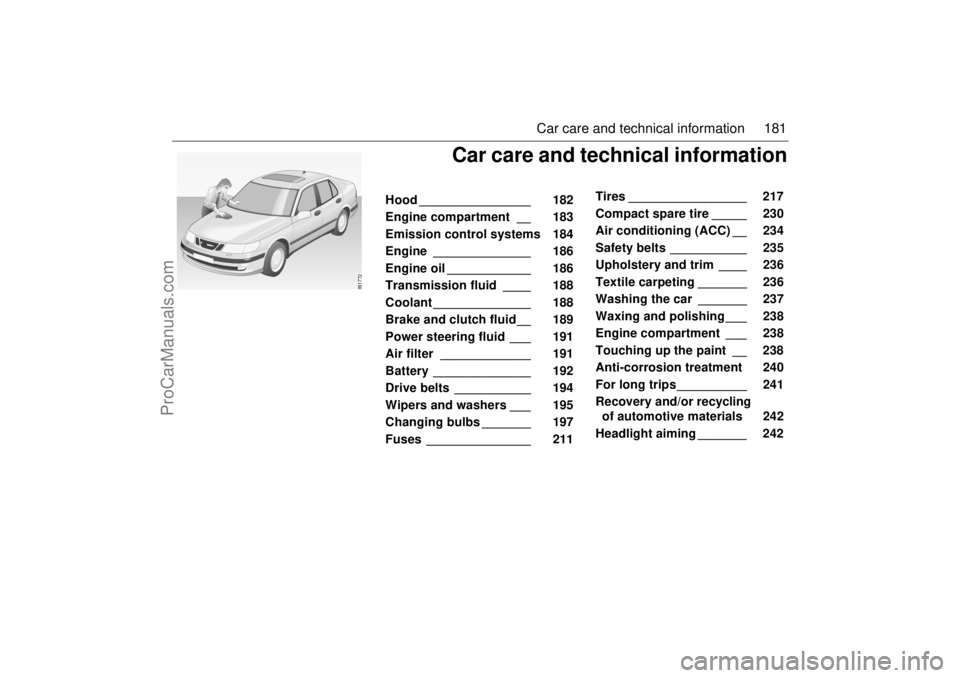
Hood ________________ 182
Engine compartment __ 183
Emission control systems 184
Engine ______________ 186
Engine oil ____________ 186
Transmission fluid ____ 188
Coolant ______________ 188
Brake and clutch fluid__ 189
Power steering fluid ___ 191
Air filter _____________ 191
Battery ______________ 192
Drive belts ___________ 194
Wipers and washers ___ 195
Changing bulbs _______ 197
Fuses _______________ 211 Tires _________________ 217
Compact spare tire _____ 230
Air conditioning (ACC) __ 234
Safety belts ___________ 235
Upholstery and trim ____ 236
Textile carpeting _______ 236
Washing the car _______ 237
Waxing and polishing ___ 238
Engine compartment ___ 238
Touching up the paint __ 238
Anti-corrosion treatment 240
For long trips __________ 241
Recovery and/or recycling
of automotive materials 242
Headlight aiming _______ 242
Car care and technical information
ProCarManuals.com
Page 193 of 276

191 Car care and technical information
Power steering fluidCheck the level of the power steering fluid in
the reservoir regularly, in accordance with
the service program.
The wheels should point forward during the
check.
Clean around the cap before it is unscre-
wed. Clean the dipstick. Screw in the cap
completely again before checking the level.
The oil should lie between the MAX and MIN
marks when the oil temperature is about
70°F (+20°C). If the oil is colder the level can
be lower, and in higher temperatures the
level can be higher, both of which are
acceptable.
Top up with ”Power Steering Fluid
CHF 11S”.
Air filter
WARNING
Do not fill the power steering fluid to
above the MAX mark. Too much fluid
can result in leakage.
Power steering fluid on hot engine
components constitutes a fire risk.
WARNING
For Service and Repair, parts equiva-
lent to those used by Saab should be
used.
Be aware that some non standard
replacement parts may put you in an
unsafe condition, even if they might fit.
IB501
Power steering fluid reservoir
ProCarManuals.com
Page 221 of 276
219 Car care and technical information
When It Is Time for New TiresOne way to tell when it’s time for new tires is
to check the treadwear indicators, which will
appear when your tires have only 1/16 inch
(1.6 mm) or less of tread remaining.
You need a new tire if any of the following
statements are true:
You can see the indicators at three or
more places around the tire.
You can see cord or fabric showing
through the tire’s rubber.
The tread or sidewall is cracked, cut or
snagged deep enough to show cord or
fabric.
The tire has a bump, bulge or split.
The tire has a puncture, cut or other
damage that can’t be repaired well
because of the size or location of the
damage.
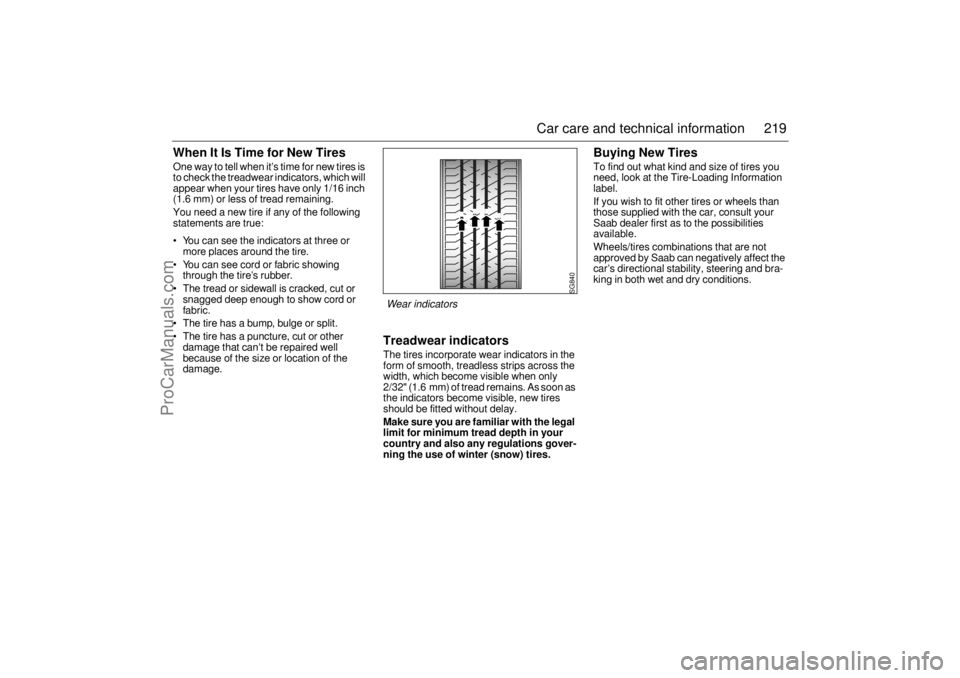
Treadwear indicatorsThe tires incorporate wear indicators in the
form of smooth, treadless strips across the
width, which become visible when only
2/32" (1.6 mm) of tread remains. As soon as
the indicators become visible, new tires
should be fitted without delay.Make sure you are familiar with the legal
limit for minimum tread depth in your
country and also any regulations gover-
ning the use of winter (snow) tires.
Buying New TiresTo find out what kind and size of tires you
need, look at the Tire-Loading Information
label.
If you wish to fit other tires or wheels than
those supplied with the car, consult your
Saab dealer first as to the possibilities
available.
Wheels/tires combinations that are not
approved by Saab can negatively affect the
car’s directional stability, steering and bra-
king in both wet and dry conditions.
SG840
Wear indicators
ProCarManuals.com
Page 224 of 276
222 Car care and technical informationWheel Alignment and Tire BalanceThe wheels on your vehicle were aligned
and balanced carefully at the factory to give
you the longest tire life and best overall per-
formance.
Scheduled wheel alignment and wheel
balancing are not needed. However, if you
notice unusual tire wear or your vehicle pul-
ling one way or the other, the alignment may
need to be reset. If you notice your vehicle
vibrating when driving on a smooth road,
your wheels may need to be rebalanced.Wheel ReplacementReplace any wheel that is bent, cracked or
badly rusted or corroded. If wheel nuts keep
coming loose, the wheel, wheel bolts and
wheel nuts should be replaced. If the wheel
leaks air, replace it (except some aluminum
wheels, which can sometimes be repaired).
See your dealer if any of these conditions
exist.
Your dealer will know the kind of wheel you
need.
Each new wheel should have the same
load-carrying capacity, diameter, width,
offset and be mounted the same way as the
one it replaces.
If you need to replace any of your wheels,
wheel bolts or wheel nuts, replace them only
with new Saab original equipment parts.
This way, you will be sure to have the right
wheel, wheel bolts and wheel nuts for your
vehicle.Make sure tires with Tire Pressure Monitors
are fitted as replacement tires on cars with
this system.
Notice:
The wrong wheel can also cause
problems with bearing life, brake coo-
ling, speedometer or odometer calibra-
tion, headlamp aim, bumper height,
vehicle ground clearance and tire or tire
chain clearance to the body and chassis.
See “Changing a wheel” on page 231.
Used Replacement Wheels
WARNING
Using the wrong replacement wheels,
wheel bolts or wheel nuts on your vehicle
can be dangerous. It could affect the
braking and handling of your vehicle,
make your tires lose air and make you
lose control. You could have a collision in
which you or others could be injured.
Always use the correct wheel, wheel bolts
and wheel nuts for replacement.
WARNING
When fitting just
one
new pair of tires,
these should be fitted to the rear wheels,
as these are more critical to the direc-
tional stability of the car (e.g. on braking
or in a skid). The existing rear wheels
should therefore be moved to the front.
WARNING
Putting a used wheel on your vehicle is
dangerous. You can’t know how it’s been
used or how far it’s been driven. It could
fail suddenly and cause a crash. If you
have to replace a wheel, use a new GM
original equipment wheel.
ProCarManuals.com
Page 225 of 276

223 Car care and technical information
Tire Chains
Notice:
If your vehicle does not have
225/45R17 size tires, use tire chains only
where legal and only when you must.
Contact your Saab dealer regarding sui-
table snow chains. Install them on the
front tires and tighten them as tightly as
possible with the ends securely faste-
ned. Drive slowly and follow the chain
manufacturer’s instructions. If you can
hear the chains contacting your vehicle,
stop and retighten them. If the contact
continues, slow down until it stops. Dri-
ving too fast or spinning the wheels with
chains on will damage your vehicle.If a Tire Goes Flat
It’s unusual for a tire to “blow-out” while
you’re driving, especially if you maintain
your tires properly. If air goes out of a tire,
it’s much more likely to leak out slowly. But
if you should ever have a “blow-out”, here
are a few tips about what to expect and what
to do:
If a front tire fails, the flat tire will create a
drag that pulls the vehicle toward that side.
Take your foot off the accelerator pedal and
grip the steering wheel firmly. Steer to main-
tain lane position, and then gently brake to
a stop well out of the traffic lane.
A rear blow-out, particularly on a curve, acts
much like a skid and may require the same
correction you’d use in a skid. In any rear
blowout, remove your foot from the accele-
rator pedal. Get the vehicle under control by
steering the way you want the vehicle to go.
It may be very bumpy and noisy, but you can
still steer. Gently brake to a stop – well off
the road if possible.
If a tire goes flat, the next part shows how to
use your jacking equipment to change a flat
tire safely.
WARNING
If your vehicle has 225/45 R17 size tires,
don’t use tire chains, there’s not enough
clearance.
Tire chains used on a vehicle without the
proper amount of clearance can cause
damage to the brakes, suspension or
other vehicle parts. The area damaged by
the tire chains could cause you to lose
control of your vehicle and you or others
may be injured in a crash.
Use another type of traction device only if
its manufacturer recommends it for use
on your vehicle and tire size combination
and road conditions. Follow that manu-
facturer’s instructions. To help avoid
damage to your vehicle, drive slowly,
readjust or remove the device if it’s
contacting your vehicle, and don’t spin
your wheels.
If you do find traction devices that will fit,
install them on the front tires.
ProCarManuals.com
Page 228 of 276
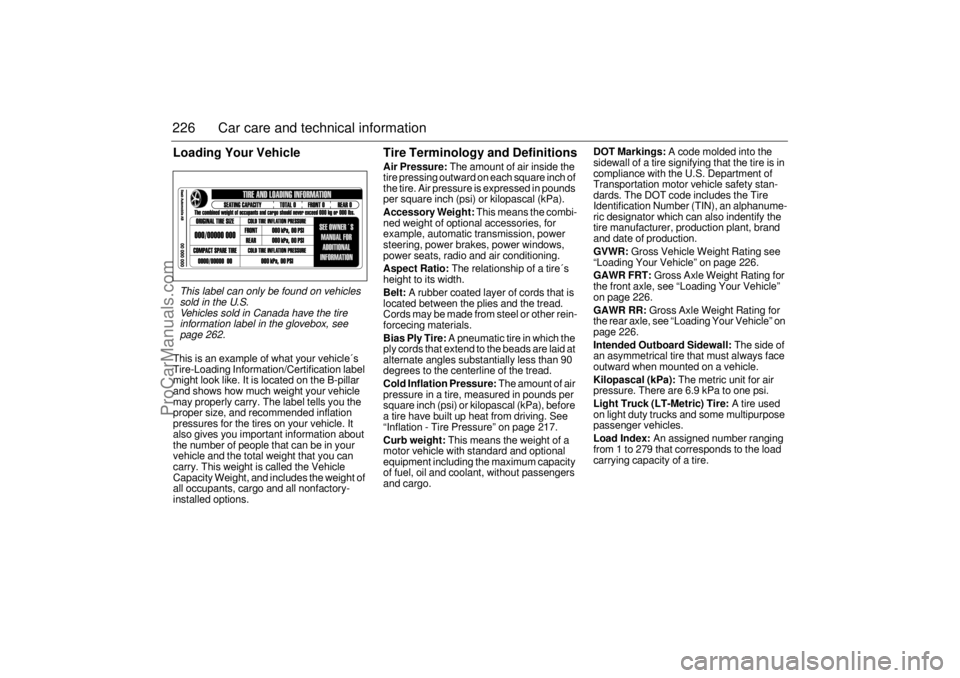
226 Car care and technical informationLoading Your VehicleThis is an example of what your vehicle´s
Tire-Loading Information/Certification label
might look like. It is located on the B-pillar
and shows how much weight your vehicle
may properly carry. The label tells you the
proper size, and recommended inflation
pressures for the tires on your vehicle. It
also gives you important information about
the number of people that can be in your
vehicle and the total weight that you can
carry. This weight is called the Vehicle
Capacity Weight, and includes the weight of
all occupants, cargo and all nonfactory-
installed options.
Tire Terminology and DefinitionsAir Pressure:
The amount of air inside the
tire pressing outward on each square inch of
the tire. Air pressure is expressed in pounds
per square inch (psi) or kilopascal (kPa).
Accessory Weight:
This means the combi-
ned weight of optional accessories, for
example, automatic transmission, power
steering, power brakes, power windows,
power seats, radio and air conditioning.
Aspect Ratio:
The relationship of a tire´s
height to its width.
Belt:
A rubber coated layer of cords that is
located between the plies and the tread.
Cords may be made from steel or other rein-
forcecing materials.
Bias Ply Tire:
A pneumatic tire in which the
ply cords that extend to the beads are laid at
alternate angles substantially less than 90
degrees to the centerline of the tread.
Cold Inflation Pressure:
The amount of air
pressure in a tire, measured in pounds per
square inch (psi) or kilopascal (kPa), before
a tire have built up heat from driving. See
“Inflation - Tire Pressure” on page 217.
Curb weight:
This means the weight of a
motor vehicle with standard and optional
equipment including the maximum capacity
of fuel, oil and coolant, without passengers
and cargo.
DOT Markings:
A code molded into the
sidewall of a tire signifying that the tire is in
compliance with the U.S. Department of
Transportation motor vehicle safety stan-
dards. The DOT code includes the Tire
Identification Number (TIN), an alphanume-
ric designator which can also indentify the
tire manufacturer, production plant, brand
and date of production.
GVWR:
Gross Vehicle Weight Rating see
“Loading Your Vehicle” on page 226.
GAWR FRT:
Gross Axle Weight Rating for
the front axle, see “Loading Your Vehicle”
on page 226.
GAWR RR:
Gross Axle Weight Rating for
the rear axle, see “Loading Your Vehicle” on
page 226.
Intended Outboard Sidewall:
The side of
an asymmetrical tire that must always face
outward when mounted on a vehicle.
Kilopascal (kPa):
The metric unit for air
pressure. There are 6.9 kPa to one psi.
Light Truck (LT-Metric) Tire:
A tire used
on light duty trucks and some multipurpose
passenger vehicles.
Load Index:
An assigned number ranging
from 1 to 279 that corresponds to the load
carrying capacity of a tire.
This label can only be found on vehicles
sold in the U.S.
Vehicles sold in Canada have the tire
information label in the glovebox, see
page 262.
ProCarManuals.com
Page 236 of 276
234 Car care and technical information
Air conditioning
(ACC)
WARNING
All repairs and adjustments on the A/C
system must be carried out by a Saab
dealer authorized for this kind of work.
The A/C system is pressurized. Do not
break any connections or undo A/C
system components.
Escaping refrigerant gas can cause
visual impairment or other injury.NOTICE The A/C system is designed for use
with R134a refrigerant.
Refrigerant handling requires special
equipment and special procedures for
charging and draining the system.
Never mix R134a and R12 refriger-
ants.
IB1800IB1800
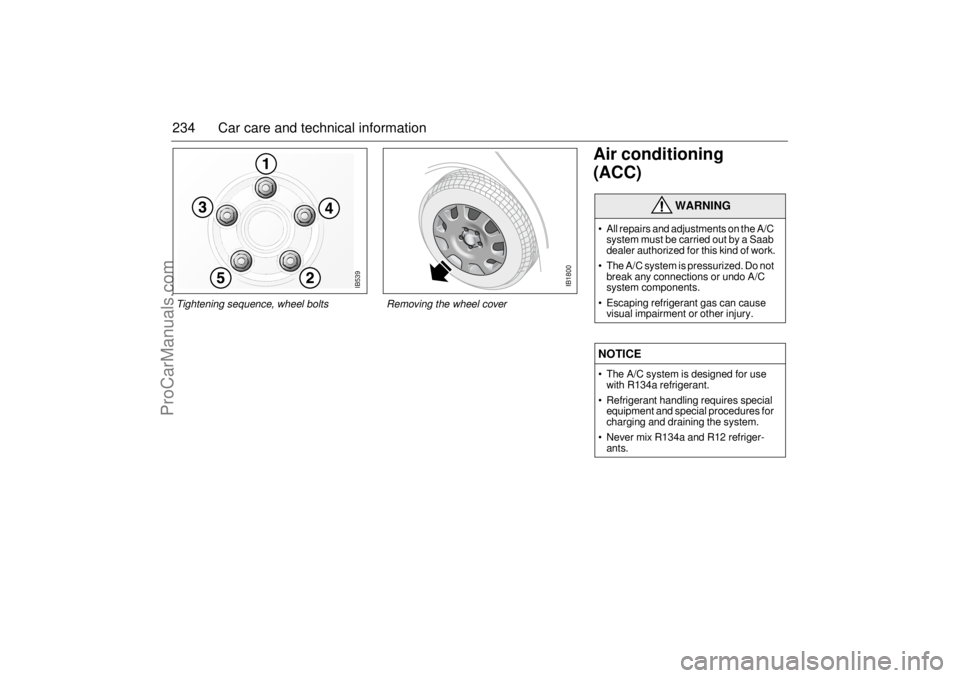
Removing the wheel cover
IB539
Tightening sequence, wheel bolts
ProCarManuals.com